Founded in 2019, Trade Republic has rapidly become one of Europe’s leading neo-brokers and savings platforms, establishing a significant presence in the European financial landscape. Since its launch, the platform has grown to 10 million customers across 18 European countries and now manages over €150 billion in client assets.
The company holds a full German banking licence (issued by the ECB in December 2023), is supervised by BaFin and the Bundesbank, and was valued at approximately €12.5 billion following a December 2025 secondary share sale.
This article dives into the key statistics surrounding Trade Republic, including its assets under management (AUM), user base growth, revenues, and other critical metrics that reflect its evolving role in the European financial ecosystem.
Revenues
As a private company, it remains difficult to get a complete picture of Trade Republic’s financials. In the German company registers, the company’s official name is Trade Republic Bank GmbH. The latest available publication is a separate non-financial report for FY 2023/24 (published 13 October 2025), which reports total assets of €37.203 billion as of 30 September 2024.
The non-financial report also discloses EU Taxonomy KPIs, with a Green Asset Ratio (GAR) of 1% on both turnover- and CapEx-based measures. Trade Republic received its full German banking licence from the ECB in December 2023 and is supervised by the Bundesbank and BaFin.
Profit and loss figures are now available. Regulatory filings covering the 12 months to 30 September 2024 show a net profit of €34.8 million, up from €14.1 million in the prior year. Reported revenue for that period differs by source: TradeInformer, reading the filings directly, puts it at €272.4 million, a 51.5% increase year on year, while Finance Magnates reports €340 million for the same year. The two profit figures agree, so the gap is most likely a difference in what each counts as revenue rather than a contradiction. Cumulatively, the company is still reported to have lost around €146 million since its founding in 2015.
No filing has yet been published for the year to 30 September 2025, so the figures above remain the most recent audited picture.
Trade Republic AUM and number of users
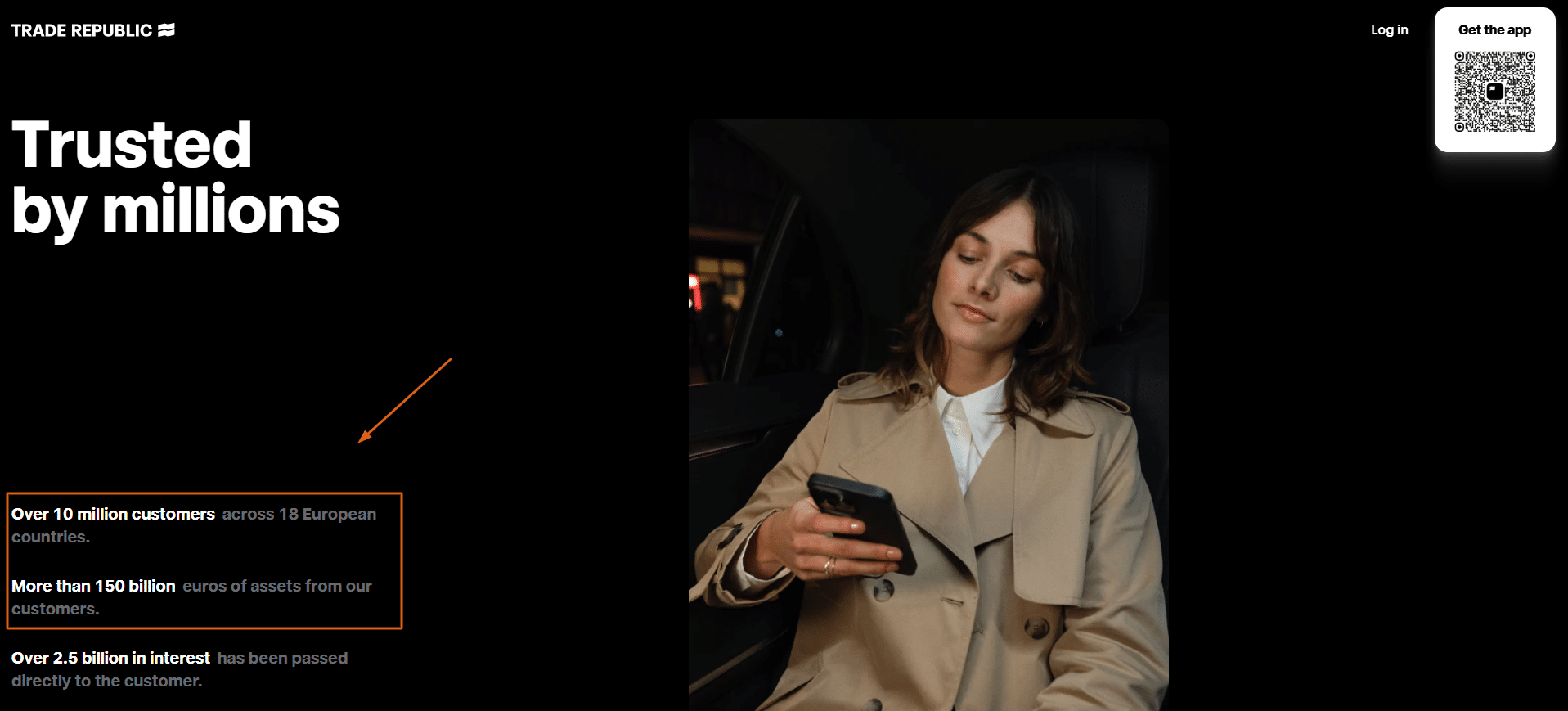
As of recent disclosures, the assets under management (AUM) at Trade Republic stood at €150 billion in client assets and cash, with 10 million users across 18 European countries. The customer base doubled in the 18 months to December 2025, and the count crossed 10 million during 2026, up from roughly 8 million around the Poland launch in September 2025. The map below shows the current geographic footprint as published on Trade Republic’s website:
Average account balance
By dividing the assets under management by the number of users, we get an estimated average account balance of approximately €15,000 per user, a meaningful figure that reflects the platform’s broad retail appeal across savings, ETF investing and active trading. Treat it as an average rather than a typical balance: in a retail base of this size, a minority of large accounts pulls the mean well above what most users hold.
Who are Trade Republic investors?
Trade Republic is backed by a high-profile roster of venture capital funds and institutional investors, including:
- Sequoia Capital
- Founders Fund
- Ontario Teachers’ Pension Plan
- TCV (Technology Crossover Ventures)
- Accel
- Thrive Capital
- Creandum
The December 2025 secondary sale brought in a further set of institutional names, including Wellington Management, Singapore’s GIC, Fidelity Management & Research, Khosla Ventures, Lingotto Innovation and Aglaé, the Arnault family’s technology arm, while Founders Fund, Sequoia, Accel, TCV and Thrive increased their stakes.
The company has raised over €1 billion in total funding across multiple rounds, and the €1.2 billion secondary share sale on 17 December 2025 valued it at approximately €12.5 billion.

Business model
As a brokerage firm, Trade Republic’s main revenue source is related to user transactions in stocks, ETFs (exchange-traded funds), bonds, cryptocurrencies, and other financial products.
Here’s a breakdown of how Trade Republic earns money:
1. Transaction fees
Although Trade Republic markets itself as commission-free, it charges a flat €1 settlement fee per trade on its default Best Price execution. Since the execution overhaul of mid 2026 there is a second tier: €2 per order for Direct Price, where the client chooses which of around 30 venues executes the trade. Compared to traditional brokers these fees are small, but they provide a steady revenue stream from active traders, and the €2 tier is a deliberate step up in monetisation per trade. Savings plan executions remain free, which is a key part of the platform’s value proposition.
2. Payment for order flow (PFOF)
This revenue line no longer exists. It is worth understanding because it funded much of Trade Republic’s growth, and because its disappearance is the single biggest change to the company’s economics.
Until mid 2026, one key way Trade Republic earned revenue was through Payment for Order Flow (PFOF). This practice involves receiving payments from market makers (financial institutions or liquidity providers) in exchange for routing client trades to them. While the end-user gets commission-free or low-fee trading, the broker monetises the transaction by directing it to a specific market maker who compensates the platform.
According to a Financial Times article, “Payment-for-order-flow agreements only accounted for about a third of Trade Republic’s overall income”, Hecker (co-founder of Trade Republic) was quoted as saying.
PFOF has been controversial, as it raises concerns about potential conflicts of interest in order execution (e.g., ensuring the best price for the user). According to a paper prepared on behalf of Trade Republic, PFOF “does not harm private investors. On the contrary, customers benefit”.
The European Union’s general ban on PFOF required it to be phased out by 30 June 2026, and Germany’s temporary national exemption expired on that date.
Trade Republic responded by rebuilding how it executes orders rather than by raising headline fees. At the end of June 2026 it moved to its own trading system, underpinned by a BaFin licence to operate a multilateral trading facility obtained by a group subsidiary in January 2026. Orders now execute either at Best Price, where an algorithm compares quotes across several reference exchanges and Trade Republic itself is the counterparty, or at Direct Price, where the client picks the venue for €2. Alongside it launched a free Web Terminal aimed at active investors.
The economic shift is the important part. Instead of being paid by a third-party market maker for order flow, Trade Republic now stands on the other side of its clients’ trades at Best Price and earns from the spread it captures, plus the per-order fee. The revenue is internalised rather than removed, which is a different arrangement from the one the PFOF ban was written to address, and one worth watching.
3. Not securities lending
Many neo-brokers earn from securities lending, lending client holdings to institutional investors or hedge funds for short-selling and keeping a share of the fee. Trade Republic does not do this. Its own support pages state plainly that “your securities held with Trade Republic won’t be loaned”, and the company presents this as a deliberate differentiator against platforms such as DEGIRO and eToro, which do lend.
It is worth naming because it is a revenue line Trade Republic has chosen to forgo, which makes the remaining sources carry more weight.
4. The card and everyday banking
Since the banking licence, Trade Republic has built out a payments business: a debit card with 1% Saveback on card spending and 2% when paying from a crypto balance, a personal IBAN with standing orders and direct debits, and a round-up feature. Card schemes pay interchange on every transaction, and the Saveback mechanic is designed to pull users into savings plans, which deepens the relationship even though the plans themselves are free to execute.
5. Net interest margin on customer cash
Trade Republic offers interest on uninvested cash at rates aligned with the ECB deposit facility rate, which rose to 2.25% on 17 June 2026 and again to 2.50% on 16 September 2026, after holding at 2.00% since June 2025. Historically Trade Republic has passed through close to the full deposit facility rate to customers, meaning its net interest margin on cash balances is relatively narrow. With €150 billion in client assets, even a small spread on the cash portion becomes a meaningful revenue line.
The promotional structure is where the margin sits. New clients outside Germany are offered 3.00% on balances up to €50,000, above the ECB rate, which is a customer acquisition cost rather than a margin. Existing clients receive the ECB-linked rate with no cap, and balances above the promotional ceiling earn the standard rate. Higher balances may be allocated to money market funds rather than held as deposits.
As a curiosity, DEGIRO takes the opposite approach and pays no interest on uninvested cash.
Trade Republic valuation
Trade Republic, the German-based fintech, has been through multiple major funding milestones:
- 2021, Series C: reached a valuation of over $5 billion USD, led by Sequoia Capital;
- 2022, Series C extension: raised an additional €250 million, led by the Ontario Teachers’ Pension Plan Board, reaffirming the prior valuation;
- 2023, banking licence: received a full European banking licence from the ECB in December 2023, a substantive credential that materially raised the company’s strategic profile;
- December 2025, secondary share sale: a €1.2 billion transaction valued the company at approximately €12.5 billion, more than doubling the 2021 valuation. The secondary sale allowed existing employees and early investors to take partial liquidity without the company itself raising primary capital.
Is Trade Republic planning an IPO?
To the best of our knowledge, Trade Republic has not officially confirmed plans to pursue an initial public offering (IPO). The company has not made any public statements or shared press releases indicating an immediate intention to go public.
The December 2025 secondary share sale, in particular, signals that the company is comfortable remaining private for now. Secondary sales allow existing investors and employees to take liquidity without triggering the public-market scrutiny and reporting obligations of an IPO.
That said, in a past podcast appearance, Johan Brenner (one of Trade Republic’s VC investors at Creandum) predicted that Trade Republic would be a public company within five years, anticipating an IPO in the medium term.
The decision to pursue an IPO is rarely straightforward. Financial performance, future growth prospects, market conditions, the regulatory environment and strategic considerations all weigh on the timing. Several Trade Republic competitors such as Interactive Brokers, XTB, and DEGIRO* are publicly listed, so it is plausible that Trade Republic may eventually follow suit.
*Disclaimer: investing involves risk of loss.
Competitors statistics
Curious to see similar analyses on Trade Republic’s competitors? We have also covered Trading 212, Interactive Brokers, and eToro.
Bottom line
Trade Republic has grown rapidly into one of Europe’s major players in fintech and retail brokerage. With 10 million users across 18 European countries and €150 billion in assets under management, the platform has built impressive scale in just a few years.
The company posted losses in its early years and turned profitable in the year to September 2023, reaching €34.8 million of net profit in the year to September 2024, though it remains around €146 million behind cumulatively since 2015. Revenue is now driven by settlement fees of €1 and €2 per order, the spread captured on Best Price execution, card interchange and Saveback, and net interest margin on customer cash. Two changes reshaped that mix: the EU ban on payment for order flow took effect on 30 June 2026, removing what was once roughly a third of income, and Trade Republic notably does not lend out client securities, forgoing a revenue line most of its rivals use.
The €12.5 billion valuation from the December 2025 secondary share sale, backed by Sequoia, Founders Fund, Ontario Teachers, Wellington, GIC, Fidelity and others, underscores how the market values Trade Republic’s scale and growth potential. The firm has yet to announce a definitive IPO timeline, but its full European banking licence, its new multilateral trading facility permission and continued expansion into private markets, crypto and everyday banking suggest a strong foundation for whichever path it ultimately chooses.