
You have probably heard about the Robinhood app on YouTube and want to know if it’s available in Denmark, right?
Robinhood is a modern and easy-to-use investment app from the US that introduced the concept of commission-free trading in stocks, ETFs, options and futures, and has transformed the way millions of retail investors approach trading.
Want to know if the Robinhood app is available in Denmark, its expansion plans, and the alternatives available to Danish investors? We’ve got you covered.
Is Robinhood available in Denmark?
Yes, Robinhood is available in Denmark, as Robinhood Europe serves eligible residents of the EU and EEA, and it is no longer just for cryptocurrencies.
Robinhood initially launched its cryptocurrency trading service in the European Union, starting with around 25 digital assets. The list has since grown to more than 90 cryptocurrencies, including Bitcoin, Ethereum and Solana, and the platform has added crypto transfers, staking on ETH and SOL and perpetual futures. Crypto trades carry a 0.95% fee, according to Robinhood’s EU fee schedule.
Since June 2025, Robinhood has expanded its offering significantly for European users:
- Danish investors can now trade tokenised versions of more than 2,000 US stocks and ETFs through Robinhood (Robinhood calls them Classic Stock Tokens). These “stock tokens” provide fractional, 24/5 access to major US-listed equities such as Apple, Tesla and NVIDIA, with a 0.10% currency conversion fee per transaction and no other Robinhood fees.
- Uninvested euros can be placed in a J.P. Morgan money market fund, and perpetual futures now cover commodities, ETFs and FX as well as crypto, with up to 10x leverage.
- The offering operates via Robinhood Europe UAB, authorised by the Bank of Lithuania as a financial brokerage firm (MiFID II) for stock tokens and perpetual futures, and as a crypto-asset service provider under MiCA for crypto.
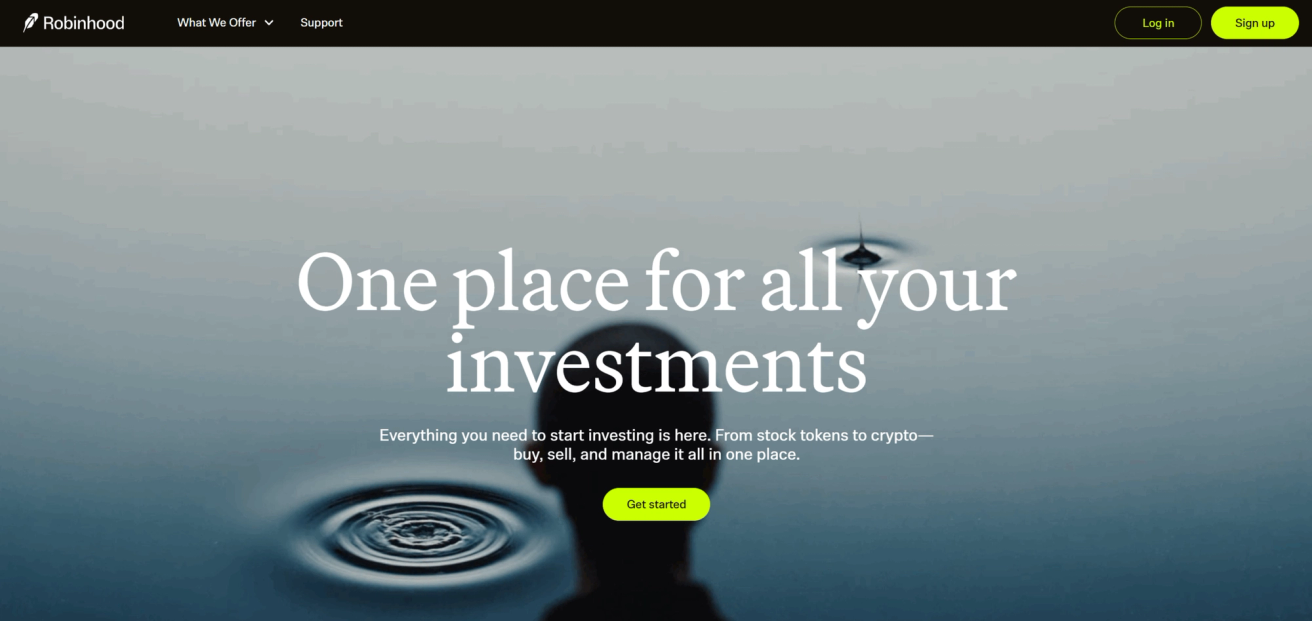
Robinhood Europe homepage, as of October 2026
These stock tokens are not the same as owning real shares. They are derivative contracts between you and Robinhood Europe UAB that track the price of the underlying stock or ETF. Robinhood says it hedges them by holding the underlying securities 1:1, but those securities belong to Robinhood, not to you. Danish users get price exposure to US stock movements through the Robinhood app, including fractional purchases and 24/5 trading hours, but not ownership.
However, please note that by investing in a stock token, you are not covered by the standard investor compensation scheme that applies to traditional brokerage relationships. This is clearly stated in the Key Information Document (KID) of each stock token. As an example, you can review the KID for the NVIDIA stock token:
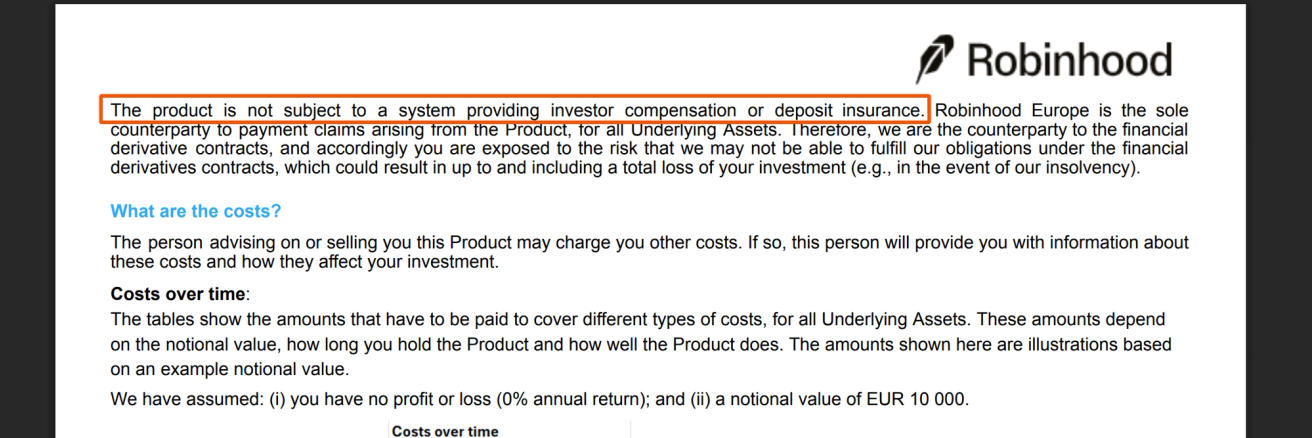
Robinhood Europe - No investor compensation scheme
Key implications of trading stock tokens (rather than real shares):
- No voting rights: stock tokens do not grant shareholder voting rights.
- Dividend treatment differs: you receive a cash amount equivalent to the dividend, paid by Robinhood at its discretion, rather than a dividend from the company itself, which can change how it is taxed.
- Counterparty exposure: your position depends on the issuer’s solvency and the underlying collateral framework.
- No investor protection on the tokens: according to the KID, stock tokens are not covered by an investor compensation scheme (the money market fund is covered up to €22,000 by the Lithuanian scheme).
- Tax treatment may differ: Danish tax treatment of stock tokens may differ from traditional shares, so consult a Danish tax adviser.
If these distinctions are material to you, consider investing in real shares through one of the alternative brokers mentioned below, which provide direct equity ownership, full shareholder rights, and protection under EU/Danish investor compensation schemes.
Robinhood’s expansion plans extend further: in April 2025, the Bank of Lithuania granted Robinhood an A-category brokerage licence, paving the way for a broader rollout of full stock brokerage services across the EU. This licence could allow Robinhood to offer real share trading (rather than just tokenised access) in Denmark and other EU countries in the future. As of October 2026, however, Robinhood still only offers stock tokens in the EU, and no timeline for real shares has been announced.
If you decide to open a Robinhood Europe account, Robinhood runs a referral programme that rewards both you and the friend who invited you in crypto, and it also advertises a sign-up offer of up to €50 in crypto in some countries. This Robinhood Europe referral guide explains the offer step by step. Terms apply and the amounts can change without notice.
Robinhood alternatives in Denmark
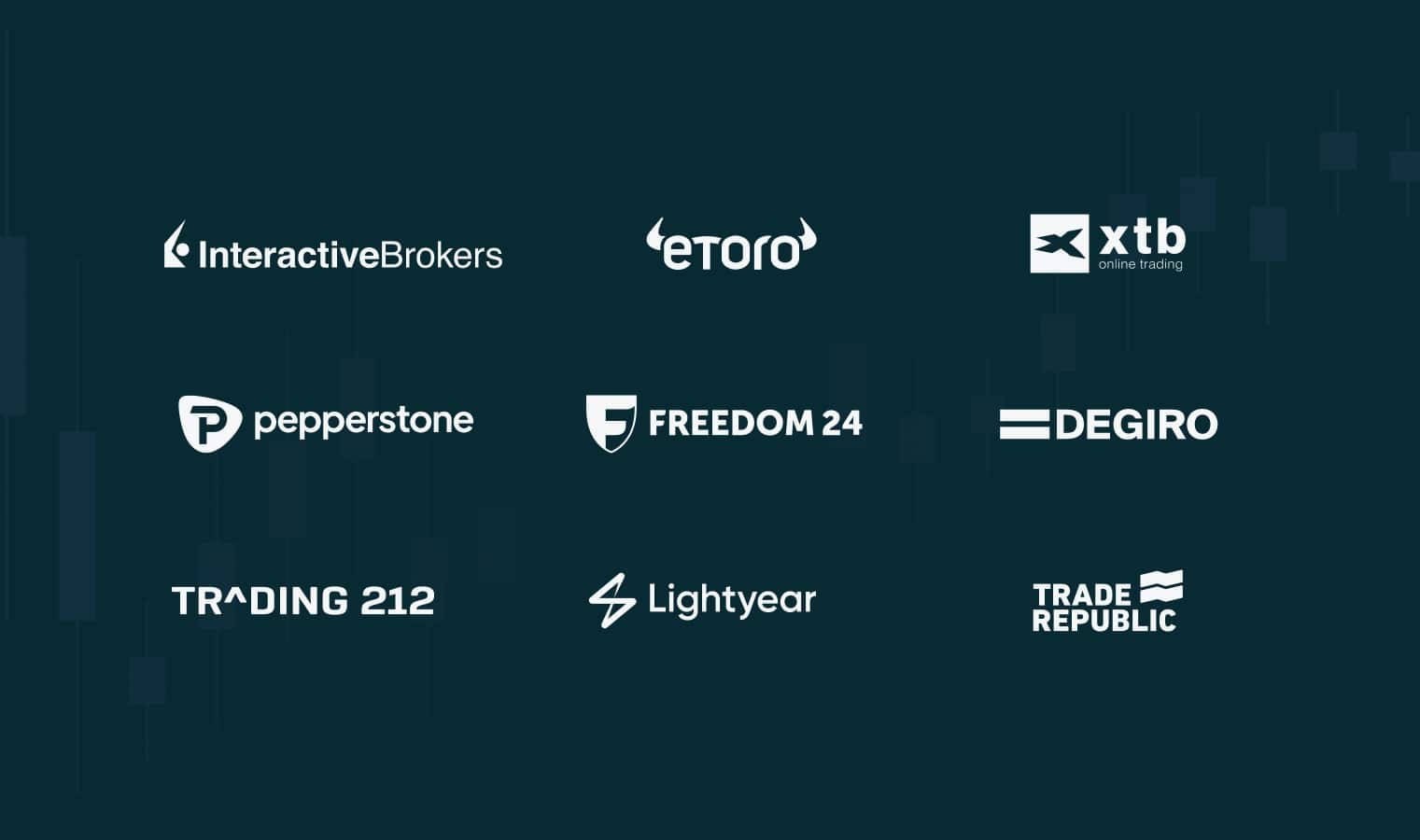
To answer this question, we focused on low-cost brokers available in Denmark. Here are our suggestions:
eToro
With over 40 million users, eToro is a leading social investing platform, where you can follow and copy other investors. It offers commission-free ETF trading (other fees apply).
Disclaimer: eToro is a multi-asset investment platform. The value of your investments may go up or down. Your capital is at risk.
Interactive Brokers
Founded in 1978, IBKR is one of the world’s most trustworthy brokers. It offers an enormous range of financial products (stocks, ETFs, options and more) and low currency conversion fees.
💡 Interactive Brokers also launched IBKR GlobalTrader, a modern mobile trading app to trade stocks, options and ETFs, ideal for novice investors.
DEGIRO
One of the leading online brokers in Europe due to its low-cost structure. It offers commission-free ETF trading (external fees apply) and a wide product portfolio.
Disclaimer: Investing involves risk of loss.
All these alternatives to Robinhood are regulated by top-tier authorities: eToro by the Cyprus Securities and Exchange Commission (CySEC), Interactive Brokers by the Central Bank of Ireland and DEGIRO by Germany’s Federal Financial Supervisory Authority (BaFin).
eToro at a glance

55% of retail CFD accounts lose money.
Founded in 2007, eToro is an international online broker with over 40 million users in 75 countries. The platform offers access to thousands of financial instruments, including real stocks, ETFs, cryptocurrencies, and CFDs on stocks, ETFs, commodities, forex, indices, and crypto. eToro listed on NASDAQ in May 2025 (ticker: ETOR), reinforcing its credibility as a publicly traded company. ETFs are traded commission-free as whole or fractional shares (other fees apply), while real stocks carry a flat commission of $1 or $2 per trade, depending on the exchange.
eToro’s investment platform, accessible via web and mobile, is built around a social trading hub. Investors can engage in discussions about market news, speculations, and trade ideas alongside other users. The platform also offers CopyTrader (allowing you to automatically replicate the trades of experienced “Popular Investors”) and Smart Portfolios (ready-made thematic portfolios based on themes like artificial intelligence, renewable energy, and dividend-paying stocks). New users can claim a free asset for new users meeting deposit thresholds.
The demo account is particularly useful for beginners, offering $100,000 of virtual money to practise trades risk-free. It lets you experience the platform identically to live trading, easing the transition when you switch to real capital. On the downside, there is a $5 withdrawal fee on the USD account. Danish investors can open a DKK account (provided by eToro Money Malta), which has free withdrawals, but buying US stocks still involves converting kroner into dollars.
eToro is regulated by multiple top-tier authorities globally, including the FCA (UK), CySEC (Cyprus), ASIC (Australia) and the SEC and FINRA (US). Danish clients are typically served by eToro (Europe) Ltd, authorised and regulated by CySEC and passported across the EEA under MiFID II (with oversight from Finanstilsynet, the Danish Financial Supervisory Authority, for cross-border financial services). Client funds are protected up to €20,000 under the Cyprus Investor Compensation Fund (ICF).
CFDs are complex instruments and come with a high risk of losing money rapidly due to leverage. 55% of retail investor accounts lose money when trading CFDs with this provider. You should consider whether you understand how CFDs work and whether you can afford to take the high risk of losing your money.
Interactive Brokers at a glance

Founded in 1978 and publicly listed on the Nasdaq (ticker: IBKR), Interactive Brokers is a global online broker that has survived multiple financial crises through rigorous risk management. The broker became a constituent of the S&P 500 in 2025 and now serves about 5.5 million client accounts across 175 markets in 40 countries.
Interactive Brokers offers an advanced investment platform with a wide range of products (stocks, options, mutual funds, ETFs, futures, bonds, forex, and crypto), robust trade execution through IB SmartRouting, and comprehensive technical and fundamental tools to support investment decisions. Danish residents are typically served via Interactive Brokers Ireland Limited, regulated by the Central Bank of Ireland (CBI), with MiFID II passporting providing access to global markets including Nasdaq Copenhagen for Danish stocks.
Beginners and intermediate investors can access extensive educational resources via IBKR Campus (formerly Traders’ Academy), though the platform’s learning curve is steeper than simpler apps. Customer service provides clear and detailed answers, reducing the need for back-and-forth communication. Because of the depth and complexity, we mainly recommend Interactive Brokers to intermediate and advanced traders.
On the downside, IBKR’s fee structure is more complex than simpler apps, the registration process is more thorough (though fully online), and the broker doesn’t offer fully commission-free trading. However, when considering low FX conversion fees (0.2 basis points, or 0.002%, with a $2 minimum), narrow spreads, the Stock Yield Enhancement Program (SYEP), and tiered cash interest on uninvested DKK, EUR, USD, and GBP balances (linked to central bank policy), Interactive Brokers’ clients typically achieve significant savings compared to most other brokers, especially active traders and larger portfolios.
Interactive Brokers also offers IBKR GlobalTrader, a streamlined mobile trading app for stocks, ETFs, and options, ideal for beginner investors. Features include automatic currency conversion, fractional shares from $1 and a demo account.
Want to know more about Interactive Brokers? Check our Interactive Brokers review.
DEGIRO at a glance

Investing involves risk of loss.
Founded in 2013, DEGIRO is a low-cost European brokerage that has become very popular thanks to its competitive pricing. With more than 3 million clients in 15 European countries (including Denmark), the platform has built a reputation around its “do-it-yourself” philosophy, giving investors everything they need to manage their own portfolios. DEGIRO offers a wide range of financial assets including stocks, ETFs, bonds, options, futures, warrants, investment funds, and leveraged products (which are similar to but not identical to CFDs, more details here).
Key cost considerations for Danish investors, according to DEGIRO Denmark’s price list:
- Danish stocks (Nasdaq Copenhagen): 10 DKK commission + 10 DKK handling fee per order.
- Core Selection ETFs: €0 commission + €1 handling fee. Other ETFs cost €2 + €1.
- US stocks: €1 commission + €1 handling fee, or €2 per order.
- Annual connectivity fee: up to €2.50 per foreign exchange you trade on each year (Nasdaq Copenhagen is free).
- Currency conversion: 0.25% with automatic conversion.
- Options: €0.75 per contract.
The web and mobile platforms are intentionally minimalist, efficient and straightforward, with a short learning curve. On the downside, the absence of in-depth fundamental research, the lack of price alerts in the app, and the limited charting tools may frustrate more advanced traders.
In terms of safety, DEGIRO is the Dutch branch of flatexDEGIRO Bank SE, a German bank supervised by BaFin, with the branch also overseen by the Dutch AFM and DNB. Danish clients are served via MiFID II passporting. In the unlikely event that segregated client assets cannot be returned, DEGIRO falls under the German investor compensation scheme, which covers 90% of the claim up to €20,000, worth bearing in mind if you plan to invest much larger amounts.
Cash deposited into a DEGIRO Cash Account with flatexDEGIRO Bank SE is additionally protected up to €100,000 under the German Deposit Guarantee Scheme.
Still have doubts? Go through our DEGIRO review.
What is Robinhood?
Robinhood was founded in 2013 in the US and has played a major role in transforming the brokerage industry by allowing US retail investors to trade without commissions. Alongside competitors like Webull, Robinhood pioneered the commission-free model now standard across the industry.
The results are clear: 28.6 million funded customers and about $384 billion in total platform assets (as of August 2026, per its monthly operating data). Robinhood is publicly listed on NASDAQ (ticker: HOOD) since July 2021 and has been a constituent of the S&P 500 since 2025. The platform’s success forced major US incumbents like E*TRADE, TD Ameritrade, and Charles Schwab to eliminate trading commissions in October 2019. TD Ameritrade was subsequently acquired by Charles Schwab, with the brand fully retired by 2024.
Which platform should you choose?
The best online broker for you depends on your investor profile, financial goals, and preferences as a Danish investor. Here are the most important factors to evaluate:
- Fees and total cost of ownership: compare commissions, FX conversion fees, custody charges, withdrawal costs, and inactivity fees. For Danish investors trading non-DKK-denominated stocks, FX impact can be substantial over the long term.
- Regulation: confirm the broker is supervised by top-tier authorities like the FCA (UK), BaFin (Germany), CBI (Ireland), CySEC (Cyprus), or Finanstilsynet (Denmark). Most international brokers serve Danish clients via MiFID II passporting with Finanstilsynet oversight.
- Product range: not all platforms offer cryptocurrencies, options, futures, or access to Nasdaq Copenhagen for Danish equities, so verify the broker covers the markets you want.
- Multi-currency support: brokers offering DKK accounts alongside other currencies (like Interactive Brokers and eToro) reduce FX conversion costs over time.
- Tax reporting: Danish residents are subject to specific capital gains and dividend taxation. Look for brokers providing annual tax reports compatible with Danish requirements.
- Investor protection: ensure the applicable investor compensation scheme provides meaningful coverage in your jurisdiction.
Explore the websites above, compare the platforms against your investment strategy, and decide for yourself which best fits your needs.
A reminder that the above should not be seen as investment advice and should be considered information only. Investors should do their own research and due diligence about the services and opportunities best suited for their risk, returns, and impact strategy.
FAQs
How exactly does Robinhood make money?
The online broker earns money from interest on customers’ uninvested cash, from margin lending and, in the US, from routing orders to market makers.
In the US, the biggest source is payment for order flow: market makers pay Robinhood to execute customer orders. Robinhood paid $65 million in December 2020 to settle SEC charges that, until 2018, it had not properly disclosed this practice. In Europe, payment for order flow has been banned since 30 June 2026, so Robinhood Europe earns its money from the 0.10% FX fee on stock tokens, the 0.95% fee on crypto trades, perpetual futures fees and a commission on staking rewards.