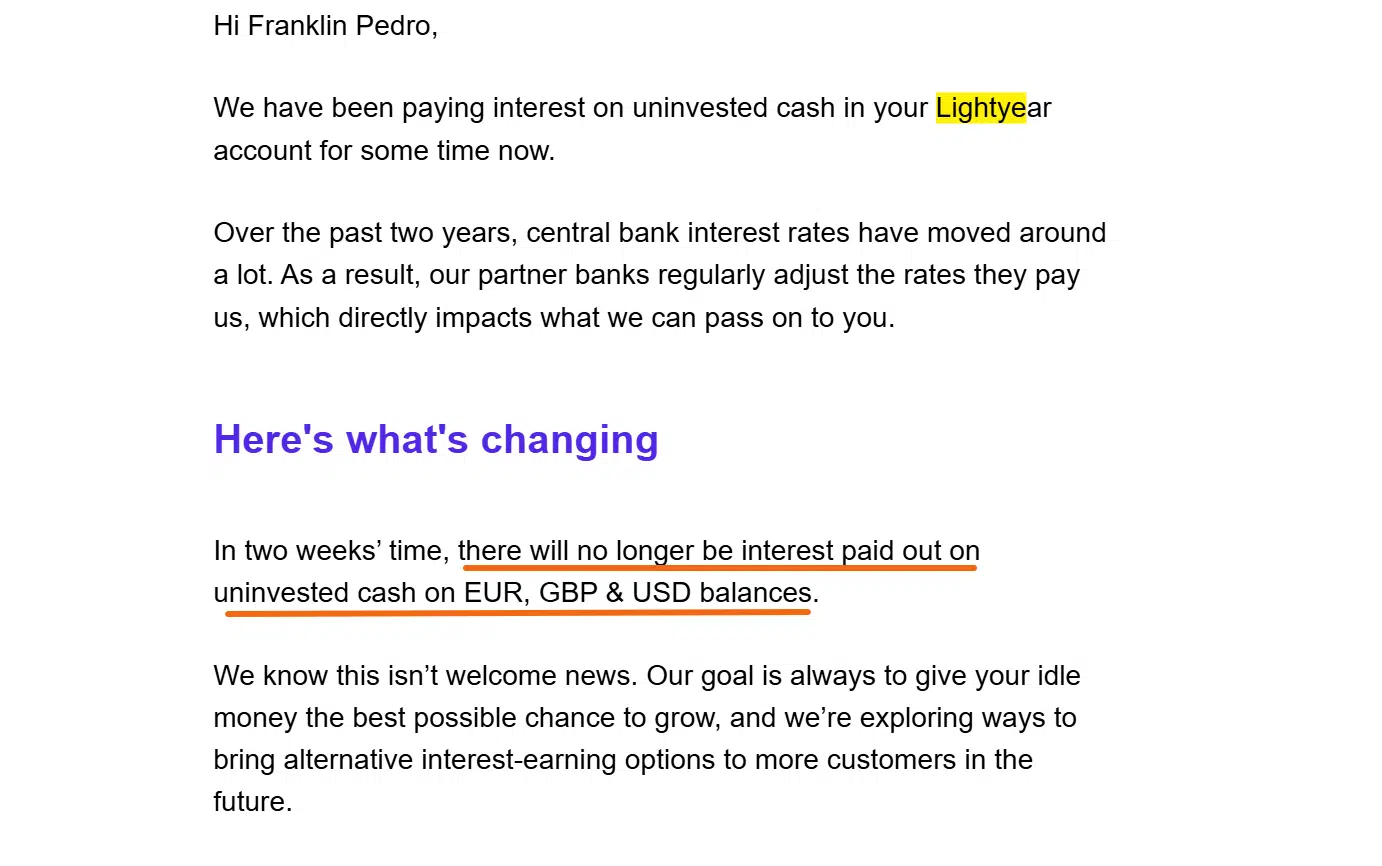
Lightyear does not pay interest on uninvested cash. It offers Savings, a tool that invests your cash in Money Market Funds (MMFs) run by professional asset managers. Rates currently reach 2.25% in EUR, 3.67% in USD and 3.84% in GBP.
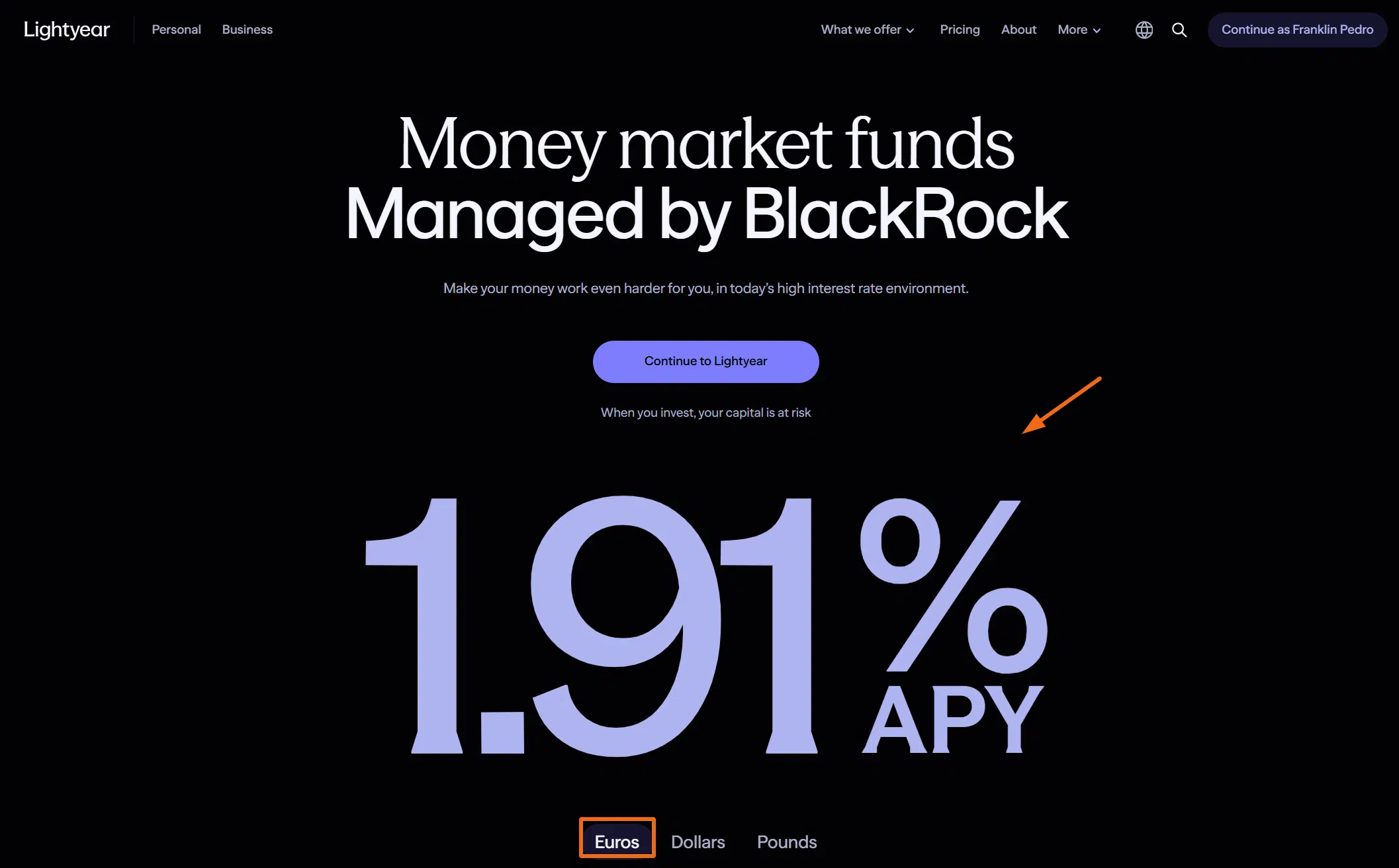
One thing to be clear about from the start: this is an investment product, not a deposit. Lightyear says so itself on its Savings page, where the line under the headline rate reads “When you invest, your capital is at risk”. The protections that apply are different from those covering money in a bank, and we explain exactly how below.
Which funds is your money actually in? How is the rate built? Is there a catch? Let’s dig in.
What is Lightyear Savings and how does it work?
Savings is a tool that invests your cash in money market funds.
MMFs invest in low-risk, short-term debt securities such as government bills, bank certificates of deposit and repurchase agreements, and aim to maintain a stable share price. They are widely used by institutional investors including pension funds, insurers and banks. In Europe, around 1.4 trillion euros sits in these vehicles.
You are not lending money to Lightyear. You buy units in a fund, Lightyear passes on the yield the fund generates, and it deducts its own fee before the rate you see.
Each currency tracks a different central bank:
- EUR follows ECB rate trends;
- USD follows the Federal Reserve’s variable overnight rate;
- GBP follows Bank of England rate trends.
In each case the fund aims for a slightly higher return than holding cash.
What rate does Lightyear Savings pay?
The current rates are:
| Currency | Rate (APY) | Tracks |
| EUR | 2.25% | ECB rate trends |
| USD | 3.67% | Federal Reserve overnight rate |
| GBP | 3.84% | Bank of England rate trends |
Rates as displayed on Lightyear’s money market fund pages on 9 September 2026, for the J.P. Morgan funds. They are variable and change with central bank policy, so check the current figure in the app before deciding.
Which funds does your money go into?
In the markets served by J.P. Morgan Asset Management, Savings invests in three share classes of JPMorgan Liquidity Funds, a Luxembourg SICAV authorised as a UCITS and supervised by the CSSF:
| Currency | Fund | ISIN | Ongoing charge |
| EUR | JPM EUR Liquidity LVNAV Select (dist.) | LU2599140782 | 0.10% |
| GBP | JPM GBP Liquidity LVNAV Select (dist.) | LU1747646625 | 0.10% |
| USD | JPM USD Liquidity LVNAV Select (dist.) | LU1747647607 | 0.10% |
Ongoing charges from each fund’s Key Information Document (KID), the standard disclosure document EU funds must publish. The euro document is dated 1 January 2026, the dollar and pound documents 24 April 2026.
All three are Low Volatility Net Asset Value (LVNAV) money market funds under Regulation (EU) 2017/1131, the European rulebook for this fund type. That regulation is what keeps the portfolios short and conservative:
- Maturity: the weighted average maturity of the portfolio cannot exceed 60 days, and no individual security can have more than 397 days left to run when it is bought;
- Credit quality: debt with a long-term rating must be rated at least “A”, and debt with a short-term rating at least “A-1” by Standard & Poor’s or the equivalent from another agency. Unrated debt is allowed only if J.P. Morgan judges it to be of comparable quality;
- Fund rating: each fund aims to hold a “AAA” rating, or equivalent, from at least one rating agency, and pays for that rating itself;
- Diversification: Lightyear states the funds hold over 300 individual positions, and money market fund rules cap any single holding at 5% of the portfolio.
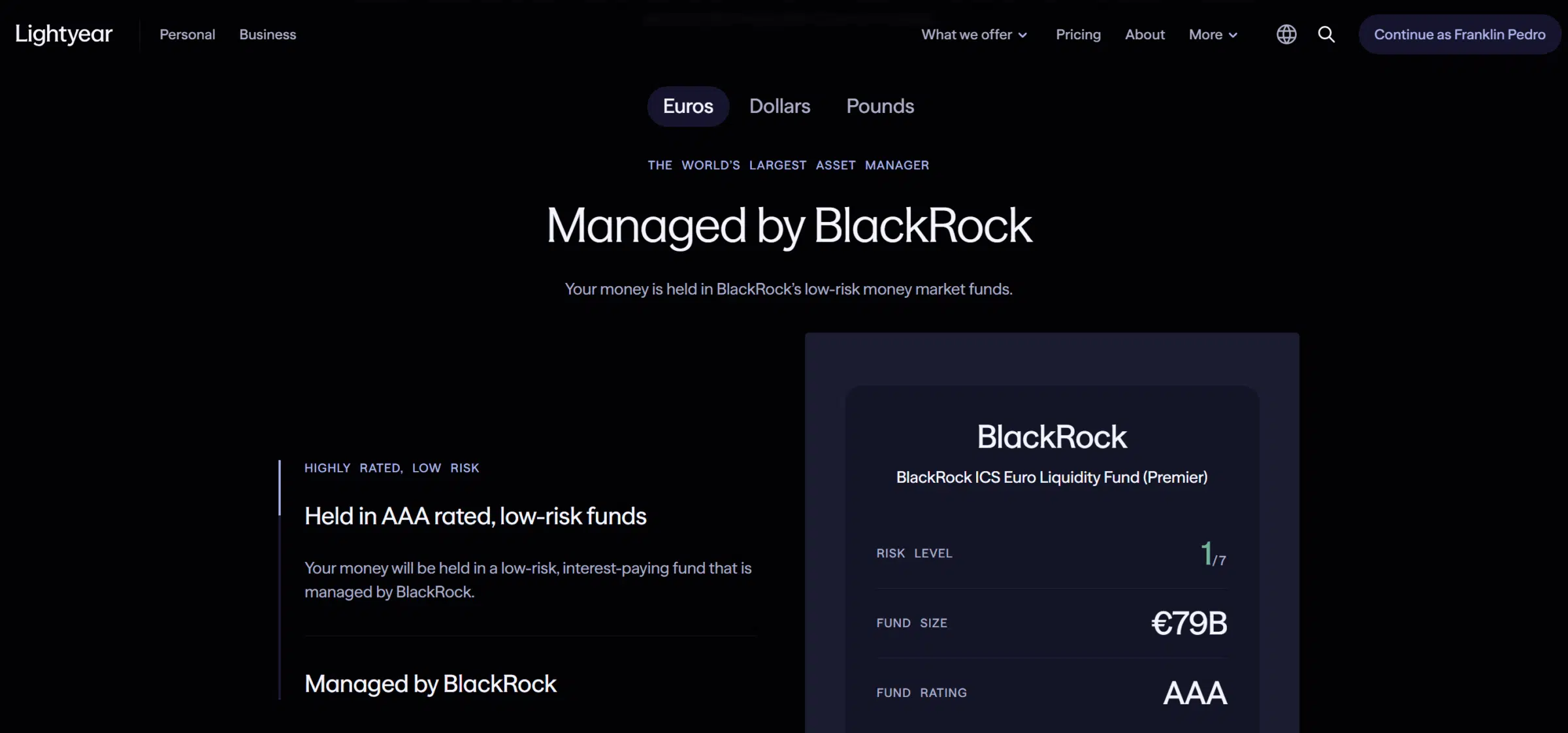
On size, Lightyear’s fund card for the euro fund shows €39 billion under management and a AAA rating, with a risk indicator of 1 out of 7, the lowest band on the scale used in the KID.
Dealing is daily. The KID states that redemptions are possible on every business day with proceeds settled within one business day, while Lightyear says withdrawals from Savings aim to be instant.
Two smaller details worth knowing. These are distributing share classes, so the funds pay out dividends rather than rolling the income into the price. And all three are classified as Article 8 under the EU’s sustainable finance rules, meaning they promote environmental and social characteristics: at least 51% of assets go to issuers screened as having positive environmental or social characteristics, and at least 10% to investments the fund classifies as sustainable.
Do I pay any fee to invest in MMFs?
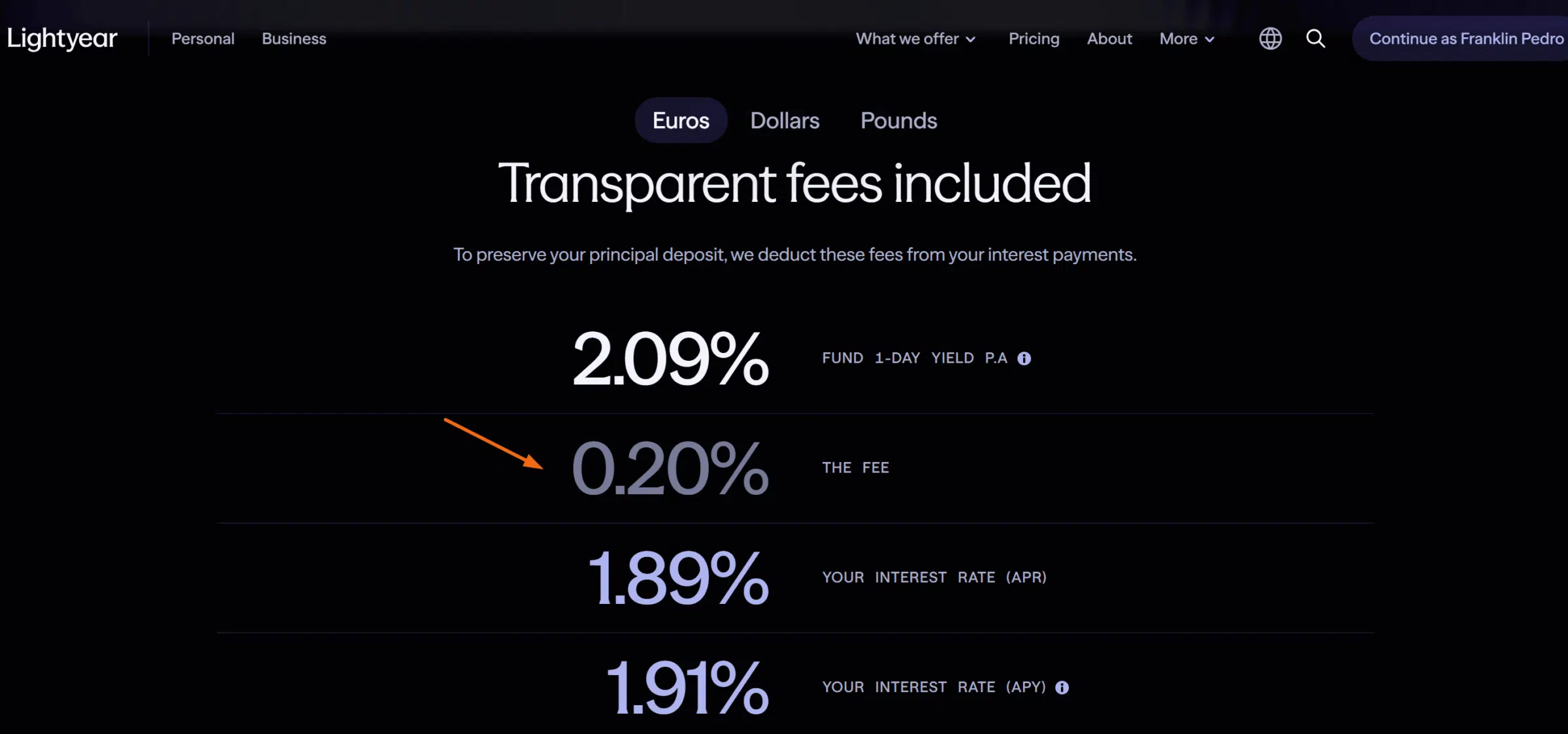
Yes, and Lightyear shows the arithmetic openly. The headline APY is what is left after both the fund manager’s charge and Lightyear’s fee, compounded monthly over a year.
The chain works like this. The fund earns a yield on its portfolio. The fund’s own 0.10% ongoing charge comes out first, which is why Lightyear labels the yield it displays as “net of fund manager fees”. Lightyear’s own annual fee comes out next, and what remains is an annual percentage rate (APR). Compounded monthly, that APR becomes the APY you see on the screen.
| Currency | Fund yield | Lightyear fee | Your rate (APR) | Your rate (APY) |
| EUR | 2.33% | 0.10% | 2.23% | 2.25% |
| GBP | 3.86% | 0.10% | 3.76% | 3.83% |
| USD | 3.80% | 0.15% | 3.65% | 3.71% |
Figures shown on Lightyear’s money market fund pages on 9 September 2026. The fund yield is the annualised 1-day yield, already net of the fund manager’s charge. The headline rate at the top of each page and the figures in this breakdown refresh at slightly different moments, so they can differ by a basis point or two.
Three things stand out:
- The dollar fund costs more. Lightyear charges 0.15% a year on USD against 0.10% on EUR and GBP, so a dollar balance keeps slightly less of the fund’s yield.
- There is nothing else to pay. The KIDs confirm no entry fee, no exit fee charged by the fund and no performance fee. The pound fund reports transaction costs of 0.01% a year and the dollar fund 0.05%, both already reflected in the yield. Switching between share classes can carry a charge of up to 1% of net asset value, which does not apply to normal use of Savings.
- Total cost is small in cash terms. On a £10,000 balance held for a year, the pound fund’s KID puts total product costs at £11. On $10,000, the dollar fund’s KID puts them at $15. Lightyear’s fee sits on top of that.
The APY, or Annual Percentage Yield, accounts for monthly compounding, meaning interest you earn is reinvested and earns further interest.
Are the MMFs safe? What are the risks?
The structure is sound, but it is worth being precise about what is and is not protected, because this is where people most often assume too much.
- Segregation. Your investment in an MMF is held separately from Lightyear’s own accounts, so it is not exposed to Lightyear’s financial position.
- Investor protection, not deposit protection. If all other safeguards fail, EU clients are covered by the Estonian Investor Protection Sectoral Fund only for amounts up to €20,000 across all your investments. That is materially lower than the €100,000 deposit guarantee covering money in a bank account, and it covers the failure of the institution rather than losses on the investment itself. In the UK, the FSCS does not cover money market fund holdings at all, since they are investments rather than deposits.
- It is an investment, so the value can fall. Money market funds are among the lowest-risk investments available, and each of these three sits in category 1 of 7 on the KID risk scale. Lowest risk is not no risk. The stress scenario in the pound fund’s KID shows £10,000 falling to £9,940 over a year, a loss of 0.6%, and the dollar fund’s KID shows the same figure in dollars. That is what an extreme market looks like for this asset class.
- The stable price is a mechanism, not a promise. An LVNAV fund deals at a constant price only while that price stays within 20 basis points of the fund’s actual variable net asset value. If the gap widens beyond that, subsequent purchases and redemptions switch to the variable price. It is rare, and it is the point at which “stable” stops being automatic.
None of this makes Savings a bad option for parking cash. It does mean it is not equivalent to a savings account, and if you are holding a large balance, the €20,000 protection ceiling is worth weighing against a bank paying slightly less.
How can I start earning interest?
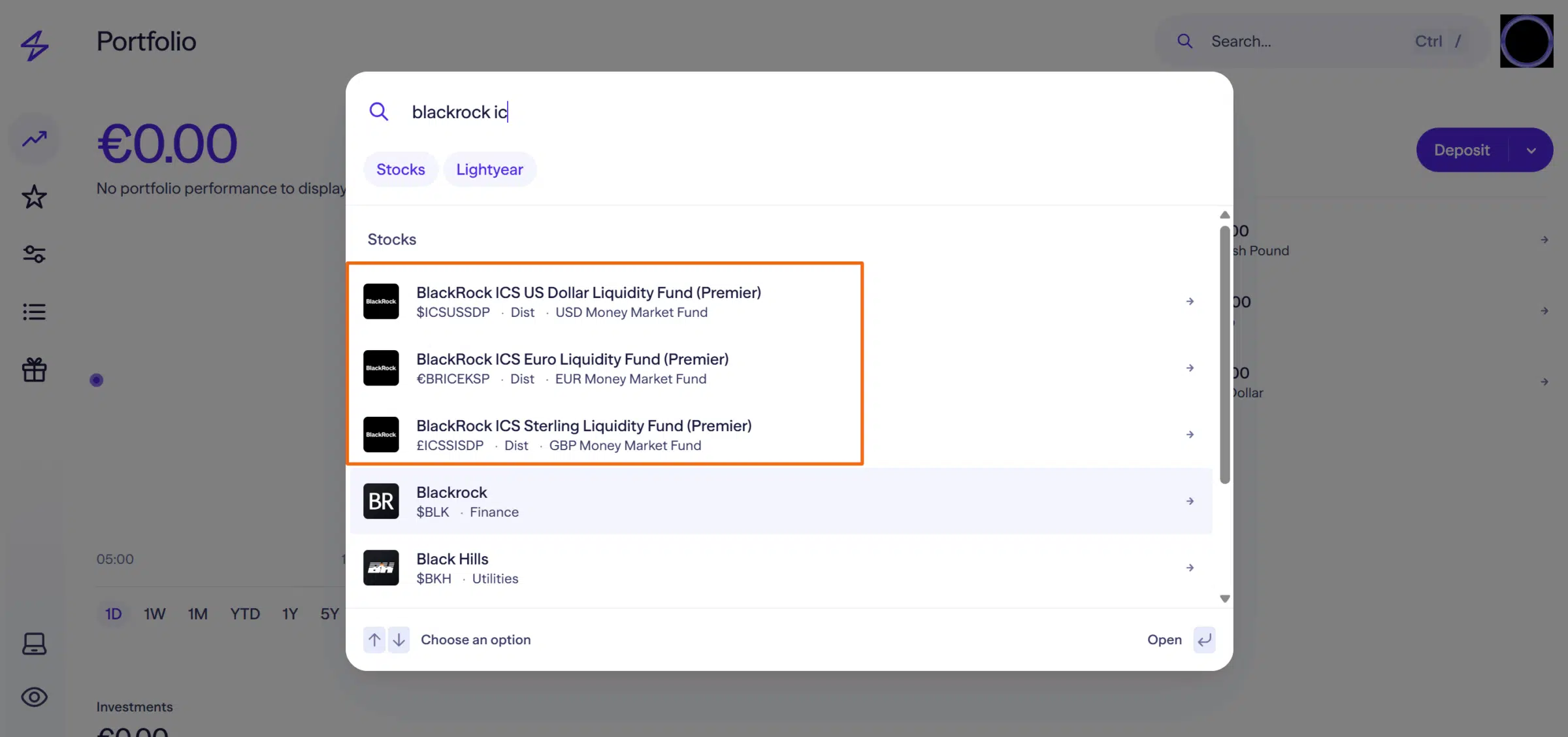
Open the Savings section of the app, choose the currency, and the money market fund for that currency is the instrument you buy. You can also search for the fund by name and invest in it as you would a stock or ETF. If Savings is available in your country, you will see it in your Portfolio tab.
Is the rate fixed or variable?
The rate is variable and moves with central bank policy.
For the euro, the ECB Governing Council holds eight monetary policy meetings a year, roughly every six weeks, at which it sets interest rates for the euro area. Participants are the ECB President, Vice President, the four other Executive Board members, and the governors of the national central banks of the euro area. You can check the scheduled meetings here.
If the ECB, the Federal Reserve or the Bank of England raises or lowers rates, the return on the corresponding MMF will usually move in the same direction, with a short lag. The funds are built to make that lag short: with a weighted average maturity capped at 60 days, the portfolio reprices quickly after a policy change, in both directions.
Rates on all three currencies are lower today than at their peak, and will keep moving. Do not treat a rate you read here or anywhere else as fixed.
Are there any constraints?
No hard limits, but note the following:
- There is no minimum and no maximum. Lightyear states you can start from as little as €1, $1 or £1, with no cap on how much you add;
- You are free to use your money when needed for withdrawals or investments, with no interest penalty for taking it out.
Do I have to pay taxes on MMF interest?
Almost certainly, yes. Other than in special account types such as a UK ISA, tax will be due on the return you receive.
There is one point worth understanding: because this is an investment in a fund rather than interest on a cash balance, some countries will treat the return differently from bank interest, which can change both the rate and when the tax falls due. These are distributing share classes that pay dividends, so in several countries the income arrives as a fund distribution rather than as interest. That distinction matters more in some jurisdictions than others.
We cannot analyse each country’s rules or your personal circumstances here. Check with your tax authority or an adviser to establish how MMF returns are treated where you live.
Is Savings available in my country?
Availability depends on where the funds are registered locally, so Savings does not cover every market Lightyear serves. Check the Savings section of Lightyear’s website or look for Savings in your Portfolio tab, which appears only if the product is available to you.
Which manager you get also depends on your country. Lightyear runs Savings through two asset managers, and its own pages set out the split: BlackRock in Austria, Denmark, Estonia, Finland, France, Germany, Hungary, Italy, Latvia, Lithuania (euro only), Luxembourg, Malta, the Netherlands, Spain, Sweden and the UK, and J.P. Morgan Asset Management in Bulgaria, Croatia, Cyprus, Greece, Ireland, Portugal, Slovakia and Slovenia.
The two sets of funds are close cousins: AAA-rated, risk level 1 out of 7, over 300 holdings, same 0.10% Lightyear fee on euros and pounds. Rates differ slightly. On 9 September 2026 the pound fund showed 3.84% APY on the J.P. Morgan pages against 3.83% on the BlackRock pages. The fund you actually hold is named on the instrument page in the app, which is the reliable place to check.
Lightyear alternatives for interest
If you are looking for alternatives, see our comparisons of the best brokers and digital banks paying interest on cash in EUR, USD and GBP.
Worth knowing when you compare: several brokers that advertise interest on uninvested cash use the same money market fund mechanism rather than paying interest directly, so the €20,000 investor protection point applies there too. Others pay genuine interest on cash held at partner banks, which brings deposit guarantee cover instead. The headline rate does not tell you which you are getting.
Bottom line
Lightyear Savings gives you a way to earn a return on money you have not yet invested, currently 2.25% in EUR, 3.67% in USD and 3.84% in GBP, with no minimum and instant access.
Just remember these are different products with different risks. You are buying units in a money market fund run by J.P. Morgan Asset Management or BlackRock, depending on your country, rather than depositing money in a bank. For most people parking cash between investments, that is a reasonable trade. For a large emergency fund, the €20,000 protection ceiling deserves a moment’s thought.
Looking for a sign-up bonus? Lightyear offers up to €100 in fractional shares with the promo code INVESTINGINTHEWEB.
Up to €100 in fractional shares
Lightyear operates under Estonian and UK regulation. Lightyear Europe AS is regulated by the Estonian Financial Supervision Authority (EFSA), licence 4.1-1/31. In the UK, Lightyear UK Ltd is authorised and regulated by the Financial Conduct Authority, FRN 987226.
Disclaimer: Investing involves risk. See full T&Cs. Terms apply: lightyear.com/terms. Only invest excess capital. Money market funds are considered investments and are not FSCS protected.
Do you have feedback or questions about this broker? Read our review and get in touch to share your experience.