Imagine you just got a notification on your phone: “Federal Reserve cuts rates by 50 basis points – largest move since 2020”. You think to yourself, “Let me reevaluate my portfolio and maybe adjust exposure before things move further”. Then you realise the market is not yet open. Is there a way to trade outside regular hours?
Yes – extended hours trading allows you to react promptly to macroeconomic events (central bank decisions, inflation prints, employment data), unexpected geopolitical news, or volatility around scheduled earnings reports. For active investors, the ability to act before regular market hours can make a meaningful difference, particularly when news breaks outside trading windows.
This article addresses three questions: Does DEGIRO offer pre-market and after-hours trading? If so, is it the right platform for it? And what are the best alternatives? Let’s get into it.
What is pre-market and after-hours trading?
Pre-market trading takes place before the regular market session opens, while after-hours trading happens once the regular session closes. Together, they’re often referred to as “extended hours trading”.
What are the advantages of extended-hours trading? Stock exchanges are typically open during working hours, so one practical advantage is the ability to trade outside what, for most people, is a busy workday. Additionally, major market-moving news – such as quarterly earnings reports, central bank announcements, employment statistics, and inflation prints – is often released outside regular trading hours. For example, US corporate earnings are typically released either before market open (BMO) or after market close (AMC), and the Federal Reserve usually announces its policy decisions at 14:00 ET (after most European markets have closed). Extended hours trading allows investors to react before the next regular session begins.
Does DEGIRO offer pre-market and after-hours trading?
Yes – DEGIRO offers extended hours access to more than 10,000 securities from 07:00 to 21:00 CET, including European, UK, and US-listed stocks. This is done via the Tradegate Exchange (symbol: TDG), a fully regulated German exchange that is 60% owned by Deutsche Börse AG – one of Europe’s largest exchange operators.
An important caveat: positions opened on Tradegate must also be closed on Tradegate. If you own Apple shares purchased on NASDAQ, for example, you cannot sell them via Tradegate after hours – DEGIRO’s extended hours feature applies only to instruments bought and held on Tradegate itself.
Disclaimer: Investing involves risk of loss.
Example: Apple’s full-year financial results are released and blow expectations, but the market is closed. You can simply search for the Apple stock on DEGIRO with the TDG symbol and get in the action straight away:
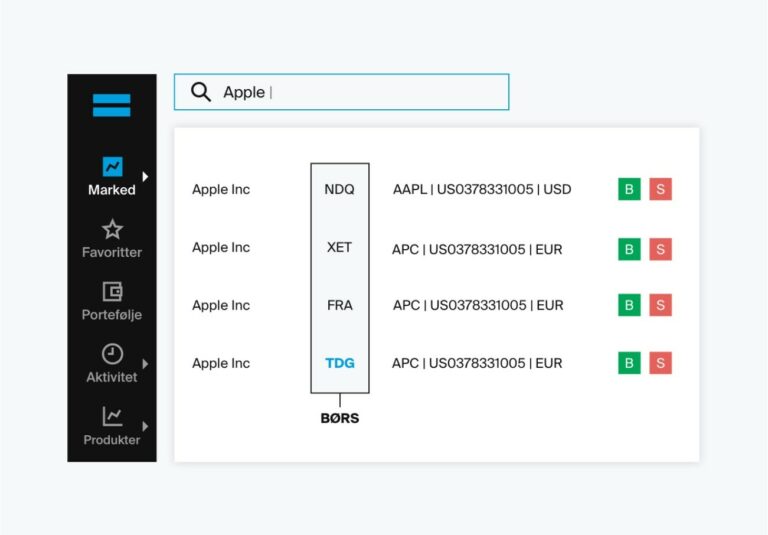
Note: Keep in mind that, as it’s the case with all exchanges, if you buy a stock in Tradegate, that is also where you’ll sell it once you choose to do it, so if you own Apple shares bought in NASDAQ, you won’t be able to sell them after-hours using this DEGIRO feature since the after-hours trading only occurs in the Tradegate Exchange.
The cons of DEGIRO extended hours trading
The main drawbacks of DEGIRO’s extended hours offering:
- €3.90 flat fee per Tradegate transaction: significantly more expensive than the €/$2 (€1 commission + €1 handling fee) that DEGIRO charges for US stocks during regular market hours;
- Lower liquidity: trading volumes outside regular hours are typically a fraction of regular-session volumes, which can lead to wider bid-ask spreads and worse execution;
- Higher volatility: news-driven price moves in thin markets can be exaggerated, increasing the risk of slippage on market orders;
- Tradegate-only execution: positions cannot be carried between Tradegate and home exchanges (NASDAQ, NYSE, LSE).
If you want to avoid the €3.90 extra fee or simply want to consider other options, here are some broker alternatives that don’t charge additional costs for extended hours trading:
The Cons of DEGIRO Extended Hours Trading
If you want to save the €3.90 extra fee or just want to consider other alternatives, below we present some broker alternatives that require no additional costs for extended hours trading:
Interactive Brokers
Founded in 1978 and a NASDAQ-listed S&P 500 constituent, IBKR is one of the world’s most trusted brokers and a strong choice for extended hours trading. When placing an order, select “Time-in-Force” and check the “Outside RTH (Regular Trading Hours)” option – this enables order execution during pre-market (4:00 AM ET) and after-hours (until 8:00 PM ET) for US equities, with no extra commission beyond standard pricing. IBKR also offers overnight trading sessions on selected US stocks. Check out our full Interactive Brokers review.
💡 Interactive Brokers also offers IBKR GlobalTrader, a modern mobile trading app for stocks, options, and ETFs – ideal for novice investors looking to start trading.
Trading 212
Trading 212 is a versatile investment platform offering pre-market and after-hours trading on the most liquid US stocks, available via Trading 212 CFD (leveraged products only – real stocks are limited to regular session trading). Extended hours coverage runs from 09:30 to 01:00 GMT on the most liquid US names, with no extra fees or commissions beyond the standard CFD spreads. Read our Trading 212 review for more details.
💡 You can get a free fractional share of up to €100 when signing up.
Disclaimer: when investing, your capital is at risk and you may get back less than invested. Past performance doesn’t guarantee future results. CFDs are complex instruments and approximately 80% of retail CFD accounts lose money – they may not be suitable for everyone.
Wrapping up
Pre-market and after-hours trading can give you an edge when reacting to breaking news or playing increased volatility – but the two have something important in common: they require experience in the markets and time spent analysing them. Before exploring extended hours strategies, it’s crucial to decide how much time you’re willing to devote to active trading and how big your risk appetite is.
If your approach is passive and long-term, you’re most likely investing in broad-market ETFs or blue-chip companies. In that case, dollar-cost averaging during regular market hours will typically yield better execution prices (thanks to higher liquidity and tighter spreads) and lower psychological stress – extended hours trading is unlikely to add meaningful value to a buy-and-hold strategy.
For active traders who want to react to overnight news, Interactive Brokers and Trading 212 (for CFD traders) remain the most cost-effective alternatives to DEGIRO’s Tradegate route, particularly given the €3.90 per-trade premium on DEGIRO.
Disclaimer: Investing involves risk of loss.