Investors looking to buy and sell stocks will often first look towards recognisable names and brands. Charles Schwab is an investment company that’s well-known and respected around the world, so it’s no surprise that investors in Switzerland want to know if it’s possible to invest using the platform.
Keep on reading if you’re keen to find out if the Charles Schwab platform is available to investors in Switzerland. We’re going to uncover everything you need to know about opening an account with Charles Schwab and the relevant alternatives in Switzerland.
Is Charles Schwab available in Switzerland?
Yes, it is possible to sign up for the Schwab One International brokerage account. But there are some crucial things investors need to understand about using the platform in Switzerland.
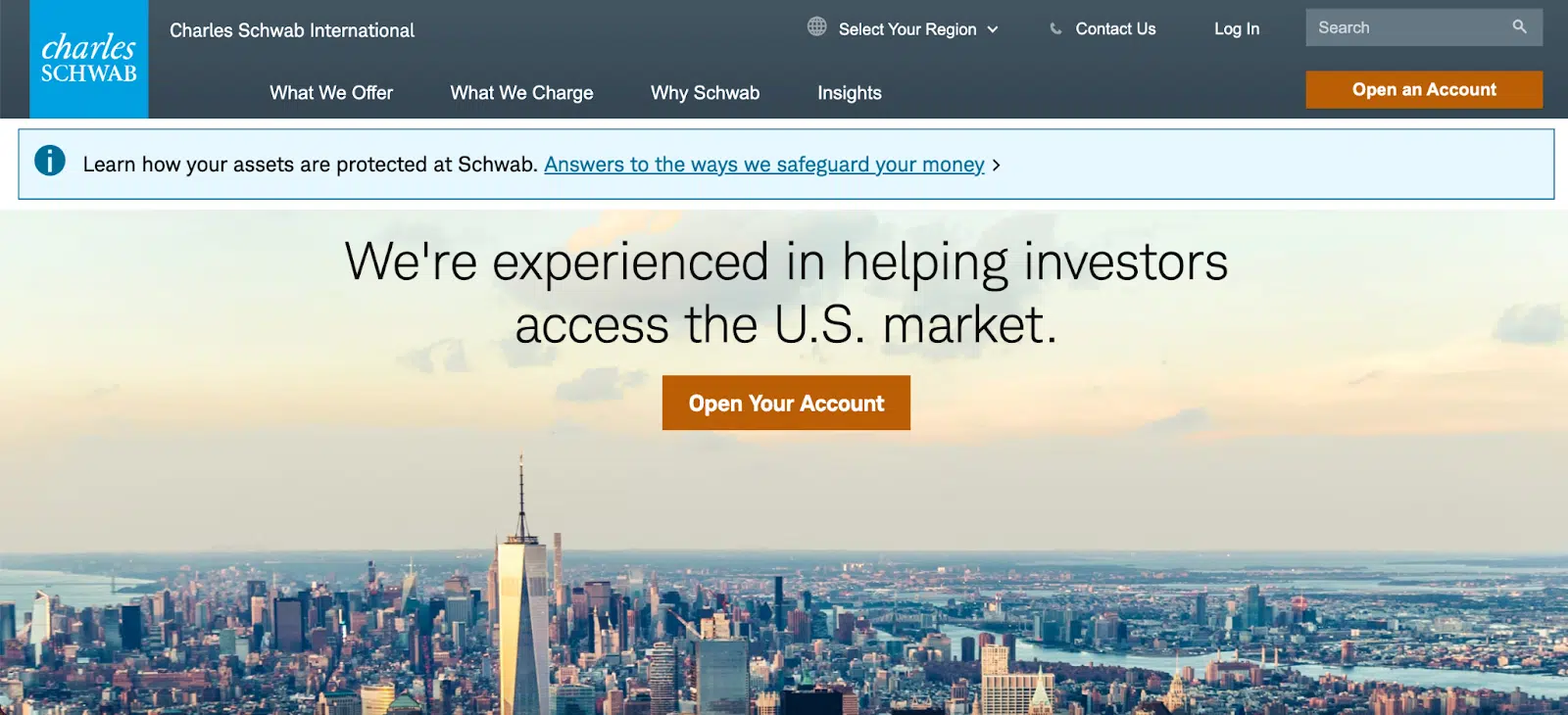
Charles Schwab works primarily in the US. However, the company offers an international service open to applicants from Switzerland, available in more than 100 countries and based on your country of residence rather than your citizenship.
One thing has changed in the applicant’s favour: the $25,000 minimum deposit that Schwab used to require on international accounts has been removed, and its international brokerage page now shows no minimum for individual or joint accounts. The limitations that matter are elsewhere, and we cover them below.
How to use Charles Schwab in Switzerland
The application runs online and takes around 15 to 20 minutes, but you will need a few things to hand:
- Your tax identification number. A US Social Security number is not required for non-US residents, though a tax ID usually is;
- Current ID, normally your passport;
- Proof of residence, such as a recent utility bill showing your full name, address, and date;
- Employment details, including the name and mailing address of your current employer;
- A way to upload digital copies of your documents.
Along with all these documents, Charles Schwab has specific requirements and limitations for European investors hoping to use its Schwab One International brokerage account.
Other things you need to know about using Charles Schwab in Switzerland
The real constraints are not about the size of your deposit:
- You can only trade in US dollars. The account holds USD, so Swiss francs have to be converted first, and you pay a conversion cost every time you fund the account or take money out;
- You cannot buy US ETFs from Switzerland. US-listed ETFs do not publish the Key Information Document that European rules require, which blocks the single most useful product for a passive investor. Commission-free US stock trading is of limited comfort if the funds you actually want are off the menu;
- Everything is US-centric. Swiss and European listings are not the focus of the platform, so a portfolio built here will lean heavily towards US assets;
- Support and paperwork run on US time and in US formats, including the tax documentation you will need to keep current.
None of this makes the account unusable. It does mean that for most Swiss residents building a long-term portfolio, a European broker is the simpler route.
Charles Schwab alternatives in Switzerland
If you’re in Switzerland and want to access the best brokerages and investing options, some alternatives to Charles Schwab provide more choice and flexibility, starting with access to European-domiciled ETFs.
Here are some of the best brokerages available in Switzerland:
Interactive Brokers | Best overall trading platform
Founded in 1978, IBKR is one of the world’s most trustworthy brokers. It offers an enormous range of financial products (stocks, ETFs, options), and low currency conversion fees. It also offers IBKR GlobalTrader, a modern mobile trading app to trade stocks, ETFs, and options, ideal for novice investors.
eToro | Best for commission-free investing, beginners, and social trading
The leading social trading platform, with over 40 million users worldwide. Copy other traders and investors, invest in one of the pre-built portfolios, or trade for yourself.
Disclaimer: eToro is a multi-asset investment platform. The value of your investments may go up or down. Your capital is at risk.
XTB | Best for forex and CFD trading
It offers low spreads on hundreds of markets through CFDs on forex, indices, commodities, and cryptocurrencies. Awarded multiple times as the best forex and CFD broker. Note that in Switzerland the offering is CFDs only.
Saxo Bank | Best for experienced investors
Saxo is a multi-asset broker providing retail and institutional clients access to a full suite of investment products like stocks, bonds, funds, and derivatives. It runs its own trading platforms and offers high-touch customer support, through a Swiss entity supervised by FINMA.
DEGIRO | Best European discount broker
One of the leading online brokers in Europe due to its low-cost structure. It offers an ETF Core Selection list with low commissions (external fees apply) and a wide product portfolio.
Disclaimer: Investing involves risk of loss.
| Broker | Fees for US stocks | Minimum deposit |
| Interactive Brokers | $0.0005-$0.0035 per share (min $0.35 per order) | CHF 0 |
| eToro | $1 per stock trade in most regions (CFDs on stocks: eToro spread fee) | $50 |
| DEGIRO | €/£1 (+ €/£1 handling fee) | CHF 0.01 |
| XTB | $0 (for CFDs on US stocks) | $0 |
| Saxo Bank | Classic: 0.08% (min. $1); Platinum: 0.05% (min. $1); VIP: 0.03% (min. $1) | CHF 0 for Classic; CHF 250,000 for Platinum and CHF 1,000,000 for VIP |
#1 Interactive Brokers

Interactive Brokers at a glance
Interactive Brokers, founded by Thomas Peterffy in the late 1970s, revolutionised finance with automated trading. It’s now a global leader, known for advanced technology and low-cost trading services, offering a wide range of financial instruments to traders and investors worldwide.
Interactive Brokers provides a wide array of financial instruments, encompassing stocks, ETFs, options, futures, and forex across global markets. For a Swiss investor, the key point is that it gives you access to European-domiciled UCITS ETFs, which the Schwab account does not.
Swiss residents do not open an account with a Swiss entity: depending on your profile, you contract with one of the group’s companies in Ireland, the UK or the US, each supervised by its own regulator, with investor protection that varies accordingly. Check which entity you are signing with during the application.
All of which makes it a strong alternative to Charles Schwab for investors in Switzerland. Take a look at our full Interactive Brokers review and visit Interactive Brokers’ website for more details.
#2 eToro

eToro at a glance
52% of retail CFD accounts lose money.
eToro gives Swiss investors access to thousands of instruments across equities, commodities and more. It is used by over 40 million people worldwide, has been listed on the Nasdaq since May 2025, and holds authorisation from the FCA, CySEC and ASIC.
eToro distinguishes itself through social trading features such as CopyTrader and a virtual account, which lets you practise with $100,000 in demo funds. It also accepts deposits in Swiss francs, which spares you a conversion on the way in.
eToro’s platform, accessible through web and mobile, is a social trading hub. Investors can discuss ideas and market news with each other, replicate the strategies of other users, and invest in ready-made Smart Portfolios built around themes.
For more details, visit our eToro review and check eToro’s website directly.
#3 XTB

XTB at a glance
69-80% of retail CFD accounts lose money.
Founded in 2002, XTB presents itself as a market player with extensive worldwide experience. Even though XTB is not regulated by FINMA, it is overseen by top-tier regulators: the FCA, KNF, CySEC and FSC.
The award-winning trading app xStation, available for mobile and desktop, lets you trade a wide range of instruments, gives you access to technical analysis tools, and provides comprehensive educational resources. However, in Switzerland you can only buy CFDs on stocks, forex, indices, commodities, and cryptocurrencies. You will not have direct exposure to shares, only indirect exposure through the derivative. This is a complex and risky instrument, and most retail investors lose money trading it.
On the downside, you will face an inactivity fee of €10 a month if you have not traded for a year and have not deposited in the last 90 days, and it charges high commissions on cryptocurrency CFDs.
Opening an account and transferring money is quick and hassle-free, with a demo account available, and you can start with just €1. Take a look at our full XTB review and check XTB’s website for more details.
#4 Saxo Bank

Saxo Bank at a glance
62% of retail CFD accounts lose money.
Launched in 1992, Saxo Bank is one of the most solid financial entities in the brokerage industry, with a proven track record. It lets you trade tens of thousands of financial instruments through its own trading platforms, on desktop and mobile.
Saxo provides a vast selection of instruments, encompassing stocks, ETFs, bonds, futures, options, forex, and managed portfolios. That range, along with advanced trading tools, market research, and real-time news feeds, makes for a deep trading experience.
For Swiss investors, Saxo has a local entity supervised by FINMA, which is a meaningful difference from most of the other names on this list.
In a nutshell, the broker offers competitive prices, good educational resources, an impressive range of tradable assets, and capable trading applications, making it a strong alternative for investors in Switzerland thinking about using Charles Schwab.
Want to know more about Saxo? Check our Saxo review and visit Saxo’s website.
#5 DEGIRO

DEGIRO at a glance
Investing involves risk of loss.
DEGIRO serves over 3 million European clients and is a common first choice for beginners in Switzerland. Its straightforward design makes stock trading accessible to new investors.
DEGIRO offers a wide range of investment options, including stocks, ETFs, bonds, options, and futures across global markets, which allows investors to build diversified portfolios aligned with their objectives and risk tolerance. Its ETF Core Selection is the feature most passive investors come for.
DEGIRO is licensed by the Dutch Authority for the Financial Markets (AFM) and the Dutch Central Bank, and it is the Dutch branch of flatexDEGIRO Bank AG. It accepts clients resident in Switzerland.
Notably, DEGIRO stands out with its low fees. On the downside, it does not offer forex trading, charges €/£1 commission plus a handling fee on most trades, and applies a €/£2.50 annual connectivity fee per exchange you trade on.
For further details, you can read our full DEGIRO review and check DEGIRO’s website directly.
Bottom line
In conclusion, Charles Schwab is available in Switzerland through the Schwab One International account, and the old $25,000 minimum deposit is no longer required. What remains are the limits that matter more: the account trades only in US dollars, the product range is US-centric, and you cannot buy US-listed ETFs from Switzerland.
For Swiss investors seeking alternatives, there are several options. Interactive Brokers stands out with its wide range of financial instruments, competitive fees, and access to European-domiciled ETFs. DEGIRO is a user-friendly platform with low fees, handling fees aside. eToro offers social trading features, CHF deposits and a demo account for learning. XTB has extensive experience in global markets and a low minimum deposit, though in Switzerland it offers CFDs only. Saxo Bank runs a Swiss entity supervised by FINMA and a very broad instrument range.
Ultimately, the choice depends on your specific needs. Charles Schwab may work for someone who wants a US account and trades US shares directly. For a Swiss resident building a long-term portfolio around ETFs, a European broker will almost always be simpler and cheaper.