It’s very difficult to keep track of the best offers for high-yield savings accounts in Europe: new offers appear almost daily, and existing ones change their rates frequently. That’s even more true now that the European Central Bank has started raising rates again, taking its deposit rate to 2.50% on 16 September 2026.
In this post, we look at the best places to earn interest on cash across Europe. That includes not only banks but also e-money institutions and brokers, which often lead the way on rates.
Trading 212* currently offers the highest rate on euro cash in our comparison: 4.20% a year for new Trading 212 EU GmbH clients who open an account between 16 September and 2 November 2026, for four months, then 2.80%.
It’s not just about the highest rate, though: how your money is held matters just as much.
For a combination of a competitive rate and deposit protection, Trade Republic stands out: it pays the ECB deposit rate (currently 2.50%) on cash held at partner banks, with a promotional 3.00% for new clients in some countries.
Best savings accounts in Europe
| Platform | Interest rate on EUR | Notes |
| Trading 212* | 4.20% for new clients; 2.80% for existing clients | Promo until 2 November, then 2.80% (2.50% on the CySEC entity) |
| Trade Republic | 2.50% (3.00% promotional rate for new clients in some countries) | Follows the ECB deposit rate |
| Scalable Capital** | 2.60% instant access; 3.00% fixed for 2 years | Overnight account, or a fixed term of 12 months (2.75%) or 24 months |
| Mintos | Up to 2.50% | Smart Cash, a money market fund |
| Lightyear | 2.39% APY | Money market fund, not a deposit |
| Wise | 2.02% | Money market fund, not a deposit |
| BUX*** | Up to 2.00% | Rate depends on your account type |
| Interactive Brokers | 1.858% (IBKR Pro) | Only on balances above €10,000, with conditions |
Rates checked on 23 September 2026 and variable. The ECB deposit rate rose to 2.50% on 16 September 2026, and money market fund yields follow it with a lag of a few weeks.
**Only available to residents of Austria, France, Germany, Italy, Spain and the UK.
***Only available to residents of the Netherlands, Belgium, France, Germany, Spain, Italy, Austria and Ireland.
Why not bookmark this page, so you can come back and check the latest offers available to Europeans?
The accounts we select have to be available to most European residents. Depending on where you live, you may have additional options at equivalent or better rates.
*Trading 212: when investing, your capital is at risk and you may get back less than invested. Past performance doesn’t guarantee future results. Other fees may apply. See terms and fees. If you enable interest, Trading 212 will hold your cash in qualifying money market funds and banks. Otherwise, your cash will be held only in banks. Interest applies on cash in an investment account. Terms apply. Interest rates may no longer be current: see the Trading 212 Terms and Fees page for the live rates. Pies & AutoInvest is an execution-only service. Not investment advice or portfolio management. Automatic investing refers to executing scheduled deposits. You are responsible for all investment and rebalancing decisions. Sponsored Code: to get free fractional shares worth up to 100 EUR, you can open an account with Trading 212 using the code IITW. Terms apply.
The best European savings accounts explained
Trading 212
- Interest rate on offer: 4.20% a year on euro cash for new Trading 212 EU GmbH clients who open an account between 16 September and 2 November 2026, for four months. After that, the standard rate applies: 2.80% at Trading 212 EU GmbH and 2.50% at Trading 212 Markets Ltd (the CySEC entity, which includes older Portuguese accounts). Rates are variable.
- How often interest is paid: accrued daily and paid monthly.
- Limitations: no cap on the balance that earns interest. The promotional rate does not apply to CFD accounts, and you must deposit the minimum amount within 10 days of opening the account and opt in to the Interest Sharing Programme.
- Safety: if you enable interest, Trading 212 holds your cash in qualifying money market funds and banks. Otherwise, your cash is held only in banks. Bank deposits are covered by the applicable deposit guarantee scheme up to €100,000 per person, while the part held in money market funds is not covered by a deposit guarantee and carries the fund’s own risk.
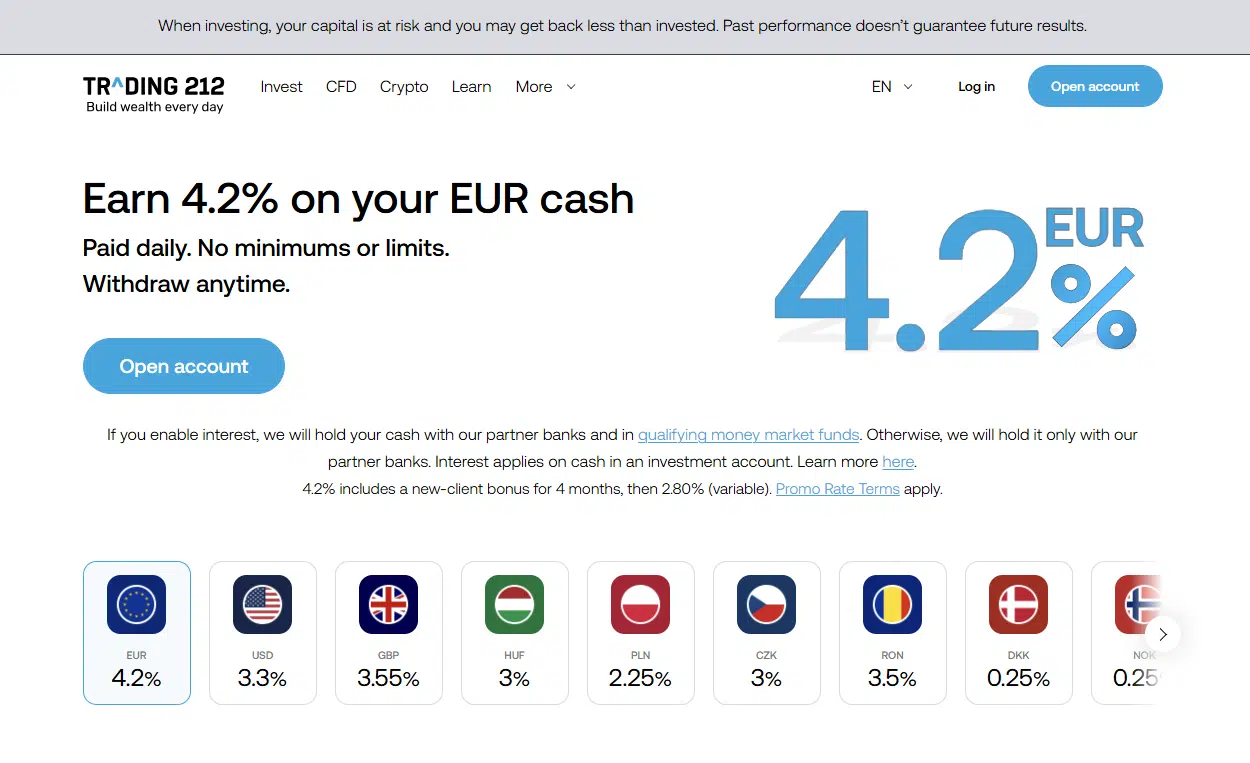
Founded in 2004, Trading 212 is a London-headquartered fintech whose mission is to make investing simple through a mobile-first experience, with more than 10,000 stocks and ETFs. Sponsored Code: new clients can get free fractional shares worth up to 100 EUR using the code IITW. Terms apply.
Trading 212 offers no commissions on stocks and ETFs (other fees may apply, see terms and fees), fractional shares, Pies and AutoInvest for scheduled investing into a portfolio of your choice, and, in the UK, Stocks and Shares and Cash ISAs. The product range still lacks bonds and options. 0,15% FX fee applies when converting funds.
Interested in knowing more? Read our Trading 212 review.
*Trading 212: when investing, your capital is at risk and you may get back less than invested. Past performance doesn’t guarantee future results. Other fees may apply. See terms and fees. If you enable interest, Trading 212 will hold your cash in qualifying money market funds and banks. Otherwise, your cash will be held only in banks. Interest applies on cash in an investment account. Terms apply. Interest rates may no longer be current: see the Trading 212 Terms and Fees page for the live rates. Pies & AutoInvest is an execution-only service. Not investment advice or portfolio management. Automatic investing refers to executing scheduled deposits. You are responsible for all investment and rebalancing decisions. Sponsored Code: to get free fractional shares worth up to 100 EUR, you can open an account with Trading 212 using the code IITW. Terms apply.
Trade Republic
- Interest rate on offer: 2.50% a year on euro cash, in line with the ECB deposit rate since 16 September 2026. New clients in some countries (not Germany) get a promotional 3.00% on up to €50,000.
- How often interest is paid: calculated daily and paid monthly.
- Limitations: no limit on the balance that earns the ECB rate. The promotional 3.00% applies to the first €50,000.
- Safety: your uninvested cash is held with Trade Republic Bank GmbH or partner banks such as Citibank Europe plc, Deutsche Bank AG and J.P. Morgan SE, covered by a deposit guarantee scheme up to €100,000 per person and per institution. Part of the cash may also be held in money market funds, which are not covered.
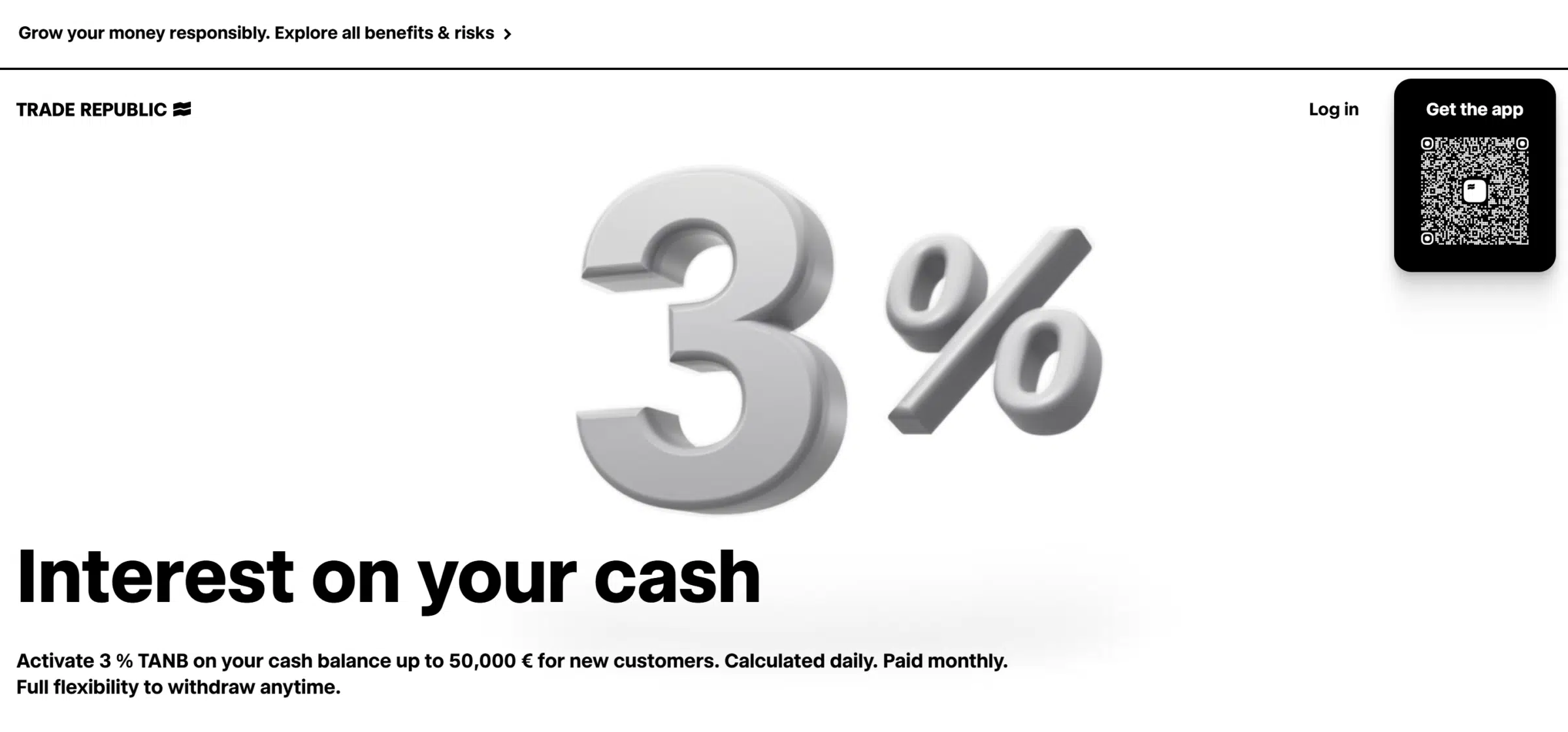
Founded in 2015 in Berlin, Trade Republic is one of Europe’s largest neobrokers, with more than 10 million clients across 18 countries and over €150 billion in customer assets. It offers stocks, ETFs, bonds, cryptocurrencies and derivatives, alongside a full banking setup (cash account, card and savings plans). Trade Republic holds a full banking licence and is supervised by BaFin and the Deutsche Bundesbank.
Trade Republic’s rate followed the ECB’s increase to 2.50% on 16 September 2026, as it did in June.
Interested in knowing more? Read our Trade Republic review.
Scalable Capital
- Interest rate on offer: 2.60% a year with instant access on the Overnight account, or 3.00% fixed for 2 years (2.75% for 12 months) on the Fixed-term account, on an unlimited amount.
- How often interest is paid: monthly on the Overnight account, at maturity on the fixed-term account.
- Limitations: the 3.00% rate requires you to lock your money for two years.
- Safety: Scalable itself isn’t a member of a deposit guarantee scheme. Your cash is placed with partner banks, which are members of their own national schemes.
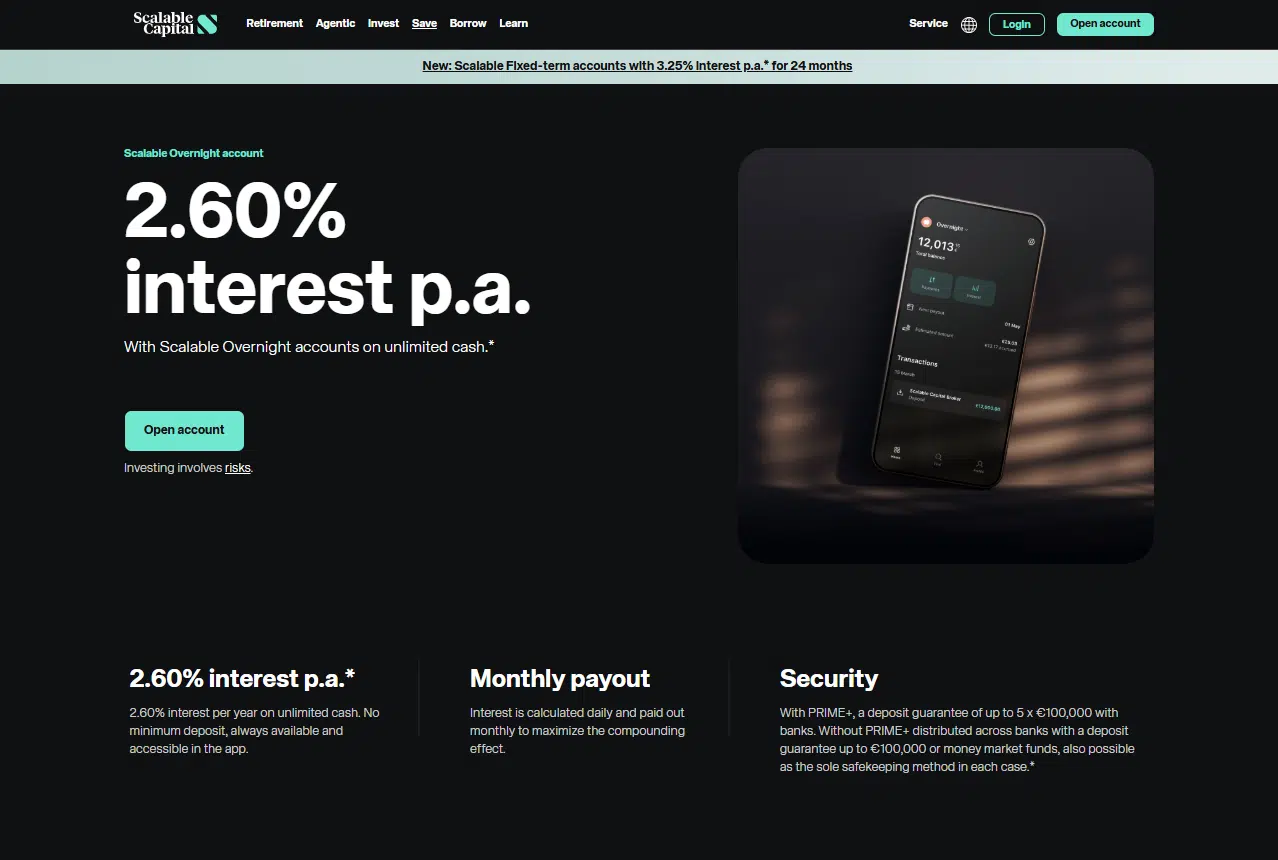
Scalable Capital, founded in 2014, is a Munich-based broker regulated by BaFin, with more than 1 million clients across Germany, Austria, Italy, Spain, the Netherlands and France. It lets you invest in stocks, ETFs, funds, cryptocurrencies and derivatives.
Its instant-access rate rose to 2.60% on 1 September 2026, which makes it one of the best options without a lock-up. If you can commit your money, the Scalable Fixed-term account pays 3.00% a year fixed for two years, or 2.75% for one year, on an unlimited amount, through partner banks.
In Scalable’s risk information, there’s no reference to Scalable itself being a member of a deposit guarantee scheme. It does note that some of the partner banks where it places your cash are members of their national schemes, but this protection comes through those banks rather than through Scalable. It’s worth checking which partner banks hold your cash and what guarantees apply to each.
Mintos
- Return on offer: up to 2.50% a year on euro balances, through Smart Cash.
- How often it’s paid: accrued daily and paid monthly.
- Limitations: no maximum amount, and you can withdraw on the same day with no fees or penalties.
- Safety: not a deposit and not covered by a deposit guarantee scheme. Your money is invested in a money market fund, so your capital is at risk.
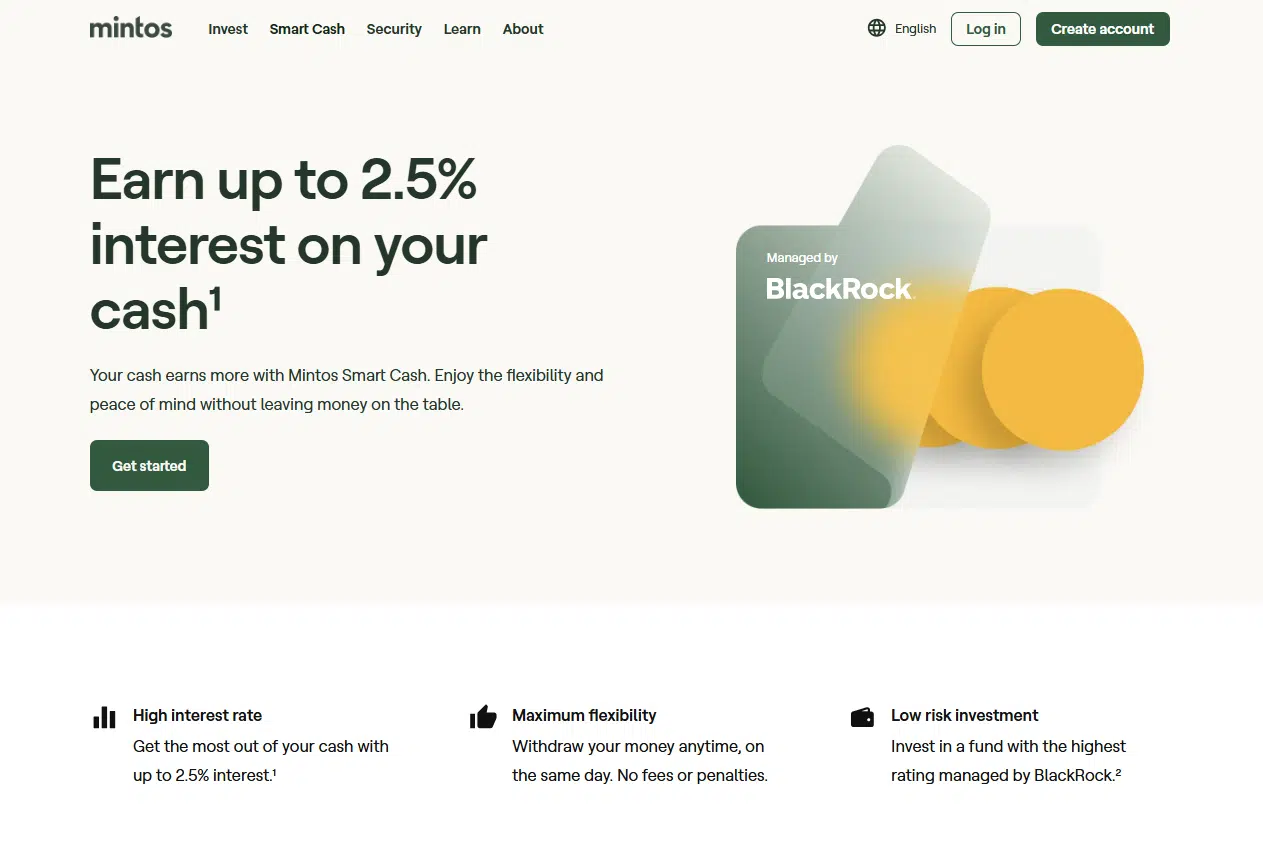
Mintos’s cash feature is called Smart Cash. It invests your money in a money market fund, which holds low-risk, highly liquid instruments such as short-term government bonds and commercial paper. These funds pay a return, but the value of your investment can fluctuate and your capital is at risk, since they are not deposits.
Mintos invests your Smart Cash balance in the BlackRock ICS Euro Liquidity Fund, authorised and regulated under the EU Money Market Fund Regulation (Regulation (EU) 2017/1131). Mintos Smart Cash uses the Premier Distributing share class (ISIN IE000GWTNRJ7), which maintains a stable net asset value of €1.00 per share.
As a side note, Mintos offers a bonus when you create an account using the promo code “GO-INVESTWEB“.
Lightyear
- Return on offer: 2.39% APY on euros (September 2026), through a money market fund managed by J.P. Morgan Asset Management that follows the ECB’s rate trends.
- How often it’s paid: accrued daily and paid monthly.
- Limitations: no minimum or maximum amount.
- Safety: this is an investment product, not a deposit. Your capital is at risk and it isn’t covered by a deposit guarantee scheme.
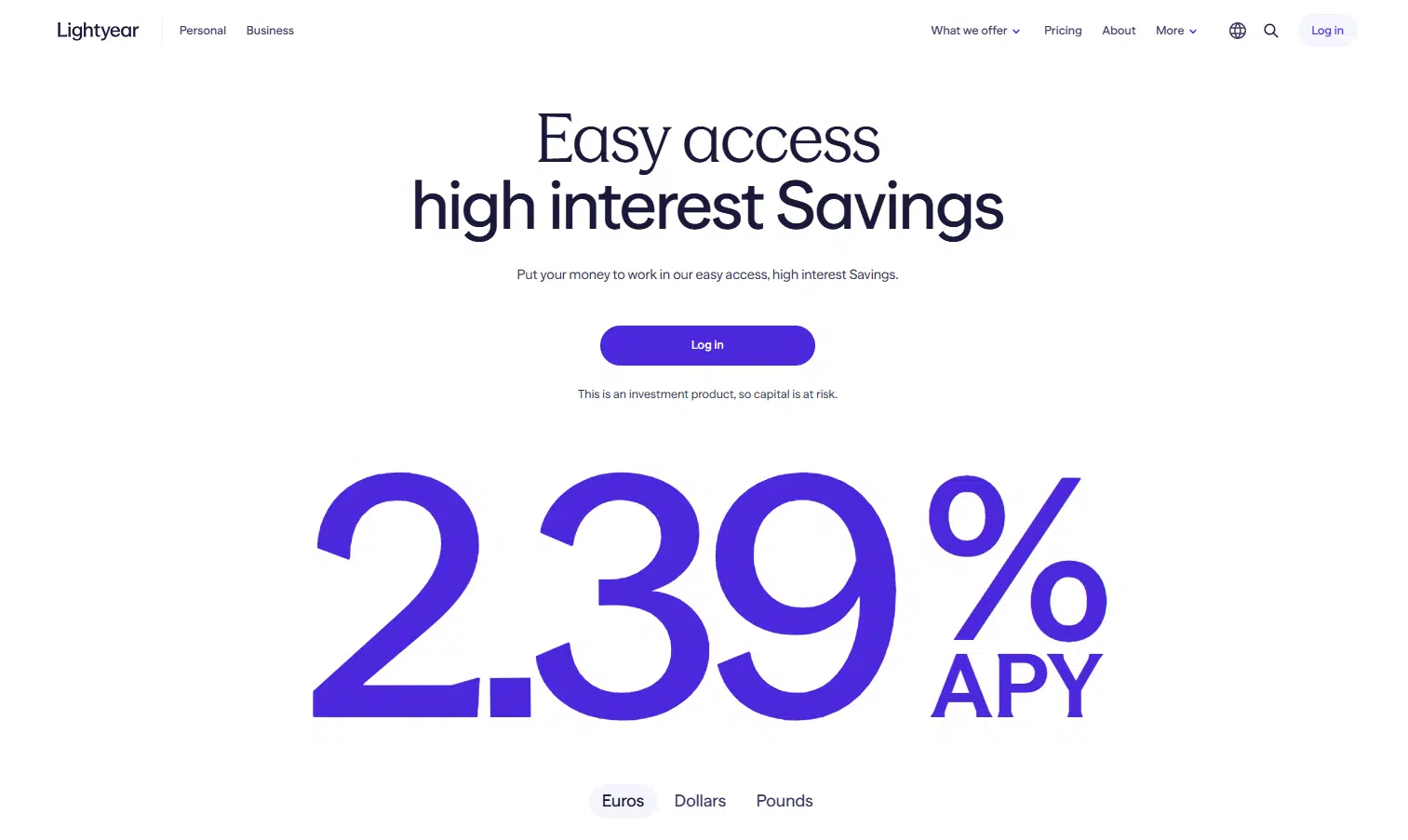
Lightyear’s Savings feature invests your cash in money market funds rather than holding it as a deposit, which is why the return is variable and your capital is at risk. Cash you don’t move into the fund is held separately from Lightyear’s own money, with regulated EU credit institutions such as ABN AMRO Bank (Netherlands) and AS LHV Bank (Estonia).
Co-founded by former Wise employees, Lightyear aims to let users invest globally with transparent pricing. It offers stocks, ETFs, bonds and multi-currency accounts (EUR, USD and GBP), with a return on idle cash in all three currencies.
Lightyear is available across most of the EEA and the UK, including Austria, Belgium, Cyprus, Estonia, Finland, France, Germany, Greece, Ireland, Italy, Latvia, Lithuania, Luxembourg, Malta, the Netherlands, Portugal, Slovakia, Slovenia, Spain and the UK.
Lightyear also offers a free share worth up to €100 with our promo code INVESTINGINTHEWEB.
Wise
- Return on offer: 2.02% on euro balances (September 2026), through Wise Assets. Wise also pays 3.44% on US dollars and 3.32% on pounds.
- How often it’s paid: at the beginning of the following month.
- Limitations: no limit on the amount.
- Safety: not a deposit and not covered by a deposit guarantee scheme. Money in the Interest feature is invested in a money market fund, so your capital is at risk.
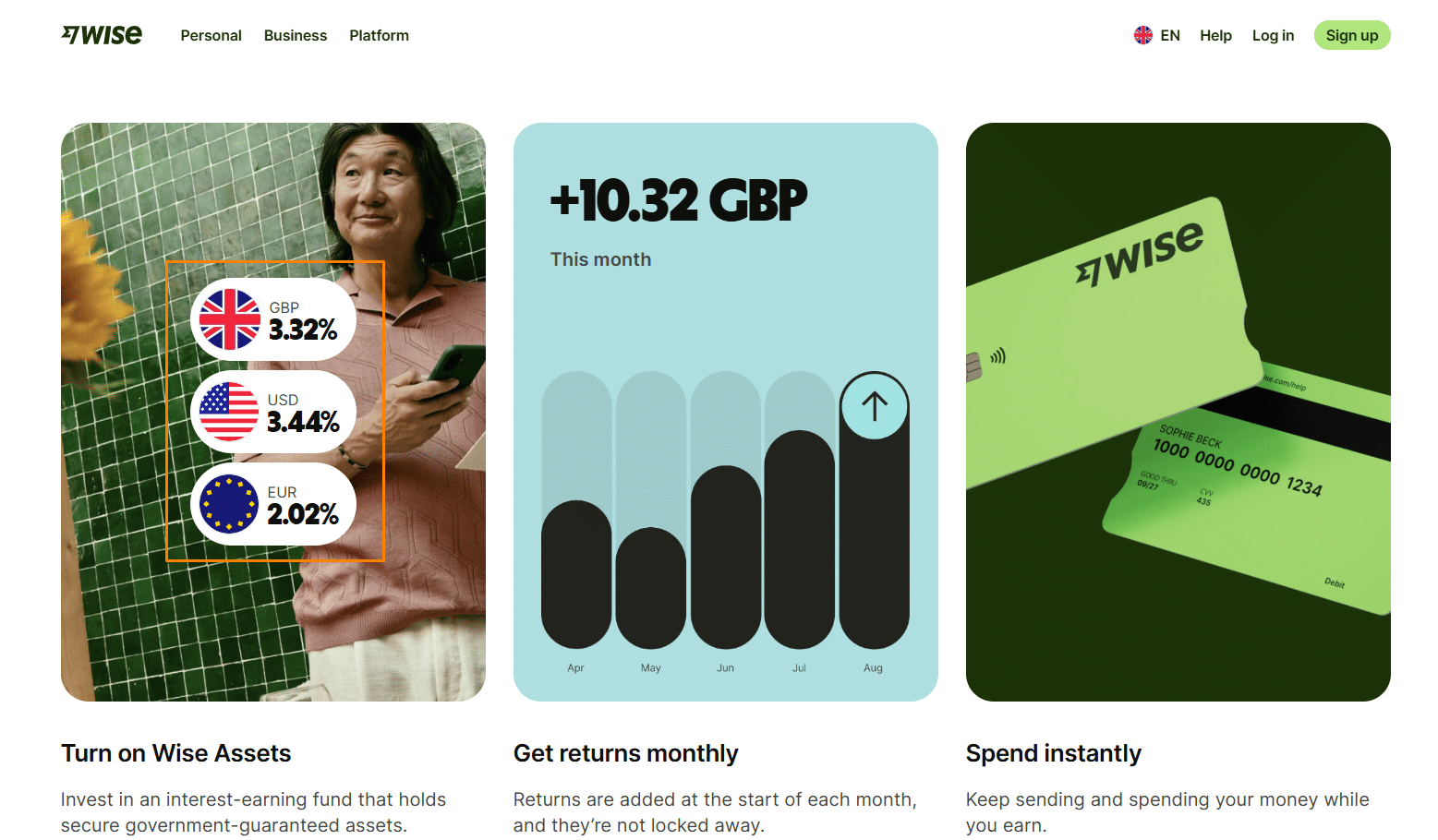
Wise is not a bank, but it does safeguard customer money. It keeps customer funds separate from its own, in a mix of cash at major commercial banks (such as JPMorgan Chase) and low-risk, highly liquid assets (money market funds from BlackRock and State Street).
Launched in 2011 as TransferWise and rebranded to Wise in 2021, Wise is listed on the London Stock Exchange (ticker: WISE) and is primarily an e-money business focused on cheap international transfers.
Within Wise Assets, you can hold your money as cash, stocks or interest. If you choose “Interest”, your money is invested in a fund holding short-term, government-backed assets, and the return is passed on to you after Wise’s fee. Because it pays a return on three currencies, it suits people who hold more than one.
BUX
- Interest rate on offer: up to 2.00% a year on euro balances, depending on your account type.
- How often interest is paid: accrued daily and paid quarterly.
- Limitations: the top rate requires a paid plan, and interest is only paid on balances up to a certain amount.
- Safety: your cash is held with ABN AMRO Clearing Bank, covered by a deposit guarantee scheme up to €100,000.
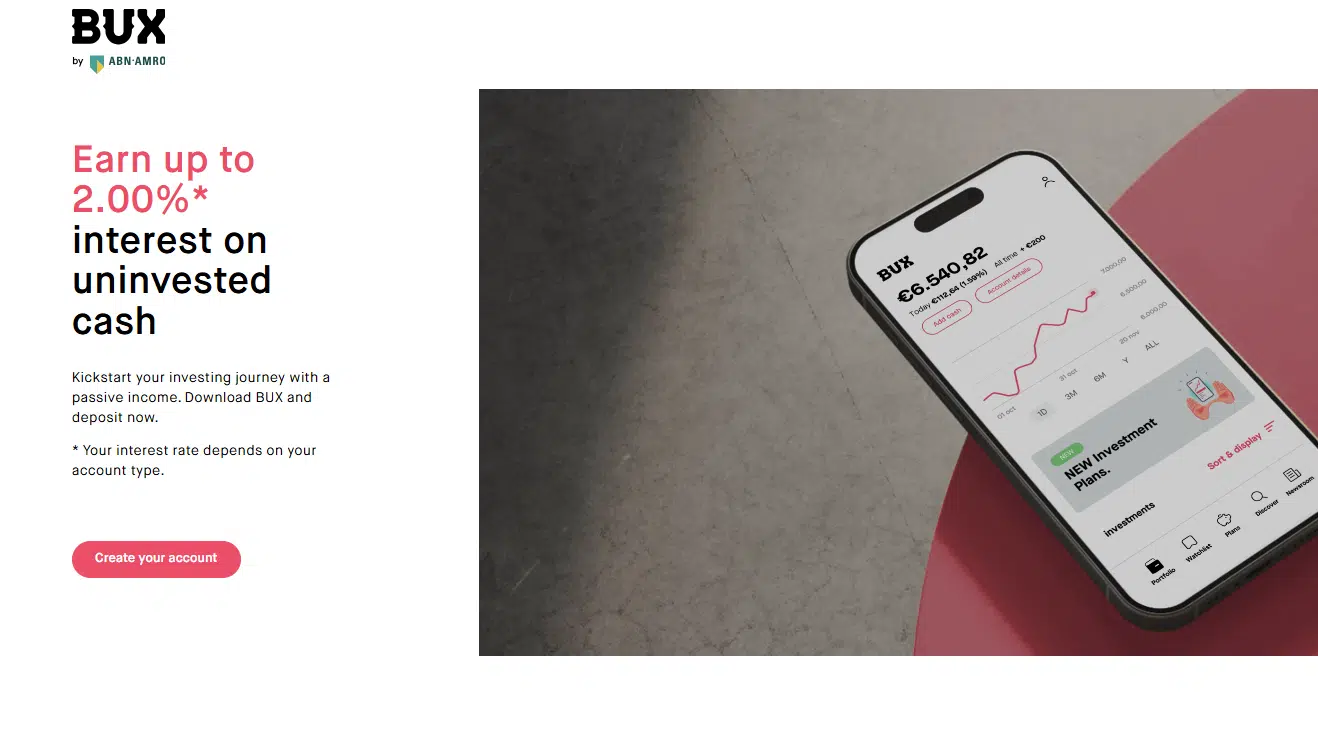
With more than 700,000 users, BUX is a popular mobile-first investing app, particularly useful if you want monthly savings plans to automate investing in stocks or ETFs. BUX was acquired by ABN AMRO in 2023, bringing it under one of the Netherlands’ largest banking groups.
The rate depends on your account type, and the top rate of 2.00% requires a paid plan. BUX’s fees have crept up recently, including a monthly service fee on some plans, which can eat into your interest if your only reason for opening an account is to earn a return on cash.
All cash held at BUX is kept at ABN AMRO Clearing Bank and protected up to €100,000 per person under the Dutch deposit guarantee scheme.
Check out our full BUX review.
Interactive Brokers
- Interest rate on offer: 1.858% on euro balances for IBKR Pro accounts, which is the IBKR benchmark rate minus 0.5%. IBKR Lite accounts get 0.858% (benchmark minus 1.5%). Rates can change without notice.
- How often interest is paid: accrued daily and paid monthly.
- Limitations: no interest on the first €10,000 of cash, and accounts below $100,000 receive a proportionally lower rate.
- Safety: the protection depends on the entity your account is with. European clients are served by Interactive Brokers Ireland, covered by the Irish investor compensation scheme.
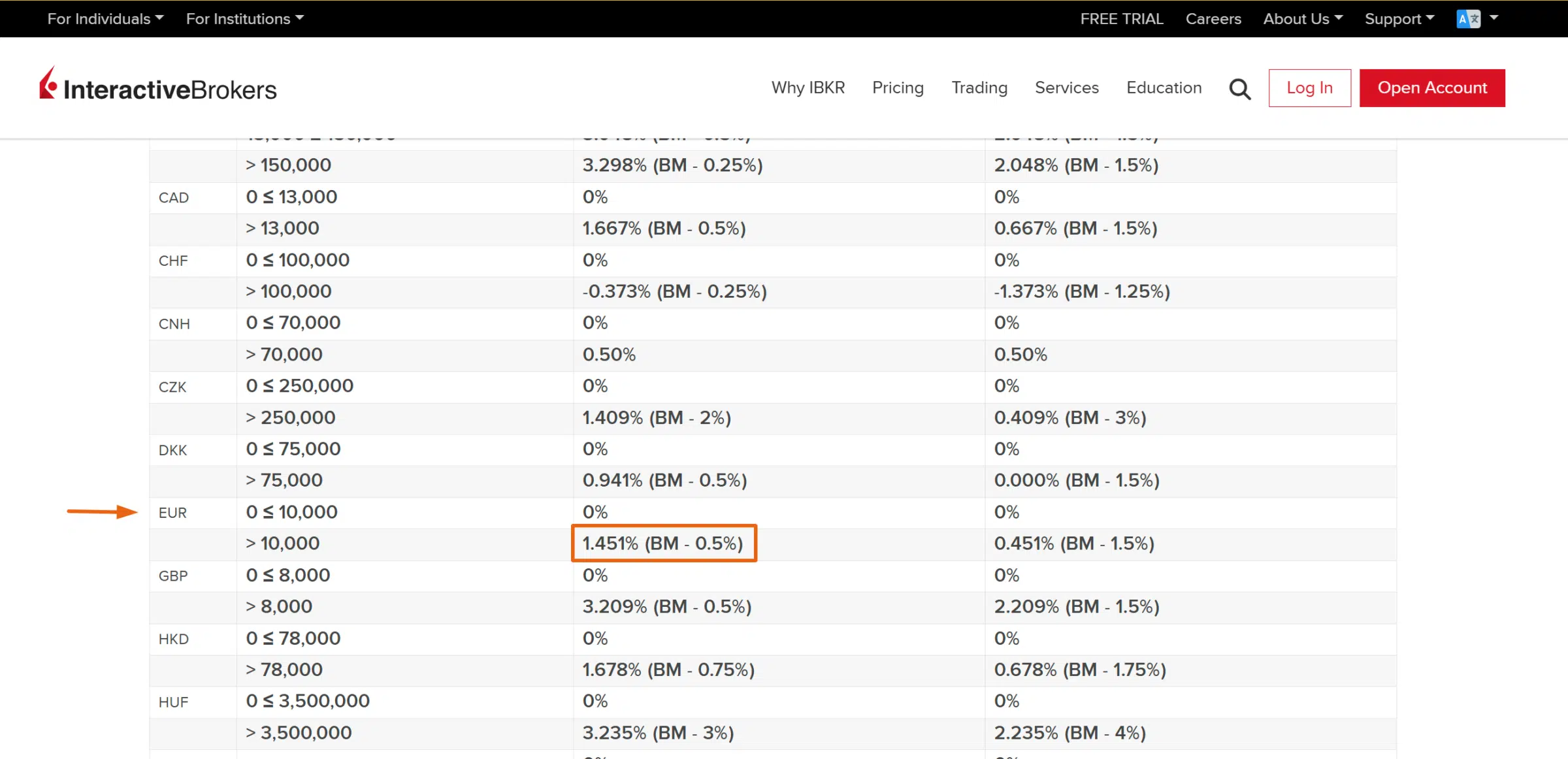
The protection on cash deposited with Interactive Brokers varies a lot between jurisdictions, which we cover in detail in a separate article. We also have a full review of IBKR’s services.
Interactive Brokers is a well-known broker offering individuals and institutions a very wide range of investment products, from stocks and ETFs to bonds, options and futures, through its Trader Workstation platform and simpler apps.
IBKR pays a different rate on each currency, from USD to ZAR. To earn the full rate on a euro balance, two conditions apply:
- Your total account value must exceed $100,000 (or the equivalent in euros).
- Interest is only paid on the cash above $10,000 (or the equivalent in euros).
The rate also depends on your plan: IBKR Pro pays the benchmark minus 0.5%, while IBKR Lite pays a full percentage point less, at benchmark minus 1.5%.
For example, if you have €120,000 in your account and €40,000 of that is cash, you only earn interest on €30,000:
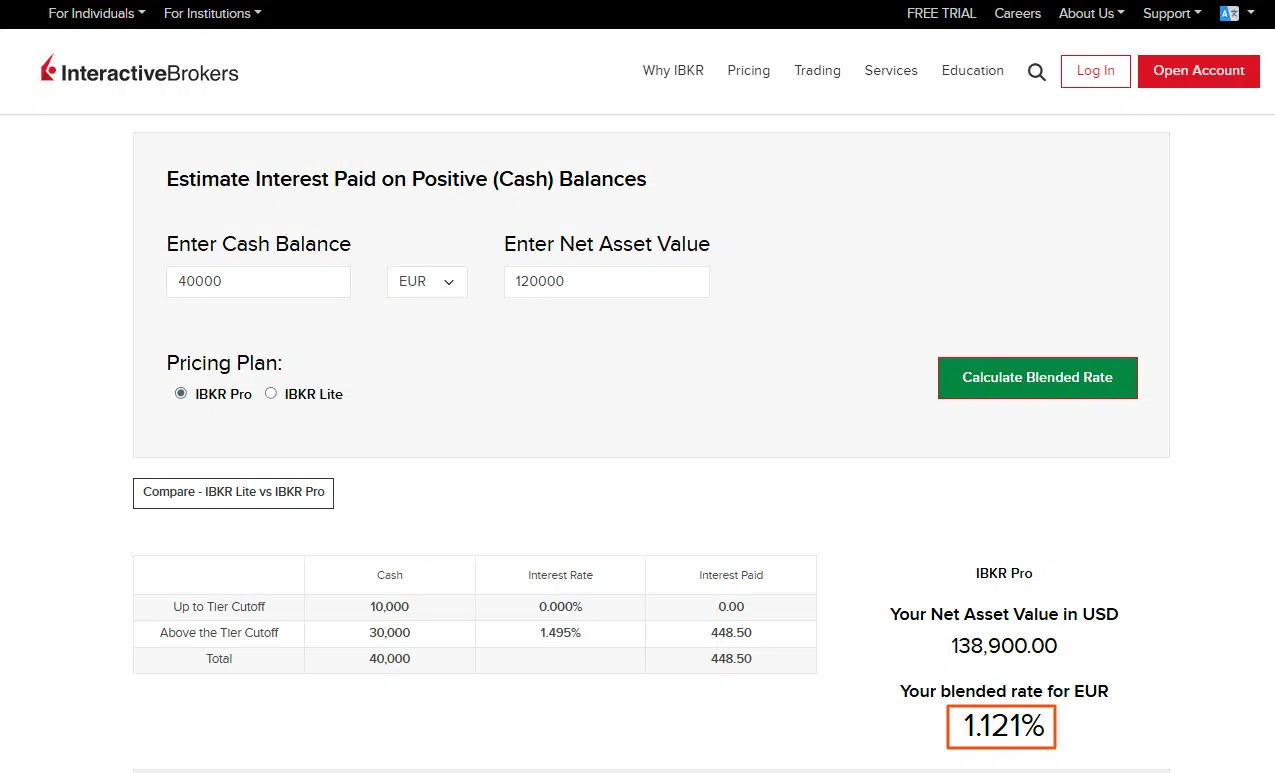
Accounts with a net asset value above USD 100,000 (or the equivalent in euros) earn the full rate they’re eligible for. Accounts below USD 100,000 earn a rate proportional to the size of the account.
This makes it harder to work out exactly what you’ll earn, but Interactive Brokers has a calculator you can use to estimate it.
Fixed-term deposits (through Raisin)
So far, all the offers we’ve covered let you withdraw your money at any time, except Scalable’s fixed-term account. Generally, you can earn higher rates on fixed-term deposits, which banks offer in exchange for committing your cash for a set period.
The problem is that rates vary a lot between European countries, and you may live in a country with fewer options than its neighbours.
Raisin helps solve this. Raisin is a savings marketplace that partners with banks across Europe to offer savings and fixed-term deposit products, covered by their respective national deposit guarantee schemes. Many of these products are only available through Raisin.
Raisin acts as an intermediary: you open a Raisin account once, choose the product you want (rate and term), transfer your money, and Raisin routes your deposit to the partner bank.
While Raisin operates across most of Europe, the strongest fixed-term options are currently available to residents of Germany, the Netherlands, Spain, Ireland, Austria, France and the UK.
Discover the best savings rates in each European country
Check our Cash Interest Tool, where we filter the banks and brokers offering the highest rates available in each country. The tool is updated monthly.
Can you open a savings account in another EU member state as a non-resident?
If you live in an EU country, you’re entitled to open a basic payment account in any other member state, which lets you deposit, withdraw and make payments, even at a bank in a different country. The bank may ask why you want the account, but EU rules under the Payment Accounts Directive generally require it to accept your application.
This right does not extend to other account types: savings accounts, fixed-term deposits, investment accounts and loans aren’t covered by the same cross-border rules.
That makes it harder to chase the highest rates across the EU on your own. Marketplaces such as Raisin partly solve this by aggregating partner banks from several countries under a single account, so you can access higher-yielding products without opening an account at each bank yourself.
Are there any alternatives to savings accounts?
Rates on cash have improved across Europe, but if the returns still don’t meet your needs, here are some alternatives worth researching:
- Fixed-term deposits: bank deposits with a fixed rate and term.
- Money market funds: low-risk funds investing in short-term debt instruments (not deposits, so capital is at risk).
- Government bonds and Treasury bills: sovereign debt, generally the lowest-risk option with a yield.
- Corporate bonds: debt issued by companies, with yields that reflect the issuer’s credit risk.
- Peer-to-peer lending: lending to borrowers through platforms such as Mintos, with a significantly higher risk of loss.
- REITs: listed real estate with regular distributions.
- Dividend-paying ETFs and stocks: higher long-term return potential, with much higher volatility.
All of these carry different degrees of risk. Weigh your risk tolerance, time horizon and liquidity needs, and diversify rather than relying on a single product. None of them replaces an emergency fund, which should stay in an instant-access account.
Conclusion
The interest rate environment in Europe has shifted again in 2026: after two years of cuts, the ECB has started raising rates, and competition between banks, neobrokers, e-money institutions and savings marketplaces has intensified.
Everyone has different goals and time horizons, so choosing where to keep your cash is a personal decision. Some key points to weigh before deciding:
- Liquidity: do you need instant access, or can you lock your money away for a set period in exchange for a higher rate?
- Fees: are there monthly account fees, withdrawal fees or other charges that eat into your return?
- Protection: is a higher rate worth it if your money isn’t covered by a deposit guarantee scheme, or is only partly covered because it sits in money market funds rather than bank deposits?
- Tax: calculate the tax on interest in your country of residence to see the net return you actually keep (for example, 19% in Poland, 28% in Portugal and around 26% in Germany).
- Inflation: even good nominal rates can be eroded by inflation, so look at your real return after inflation and tax.
Once you’ve weighed these factors, the right setup is often a combination rather than a single account: instant-access cash for emergencies, fixed-term deposits for medium-term goals and higher-yielding investments for money you genuinely won’t need for years.
FAQs
How is interest on savings taxed in Europe?
Interest earned on savings is taxable in most European countries, and the rules vary widely:
- Local rules: each country taxes interest differently, from a flat withholding rate to your marginal income tax rate.
- Foreign accounts: if you earn interest abroad, you normally still have to declare it in your country of residence. Double taxation treaties usually prevent you from paying twice.
- Tax-advantaged accounts: some countries offer accounts where interest is exempt up to a limit, such as ISAs in the UK or the Freistellungsauftrag allowance in Germany.
- Investment products: money market funds and similar products may be taxed differently from bank interest.
Check the rules that apply to you, or speak to a tax adviser, before comparing net returns.
Is a money market fund as safe as a savings account?
No. A bank deposit is covered by a deposit guarantee scheme up to €100,000 per person and per bank, while a money market fund is an investment: your capital is at risk and no guarantee applies. In practice, these funds hold short-term, high-quality debt and aim to keep a stable value, but the return is variable and losses, though rare, are possible. Lightyear, Wise and Mintos pay their returns through money market funds, while Trade Republic and BUX hold your cash as deposits.
What terms should I know about savings accounts?
Here are some useful definitions:
- Compound interest: interest calculated on your initial capital and on the interest already earned.
- Fixed-term deposit: an account where your money stays locked for a set period, usually in exchange for a higher rate.
- Instant-access account: an account where you can deposit and withdraw at any time, usually at a lower rate.
- Money market fund: a fund investing in short-term debt. It pays a variable return and is not a deposit, so it isn’t covered by a deposit guarantee scheme.
- Deposit guarantee scheme: the national scheme that protects bank deposits up to €100,000 per person and per institution in the EU.
- Real return: your return after inflation and tax, which is what actually matters.