For active traders in the UK, the spread is often the single largest trading cost. A difference of a fraction of a pip on EUR/USD or GBP/USD may look trivial on one trade, but multiplied across hundreds of trades a month, it directly determines whether a strategy is profitable or not.
In this article, we compare the best lowest spread forex brokers available to UK residents, all of them authorised and regulated by the Financial Conduct Authority (FCA), and we look beyond the headline spread to the all-in cost per trade, including commissions.
If you are looking for a broader comparison, see our guides to the best trading platforms in the UK and the best forex brokers in the UK.
Best lowest spread forex brokers in the UK
- Interactive Brokers: Best overall, interbank spreads from 0.1 pips plus low commissions
- Pepperstone: Best raw spread account, from 0.0 pips on the Razor account
- Capital.com: Best commission-free option with competitive all-in spreads
- XTB: Low forex spreads with a strong proprietary platform
- Plus500: Simple, spread-only pricing on a beginner-friendly platform
Disclaimer: Investing involves risk of loss.


72-95% of retail CFD accounts lose money.

Spread bets and CFDs are complex instruments and come with a high risk of losing money rapidly due to leverage. 65% of UK retail investor accounts lose money when trading spread bets and CFDs with this provider.

69-80% of retail CFD accounts lose money.

81% of retail CFD accounts lose money.
Comparison of the best lowest spread forex brokers in the UK


For a list of brokers we do not recommend, you can visit our full list of broker reviews, and filter by “Not recommended”.
Other resources
- Check our Youtube channel! You will find step-by-step guides of how to invest in the S&P 500 on different apps, as well as other educational videos about investing and investment platforms.
- Explore our tools: Check our comparison tool, reviews, broker bonuses, broker interest rates, BrokerMatch, and others.
Broker reviews
Interactive Brokers at a glance
Founded in 1978 and listed on Nasdaq, Interactive Brokers is one of the largest brokers in the world. UK clients are served by Interactive Brokers (U.K.) Limited, authorised and regulated by the FCA (reference number 208159), with FSCS protection of up to £85,000.
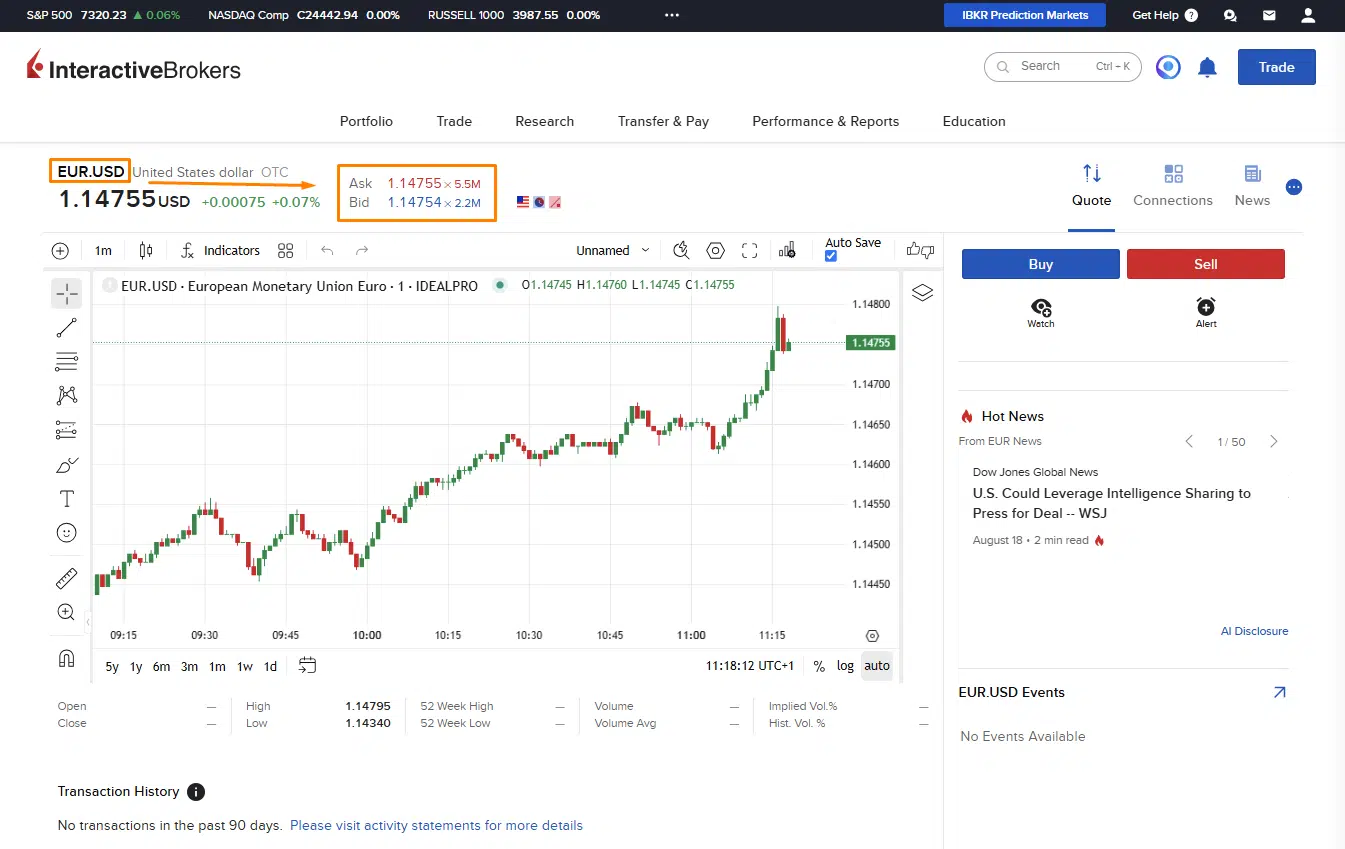
On forex, IBKR aggregates quotes from many of the world’s largest interbank dealers, which together account for the majority of global interbank market share. The result is spreads as low as 0.1 pips on major pairs. Instead of marking up the spread, IBKR passes through the raw price and charges a transparent, volume-tiered commission starting at 0.08 basis points of trade value (minimum $2 per order). For most trade sizes, the all-in cost is among the lowest available to retail traders in the UK.
The low-cost philosophy extends across the whole account. Share CFD commissions start at 0.05% (0.5 cents per US share), overnight financing on CFDs starts at benchmark plus or minus 1.5%, and margin rates are consistently the lowest in the industry. IBKR also pays competitive interest on idle cash, which matters if you keep a trading float in the account between positions.
Beyond costs, there is no minimum deposit and access to over 150 markets across stocks, ETFs, options, futures, bonds, and CFDs, so a spread-sensitive forex trader can run everything from one account. The main trade-off is complexity: Trader Workstation is a professional-grade platform with a learning curve, although the newer IBKR Desktop and mobile apps are considerably friendlier.
Pros
- Acessible and responsive platform
- Low spreads
- No dealing commissions
- Demo Account
- Top-tier regulators
Cons
- No ETF offering
- Inactivity fee ($10 per month after no login activity in 3 months)
- High overnight funding fees
- Very little research and education provided
Want to know more? Check our Interactive Brokers review and visit Interactive Brokers’ website.
CFDs are complex instruments and come with a high risk of losing money rapidly due to leverage. 59.7% of retail investor accounts lose money when trading CFDs with IBKR. You should consider whether you understand how CFDs work and whether you can afford to take the high risk of losing your money.
Pepperstone at a glance
72-95% of retail CFD accounts lose money.
Founded in 2010, Pepperstone has built its reputation precisely on tight spreads and fast execution. UK clients trade with Pepperstone Limited, authorised and regulated by the FCA (reference number 684312), with FSCS protection of up to £85,000 and client funds held in segregated accounts.
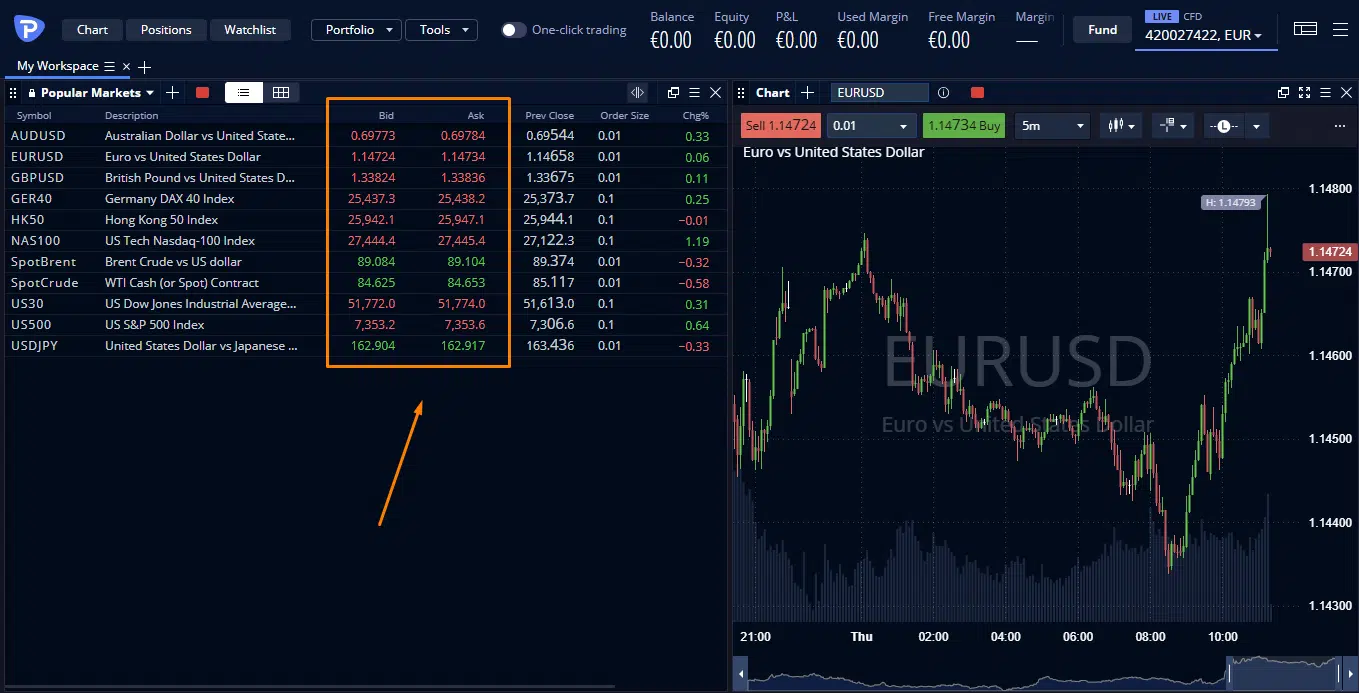
The Razor account is the standout product for cost-sensitive traders: raw spreads from 0.0 pips on majors such as EUR/USD, plus a commission of £2.25 per side, per standard lot. For traders who prefer all-in pricing, the Standard account has no commission and spreads from around 1.0 pip. There is no minimum deposit on either account, and deposits and withdrawals are free.
Execution quality is the other half of the low-cost equation, since slippage can silently undo the benefit of a tight spread. Pepperstone routes orders through low-latency infrastructure with average execution measured in milliseconds, and the group reports a 99.32% order fill rate (Pepperstone Group data, as at 31 March 2026).
Platform choice is another strength: MetaTrader 4, MetaTrader 5, cTrader, TradingView integration, and Pepperstone’s own platform, so scalpers and algorithmic traders can pick the environment that suits their strategy. UK residents can also trade via spread betting, which may be free of capital gains tax depending on individual circumstances.
Pros
- Acessible and responsive platform
- Low spreads
- No dealing commissions
- Demo Account
- Top-tier regulators
Cons
- No ETF offering
- Inactivity fee ($10 per month after no login activity in 3 months)
- High overnight funding fees
- Very little research and education provided
Want to know more? Check our Pepperstone review and visit Pepperstone’s website.
Spread bets and CFDs are complex instruments and come with a high risk of losing money rapidly due to leverage. 75.3% of retail investor accounts lose money when trading spread bets and CFDs with this provider. You should consider whether you understand how spread bets and CFDs work, and whether you can afford to take the high risk of losing your money.
Capital.com at a glance
Spread bets and CFDs are complex instruments and come with a high risk of losing money rapidly due to leverage. 65% of UK retail investor accounts lose money when trading spread bets and CFDs with this provider.
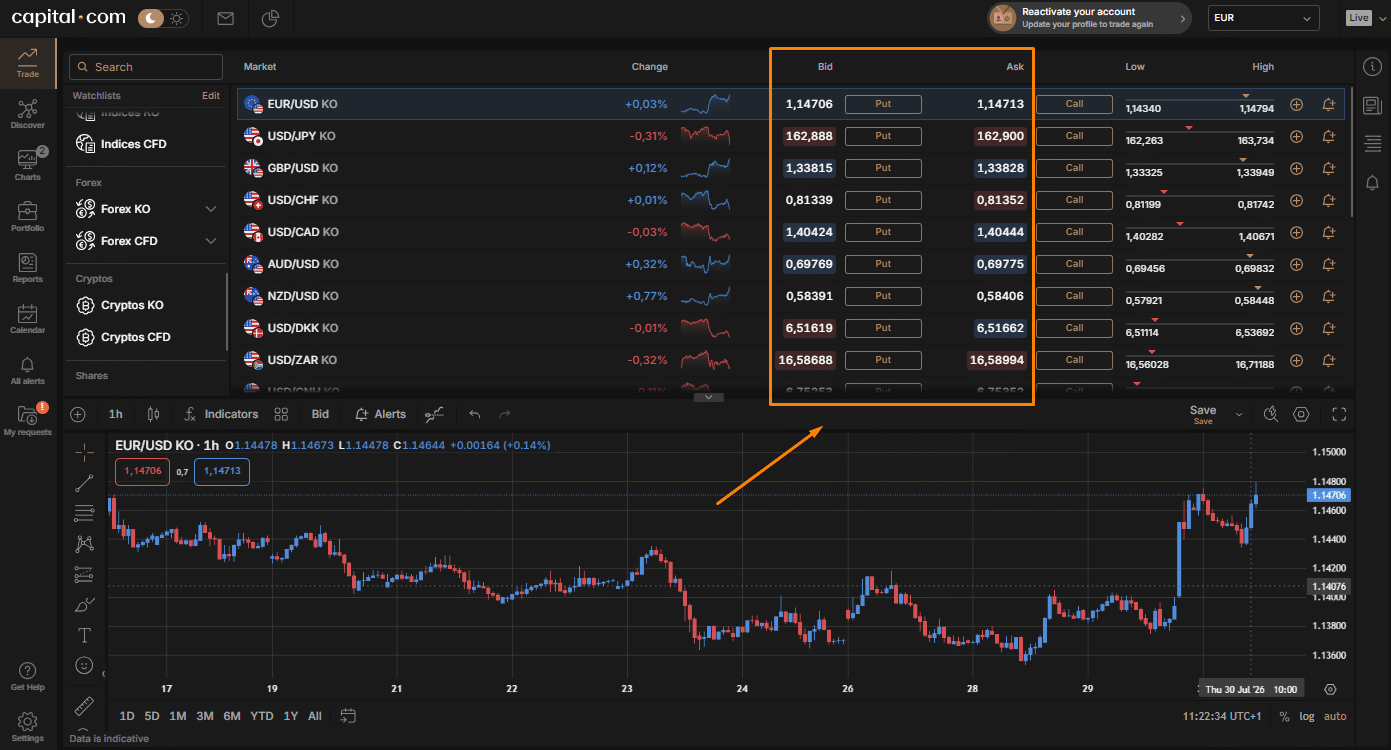
Capital.com serves UK clients through Capital Com (UK) Limited, authorised and regulated by the FCA (reference number 793714). It is a commission-free broker: the cost of trading is built entirely into the spread, which keeps pricing simple and predictable, with no separate commission line to calculate.
Spreads on major forex pairs start at around 0.6 pips, competitive for a commission-free model, and the minimum deposit is just £20, the lowest barrier to entry on this list. UK clients can trade CFDs or spread bets on over 3,000 markets, on Capital.com’s own web and mobile platforms, TradingView, or MetaTrader 4. There are no deposit or withdrawal fees, and no inactivity fee.
Capital.com also stands out for education and trader development, with the Investmate learning app, extensive in-platform guides, and AI-powered insights that analyse your own trading history and flag behavioural patterns, such as overtrading after losses, that quietly increase your costs.
The main limitation for very active traders is the absence of a raw spread account: at high volumes, a spread of 0.6 pips will cost more than a raw spread plus commission structure. For everyone else, the simplicity is a genuine advantage.
Pros
- Acessible and responsive platform
- Low spreads
- No dealing commissions
- Demo Account
- Top-tier regulators
Cons
- No ETF offering
- Inactivity fee ($10 per month after no login activity in 3 months)
- High overnight funding fees
- Very little research and education provided
Want to know more? Check our Capital.com review and visit Capital.com’s website.
CFDs are complex instruments and come with a high risk of losing money rapidly due to leverage. 61% of retail investor accounts lose money when trading CFDs with this provider. You should consider whether you understand how CFDs work and whether you can afford to take the high risk of losing your money.
XTB at a glance
69-80% of retail CFD accounts lose money.
XTB is a Warsaw-listed broker with over two decades of history, serving UK clients through XTB Limited, authorised and regulated by the FCA (reference number 522157). Its Standard account is commission-free on forex CFDs, with spreads from around 0.5 pips on EUR/USD, among the tightest commission-free pricing available in the UK.
The proprietary xStation 5 platform is one of the best in the industry: fast, highly customisable, and with a built-in trader calculator that shows the exact cost of each position before you open it, which is genuinely useful when spreads are your main cost. Execution statistics, sentiment data, and a heatmap of market movers are built in rather than bolted on.
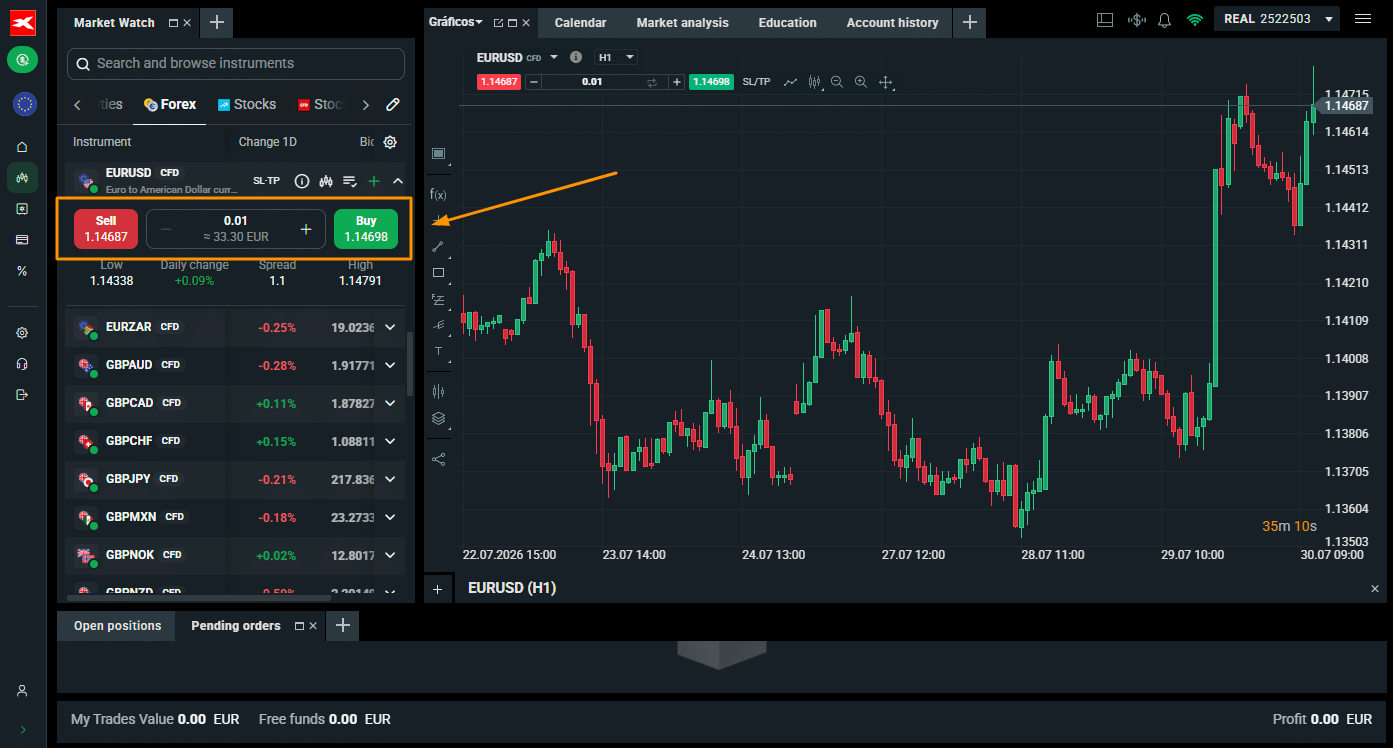
Unlike the pure CFD brokers on this list, XTB also offers commission-free real stocks and ETFs in the UK, plus interest on uninvested cash, so the same account can serve trading and long-term investing. There is no minimum deposit, and standard withdrawals above a small threshold are free.
The gap in the line-up is the absence of a raw spread plus commission account, which keeps XTB a step behind IBKR and Pepperstone for the highest-volume traders, but for most retail traders the all-in cost is very competitive.
Pros
- Acessible and responsive platform
- Low spreads
- No dealing commissions
- Demo Account
- Top-tier regulators
Cons
- No ETF offering
- Inactivity fee ($10 per month after no login activity in 3 months)
- High overnight funding fees
- Very little research and education provided
Want to know more? Check our XTB review and visit XTB’s website.
CFDs are complex instruments and come with a high risk of losing money rapidly due to leverage. 72% of retail investor accounts lose money when trading CFDs with this provider. You should consider whether you understand how CFDs work and whether you can afford to take the high risk of losing your money.
Plus500 at a glance
81% of retail CFD accounts lose money.
Plus500 serves UK clients through Plus500UK Ltd, authorised and regulated by the FCA (reference number 509909), and its parent company is listed on the London Stock Exchange, which adds a level of financial transparency, published accounts, capital position, and market scrutiny, uncommon among CFD brokers.
Pricing is spread-only, with EUR/USD from around 0.8 pips and no commissions on any of the 2,800+ CFD instruments. While the headline spreads are wider than the raw spread accounts above, there are no hidden per-trade charges, and the simplicity of the model appeals to traders who want a single, predictable cost per trade.
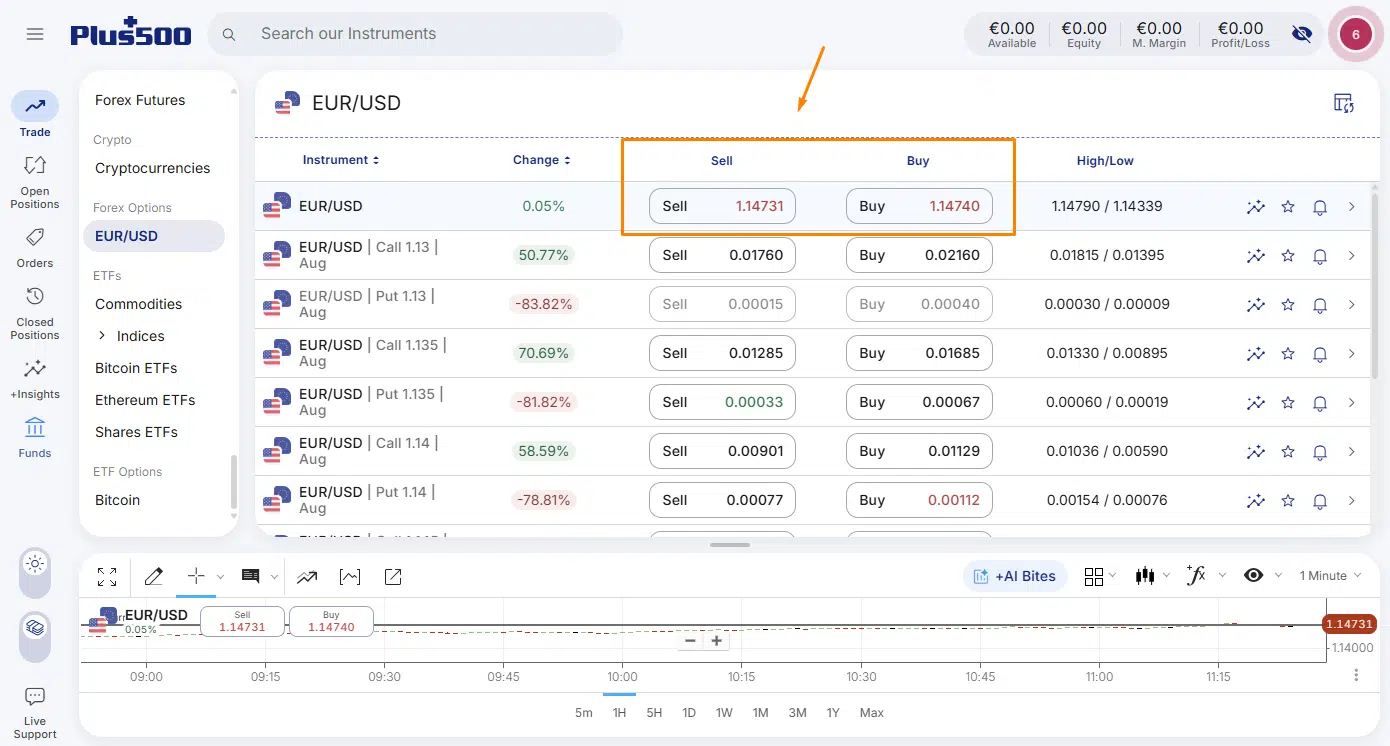
The proprietary platform is deliberately simple, with useful risk tools including guaranteed stop orders (for a fee), price alerts, and negative balance protection. The minimum deposit is £100, and the demo account is unlimited in time, which makes it easy to compare Plus500’s live spreads against competitors before committing.
Pros
- Acessible and responsive platform
- Low spreads
- No dealing commissions
- Demo Account
- Top-tier regulators
Cons
- No ETF offering
- Inactivity fee ($10 per month after no login activity in 3 months)
- High overnight funding fees
- Very little research and education provided
Want to know more? Check our Plus500 review and visit Plus500’s website.
CFDs are complex instruments and come with a high risk of losing money rapidly due to leverage. 76% of retail investor accounts lose money when trading CFDs with this provider. You should consider whether you understand how CFDs work and whether you can afford to take the high risk of losing your money.
How we chose the best lowest spread forex brokers
Our team has professional experience in finance and portfolio analysis, and we have reviewed well over 100 brokers and trading platforms since we started publishing comparisons. This ranking follows the same methodology we apply across the site.
First, we only considered brokers authorised and regulated by the FCA for their UK entity, verified directly on the Financial Conduct Authority register, and we checked FSCS eligibility where applicable. Offshore entities accepting UK clients were excluded.
Second, we measured the all-in cost of trading rather than headline spreads alone. A “0.0 pip” spread means little without the commission on top, so we compared the total cost of a standard one-lot EUR/USD round trip across account types, using each broker’s published pricing and our own account testing. We also factored in overnight financing rates, which matter for positions held beyond a day, and non-trading costs such as deposit, withdrawal, inactivity, and currency conversion fees.
Third, we assessed execution quality, because slippage can quietly cost more than the spread itself. Where brokers publish execution statistics, such as fill rates and average execution speed, we took them into account, alongside platform stability and order type availability.
Final thoughts
Interactive Brokers takes the top spot for the lowest all-in trading costs and unmatched market access, while Pepperstone’s Razor account is the benchmark for raw spreads among dedicated CFD brokers. Capital.com and XTB are strong commission-free alternatives, and Plus500 suits traders who prioritise simplicity over the last fraction of a pip.
Whichever broker you choose, always check that it is authorised by the FCA, and consider starting with a demo account before committing real money. For related comparisons, see our guides to the best trading platforms in the UK and the best forex brokers in the UK.
This article is for information purposes only and does not constitute investment advice or a recommendation. Trading leveraged products carries a high level of risk and may not be suitable for all investors. Between 51% and 76% of retail investor accounts lose money when trading CFDs with the providers listed in this article.