The forex market is the most active in the world, and accessing it starts with choosing the right broker.
At Investing in the Web, we help users find the platform that best suits their needs.
If you’re looking for the best UK (FCA-regulated) forex brokers, this guide is for you. Fees, entities and features were checked in September 2026.
Best forex brokers in the UK
Here’s the list of our top picks for the best forex brokers in the UK:
- Interactive Brokers: best overall
- Pepperstone: best for MT4 and MT5 trading
Disclaimer: 74-89% of retail CFD accounts lose money. - Capital.com: most user-friendly UK forex broker
Disclaimer: CFDs are complex instruments and come with a high risk of losing money rapidly due to leverage. 65% of retail investor accounts lose money when trading spread bets and CFDs with this provider. - XTB: best for customer service
Disclaimer: 69-80% of retail CFD accounts lose money. - Plus500: best for demo account
Disclaimer: 81% of retail CFD accounts lose money. - CMC Markets: best for CFD trading
- Forex.com: best for professional traders
Disclaimer: 74% of retail investor accounts lose money when trading CFDs with this provider. - IG: best for a wide range of markets
- eToro: best for social trading
Disclaimer: your capital is at risk. Other fees apply. For more information, visit etoro.com/trading/fees.
For a list of brokers we do not recommend, you can visit our full list of broker reviews and filter by “Not recommended”.
Video summary
Comparison table


Spreads are not fixed: they vary depending on the currency pair, liquidity and market events. The above spreads are mentioned as presented on each broker’s website in September 2026.
Safety and regulation
Before diving into a deeper analysis of each broker, it is important to know your safeguards.
When choosing a forex broker in the UK, regulation and client protection should always come first. The UK remains one of the most strictly regulated financial markets in the world, with brokers supervised by the Financial Conduct Authority (FCA), a top-tier regulator known for its transparency, enforcement and investor safeguards.
- FCA regulation: all legitimate forex brokers operating in the UK must be authorised and regulated by the FCA. This ensures they meet strict requirements on capital adequacy, client fund segregation, transparent pricing and fair dealing. You can check any firm’s status in the Financial Services Register.
- Financial Services Compensation Scheme (FSCS): if a regulated broker becomes insolvent, UK clients are protected under the Financial Services Compensation Scheme (FSCS). This scheme compensates eligible clients up to £85,000 per person, per firm for investment business, offering peace of mind that your money is safeguarded even in extreme scenarios.
- Negative balance protection: another crucial safeguard under FCA rules is negative balance protection. This means that retail traders can never lose more money than they deposit, even during periods of high market volatility or sudden price movements. Your account balance will not fall below zero, which is essential for retail traders using leverage.
- Leverage limits: since 2019, FCA rules cap retail leverage at 30:1 on major currency pairs and 20:1 on minors, and ban bonuses and other incentives to trade CFDs. Any broker offering UK retail clients 500:1 leverage or a deposit bonus is not operating under the FCA.
Additional security measures: UK brokers also use encryption protocols, two-factor authentication (2FA) and secure account verification processes to protect your data and prevent unauthorised access.
Detailed broker analysis
#1 Interactive Brokers at a glance

Founded in 1978 and listed on Nasdaq (ticker: IBKR), Interactive Brokers is regulated by several top-tier authorities worldwide, including the UK’s Financial Conduct Authority (FCA) through its subsidiary Interactive Brokers (U.K.) Limited (FRN 208159).
It gives UK investors access to more than 160 markets in 36 countries. The broker supports virtually every type of financial instrument, including shares, bonds, ETFs, forex, funds, commodities, options, futures, CFDs and crypto.
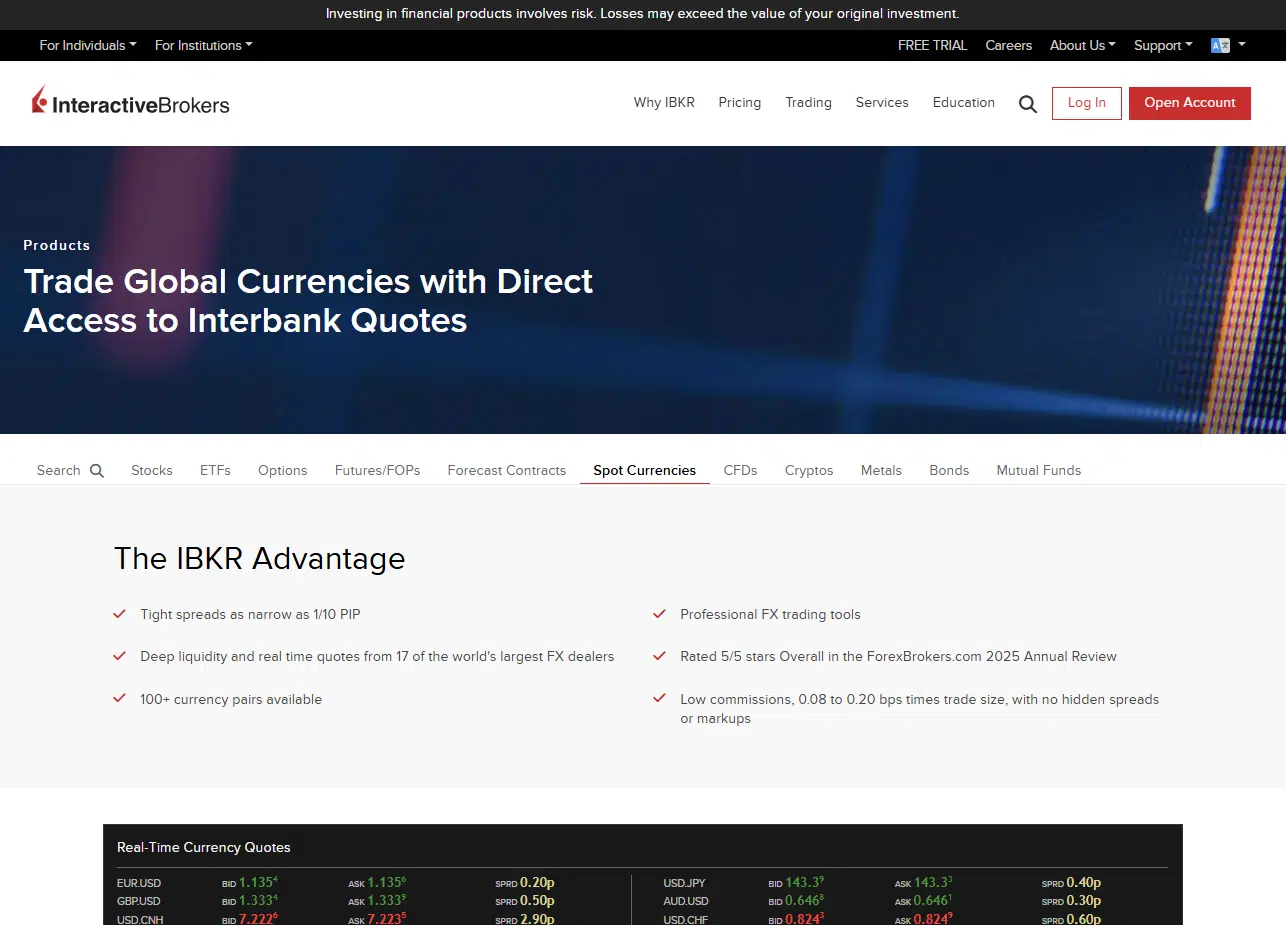
Interactive Brokers offers a robust and professional-grade environment for forex trading, providing access to over 100 currency pairs across major and emerging markets. Unlike the CFD brokers on this list, IBKR lets you trade spot forex directly in the interbank market, with deep liquidity, institutional-grade execution and low trading costs, which makes it a top choice for advanced traders seeking efficiency and scale.
Key forex highlights:
- Trade 100+ currency pairs with interbank spreads from 0.1 pip
- Direct market access and smart order routing for optimal pricing
- Ultra-low commission-based pricing on a tiered structure
- Advanced risk management tools and real-time analytics
- Integrated within the Trader Workstation (TWS), a platform designed for professionals
Interactive Brokers supports more than 20 base currencies, offers leverage up to 30:1 (the maximum allowed by the FCA for retail clients) and operates under strict oversight from top-tier global authorities in addition to the FCA. While the platform is best suited to experienced users, its mobile app and web platform offer simplified access to the forex market for less advanced traders.
IBKR uses a tiered commission model. For most traders, the cost is 0.20 basis points (0.002%) of the trade value, with a minimum of $2 per order. The more you trade each month, the lower the rate: large-volume traders pay as little as 0.08 basis points.
With no minimum deposit, a transparent fee structure and reliable execution, Interactive Brokers is ideal for serious forex traders who value performance, control and global market access.
We recommend you check out our comprehensive Interactive Brokers review.
Pros
- Low commissions on US stock trading
- No monthly inactivity fee
- The broadest product and markets range in the brokerage industry
- Demo account
- Excellent reputation (founded in 1978)
- Extensive research and Education tools
- Has a modern mobile trading app to trade Stocks, Options and ETFs, ideal for novice investors, IBKR GlobalTrader.
- Offers interest on uninvested cash balances
Cons
- Complicated and lengthy account opening process (but fully online)
- Steeper learning curve for beginners
- Website is difficult to navigate
- Interactive Advisors (Robo-advisor feature) is only available for US customers
#2 Pepperstone at a glance

74-89% of retail CFD accounts lose money.
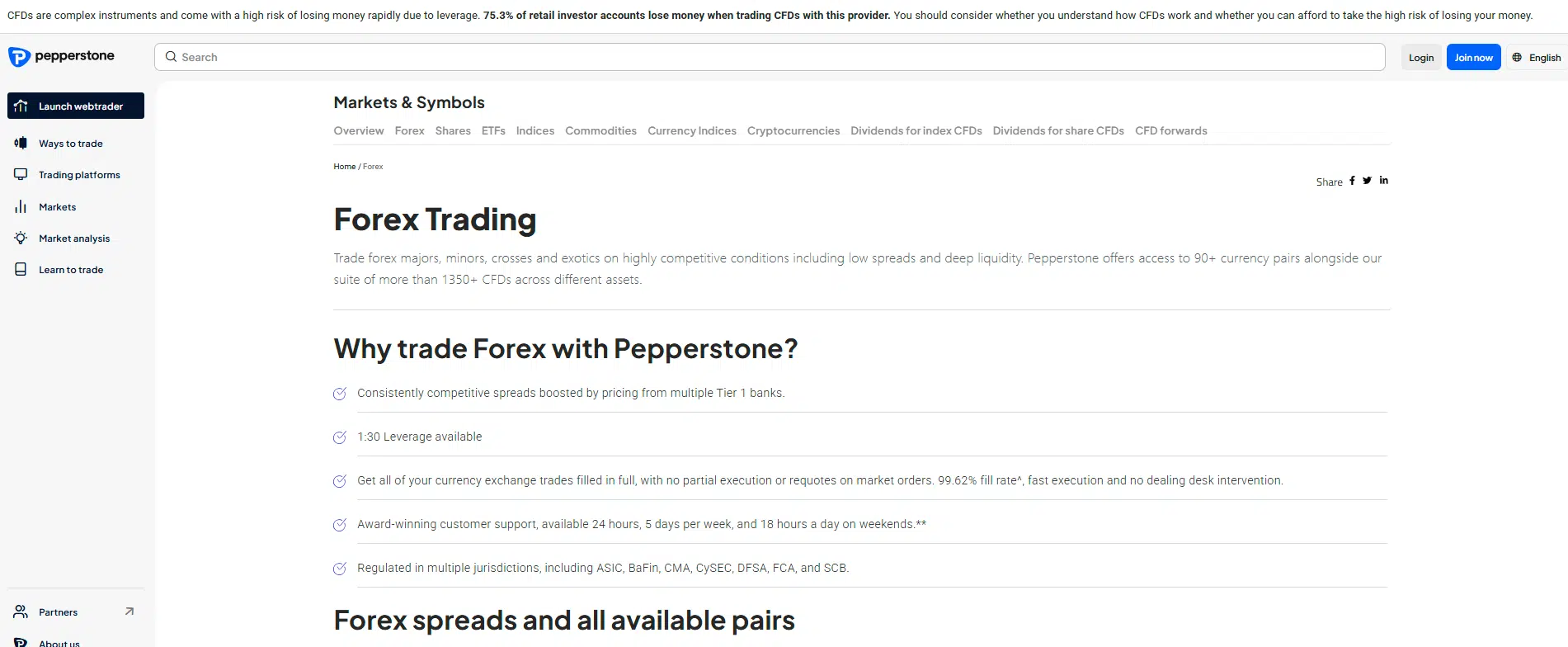
Pepperstone, founded in 2010 in Melbourne, has positioned itself as one of the largest forex and CFD brokers, serving more than 900,000 accounts across the group as of March 2026. It has earned several awards for its services, notably receiving the “Best MT4 and MT5 Broker” award for 2025 from us. With access to over 90 currency pairs and tight spreads starting from 0.0 pips, it particularly appeals to day traders, scalpers and algorithmic traders.
Pepperstone operates under strict regulation from top-tier authorities such as ASIC and the FCA (Pepperstone Limited, FRN 684312), and UK clients are covered by the FSCS. The broker offers various trading platforms, including MetaTrader 4, MetaTrader 5, cTrader and TradingView, with features such as advanced charting and automated trading. UK clients can also choose spread betting instead of CFDs.
Account types cater to various trader needs. The Razor account, favoured by scalpers and users of Expert Advisors, offers spreads starting from zero pips with a small commission (£2.25 per side per standard lot on the MetaTrader platforms), while the Standard account incorporates the cost into the spread and is suitable for those preferring a straightforward approach.
Key forex highlights:
- Trade 90+ major, minor and exotic forex pairs
- Low-latency execution and spreads from 0.0 pips on Razor accounts
- Commission-based and spread-based pricing models to suit different trading styles
- Regulated by the FCA, ASIC and other top-tier authorities, ensuring a secure trading environment
Pepperstone’s forex offering is enhanced by strong platform flexibility, fast execution speed and deep liquidity from multiple tier-1 providers.
Although the broker focuses solely on CFDs and spread bets (meaning you do not own the underlying asset), it remains one of the best choices for forex traders seeking cost-efficiency and execution quality.
Read our Pepperstone review for a deeper insight!
Pros
- Quick customer support response times
- No fees for deposits, withdrawals, or account inactivity
- Competitive spreads in the Razor account with active trader rebates
- Higher leverage options are available depending on region and client categorization
Cons
- Limited to CFD trading; no direct asset ownership
- Higher Forex spreads in the standard account
- Crypto CFDs offerings are limited compared to competitors
- Limited educational resources
#3 Capital.com at a glance

Spread bets and CFDs are complex instruments and come with a high risk of losing money rapidly due to leverage. 65% of UK retail investor accounts lose money when trading spread bets and CFDs with this provider.
Founded in 2016, Capital.com is a global CFD trading platform that has quickly grown thanks to its commission-free model and user-friendly technology. Trusted by hundreds of thousands of traders worldwide, it offers access to a wide range of markets, including CFDs on forex, stocks, indices and commodities. Plus, in the UK it provides spread betting and an “X1” account, which means CFD trading without leverage.
It offers its in-house web and mobile app (packed with innovative tools such as AI-driven insights and risk management features), and you can also trade through TradingView and MT4, where you can create automated strategies. A free demo account is available to practise before investing real money.
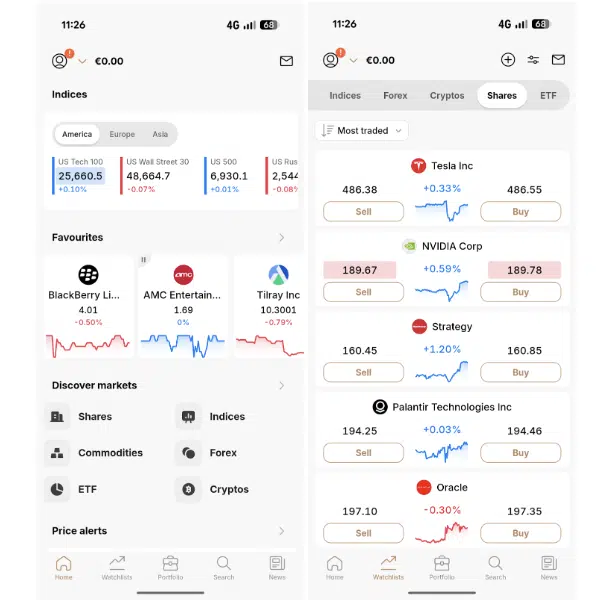
Capital.com doesn’t charge any commission on your trades. Instead, its cost is the spread (the difference between the buy and sell prices). Spreads are dynamic and change with underlying market conditions. Apart from spreads, the broker also charges a fee on guaranteed stop-loss orders and on overnight funding (only applicable when you use leverage).
On the downside, as with many CFD-only brokers, it might not be suitable for investors seeking traditional investment products like ETFs, bonds or long-term retirement accounts, or direct ownership of the underlying assets rather than derivatives.
In terms of regulation, Capital Com (UK) Limited is authorised and regulated by the Financial Conduct Authority (FCA) under registration number 793714. It holds clients’ funds in segregated bank accounts and provides negative balance protection for retail clients.
Additionally, UK clients are protected by the Financial Services Compensation Scheme (FSCS), which provides up to £85,000 in compensation if the firm fails.
Capital.com is a great solution for forex traders looking for a wide range of currency pairs, low spreads (other fees may apply) and an established UK broker.
Read our Capital.com UK review for a deeper insight!
Pros
- 0% commission trading (only spreads apply)
- Offers a 1X (non-leveraged) account with no overnight funding fees
- Spread betting is available
- User-friendly web and mobile platforms
- Integration with MT4 and TradingView
- Wide range of tradable assets (over 5,000 markets)
- Low minimum deposit of £20
- 24/7 index CFD trading (extended hours)
- 24/7 customer support
- Excellent educational resources, including guides and webinars
- Demo account
Cons
- No ownership of underlying assets (CFD/spread betting only)
- Overnight financing fees can become expensive for long-term, highly leveraged positions.
- Not suitable for passive or dividend-focused investors
- No interest on uninvested cash
#4 XTB at a glance

69-80% of retail CFD accounts lose money.
XTB is a global broker headquartered in Poland and listed on the Warsaw Stock Exchange, with more than 1.19 million active clients at the end of 2025. It offers access to 48+ currency pairs with competitive spreads, no minimum deposit and its own xStation platform. With regulation across multiple jurisdictions and over 20 years of market presence, XTB provides a secure and reliable environment for forex trading.
XTB’s forex trading fees are built into the spread, with no separate trading commission on the Standard account. Typical spreads start from around 0.9 pips on major pairs like EUR/USD, depending on market conditions. If you trade in a currency different from your account base (for example, funding in GBP but trading USD pairs), a currency conversion fee of about 0.5% applies.
Holding leveraged positions overnight incurs swap or financing charges, which vary by currency pair and direction of the trade.
XTB, through its subsidiary XTB Limited, is authorised and regulated by the Financial Conduct Authority (FCA) in the UK (FRN 522157), and UK clients are covered by the FSCS.
Key forex highlights:
- Trade 48+ forex pairs, covering major and minor currencies
- Platforms: xStation 5 (web and desktop) and xStation Mobile, both user-friendly and feature-rich (MetaTrader is no longer offered)
- No minimum deposit, making it accessible to all traders
- Funding methods include bank transfers, credit/debit cards, Skrill and Paysafe
- Regulated by the FCA, KNF, CySEC, DFSA and FSC, offering high levels of investor protection
- Competitive spreads, especially on major pairs, and a commission-free model
- UK clients can also invest in real stocks and ETFs (commission-free up to £100,000 of monthly turnover) alongside CFDs
XTB suits beginner to intermediate forex traders who value strong educational resources, responsive support and a seamless trading experience. While the number of forex pairs is more limited compared to some global brokers, its transparent pricing, regulatory framework and platform quality make it a solid choice for everyday forex trading.
On the downside, while XTB doesn’t charge withdrawal fees for amounts over £60, smaller withdrawals incur a £12 fee. After 12 months of inactivity, a monthly £10 inactivity fee applies.
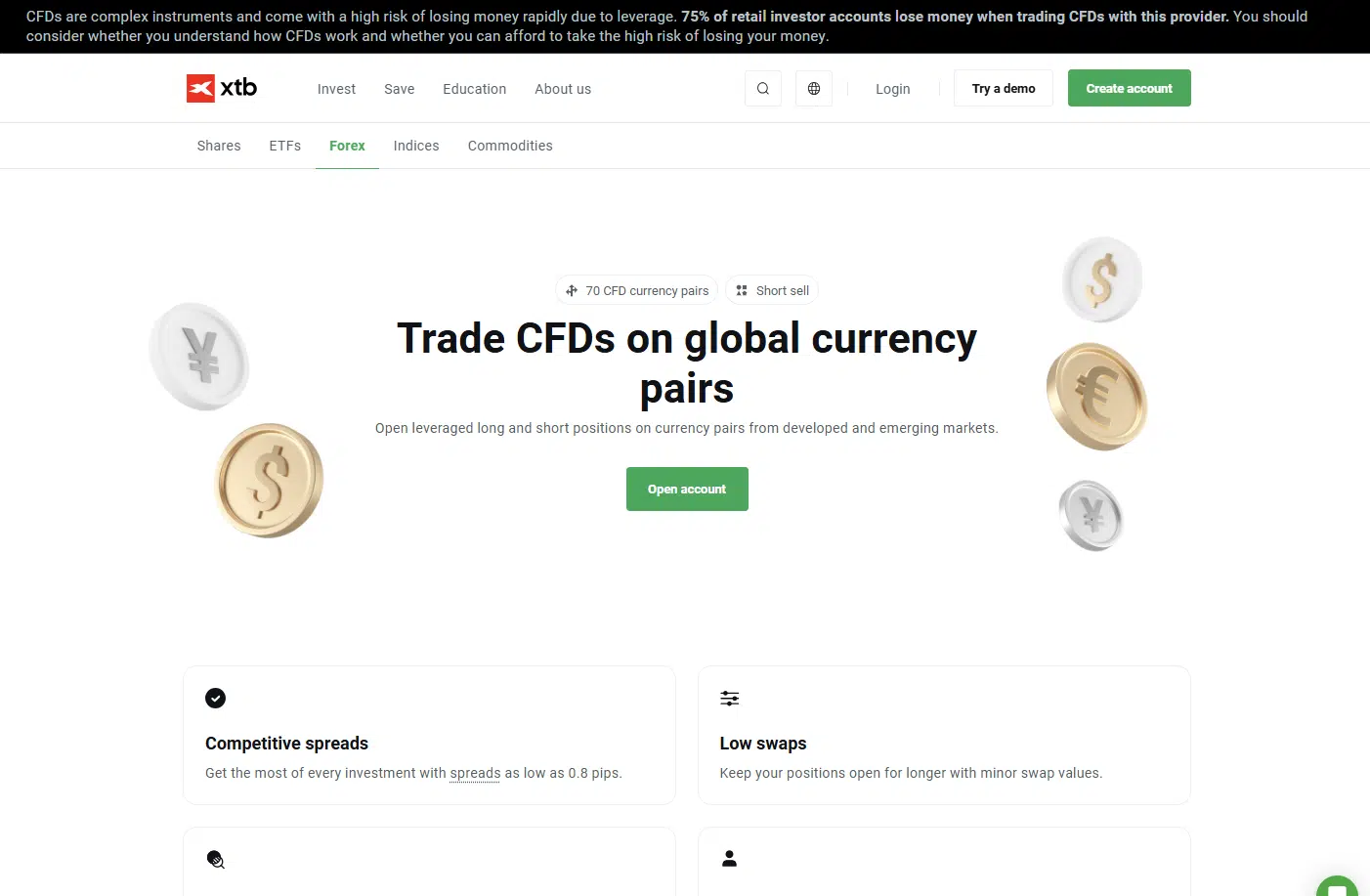
Read our XTB review for further insights.
Pros
- Free stocks trading (only applicable to some countries)
- Customizable trading platform (charts and workspace)
- Low Forex Spreads
- Demo account
- No minimum account deposit
- Valuable education materials
- Top-tier Regulators
Cons
- Complex trading platform for a beginner
- High Stock CFD spreads
- Limited product portfolio
- Withdrawal fees for transfers below $100
- Inactivity fee (€10/monthly after 1+ year with no activity plus no deposit in the last 90 days)
#5 Plus500 at a glance

81% of retail CFD accounts lose money.
Founded in 2008, Plus500 is an online broker offering CFDs on forex, indices, shares, commodities, options, ETFs and cryptocurrencies (real shares are available through Plus500 Invest in selected countries, but not in the UK). It is available in over 50 countries and is listed on the London Stock Exchange, where it is a FTSE 250 constituent.
Plus500 offers a straightforward and accessible way to trade the forex market through its proprietary WebTrader platform. While primarily known for its CFD offering, the platform provides retail traders with access to major and minor currency pairs, backed by user-friendly tools and regulatory protections across various jurisdictions. Its free, unlimited demo account is the reason it takes the “best for demo account” spot.
Key forex highlights:
- Trade major and minor forex pairs with leverage up to 30:1 (per FCA regulation)
- WebTrader platform is intuitive, stable and available across devices
- Forex orders supported: market, limit, stop loss, guaranteed stop and trailing stop
- Spreads vary by currency pair, depending on liquidity and market conditions (from about 0.6 pips on EUR/USD)
- Regulated by top-tier authorities, including the FCA (UK) and CySEC (EU)
Plus500 is well suited to beginner and intermediate traders seeking a clean interface and simplified experience. While spreads may be wider than some ECN-style brokers, there is no MetaTrader support and forex is only available via CFDs, the platform provides a reliable and regulated environment for retail forex trading. Note the £10 monthly inactivity fee after three months without logging in.
Finally, Plus500UK Ltd is authorised and regulated by the UK Financial Conduct Authority (FRN 509909), ensuring that it operates under strict standards of transparency and client protection.
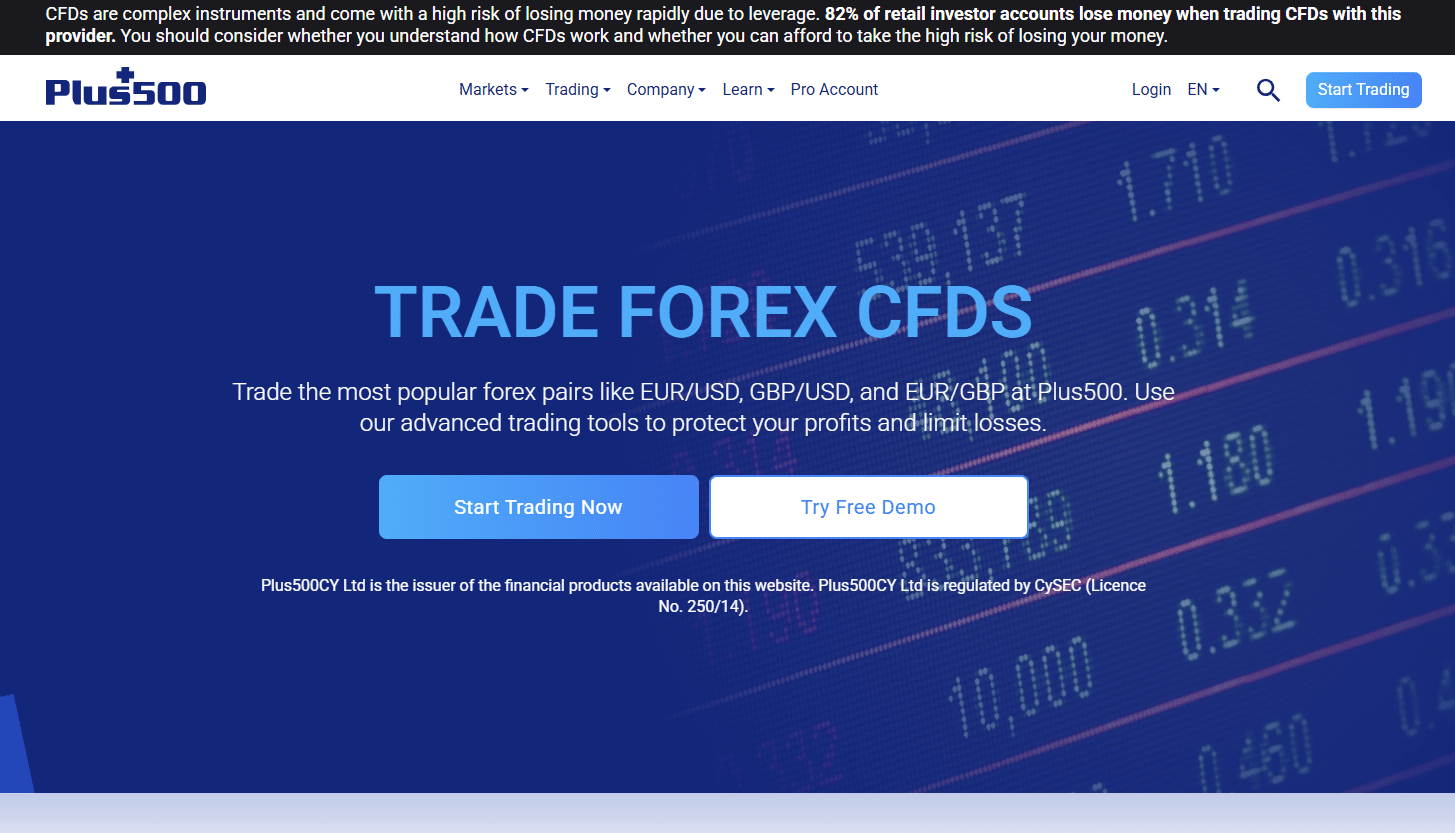
Want to know more about Plus500? Check our Plus500 review.
Pros
- Acessible and responsive platform
- Low spreads
- No dealing commissions
- Demo Account
- Top-tier regulators
Cons
- No ETF offering
- Inactivity fee ($10 per month after no login activity in 3 months)
- High overnight funding fees
- Very little research and education provided
#6 CMC Markets at a glance

69% of retail CFD accounts lose money.
CMC Markets is a global CFD and forex broker, operating since 1989 and listed on the London Stock Exchange. It is regulated by several international regulators, such as the UK’s FCA (FRN 173730).
CMC Markets is a long-established forex and CFD broker, offering over 330 currency pairs, one of the most diverse forex selections in the industry. With deep liquidity, competitive pricing and flexible platforms, it caters to both active traders and those seeking broad market access. UK clients can trade forex as CFDs or as spread bets.
Key forex highlights:
- Access to 330+ forex pairs, including majors, minors and exotics
- Tight spreads and no deposit or withdrawal fees
- Multiple platform options: CMC’s Next Generation platform, mobile app and MetaTrader 4 (MT4)
- Support for up to 10 base currencies, reducing conversion costs
- Regulated by the FCA, BaFin and other top-tier authorities
Unlike other brokers, CMC Markets supports up to 10 account currencies, and you can fund your account by credit or debit card, bank transfer or PayPal. It does not charge any fees on deposits or withdrawals. However, if your account has no trading activity for 12 months, you will be charged a monthly inactivity fee of £15.
On the downside, the CFD and spread betting platform does not give you ownership of stocks or crypto. If you also want to hold real shares and ETFs in an ISA, CMC’s separate UK investing app, CMC Invest, covers that.
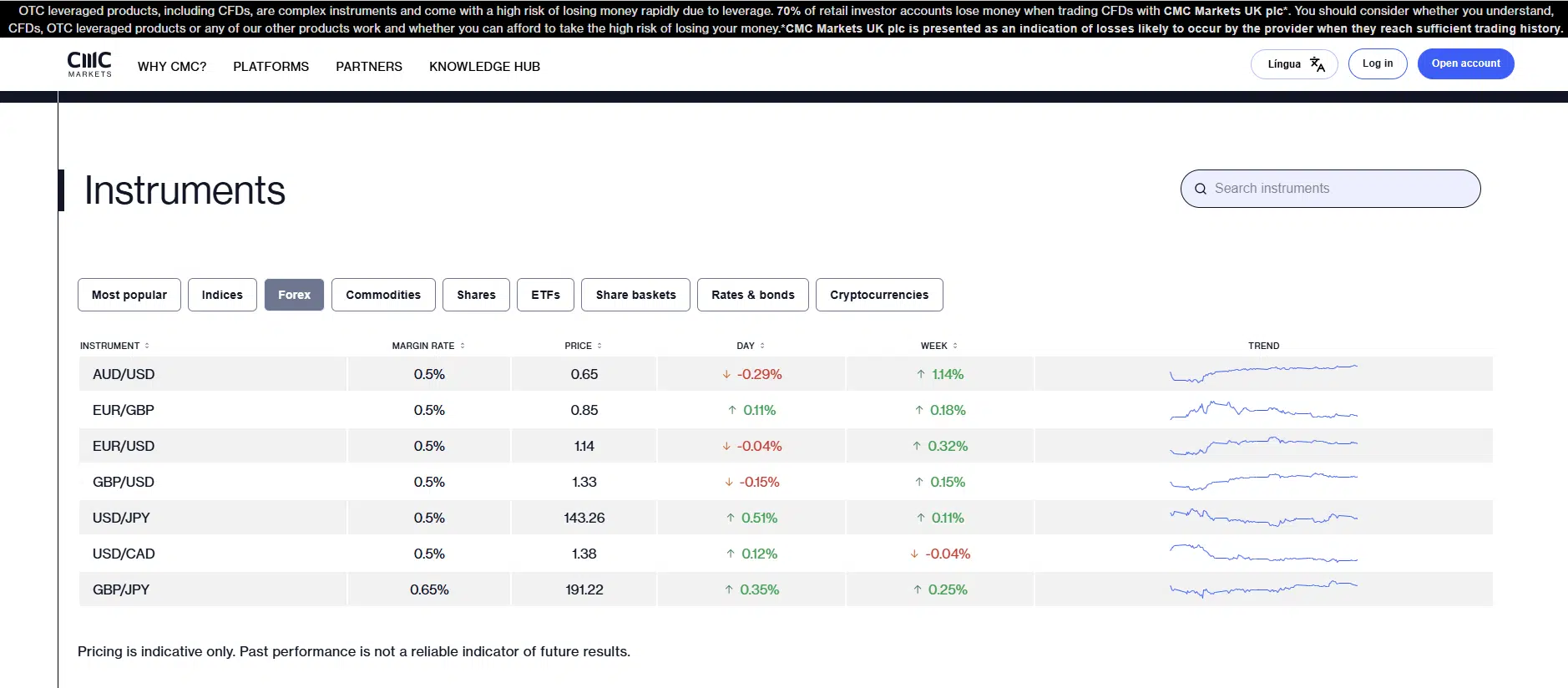
Pros
- Listed in the London Stock Exchange (higher financials transparency)
- Spread betting (Ireland and UK only)
- High track record (since 1989)
- Valuable educaiton tools
- Good customer service
- No minimum deposit
Cons
- Doesn't accept US residents
- High CFD spreads for some stocks and indices
- Limited funding methods
- No offer of real stocks and ETFs, options and bonds: only available through "CMC Invest"
#7 Forex.com at a glance

76% of retail CFD accounts lose money.
Forex.com is a global online broker regulated by several top-tier authorities, such as the NFA and CFTC in the US, the FCA in the UK (StoneX Financial Ltd, FRN 446717), CIRO in Canada and the FSA in Japan.
Additionally, it is a subsidiary of a publicly traded company, StoneX, which adds transparency thanks to the strict reporting requirements of listed companies.
Key forex highlights:
- Trade 80+ forex pairs, including majors, minors and exotics
- Multiple account types: spread-only, commission-based (RAW) and active trader discounts
- Platform options: MetaTrader 4, MetaTrader 5, TradingView and Forex.com’s proprietary trading platform
- No deposit or withdrawal fees, minimum deposit of £100
- Regulated in the US, UK, Canada and other jurisdictions
Forex.com is flexible when it comes to trading platforms: the two popular MetaTrader platforms, TradingView and its own platform, accessible via desktop app, web or mobile app. It offers powerful tools for experienced traders requiring sophisticated functionality and analytics.
Forex.com does not charge any commission on depositing or withdrawing funds. The minimum deposit is £100, and you can fund your account through bank transfer, credit or debit card, Neteller or Skrill. As for pricing, Forex.com offers account types with different fee structures, ranging from spread-only to commission-based, with special discounts for high trading volumes.
On the downside, Forex.com charges a monthly inactivity fee of £15 if you don’t trade for 12 months, and it has a limited range of instruments beyond forex and CFDs.
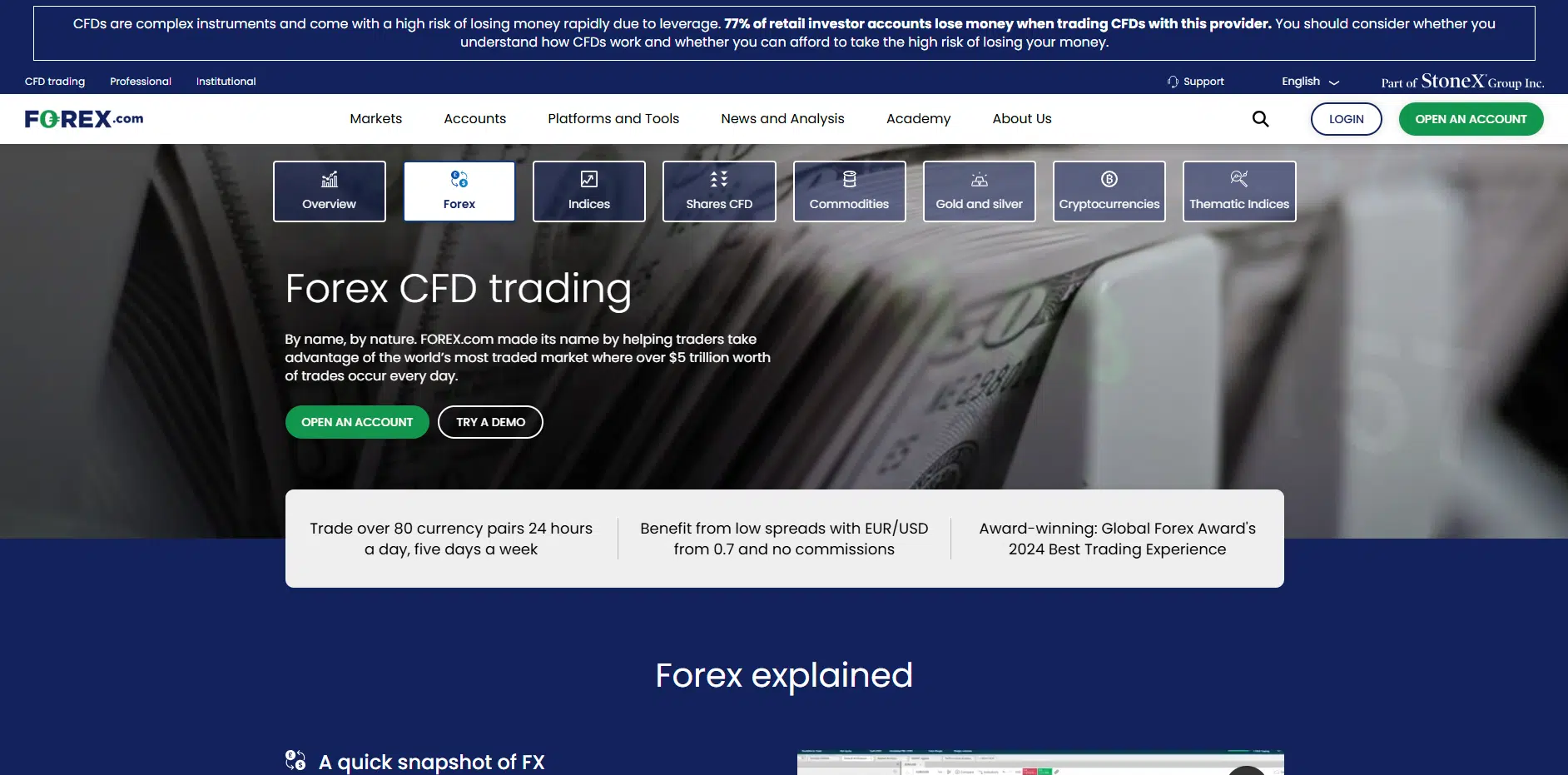
Pros
- Top-tier regulation
- Wide range of trading platforms (MT4, MT5)
- Part of StoneX Group Inc. (a NASDAQ-listed, financially strong company)
- Large selection of markets
- Excellent execution speed (fast and reliable)
Cons
- High minimum deposits for certain account types
- High fees for some products (e.g., CFDs outside of main FX pairs)
- Inactivity fees for dormant accounts
- Limited product offering compared to full-service brokers (doesn't offer traditional stocks or bonds)
#8 IG at a glance

67% of retail CFD accounts lose money.
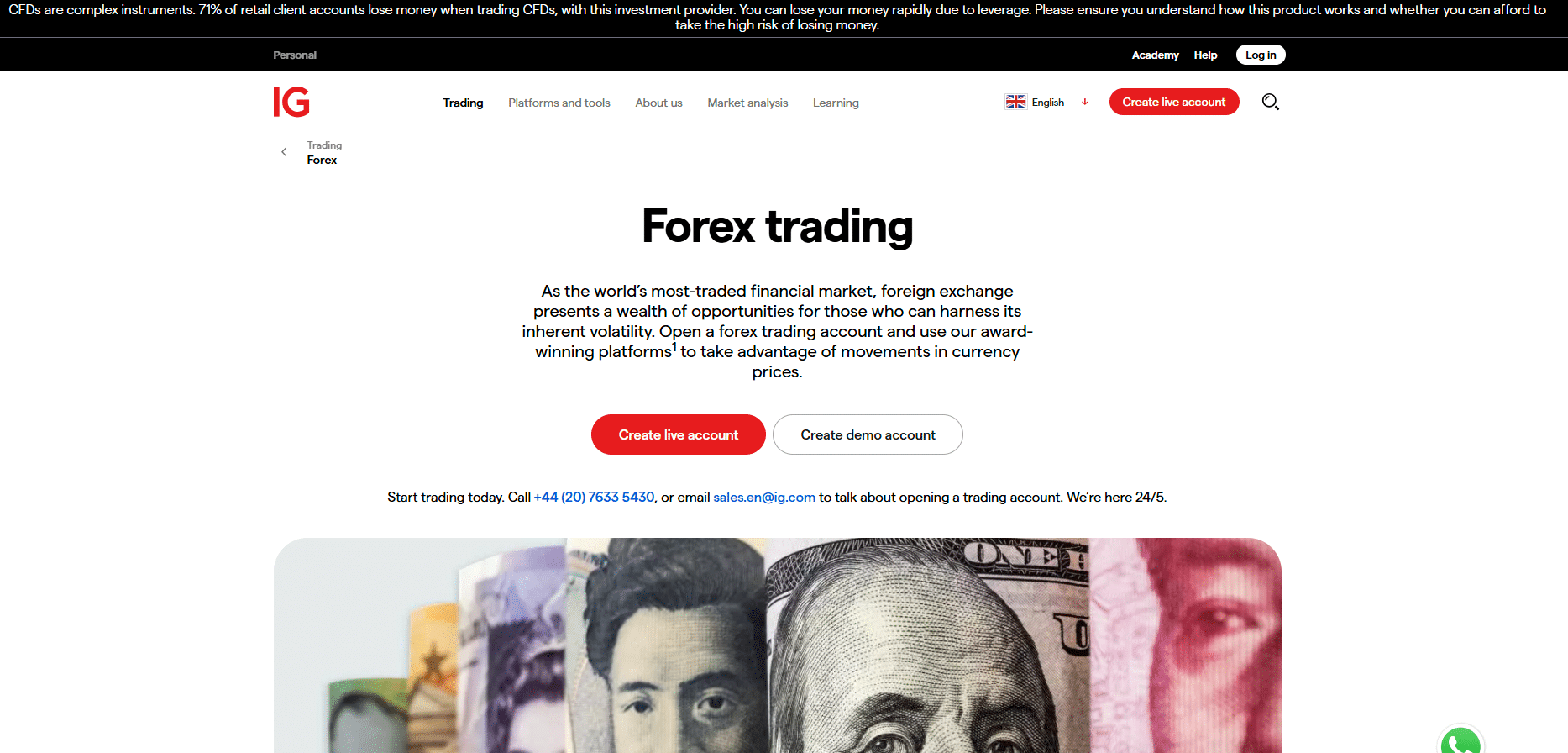
IG Group, headquartered in London and listed on the London Stock Exchange, was founded in 1974 as the world’s first spread betting firm and is one of the largest brokers in the world. Its primary regulator is the FCA (FRN 195355), alongside several other international authorities, such as ASIC in Australia, BaFin in Germany and FINMA in Switzerland. IG also owns Freetrade, the UK investing app it acquired in 2025.
Key forex highlights:
- 80+ forex pairs covering majors, minors and exotic currencies
- Advanced and user-friendly proprietary platform plus support for MetaTrader 4, ProRealTime and L2 Dealer (DMA)
- Extensive market research, analysis tools and educational resources via IG Academy
- Multiple funding options: credit/debit card, bank transfer, PayPal
- Forex available as CFDs or spread bets, with 24-hour weekday trading on major pairs
You can fund your IG account using a credit or debit card, bank transfer or PayPal. For UK clients, the minimum deposit is £250 by card or PayPal, with no minimum for bank transfers. IG offers its own intuitive web and mobile trading platform, and you can also trade through MetaTrader 4 (MT4) if you prefer. Note that IG charges a £12 monthly inactivity fee after two years without trading.
Pros
- Advanced trading tools
- No minimum deposit
- List on the FTSE 250 index
- No withdrawal fee
Cons
- Limited product portfolio (mostly CFDs)
- High stock CFD fees
- Inactivity fee after 2 years of no activity
- Complex fee structure
#9 eToro at a glance

55% of retail CFD accounts lose money.
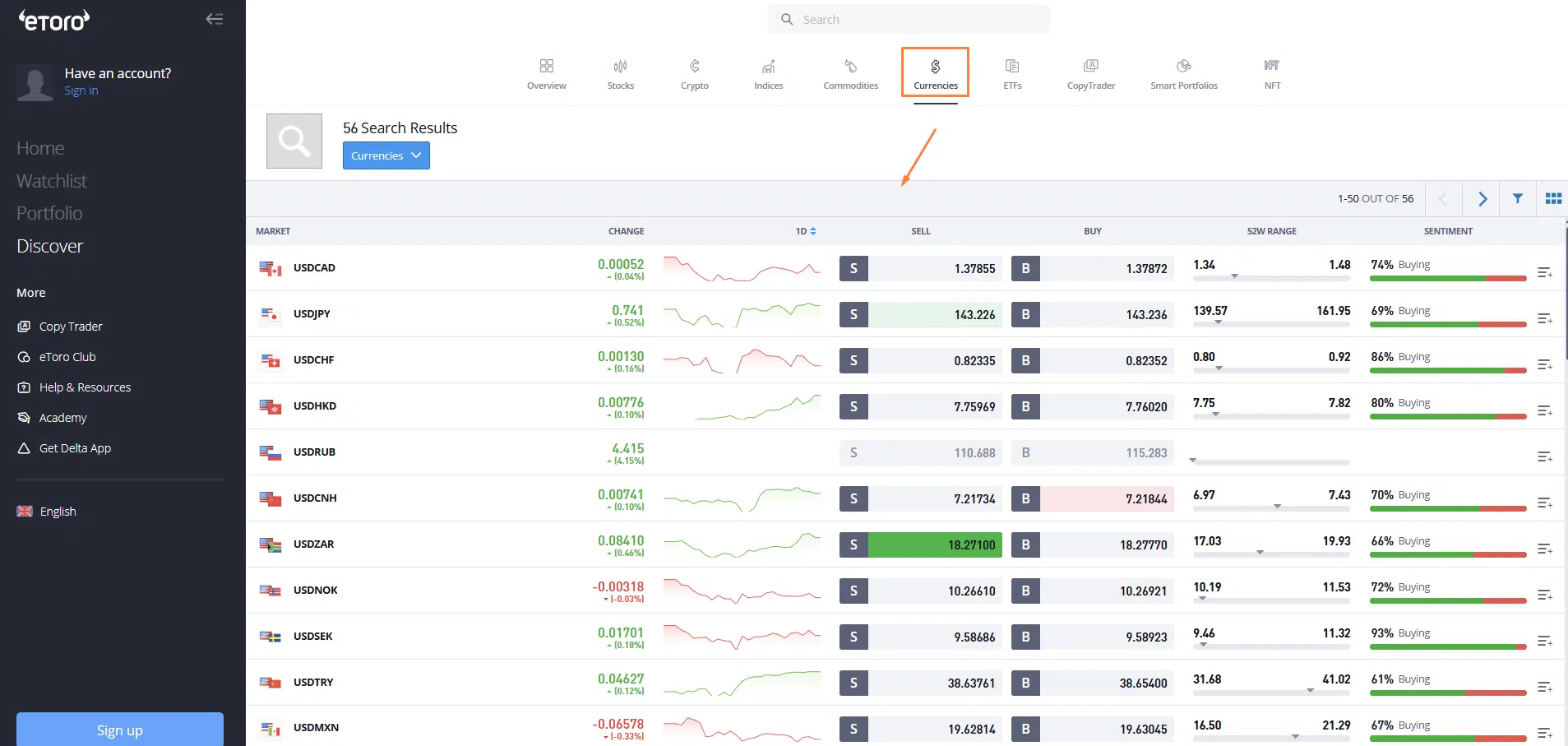
Since 2007, eToro has been a unique broker in the forex space, offering a social trading platform that allows users to copy the trades of experienced investors. With access to over 50 currency pairs, eToro blends forex trading with community-driven insights, making it a compelling option for beginner and intermediate traders.
eToro has been listed on Nasdaq (ticker: ETOR) since May 2025, and UK clients are served by eToro (UK) Ltd, regulated by the FCA (FRN 583263).
There is no separate commission for opening or closing forex trades: your cost is built into the spread (the difference between the buy and sell price). When holding leveraged forex positions overnight (or over the weekend), you’ll incur overnight or rollover financing costs, which vary depending on the currency pair, the size of the position and the funding rate.
Key forex highlights:
- Trade 50+ forex pairs, including majors, minors and selected exotics
- Social trading features allow you to follow and copy top-performing traders
- Regulated by the FCA, ASIC and CySEC, ensuring strong investor protection
- Minimum deposit from $50
- Intuitive platform focused on simplicity rather than advanced technical tools
eToro is ideal for those looking to learn from others or simplify the trading process through copy trading. While its forex offering is less extensive than that of specialist brokers and spreads may be wider, its community features, low entry barrier and strong regulation make it a good starting point for aspiring forex traders.
eToro lets UK users open a GBP account (via eToro Money) alongside the traditional USD investment account. This means you can deposit, hold and trade in GBP, avoiding conversion to USD when you trade GBP-denominated assets.
However, it’s important to understand the nuance: although you can hold GBP and use it when trading assets listed in GBP with no conversion fee, if you trade assets denominated in USD (which includes most global stocks and forex CFDs), your funds still need to be converted into USD for execution, and eToro’s conversion fee applies.
Read our eToro review.
Pros
- Low stock trading fees (from $0 per trade)
- Commission-free ETFs (other fees apply)
- Social trading and other innovative products
- Wide variety of financial products
- Slick, modern, and easy for anyone to use
- European users have access to three account currencies: EUR, USD and GBP
- Top tier regulators
Cons
- Limited disclosed financial information
- Withdraw and inactivity fees
- Spread, overnight, inactivity, and currency conversion fees higher than average
- Doesn’t offer bonds, futures, or options
What makes a good forex broker?
Many features and benefits should be considered when looking for a good forex broker, whether you are a beginner or an experienced trader. Among the most critical factors that you might want to check are:
Regulation: the first and most important criterion. You should always ensure that the broker is authorised by a reputable financial authority, such as the FCA in the UK, before transferring any funds. Regulation ensures the broker follows strict standards on client fund protection and fair trading practices.
Commissions and spreads: good forex brokers typically offer tight spreads and low commissions, helping traders keep costs under control. Competitive pricing can make a big difference, especially for active traders or those using short-term strategies. However, spreads and commissions vary by currency pair, trading volume and account type, so always compare fee structures before opening an account, and do not forget overnight financing if you hold positions for more than a day.
Deposits and withdrawals: a trustworthy UK broker will make it easy for you to fund and withdraw from your trading account. Look for platforms that support multiple payment options such as bank transfers, debit/credit cards and digital wallets like PayPal or Skrill. Processing times should be fast, and there should be no hidden fees for deposits or withdrawals.
Trading platforms and tools: a good forex broker provides a stable, intuitive and powerful trading platform, whether it’s MetaTrader 4/5, cTrader, TradingView or a proprietary web platform. Look for features such as real-time charts, advanced order types, risk management tools and mobile access, all of which can make trading more efficient.
Education and market research: for new traders, access to educational resources like webinars, tutorials and market analysis can be extremely valuable. For experienced traders, professional-grade research tools, economic calendars and in-depth reports can enhance trading decisions and improve performance.
Customer support: reliable and responsive customer service is a must. A good broker should offer 24/5 support (or better) through multiple channels such as live chat, phone and email. Fast assistance can make all the difference when issues arise, especially in the fast-moving forex market.
Bottom line
Searching for the best forex broker in the UK and comparing different trading conditions is challenging. Many factors should be considered, and it is time-consuming to gather all the information to choose the one that fits your needs. Our analysts performed this task and concluded their findings in this review of the best forex brokers in the UK, summarised below:
Interactive Brokers
Best overallPepperstone
Best MT4 and MT5 brokerCapital.com
Most user-friendly UK forex brokerXTB
Best for customer servicePlus500
Best for demo accountCMC Markets
Best for CFD tradingForex.com
Best for professional tradersIG
Best for a wide range of marketseToro
Best for social trading
You can always try our BrokerMatch tool to know which broker might be best for you, or check our comparison table for an in-depth overview of the main features of several global brokers. You can also read our reviews for more information about the products and services offered by each broker.
Whether you’re a beginner trader looking to start your trading journey or an experienced investor searching for enhanced brokerage services, we hope this article saved you some time while searching for UK forex brokers. We recommend you do your own research to assess which online broker will be better for you (a demo account might be helpful).
FAQs
Can you trade forex without a broker?
No, you can’t have direct access to the forex market without a broker. Still, you can exchange currencies over the counter at any currency exchange or through a multi-currency account, but that is not trading with leverage.
Can I trade forex with £10? And £100?
Yes, several brokers on this list have no minimum deposit, so you can start with £10 or £100. But the trade size will be small: at 30:1 leverage, £100 controls a position of £3,000, and a few pips against you can wipe out a large share of the account, so start on a demo account first.
How do I open an account with a forex broker in the UK?
It is very simple: visit the broker’s website, sign up by filling in the required fields, pass the appropriateness test (FCA rules require brokers to check you understand CFDs) and upload proof of identity and address. Accounts are usually approved within a day.
What is a pip (percentage in point)?
Pip stands for “percentage in point”, the unit of change in an exchange rate. For most pairs, 1 pip equals a 0.0001 change (for JPY pairs, 0.01). On a standard lot of 100,000 units, one pip is worth about $10 on EUR/USD.
Is forex trading tax-free in the UK?
Profits from forex CFDs are subject to capital gains tax (with the annual allowance and the ability to offset losses), while profits from forex spread bets are currently tax-free for UK residents, because HMRC treats spread betting as gambling. Pepperstone, Capital.com, CMC Markets and IG all offer spread betting accounts to UK clients. Tax rules can change and depend on your circumstances.
What leverage can UK retail traders use?
The FCA caps leverage for retail clients at 30:1 on major currency pairs and 20:1 on minor and exotic pairs. Professional clients who meet the FCA’s experience and wealth criteria can request higher leverage, but they give up protections such as negative balance protection and FSCS eligibility in some cases.