Contracts for difference (CFDs) let UK traders speculate on rising and falling prices across forex, indices, shares, and commodities without owning the underlying asset. They are flexible and capital-efficient, but they are also leveraged products, which makes the choice of platform, its costs, tools, and regulatory protections, genuinely important.
Below we compare the best CFD trading platforms available to UK residents. Every broker on this list is authorised and regulated by the Financial Conduct Authority (FCA).
For broader comparisons, see our guides to the best trading platforms in the UK and the best forex brokers in the UK.
Best CFD trading platforms in the UK
- Capital.com: Best overall CFD platform, commission-free with strong education
- Pepperstone: Best for low spreads and platform choice
- Interactive Brokers: Best for professionals and multi-asset traders
- XTB: Best proprietary platform (xStation 5)
- eToro: Best for social and copy trading
- Plus500: Best for simplicity
Disclaimer: Investing involves risk of loss.

Spread bets and CFDs are complex instruments and come with a high risk of losing money rapidly due to leverage. 65% of UK retail investor accounts lose money when trading spread bets and CFDs with this provider.

72-95% of retail CFD accounts lose money.


69-80% of retail CFD accounts lose money.

52% of retail CFD accounts lose money.

81% of retail CFD accounts lose money.
Comparison of the best CFD trading platforms in the UK


For a list of brokers we do not recommend, you can visit our full list of broker
Other resources
- Check our Youtube channel! You will find step-by-step guides of how to invest in the S&P 500 on different apps, as well as other educational videos about investing and investment platforms.
- Explore our tools: Check our comparison tool, reviews, broker bonuses, broker interest rates, BrokerMatch, and others.
Broker reviews
Capital.com at a glance
Spread bets and CFDs are complex instruments and come with a high risk of losing money rapidly due to leverage. 65% of UK retail investor accounts lose money when trading spread bets and CFDs with this provider.
Capital.com serves UK clients through Capital Com (UK) Limited, authorised and regulated by the FCA (reference number 793714). It takes the top spot as the best all-round CFD platform for UK traders: commission-free pricing, a £20 minimum deposit, and over 3,000 markets spanning forex, indices, shares, and commodities, with no deposit, withdrawal, or inactivity fees.
The proprietary web and mobile platforms are clean and fast, with over 75 technical indicators, and TradingView and MetaTrader 4 available for traders who prefer them. Major index CFDs can be traded 24 hours a day, five days a week, useful for reacting to news outside London hours.
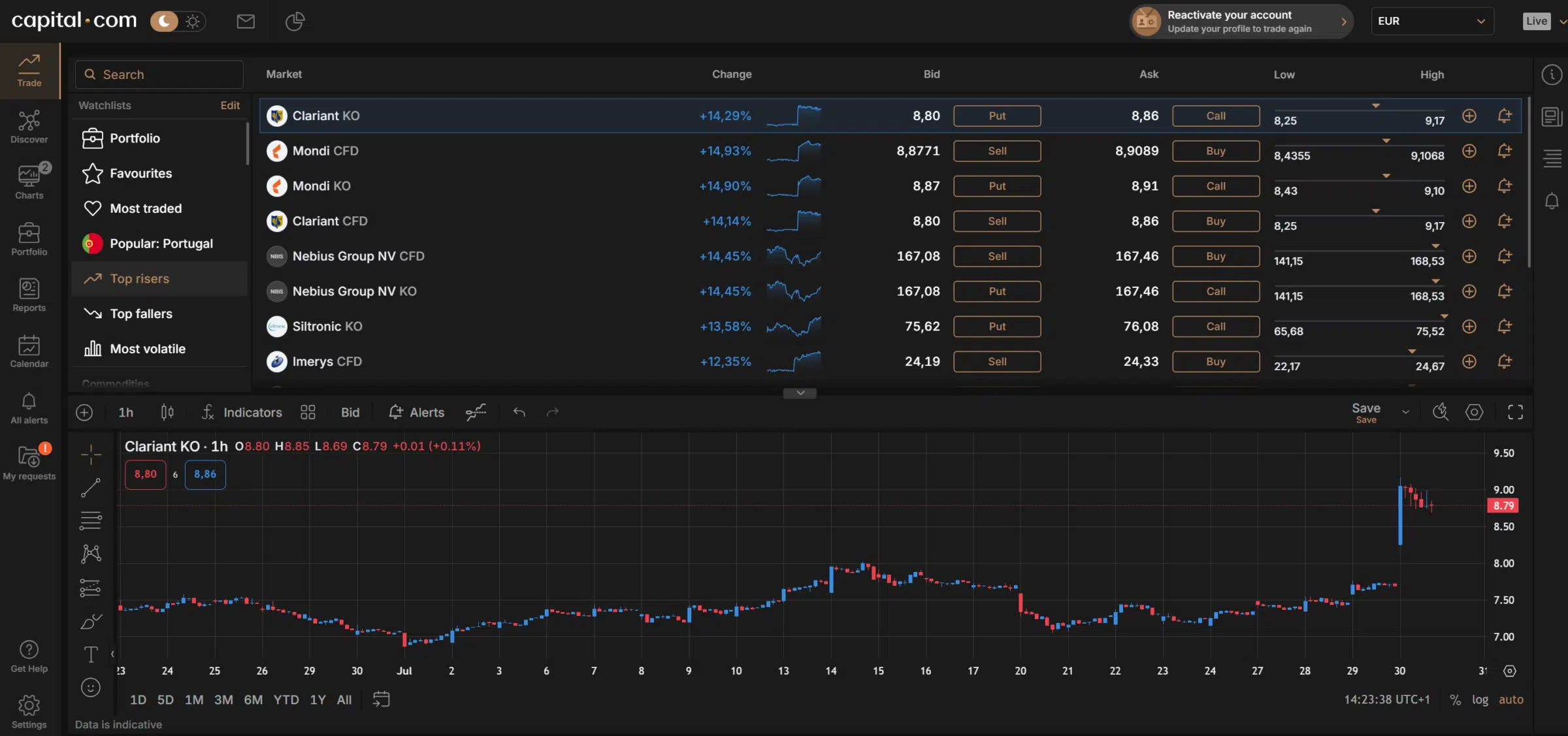
Where Capital.com really separates itself is education and risk awareness: the Investmate learning app, extensive in-platform courses and guides, and AI-powered insights that analyse your own trading patterns and flag behavioural biases, such as revenge trading or oversized positions, before they become expensive habits.
UK residents can also choose spread betting, which may be free of capital gains tax depending on individual circumstances, or the 1X option to trade without leverage, a differentiator that few CFD brokers offer and a sensible starting point for newer traders who want market exposure without amplified risk.
Pros
- 0% commission trading (only spreads apply)
- Offers a 1X (non-leveraged) account with no overnight funding fees
- Spread betting is available
- User-friendly web and mobile platforms
- Integration with MT4 and TradingView
- Wide range of tradable assets (over 5,000 markets)
- Low minimum deposit of £20
- 24/7 index CFD trading (extended hours)
- 24/7 customer support
- Excellent educational resources, including guides and webinars
- Demo account
Cons
- No ownership of underlying assets (CFD/spread betting only)
- Overnight financing fees can become expensive for long-term, highly leveraged positions.
- Not suitable for passive or dividend-focused investors
- No interest on uninvested cash
Want to know more? Check our Capital.com review and visit Capital.com’s website.
CFDs are complex instruments and come with a high risk of losing money rapidly due to leverage. 61% of retail investor accounts lose money when trading CFDs with this provider. You should consider whether you understand how CFDs work and whether you can afford to take the high risk of losing your money.
Pepperstone at a glance
72-95% of retail CFD accounts lose money.
Pepperstone Limited is authorised and regulated by the FCA (reference number 684312), with FSCS protection of up to £85,000 for UK clients and segregated client funds. Founded in 2010, it has become a reference among CFD brokers for execution quality and cost.
The Razor account offers raw spreads from 0.0 pips plus a small commission, while the Standard account is commission-free with spreads from around 1.0 pip. There is no minimum deposit, deposits and withdrawals are free, and execution is genuinely fast, with the group reporting a 99.32% order fill rate (Pepperstone Group data, as at 31 March 2026).
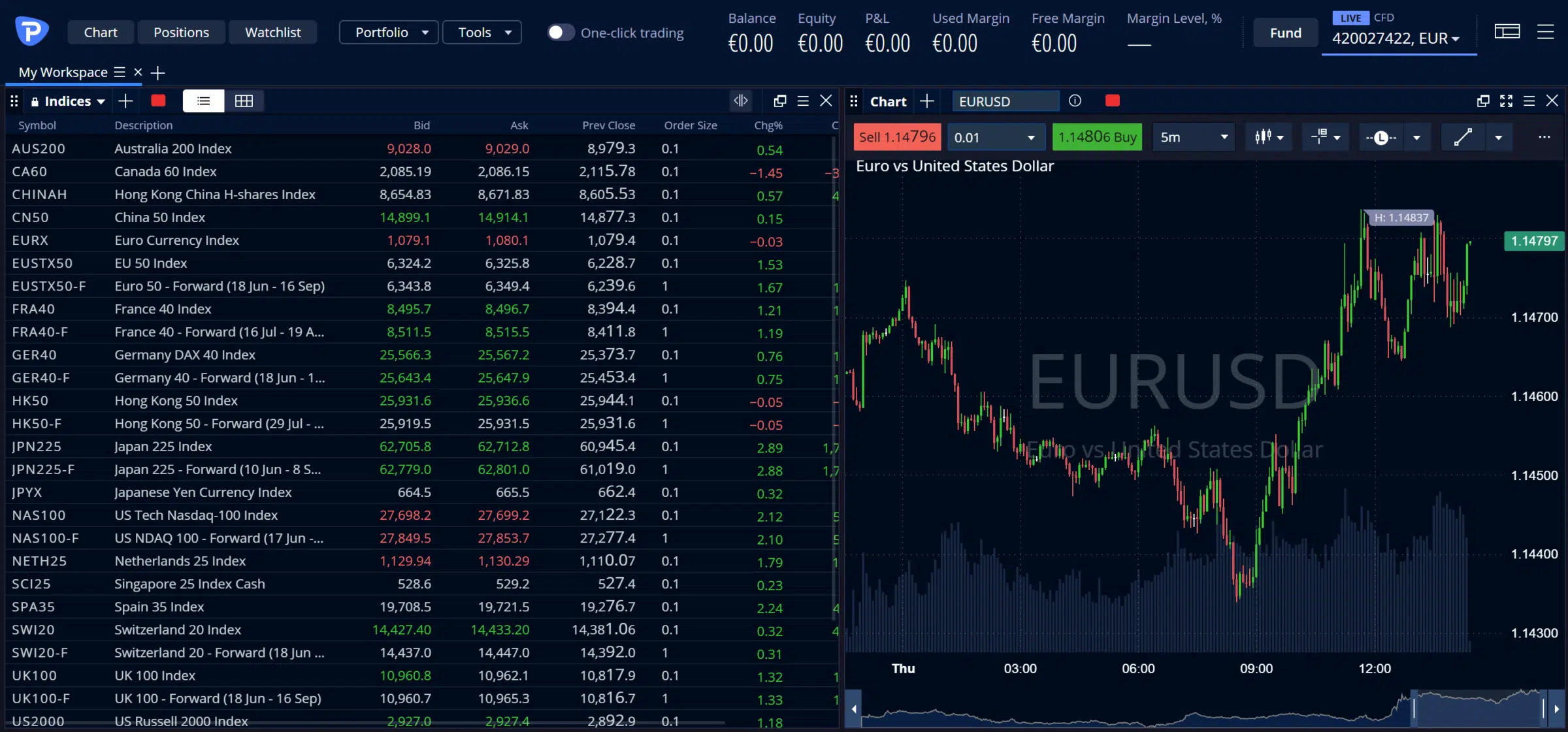
Platform choice is the widest on this list: MetaTrader 4, MetaTrader 5, cTrader, TradingView integration, and Pepperstone’s own platform. That range matters in practice: MT4 and MT5 support expert advisors for automated strategies, cTrader offers level II depth-of-market pricing, and the TradingView connection lets you trade directly from the charts many traders already use for analysis.
With over 1,350 instruments covering forex, indices, shares, commodities, and ETF CFDs, plus spread betting for UK residents, Pepperstone is the strongest choice for traders who want institutional-grade pricing with full platform flexibility.
Pros
- Quick customer support response times
- No fees for deposits, withdrawals, or account inactivity
- Competitive spreads in the Razor account with active trader rebates
- Higher leverage options are available depending on region and client categorization
Cons
- Limited to CFD trading; no direct asset ownership
- Higher Forex spreads in the standard account
- Crypto CFDs offerings are limited compared to competitors
- Limited educational resources
Want to know more? Check our Pepperstone review and visit Pepperstone’s website.
Spread bets and CFDs are complex instruments and come with a high risk of losing money rapidly due to leverage. 75.3% of retail investor accounts lose money when trading spread bets and CFDs with this provider. You should consider whether you understand how spread bets and CFDs work, and whether you can afford to take the high risk of losing your money.
Interactive Brokers at a glance
Interactive Brokers (U.K.) Limited, authorised and regulated by the FCA (reference number 208159), brings a professional-grade offering to CFD trading. Founded in 1978 and listed on Nasdaq, IBKR is one of the largest and best-capitalised brokers in the world, and UK clients benefit from FSCS protection.
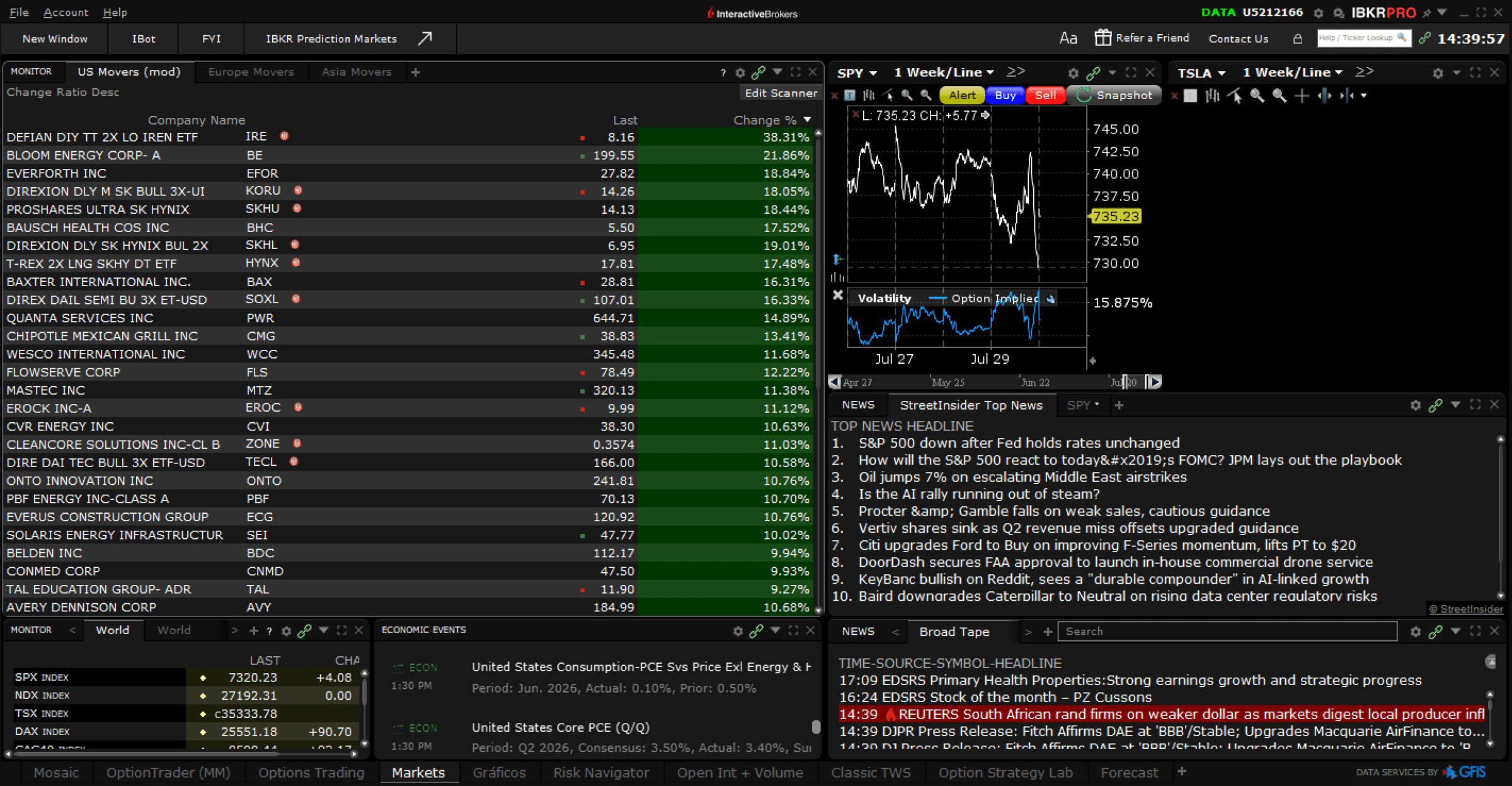
Share CFD commissions start at 0.05% (0.5 cents per US share) with volume-tiered discounts, and index, forex, and metals CFDs are similarly competitive. Two things set IBKR apart. First, financing: overnight rates start at benchmark plus or minus 1.5%, among the lowest in the industry, which matters enormously if you hold CFD positions for more than a few days. Second, breadth: over 8,500 share CFDs globally, with US share CFDs tradable in extended and overnight hours, and no UK stamp duty on CFD transactions.
The same account gives access to real stocks, ETFs, options, futures, and bonds across 150+ markets, so CFDs can sit alongside a long-term portfolio rather than in a separate silo. Idle cash earns competitive interest, and there is no minimum deposit.
The Trader Workstation platform is powerful but demanding; the newer IBKR Desktop and mobile apps are considerably friendlier, and paper trading lets you learn either without risk.
Pros
- Low commissions on US stock trading
- No monthly inactivity fee
- The broadest product and markets range in the brokerage industry
- Demo account
- Excellent reputation (founded in 1978)
- Extensive research and Education tools
- Has a modern mobile trading app to trade Stocks, Options and ETFs, ideal for novice investors, IBKR GlobalTrader.
- Offers interest on uninvested cash balances
Cons
- Complicated and lengthy account opening process (but fully online)
- Steeper learning curve for beginners
- Website is difficult to navigate
- Interactive Advisors (Robo-advisor feature) is only available for US customers
Want to know more? Check our Interactive Brokers review and visit Interactive Brokers’ website.
CFDs are complex instruments and come with a high risk of losing money rapidly due to leverage. 59.7% of retail investor accounts lose money when trading CFDs with IBKR. You should consider whether you understand how CFDs work and whether you can afford to take the high risk of losing your money.
XTB at a glance
69-80% of retail CFD accounts lose money.
XTB Limited is authorised and regulated by the FCA (reference number 522157), and its parent is listed on the Warsaw Stock Exchange, adding the transparency of published accounts. Its case for inclusion rests largely on xStation 5, one of the best proprietary trading platforms in the industry: fast, highly customisable, with excellent charting, a built-in position cost calculator, sentiment data, and seamless switching between desktop and mobile.
CFD trading on the Standard account is commission-free, with forex spreads from around 0.5 pips across forex, indices, and commodities. Execution is fast, and the platform displays real-time execution statistics rather than hiding them.
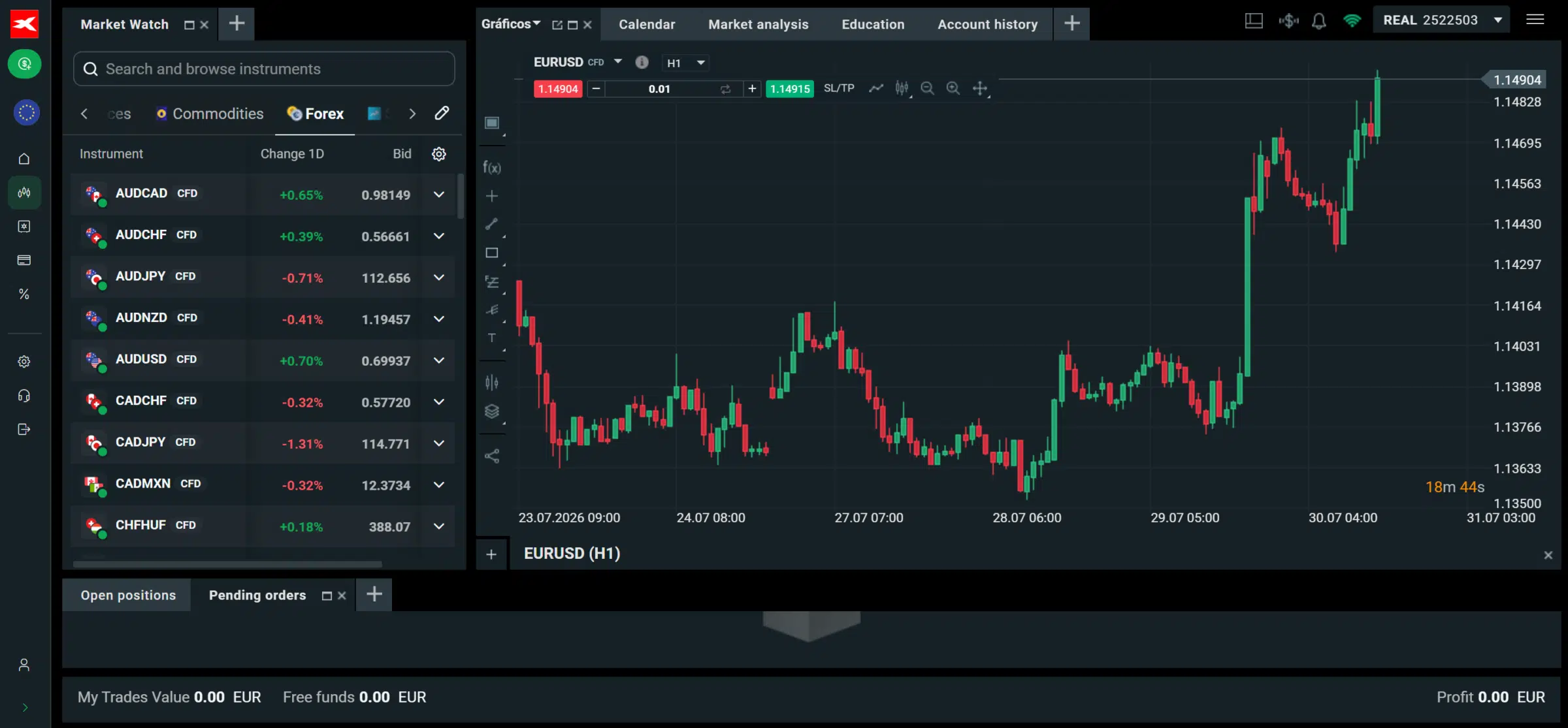
XTB also pays interest on uninvested cash and requires no minimum deposit, which lowers the cost of simply keeping an account funded between trades. Educational content is strong, with a structured trading academy built into the platform.
Unusually for a CFD-focused broker, UK clients also get commission-free real stocks and ETFs, so XTB can serve as a single account for both trading and investing, something neither Capital.com nor Pepperstone offers in the UK.
Pros
- Free stocks trading (only applicable to some countries)
- Customizable trading platform (charts and workspace)
- Low Forex Spreads
- Demo account
- No minimum account deposit
- Valuable education materials
- Top-tier Regulators
Cons
- Complex trading platform for a beginner
- High Stock CFD spreads
- Limited product portfolio
- Withdrawal fees for transfers below $100
- Inactivity fee (€10/monthly after 1+ year with no activity plus no deposit in the last 90 days)
Want to know more? Check our XTB review and visit XTB’s website.
CFDs are complex instruments and come with a high risk of losing money rapidly due to leverage. 72% of retail investor accounts lose money when trading CFDs with this provider. You should consider whether you understand how CFDs work and whether you can afford to take the high risk of losing your money.
eToro at a glance
52% of retail CFD accounts lose money.
eToro (UK) Ltd is authorised and regulated by the FCA (reference number 583263). Founded in 2007 and listed on Nasdaq since 2025, eToro’s defining feature is social trading: with CopyTrader, you can automatically replicate the positions of other traders on the platform, in proportion to the amount you allocate, and the social feed turns trading into a community experience shared by tens of millions of registered users.
CFDs on forex, indices, commodities, and shares are commission-free, with costs built into the spread. Smart Portfolios add a middle path between self-directed trading and copying: thematic, ready-made baskets built around ideas such as AI or renewable energy.
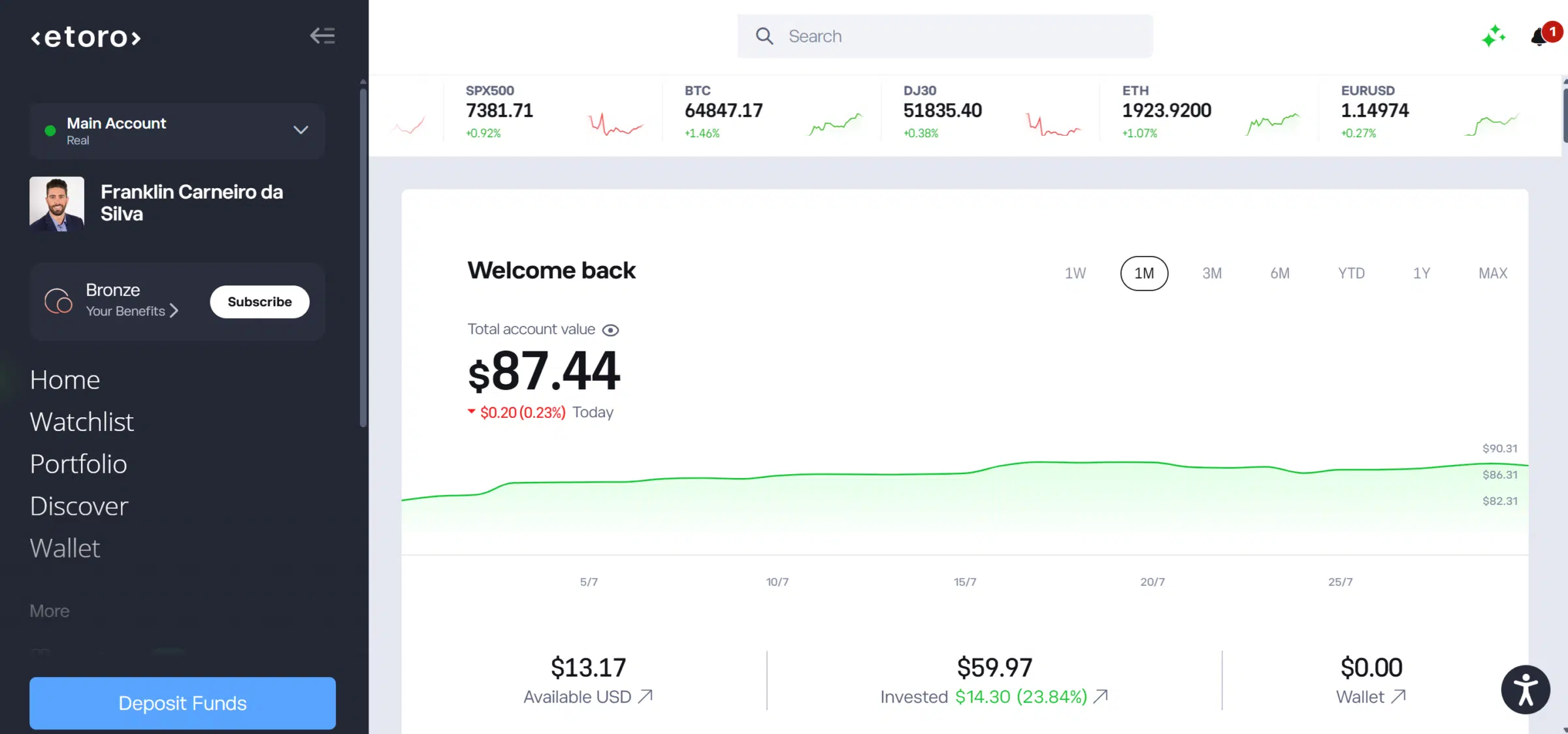
The same account also offers commission-free real stocks and crypto, making eToro a versatile choice for traders who mix CFDs with longer-term investing, and the free $100,000 demo portfolio makes it easy to test strategies or evaluate copied traders before committing.
The main caveats are the USD-denominated accounts, which mean a conversion fee on GBP deposits and withdrawals, a $5 withdrawal fee, and spreads that are wider than the cost leaders on this list.
Pros
-
CopyTrader and the largest social trading community
-
Commission-free real stocks alongside CFDs
-
Low minimum deposit
- Simple, beginner-friendly platform
Cons
-
USD accounts mean currency conversion fees for GBP deposits
- Wider spreads than dedicated low-cost CFD brokers
Want to know more? Check our eToro review and visit eToro’s website.
Plus500 at a glance
81% of retail CFD accounts lose money.
Plus500UK Ltd is authorised and regulated by the FCA (reference number 509909), and its parent company is listed on the London Stock Exchange, publishing audited accounts and maintaining a strong capital position, a level of transparency uncommon among CFD brokers. In the UK, Plus500 is a pure CFD provider with over 2,800 instruments.
The proprietary platform is the simplest on this list, which is precisely its appeal: clean design, spread-only pricing with no commissions, and no charge for deposits or standard withdrawals. Built-in risk tools include guaranteed stop orders (for a fee), trailing stops, price alerts, and negative balance protection.
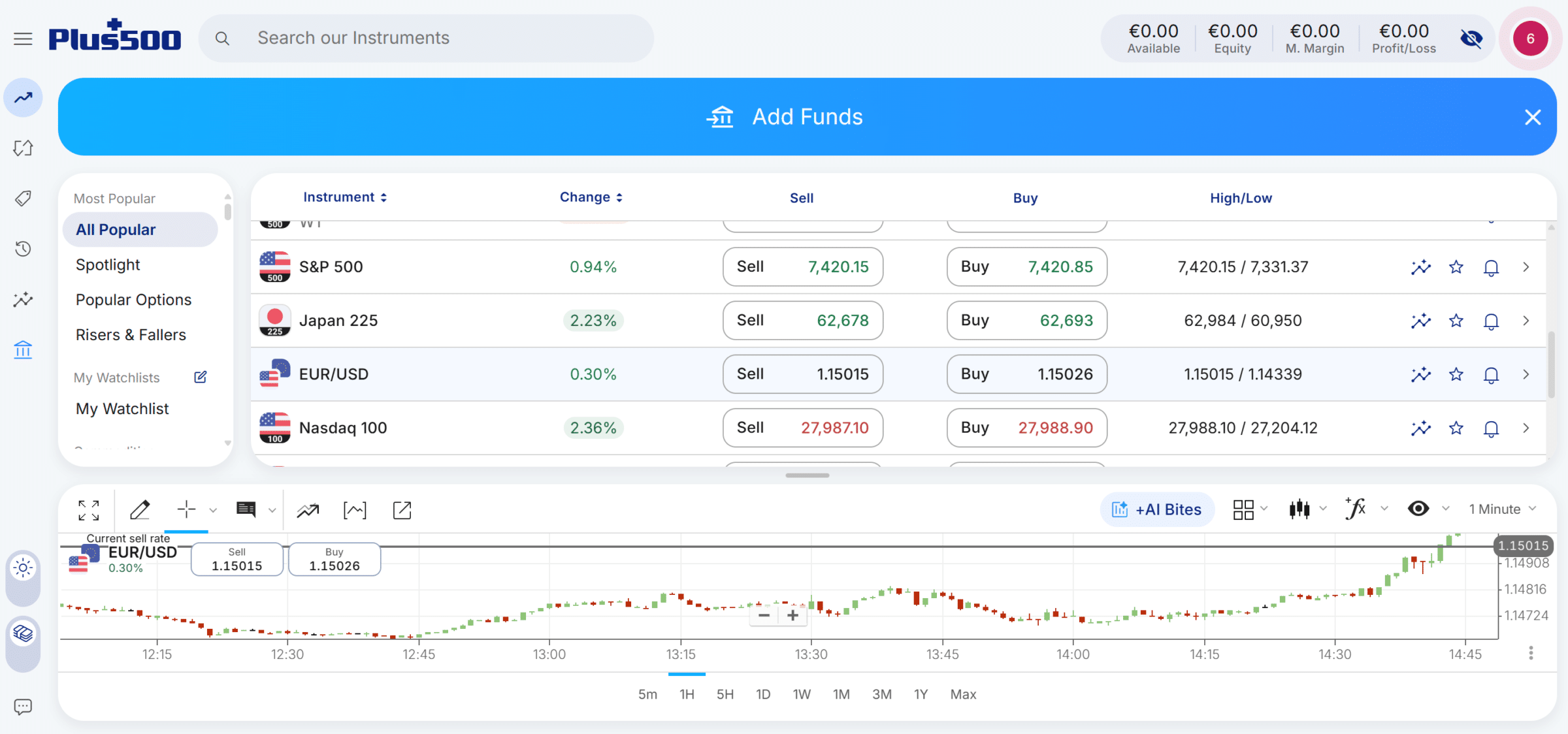
The unlimited demo account is a genuine differentiator: you can watch Plus500’s live spreads side by side with a competitor’s for as long as you like before funding an account. The minimum deposit is £100.
For traders who want a straightforward way to trade CFDs without configuring a professional platform, Plus500 is a solid, well-capitalised option; advanced traders will miss deeper charting and automation.
Pros
- Acessible and responsive platform
- Low spreads
- No dealing commissions
- Demo Account
- Top-tier regulators
Cons
- No ETF offering
- Inactivity fee ($10 per month after no login activity in 3 months)
- High overnight funding fees
- Very little research and education provided
Want to know more? Check our Plus500 review and visit Plus500’s website.
CFDs are complex instruments and come with a high risk of losing money rapidly due to leverage. 76% of retail investor accounts lose money when trading CFDs with this provider. You should consider whether you understand how CFDs work and whether you can afford to take the high risk of losing your money.
How we chose the best CFD trading platforms
Our team has professional experience in finance and portfolio analysis, and we have reviewed well over 100 brokers and trading platforms since we started publishing comparisons. This ranking follows the same methodology we apply across the site.
First, regulation: we only considered brokers authorised by the FCA for their UK entity, verified directly on the Financial Conduct Authority register, with FSCS eligibility checked where applicable. Offshore entities accepting UK clients were excluded.
Second, total cost of trading: spreads, commissions, overnight financing, and non-trading fees (deposits, withdrawals, inactivity, and currency conversion), measured on standard trade sizes using each broker’s published pricing and our own account testing, rather than headline claims.
Third, platform quality and range of markets: charting, order types, execution speed, mobile experience, and the breadth of instruments available. We gave extra weight to features that matter specifically to UK traders, such as spread betting availability, GBP account support, and trading hours on major indices.
Final thoughts
Capital.com leads as the best all-round CFD platform for UK traders, combining commission-free pricing, education, and flexible ways to trade. Pepperstone is the pick for cost-focused traders who want raw spreads and platform choice, while Interactive Brokers suits professionals who want CFDs inside a full multi-asset account. XTB, eToro, and Plus500 each serve a distinct profile: platform quality, social trading, and simplicity respectively.
Whichever you choose, confirm the FCA authorisation on the Financial Services Register and start with a demo account. For related comparisons, see our guides to the best trading platforms in the UK and the best forex brokers in the UK.
This article is for information purposes only and does not constitute investment advice or a recommendation. CFDs are leveraged products and carry a high level of risk. Between 51% and 76% of retail investor accounts lose money when trading CFDs with the providers listed in this article.