Opening a business bank account in Europe used to mean visiting a branch in the country where your company is registered. Today, digital banks and payment institutions open an account online in a few days, with a euro IBAN, cards for your team and no branch visit.
Which one you can open depends on two things: where your company is registered and where its directors live. Some providers only accept companies from a handful of EU countries, while others accept companies registered in the UK, the US and other countries outside the EU.
This article presents our picks for the best business bank accounts in Europe, for European companies and for businesses outside the EU that need a euro account. All fees were checked on the providers’ own websites in October 2026, using eurozone pricing (Ireland unless stated otherwise).
Best business bank accounts in Europe
Revolut Business (Best overall)
Multi-currency account with free currency exchange within the plan allowance, team cards, card payment acceptance and savings, from €10 a month. Open to companies in the EEA, the UK, Switzerland and several countries outside Europe. New businesses get a €200 Revolut Business bonus in most eurozone countries.
Wise Business (Best for non-EU companies)
No monthly fee and euro account details for a one-off €60, available to companies registered in many countries outside the EU. Conversions from 0.2%.
bunq (Best free plan)
Dutch bank with a free business plan and paid plans from €7.99 a month, up to 25 IBANs and deposits protected up to €100,000.
Qonto (Best for admin tools)
Business account built around invoicing, expense management and accounting, from €9 a month. For companies in France, Germany, Italy and Spain.
N26 Business (Best for freelancers)
Free plan for freelancers and the self-employed, with 0.1% cashback on card payments. Not available to limited companies.
Comparison table
| Account | Monthly fee | Who can open | Protection |
| Revolut Business | From €10* | Companies in the EEA, UK, Switzerland, US, Australia, Singapore and India | Up to €100,000 |
| Wise Business | €0 (€60 one-off) | Companies in Europe and many countries outside it | Safeguarding, no deposit guarantee |
| bunq | €0 to €23.99 | Companies in 9 EU countries, directors living in the EEA | Up to €100,000 |
| Qonto | From €9** | Companies in France, Germany, Italy and Spain | Safeguarding, no deposit guarantee |
| N26 Business | €0 to €16.90 | Freelancers and the self-employed only | Up to €100,000 |
Checked on the providers’ websites in October 2026, with Irish pricing for Revolut and Wise. Prices vary by country.
*€10 (Basic), €35 (Grow) or €125 (Scale) a month.
**Excluding VAT, billed annually. Team plans start at €49 a month.
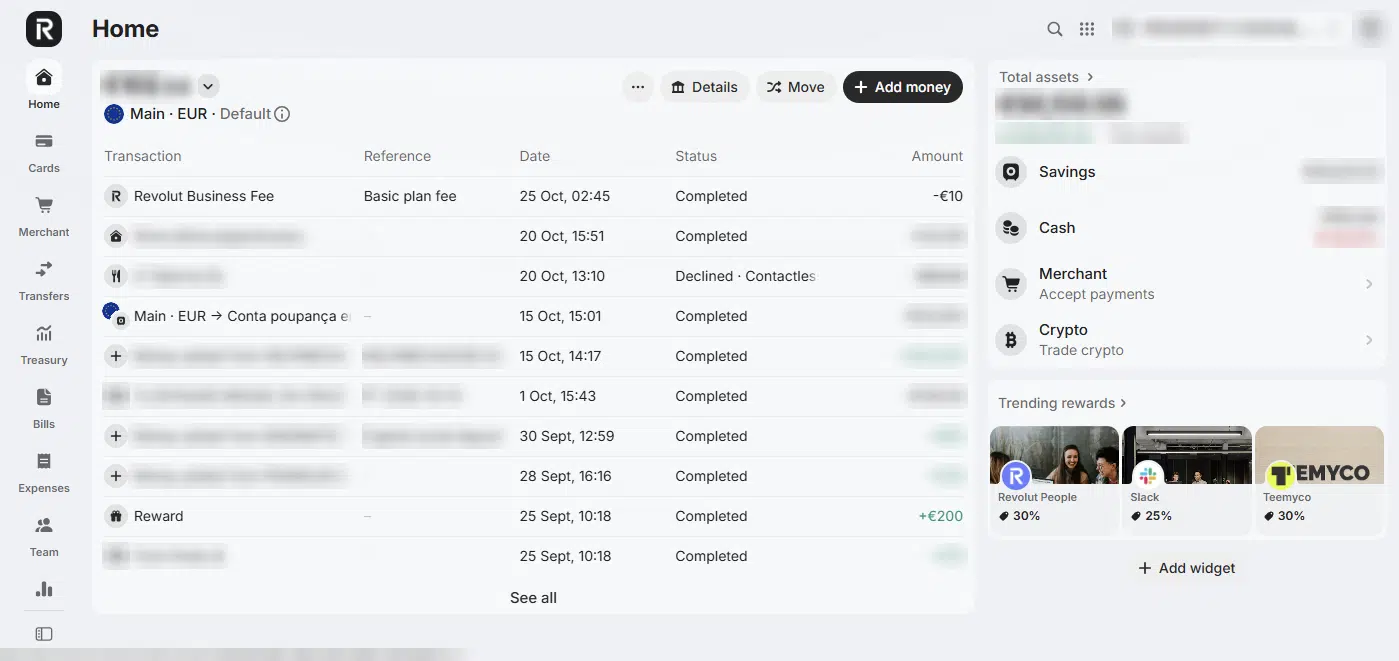
Revolut Business account at a glance
Revolut Business is our top pick for companies in Europe, and it is the account we use as the only bank of one of our own companies. It served 767,000 businesses at the end of 2025, according to Revolut’s 2025 annual results.
In the EEA, the account is provided by Revolut Bank UAB, a bank licensed by the European Central Bank and the Bank of Lithuania, so eligible deposits are protected up to €100,000. Revolut issues local IBANs for business accounts in France, Ireland, Lithuania, the Netherlands, Romania and Spain. Companies in other countries get a Lithuanian IBAN.
It accepts companies registered in the EEA, Switzerland, the UK, the US, Australia, Singapore and India, which makes it one of the few options that works for both European and non-European businesses. You can hold and exchange more than 25 currencies, with free exchange at the interbank rate within your plan allowance. You also get unlimited team members with cards, invoices and payment links, and card payments from 0.8% + €0.02 in person.
The plans in Ireland, as listed on Revolut’s pricing page, are:
- Basic (€10 a month): 10 free local transfers and €1,000 of free exchange
- Grow (€35 a month): 100 local and 5 international transfers, €15,000 of exchange, spend approvals and bulk payments
- Scale (€125 a month): 1,000 local and 25 international transfers and €60,000 of exchange.
On the downside, there is no free plan, exchanges at weekends cost 1% and ATM withdrawals cost 2%. Revolut can also restrict accounts during compliance checks, so answer document requests quickly.
New businesses that open their first account through our link and add €0.01 get €200 in most eurozone countries (€50 in Italy). For fees and plans in detail, read our Revolut Business review.
Pros
- Free currency exchange at the interbank rate within the plan allowance (£1,000 to £60,000 a month)
- Card payment acceptance online and in person in the same account
- FSCS protection up to £120,000 and savings from 2.15% AER on Grow
- Unlimited team members with card controls and approvals
- £200 welcome bonus for new businesses
Cons
- No free plan: Basic costs £10 a month
- 1% fee on weekend exchange and 2% on ATM withdrawals
- Accounts can be restricted during compliance checks
Wise Business account at a glance

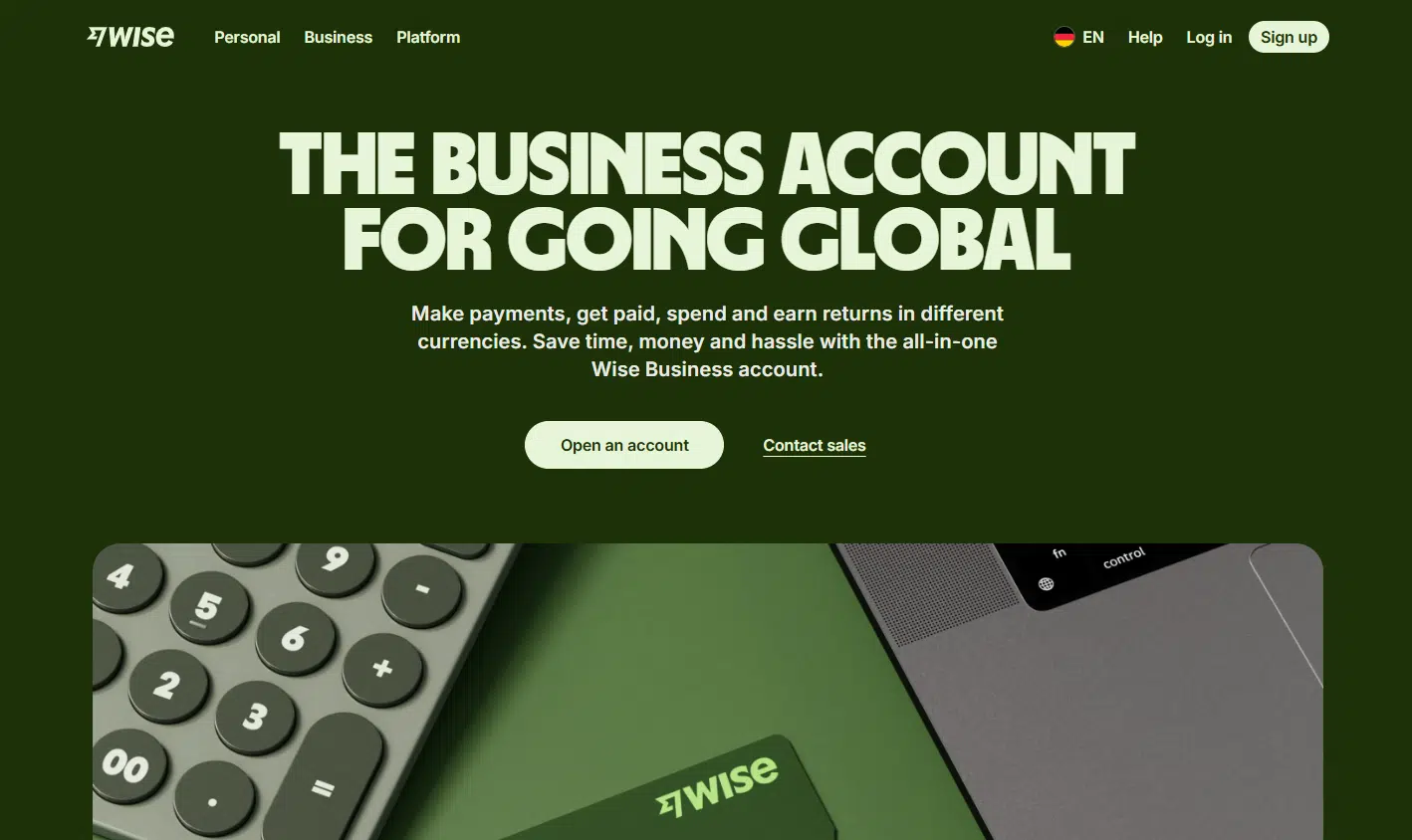
Wise Business is a multi-currency account rather than a bank account, and it is the most practical way for a company outside the EU to get euro account details. It is available to businesses registered in many countries, including the UK and the US, and in the EEA it is regulated by the National Bank of Belgium.
There is no monthly fee. A one-off €60 (in Ireland) unlocks account details to receive money in 22 currencies, and conversions use the mid-market rate plus a fee from 0.2%, with a volume discount above €22,000 a month. Card spending in currencies you hold is free, and ATM withdrawals are free up to €250 a month, then 2.69%. Prices are on Wise’s business pricing page.
The limits matter if you plan to use it as your main account. Wise is an e-money institution, so your money is safeguarded but not covered by a deposit guarantee scheme, and it doesn’t offer loans or overdrafts. Wise also gives out Belgian bank details for euros and doesn’t issue local IBANs in other countries.
If you are weighing it against Revolut, see our Wise Business vs Revolut Business comparison.
bunq business account at a glance

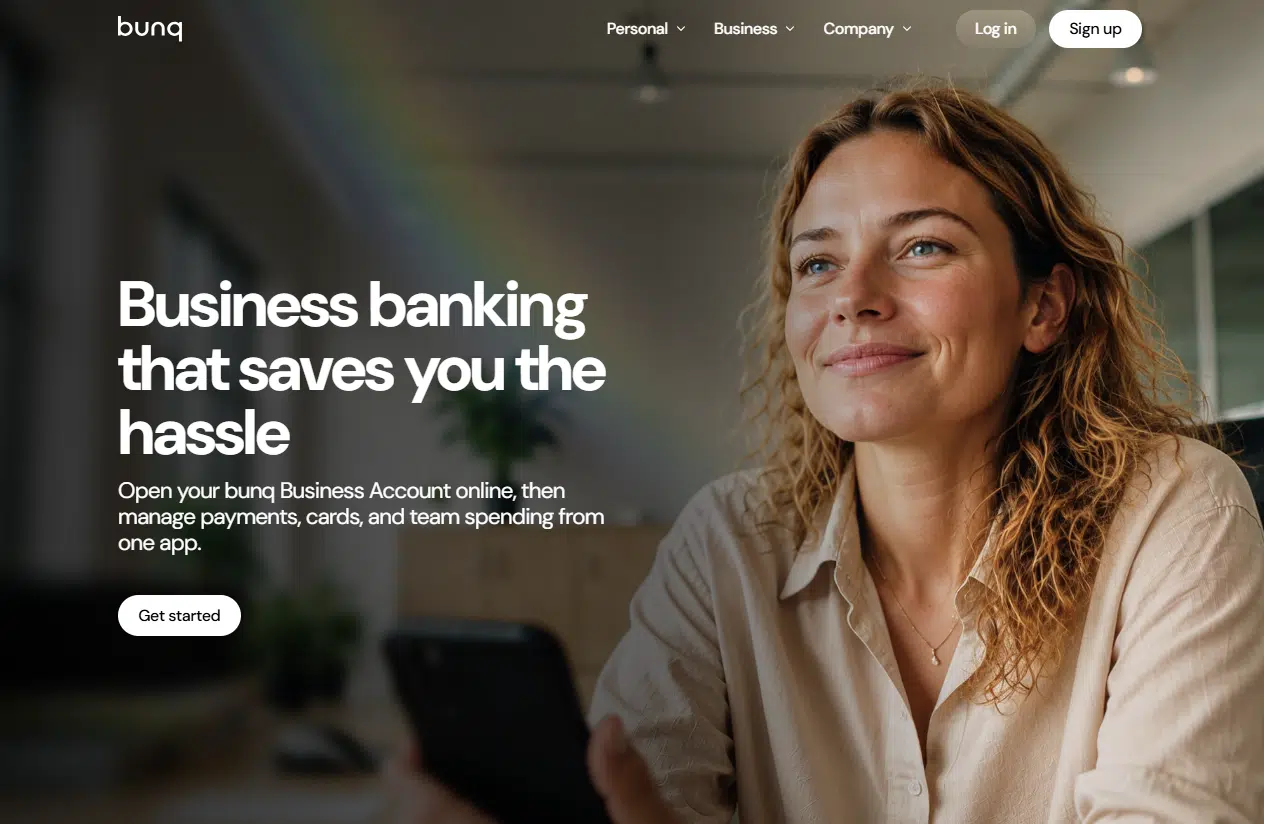
bunq is a Dutch bank with more than 22 million users across its platforms. Eligible deposits are protected up to €100,000 by the Dutch deposit guarantee scheme.
Its business plans start with a free plan with 3 bank accounts. Core (€7.99 a month) has 5 accounts, while Pro (€13.99) and Elite (€23.99) have 25, each with its own IBAN. Pro includes up to 25 virtual and 3 physical cards, company cards for employees, Tap to Pay and accounting integrations, with a 30-day free trial.
The catch is eligibility. According to bunq’s help centre, your company must be registered in the Netherlands, Belgium, France, Germany, Austria, Spain, Italy, Ireland or Portugal, and every director and ultimate beneficial owner must live in the EEA. Companies from outside the EU, or with a shareholder living outside the EEA, can’t open an account.
bunq suits small EU companies that want separate IBANs for taxes, salaries and savings, starting with a free plan.
Qonto business account at a glance

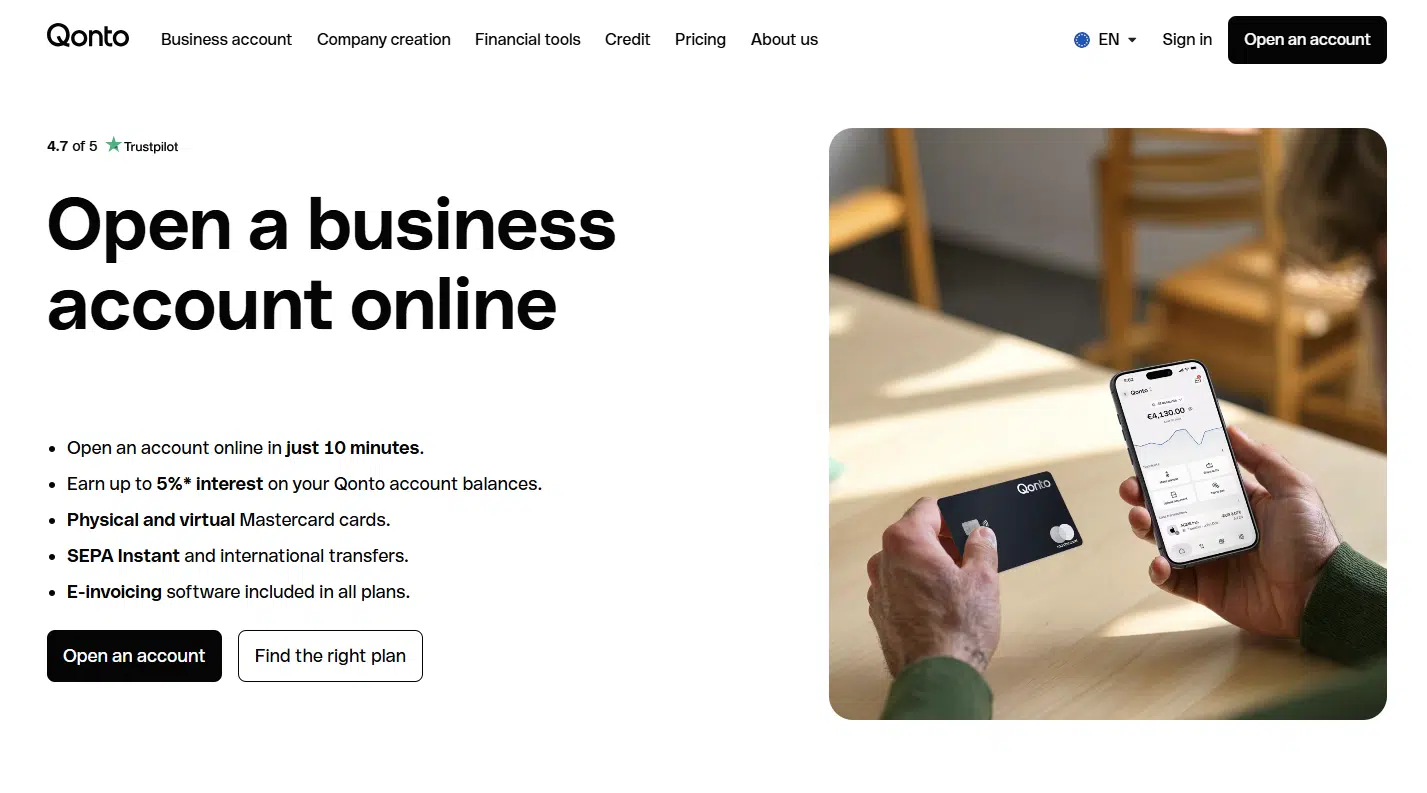
Qonto is a French business account used by more than 750,000 small and medium-sized companies. It is a payment institution supervised by the Banque de France, not a bank, so customer funds are safeguarded and kept separate from Qonto’s own money, but they are not covered by a deposit guarantee scheme.
Its plans are split between solo plans (Basic at €9, Smart at €19 and Premium at €39 a month, excluding VAT and billed annually) and team plans (Essential at €49, Business at €109 and Enterprise at €199). Each plan includes a set number of transfers, from 30 to 10,000 a month, then €0.10 to €0.20 per transfer. International transfers cost 0.56% to 1.8%, with a €5 minimum.
Qonto stands out for admin: invoicing and e-invoicing, team expense management and bookkeeping tools are built into the account, and it connects to more than 2,000 external tools. It is a good fit for French, German, Italian and Spanish companies that want to cut bookkeeping time, and less suited to businesses that move a lot of money in other currencies.
N26 Business account at a glance

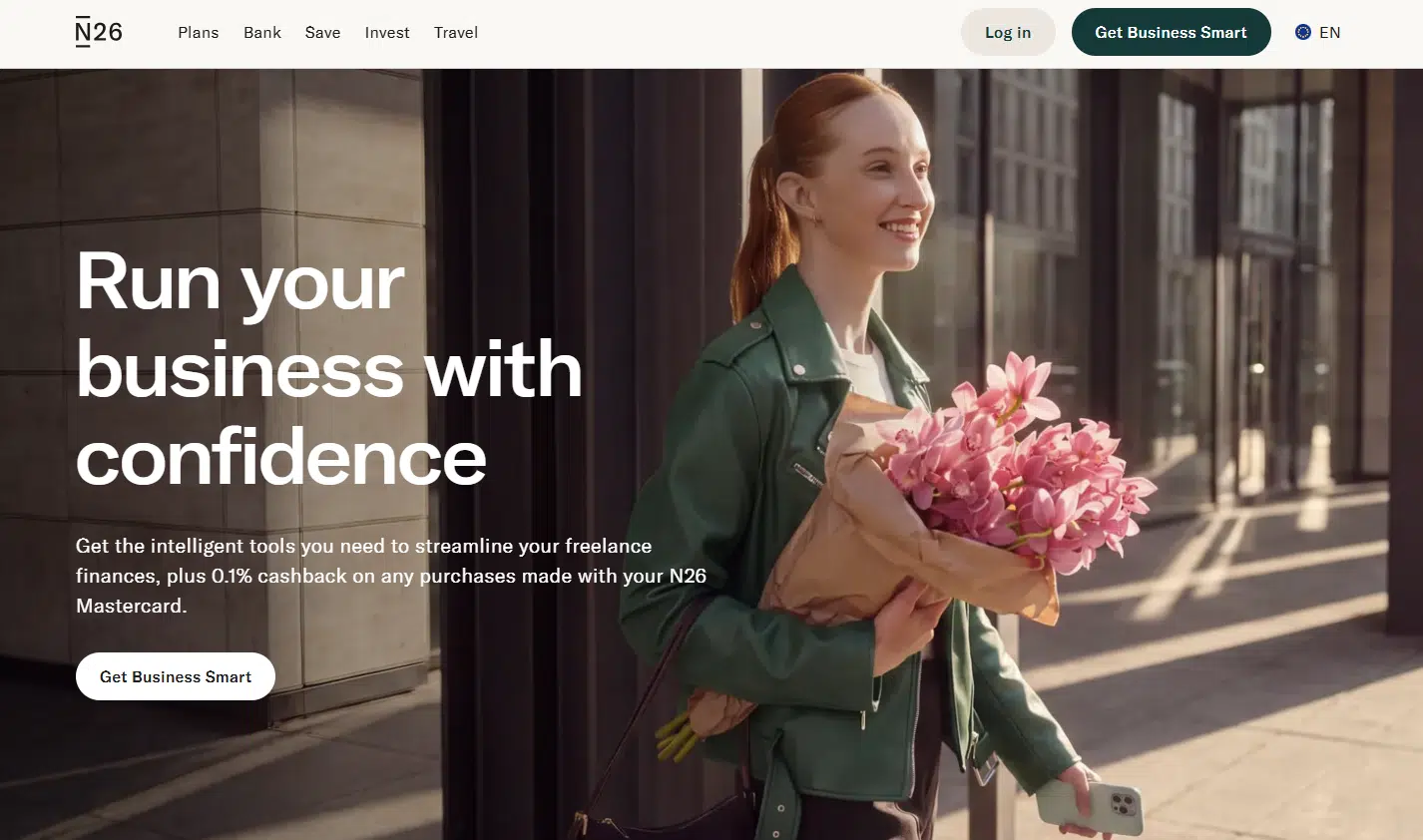
N26 is a German bank, and eligible deposits are protected up to €100,000. N26 Business is designed for freelancers and the self-employed: the account is opened in your own legal name and a company name can’t appear on it, so it is not an option for a limited company.
The plans are Business Standard (free, with a virtual card), Smart (€4.90 a month), Go (€9.90) and Metal (€16.90). All plans pay 0.1% cashback on card payments, rising to 0.5% on Metal, and you get from 2 to 8 free euro ATM withdrawals a month depending on the plan. Smart and above add up to 10 Spaces, sub-accounts with their own IBAN, which help you set money aside for taxes.
You can’t hold an N26 personal account and an N26 Business account at the same time. N26 is the simplest choice for a sole trader in the eurozone who wants a free account with cashback.
Which business bank accounts should you avoid?
Every account on this list is a good product, but some are a poor fit for certain businesses. These are the situations where we would look elsewhere:
- An account your company can’t legally use: N26 Business is for freelancers, so a limited company needs a different account. bunq and Qonto only accept companies from specific EU countries, so check eligibility before you apply.
- Large reserves in a payment or e-money institution: Wise and Qonto safeguard your money but are not covered by a deposit guarantee scheme. If your company holds more than a few months of costs, keep the reserve with a licensed bank.
- Per-transaction plans for busy companies: plans with small transfer allowances get expensive once you go over them. At €0.20 per extra transfer, 100 extra payments a month cost €20, more than an upgrade to a bigger plan in many cases.
- A personal account for company money: mixing company and personal money makes bookkeeping harder, and most personal account terms don’t allow business use.
Can a non-EU company open a business bank account in Europe?
Yes, but your choice is narrower. Of the providers on this list, Revolut Business accepts companies registered in the UK, Switzerland, the US, Australia, Singapore and India, and Wise Business is available to companies in many countries outside the EU.
bunq and Qonto only accept companies registered in specific EU countries, and bunq also requires every director and beneficial owner to live in the EEA. Traditional European banks usually ask for a local registered office, a local director or a visit to a branch.
If your company is registered outside the EU, the practical route is to open Revolut Business or Wise Business in your own country and use the euro account details they provide to get paid by European clients.
Will my foreign IBAN be accepted?
Many digital business accounts give you an IBAN from another EU country, such as a Lithuanian IBAN from Revolut or a Belgian one from Wise. Some companies, utilities and tax authorities still refuse IBANs that don’t start with their own country code, a practice known as IBAN discrimination.
Under Article 9 of the SEPA Regulation, a payer or payee in the EU can’t refuse a euro account just because it is held in another EU country. If it happens, you can report it to your national authority. To avoid the problem altogether, choose a provider that issues a local IBAN in your country, such as Revolut in France, Ireland, the Netherlands or Spain.
Is my money safe in a European business account?
In the EU, the Deposit Guarantee Schemes Directive protects eligible deposits up to €100,000 per depositor, per bank, if the bank fails. Companies are covered as well as individuals. Revolut, bunq and N26 are licensed banks, so their business accounts are covered by the Lithuanian, Dutch and German schemes respectively.
Payment and e-money institutions such as Wise and Qonto work differently. They must keep customer money separate from their own (safeguarding), but there is no €100,000 guarantee if they fail. That’s fine for money moving through the account, and less so for long-term reserves. To earn more on spare company cash, see our guide to the best business brokerage accounts.
What do you need to open a business bank account in Europe?
Requirements vary by provider and country, but most ask for:
- Company name, registration number and registered address
- Details of every director and of any beneficial owner with 25% or more
- Photo ID for the directors, and sometimes proof of address
- A description of what the company does, its expected turnover and where its money comes from
- Company documents such as the certificate of incorporation and articles of association.
Digital providers usually open an account within a few days. Revolut says business verification can take up to 5 business days, and requests for extra documents can add time.
Bottom line
For most companies in Europe, Revolut Business is the most complete account: multi-currency accounts, free exchange within the allowance, team cards, card payments and local IBANs in several countries, with deposits protected up to €100,000 and a €200 welcome bonus for new businesses. It also accepts companies from the UK, the US and other countries outside the EU.
Wise Business is the simplest way for a non-EU company to get paid in euros. bunq is the best free plan for small EU companies, Qonto is the pick for admin tools, and N26 Business is the free choice for freelancers.
Please remember that the above should not be construed as financial advice and is intended only as an information resource. Check eligibility and fees for your country before you apply.
Disclaimer: Fees, interest rates and offers are variable and were checked in October 2026. Prices vary by country. The Revolut Business welcome bonus is for new businesses only, runs until 31 December 2026 and is subject to Revolut’s terms. Revolut Business plans have monthly fees.