
The cheapest US options platforms now charge $0 per contract on stock and ETF options, while the traditional brokers still charge $0.65 per contract. On 10 contracts opened and closed, that is the difference between less than $1 and $13. Price is not the only thing that matters, though: margin rates, index option fees, the platform and the strategies you are approved for all change what you really pay.
We compared 8 options brokers available to US residents, using the fees published on each broker's own website as of 24 November 2026. This guide is for investors who live in the US. If you live elsewhere, see our guides to the best options platforms in Europe and the UK.
Best options trading platforms in the US
Here are our top picks for US options traders in 2026:
Interactive Brokers
Best for advanced traders. Interactive Brokers charges up to $0.65 per contract with lower rates at high volumes, gives access to options on exchanges in the US and other countries, and has low margin rates at every balance size.
Public
Public charges $0 per contract on stock and ETF options and is the only broker of the 8 that pays a rebate of $0.06 to $0.18 per contract. Its margin rate of 5.15% on balances up to $50,000 is the lowest of this list for small balances.
Webull
Webull charges $0 per contract on stock and ETF options and $0.50 on index options such as SPX, with a desktop platform, a mobile app and paper trading.
tastytrade
Best for active traders who place large orders: $1 per contract to open, capped at $10 per leg, and $0 to close, plus options on futures.
Robinhood
Robinhood charges $0 per contract on stock and ETF options in a simple app, with margin from 5.25% and a cheaper index option fee for Gold members.
Firstrade
Firstrade charges $0 commission, $0 per contract and no exercise or assignment fees, with no minimum to open an account.
Fidelity
Fidelity charges $0.65 per contract and suits investors who use options next to a long-term portfolio. Buy-to-close orders at $0.65 or less are free.
Charles Schwab
Schwab charges $0.65 per contract, with the thinkorswim platform and futures options at $2.25 per contract.
Options trading fees compared
The table shows what each broker charges per contract for US stock and ETF options and for index options such as SPX, and its margin rate for small balances. All of them also pass on regulatory and clearing fees, which are usually a few cents per contract.


Sources: pricing pages and fee schedules of each broker, November 2026. Margin rates are variable: Robinhood and Firstrade as of 16 September 2026, Public as of 17 September 2026, Fidelity and Schwab base rates effective 18 September 2026, Webull for a $10,000 loan.
How much does a typical options trade cost?
Commissions per contract are easier to compare on a real trade. The example below assumes you buy 10 stock option contracts with a premium of $0.10 or more and later sell them. It counts the broker's commission and the regulatory or clearing fees each broker publishes, but not exchange fees or the bid-ask spread.
| Broker | Cost of 10 contracts opened and closed | How it adds up |
| Public | About -$0.20 (you receive money) | $1.20 rebate at Tier 1, minus about $1 of regulatory fees |
| Firstrade | $0.40 | $0.02 Options Regulatory Fee on 20 contracts |
| Robinhood | About $0.80 | $0.04 of regulatory and clearing fees per contract |
| Webull | $0.90 | $0.02 regulatory fee plus $0.025 clearing fee per contract |
| tastytrade | $10 plus fees | $1 on each of the 10 opening contracts, closing is free |
| Interactive Brokers | $13 plus fees | $0.65 on 20 contracts |
| Fidelity | $13 plus fees | $0.65 on 20 contracts |
| Charles Schwab | $13 plus fees | $0.65 on 20 contracts |
For someone who trades a few contracts a month, the gap is small in dollars. For an active trader with 500 contracts a month, $0.65 per contract adds up to $325 a month, against close to nothing at the $0 brokers. tastytrade sits in between: its $10 cap per leg makes large orders cheaper than at the $0.65 brokers, and closing a position costs nothing.
Free contracts come with a trade-off. Robinhood, Webull, Public and Firstrade receive payment for order flow from the market makers that fill your orders, and Public returns 50% of that revenue as its rebate. The price you get on the fill, and the spread on less liquid options, can matter more than a few cents of commission.
1# Interactive Brokers

IB at a glance
Interactive Brokers gives access to options on stocks, ETFs, indices and futures in the US and on exchanges in other countries, all from one account. For US residents, options pricing works like this:
- US stock and ETF options: up to $0.65 per contract, with a $1 minimum per order. On the IBKR Pro Tiered plan, contracts cost $0.50 when the premium is between $0.05 and $0.10 and $0.25 below $0.05, falling to $0.15 for clients trading more than 100,000 contracts a month.
- IBKR Lite: only open to US residents, with the same $0.65 first tier.
- Exercise and assignment: no commission on US options.
- Third-party fees: the Options Regulatory Fee, a $0.025 OCC clearing fee and a $0.0003 CAT fee per contract, plus exchange fees and the SEC fee on sales.
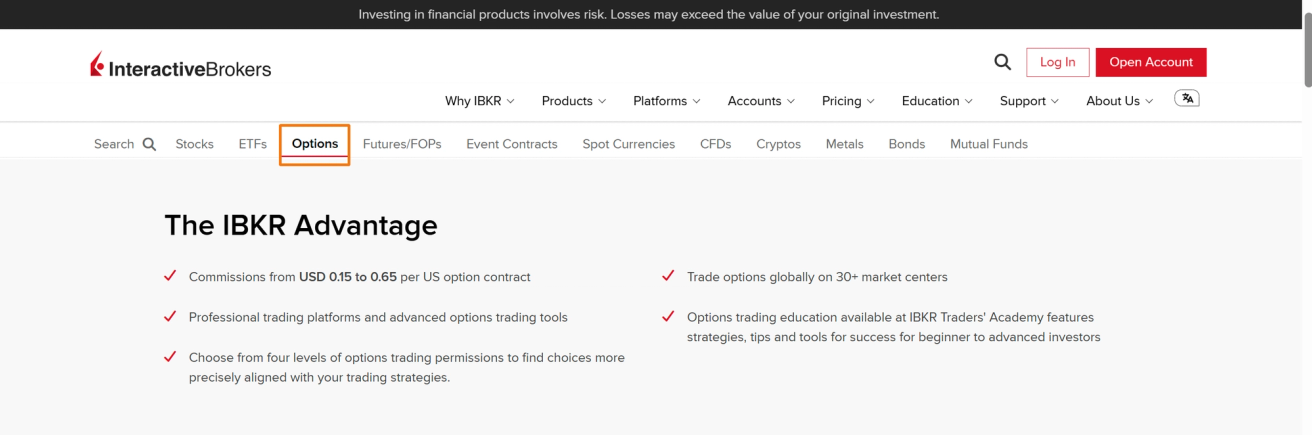
Interactive Brokers options page. Screenshot from Interactive Brokers' website, 24 November 2026.
Its margin rates are low at every balance size. IBKR Pro charges 5.38% on the first $100,000 borrowed, 4.88% from $100,000 to $1 million and 4.63% from $1 million to $50 million. IBKR Lite charges 6.38% on any balance.
The trade-off is Trader Workstation, a desktop platform built for active traders that takes time to learn. US clients hold their account with Interactive Brokers LLC, a FINRA member. Your securities are covered by SIPC up to $500,000, including $250,000 for cash. SIPC does not cover losses from trading.
Want to know more about Interactive Brokers? Check our Interactive Brokers review and our Interactive Brokers fees guide.
2# Public

Public at a glance
Public charges no commission and no contract fee on stock and ETF options. If you enroll in its Options Rebate Program, it also pays you a rebate on each contract, which depends on how many contracts you trade in a month:
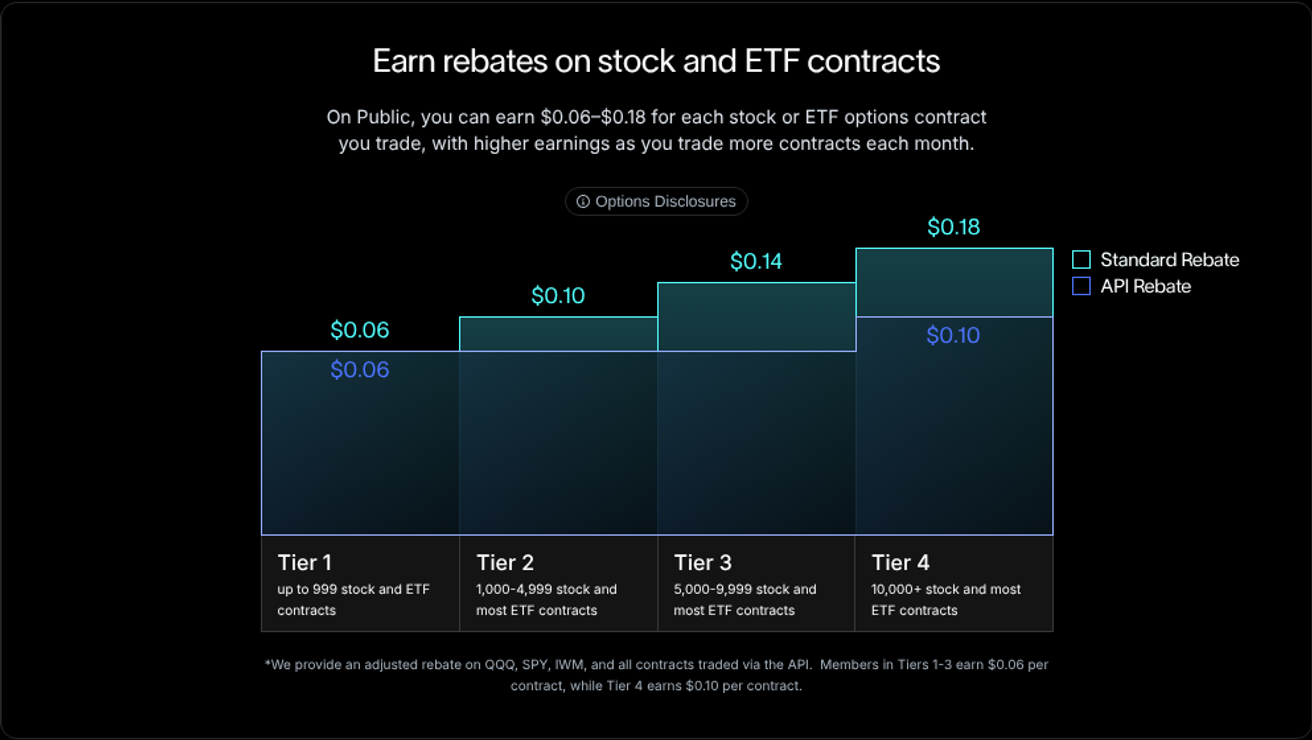
Public's options rebate tiers. Screenshot from Public's options trading page, 24 November 2026.
- Stock and ETF options: $0 commission and $0 per contract, with a rebate of $0.06 to $0.18 per contract.
- QQQ, SPY, IWM and API trades: a lower rebate of $0.06 per contract in Tiers 1 to 3 and $0.10 in Tier 4.
- Index options (SPX, NDX, VIX): $0.35 to $0.50 per contract.
- Regulatory fees: Public puts them at about $0.05 per contract, so at Tier 1 the rebate covers them.
Public says it returns 50% of its options payment for order flow to customers as the rebate. Once you reach a higher tier, you keep that rate for the rest of the month and all of the next one.
Margin costs 5.15% on balances up to $50,000 and 5.00% up to $100,000, falling to 4.20% above $50 million (rates as of 17 September 2026). Spreads and other margin-based strategies need Level 3 options approval and margin investing. The platform includes an Options Hub with the most traded contracts, a customizable options chain, a strategy builder, a rolling tool and a trading API.
Public's brokerage accounts are held with Open to the Public Investing, a FINRA member, with Apex Clearing as the clearing firm. Your securities are covered by SIPC up to $500,000, including $250,000 for cash. SIPC does not cover losses from trading. New customers can check the Public referral code before opening an account.
3# Webull

Webull at a glance
Webull charges no commission and no contract fee on US stock and ETF options, with a desktop platform, a mobile app and a paper trading account to practise with virtual money. Options pricing:
- Stock and ETF options: $0, plus a $0.02 Options Regulatory Fee and a $0.025 OCC clearing fee per contract.
- Index options such as SPX: $0.50 per contract plus the exchange's own fee. Premium members trading more than 1,000 index option contracts a month pay $0.40, or $0.30 above 5,000.
- Oversized option orders: $0.10 per contract.
Margin costs 8.74% on a $10,000 loan, or 5.45% with Webull Premium, which costs $3.99 a month or $40 a year. A margin account needs at least $2,000.
US clients hold their account with Webull Financial LLC, a FINRA member. Your securities are covered by SIPC up to $500,000, including $250,000 for cash. SIPC does not cover losses from trading.
Want to know more about Webull? Check our Webull US review and our Webull fees guide.
4# tastytrade

tastytrade at a glance
tastytrade is a US broker built around options trading, with stocks, ETFs, futures and options on futures in the same account. Options pricing:
- Stock and ETF options: $1 per contract to open, capped at $10 per leg, and $0 to close.
- Broad-based index options: $1 per contract to open and $0 to close.
- Options on futures: $1.25 per contract to open and to close on E-mini futures, $0.75 on Micro E-mini and E-nano futures.
- Other fees: exchange, clearing and regulatory fees are added on all opening and closing trades.
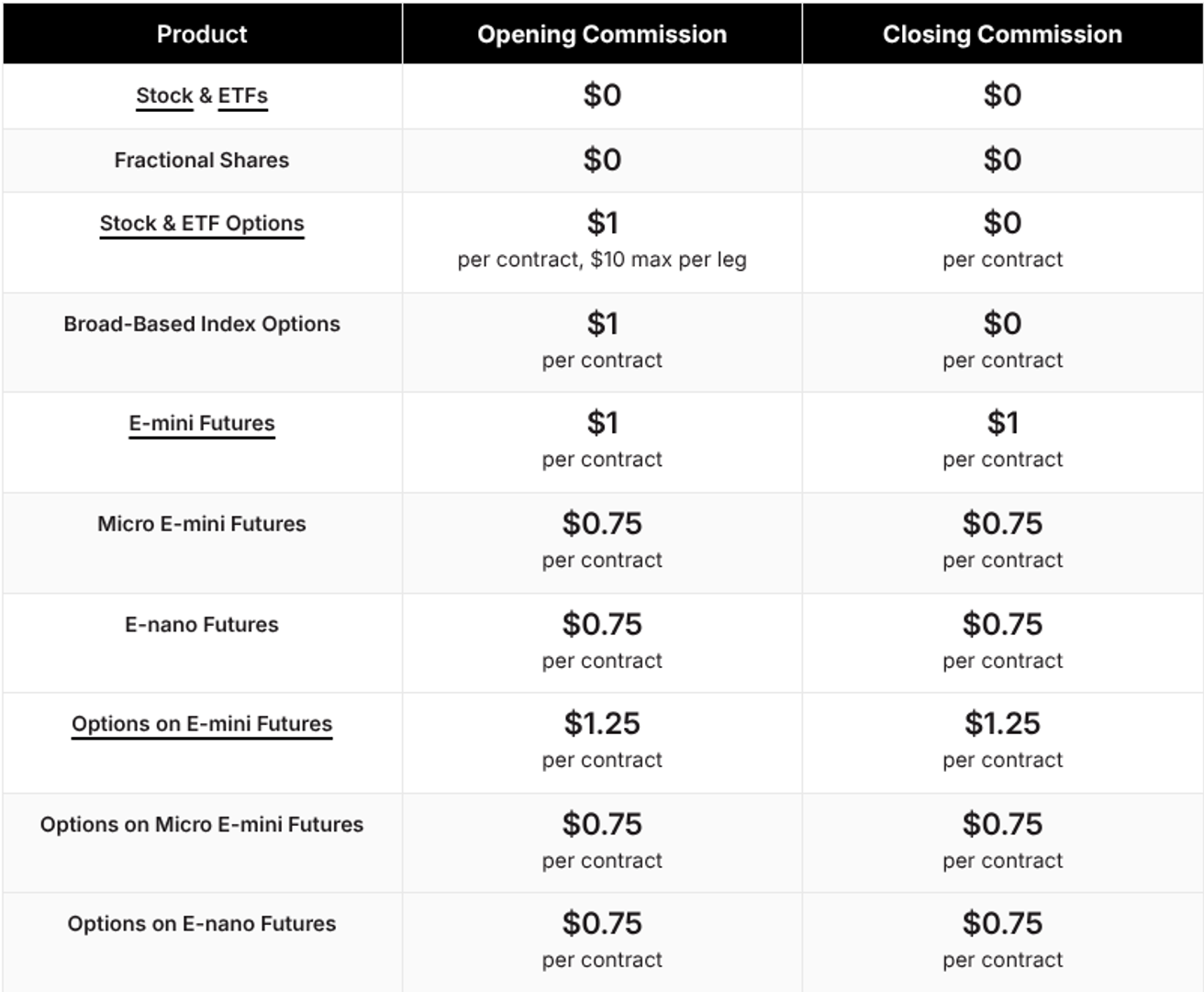
tastytrade commissions on options and futures. Screenshot from tastytrade's pricing page, 24 November 2026.
The $10 cap makes large orders cheaper: 50 contracts cost $10 to open, against $32.50 at $0.65 per contract. The margin rate is a flat 6.75% on the whole balance, but only if you open your first tastytrade margin account or bring $25,000 or more in new assets. The platform includes options backtesting and an API.
tastytrade, Inc. is a member of FINRA, SIPC and the NFA. Your securities are covered by SIPC up to $500,000, including $250,000 for cash. SIPC does not cover losses from trading.
5# Robinhood

Robinhood at a glance
Robinhood charges no commission and no contract fee on stock and ETF options, in an app built for simplicity. Options pricing:
- Stock and ETF options: $0, with about $0.04 of regulatory and clearing fees per contract.
- Index options: $0.50 per contract, or $0.35 for Robinhood Gold members, plus the exchange's fee.
Margin rates run from 5.25% for the smallest balances to 4.20% for the largest, as of 16 September 2026. Robinhood Gold costs $5 a month or $50 a year. It includes the first $1,000 of margin with no interest and pays interest on the cash you hold as collateral for short puts and eligible multi-leg strategies.
Robinhood Financial is a FINRA member. Your securities are covered by SIPC up to $500,000, including $250,000 for cash. SIPC does not cover losses from trading. See our Robinhood fees guide for the full list of costs.
6# Firstrade

Firstrade at a glance
Firstrade is a US discount broker with no commission on stocks, ETFs, options and mutual funds, no minimum to open an account and no inactivity fee. Options pricing:
- Stock and ETF options: $0 commission and $0 per contract.
- Exercise and assignment: $0.
- Regulatory fees: a $0.02 Options Regulatory Fee per contract on buys and sells, charged by Apex Clearing, and the SEC fee on sales.
- Index options: Cboe's index option fee is passed on.
- Broker-assisted orders: $19.95 plus $0.50 per contract.
Margin is expensive for small balances: 12.25% up to $24,999, falling to 8.25% above $1 million, based on a base rate of 11% as of 16 September 2026.
Firstrade Securities is a FINRA member. Your securities are covered by SIPC up to $500,000, including $250,000 for cash. SIPC does not cover losses from trading.
7# Fidelity

Fidelity at a glance
Fidelity charges no commission on online US stock, ETF and options trades and has no minimum to open an account. Options pricing:
- Stock and ETF options: $0.65 per contract.
- Buy-to-close orders at $0.65 or less: free, which helps when you close a short option that is nearly worthless.
- Regulatory fees: the Options Regulatory Fee is passed on for buys and sells.
Margin rates run from 12.075% for balances up to $24,999 to 7.75% above $1 million, based on a base rate of 10.825% since 18 September 2026. Fidelity is a FINRA member. Your securities are covered by SIPC up to $500,000, including $250,000 for cash. SIPC does not cover losses from trading.
Want to know more? Check our Fidelity fees guide.
8# Charles Schwab

Schwab at a glance
Charles Schwab offers options on its thinkorswim platform as well as on its website and app. Options pricing:
- Stock and ETF options: $0 commission and $0.65 per contract online. Multi-leg orders pay $0.65 for every contract in the order.
- Exercise and assignment: $0.
- Futures options: $2.25 per contract.
- Broker-assisted trades: $0.65 per contract plus a $25 service charge.
- Index options: some carry an extra exchange fee.
Schwab's base margin rate is 10.25%, so a balance under $25,000 pays 12.075%. Schwab is a FINRA member. Your securities are covered by SIPC up to $500,000, including $250,000 for cash. SIPC does not cover losses from trading.
How to choose an options trading platform
- Contract fees: if you trade often, a $0 or capped contract fee saves more than any other feature. Check the index option fee too if you trade SPX or NDX, since $0 brokers charge for those.
- Margin rates: spreads, uncovered options and other strategies of the higher levels usually need a margin account. $10,000 borrowed for a year costs about $515 at Public, $538 at IBKR Pro and $1,208 at Fidelity or Schwab.
- Options approval levels: brokers approve you for a level of options trading based on your experience, income and goals. Lower levels cover covered calls, cash-secured puts and buying calls and puts. Higher levels add spreads and, at the top, selling uncovered options. The names of the levels differ between brokers.
- Platform and tools: check the options chain, the strategy builder, the risk graphs and how fast you can roll a position. Interactive Brokers and Webull offer paper trading, so you can test the platform with virtual money first.
- Margin minimum: FINRA rules require at least $2,000 of equity to trade on margin, whatever the broker's minimum to open a cash account.
- Investor protection: all 8 brokers are FINRA members, and their securities accounts are covered by SIPC up to $500,000, including $250,000 for cash.
Are options right for you?
Options can lose all of their value in a short time, and some strategies, such as selling uncovered calls, can lose more than you invested. Before your first trade, read the Characteristics and Risks of Standardized Options document published by the Options Clearing Corporation, which brokers must give you when you apply for options trading.
If you mainly invest for the long term, the cheapest broker for your stocks and ETFs matters more than the options fees. If you trade options every week, the per-contract fee, the index option fee and the margin rate are the three numbers to compare first.
Disclaimer: When investing, your capital is at risk and you may get back less than invested. This article is for information only and is not tax or investment advice.
FAQs
Which is the cheapest options trading platform in the US?
Public, Firstrade, Robinhood and Webull charge $0 commission and $0 per contract on stock and ETF options, so you only pay regulatory and clearing fees of a few cents per contract. Public also pays a rebate of $0.06 to $0.18 per contract, which covers those fees at Tier 1. For index options, Public, Robinhood and Webull charge $0.35 to $0.50 per contract, and exchange fees apply at every broker.
Which options broker has the lowest margin rates?
For small balances, Public, at 5.15% up to $50,000, followed by Robinhood at 5.25% and IBKR Pro at 5.38% up to $100,000. Fidelity and Schwab charge 12.075% and Firstrade 12.25% on balances under $25,000.
Which is the best options broker for beginners?
A broker with no contract fees and a simple app, such as Public, Webull or Robinhood, keeps costs low while you learn on small trades. Before you trade, learn how options lose value over time and start with strategies of the lower approval levels, such as covered calls or buying calls and puts.
Which is the best options broker for advanced traders?
Interactive Brokers, for its low margin rates, tiered pricing at high volumes and access to options on exchanges outside the US. tastytrade suits active traders who place large orders, thanks to free closing trades and the $10 cap per leg.
Do you need a margin account to trade options?
Not for buying calls and puts, covered calls or cash-secured puts, which most brokers allow in a cash account. Spreads, uncovered options and other strategies of the higher approval levels usually need a margin account, which requires at least $2,000 of equity.
What fees do you pay on top of the options commission?
US options pay an Options Regulatory Fee on buys and sells, an OCC clearing fee and, on sales, the SEC fee. Index options such as SPX also pay an exchange fee. These usually add a few cents per contract, while index option exchange fees can be higher.
Are $0 options trades really free?
You pay no commission or contract fee, but brokers with $0 options earn payment for order flow from market makers. This does not appear on your statement, but it can affect the price you get, especially on options with wide bid-ask spreads.