In the world of investing, simplicity often wins. That’s the essence of the “chill” philosophy, which favours a hands-off, stress-free approach. And if you’re looking for an investment that fits this mould, VWCE might be the answer. But what exactly is VWCE, and why has it become so popular among European investors?
In this article, we explain how VWCE became synonymous with the “chill” investing strategy, its pros and cons, how it compares with other strategies, and the alternatives, including the new Vanguard FTSE Global All-Cap ETF that many investors already call the new “VGLA and chill”.
What is VWCE?
VWCE is the Xetra and Euronext ticker of the Vanguard FTSE All-World UCITS ETF (USD) Accumulating, an exchange-traded fund (ETF) managed by Vanguard, one of the most reputable asset managers in the world. It tracks the FTSE All-World Index, which covers large and mid cap companies in both developed and emerging markets.
Key features of VWCE (factsheet, as of July 31, 2026):
- Asset manager: Vanguard;
- Index: FTSE All-World Index;
- Fund size: $53.4 billion in this share class ($79.6 billion across the whole fund);
- Inception date: July 23, 2019;
- Fund currency: USD (but you can buy it in EUR, GBP or CHF, depending on the exchange);
- Replication: physical, with a representative sample of the index;
- TER: 0.14% a year.
Because it uses physical replication, the ETF holds the actual stocks of its index. As an accumulating ETF, it reinvests dividends instead of paying them out, which lets your investment compound over time.
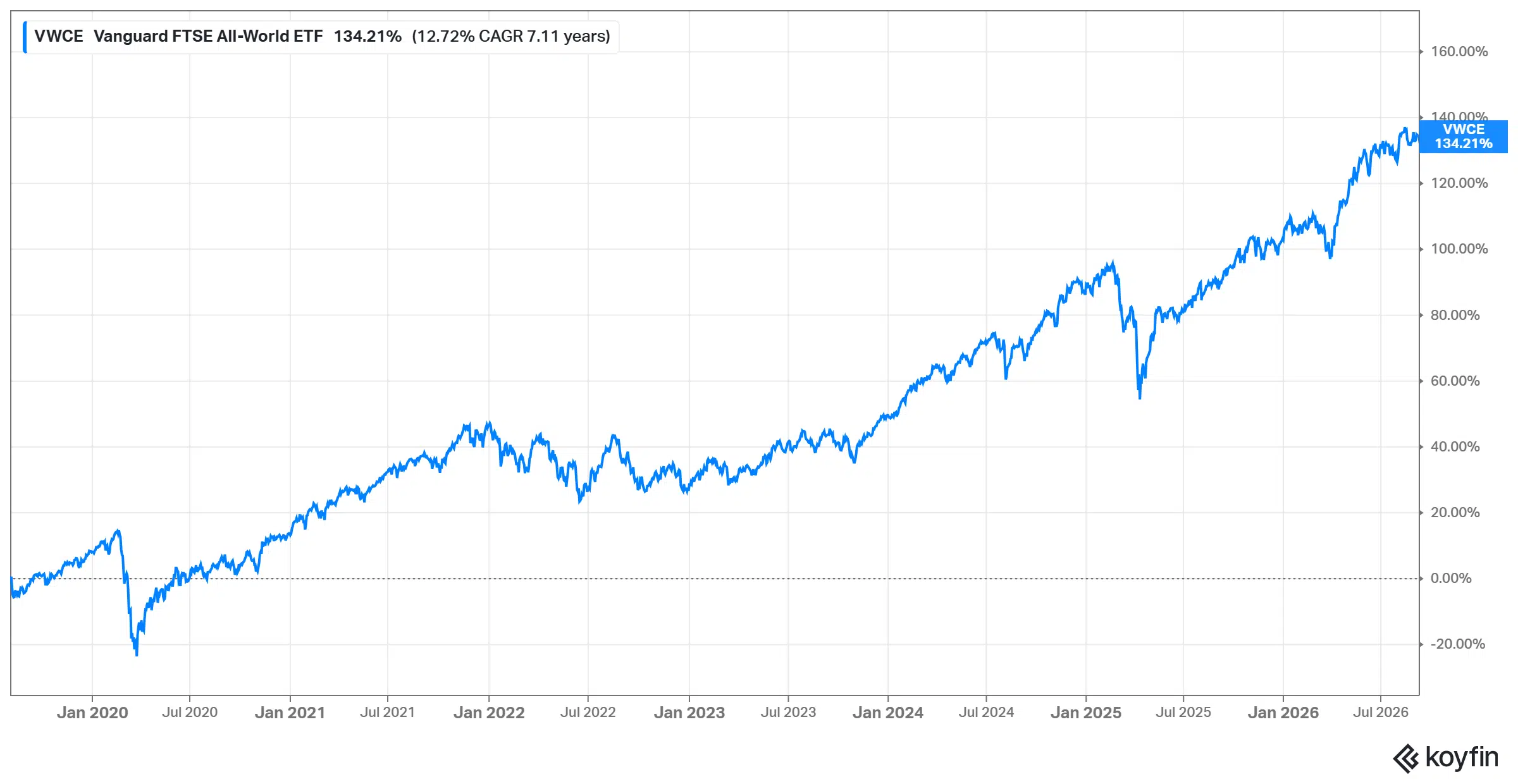
At the end of July 2026, VWCE held 3,782 stocks. Since its launch, it has returned 13.01% a year in USD (10.84% a year over the last 5 years), according to Vanguard. Returns in euros are different, because they also reflect the EUR/USD exchange rate.
The “chill” approach to investing
So, what exactly does “VWCE and chill” mean? The phrase, popularised on Reddit, describes a passive, hands-off approach to investing. The idea is simple: instead of actively trading, you invest in a diversified, low-cost ETF like VWCE, set up regular investments (weekly, monthly…) and let time and compounding do the work.
VWCE fits the “chill” philosophy well:
- Global diversification: VWCE covers both developed and emerging markets, spreading your money across thousands of companies;
- Accumulating: by reinvesting dividends, VWCE lets your investment grow without constant attention;
- Passive management: the key to the chill approach is not overthinking or constantly adjusting your portfolio. With VWCE, the focus is on long-term growth, with minimal effort.
This strategy suits investors who prefer a “set it and forget it” method. By investing a fixed amount regularly (dollar-cost averaging, or DCA), you keep buying whatever the market does. As the saying goes, time in the market beats timing the market.
Is VWCE suitable for every investor?
While VWCE provides global diversification and a simple approach, it may not suit every investor. Taxes, risk profile and goals all matter. Below, we look at the main points to consider.
1. Tax considerations
The tax treatment of accumulating ETFs like VWCE can significantly affect your returns, depending on where you live.
In Germany, investors pay tax every year on a notional return from accumulating funds, known as the Vorabpauschale, even if they don’t sell. It’s based on the Basiszins, a rate set every January from German government bond yields: 2.53% for 2025 and 3.20% for 2026. For example:
Suppose you start 2026 with €10,000 in VWCE and the value rises to €11,000 by the end of the year. The notional return is €10,000 × 3.20% × 0.7 = €224. Since VWCE is an equity fund, 30% of that amount is tax-exempt (Teilfreistellung), leaving €156.80 taxable. At 25% plus the 5.5% solidarity surcharge, the tax is around €41, deducted by your bank in January 2027, unless it’s covered by your €1,000 annual tax-free allowance (Sparer-Pauschbetrag). The Vorabpauschale is not an extra tax: it is credited against the tax you pay when you eventually sell.
In other European countries, tax systems vary widely, and some use different methods to tax ETF investments (such as capital gains or wealth taxes). Check how your country treats accumulating ETFs, and consult your local tax authority or a tax adviser if in doubt.
2. Conservative investors
VWCE is an all-equity ETF, which makes it volatile. For conservative investors, the lack of bonds can be a significant drawback. Bonds usually reduce volatility and help stabilise a portfolio during market declines, while equities drive long-term returns but can suffer large drawdowns during crises.
A 100% equity strategy like VWCE can lead to large swings in your portfolio, which may not suit investors nearing retirement or those who need more predictable returns. Adding bonds can help smooth returns.
For example, a retiree might hold fewer equities and more bonds, to reduce the risk of having to sell stocks during a bear market. You can learn more about balancing stocks and bonds in this video by Ben Felix.
3. Fees
VWCE has a low total expense ratio (TER) of 0.14%, after Vanguard cut it from 0.19% in July 2026. For years, however, it was one of the more expensive global ETFs domiciled in Ireland, and cheaper options now exist: the new Vanguard FTSE Global All-Cap ETF (VGLA) and the Amundi Prime All Country World (WEBN) both charge 0.07%. Since fees compound over time, it’s worth comparing TERs across similar ETFs.
Invesco, for example, offers a similar global ETF tracking the same index (FWRA) with a TER of 0.15%. Besides the TER, look at fund size and tracking difference: smaller funds can have wider spreads, and a fund’s actual gap to its index matters more than its TER alone. You can compare the FTSE All-World ETFs on justETF.
4. Age and time horizon
Age is another key factor. Younger investors with long-term goals can benefit from VWCE’s equity exposure, since they have time to recover from short-term falls. However, handling market downturns requires discipline, especially knowing that global stocks have fallen around 50% in past crises.
As investors approach retirement, reducing equity exposure and adding bonds (for example, through an ETF like VAGF) can reduce risk. A common approach, known as the glide path, gradually shifts from equities to bonds as retirement nears.
Who benefits most from VWCE?
VWCE is best suited for:
- Long-term investors: those with a long investment horizon (10+ years) looking for global equity exposure;
- Growth-oriented investors: investors focused on building capital, since VWCE reinvests dividends;
- Cost-conscious investors: at 0.14%, VWCE is a low-cost, globally diversified option for passive investors.
Who might consider alternatives?
VWCE may not be the best option for:
- Income-seeking investors: those looking for regular dividends might prefer a distributing ETF, such as VWRL;
- Conservative investors: investors who want a balanced portfolio with bonds may find VWCE too volatile on its own;
- Investors with specific tax rules: in some countries, distributing funds or local products may be more tax-efficient than accumulating ETFs.
By considering these factors, you can decide whether VWCE fits your strategy or whether an alternative suits your goals and risk tolerance better.
How does VWCE compare to other investment strategies?
When comparing VWCE with other popular ETFs and strategies, consider diversification, costs and performance.
1. VWCE vs IWDA + EMIM
VWCE and IWDA + EMIM are both popular strategies for global investors. VWCE is a single ETF covering developed and emerging markets, while combining IWDA and EMIM lets you control the mix by holding developed and emerging markets in two separate ETFs.
Diversification
VWCE tracks the FTSE All-World Index, which has more than 4,200 large and mid cap stocks from developed and emerging markets. This makes it a convenient one-stop solution.
IWDA follows the MSCI World Index, with around 1,280 stocks from developed markets only. To fill the gap, investors add EMIM, which tracks the MSCI Emerging Markets IMI Index, including emerging market small caps.
Together, IWDA and EMIM hold several thousand stocks, more than VWCE, and let you set your own emerging markets weight. The two approaches also classify some countries differently: FTSE treats South Korea as a developed market, while MSCI treats it as emerging.
TER and brokerage fees
When comparing VWCE with IWDA + EMIM, consider both the TER and brokerage fees.
With IWDA at 0.20% and EMIM at 0.18%, an allocation of 88% IWDA and 12% EMIM costs just under 0.20% a year, more than VWCE’s 0.14% since its July 2026 fee cut. On a €100,000 portfolio, that’s a difference of around €60 a year.
Managing two ETFs also usually means more trades and, depending on your broker, more brokerage fees. With VWCE, you only buy one ETF, which keeps regular investing simple and cheap.
Simplicity
In terms of simplicity, VWCE has a clear advantage. A single global ETF removes the need to rebalance between regions.
IWDA + EMIM gives you more control, but you have to manage the split between developed and emerging markets yourself.
Performance
Since VWCE’s launch in July 2019, its performance has been close to that of the IWDA + EMIM basket, with the basket slightly ahead in the period shown in the chart below. The gap comes mainly from the differences between the FTSE and MSCI indices (country classification and the small caps in EMIM) rather than from fees, since VWCE was only cheaper from 2026.
Here’s the total return in EUR of VWCE against a basket of 88% IWDA and 12% EMIM:

Should you choose VWCE or IWDA + EMIM?
If you’re deciding between VWCE and IWDA + EMIM, consider the following:
- Do you want more control? IWDA + EMIM lets you set your own weight in developed and emerging markets. VWCE is an all-in-one solution;
- Are you focused on costs? VWCE is now cheaper (0.14% against just under 0.20%). The difference is small but adds up over time, especially for large portfolios;
- Are you comfortable rebalancing? Two ETFs need occasional rebalancing. If you prefer a hands-off approach, VWCE is easier to maintain.
Ultimately, if you value control over your emerging markets weight, IWDA + EMIM may suit you better. If simplicity and cost are your priorities, VWCE is the more natural choice.
2. VWCE vs VGLA: the new “VGLA and chill”?
On August 20, 2026, Vanguard started trading the Vanguard FTSE Global All-Cap UCITS ETF (ticker VGLA on Xetra and VALL on most other exchanges, ISIN IE000VAHT5T0), and many investors already see it as the new “VGLA and chill”. It tracks the FTSE Global All Cap Index, which adds small caps to the companies in VWCE’s index.
The main differences:
- Diversification: the FTSE Global All Cap had 10,127 stocks at the end of July 2026, covering around 98% of the world’s investable stock market, against around 90% for the FTSE All-World. Small caps make up around 9% of the index;
- Cost: VGLA’s TER is 0.07% a year, half of VWCE’s 0.14%;
- Track record: VGLA is very new, so it has no tracking history yet, and its fund size and liquidity are still building. VWCE has a record since 2019 and is one of the largest ETFs in Europe.
Since small caps are a small slice of the index, the two ETFs should perform very similarly most of the time. If you already hold VWCE, selling it to switch would usually trigger capital gains tax, which could cancel out the 0.07% annual saving for many years. For most investors, it makes more sense to keep the VWCE they already own and, if they prefer, direct new contributions to VGLA.
You can read more in our full review of the Vanguard FTSE Global All-Cap ETF (VGLA).
3. Sector-focused ETFs
VWCE offers broad exposure to global markets. Sector ETFs, on the other hand, concentrate on specific industries such as technology, healthcare or energy. They can outperform the global market when their sector does well, but they carry more risk, because they depend on a single industry.
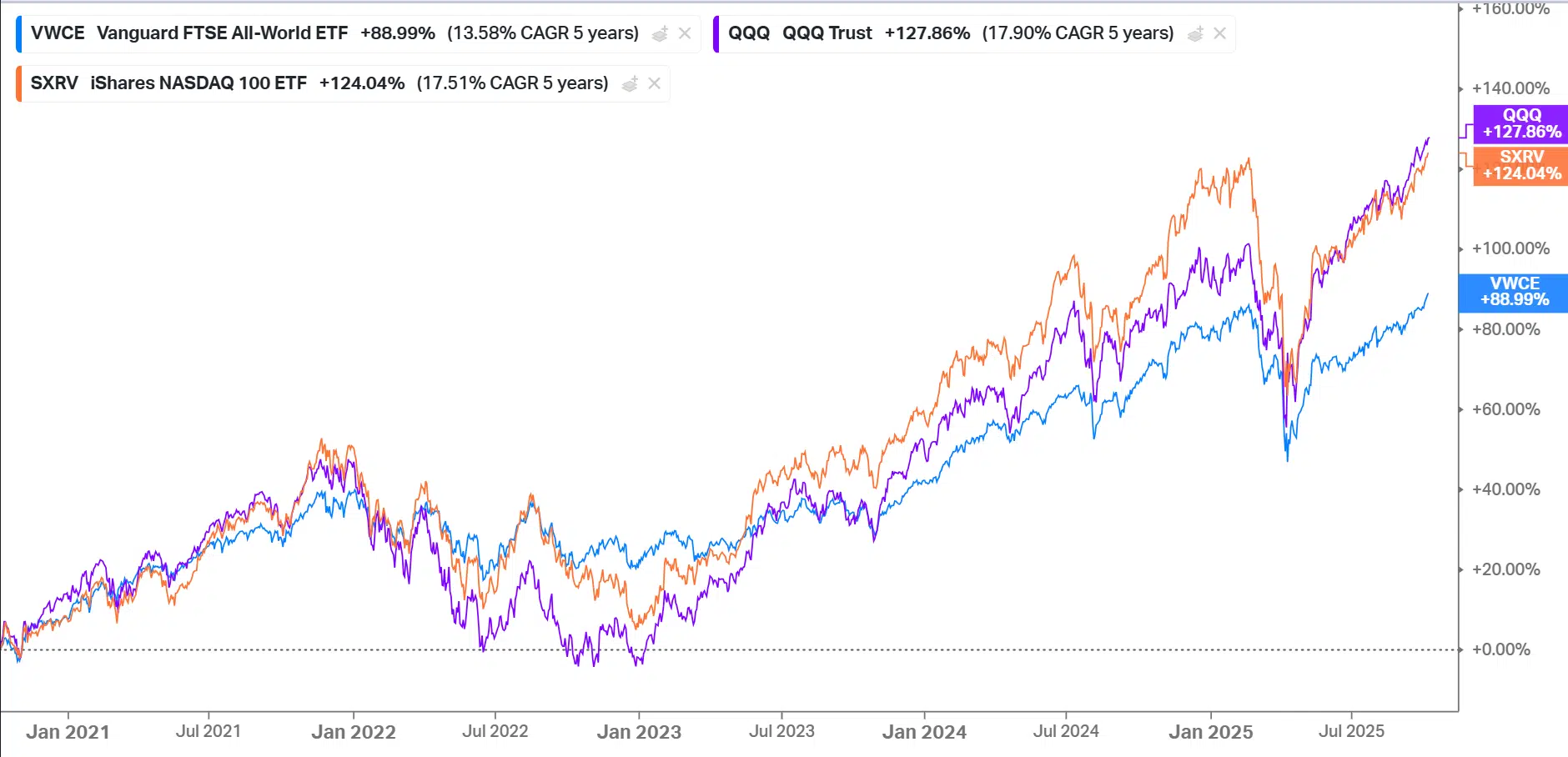
For example, a technology ETF might have outperformed VWCE during periods of strong tech growth, but during downturns, such as the 2022 tech sell-off, VWCE’s broader diversification cushioned the fall.
Below is an example of how VWCE compares with technology-heavy ETFs like QQQ and SXRV:
4. Portfolio of VWCE + bonds
Bonds or bond ETFs, such as those tracking government or corporate bonds, are generally less volatile than equities like VWCE. They tend to offer lower returns but can provide regular income through interest payments.
Total return
VWCE, being 100% equities, doesn’t offer the stability of a 60% VWCE / 40% VAGF portfolio, but it may deliver higher returns over the long term.
Below is an example comparing the total return of VWCE with a 60% VWCE / 40% VAGF portfolio:

Drawdown
For investors who want a more balanced approach, combining VWCE with a bond ETF like VAGF can reduce volatility during market downturns, while still allowing for equity growth.
In the period shown in the charts below, VWCE had a maximum drawdown of around 20%, while the 60% VWCE / 40% VAGF portfolio had a smaller maximum drawdown of around 14%, showing how bonds can cushion losses.
Below is the maximum drawdown for VWCE:

Below is the maximum drawdown for a 60% VWCE / 40% VAGF portfolio:

5. Actively managed portfolios
VWCE is passively managed: it simply tracks the FTSE All-World Index. This keeps costs low (TER of 0.14%), and research consistently shows that most actively managed funds underperform their index over the long term, largely because of higher fees.
Actively managed portfolios try to beat the market by picking specific stocks, sectors or regions, but they charge higher fees and offer no guarantee of better results.
6. VWCE vs popular ETFs
VWCE has delivered solid returns since its launch in 2019 (13.01% a year in USD, according to Vanguard). However, ETFs such as the iShares Core MSCI World (IWDA) and the Vanguard S&P 500 UCITS ETF (VUAA) did better over most of this period, reflecting the strength of US stocks, and especially US technology companies.
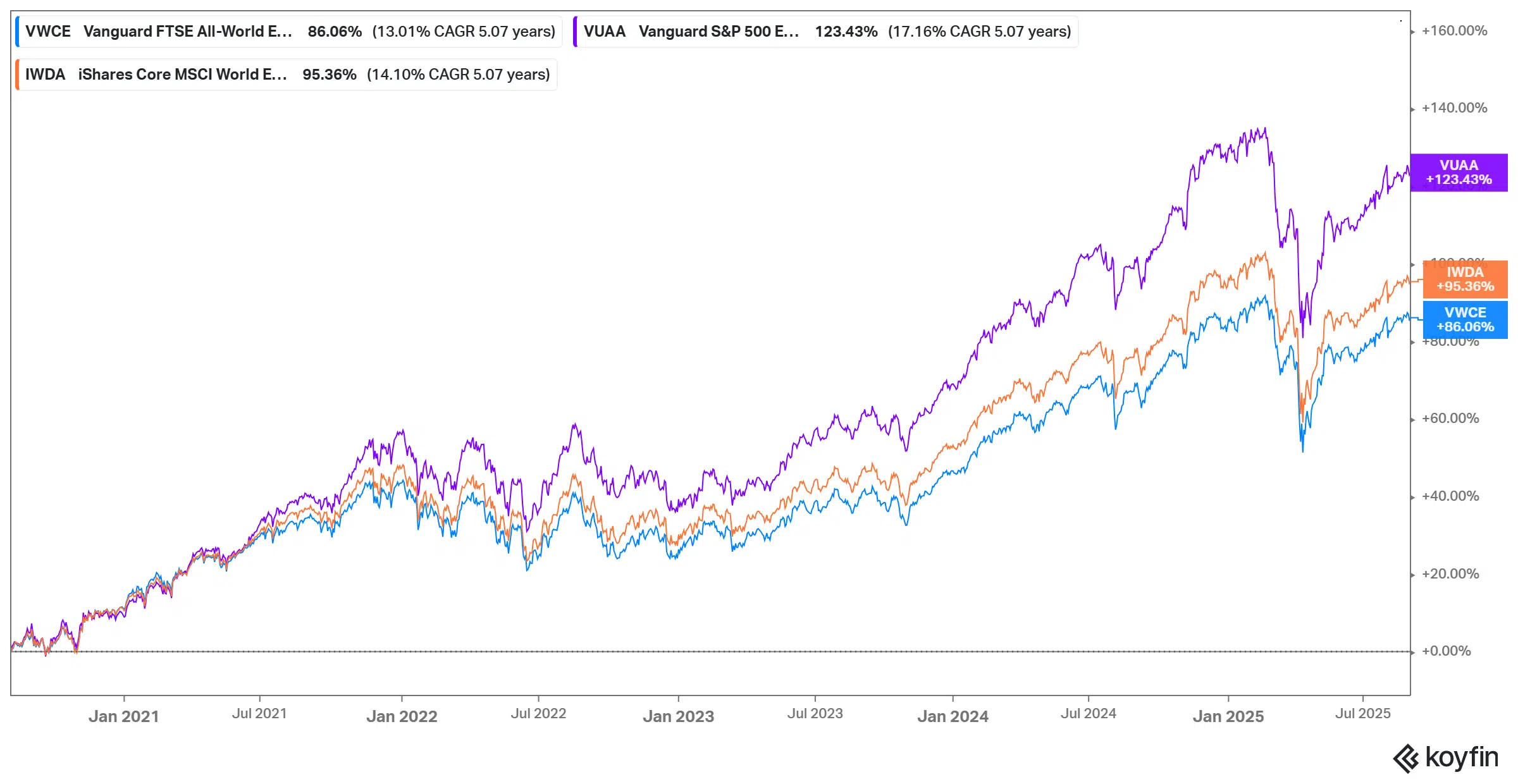
This can change: in 2025, for example, VWCE (22.56% in USD) beat IWDA (21.16%), helped by the strong performance of emerging markets. VWCE’s broader diversification makes it a more balanced choice for investors who don’t want to bet on any single region.
How to incorporate VWCE into a broader portfolio?
VWCE can serve as the core of a diversified portfolio. For many investors, however, combining an all-equity ETF with other asset classes, such as bonds, real estate or gold, can smooth returns and help manage risk. Here are some common approaches.
1. Combining VWCE with bonds
For those who want to reduce the volatility of equities, combining VWCE with bonds is a popular strategy. The classic 60/40 portfolio puts 60% in equities (like VWCE) and 40% in bonds.
- Bonds offer stability: high-quality bonds, like the government and corporate bonds in the Vanguard Global Aggregate Bond UCITS ETF (VAGF), are usually less volatile than stocks and often hold up better when stock markets fall, although not always (in 2022, stocks and bonds fell together).
2. Adding REITs or gold
Some investors also add real estate investment trusts (REITs) or gold:
- Real estate: REITs give you exposure to property and pay regular dividends, although they tend to move quite closely with the stock market;
- Gold: gold is often used as a hedge against inflation and crises, and it has sometimes held its value during market sell-offs, although it pays no income and can go through long periods of weak returns.
3. Cash and short-term assets
Holding some cash or money market funds gives you liquidity and a buffer against market volatility. While cash doesn’t generate high returns, interest on uninvested cash or short-term assets like Treasury bills can earn a modest return. A cash reserve also lets you take advantage of market falls without having to sell other assets at a loss.
Building a balanced portfolio
For illustration only, a diversified portfolio built around VWCE might look like this:
- 50-60% VWCE (global equities for long-term growth);
- 20-30% bonds (for stability and income, for example VAGF);
- 5-10% alternatives (REITs, gold or other commodities);
- 5-10% cash (for liquidity and short-term needs).
The right mix depends on your goals, time horizon and risk tolerance.
What are the risks of the “VWCE and chill” strategy?
While the VWCE and chill strategy is simple and diversified, it has risks you should understand.
1. Market risk
VWCE invests entirely in equities, so it is fully exposed to stock market falls. If global markets drop, VWCE drops too. Diversifying into other asset classes, such as bonds, can provide a buffer.
2. Inflexible asset allocation
With VWCE, you get the allocation defined by the FTSE All-World Index, where the US weighs around 62%. If you want more exposure to specific regions (for example, more European stocks) or less US dollar exposure, VWCE alone won’t give you that control.
3. Currency risk
VWCE’s fund currency is the US dollar, but that’s only an accounting unit. The fund holds stocks in many currencies (US dollar, yen, pound, euro and others), and their movements against your own currency affect your returns. Buying the EUR listing on Xetra or Euronext avoids conversion fees when you buy, but not this currency exposure.
4. No control over rebalancing
Since VWCE follows a fixed index, you can’t rebalance between regions or sectors. As you approach your goals, you may want to reduce your equity exposure, which requires adding other investments alongside VWCE.
5. No regular dividend income
VWCE is an accumulating ETF, so dividends are reinvested rather than paid out. This helps compounding but doesn’t suit investors who need a regular income. Distributing ETFs like VWRL may be a better fit for them.
Best trading platforms to invest in VWCE
Choosing the right platform can make a real difference to your costs. To help you find one that suits your needs, we’ve compared the best ETF brokers in Europe, from low-cost options to platforms with a wide range of ETFs and savings plans.
Bottom line
VWCE is a great option for investors who want a passive, hands-off approach to global investing. Whether you’re just starting or have years of experience, it offers simplicity and lets you focus on your long-term goals rather than short-term market movements.
Like any investment, it’s important to consider how it fits your goals and risk tolerance. If you want more control over your emerging markets exposure, IWDA + EMIM is an alternative, although it’s now slightly more expensive than VWCE. If you want the broadest coverage at the lowest cost, the new VGLA adds small caps for 0.07% a year, although it’s still very young. And if you want less volatility, a 60/40 portfolio with a bond ETF like VAGF can reduce risk while keeping part of the growth potential.
In the end, the choice depends on how much flexibility, control and simplicity you want in managing your portfolio.
If you have questions, feel free to reach out to us.
Investing involves risk and you may get back less than you invest. Past performance is not a reliable indicator of future results. This article is for information only and is not investment or tax advice.
FAQs
VWCE vs IWDA: Which is better for global exposure?
VWCE includes both developed and emerging markets, while IWDA only covers developed markets. If you want broader diversification in a single ETF, VWCE is the more complete option. For a detailed comparison, read our VWCE vs IWDA article here.
VWCE vs VWRL: Accumulating or distributing ETFs?
VWCE reinvests dividends (accumulating), whereas VWRL pays them out (distributing). Your choice depends on whether you prefer regular income or long-term growth through reinvestment. For more details, read our VWCE vs VWRL article here.
VWCE vs VGLA: should I switch?
VGLA tracks a broader index (with small caps) and costs 0.07% a year, against 0.14% for VWCE, but it only started trading in August 2026. If you already own VWCE, selling to switch usually triggers capital gains tax, so many investors keep VWCE and direct new money to VGLA. Read our VGLA review for details.
Does global diversification reduce risk?
Yes. Global diversification spreads your money across different countries and sectors, which reduces the impact of poor performance in any single market. It doesn’t remove market risk, though: global stocks can still fall sharply together.
What happens if emerging markets underperform?
Emerging markets make up only around 10% of VWCE, so a weak period for them has a limited effect on the whole fund. The developed markets, and the US in particular, drive most of VWCE’s returns.
What are the tax implications of investing in VWCE?
Since VWCE reinvests dividends, in many countries you only pay tax when you sell. Some countries, such as Germany with its Vorabpauschale, tax accumulating funds every year, so check how your local rules apply.