Porsche AG has been publicly traded since its September 2022 IPO on the Frankfurt Stock Exchange, listed under the name Porsche AG with ticker P911.DE (not to be confused with PAH3.DE – Porsche Automobil Holding SE, the separate holding company). The “P911” ticker is a nod to the iconic Porsche 911 sports car.
The IPO was one of the largest in European history, valuing Porsche AG at around €75 billion and raising approximately €9.4 billion – briefly making it one of Germany’s most valuable listed companies. Since then, however, the share price has fallen considerably from its post-IPO highs, weighed down by weak demand in China, a costly and repeatedly delayed EV transition, and broader pressure across the European luxury auto sector. As of May 2026, the stock trades in the €39-46 range, with a market capitalisation of roughly €37-42 billion – around half its IPO valuation. Notably, Porsche AG was removed from Germany’s DAX 40 index in 2025 after its market value declined, and now trades in the MDAX.
In this article, we’ll explain everything you need to know about investing in Porsche AG – the story of its IPO, how to buy Porsche AG shares today, the key facts about the stock, and the important distinction between Porsche AG (P911) and Porsche SE (PAH3).
When was the Porsche AG’s IPO date?
Porsche AG’s IPO took place on September 29, 2022, and ranks as one of the biggest IPOs in German stock market history. The shares started trading at €82.50, valuing the company at around €75 billion.
On the financial side, Porsche AG’s sales revenue grew in its first years as a listed company before contracting in 2025:
- 2022: €37.6 billion
- 2023: €40.5 billion
- 2024: €40.1 billion
- 2025: €36.3 billion (down 9.5% year-on-year)
The sharp decline in 2025 reflects a genuinely difficult period for the company. Vehicle deliveries fell 15% to 265,663 units, driven by weak demand in China (where the luxury market remains under heavy pressure) and intensifying price competition in electric vehicles. More strikingly, Porsche AG’s operating profit collapsed from €5.6 billion in 2024 to just €413 million in 2025, cutting its operating return on sales from 14.1% to 1.1%. This was largely due to around €3.1 billion in extraordinary costs tied to a major strategic realignment – including a slowdown of its EV-only ambitions, adjustments to its battery activities, and the impact of US import tariffs (15% from August 2025).
Looking ahead, Porsche AG has guided for an operating return on sales of 5.5% to 7.5% in 2026 as the one-off realignment costs ease, though management continues to expect very challenging market conditions, particularly in China and the EV segment. The dividend for 2025 was significantly reduced compared with prior years.
How to order Porsche AG stock?
We will present you with the trading platforms that allow you to invest in Porsche AG stock! Our criteria included fees, trading platform, regulation, customer support, among others! Here our top pick:
Interactive Brokers
Founded in 1978, Interactive Brokers is a global online broker that provides advanced web and mobile trading platforms, and offers a vast array of financial products (stocks, options, mutual funds, ETFs, futures, bonds, and currencies) from over 150 markets.
eToro
Established in 2007, eToro is one of the leading online brokers known for its social trading platform, with over 35 million users. It gives access to different products such as stocks, ETFs, cryptos, and CFDs on stocks, ETFs, commodities, Forex, indices, and cryptocurrencies.
Disclaimer: Your capital is at risk. Other fees apply. For more information, visit etoro.com/trading/fees.
In the following reviews, we discuss the features of each trading platform, where each broker differs in terms of pricing, accessible markets and instruments, and other special features.
#1 Interactive Brokers

Interactive Brokers caters both to beginners and professional investors looking for educational materials and an easy-to-use platform and advanced technical and fundamental trading tools, and for in-depth research. Investors can use Interactive Brokers’ web-based Client Portal trading platform, as well as the IBKR GlobalTrader Mobile app and the professional Trader Workstation platform.
The TWS platform is easy to use and includes many standard features such as watchlists, alerts, and real-time monitoring, in addition to advanced tools, such as the volatility lab, which is a brief overview of a stock’s past and future volatility parameters, as well as its industry peers and the broader market. In addition, it has advanced technical analysis tools with over 120 indicators and many other highly customizable features.
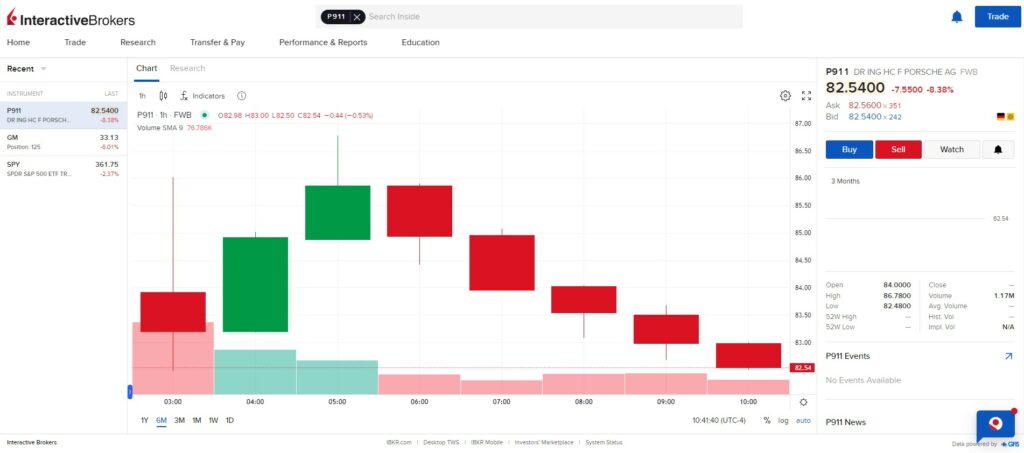
IBKR is a great option for retail investors interested in trading international stocks, ETFs, bonds, futures, options, and even penny stocks. It is ideal for beginners or professionals looking for a large number of instruments and a secure broker. Nearly all Europeans can open an account at IBKR.
On the downside, if you are new to investing, you might find the platform a bit complicated with too many buttons and features. You can read our IBKR review for more information.
#2 eToro

52% of retail CFD accounts lose money.
eToro is an international online broker with over 35 million users who trade stocks, forex, commodities, cryptocurrencies, CFDs, and ETFs. It is known for its social trading feature, where you can copy the trades of other experienced traders. There are thousands of verified traders on eToro, and you can pick the best trader based on past Return on Investment (ROI), risk profile, or other factors.
The eToro platform gives users access to over 3,000 financial instruments and offers commission-free trades on ETFs (other fees apply). Additionally, users can invest in ready-made investment portfolios (Smart Portfolios), a group of several assets or traders combined together based on a theme or strategy.
The web platform has an easy-to-use and intuitive interface that is beginner-friendly while offering advanced features for experienced traders. Among those features is one-click trading, which lets traders open a new position while using pre-determined parameters with just a click.
Additionally, it offers a stop loss feature that lets you keep a position open as long as the market price moves in the right direction. Another feature is the eToro Research Tab, powered by TipRanks, which helps you enhance your knowledge to make better-informed investment decisions.
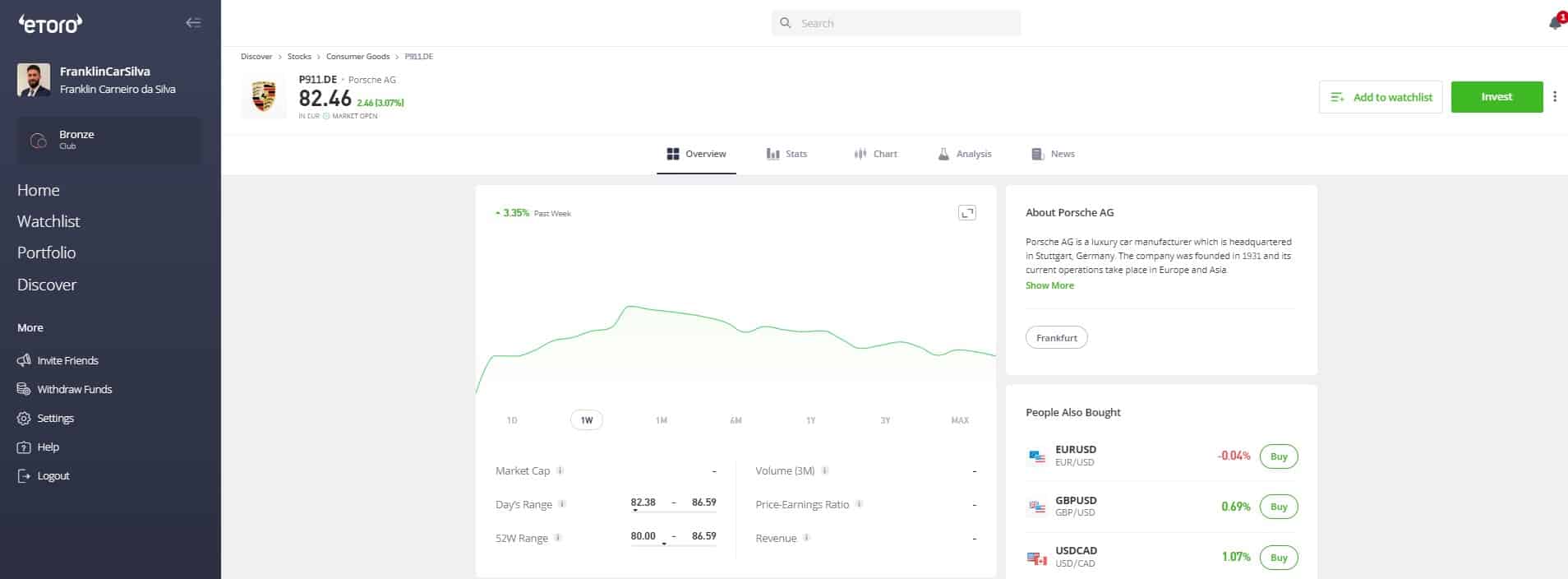
Although the platform is attractive for beginners, it is not the ideal platform for day traders or experienced investors as spreads are high for some products. Additionally, withdrawing money is somewhat expensive compared to other brokers ($5 per withdrawal request). For a full assessment, read our comprehensive eToro review.
Is Porsche AG a good investment?
Whether Porsche AG is a good investment depends on your view of its turnaround prospects, but the recent financials show a company under genuine pressure. Here are the key 2025 figures (in EUR):
- Revenue (2025): €36.27 billion, down 9.5% from 2024 (€40.08 billion)
- Operating Profit (2025): €413 million, a sharp fall from €5.64 billion in 2024 – cutting the operating return on sales from 14.1% to just 1.1%
- Vehicles Delivered (2025): 265,663 units, a 15% decline compared to 2024 (312,620 units)
Additional insights
- Electrified vehicles: rose to around 35% of total deliveries globally (56% in Europe), led by the new all-electric Macan. However, slower-than-expected EV demand prompted Porsche to walk back parts of its aggressive electrification timeline in 2025.
- Strategic realignment: Porsche booked around €3.1 billion in extraordinary costs in 2025 tied to a major repositioning – adjusting its product and battery strategy, streamlining management, and cutting costs. This was the main driver of the collapse in operating profit.
- China weakness: deliveries in China fell sharply (down around 28%), as the luxury segment there remains under heavy pressure and local EV competition intensifies. This remains Porsche’s biggest structural challenge.
- US tariffs: the 15% US import tariff (effective August 2025) added several hundred million euros in costs, since Porsche manufactures exclusively in Europe and has no US production base.
- Outlook: management guides for an operating return on sales of 5.5-7.5% in 2026 as one-off costs ease, but expects continued difficult conditions. The 911 remains a bright spot, with deliveries up 2.9% in 2025.
For investors, the bull case rests on Porsche’s iconic brand, pricing power, and the potential for margins to recover as realignment costs roll off. The bear case centres on structural China weakness, the costly and uncertain EV transition, tariff exposure, and the fact that the stock – despite falling well below its IPO price – still trades at a premium valuation relative to most automakers. As always, this is not investment advice; do your own research before investing.
We’ve only highlighted a few of the available metrics. For more detail, you can visit the Porsche Newsroom website, where the company regularly publishes its financials, deliveries, new model releases, and other news.
Bottom line
Porsche AG remains one of the most recognisable names in the automotive world, and its iconic brand, pricing power, and loyal customer base continue to attract investor attention. However, the investment case has become considerably more complex since its 2022 IPO.
After strong initial years, 2025 was a genuinely difficult one for the company: revenue fell 9.5%, deliveries dropped 15%, operating profit collapsed to just €413 million, and the stock now trades well below its IPO price – so far below, in fact, that Porsche AG was removed from Germany’s DAX 40 index in 2025. The company is undergoing a major strategic realignment, walking back parts of its EV-only ambitions, managing weak demand in China, and absorbing the impact of US import tariffs.
The bull case is that Porsche’s brand strength and pricing power could drive a margin recovery as one-off realignment costs roll off, with management guiding for an improved 5.5-7.5% operating return on sales in 2026. The bear case is that the structural challenges – China weakness, the costly and uncertain EV transition, and tariff exposure – persist, while the stock still trades at a premium valuation relative to most automakers despite its decline.
Whether Porsche AG fits your portfolio depends on your view of that turnaround and your risk tolerance. As with any single-stock investment, it carries company-specific risk, so be sure to conduct your own research or consult a professional financial advisor before investing.
This article is for informational purposes only and does not constitute financial advice.
FAQs
Is Porsche AG a public company?
Yes! It became one on the 29th of September 2022, and it is trading under the ticker P911.DE (not to be confused with ticker PAH3.DE for Porsche Automobil Holding SE).
What is the difference between Porsche AG and Porsche SE?
Porsche SE is just a business holding company with a stake in Volkswagen AG and is not an automobile manufacturer. Porsche AG, wholly owned by Volkswagen AG, is the actual manufacturer of the Porsche automobile brand.
When was the Porsche AG’s IPO?
Porsche’s newly issued (preferred) shares started trading on the Frankfurt Stock Exchange on the 29th September 2022. The offering period commenced on 20th September 2022 and ended on 28 September 2022.