


Covered call ETFs are often marketed as providers of steady income, but in reality, they do not generate income in the traditional sense. These funds sell call options on their holdings, and the distributions investors receive come largely from option premiums that can vary significantly over time.
Despite this limitation, covered call ETFs remain popular with investors who understand their mechanics and still want exposure to this strategy. This article compares the main options available to European investors, with data updated in September 2026.
In the US, Goldman Sachs’s covered call ETFs, most notably GPIX (S&P 500 Premium Income ETF) and GPIQ (Nasdaq-100 Premium Income ETF), were two of the fastest selling ETFs in the first half of 2025, according to The Daily Upside. Reuters reported record inflows into US covered call funds in 2025, as investors looked for yield and some protection from market volatility. The piece described the appeal as “lower highs and higher lows”: capturing around 85% of the upside while paying monthly distributions of 8% to 10% a year.
Europe is following the same path at a smaller scale. The JPMorgan Nasdaq Equity Premium Income UCITS ETF, launched in October 2024, already manages more than €3.6 billion.
What are the best covered call ETFs for European investors?
First of all, US-listed covered call ETFs such as JEPI, JEPQ or QYLD are generally not available to retail investors in the EU. Their issuers don’t publish the KID (Key Information Document) required by the EU’s PRIIPs rules, so European brokers can’t offer them to retail clients. Your route is the European versions of these funds, structured under UCITS regulations and mostly domiciled in Ireland and Luxembourg.
As of September 2026, justETF lists 37 products using covered call strategies in Europe, most of them Irish UCITS ETFs. We highlight four: the three largest by assets under management, plus the Global X S&P 500 fund as the rules-based option on the S&P 500 (some can be explored directly through Freedom24):
1. Global X Nasdaq 100 Covered Call UCITS ETF (QYLD.EU)
- ISIN: IE00BM8R0J59
- Tickers: QYLD (London Stock Exchange in USD, Borsa Italiana in EUR, SIX in CHF), QYLE (Xetra in EUR), QYLDX (Cboe Europe Amsterdam in EUR), QYLP (London Stock Exchange in GBP)
- Strategy: passive. Tracks the Cboe Nasdaq-100 BuyWrite V2 index, which holds the Nasdaq-100 and sells one-month at-the-money call options on it
- Distribution yield: 10.7% over the last 12 months (September 2026). Not guaranteed, it changes every month
- TER: 0.45%
- Replication: synthetic (swap with a bank)
- Fund size: $805 million (31 July 2026)
- Payout frequency: monthly
- Key feature: the highest yield of the four, but almost all the upside above the strike price is given up every month
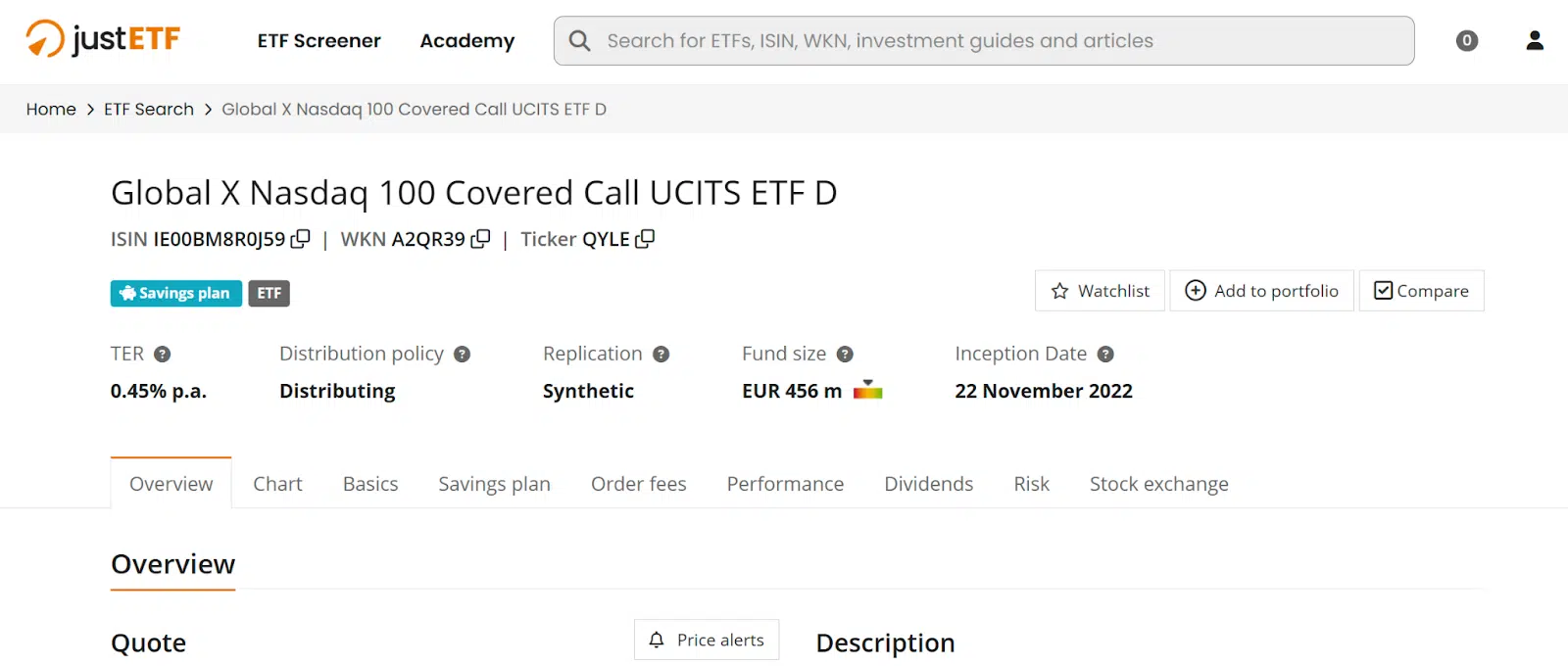
QYLD is designed for income-focused investors seeking a high cash flow and a degree of cushioning in flat or slightly falling markets. It suits those willing to give up most of the growth potential of the Nasdaq-100 in return for high monthly distributions. In the 12 months to July 2026, it returned 17.00% in USD, in line with its buy-write index (17.53%), while the Nasdaq-100 itself gained 22.34% (fund factsheets).
2. JPMorgan Nasdaq Equity Premium Income UCITS ETF (JEPQ.EU)
- ISIN: IE000U9J8HX9
- Tickers: JEPQ (London Stock Exchange in USD, Borsa Italiana in EUR), JEQP (Xetra in EUR)
- Strategy: actively managed. Holds a selection of Nasdaq-100 stocks and sells call options on the index
- Distribution yield: 10.4% over the last 12 months (September 2026). Not guaranteed, it changes every month
- TER: 0.35%
- Replication: physical
- Fund size: €3.63 billion, the largest covered call ETF in Europe
- Payout frequency: monthly
- Key feature: actively managed, with stock selection and option writing decided by JPMorgan’s team rather than by an index rule
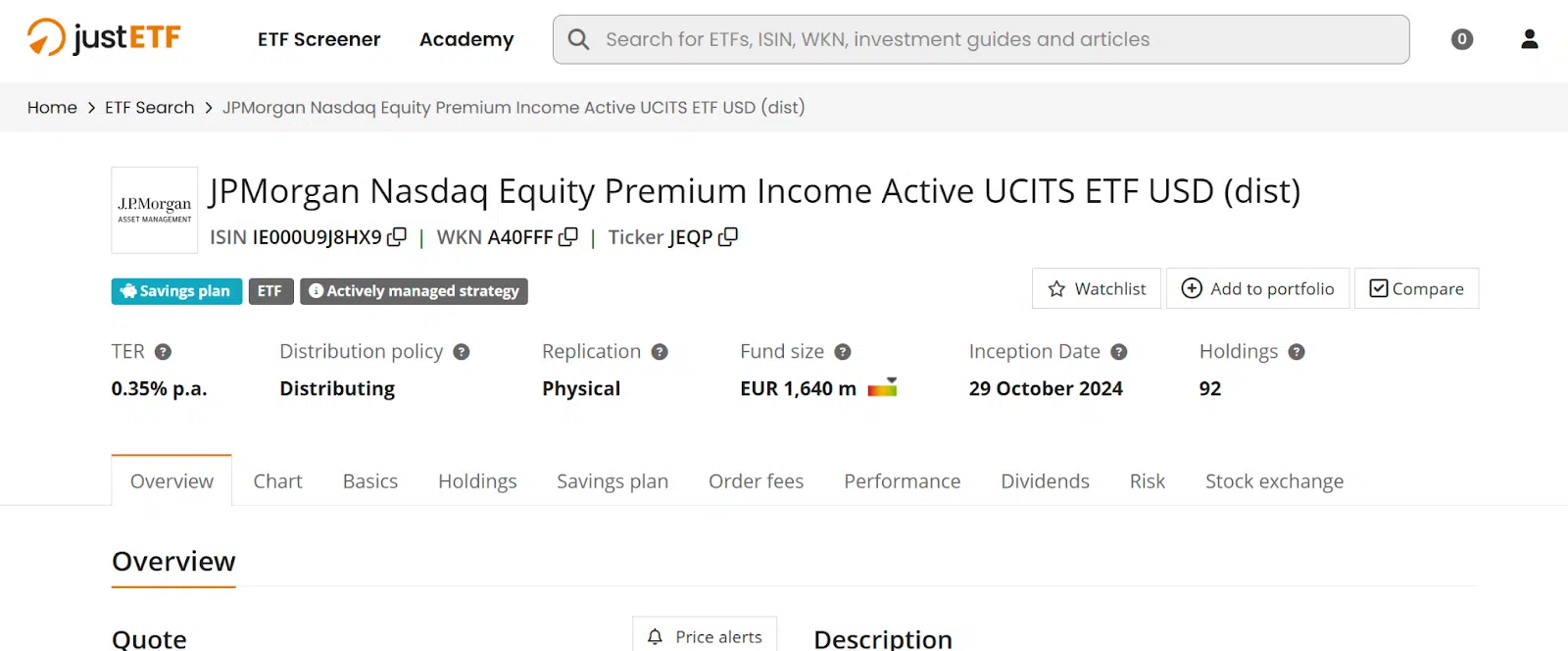
JEPQ is designed for investors who want exposure to large US growth stocks with monthly distributions, and who accept that the options overlay limits part of the upside. In the 12 months to July 2026, it returned 18.07% in USD, against 22.34% for the Nasdaq-100 (fund factsheet). JPMorgan also offers an accumulating share class (IE000N6I8IU2) and a euro hedged class (IE0006FIW9Z0).
3. Global X S&P 500 Covered Call UCITS ETF (XYLU.EU)
- ISIN: IE0002L5QB31
- Tickers: XYLU (London Stock Exchange in USD), XYLE (Borsa Italiana in EUR), XY7D (Xetra in EUR)
- Strategy: passive. Tracks the Cboe S&P 500 BuyWrite 15% WHT index, which holds the S&P 500 and sells one-month call options at or just above the index level
- Distribution yield: 8.7% over the last 12 months (September 2026). Not guaranteed, it changes every month
- TER: 0.45%
- Replication: synthetic (swap with a bank)
- Fund size: €189 million
- Payout frequency: monthly
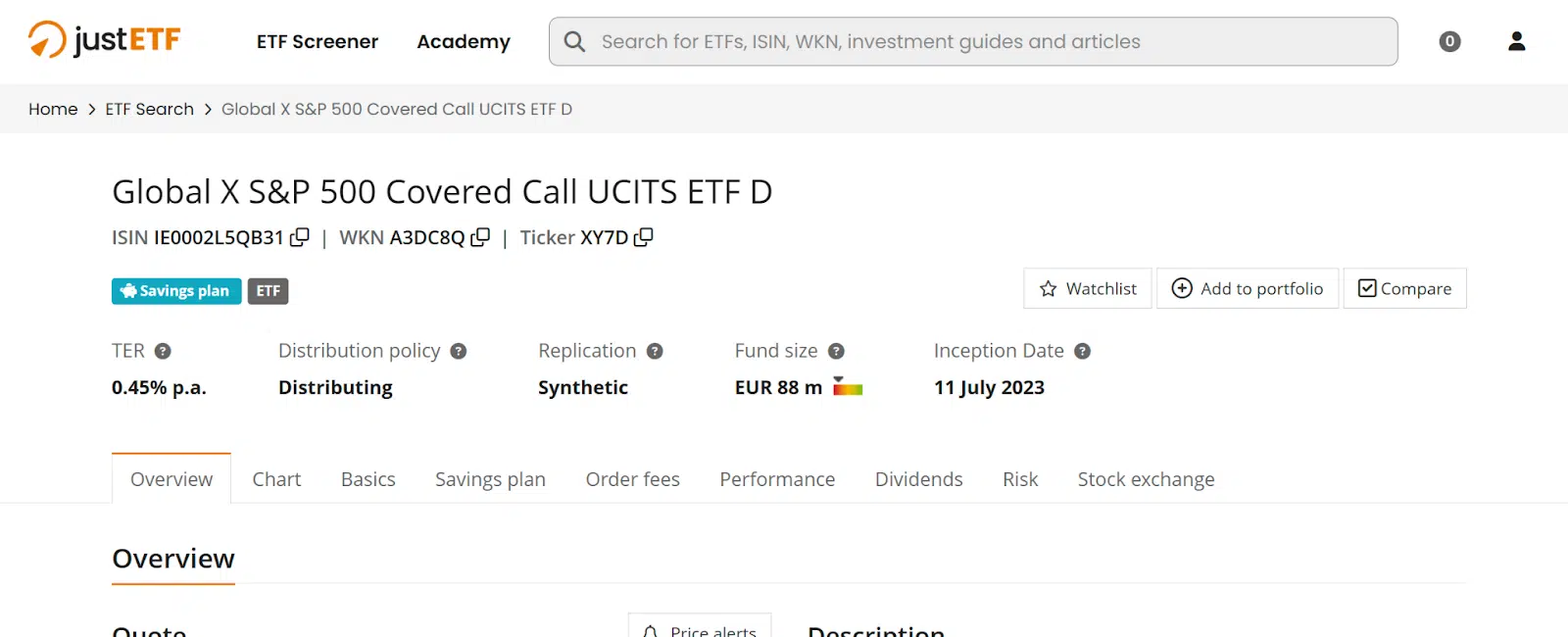
This ETF is designed for income-focused investors who want high monthly distributions from a rules-based covered call strategy on the S&P 500, with limited upside potential and some cushion in falling markets.
4. JPMorgan Global Equity Premium Income UCITS ETF (JEPG.EU)
- ISIN: IE0003UVYC20
- Tickers: JEPG (London Stock Exchange in USD, Borsa Italiana in EUR), JGPI (Xetra in EUR)
- Strategy: actively managed. Holds around 240 developed market stocks with a tilt towards undervalued companies (benchmark: MSCI World) and sells call options on indices
- Distribution yield: 8.1% over the last 12 months (September 2026). Not guaranteed, it changes every month
- TER: 0.35%
- Replication: physical
- Fund size: €1.28 billion
- Payout frequency: monthly
- Key feature: broad diversification across countries and sectors (US 62%, Japan 10%, as of July 2026)
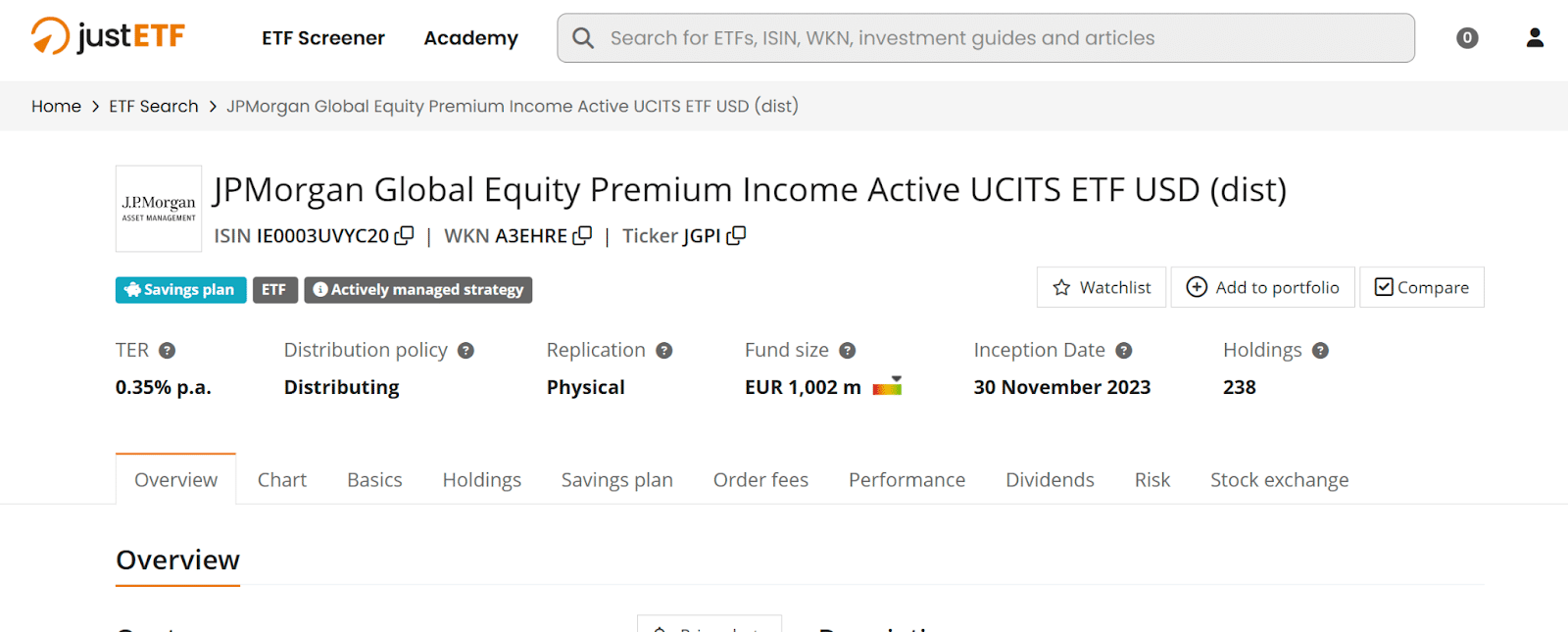
JEPG suits income-oriented investors who want global exposure and monthly distributions. Its more defensive stock selection has a cost in strong markets: in the 12 months to July 2026, it returned 7.42% in USD, against 20.41% for the MSCI World (fund factsheet).
Other covered call ETFs available in Europe
If none of the four fits, these are the other large options on justETF (fund size as of September 2026):
- iShares World Equity High Income UCITS ETF (IE000KJPDY61): a global option from BlackRock, with around €646 million, TER 0.35%
- JPMorgan US Equity Premium Income UCITS ETF (IE000U5MJOZ6): the European version of JEPI, focused on US stocks, with around €482 million, TER 0.35%
- Global X EURO STOXX 50 Covered Call UCITS ETF (IE000SAXJ1M1): for exposure to European blue chips in euros, with around €122 million, TER 0.45%
Covered call ETFs compared
| ETF | Yield | TER | Fund size | 1 year |
| Global X Nasdaq 100 Covered Call (QYLD) | 10.7% | 0.45% | €728m | 20.9% |
| JPMorgan Nasdaq Equity Premium Income (JEPQ) | 10.4% | 0.35% | €3.63bn | 21.8% |
| Global X S&P 500 Covered Call (XYLU) | 8.7% | 0.45% | €189m | 17.8% |
| JPMorgan Global Equity Premium Income (JEPG) | 8.1% | 0.35% | €1.28bn | 7.6% |
Source: justETF. Yield: distributions over the last 12 months divided by the current price, as of 10 September 2026. 1 year: total return in EUR including distributions, to 31 August 2026. Returns in euros include currency movements, since all four funds invest in USD assets.
How to invest in a covered call ETF: step by step
The process of investing in a covered call ETF is the same as for any other ETF or stock. We will use Freedom24, a CySEC-regulated broker, to illustrate it.
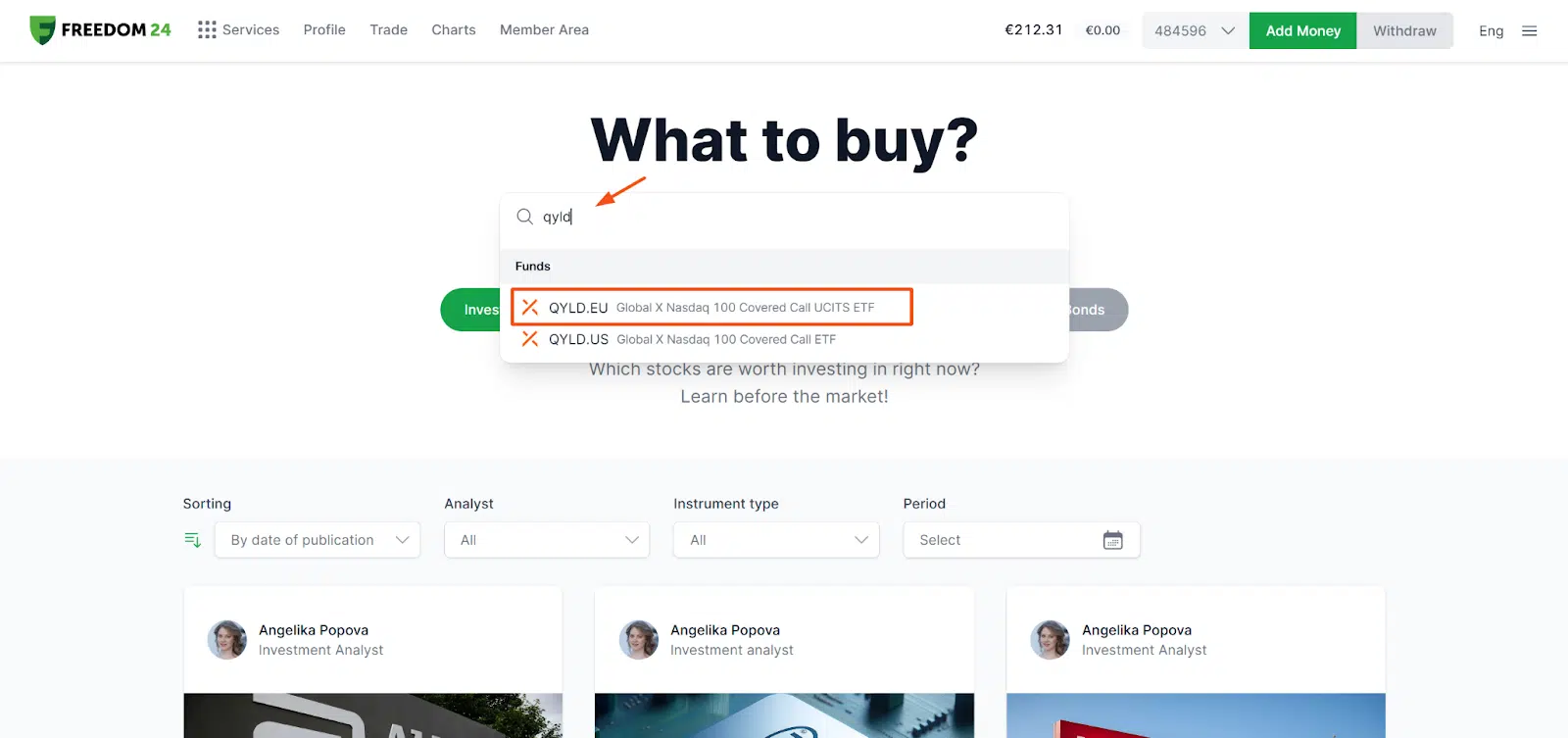
Step 1: Search for the covered call ETF
Let’s go for QYLD:
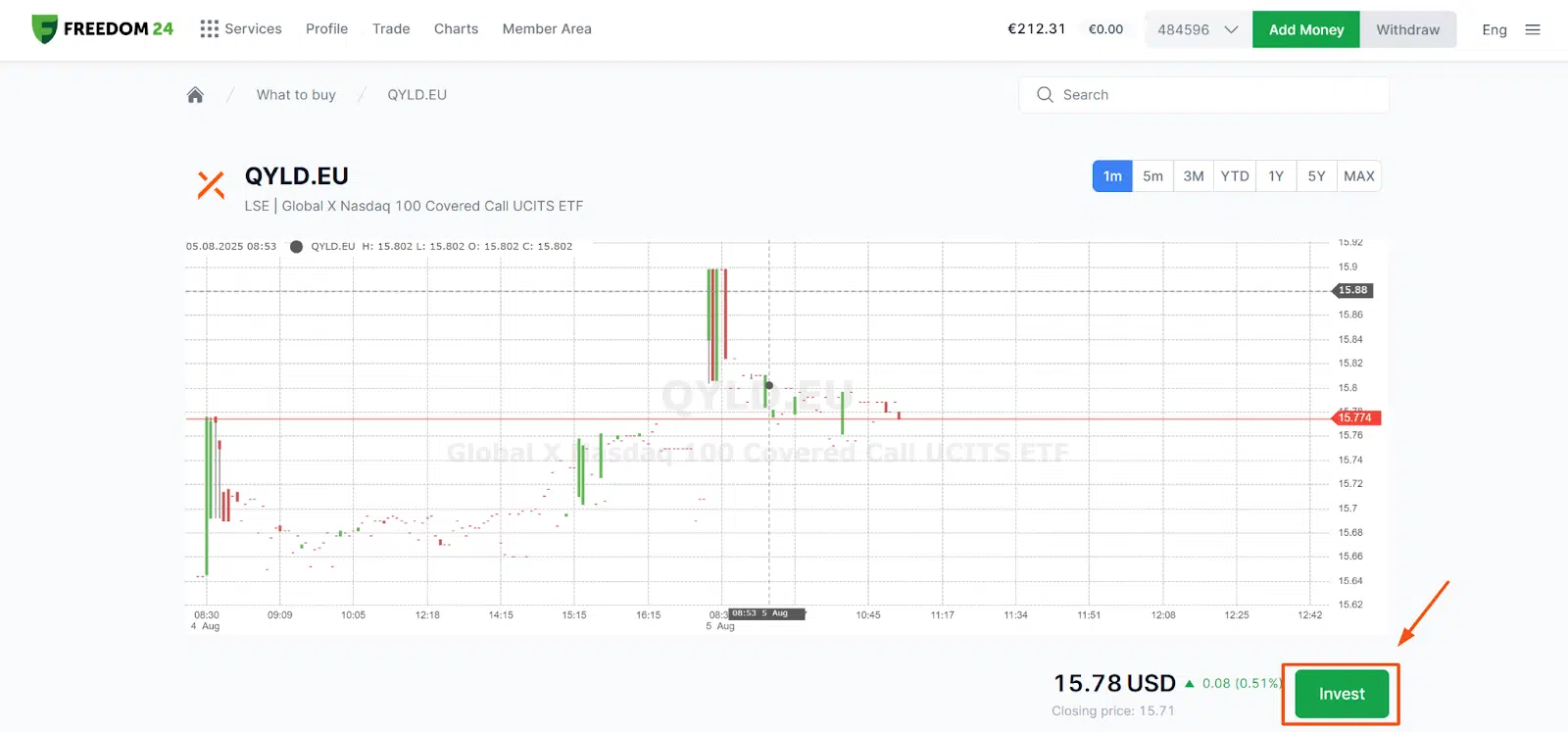
Step 2: Select the ETF and click “Invest”
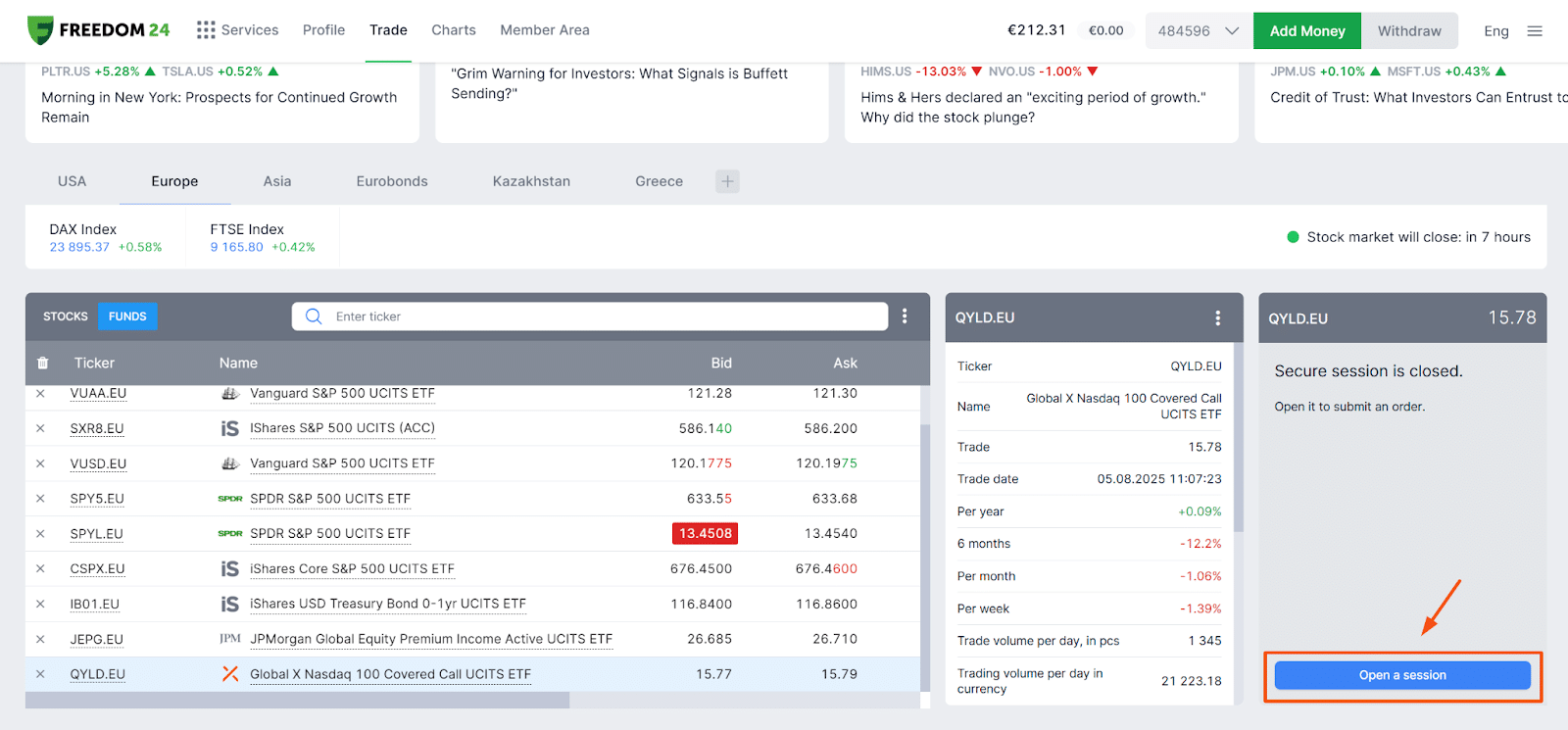
Step 3: Open a session
After clicking “Invest”, you will be redirected to the “Trade” window. Click “Open a session” and follow the security steps: open the Freedom24 app on your phone and scan the QR code with the scanner inside the app.
Step 4: Place a buy order
Choose the quantity you want to buy (1 share in our example) and the order type (we chose “market price”). Then, click “PLACE BUY ORDER”:
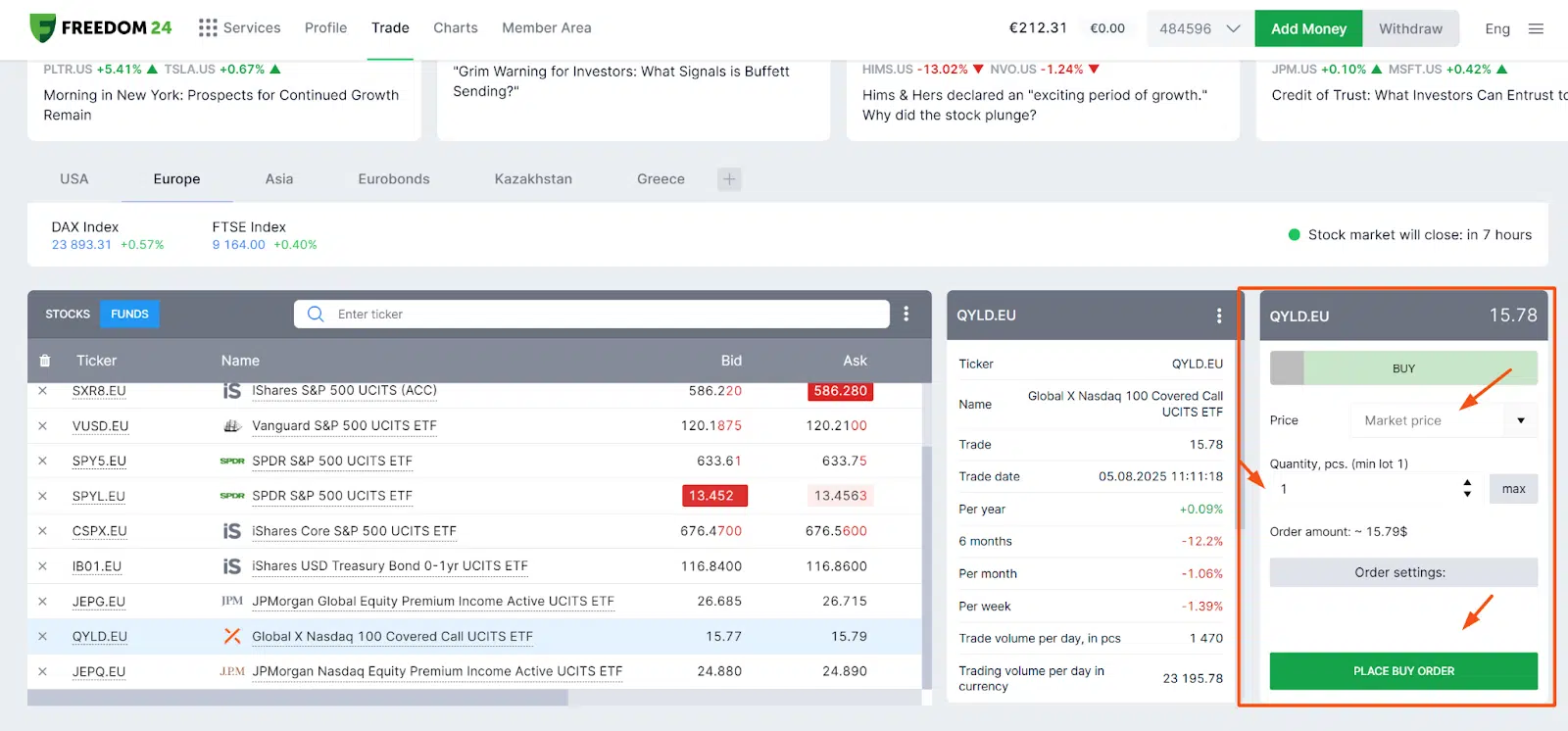
Please note that the QYLD listing in this example trades in USD, so you will need to convert euros to dollars first. Press the “3 lines” icon in the top right corner, select “Currency exchange”, choose “USD” and enter the amount you want to convert. If your broker offers a euro listing of the same ETF (such as QYLE on Xetra), buying it avoids the conversion fee, although the fund still invests in USD assets.
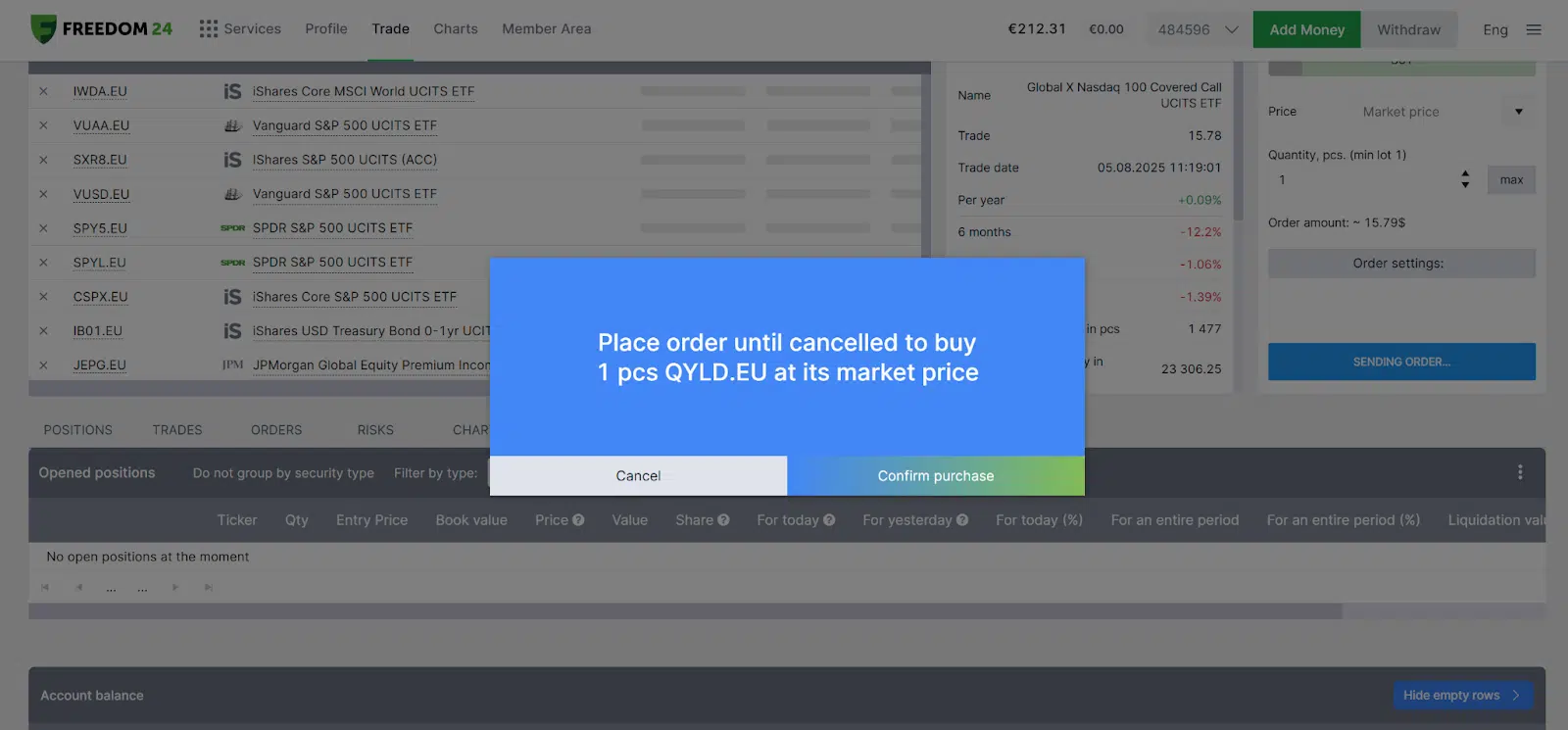
Step 5: Confirm the trade
Just click “Confirm purchase”:
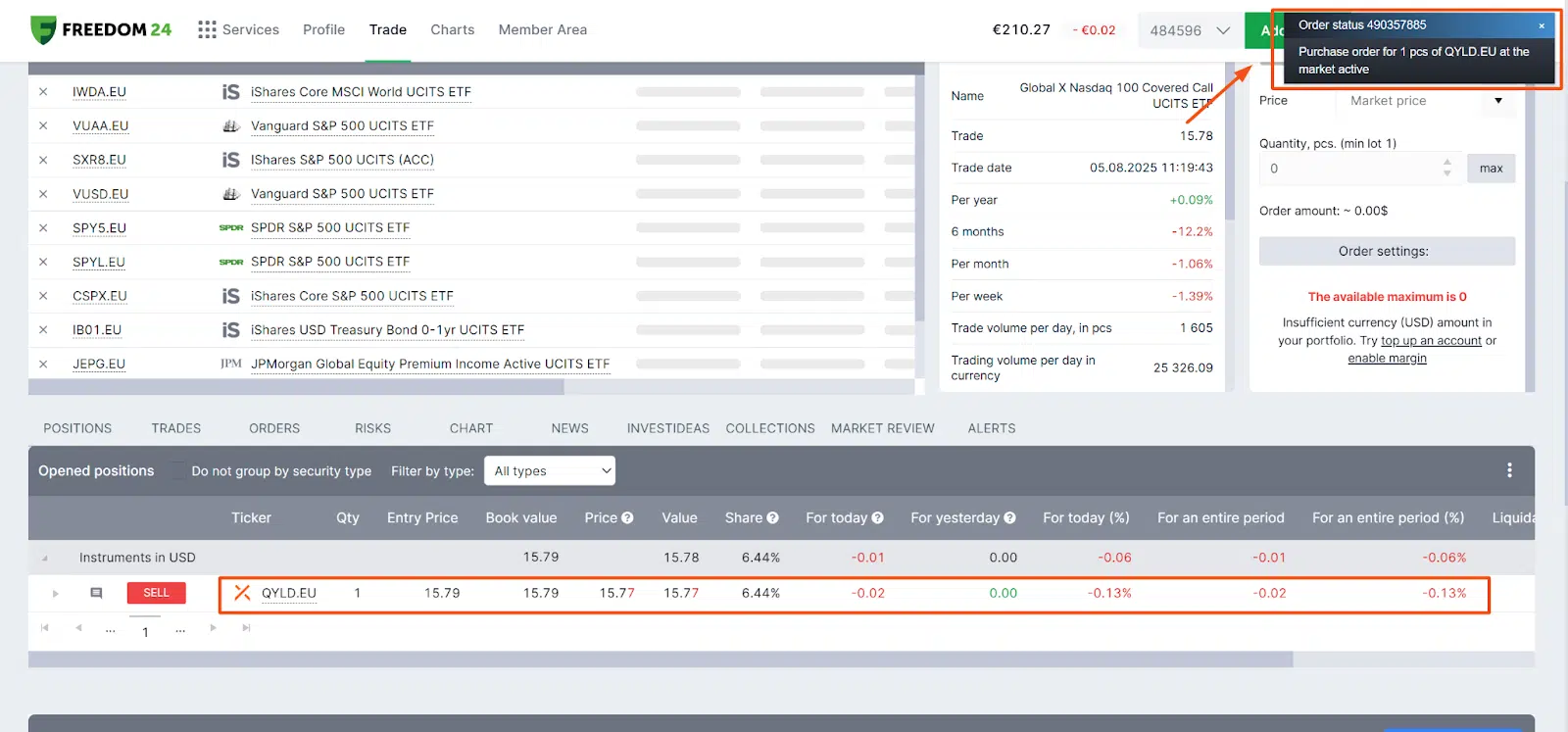
Step 6: Check your portfolio
Your order has been filled and the ETF now shows up in your portfolio:
What is a covered call ETF?
First, we need to understand what a call option is. A call option gives the buyer the right to buy a stock or index at a set price (the strike price) until a certain date (the expiration date). One standard US stock option contract covers 100 shares. However, a covered call ETF sells options, it does not buy them.
What does this mean? As a seller, you have the obligation (not the right, as the buyer does) to sell the stock at the strike price if the buyer exercises the option. In exchange, you receive a payment upfront: the premium. We give an example below.
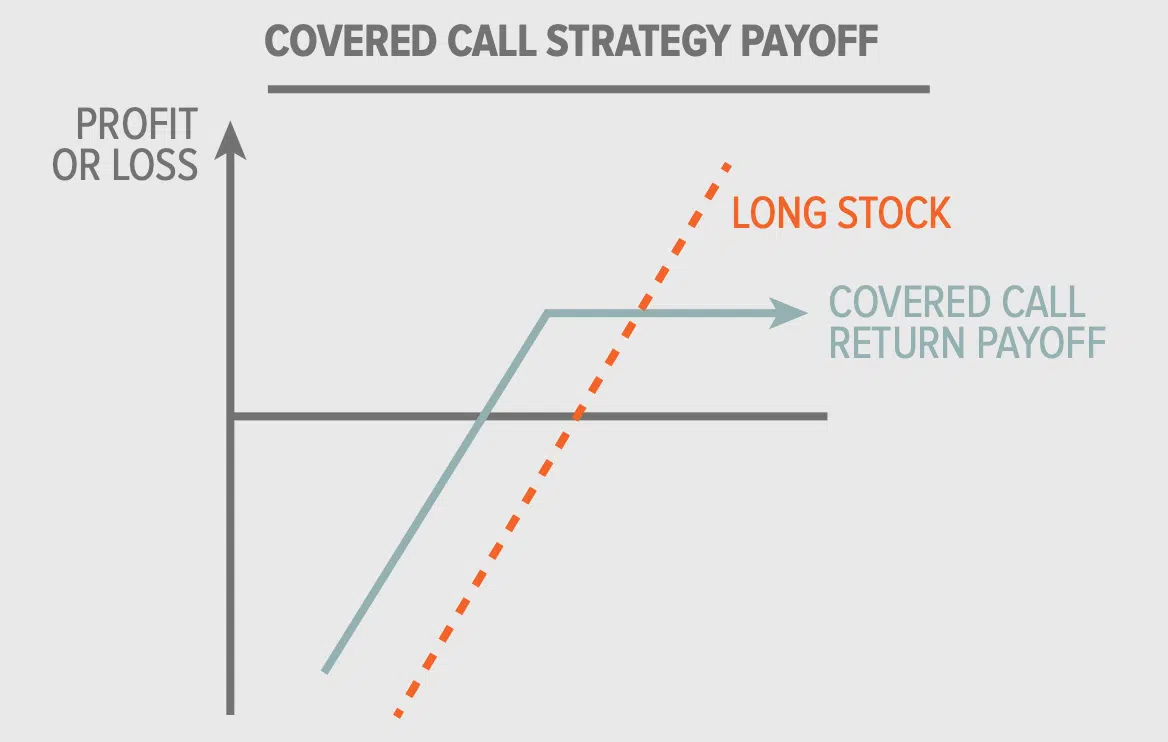
A covered call ETF is an exchange-traded fund that combines stock ownership with the sale of call options to generate extra yield. These funds typically hold shares of major indices, such as the S&P 500, Nasdaq-100 or EURO STOXX 50, and write (meaning “sell”) call options on those holdings or on the index itself. The premiums collected are paid out to investors, which boosts the distributions beyond what the stocks’ dividends alone would pay.
At the same time, the premiums help cushion small market declines. The trade-off is that the upside is capped, so the fund gives up part of the gains in strong bull markets. What draws many investors is the distribution yield, between roughly 8% and 11% a year for the four ETFs above as of September 2026, paid monthly.
How do covered call ETFs work? (with an example)
The ETF holds a portfolio of stocks and systematically sells call options with strike prices at or slightly above current market levels.
If prices stay below the strike, the options expire worthless and the fund keeps both the stocks and the premium. If prices rise above the strike, the fund gives up the gains above that level, but keeps the premium.
Real-life example
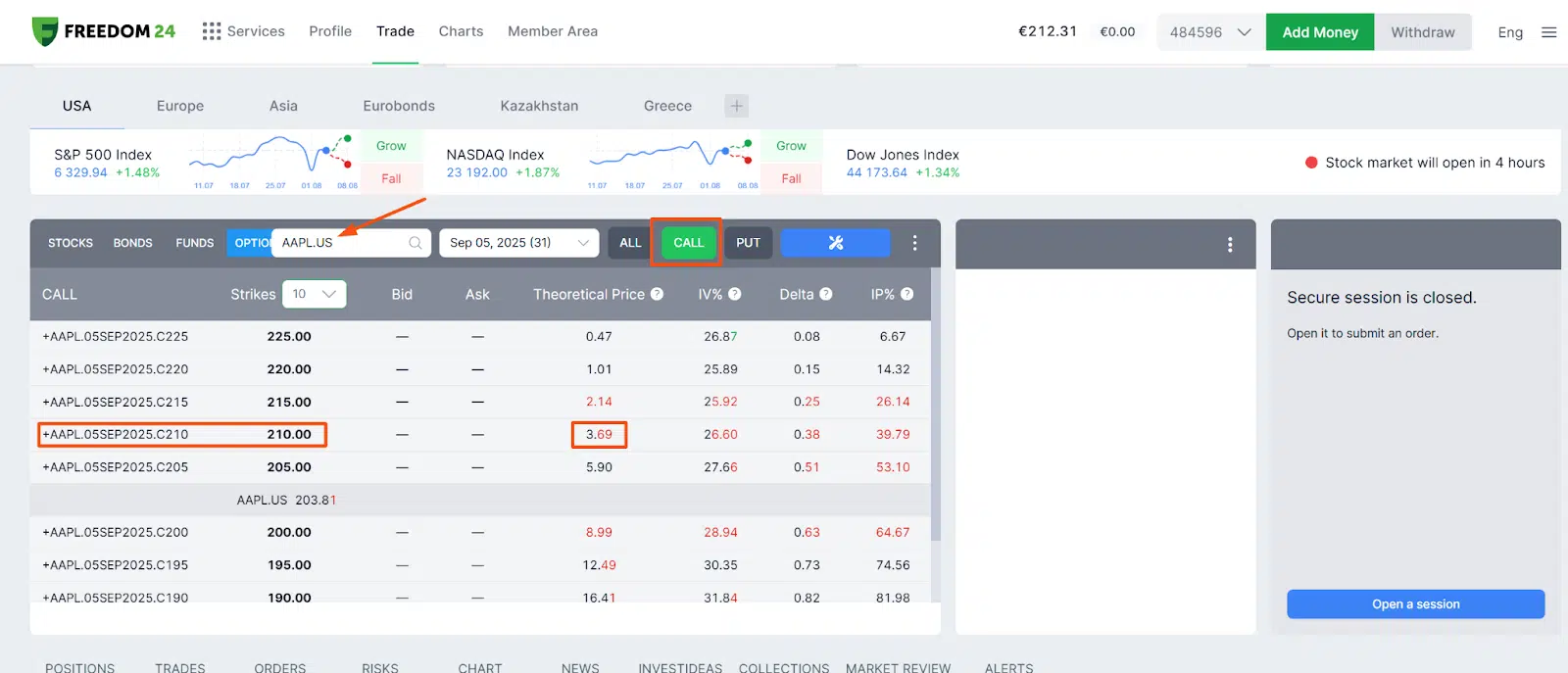
Suppose you own 100 Apple shares, trading at around $203 in early August 2025 (we use Freedom24 as the investment platform for this example, and new users can get up to 20 gift shares, depending on the amount deposited).
You sell one call option contract on Apple with a $210 strike price and an expiration date of September 5, 2025. In exchange, you receive $3.69 per share, or $369 of immediate income for your 100 shares.
If Apple rises to $220 by the expiration date: the option buyer exercises and pays you $210 per share. You keep the $3.69 premium and the $7 gain from $203 to $210, but you miss the $10 per share above the strike ($220 minus $210), which you would have kept by simply holding the shares.
If Apple stays below $210: the option expires worthless. You keep your shares and the premium, which adds to your return.
If Apple falls: the premium offsets part of the loss. In this example, you only start losing money below $199.31 ($203 minus the $3.69 premium).
What to watch out for before buying
- Capped upside: in strong markets, covered call ETFs lag their indices. Over the 12 months to July 2026, QYLD trailed the Nasdaq-100 by around 5 percentage points, JEPQ by around 4 and JEPG trailed the MSCI World by around 13 (USD, fund factsheets)
- Distributions are not fixed: they depend on option premiums, which rise and fall with market volatility. When premiums and dividends fall short of the payout, part of a distribution can come from the fund’s own capital. The factsheet of the US-listed QYLD, for example, estimates that part of its distributions are a return of capital
- Taxes: in many European countries, distributions are taxed in the year you receive them, even if you reinvest them. Accumulating share classes, such as JEPQ (IE000N6I8IU2) and JEPG (IE000WX7BVB0), reinvest the income inside the fund. Check the rules in your country
- Synthetic replication: QYLD and XYLU get the index return through a swap with a bank, which adds counterparty risk. UCITS rules limit that exposure, but it is a difference from the physically replicated JPMorgan funds
- Currency risk: all four funds invest in USD assets. Buying a euro listing does not remove the exposure to the dollar. Only hedged share classes, such as JEPQ in EUR hedged (IE0006FIW9Z0), reduce it
Bottom line
Covered call ETFs are gaining momentum among European investors who understand the strategy and are willing to trade upside potential for option premium distributions and partial downside cushioning. Rather than offering truly steady income, these ETFs appeal to those seeking continued equity exposure with a more defensive return profile, particularly in flat or uncertain markets.
If you’re looking to start investing in covered call ETFs, Freedom24 lets you buy these UCITS ETFs through a CySEC-regulated account. We’ve prepared a detailed Freedom24 review to help you understand its features, fees and how it compares to other brokers, making it easier to decide if it’s the right choice for your investment strategy.
Risk warning: investing involves risk and you may get back less than you invest. Distribution yields and past performance are not reliable indicators of future results. This article is for information only and is not investment advice. Figures as of September 2026.



