Gilts are partly tax free. For a UK individual who holds gilts directly, any gain on a gilt is exempt from Capital Gains Tax (CGT). The coupons are not: outside an ISA or a pension they are taxed as income.
That split is why low-coupon gilts have become popular with investors who have already used their ISA allowance. Most of their return comes as a CGT-free gain rather than as taxable interest.
This guide explains what is taxed and what is not, works through an example with numbers and lists the cases where the exemption does not apply. Tax rates and allowances are for the 2026/27 tax year and were checked on 22 October 2026.
Investing involves risk. Gilt prices move as interest rates change. Timing and rates affect returns; you may get back less than invested. This is not tax advice. Tax treatment depends on your personal circumstances and may change in future. Get advice if you’re unsure. Available in the UK only.
What is taxed and what is not?
| Part of the return | GIA (UK individual) | ISA or SIPP |
| Gain on sale or at maturity | CGT-free | Tax-free |
| Coupons | Income tax | Tax-free |
| Loss on sale | Not allowable | Not relevant |
Sources: section 115 TCGA 1992, DMO taxation rules for gilts. Checked 22 October 2026.
The CGT exemption comes from section 115 of the Taxation of Chargeable Gains Act 1992 (TCGA 1992). It covers the gilts on HMRC’s list of gilt-edged securities exempt from Capital Gains Tax, which includes conventional and index-linked gilts. The Treasury adds new gilts to the list as they are issued.
The exemption works in both directions. A gain on a gilt is not a chargeable gain, and a loss is not an allowable loss, so you cannot set a gilt loss against gains on shares or funds.
According to the DMO, individual investors do not need to report gilt gains or losses on their tax return, either as income or as capital gains. The accrued income scheme, covered below, is the exception.
How are gilt coupons taxed?
Coupons are paid gross, with no tax taken off. Outside an ISA or SIPP they are taxed as interest, the same way as bank interest (GOV.UK guide to tax on interest).
- Tax-free allowance for interest: £1,000 a year for basic rate taxpayers, £500 for higher rate taxpayers and £0 for additional rate taxpayers.
- Starting rate band: if your other taxable income is below £17,570, up to £5,000 of interest can be tax-free.
- Rates above the allowances: 20%, 40% or 45% in 2026/27, depending on your income tax band.
- From 6 April 2027: the rates on interest rise by 2 percentage points to 22%, 42% and 47%, as announced at the Autumn Budget 2025. The allowances stay the same.
If your interest goes above your allowances, you pay the tax through Self Assessment or a change to your tax code.
Why do low-coupon gilts get more out of the exemption?
The answer depends on how the return is split between coupon and gain. A gilt with a 4.5% coupon priced at £100 pays its whole return as taxable coupons. A gilt with a 0.25% coupon priced well below £100 pays most of its return as the gain at maturity, which is CGT-free.
Worked example: two gilts with a similar yield
A higher rate taxpayer invests £10,000 in a GIA, has already used the tax-free allowance for interest and holds to maturity in five years.
| Gilt A (0.25% coupon) | Gilt B (4.5% coupon) | |
| Price per £100 nominal | £81.30 | £100 |
| Nominal bought | £12,300 | £10,000 |
| Coupons over 5 years | £153.75 | £2,250 |
| Gain at maturity | £2,300 | £0 |
| Income tax at 40% | £61.50 | £900 |
| Return after tax | £2,392.25 | £1,350 |
Illustration only. Gilt A and Gilt B are hypothetical gilts, chosen so that both have a yield to maturity of about 4.5% a year before tax (calculated with annual coupons). Prices and yields change every day and this is not a forecast of future returns. Assumes the gilts are held to maturity, the UK government makes every payment in full and on time, coupons are not reinvested and the 2026/27 higher rate of 40% applies. From April 2027 the rate on interest is 42%, which would raise the tax to £64.58 on Gilt A and £945 on Gilt B.
Both gilts produce a similar return before tax. After tax, Gilt A keeps £1,042.25 more, because £2,300 of its return is a CGT-free gain.
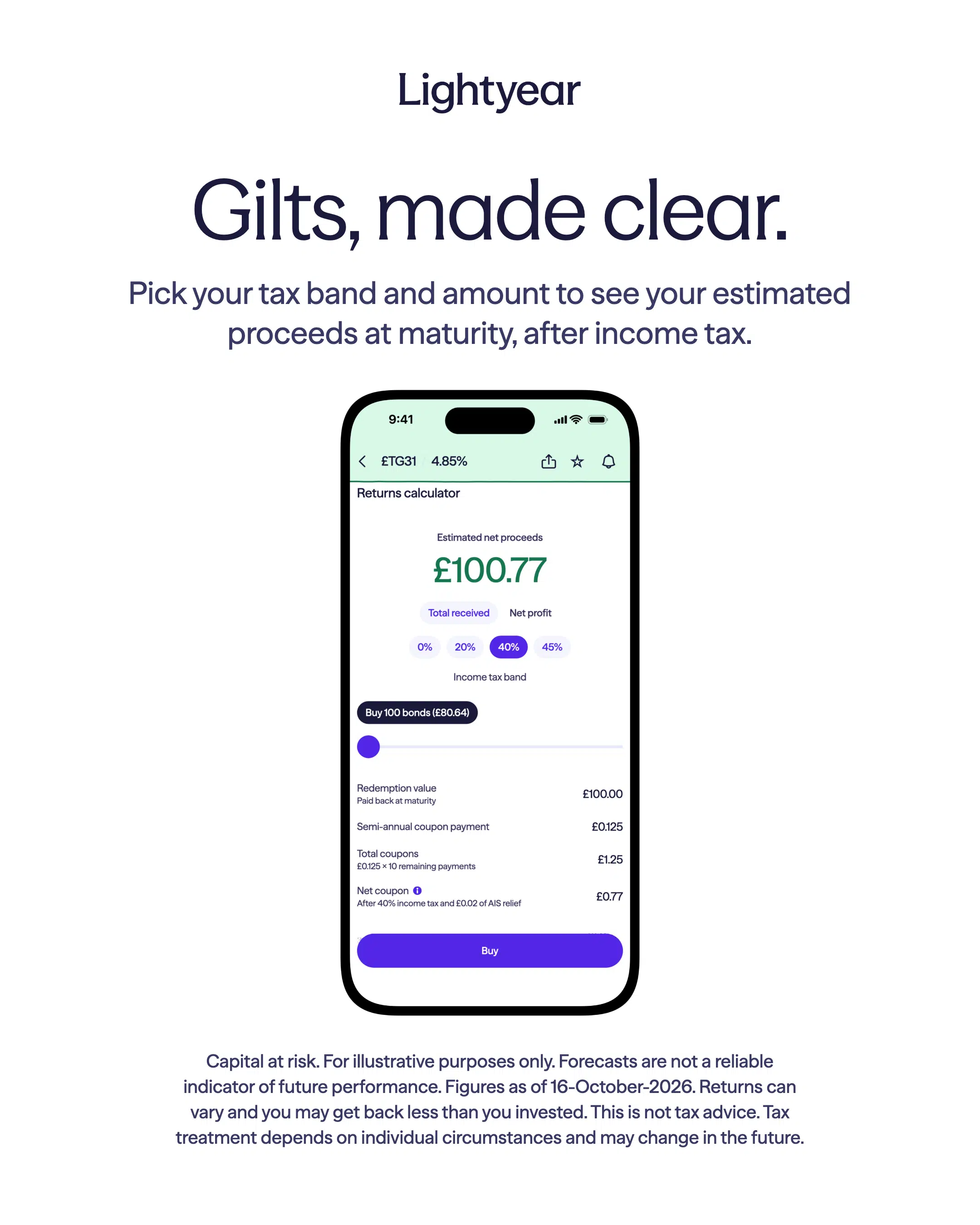
The gap narrows for basic rate taxpayers and disappears inside an ISA or SIPP, where neither part of the return is taxed. Lightyear’s returns calculator shows this split for each gilt on its list, by income tax band.
When does the CGT exemption not apply?
- Gilt funds and ETFs: the exemption covers gilts held directly. Gains on units of a gilt fund or ETF are subject to CGT under the normal rules. A fund that holds more than 60% in bonds and similar assets pays distributions that are taxed as interest.
- Gilt strips: strips are gilts split into separate coupon and principal payments. For individuals, all gains and losses on strips are taxed as income each year, based on the change in value at the end of the tax year.
- Companies: under the loan relationship rules, a company pays corporation tax on the total return of its gilts, coupons and gains included. The CGT exemption does not help a company.
- Accrued income scheme: if the nominal value of all your interest-bearing securities is above £5,000 at any time in the tax year or the previous one, the interest built up between coupon dates is taxed as income when you buy or sell (HMRC helpsheet HS343). It does not apply below £5,000 nominal.
- Selling before maturity: the gain is CGT-free, but a sale can also produce a loss if interest rates have risen. That loss cannot be used against other gains.
Are index-linked gilts tax free too?
Gains on index-linked gilts are also CGT-free for individuals. The coupon, including its inflation uplift, is taxed as interest. According to the DMO, the uplift in the principal from index-linking is not interest and is not taxable.
Gilts in an ISA or in a GIA?
Gilts can be held in a Stocks and Shares ISA, where both the coupons and the gains are free of UK tax. The ISA allowance is £20,000 per tax year.
A common approach is to keep higher-coupon gilts inside the ISA, where their taxable coupons are sheltered, and hold low-coupon gilts in a GIA, where most of the return is already CGT-free. Whether this suits you depends on your tax band and on what else you hold in the ISA.
Lightyear lists 20 conventional gilts in its GIA and ISA, from 0.125% to 5.375% coupons, with no order fee for personal accounts. Our guide How to buy gilts in the UK (2026) compares the costs of the main UK platforms.
Who sets the tax rules for gilts?
HMRC sets and collects the tax on gilt coupons and keeps the list of CGT-exempt gilts. HM Treasury specifies new exempt gilts by order. The UK Debt Management Office issues gilts on behalf of HM Treasury. Platforms that sell gilts are authorised by the Financial Conduct Authority (FCA).
Investing involves risk. Gilt prices move as interest rates change. Timing and rates affect returns; you may get back less than invested. This is not tax advice. Tax treatment depends on your personal circumstances and may change in future. Get advice if you’re unsure. Available in the UK only.
Frequently asked questions
Do I pay Capital Gains Tax on gilts?
Not on gilts you hold directly as a UK individual. Gains on gilts are exempt under section 115 TCGA 1992. Gains on gilt funds and ETFs are not exempt.
Is the interest on gilts tax free?
No, unless the gilts are in an ISA or SIPP. Coupons are taxed as interest, after your tax-free allowance for interest.
Do I need to put gilt gains on my tax return?
According to the DMO, individual investors do not need to report gains or losses on gilts. Coupons are taxable income, and accrued income scheme amounts must be reported when the scheme applies.
Can I use a loss on a gilt against other gains?
No. Because gilt gains are exempt, gilt losses are not allowable losses.
Are gilts tax free for limited companies?
No. Companies pay corporation tax on the full return of their gilts under the loan relationship rules.
Is tax taken off gilt coupons before they are paid?
No. Coupons on gilts are paid gross. You pay any tax due through Self Assessment or your tax code.
Are gilt ETFs tax free?
No. Gains on gilt ETFs and funds are subject to CGT outside an ISA or SIPP, and their distributions are usually taxed as interest.