A gilt is a bond issued by the UK government. You lend money to the government, receive a fixed coupon twice a year and get the nominal value back on the maturity date.
UK investors can buy gilts in three ways: through an investment platform, through a broker with a bond desk such as Interactive Brokers or through the Debt Management Office’s (DMO) postal Purchase and Sale Service. The cost of the same £10,000 purchase ranges from £0 to more than £50 depending on the route.
This guide explains how gilt prices work, compares the costs of the main UK platforms and shows the purchase step by step on Lightyear, which charges no order fee on gilts for personal accounts. Fees were checked on the providers’ own websites on 22 October 2026 and can change.
Investing involves risk. Gilt prices move as interest rates change. Timing and rates affect returns; you may get back less than invested. This is not tax advice. Tax treatment depends on your personal circumstances and may change in future. Get advice if you’re unsure. Available in the UK only.
What is a gilt and how does it pay you?
Every gilt has three fixed features, set when it is first issued:
- Coupon: the annual interest rate, paid in two halves six months apart. A 4% gilt pays £4 a year for every £100 of nominal value.
- Nominal value: the amount the government repays at maturity. Prices are usually quoted per £100 nominal. Some apps, including Lightyear and Freetrade, quote per £1 nominal instead.
- Maturity date: the day the nominal value is repaid. On the UK platforms covered here, maturities run from a few months to several decades.
You can hold a gilt until it matures or sell it on the London Stock Exchange before that date. If you sell early, you get the market price on the day, which can be above or below what you paid.
Why does a gilt cost less (or more) than £100?
The question most new gilt buyers ask is why a gilt that repays £100 can trade at £81.
The answer is the coupon. Gilts issued in 2020 and 2021, when interest rates were close to zero, carry coupons as low as 0.125% or 0.25%. A buyer today wants a return in line with current market rates, so these gilts trade below £100. The gap between the price and the £100 repaid at maturity makes up most of the return.
Gilts issued more recently carry higher coupons and trade closer to £100, or above it. The rule that ties this together:
- When interest rates rise, gilt prices fall: existing gilts become less attractive than new ones, so their price drops until their yield matches the market.
- When interest rates fall, gilt prices rise: for the same reason in reverse.
Longer gilts move more for the same change in rates. A gilt maturing in 2061 reacts far more than one maturing in 2028.
The figure that combines price, coupon and time to maturity is the yield to maturity (YTM). It is the annual return you would get if you bought at today’s price, held to maturity and every payment arrived on schedule. It is before tax and changes every day with the price.
Where can you buy gilts in the UK?
- Investment platforms: apps and platforms such as Lightyear, Freetrade, AJ Bell, Hargreaves Lansdown and interactive investor (ii) let you buy gilts like a share, in a general investment account (GIA) and, on most of them, in a Stocks and Shares ISA. This is the simplest route for most people.
- Brokers with a bond desk: Interactive Brokers gives access to the full list of gilts with a commission based on nominal value. It suits investors who want a gilt that apps do not list.
- DMO Purchase and Sale Service: the government’s own route, run by Computershare. You join the DMO’s Approved Group of Investors, send a dealing form and pay by bank transfer. You cannot set a price, the gilts are held in your name on the register and the service is open to UK residents only. It cannot be used inside an ISA.
For a wider comparison of UK platforms beyond gilts, see our guide to the best online stock brokers in the UK.
Gilt platform costs compared (October 2026)
¹ 0.1% on the first £10,000 of nominal value, 0.025% above. ² After 10 or more share deals in the previous month. ³ After 20 or more deals in the previous month. ⁴ On purchases up to £5,000. Above £5,000: £35 plus 0.375% of the amount over £5,000. Sources: Lightyear, Freetrade, Interactive Brokers, AJ Bell, Hargreaves Lansdown and DMO. Checked 22 October 2026. Fees can change.
interactive investor also offers gilts, some online and some by phone only. It charges a monthly plan fee from £5.99 but does not publish a separate gilt dealing rate, so it is not in the table. Lightyear business accounts pay £1 per gilt order.
What does a £10,000 purchase cost in the first year?
Example: you buy £10,000 of a gilt priced at £100 in a GIA and hold it for 12 months.
| Provider | First-year cost |
| Lightyear | £0 |
| Freetrade (Basic) | £0 |
| Interactive Brokers | £10 |
| AJ Bell | £30 (£5 + £25) |
| Hargreaves Lansdown | £41.95 (£6.95 + £35) |
| DMO service | £53.75 |
Illustration based on the fees in the table above, checked 22 October 2026. It ignores other holdings, which can change the holding fee caps. Selling before maturity adds a second order fee where one applies.
Over five years the gap widens, because the holding fee repeats every year: £125 at AJ Bell (plus the £5 order) and £175 at Hargreaves Lansdown (plus the £6.95 order) on the same £10,000.
How to buy gilts on Lightyear, step by step
Lightyear launched gilts at the end of September 2026 for UK personal and business customers. It lists 20 conventional gilts, from short to long maturities and from low to high coupons. Personal accounts pay no order fee, no holding fee and no FX fee when buying with GBP.
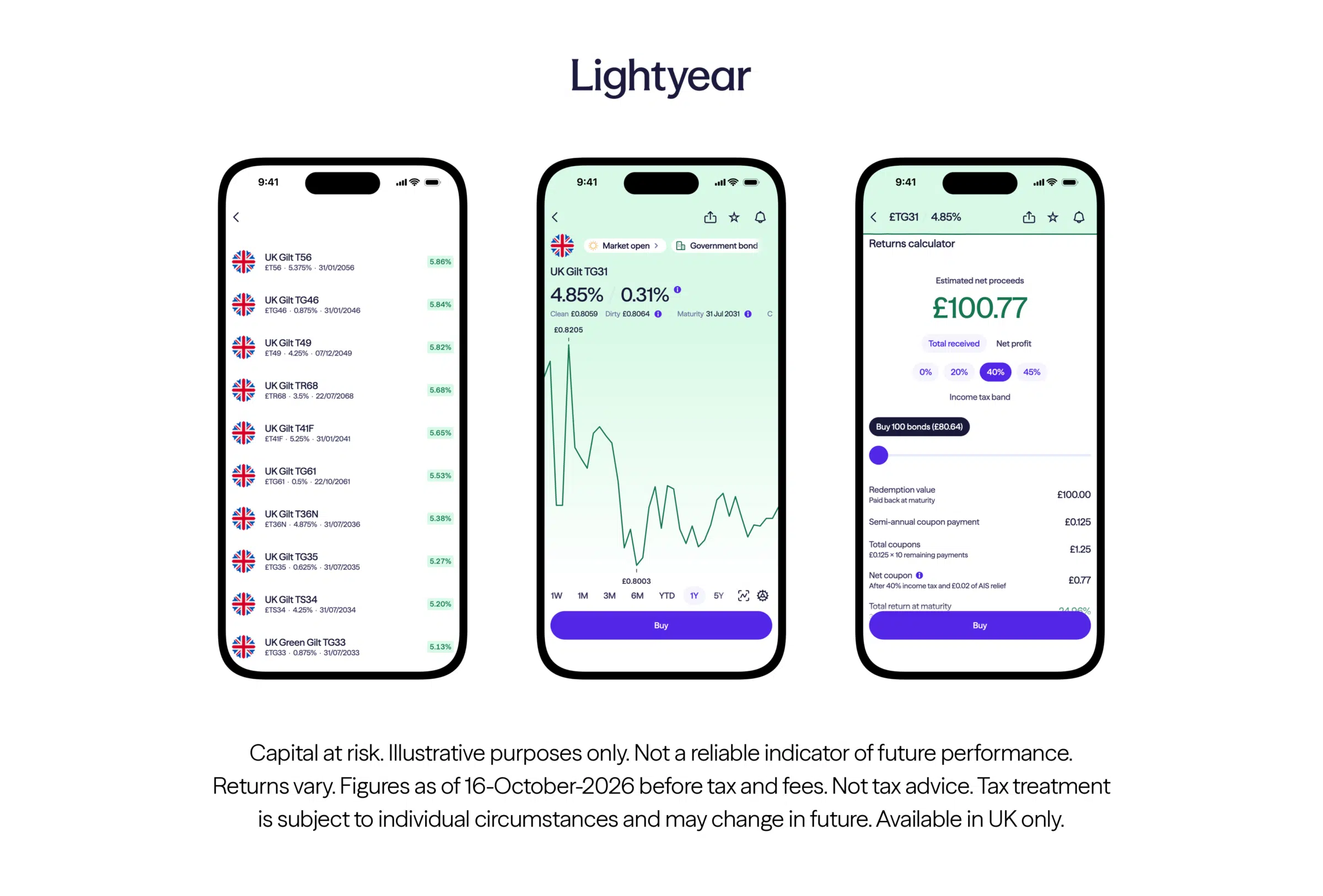
- Open a Lightyear UK account: download the app, verify your identity and choose a General Investment Account or a Stocks and Shares ISA.
- Add GBP: transfer pounds from your bank. Buying in GBP avoids any currency conversion.
- Find a gilt: make sure the app is up to date, then browse the gilts by coupon or maturity date, or search by symbol, such as TG31.
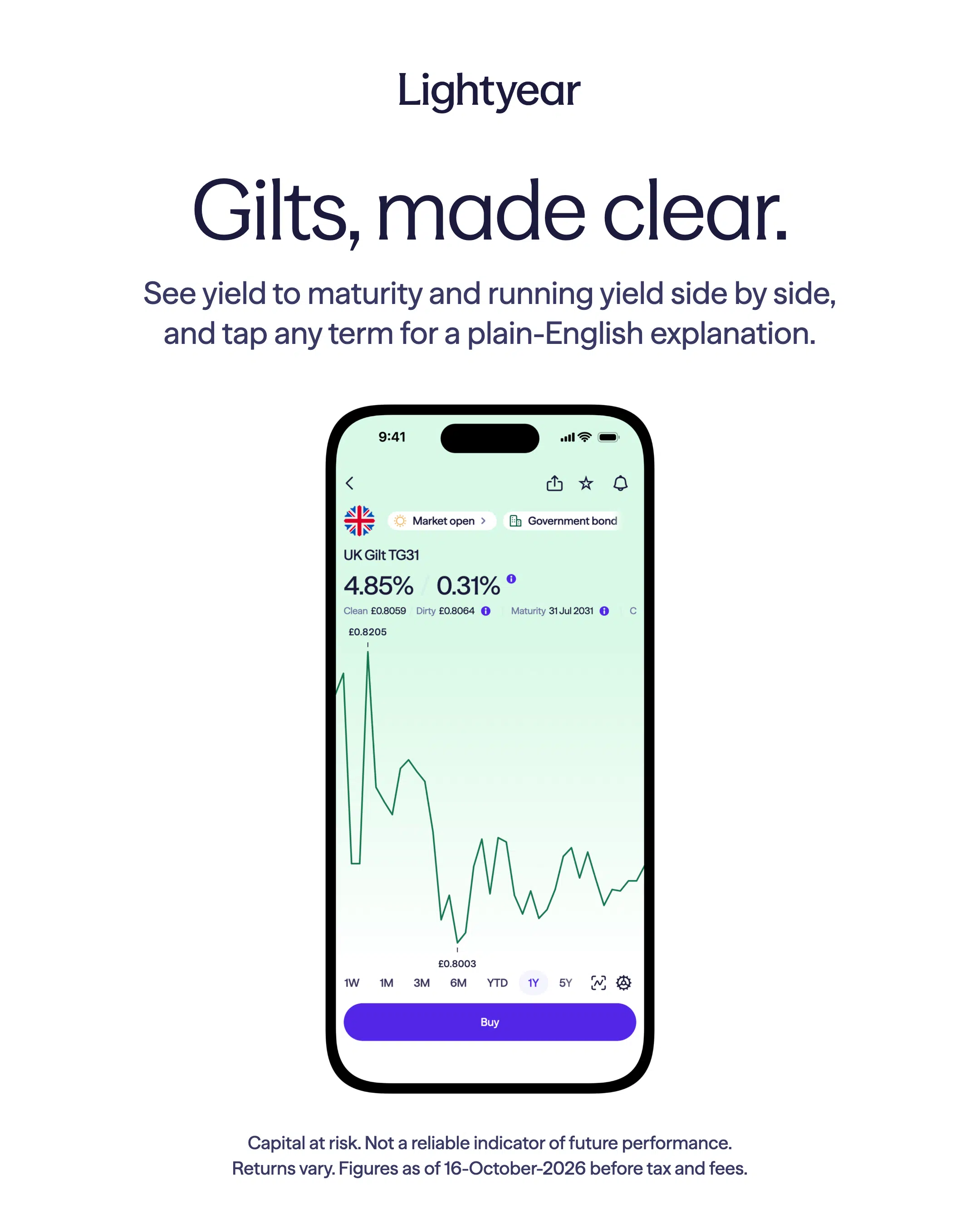
- Check the gilt’s details: coupon, maturity date, price per £1 nominal and yield to maturity. Lightyear also shows an after-tax YTM for each income tax band.
- Enter the amount and review: type how much you want to invest. The confirmation screen shows the estimated price including accrued interest.
- Confirm the order: the gilt appears in your portfolio. Coupons are paid into your account twice a year and the nominal value is paid at maturity.
Should you hold gilts in a GIA, an ISA or a SIPP?
- Stocks and Shares ISA: coupons and gains are free of UK tax. The ISA allowance is £20,000 per tax year and covers everything you put into ISAs that year.
- SIPP: coupons and gains build up free of tax, but the money is locked until pension age. Lightyear does not offer a SIPP. Freetrade, AJ Bell, Hargreaves Lansdown and Interactive Brokers do.
- GIA: coupons are taxed as income. Gains on gilts held directly are free of Capital Gains Tax for UK individuals, so a GIA is where low-coupon gilts are often held once the ISA allowance has been used. The tax rules are covered in our guide Are gilts tax free?
Gilts for business accounts
Some companies hold cash they will need on a known date, such as a tax bill or a planned purchase. A gilt that matures shortly before that date returns a known nominal amount from the UK government on that day, provided it is held to maturity.
On Lightyear Business, gilts cost £1 per order. Company holdings are taxed differently from personal ones, so a company should check the treatment with its accountant.
What is a gilt ladder?
A gilt ladder is a set of gilts with staggered maturities, for example one maturing each year for five years. Each year one gilt pays back its nominal value, which can fund a planned cost or be reinvested at the rates then available. It spreads the reinvestment risk across several dates instead of one. With 20 gilts maturing between 2027 and 2068, Lightyear’s list covers most ladder lengths.
What are the risks of buying gilts?
- Price risk: if you sell before maturity, rising interest rates can mean a lower price than you paid. Long gilts swing the most.
- Inflation risk: conventional gilts pay fixed amounts. High inflation reduces what those pounds buy.
- Reinvestment risk: coupons and maturing gilts may have to be reinvested at lower rates.
- Credit risk: the UK government has never failed to make a payment on a gilt, according to the DMO. Past performance is not a reliable guide to the future.
Who regulates gilts and gilt platforms?
Gilts are issued by the UK Debt Management Office on behalf of HM Treasury. Computershare keeps the register of gilt holdings and runs the DMO’s Purchase and Sale Service.
Platforms that sell gilts must be authorised by the Financial Conduct Authority (FCA). Lightyear UK Ltd is authorised and regulated by the FCA under firm reference number 987226. You can check any provider on the FCA register.
Investing involves risk. Gilt prices move as interest rates change. Timing and rates affect returns; you may get back less than invested. This is not tax advice. Tax treatment depends on your personal circumstances and may change in future. Get advice if you’re unsure. Available in the UK only.
Frequently asked questions
What is the minimum amount to buy a gilt?
It depends on the provider. Lightyear and Freetrade price gilts per £1 nominal, so you can buy small amounts. Interactive Brokers trades in nominal amounts set by the market.
What are clean and dirty prices?
The clean price is the quoted market price. When you buy, you also pay the seller the interest that has built up since the last coupon date. The total is the dirty price, which is what leaves your account.
Can I get my money back before the maturity date?
You cannot redeem a gilt early, but you can sell it on the market at any time. The price you get depends on interest rates on that day.
How are gilt prices quoted?
Usually per £100 of nominal value. Lightyear and Freetrade quote per £1 of nominal value, so a price of £0.81 on the app equals £81 per £100 elsewhere.
Can businesses buy gilts?
Yes. Lightyear Business accounts can buy gilts for £1 per order. The tax treatment for companies differs from that for individuals.
What is the difference between gilts and Treasury bills?
Treasury bills are short-term government debt with maturities of up to about a year and no coupon. They are sold at a discount at weekly DMO tenders. Gilts run from a few years to several decades and pay a coupon twice a year.
Are gilt funds and ETFs the same as buying gilts?
No. A fund holds many gilts and never matures, so you do not get a known amount back on a set date. Funds also have ongoing charges and different tax rules.