A brokerage account is not only available to private individuals. Companies and self-employed people can also invest their assets through investment accounts.
However, there are significantly fewer providers of company accounts, and they usually do not actively advertise them.
Below, we cover three different business brokerage accounts that work for international investors. So, if you live in Europe, the MENA region, or anywhere else outside the USA, we’ve got you covered!
Best international business brokerage accounts
- Interactive Brokers: Best overall
- Lightyear: Best for high yield on your money
- eToro: Most user-friendly platform
- Saxo Bank: Best for professionals looking to diversify their holdings in different brokers


Terms apply, seek guidance if necessary. When you invest, your capital is at risk.

52% of retail CFD accounts lose money.

62% of retail CFD accounts lose money.
Comparison


Reviews
Interactive Brokers corporate accounts at a glance
Founded in 1978 and publicly listed on the NASDAQ (ticker: IBKR), Interactive Brokers is a global online broker that has weathered every major financial crisis since, a testament to its resilience and rigorous risk management. It is also a member of the S&P 500.
Interactive Brokers offers an advanced platform that lets you invest globally in stocks, options, futures, currencies, bonds, and funds across more than 150 markets in over 30 countries, all from a single integrated account. Its account management tools let you control and delegate user permissions, which is particularly useful for a business account.
With Interactive Brokers, businesses around the world can open a company account. Eligible entities include small businesses, hedge funds, proprietary trading groups, and family offices, among others. Non-US companies are onboarded through IBKR’s regulated regional entities (such as Interactive Brokers Ireland or Interactive Brokers U.K.), and you get strong execution via IB SmartRouting plus a full set of technical and fundamental research tools.
The trade-offs: the fee schedule is complex, the registration process is thorough (though fully online), and commission-free trading via IBKR Lite is limited to the US. Even so, once you factor in low FX fees, narrow spreads, and the stock-lending programme, IBKR clients typically save significantly compared with most brokers.
Want to know more? Read the details on Interactive Brokers’ business account page, or follow our step-by-step guide on how to open a business brokerage account with Interactive Brokers.

Pros
- Low commissions on US stock trading
- No monthly inactivity fee
- The broadest product and markets range in the brokerage industry
- Demo account
- Excellent reputation (founded in 1978)
- Extensive research and Education tools
- Has a modern mobile trading app to trade Stocks, Options and ETFs, ideal for novice investors, IBKR GlobalTrader.
- Offers interest on uninvested cash balances
Cons
- Complicated and lengthy account opening process (but fully online)
- Steeper learning curve for beginners
- Website is difficult to navigate
- Interactive Advisors (Robo-advisor feature) is only available for US customers
Lightyear business accounts at a glance
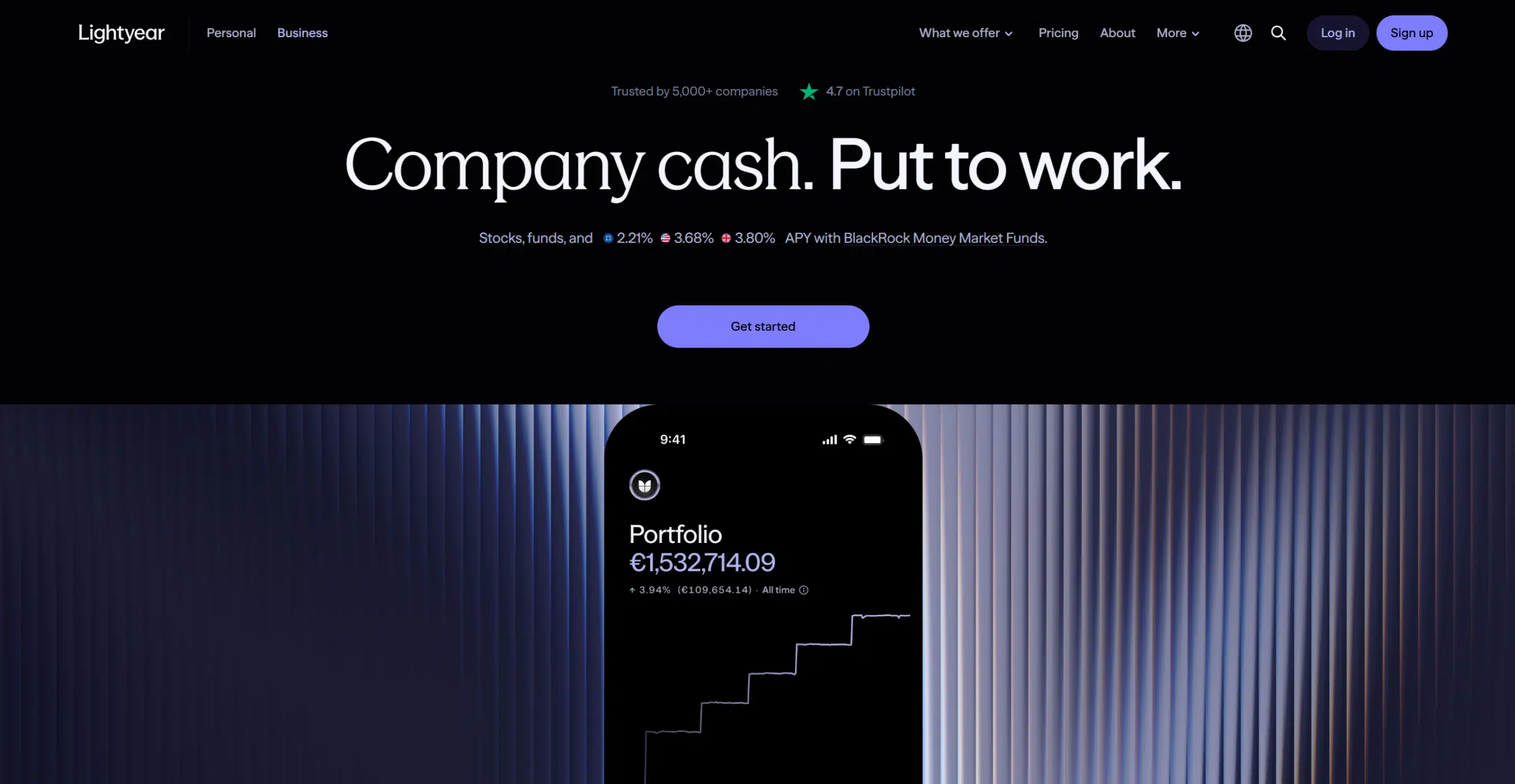
Lightyear is a European investment app that operates in Europe and the UK via the entity Lightyear Europe AS, authorized and regulated by the Estonian Financial Supervision Authority (EFSA – license number 4.1-1/31) and the entity Lightyear UK Ltd, which is authorised and regulated by the Financial Conduct Authority (FCA).
The business accounts are currently available in 22 countries, including the UK, Estonia and Hungary, and can be opened by freelancers and sole directors in addition to small, medium and large companies. You can invest in Money Market Funds (MMFs) – low-risk, highly liquid and AAA-rated investments, over 6,000 stocks and ETFs, and direct access to a Legal Entity Identifier (LEI) registration for £42.50 + VAT or €48 + VAT for European businesses. Besides, it automatically fulfils a W-8BEN-E form to get a reduced tax rate on dividends from US stocks.
There are no Lightyear execution fees to trade ETFs (do note that fund manager fees apply). For stocks, commissions do not exceed €/$/£1 per order, and there is a flat 0.35% fee for currency conversion (this fee can be minimized by their multi-currency account in EUR, GBP, and USD). Lightyear offers one of the highest interests through MMFs. The following rates are net, variable, true as of 25-Aug-2026 and differ slightly depending whether MMFs are managed by BlackRock or J.P. Morgan:
- EUR: 2.22% (AER/APY) or 2.24% (AER/APY)
- GBP: 3.82% (AER/APY) or 3.84% (AER/APY)
- USD: 3.70% (AER/APY) or 3.67% (AER/APY)
Finally, it charges 0.45% per trade for cryptocurrencies. Crypto, however, is not available in the UK.
You can claim up to €300 in a fractional share or ETF or MMF with the promo code “INVESTINGINTHEWEBBIZ“. Retail investors have a similar offer.
However, Lightyear’s investing app has some downsides: the product offering is limited (there are no options, no direct commodities [only via ETCs], or Forex).
Disclaimer: Investing involves risk. Promotional terms apply. Only invest excess capital. Money market funds are investments and not FSCS protected.
Pros
- 0% Lightyear execution commission on ETF trading (other fees, like fund manager and FX fees, may apply)
- No account opening, inactivity, or withdrawal fees
- High interest on EUR, USD & GBP through MMFs
- Free multi-currency account
- Minimum deposit of €/£/$1
- Fractional Shares
- Account opening promotion with the promo code INVESTINGINTHEWEBBIZ
- You can automate your investments with "Plans"
Cons
- Limited financial instruments (no options or futures; commodities only via ETCs such as gold, silver and copper; bonds limited to a small Baltic selection)
- No demo account
- Business accounts only available in 22 European countries (not available internationally)
- 0.35% currency conversion fee
Saxo Bank business accounts at a glance
62% of retail CFD accounts lose money.
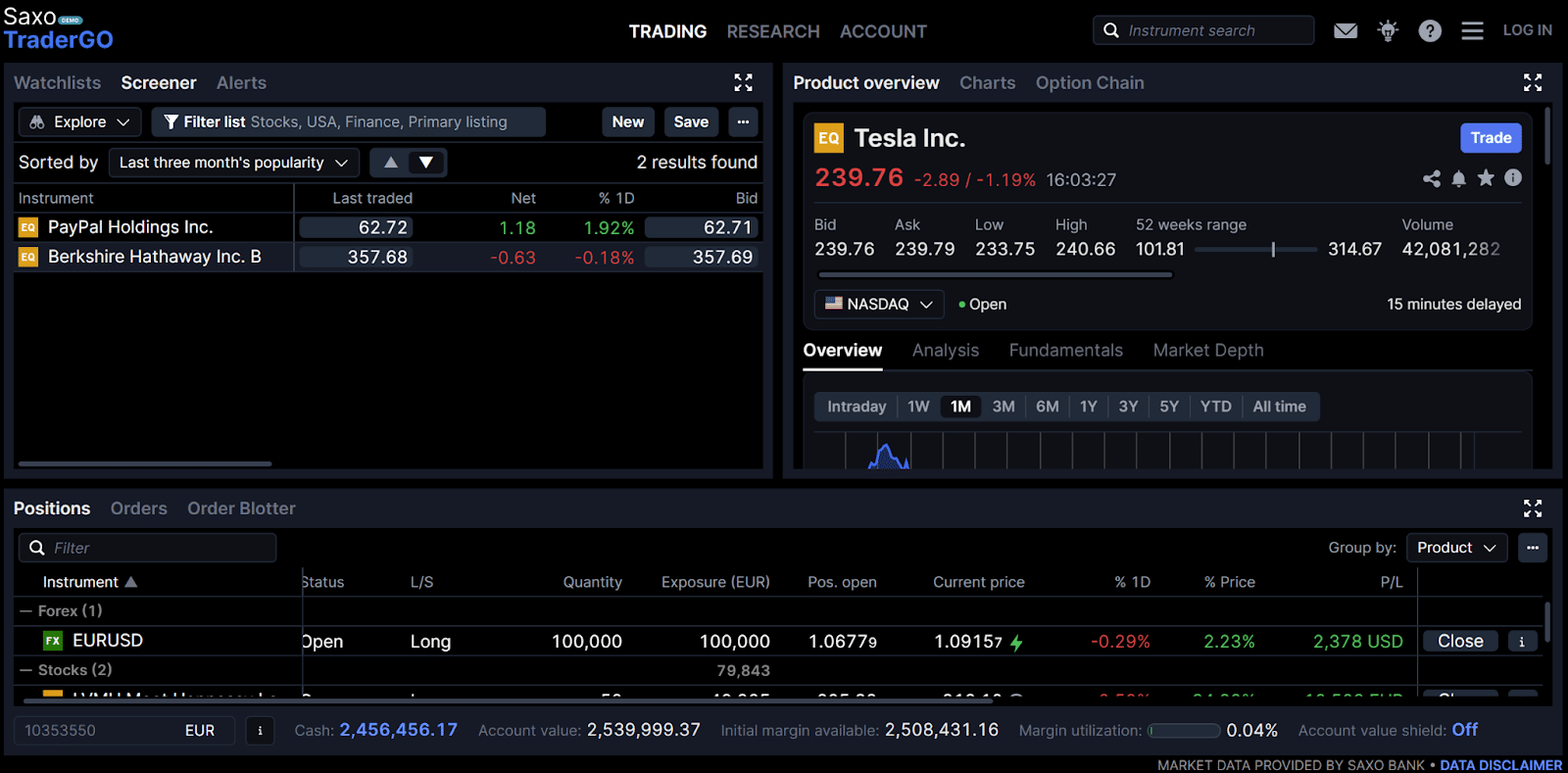
Founded in 1992, Saxo is one of the most solid entities in the brokerage industry, with a proven track record of success. It lets you trade more than 70,000 financial instruments through its unified SaxoTrader platform (on both desktop and mobile), with the simpler SaxoInvestor app available for more straightforward investing.
Saxo’s corporate account tiers are as follows:
- Classic: No minimum deposit is required, giving you access to competitive spreads and customer and technical support 24/5.
- Platinum: A minimum $200,000 deposit is required. In addition to Classic features, it lowers trading prices by up to 30% and prioritises local-language customer support.
- VIP: A minimum $1,000,000 deposit is required. Here you will find the best prices, access to trading experts, and exclusive event invitations.
The pricing structure varies according to your account tier. For instance, a US stock order costs 0.08% (min. $1) of the trade value on Classic, while the same trade on the VIP tier would be 0.03% (min. $1). Saxo is regulated in Denmark by Finanstilsynet.
Saxo states that it usually takes around a week to approve a business investment account, assuming you provide clear copies of the following documents:
- Memorandum and Articles of Association
- Certificate of Incorporation
- Proof of the company’s business address if different from its registered address (e.g. a company bank statement or utility bill less than three months old and issued in the company’s name)
- Latest financial statement
- Group structure diagram (for entities within complex group structures only)
In addition, every beneficial owner with a 25% or greater holding and each company director must provide:
- Passport
- Proof of residency – a utility bill less than three months old showing the date, the applicant’s name, and an address matching the one on the application
If you want to know more about Saxo’s corporate account, check their landing page for corporate investment accounts.
Pros
- Excellent research materials
- Outstanding trading platforms (SaxoInvestor and SaxoTrader)
- Extensive range of investment products and commercial offers
- Long track record
- Supervised by worldwide top-tier regulators
Cons
- $0 in most countries; higher minimums in some regions (e.g. $5,000 in MENA)
- Fees higher than average
- Fee structure is complex
- Does not accept US residents
eToro business accounts at a glance
52% of retail CFD accounts lose money.
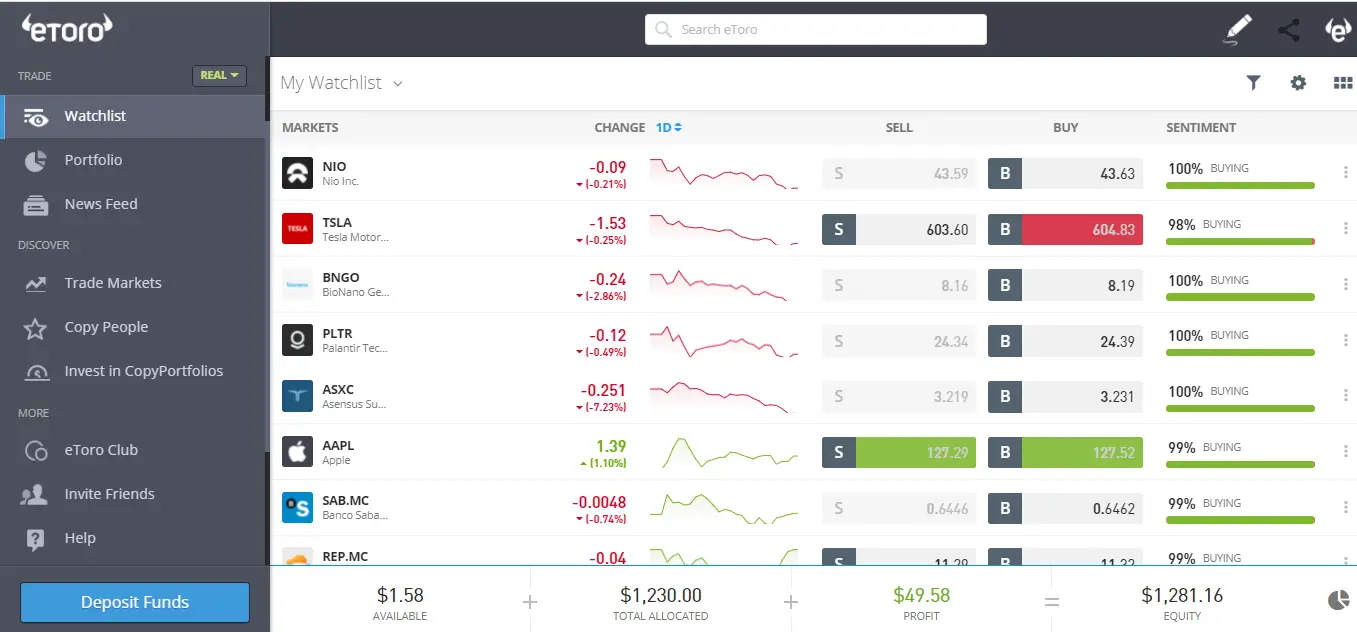
Founded in 2007, eToro is a multi-asset trading platform with a worldwide presence (over 100 countries) and more than 40 million registered users. It listed on the NASDAQ (ticker: ETOR) in May 2025. eToro offers real stocks and ETFs alongside thousands of CFD products on stocks, indices, currencies, and commodities.
Opening a business investment account through eToro is possible, though the products and markets available will vary depending on your location. In some cases, corporate account holders gain access to better spreads and fees, and increased leverage.
Your first step to opening an eToro corporate account is to contact customer support, as there is no self-service option to start the process on their website. To save time, you can provide the required documentation up front rather than waiting for their reply.
To open an eToro business investment account, open a ticket and provide eToro with the following information:
- What is the purpose of opening a corporate account with eToro?
- What type of legal entity is your company?
- Where is your company incorporated?
- A detailed description of your company’s business activity.
- A copy of your company’s Memorandum and Articles of Association, or the local equivalent.
- Confirmation that the minimum initial deposit of USD 10,000 for a corporate account is acceptable.
Want to know more? Read eToro’s FAQs for opening a corporate account.
Pros
- Low stock trading fees (from $0 per trade)
- Commission-free ETFs (other fees apply)
- Social trading and other innovative products
- Wide variety of financial products
- Slick, modern, and easy for anyone to use
- European users have access to three account currencies: EUR, USD and GBP
- Top tier regulators
Cons
- Limited disclosed financial information
- Withdraw and inactivity fees
- Spread, overnight, inactivity, and currency conversion fees higher than average
- Doesn’t offer bonds, futures, or options
CFDs are complex instruments and come with a high risk of losing money rapidly due to leverage. 52% of retail investor accounts lose money when trading CFDs with this provider. You should consider whether you understand how CFDs work and whether you can afford to take the high risk of losing your money.
What is a business brokerage account?
A business brokerage account is a brokerage account opened in a company’s name rather than an individual’s, allowing a business or self-employed person to trade, hold, and manage securities using the company’s own funds.
The main difference from a personal account is whose name everything sits under. The account belongs to the legal entity, it is funded from company money, and any gains, losses, dividends, and interest belong to the company, reported under its accounts and taxed under corporate (not personal) rules. Because of that, opening one involves more paperwork: brokers must verify the company itself, along with its directors and any beneficial owners holding 25% or more, to meet anti-money-laundering requirements.
Eligibility depends on the provider, but business accounts are typically open to limited companies, LLCs, partnerships, holding companies, and sole traders or the self-employed. Some brokers also onboard trusts and foundations. Minimums and available markets vary by broker and by the country where your company is incorporated.
Depending on the brokerage provider, various types of securities can be traded. Some business brokerage accounts allow trading of the following investment products:
- Stocks
- ETFs (exchange-traded funds)
- Funds
- Bonds
- Derivatives (e.g. certificates or options)
- Cryptocurrencies
Stocks, ETFs, and funds are almost always available, while derivatives and cryptocurrencies depend on the broker and your jurisdiction.
Why open a business investment account?
Investing your company’s spare cash, rather than leaving it idle, can offer several benefits:
- Earn a return on idle cash: brokers often pay interest on uninvested balances (frequently in several currencies), and putting reserves to work can earn more than a typical business current account.
- Protect against inflation: cash left in the bank loses real value over time. Investing a portion of your reserves helps preserve the company’s purchasing power.
- Diversification: if you would rather not reinvest everything back into your own business, holding other companies, funds, and assets spreads your risk beyond a single line of activity.
- Spread counterparty risk: concentrating reserves in one bank exposes you to that bank and to deposit-guarantee limits. A brokerage account lets you hold a range of instruments, with securities typically kept in segregated custody and covered by an investor-compensation scheme.
- Keep a clean corporate structure: holding investments in the company’s name keeps business and personal finances separate, simplifying accounting and reporting.
- Defer taxes: depending on your jurisdiction, reinvesting profits inside the company can defer the tax that would arise on withdrawing them. Tax treatment varies widely by country, so confirm the details with a qualified adviser.
That said, investing corporate cash carries risk – the value of investments can fall as well as rise, and it adds some accounting and tax-reporting overhead – so it best suits reserves you will not need in the short term.
Conclusion
All in all, outside the USA there are very few alternatives for those looking to open a corporate brokerage account. In this post, we have covered three brokers that let you invest through your company, as we’ve done ourselves.
Feel free to reach out to us if you have any feedback or questions – we’re happy to help!
FAQs
Can you open a business account at Trading 212?
No, currently a business account cannot be opened at Trading 212. Only retail private accounts are accepted.
Does DEGIRO offer a business account?
No, DEGIRO used to offer corporate accounts, but those are no longer available.
Does Trade Republic offer corporate accounts?
No, you can’t open a business account at Trade Republic, only a retail personal account.
Does Hargreaves Lansdown offer business accounts?
No, Hargreaves Lansdown does not offer corporate accounts.
Does XTB offer business accounts?
No, XTB does not offer corporate accounts.