Navigating the UK’s online brokerage scene can be difficult for every investor, mainly beginners. You can feel overwhelmed by the many fee structures, products, and marketing noise.
Throughout the article, you will find an extended analysis of what we consider to be the best online brokers in the UK. Whether you’re a beginner seeking a user-friendly platform, a fan of buy-and-hold funds and ETFs, or a crypto and CFD enthusiast, we’ve got you covered!
Don’t want to read the whole article? Find our summarized list below:
In a nutshell: best online brokers in the UK in 2026
- Interactive Brokers: Best UK broker overall
- eToro: Best broker for commission-free investing and social trading
- Capital.com: Best broker for CFD and spread betting
- XTB: Best broker for commission-free ETF trading
- Pepperstone: Best broker for forex and platform choice (MT4, MT5, cTrader and TradingView)
- Webull UK: Best for beginners looking for quick exposure to US stocks
- Plus500: Best broker for demo account
- Saxo Markets: Best broker for professionals
- Freetrade: Best broker for beginners
- Trading 212: Best broker for auto investing and ISA
- InvestEngine: Cheapest ETF broker
Comparison of UK online stock brokers
| Online Broker | Minimum deposit | Financial products available | Fees on US stocks | Regulators |
| Interactive Brokers | £0 | Stocks, ETFs, Options, Futures, Forex, Commodities, Bonds and Funds. | Between $0.0005 and $0.0035 per US share (min. $0.35) | FINRA, SIPC, SEC, CFTC, IIROC, FCA, CBI, AFSL, SFC, SEBI, MAS, MNB |
| eToro | $50 | ETFs, Stocks, Cryptocurrencies and CFDs on Stocks, ETFs, Commodities, Forex and Indices | $0 | FCA, CySEC, and ASIC |
| Capital.com | £20 | CFDs on indices, shares, Forex and commodities, Spread betting, and 1X CFD | Not applicable | FCA |
| XTB | £0 | Stocks, ETFs, Forex, and CFDs on Stocks, ETFs, Indices, cryptocurrencies and commodities. | £0 | FCA, KNF, CySEC, DFSA and FSC |
| Pepperstone | £0 | Spread bets and CFDs on Forex, Indices, Commodities, Shares, ETFs and Cryptocurrencies. No real share ownership. | Not applicable | FCA, ASIC, CySEC, BaFin, DFSA, CMA and SCB |
| Webull | £0 | US Stocks, Options, Asian Stocks, and GBP savings account | 0.025% per share | FCA |
| Plus500 | £100 | Shares (Plus500 Invest) and CFDs on Indices, Forex, Commodities, Cryptocurrencies, Shares, Options and ETFs. | $0.006 per share | FCA, CySEC, FSCA, FMA and ASIC |
| Saxo | £0 | Stocks, ETFs, Bonds, Mutual Funds, Crypto ETPs, Options, Futures, Forex, Forex Options, Crypto FX, CFDs and Commodities | Between $0.01 and $0.02 per US share (minimum between $3 and $10 per order) | ASIC, FSA, FCA, SFC, MAS, FINMA, DFSA |
| Freetrade | £0 | Stocks, ETFs, Investment Trusts, REITs and SPACs. | £0 | FCA |
| Trading 212 | £10 | Stocks, ETFs, Forex, crypto, CFDs on stocks, crypto, indices and ETFs. Fractional shares, automatic investment system. | £0 | FCA, CySEC, ASIC, BaFin |
| InvestEngine | £100 | Only ETFs. | Not available (only ETFs) | FCA |
Interactive Brokers at a glance: Best overall

Interactive Brokers leads our list as the best online broker in the UK.
Founded in 1978, Interactive Brokers is one of the largest international brokers, publicly listed on NASDAQ (ticker: IBKR) and an S&P 500 constituent since 2024. It serves 3 million+ client accounts worldwide and is regulated by multiple top-tier authorities. UK clients are served by Interactive Brokers (U.K.) Limited, authorised and regulated by the FCA, with client assets protected by the FSCS up to £85,000. There is no minimum deposit.
IBKR caters to both beginners and experienced investors looking for a genuinely broad product universe (stocks, ETFs, bonds, options, futures, forex, mutual funds, and cryptocurrencies) across 170+ markets in 36+ countries, alongside advanced technical and fundamental tools and a strong educational offering.
For UK investors specifically, Interactive Brokers offers a Stocks and Shares ISA and a SIPP, so you can invest through the standard UK tax wrappers rather than being limited to a general investment account.
Interactive Brokers supports multiple account base currencies including GBP, USD, and EUR, with funding via bank transfer. Spreads are among the tightest available, and commissions are tiered, varying with your monthly trading volume. UK shares cost from 0.05% of trade value (£1 minimum), US shares from $0.0035 per share ($0.35 minimum), and FX conversion is priced at roughly 0.20 basis points (minimum $2) – materially cheaper than the 0.50% to 1.50% typical at UK high street brokers, which matters if you buy US-listed shares regularly.
For investors who prefer to trade on the go, the IBKR Mobile app offers both convenience and advanced functionality. IBKR GlobalTrader is a second mobile app built for simpler global trading, with fractional shares from $1 and a $10,000 virtual demo account to practise in before committing real money.
On the downside, the sheer number of features can feel overwhelming, particularly if you are new to investing. Interactive Brokers offsets this with extensive educational content through IBKR Campus (formerly Traders’ Academy) and video tutorials covering each platform.
Want to know more? Check our comprehensive Interactive Brokers review and visit IBKR’s website.

Pros
- Low commissions on US stock trading
- No monthly inactivity fee
- The broadest product and markets range in the brokerage industry
- Demo account
- Excellent reputation (founded in 1978)
- Extensive research and Education tools
- Has a modern mobile trading app to trade Stocks, Options and ETFs, ideal for novice investors, IBKR GlobalTrader.
- Offers interest on uninvested cash balances
Cons
- Complicated and lengthy account opening process (but fully online)
- Steeper learning curve for beginners
- Website is difficult to navigate
- Interactive Advisors (Robo-advisor feature) is only available for US customers
eToro at a glance: Best for commission-free investing and social trading

52% of retail CFD accounts lose money.
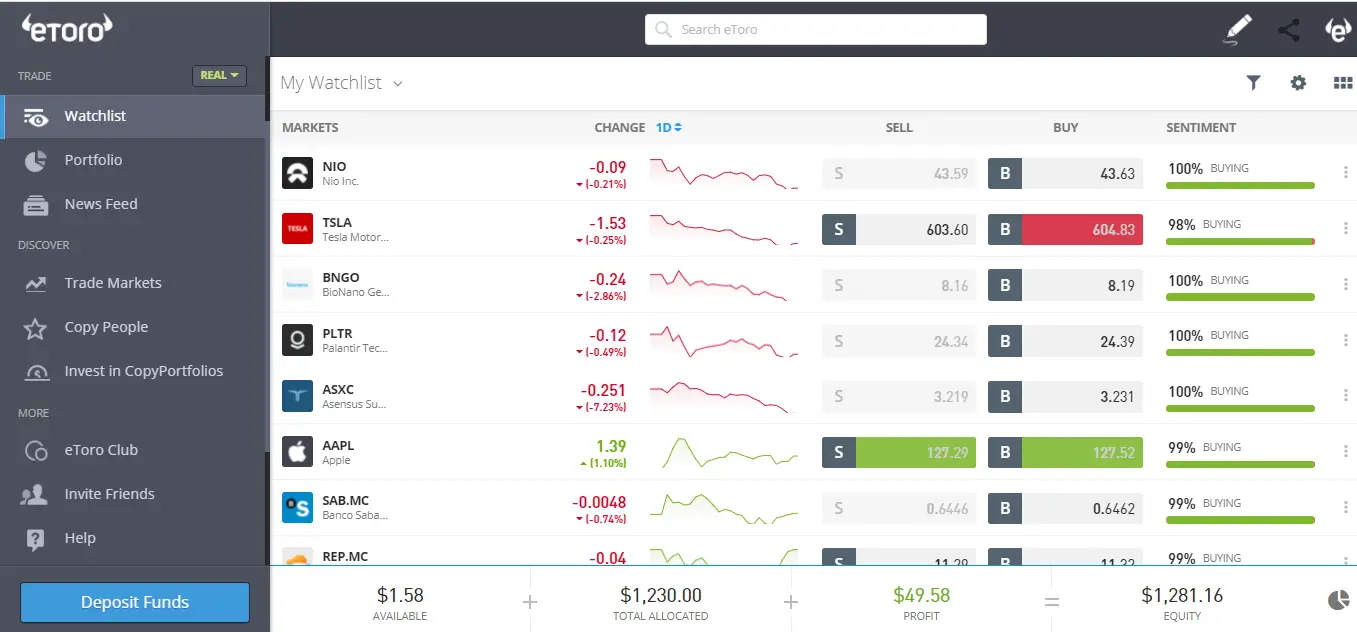
Another strong platform available in the UK is eToro, an international online broker with over 40 million users across 140+ countries trading stocks, ETFs, forex, commodities, cryptocurrencies, and CFDs. It is best known for its social trading feature, which lets you copy the trades of experienced investors through CopyTrader. Thousands of verified Popular Investors are available, and you can filter by past return, risk score, drawdown, and other published metrics.
The platform gives access to more than 3,000 financial instruments, including real stocks and ETFs from the LSE, US, and major EU exchanges. Users can also invest in Smart Portfolios, ready-made thematic allocations grouping several assets or traders around a strategy such as AI, renewable energy, or dividend investing.
eToro offers commission-free real stock and ETF investing in the UK (other fees apply), with whole or fractional shares.
Opening an account and depositing is straightforward, and you can practise first with a $100,000 virtual demo account. On the downside, spreads can be relatively high on some products, and eToro operates in USD as its only base currency – so GBP deposits are converted to USD (FX cost around 50 pips), with the same applying on withdrawal. There is also a $5 withdrawal fee and a $10 monthly inactivity fee after 12 months without login.
UK clients are served by eToro (UK) Ltd, authorised and regulated by the FCA, with FSCS protection up to £85,000. eToro also offers a Stocks and Shares ISA to UK investors, provided in partnership with Moneyfarm. eToro has been listed on NASDAQ (ticker: ETOR) since its May 2025 IPO.
If you want to learn more, check our eToro review.
Pros
- Low stock trading fees (from $0 per trade)
- Commission-free ETFs (other fees apply)
- Social trading and other innovative products
- Wide variety of financial products
- Slick, modern, and easy for anyone to use
- European users have access to three account currencies: EUR, USD and GBP
- Top tier regulators
Cons
- Limited disclosed financial information
- Withdraw and inactivity fees
- Spread, overnight, inactivity, and currency conversion fees higher than average
- Doesn’t offer bonds, futures, or options
CFDs are complex instruments and come with a high risk of losing money rapidly due to leverage. 52% of retail investor accounts lose money when trading CFDs with this provider. You should consider whether you understand how CFDs work and whether you can afford to take the high risk of losing your money.
Capital.com at a glance: Best for CFD and spread betting

Spread bets and CFDs are complex instruments and come with a high risk of losing money rapidly due to leverage. 65% of UK retail investor accounts lose money when trading spread bets and CFDs with this provider.
Founded in 2016, Capital.com is a global CFD trading platform that has quickly grown thanks to its commission-free model and user-friendly technology. Trusted by 770k+ traders worldwide, it offers access to a wide range of markets, including CFDs on forex, stocks, indices and commodities. Plus, it provides spread betting and an “X1” account, which means CFD trading without leverage.
They offer their in-house web and mobile app (packed with innovative tools such as AI-driven insights and risk management features), and you can also invest through the TradingView and MT4 platforms, where you can create automated investment strategies. A free demo account is available to practice before investing real money.
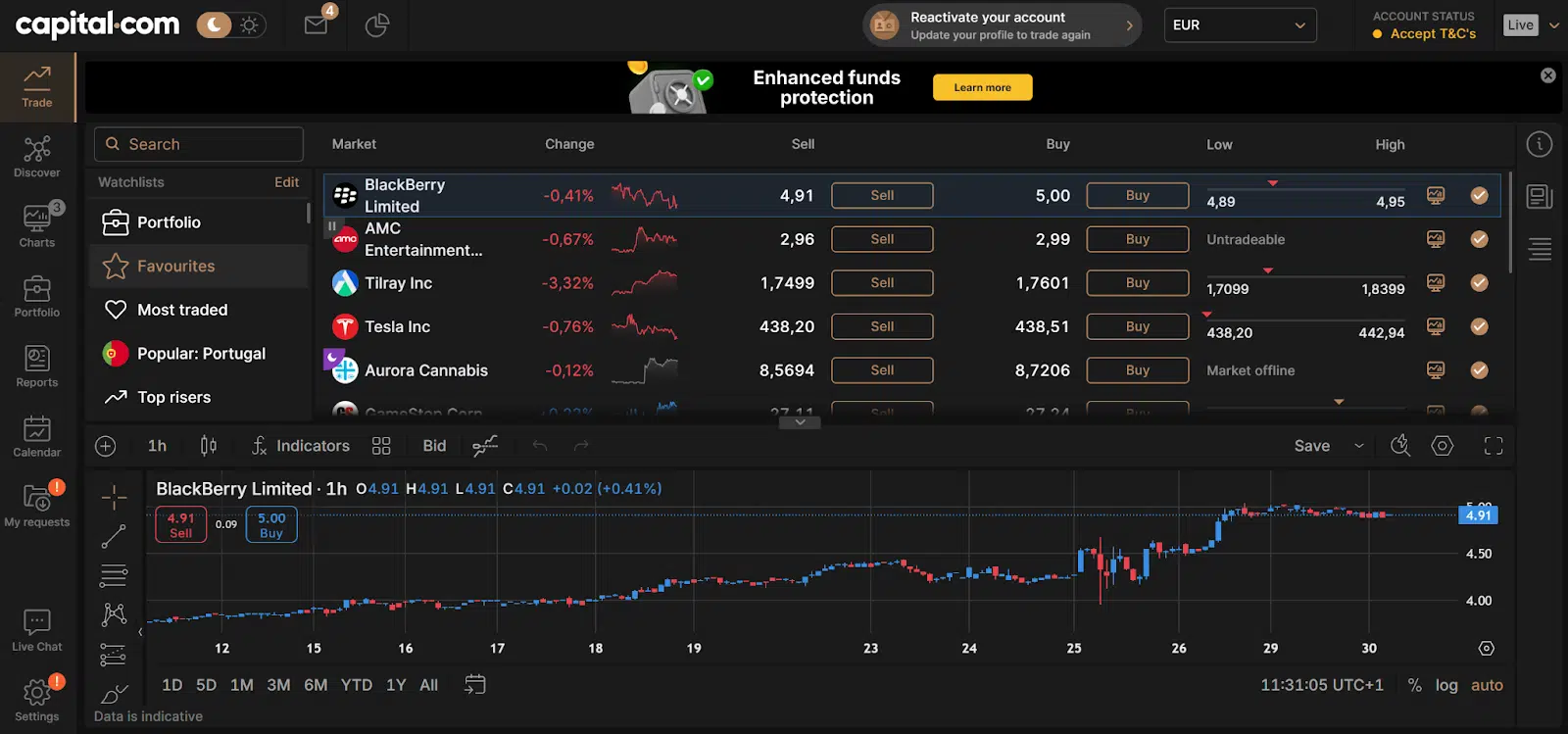
Capital.com doesn’t charge any commission on your trades. However, they charge a fee based on the spread (the difference between the buy and sell prices). Spreads are dynamic and change with underlying market conditions. Apart from spreads, the broker also charges a fee on guaranteed stop-loss orders and on overnight funding (only applicable when you use leverage).
On the downside, as with many CFD-only brokers, it might not be suitable for investors seeking traditional investment products like ETFs, bonds, long-term retirement accounts, or direct ownership of physical assets rather than derivatives.
In terms of regulation, Capital.com is regulated by the Financial Conduct Authority (FCA), under registration number 793714. It holds clients’ funds in segregated bank accounts and provides negative-balance protection for retail clients.
Additionally, all clients are protected by the Financial Services Compensation Scheme (FSCS), which provides up to £85,000 in compensation if something goes wrong with the company (e.g., fraud or operational issues).
Capital.com is a great solution for traders looking for commission-free CFD trading (other fees may apply), spread betting and no-leverage CFDs.
Pros
- 0% commission trading (only spreads apply)
- Offers a 1X (non-leveraged) account with no overnight funding fees
- Spread betting is available
- User-friendly web and mobile platforms
- Integration with MT4 and TradingView
- Wide range of tradable assets (over 5,000 markets)
- Low minimum deposit of £20
- 24/7 index CFD trading (extended hours)
- 24/7 customer support
- Excellent educational resources, including guides and webinars
- Demo account
Cons
- No ownership of underlying assets (CFD/spread betting only)
- Overnight financing fees can become expensive for long-term, highly leveraged positions.
- Not suitable for passive or dividend-focused investors
- No interest on uninvested cash
Disclaimer: Spread bets and CFDs are complex instruments and come with a high risk of losing money rapidly due to leverage. 69-80% of retail investor accounts lose money when trading spread bets and CFDs with this provider. You should consider whether you understand how spread bets and CFDs work and whether you can afford to take the high risk of losing your money.
XTB at a glance: Best for commission-free ETF trading

69-80% of retail CFD accounts lose money.
Founded in 2002 in Warsaw and publicly listed on the Warsaw Stock Exchange (ticker: XTB), XTB is a major European broker with more than 1.7 million clients across 16 countries. It is regulated by the FCA in the UK, alongside KNF (Poland), CySEC (Cyprus), BaFin (Germany), and AFM (Netherlands).
You can invest through xStation 5 and xStation Mobile across stocks, ETFs, forex, indices, commodities, cryptocurrency CFDs, and vanilla options, added in early 2026. XTB offers 0% commission on real stocks and ETFs and a flexible Stocks and Shares ISA with the following features:
- Invest in more than 3,000 stocks and 700 ETFs with 0% commission up to a monthly trading volume equivalent to €100,000 (0.2% above that, with a £10 minimum). A 0.5% currency conversion fee applies when buying assets denominated in another currency;
- Earn interest on uninvested GBP cash, calculated daily and paid monthly. Rates are linked to Bank of England policy and subject to change, so check the current rate on XTB’s website;
- As a flexible ISA, you can withdraw money and replace it within the same tax year without it counting against your annual allowance – a genuine advantage over non-flexible ISAs, where withdrawals permanently consume allowance.
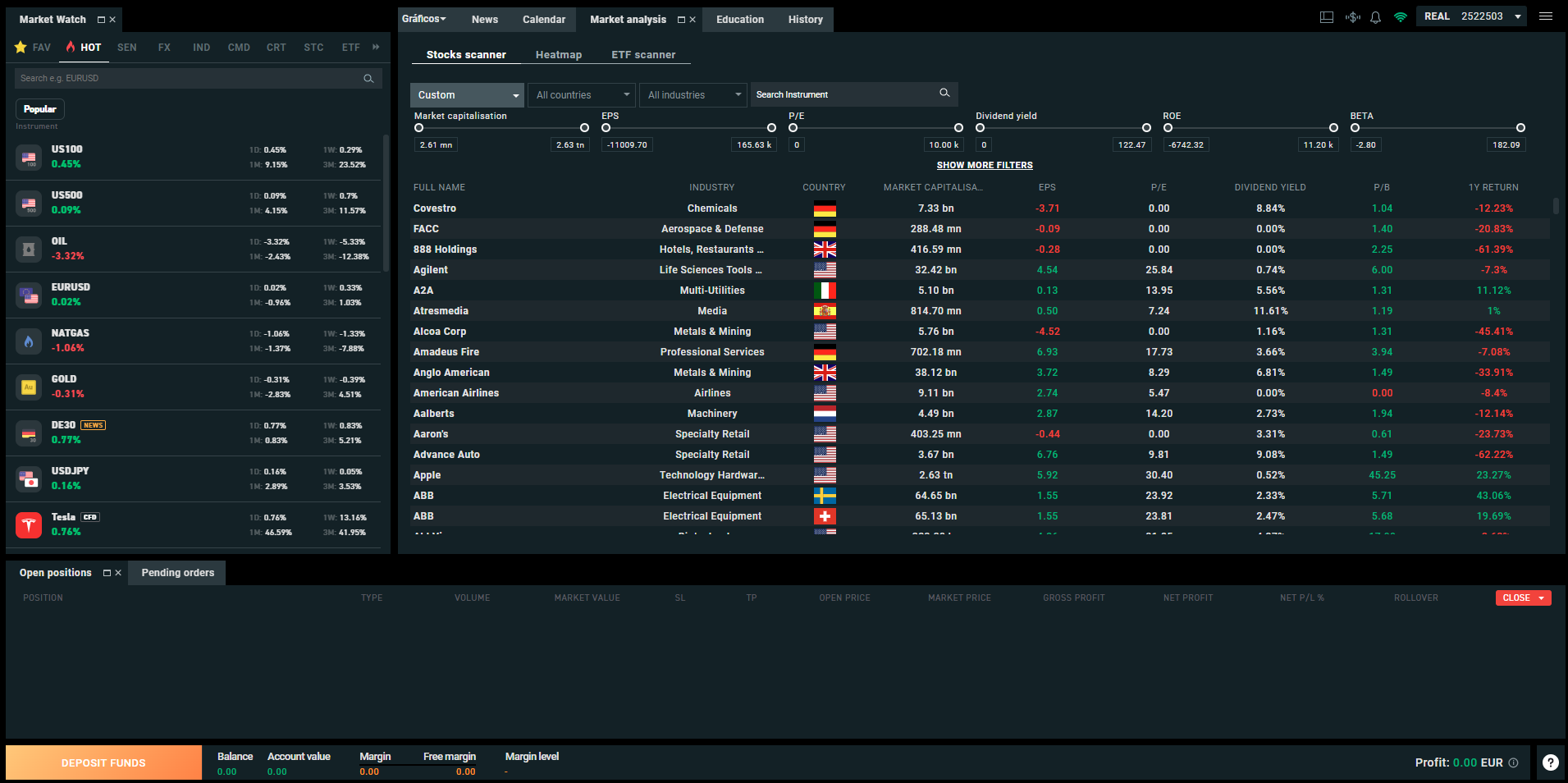
Opening an account and transferring money is quick and fully online. For beginners, XTB provides a demo account to trade under realistic conditions before committing capital, alongside the XTB Trading Academy, an extensive educational hub. For intermediate and advanced investors, xStation 5 offers a comprehensive set of technical and fundamental tools.
On the downside, XTB charges a £10 monthly inactivity fee after one year without trading and no deposit in the past 90 days. Cryptocurrency CFDs carry relatively wide spreads, though forex pricing is competitive.
Want to know more about XTB? Check our XTB review.
Pros
- Free stocks trading (only applicable to some countries)
- Customizable trading platform (charts and workspace)
- Low Forex Spreads
- Demo account
- No minimum account deposit
- Valuable education materials
- Top-tier Regulators
Cons
- Complex trading platform for a beginner
- High Stock CFD spreads
- Limited product portfolio
- Withdrawal fees for transfers below $100
- Inactivity fee (€10/monthly after 1+ year with no activity plus no deposit in the last 90 days)
CFDs are complex instruments and come with a high risk of losing money rapidly due to leverage. Between 69-80% of retail investor accounts lose money when trading CFDs. You should consider whether you understand how CFDs work and whether you can afford to take the high risk of losing your money.
Pepperstone at a glance: Best broker for forex and platform choice

72-95% of retail CFD accounts lose money.
Founded in Melbourne in 2010, Pepperstone has grown into one of the largest independent brokers outside the traditional banking sector, with more than 900,000 accounts held across the group as at March 2026. UK clients are served by Pepperstone Limited, authorised and regulated by the Financial Conduct Authority under reference number 684312, and registered at 70 Gracechurch Street, London EC3V 0HR. Eligible client assets are covered by the Financial Services Compensation Scheme up to £85,000.
One thing to be clear about before going further, because it separates Pepperstone from most of the platforms in this article: you cannot buy real shares here. Everything Pepperstone offers UK clients is a spread bet or a CFD, meaning you never own the underlying asset. There is no Stocks and Shares ISA, no SIPP, no real dividends and no shareholder rights. If you are building a long-term portfolio, one of the other brokers on this list is the right tool. Pepperstone is here because for active traders, particularly in forex, it is arguably the strongest package available to UK clients.
UK traders get three account types: a spread betting account and two CFD accounts, Standard and Razor. The difference is only how you pay. Standard builds a 1 pip mark-up into the raw spread, with no separate commission on FX, indices or commodities. Razor gives you the raw spread (from 0.0 pips on FX) plus a fixed commission from $3.50 per lot, per side. Razor is cheaper for most active traders, and the gap widens the more you trade.
The UK tax treatment is a real advantage over the CFD-only route. Spread betting profits are exempt from capital gains tax and stamp duty, subject to your circumstances and to tax law not changing. CFDs are exempt from stamp duty but still subject to CGT.
Where Pepperstone stands apart is platform choice. Alongside its own web platform and app, it supports MetaTrader 4, MetaTrader 5, cTrader and native TradingView execution – no other broker reviewed here offers all four. If you run an Expert Advisor or a cBot, or your analysis already happens in TradingView charts, that alone can settle the decision. Scalping, hedging and automated trading are all permitted.
Non-trading costs are unusually clean: no inactivity, deposit or withdrawal fees, and nothing to open or close an account. GBP is available as a base currency, so sterling funding avoids a conversion charge. What does bite is overnight funding and swaps, charged on positions held past 5pm New York time.
Pepperstone has also expanded into extended hours, with 24/5 spread bets and CFDs on 100+ US shares, so you can react to earnings and data releases outside exchange hours.
As an FCA-regulated firm, Pepperstone applies the UK product intervention rules: leverage capped at 30:1 on major currency pairs down to 2:1 on crypto, negative balance protection, and a 50% margin close-out rule.
Pros
-
Raw spreads from 0.0 pips on FX (Razor account)
-
The widest platform choice in this article: MT4, MT5, cTrader, TradingView plus its own platform and app
-
Tax-free spread betting for UK clients (subject to individual circumstances)
-
Fast execution with Tier-1 bank liquidity and no dealing desk
-
Scalping, hedging and automated strategies all permitted
-
No inactivity, deposit or withdrawal fees
-
No minimum deposit and GBP base currency available
-
Free demo account
- Commission rebates for high-volume traders
Cons
-
No real share ownership: spread bets and CFDs only
-
No Stocks and Shares ISA and no SIPP
-
No interest paid on uninvested cash
-
Overnight funding makes longer holding periods expensive
-
No native copy trading or social investing features
-
No guaranteed stop-loss orders
- Not suitable for beginners or long-term investors
Webull at a glance: Best for US stocks

Founded in 2017 in the US and launched in the UK in July 2023, Webull entered the British brokerage market with a low-cost proposition. It offers access to US stocks and options, emerging market stocks, and a GBP savings account. New users can claim a signup bonus.
UK users also get a demo account to buy and sell under realistic conditions before committing real money. Deposits are accepted in pound sterling only, so buying US stocks (traded in dollars) incurs a 0.35% currency conversion fee. Each trade also carries a 0.025% commission, meaning you pay roughly 0.375% per transaction in total, plus minimal regulatory fees.
That structure is worth understanding before you commit: because the FX charge applies on both entry and exit, a round trip on a US stock costs around 0.75% before any market movement. For frequent traders or anyone building a position through regular monthly contributions, that adds up quickly compared with brokers charging a fraction of a basis point on conversion.

Fractional shares are a genuine advantage here, since many US stocks trade at high per-share prices that would otherwise put them out of reach for smaller contributions. However, the limited asset range is a real constraint – there are no ETFs, bonds, or funds – and Webull UK offers only a general investment account, with no Stocks and Shares ISA or SIPP. For UK investors, that second point matters considerably: without a tax wrapper, gains above the annual CGT exemption and dividends above the dividend allowance become taxable, which over time can outweigh the low headline trading costs.
Webull UK is authorised and regulated by the Financial Conduct Authority (FCA) and covered by the Financial Services Compensation Scheme (FSCS), protecting eligible client assets and cash up to £85,000.
Pros
- Free Shares Sign Up Promotion
- Mobile-friendly app
- Fractional Shares
- Access to US-listed stocks and options
- One of the largest brokerages in the USA
- Regulated by the FCA
- Demo Account (paper trading)
Cons
- No ISA or SIPP
- Limited range of assets available - no ETFs, bonds, crypto
- FX fee
- No commission-free trading
Plus500 at a glance: Best for CFDs

81% of retail CFD accounts lose money.
Founded in 2008, Plus500 is an online broker offering real shares alongside CFDs on forex, indices, shares, commodities, options, ETFs, and cryptocurrencies. It operates in over 50 countries and is listed on the London Stock Exchange (ticker: PLUS), where it is a FTSE 250 constituent – a useful signal of scale and disclosure standards for UK investors.
There are two distinct account types:
- Plus500 CFD: focused exclusively on CFD products;
- Plus500 Invest: for trading real shares.
The main platform is WebTrader, Plus500’s proprietary system, offering a stable experience across devices including a mobile app. All platforms are responsive, and you can test the features through a demo account before funding.
Customer support is accessible through a chat window permanently visible within the trading platform. Spreads are competitive, and accounts are available in 16 base currencies including GBP, USD, and EUR – so UK investors can hold in sterling and avoid conversion on deposit. Plus500 charges a 0.70% currency conversion fee on CFDs (0.30% on Plus500 Invest) and a $10 monthly inactivity fee after three months without account activity. On Plus500 Invest, commissions are modest at $0.006 per share on US markets (minimum $1). Negative balance protection now applies globally.
UK investors are served by Plus500UK Ltd, authorised and regulated by the FCA, with FSCS protection up to £85,000. Note that Plus500 does not currently offer a Stocks and Shares ISA, so UK investors looking for a tax wrapper will need to look elsewhere.
Want to know more about Plus500? Check our Plus500 review.
CFDs are complex instruments and come with a high risk of losing money rapidly due to leverage. 80% of retail investor accounts lose money when trading CFDs with this provider.

Pros
- Acessible and responsive platform
- Low spreads
- No dealing commissions
- Demo Account
- Top-tier regulators
Cons
- No ETF offering
- Inactivity fee ($10 per month after no login activity in 3 months)
- High overnight funding fees
- Very little research and education provided
CFDs are complex instruments and come with a high risk of losing money rapidly due to leverage. 81% of retail investor accounts lose money when trading CFDs with this provider. You should consider whether you understand how CFDs work and whether you can afford to take the high risk of losing your money. Any educational content, market commentary, research, analysis, forecasts, coaching, training, or opinions provided by independent third parties do not represent the views of Plus500. Plus500 provides self-trading execution-only services and does not provide asset management nor investment, financial, legal, or tax advice. Plus500 accepts no responsibility or liability for any decisions made or losses incurred as a result of reliance on information, research, educational materials, coaching, or services provided by third parties.
Saxo at a glance: Best for professionals

62% of retail CFD accounts lose money.
Launched in 1992 in Copenhagen, Saxo (formerly Saxo Bank) is one of the most solidly capitalised entities in the brokerage industry, with a long track record. In March 2025, Saxo was acquired by J. Safra Sarasin, one of the world’s most conservatively run private banking groups, and holds an investment-grade A-/A2 credit rating from S&P. Saxo serves more than 1.5 million clients worldwide and gives access to over 71,000 financial instruments through two platforms:
- SaxoInvestor: a straightforward investing platform for web and mobile, covering stocks, ETFs, mutual funds, and bonds, with portfolio overviews and easy-to-use charts. Best suited to long-term, buy-and-hold investors;
- SaxoTrader: the advanced platform for web, mobile, and desktop, covering the full product range including margin and leveraged products. The desktop version adds a customisable multi-screen workspace (up to six screens), Depth Trader with Level 2 order book data, time and sales data, and bulk position management.
A single Saxo account gives you access to both platforms, so you can switch between them depending on what you are doing.
The product range spans cash and margin trading across global markets, including stocks, ETFs, bonds, mutual funds, options, futures, forex, commodities, and CFDs. Saxo does not offer direct cryptocurrency trading, only crypto ETPs and CFDs. UK investors also benefit from Level 1 and Level 2 data across 40+ exchanges, 85+ technical indicators, and integrations with third-party tools including TradingView.
Saxo’s account tiers are as follows:
- Classic: no minimum deposit since 2024 (may vary by country of residence), with access to competitive spreads and customer and technical support;
- Platinum: requires a portfolio value of £200,000+. Adds up to 30% lower trading costs and prioritised local-language support;
- VIP: requires a portfolio value of £1,000,000+. Offers the best pricing, direct access to trading specialists, and exclusive event invitations.
Platinum and VIP are based on portfolio value rather than a deposit requirement, so tiers can be reached through portfolio growth as well as through funding.

The pricing structure will vary according to your account tier. For instance, a US stock order will be 0.08% of the trade value, with a minimum of $1 in Classic. However, within the VIP tier, the same trade would be 0.03% of the trade value with the same minimum of $1. Plus, for accounts with stocks, ETFs/ETCs, or bond positions, a custody fee of up to 0.15% p.a. will apply.
Saxo Bank A/S is a fully licensed European bank under the supervision of the Danish Financial Supervisory Authority (FSA). Saxo Bank is a member of the Danish Guarantee Fund, which protects client cash deposits up to €100,000 and financial securities (stocks, ETFs,…) up to €20,000 per client.
Pros
- Extensive range of investment products
- Has ISA
- Long track record
- Supervised by worldwide top-tier regulators
Cons
- Fees higher than average and harder to understand
- More difficult to navigate the platform
Freetrade at a glance: Best for beginners

Freetrade is a mobile-only commission-free UK stockbroker founded in 2016 that lets you invest in more than 6,000 stocks (US, UK, German, Finnish and Dutch), as well as ETFs, for free.
Freetrade came to revolutionize the traditional brokerage industry. A lot of brokers still present high complexity over their platforms and product offer. Freetrade is on a mission to help customers achieve better long-term financial outcomes and, for that purpose, it wants to be as transparent and trustworthy as possible. Ultimately, their goal is to allow everyone to benefit from wealth creation.
In the Freetrade app, you will not find CFDs and other related complex products; it does not promote day trading and has no hidden fees. The accounting opening process is quick and smooth. The mobile app is remarkably user-friendly. The main drawback is the limited product offering (no options, bonds, Forex, CFDs, Commodities or Cryptocurrencies).
They operate under a freemium (free+premium) business model.

Pros
- Free stock and ETF trading
- GIA, ISA, and SIPP
- No inactivity, account, or withdrawal fees
- No minimum deposit
- Great community (forum) – where users share ideas and learn about investing
- Nice and user-friendly app
Cons
- Limited asset classes (only stocks, ETFs, REITs, and investment trusts)
- Limited research and education
- Graphs and portfolio tracking still need some development
- No phone support – however, live chat support is very fast and efficient
Trading 212 at a glance: Best for auto investing and ISA

Capital at Risk. Sponsored Link. To get free fractional shares worth up to 100 EUR/GBP, you can open an account with Trading 212 through this link. Terms apply.
Founded in 2004, Trading 212 is a fintech based in London that aims to democratize the entire investment process through a simple mobile application. The company aims to do this by allowing anyone to invest in over 10,000 stocks, ETFs and crypto, Forex, commodities, CFDs, and cryptocurrencies.
In Trading 212, you will find commission-free stocks, ETFs and crypto trading (Other fees may apply. See terms and conditions), fractional shares, and even an automatic investment system (Robo-advisor). Opening an account is extremely quick and easy. On the downside, it shows limitations regarding available products, such as the lack of bonds and options. It charges a 0.15% currency conversion fee when buying assets in a currency different from your base account.
Within the app, you will notice two distinct sub-platforms: Trading 212 Invest, where you can trade a range of assets free of charge, and trading 212 CFD, where you may trade leveraged financial products (CFDs).
Finally, Trading 212 offers one free fractional share worth up to €100! It may be worth checking that out.
If you want to learn more, check our Trading 212 Review.
Pros
- Commission-free real stock, ETFs and crypto trading (other fees may apply. See terms and fees)
- AutoInvest & Pies feature (execution-only service, not financial advice)
- Fast and easy account opening process
- Demo account
- Top Tier Regulators
- Free fractional shares worth up to €100
- High interest on uninvested cash
Cons
- Limited product portfolio (no Options, Bonds, Mutual Funds or Futures)
- No relevant Fundamental tools
- 0.15% of Foreign exchange fees
Disclaimer: When investing, your capital is at risk and you may get back less than invested. Past performance doesn’t guarantee future results. Crypto-assets are high-risk and volatile. You could lose your invested capital, and these assets are not covered by protection schemes. Make sure you understand the risks before investing. Pies & Autoinvest is an execution-only service. Not investment advice or portfolio management. Automatic investing refers to executing scheduled deposits. You are responsible for all investment and rebalancing decisions. Don’t invest in crypto-assets unless you’re prepared to lose all the money you invest. This is a high-risk investment and you should not expect to be protected if something goes wrong.
InvestEngine at a glance: Cheapest ETF broker

When investing your capital is at risk.
InvestEngine is a leading broker in the UK, founded in 2016, that offers a range of innovative tools and features to help investors build and manage their investment portfolios. One of their standout offerings is fractional investing, allowing users to invest as little as £1 in any ETF on their platform, regardless of the ETF’s share price. They have over 550 ETFs available and are one of the cheapest ETF trading platforms in the UK.
Their trading platform offers several features. For instance, the smart order technology calculates the individual trades needed to align with your chosen portfolio weights.
With their Portfolio Look-through feature, investors can gain transparency and insight into the companies, sectors, geographical regions, and asset classes they invest in. AutoInvest is another convenient feature that automatically puts your available cash to work each day, ensuring you don’t miss out on rising markets. InvestEngine also offers one-click portfolio rebalancing, allowing you to reset your portfolio to your preferred asset allocation with a single click.
For those who prefer a managed portfolio, InvestEngine offers a choice of portfolios designed to suit different risk levels, with a management fee of just 0.25% per year. All their portfolios are accessible through their General Account, which allows investors to begin their investment journey with as little as £100 without any exit charges. In addition, it provides an Individual Savings Account (ISA) option, enabling investors to enjoy tax-free investing. Finally, it is worth noting that investments made with InvestEngine may be eligible for claims under the Financial Services Compensation Scheme (FSCS) for amounts up to £85,000, providing investors with an extra layer of security.
You can read our InvestEngine review for further analysis.

Pros
- Simple and intuitive investment platform
- No ISA fees
- No deposit or withdrawal fees
- Fractional Investing
- One-click rebalancing
- Auto-invest
Cons
- Only offers ETFs: no bonds, shares, and other products
- No interest on cash balances (still you can invest in money market funds)
Bottom line
To summarize here’s the list of “Best online brokers in the UK”:
Interactive Brokers
Best UK online broker overalleToro
Best online broker for commission-free investing and social tradingCapital.com
Best broker for CFD and spread bettingXTB
Best online broker for commission-free ETF tradingPepperstone
Best online broker for forex and platform choiceWebull
Best online broker for paper tradingPlus500
Best online broker for CFDsSaxo
Best online broker for professionalsFreetrade
Best broker for beginnersTrading 212
Best online broker for auto investing and ISAInvestEngine
Best online broker for zero-commission ETF trading
Some factors you should know when choosing an online broker are the fees charged, if it is regulated by top-tier institutions such as the FCA in the UK, the range of products it allows you to trade (not all platforms allow you to trade bonds), among others.
A reminder that the above should not be seen as investment advice and should be considered information only. Investors should do their own research and diligence about the best-suited services and opportunities for their risk, returns, and impact strategy.
Whether a new investor or a seasoned professional, we hope this article helped answer a few of your concerns. When choosing an online broker, we recommend opening a demo account and testing the features before making the final decision.
Happy investments!
FAQs
How to invest in stocks from the UK?
You can use one of the online brokers shown above: Interactive Brokers, eToro, Plus500, XTB, Webull, Saxo Bank, Trading 212, InvestEngine, and Freetrade.
What is a brokerage company?
It is an entity designed to be the middleman between you and the people you are trying to buy or sell a stock, ETF, crypto,… you name it!
Which broker is best in the UK?
There is no single answer. It depends on what you value most: fees, security, investment platform, or any relevant feature.
What are the types of investments you can make with a brokerage account?
You can trade stocks, ETFs, Forex, Bonds, Futures, and CFDs on stocks, ETFs, indices, cryptocurrencies, commodities.