White label exchanges offer businesses a faster, customisable way to launch a crypto trading platform than building one from scratch. With a crowded field of providers, choosing the right one decides both the user experience and how long the business lasts.
In this article we cover what to look for in a white label solution and profile the main options, checked against each provider’s own published pages in September 2026.
One point up front, because the rest of the decision depends on it: the software vendor does not give you a licence. In the European Union the company operating the exchange is the regulated firm, and the transitional regime that let existing national-law firms keep trading closed on 1 July 2026. There was never a route for a new entrant to launch before authorisation. The section on what the software does not give you sets out what that involves.
A note on scope: the licensing detail below is written for an operator serving customers in the European Union, since that is where the rules changed most recently. The providers themselves serve operators worldwide.
What is a white label crypto exchange?
A white label crypto exchange is a turnkey solution that lets businesses launch their own cryptocurrency exchange without building one from scratch. The term “white label” refers to the fact that a third-party provider supplies the underlying platform, but it’s fully customised and branded to appear as if the business developed it in-house.
If what you actually need is an account for your company on an existing venue rather than a venue of your own, that is a different product, and our guide to the best crypto exchanges for business accounts covers it.
White label providers typically deliver the core technology stack: the matching engine, wallets, integrations for know your customer (KYC) and anti-money laundering (AML) checks, admin tools, and mobile and web front ends. The purchaser handles branding, customer acquisition, regulatory licensing and day-to-day operations. That cuts the build time sharply, from the 12 to 24 months a platform typically takes to develop in house down to a few months, though as the licensing section below explains, the build time is rarely the binding constraint.
Best white label crypto exchange providers
#1 HollaEx
HollaEx offers exchange software, crypto tools and white label solutions to businesses of all sizes. It suits companies looking for a customisable, quick-to-market option, with cloud-hosted infrastructure and a two-week free trial before any commitment. It now prices on revenue share rather than a monthly licence fee.
#2 Alphapoint
Alphapoint offers enterprise-grade exchange software for cryptocurrency exchanges, brokerages and tokenisation platforms. Founded in 2013, it has the largest published deployment footprint here, and its software is used by operators licensed in several jurisdictions, though the licences belong to those operators rather than to Alphapoint.
#3 Antier
Antier is an Indian blockchain development firm offering a customisable white label exchange platform. It is the only provider here that publishes an indicative price, and it works as a development agency rather than a platform operator, which means more bespoke work and more of the project on your side.
#4 Velmie
Velmie is a Lithuanian financial technology provider whose product has moved towards stablecoin and digital asset infrastructure rather than exchange software specifically. It offers end-to-end implementation support and integrations with custody, liquidity and payment providers including Fireblocks and Coinbase.
#5 PayBito
PayBito, now branded PayBitoPro, offers a white label exchange platform supporting fiat and crypto pairs across four packages, with geography-specific verification flows. It holds no European authorisation, which matters if your customers will be in the EU.
| Provider | Published price | Demo | Based in | Best suited to |
| HollaEx | No fixed fee, 15% revenue share | Yes, plus a two-week free trial | Singapore | Trying the model before committing |
| Alphapoint | Not published | Yes, on request | United States | Institutional throughput |
| Antier | $50,000 to $500,000 | Yes, live and on request | India | A bespoke build |
| Velmie | Not published | Book a demo | Lithuania | Stablecoin and digital asset products |
| PayBito | Not published | Live exchange to view only | United States | Packaged tiers outside the EU |
White label provider terms as published by each vendor, checked in September 2026. None of the five holds a financial licence of its own, and the price column covers software only, not the authorisation, capital and compliance costs an operator carries separately.
Best white label crypto exchange providers reviewed
#1 HollaEx

HollaEx at a glance
HollaEx develops exchange software and crypto tools designed to be straightforward to deploy, letting a company launch a crypto business from a customisable platform. It offers an interactive demo and a two-week free trial before any commitment. The white label software emphasises cloud-hosted infrastructure, deep customisability, built-in liquidity sourcing and fast deployment. It suits existing exchanges upgrading their stack, IT and fintech firms adding crypto services, and companies launching new crypto businesses.
HollaEx is run from Singapore and was for years distributed as open source through its HollaEx Kit repository. That repository is no longer publicly available, and the current site no longer describes the product as open source. If source access matters to your build, ask what the contract actually gives you.
The platform offers a modular architecture, enabling smooth integration of new workflows, custom features, and additional asset types as your business grows. This flexibility lets businesses expand and add products without rebuilding the platform underneath. HollaEx also provides a robust custody solution with institutional-grade security for digital assets, drawing on over a decade of experience in hot and cold wallet design. The enterprise-grade backend is powered by a high-performance crypto matching engine supporting all aspects of digital asset trading, alongside the tooling needed to develop advanced fintech products on top of the platform.

HollaEx enables implementation of on/off-ramps for fiat payment products including white-label debit cards, e-commerce crypto payments, and bank account integrations. The built-in crypto wallet solution supports major fiat currencies and cryptocurrencies, allowing seamless conversion and instant purchase of digital assets. Security is a core pillar, HollaEx supports advanced features including data encryption at rest and in transit, two-factor authentication, cold storage of customer funds, biometric authentication, multi-signature wallets, granular access management, comprehensive action logging, and more.
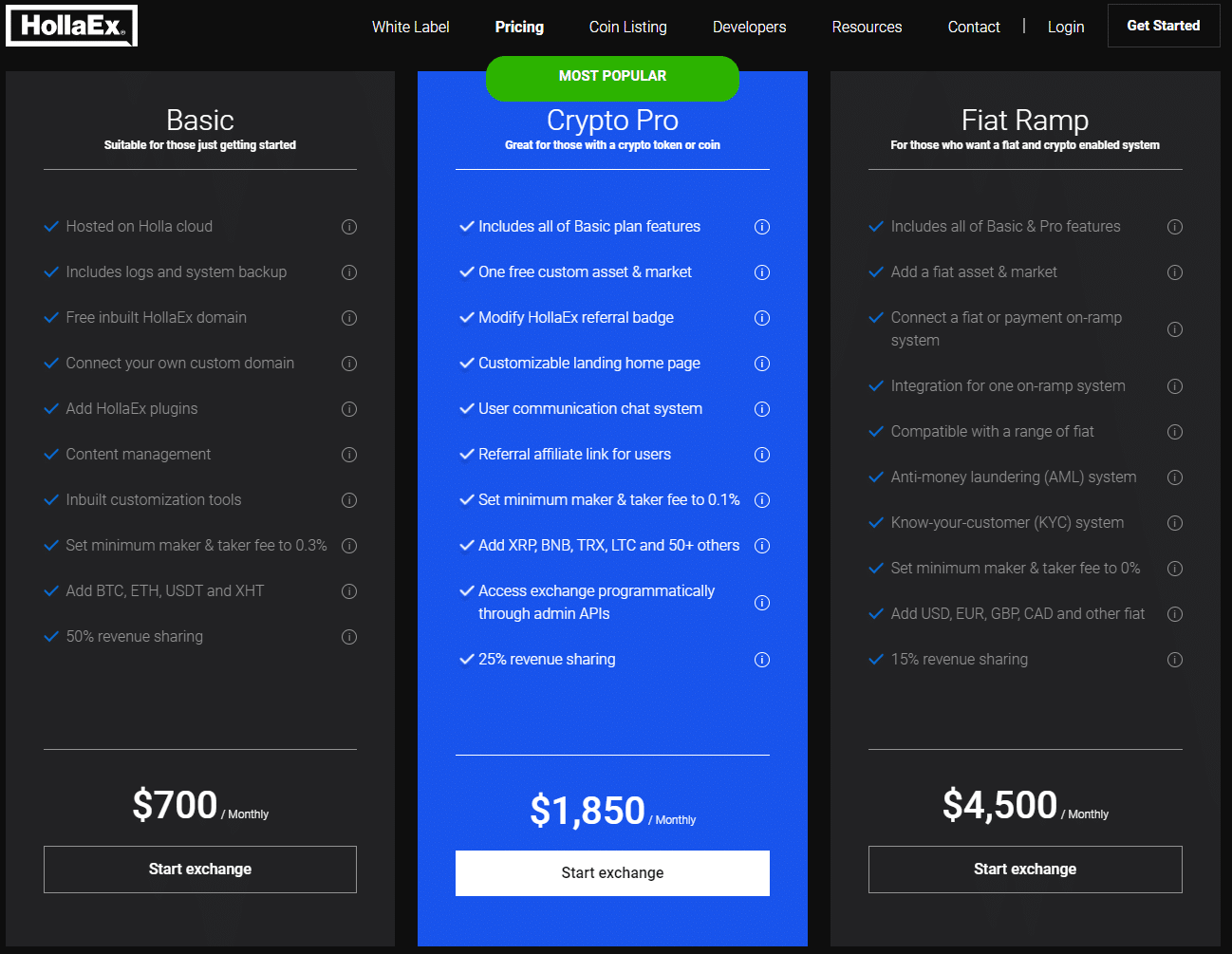
HollaEx no longer prices on monthly tiers. Its pricing page shows two entries and no fixed fees: a two-week Operator Trial with all Enterprise Cloud features and no business verification required, and Enterprise Cloud itself, priced on a 15% revenue share. Enterprise Cloud includes the customisable white label exchange, an unlimited user base, the exchange wallet, over 200 assets, a custom domain, KYC and AML plugins and a market making bot.
Revenue share changes the calculation compared with a fixed fee. There is nothing to pay before you have revenue, which suits a launch, but the cost scales with success rather than flattening out. Model it against your expected volumes before you sign, and confirm current terms directly with HollaEx.
#2 Alphapoint

Alphapoint at a glance
Alphapoint, styled with a lower-case p since its rebrand, provides enterprise-grade exchange software. Founded in 2013, it reports supporting over 150 clients and more than a trillion dollars processed across governments, banks, exchanges and fintechs. Beyond exchanges it supports the digitisation of traditional assets such as real estate, securities and commodities. Alphapoint’s software is used by exchanges licensed by regulators including the US Financial Crimes Enforcement Network (FinCEN), the Canadian Securities Administrators, Peru’s Superintendencia de Banca, Seguros y AFP (SBS), the UK Financial Conduct Authority (FCA), the Philippines Cagayan Economic Zone Authority (CEZA) and the Thai Securities and Exchange Commission. Those licences belong to the operators, not to Alphapoint. Its own company deck puts it as technology used by exchanges overseen by regulators worldwide, “including customers operating under” those authorities. Alphapoint is a technology vendor and claims no financial licence of its own. What it does report is SOC 2, an audited control standard for service organisations. The distinction is the point of the licensing section below.
On performance, Alphapoint’s 2024 company overview reports a matching engine running at close to 1 million transactions per second, individual gateway capacity of over 10,000 simultaneous users and a single order management system handling up to 5 million accounts. Its current product page advertises more than 500 granular application programming interface (API) endpoints, each with individual permissions. Note that the throughput figures above come from a document Alphapoint published in 2024 and are its own, untested by us.
The trade-offs are the ones that come with enterprise software. Alphapoint publishes no pricing, sells through a deployment process rather than a sign-up, and is built for operators with institutional volumes, so a small launch will find it heavier than it needs.
Alphapoint’s onboarding is led by a dedicated deployment team, with technical and functional training, environment configuration and a validation handover. The ongoing service desk includes an account manager, production support, service monitoring and maintenance, incident management and upgrade assistance.
A distinctive Alphapoint offering is Remarketer, now part of its liquidity solutions, which it describes as an internal liquidity tool that optimises how orders are matched within a venue before routing externally. The aim is immediate market depth and tighter spreads on a new venue with few users. Alphapoint also provides a customisable interface toolset so operators can match the platform to their own branding.
You can request a demo, or read Alphapoint’s case studies, which currently feature Coinext in Brazil, Bancolombia’s Wenia, Chivo, GreenX, Waanx and LBX.
#3 Antier

Antier at a glance
Antier, formerly Antier Solutions, is an Indian blockchain development firm registered in Mohali, Punjab and founded in 2011, with further offices in the UK, Australia, the UAE and the United States. It provides a customisable front end and a ready-to-deploy back end so a business can launch a trading platform with standard features while choosing the functionality it needs. Antier also offers marketing, growth strategy and ongoing support.
The company rebranded from Antier Solutions to Antier and moved to a new domain.
Antier’s white-label crypto exchange software includes a comprehensive set of features:
- High-volume transaction processing with low-latency execution
- Powerful matching engine for efficient order execution
- KYC and AML compliance measures integrated into the onboarding flow
- Multi-asset and multi-currency support, with the exact coverage set per build
- Automated and algorithmic trading capabilities
- Referral and reward programs for user acquisition
- High liquidity via integrated liquidity provider networks
- Staking modules and yield-generating features
- Payment gateway integration across multiple regions
- Multi-cryptocurrency wallets with hot and cold storage
- Advanced admin consoles for operational management
- Advanced charting tools for trading analysis (TradingView integration)
Antier is a development agency rather than a platform operator, which cuts both ways: more of the build can be shaped to what you actually want, and more of the project management and long-term maintenance planning sits with you.
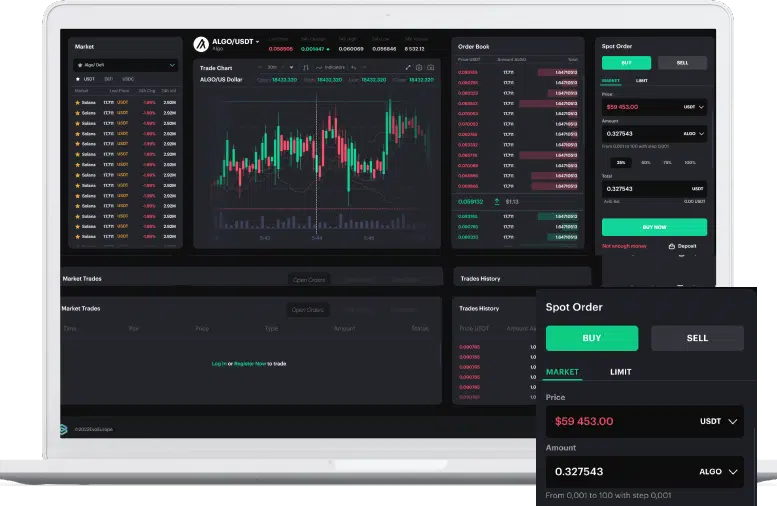
Antier publishes a security list for the trading platforms it develops covering multi-party computation wallet infrastructure, end-to-end data encryption, role-based access control, multi-failed login lockouts combined with Face ID, fingerprint and two-factor authentication, IP whitelisting and rate limiting, denial-of-service and maximal extractable value mitigation, and token-based authentication.
Antier claims SOC 2 Type II readiness and ISO 27001 information security management controls. Both describe a posture of alignment rather than an audited certificate, even though an ISO 27001 logo appears in its footer.
Antier offers post-delivery support through a team it now puts at over 700 engineers, domain experts and architects, covering technical support, advisory on technical approaches as the business scales, and help with communities and campaigns.
Antier is the only provider here that publishes a figure. Its white label page states that development typically costs between $50,000 and $500,000. That is a range rather than a quote, and it covers development rather than the licensing, capital and compliance costs set out below, but it is a useful anchor when the rest of the market publishes nothing. Both a live demo and a bespoke demo on request are offered.
#4 Velmie

Velmie at a glance
Velmie is the trading name of Rolinus UAB, a Lithuanian company whose site carries a copyright line running from 2012, with offices in New York, London, Dubai, Vilnius and Warsaw. It delivers the components needed to launch a digital asset product: mobile and web applications, a back-office system, REST APIs and integrations with third-party providers across payments, liquidity, custody and compliance tooling.
Velmie’s product page is now titled around stablecoin and digital asset infrastructure rather than exchange software, and two adjacent Velmie URLs for crypto exchange products redirect or return an error. If a matching engine and an order book are what you need, confirm that this is still the product on offer before you shortlist it.
Velmie provides end-to-end implementation support, helping clients build product configurations, perform API integrations and apply custom modifications. It maintains a network of integrated partners spanning liquidity providers, IBAN account services, payment processors and card issuers, with Fireblocks, Coinbase, Binance and Unlimit named on its own pages.
On compliance, Velmie offers tiered onboarding and verification governance, a compliance and consulting service line, and security aligned to ISO 27001. It is direct about the limit of that: Rolinus UAB states plainly that it is not a bank, financial or payment institution. It supplies tooling, not authorisation.
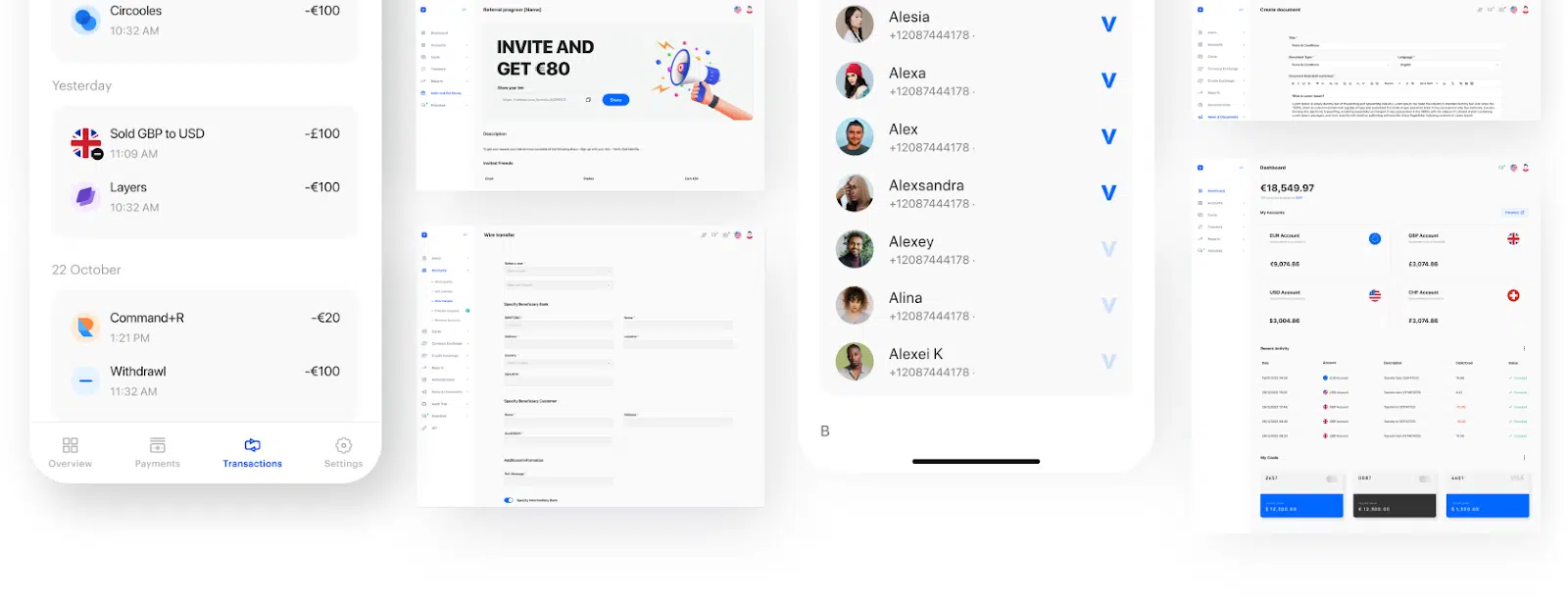
Velmie’s crypto banking software offers a range of advanced features to enhance the digital finance experience. The platform supports master and sub-accounts for digital asset storage, with automated configurable harvesting algorithms for efficient asset management. Businesses can also set up their own crypto nodes, enabling them to monitor and approve transactions independently. The platform facilitates on-chain crypto deposits and withdrawals, alongside off-chain transfers within the platform and its connected partner network.
Velmie’s software provides extensive configurability for transaction fees, exchange fees, account fees, maker-taker fees, and markups, giving businesses flexible tools to define their revenue model. Multiple payment options are supported including merchant payments, QR code transfers, payment links, and withdrawals via crypto, bank transfers, mobile wallets, or cards. The platform also facilitates bulk payments and batch transactions, optimising fees and streamlining payout processes for businesses with high transaction volumes.
#5 PayBito

PayBito at a glance
PayBito, now branded PayBitoPro, provides a white label exchange platform for buying, selling and trading digital assets. It operates through HashCash Consultants LLC, based in Palo Alto, California. The platform supports EUR and USD alongside Bitcoin, Bitcoin Cash, Ethereum, XRP, Litecoin and ERC-20 tokens, with an architecture that allows assets to be added or removed as the market changes.
PayBito’s own list also includes HCX, which is HashCash’s house token rather than a third-party asset. Its performance page publishes no price, market capitalisation or volume, and no major market data site lists it.
One of the key strengths of PayBito’s white-label solution is its comprehensive feature set. The platform includes a matching engine with order book functionality, customer management system, integrated KYC verification, wallet management, admin access console, and full UX/UI branding customisation. It also offers block confirmation tracking and compatibility with ERC-20 tokens, ensuring smooth transaction handling and broad digital asset support across the most widely traded token standards.
PayBito’s white-label cryptocurrency exchange software is accessible across multiple platforms, web, Android, and iOS, enabling users to trade conveniently from any device. The platform serves both end clients and administrators: client app dashboards display current balances, instant buy/sell prices, transaction history, and crypto price trend analysis. The admin panel provides a comprehensive operational overview including transaction details, user management, order book monitoring, and pending transaction authorisation, giving operators the visibility and control needed for day-to-day exchange management.
The platform implements security measures including multi-signature wallets, SegWit support, a three-layer architecture, firewall protection and geography-specific verification flows.
PayBito publishes the names of four tiered packages, Basic, Standard, Pro and Mega, with a feature comparison but no prices. The tiers differ in coins supported, languages, fiat integrations, liquidity connections and how many levels of customer verification are included, and the mobile apps are only included from the higher tiers, not across all four. Separately, PayBito does publish monthly prices for its own software-as-a-service payment and trading plans, which is a different product from the white label build, so do not read those figures as white label pricing.
On regulatory standing, PayBito states that HashCash Consultants is registered with the US Financial Crimes Enforcement Network as a money services business. PayBito itself adds the caveat that such a registration should not be described as a universal federal licence for every type of payment activity. Neither entity appears on an EU register, so an operator serving EU customers will be arranging its own authorisation with no help on that side from the vendor.
Factors to consider when choosing a white label crypto exchange
When selecting a white label crypto exchange provider, several factors deserve careful evaluation to ensure the platform fits your business needs and supports long-term success. The most important considerations:
- Security measures and protocols: exchange security is paramount, given the consistent targeting of crypto platforms by sophisticated attackers (the February 2025 Bybit hack alone cost roughly $1.5 billion). Evaluate the platform’s security stack including multi-factor authentication, end-to-end encryption, cold storage architecture, multi-signature wallets, protection against distributed denial-of-service attacks, IP whitelisting and incident response procedures. Ask about the provider’s track record on security incidents and remediation.
- Customisation options and branding capabilities: look for a white label solution offering extensive customisation, allowing you to tailor the platform’s look and feel to your brand identity. This includes customisable user interfaces, themes, colour schemes, branding elements, and the ability to add custom features as your business evolves.
- Liquidity and trading volume: liquidity is essential for a successful exchange. Evaluate the platform’s liquidity solutions and partnerships with liquidity providers to ensure sufficient trading depth across the cryptocurrencies you plan to offer. Higher liquidity facilitates better trade execution, tighter spreads, and attracts more traders to your platform. Ask how a provider gives a brand new venue enough depth to trade on from day one, since an empty order book is the first thing a customer notices. Most solutions mirror or route to the largest crypto exchanges, so ask which venues and on what terms.
- Supported cryptocurrencies and trading pairs: assess the breadth of cryptocurrencies and trading pairs the white label exchange supports. Offering a diverse selection caters to different trader preferences and creates more trading opportunities. Also consider how easily new assets can be added as the market evolves and regulatory requirements shift.
- Compliance tooling, and who is actually responsible: the platform needs to support know your customer and anti-money laundering checks, transaction monitoring and Travel Rule messaging. What it cannot do is hold the authorisation. Confirm what the vendor supplies, then read the section on what the software does not give you, because under the EU’s Markets in Crypto-Assets Regulation the operator remains fully responsible for everything it outsources.
- Technical features and functionality: evaluate technical capabilities including matching engine throughput in transactions per second, advanced charting tools (TradingView integration is now standard), real-time market data, intuitive UI/UX, mobile app quality, and seamless integrations with payment gateways and custody solutions.
- Customer support and service levels: reliable support is essential for smooth operations. Consider the provider’s customer support model including response times, technical support availability, dedicated account management, ongoing maintenance and upgrade support, and contractual service level agreements.
- Pricing model and total cost of ownership: white label pricing varies widely and most of it is quoted on request. Antier’s published development range of $50,000 to $500,000 is the only public anchor in this set, and HollaEx charges a share of revenue rather than a fee. Evaluate not just the headline price but the total cost including setup fees, customisation costs, transaction fees, revenue-sharing arrangements, and infrastructure scaling costs as your exchange grows.
Carefully weighing these factors will help you choose a white label crypto exchange that delivers a secure, customisable, liquid, compliant, and feature-rich platform supported by reliable service.
The other way to buy: regulated crypto-as-a-service
The providers above sell software. A second group sells the regulated service itself, which a bank, broker or fintech distributes under its own brand. You do not become the exchange, you resell someone else’s. For a European business that does not want to hold its own authorisation, this is usually the shorter path,
- Boerse Stuttgart Digital: brokerage, exchange and custody from the Boerse Stuttgart Group, holding a licence from Germany’s BaFin under the Markets in Crypto-Assets Regulation. It publishes more than 200 institutional clients and over 5.000.000.000€ in custody, naming KfW, DZ Bank and SG-FORGE among them, and in February 2026 it agreed to combine its crypto business with the group’s tradias unit;
- Bitpanda Technology Solutions: API-driven infrastructure that partners rebrand as their own. Its published client list runs to Raiffeisenlandesbank NÖ-Wien plus 55 further Raiffeisen banks, N26 and LBBW, and in September 2026 Raiffeisen Bank International extended the arrangement to 18 million customers across central and eastern Europe;
- Zerohash: embedded crypto, custody and brokerage delivered under the client’s brand. It obtained an electronic money institution licence from De Nederlandsche Bank in May 2026 alongside its crypto authorisation, and Interactive Brokers Europe runs its European crypto offering on it;
- Sygnum: a FINMA-regulated Swiss bank offering custody, trading, staking and tokenisation to partner banks through an API, with PostFinance and Zuger Kantonalbank among the names it publishes.
The trade-off is control and margin. You get someone else’s licence, capital and compliance function, and in return you take their asset list, their pricing and their roadmap. A white label build gives you the opposite: everything is yours to shape, including the obligations.
Bitstamp as a Service is worth one caution. It was a real offering, but Bitstamp was acquired by Robinhood in June 2025 and neither company now publishes whether the service is still sold separately, so verify before shortlisting it.
What the software does not give you
Every provider on this page sells technology. None of them sells authorisation, and in the European Union the company running the exchange is the regulated firm. This is the part of the decision that decides whether a launch is possible at all, and it is worth understanding before you sign anything.
You need your own licence
Under the Markets in Crypto-Assets Regulation (MiCA), nobody may provide crypto-asset services in the Union without authorisation as a crypto-asset service provider (CASP), or without already being a credit institution, investment firm, market operator or similar firm permitted to add those services. Operating a trading platform for crypto-assets is one of the ten listed services.
A typical exchange is not providing one of those services but five or six at once: operating the trading platform, holding client assets in custody, exchanging crypto for funds and for other crypto, executing orders and transferring crypto on clients’ behalf. The authorisation names the services you may provide, and adding one later means extending it.
Capital, substance and people
Because it operates a trading platform, an exchange falls in the top capital class. The permanent minimum is 150.000€, but the actual requirement is the higher of that figure and a quarter of the previous year’s fixed overheads, reviewed annually. A firm with 2.000.000€ of fixed costs is looking at 500.000€, not 150.000€. It has to be held as regulatory capital or a qualifying insurance policy, and a software subscription does not count towards it.
There is also a substance test that rules out the buy-software-and-incorporate-anywhere model. A CASP must have its registered office in a member state where it carries out at least part of its services, its place of effective management in the Union, and at least one director resident in the Union. Management have to satisfy a fit and proper assessment, client funds must sit with a credit institution or central bank by the end of the next business day, and the firm is inside the Digital Operational Resilience Act (DORA) from day one, with its incident reporting and third-party risk register.
How long it takes
On paper the competent authority has 25 working days to check the application is complete and 40 working days to assess it. In practice the clock only starts when the file is genuinely complete. The Dutch regulator publishes its own expectation on its authorisation guidance: at least five months even with a complete, high-quality application and simple products, often longer, with one to three supervisory meetings along the way.
The upside is real once you have it. A single authorisation passports across the Union on a notification to your home regulator, with services able to start at the latest 15 calendar days after the information is submitted. No second licence, no physical presence required in each country.
There is no longer a grace period
Firms already operating under national law before 30 December 2024 were allowed to continue during a transitional period. Most member states took the full 18 months, and the European Securities and Markets Authority confirmed that the transition expired across the EU on 1 July 2026. There is no launch-now-licence-later route left.
Outsourcing does not move the responsibility
Buying a white label platform is, in regulatory terms, a large outsourcing. MiCA permits it. What it does not permit is handing over the accountability: Article 73 states that a firm outsourcing services remains fully responsible for discharging all of its obligations. It also requires a written agreement, an outsourcing policy with contingency plans and an exit strategy, and that you keep enough expertise in house to supervise the vendor and direct access to the relevant information.
In plain terms: if the vendor’s screening misses a sanctioned customer, if its Travel Rule integration drops required originator data, or if its infrastructure fails mid-session, the enforcement lands on your authorisation and not on the vendor’s product. “We use a reputable vendor” is not a defence.
The Travel Rule has no minimum
One obligation catches operators out because it works differently from the banking rule they may know. Under Regulation (EU) 2023/1113, which has applied since 30 December 2024, information on the originator and the beneficiary must accompany every transfer of crypto-assets. Unlike fiat transfers, where a simplified regime applies below 1.000€, there is no de minimis threshold for crypto: the obligation applies to every transfer regardless of size and regardless of whether it is domestic or cross-border. The United Kingdom and the United States have their own versions, so this is not an EU-only problem.
The bottom line
White label crypto exchanges cut the time it takes to enter the market, turning a multi-year platform build into a project measured in months. They remain an attractive option for fintechs, established financial institutions and teams launching crypto services. The build time, though, is rarely what decides the launch date. Authorisation is.
Software is the smaller part of the problem. Selecting a provider requires weighing security, customisation, liquidity and support, and then separately solving authorisation, capital and compliance staffing, which no vendor solves for you.
The providers profiled here, HollaEx, Velmie, Alphapoint, Antier and PayBito, are software vendors, and they suit different business sizes and technical requirements. HollaEx is the easiest to try, with a free trial and revenue-share pricing. Alphapoint has the largest deployment footprint and is built for institutional throughput, though it publishes no pricing and sells through an enterprise process rather than a sign-up. Antier suits a bespoke build and is the only one that publishes a price. Velmie has moved towards stablecoin infrastructure. PayBito publishes neither prices for its white label tiers nor a bespoke demo, and its published client evidence is the thinnest here, which makes it the hardest of the five to assess before committing. Outside the EU it remains a reasonable packaged option.
If your customers will be in the European Union and you are a bank, a broker or a fintech that would rather buy a regulated service than become a regulated firm, the crypto-as-a-service providers above are a different and often better purchase.
Before committing, we strongly recommend:
- Requesting demos from multiple providers to compare platform usability and feature depth firsthand.
- Conducting reference checks with existing clients of each provider to understand real-world implementation experiences.
- Engaging legal counsel familiar with crypto regulations in your target jurisdictions before signing any contracts.
- Verifying current pricing directly with providers, as white label pricing structures evolve frequently.
This article is for informational purposes only and does not constitute business, legal, or investment advice. Operating a cryptocurrency exchange involves significant regulatory, technical, and operational complexity. Always conduct thorough due diligence and engage qualified legal and technical advisors before launching a crypto exchange business.
FAQs
What are the benefits of using a white label crypto exchange?
There are various benefits to using a white label crypto exchange, including:
- Lower build cost: the provider has already built the platform, so you pay to use it rather than to develop it from nothing. That does not make it cheap. On a revenue share the cost scales with your success, and on a bespoke build you pay for the development anyway.
- Faster time to market: the features already exist and are customised rather than written, which compresses the build.
- Mature security engineering: an established vendor has built wallet infrastructure, access controls and monitoring across many deployments, which is work a new team would otherwise do from scratch. This is not a guarantee, and you still carry the consequences of any failure.
- Scalability: capacity can be scaled up or down without re-architecting the platform.
- Support: the provider carries the platform issues, though the service levels vary a great deal and belong in the contract.
What are the risks of using a white label crypto exchange?
There are a few risks associated with using a white label crypto exchange, including:
- Limited control and reliance on the provider: you depend on the provider for support, maintenance and updates. If it is slow to fix problems, your exchange is the one that looks broken to your customers.
- The compliance risk stays with you: outsourcing to a vendor does not move the obligation. Under Article 73 of the Markets in Crypto-Assets Regulation an authorised firm remains fully responsible for discharging all of its obligations, so a failure in the vendor’s screening or reporting lands on your authorisation, not on the vendor’s product.
- Limited customisation: white label platforms customise up to a point, and beyond it you are waiting on the vendor’s roadmap.
- Differentiation: if several operators run the same platform, the product itself is not what sets you apart, so the difference has to come from pricing, service, assets or distribution.
- Vendor continuity: the infrastructure market has consolidated sharply, with acquisitions and closures through 2025 and 2026. Ask what happens to your exchange if the vendor is acquired or shuts down, and make sure the contract has an exit path and access to your own data.
How much does it cost to start a white label crypto exchange?
The software is the part people quote, and it is the smaller part. Of the providers here, only Antier publishes a figure, putting development at $50,000 to $500,000. HollaEx prices Enterprise Cloud on a 15% revenue share with a two-week free trial, and the rest do not publish anything.
The larger costs sit outside the software. For an EU operator that means regulatory capital of at least 150.000€, or a quarter of annual fixed overheads if that is higher, the regulator’s own application fees, legal and advisory work, and salaries for a compliance function and EU-resident management during an authorisation process that takes months before any revenue arrives.
How long does it take to start a white label crypto exchange?
It depends on the provider and on how much you customise, but the build is usually a few months rather than the year or more an in-house platform takes.
In the European Union, though, you cannot serve clients until you are authorised, and that is what usually sets the launch date. Plan the licensing timetable first and fit the software around it.