Investing with a purpose has gained popularity as more investors strive to align their financial goals with their values. This has put a stronger focus on Environmental, Social, and Governance (ESG) and impact investing.
Many apps have picked up on this trend and added sustainable options to their offerings. Depending on the platform, you can invest in socially responsible investment (SRI) portfolios, trade ESG funds, or buy stocks of sustainable companies.
In this article, we look at the investment options, features, and benefits of these apps. Whether you’re new to investing or an experienced investor, there is a platform suited to your needs.
Best ESG and impact investing apps
IMPACT by Interactive Brokers: Best overall
The IMPACT app by Interactive Brokers (IBKR) provides a user-friendly interface and a wide array of investment options, enabling you to align your investments with your values. With its 12 Impact Values covering various ESG issues, you can customise your portfolio according to your specific values and create a positive impact through your investment choices.
M1 Finance: Best ESG robo-advisor
M1 Finance is a flexible investment app that offers investing through “Pies,” allowing you to create personalised portfolios or choose from its pre-built options, including ESG-focused pies. It’s a top choice for investors seeking control over their portfolios with added convenience.
Betterment: Best for ESG and cash management features
Betterment is an investment and cash management app that promotes socially responsible investing through its three impact-focused portfolios: Broad Impact, Climate Impact, and Social Impact. These portfolios are constructed using low-cost ETFs and tailored to different sustainability criteria.
Wealthfront: Best for self-directed ESG investing
Wealthfront is a US-based fintech company offering various wealth management services. They provide personalised investment portfolios, including socially responsible options that prioritise ESG measures. Additionally, Wealthfront allows users to invest in individual stocks that align with their values for a more hands-on approach.
Wealthsimple: Best for Canadian investors
Wealthsimple is a Canadian investment platform known for its user-friendly interface and offers a variety of investment options, including socially responsible portfolios that align with strict sustainability standards. These portfolios prioritize excluding top carbon-emitters, promoting gender diversity on company boards, and aligning with temperature-change goals.
eToro: Best for international investors
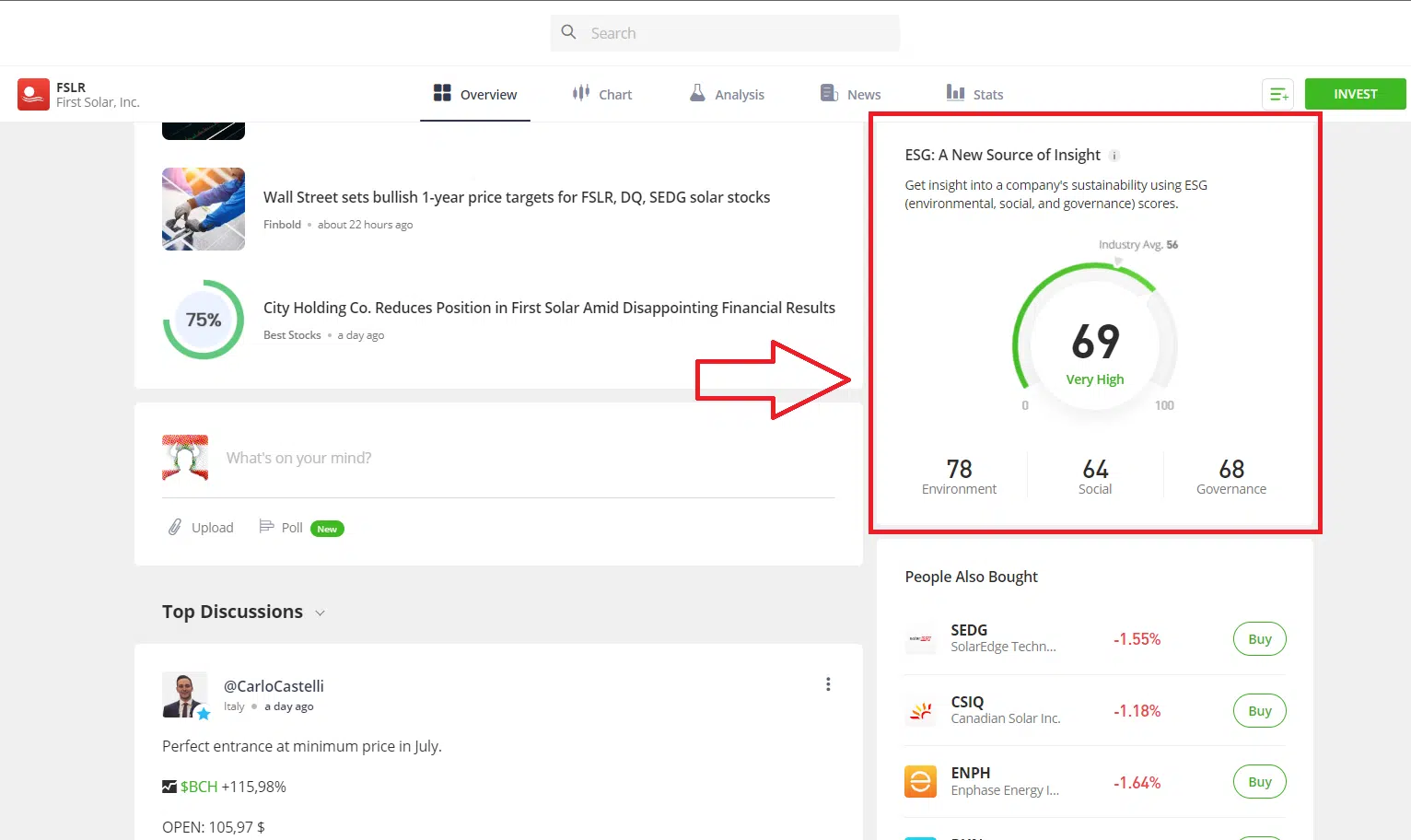
eToro is a social trading and investment platform offering a wide range of products. In 2022 it added ESG scores from ESG Book for more than 2,700 stocks, shown with a simple “traffic light” colour scheme that makes it easier to compare companies on sustainability.
Disclaimer: eToro is a multi-asset investment platform. The value of your investments may go up or down. Your capital is at risk.
ESG investing apps compared
| App | Min. deposit | Fees | ESG option | Availability |
| IMPACT by IBKR | $0 | $0 for US clients (IBKR Lite), IBKR Pro rates elsewhere | Impact Dashboard with 12 values | Most countries |
| M1 Finance | $100 ($500 for IRAs) | $0 commission, $3 per month below $10,000 | Responsible Investing model portfolios | US only |
| Betterment | $10 | $5 per month or 0.25% a year | Broad, Climate, and Social Impact portfolios | US only |
| Wealthfront | $500 (automated), $1 (stocks) | 0.25% a year (automated), $0 (stocks) | Socially responsible automated portfolios | US only |
| Wealthsimple | $1 | 0.2% to 0.5% a year | Socially responsible managed portfolio | Canada only |
| eToro | $10 to $10,000 (by region) | $0 on ETFs, $1 or $2 per stock trade | ESG scores and thematic Smart Portfolios | Most countries |
Minimum deposits, fees, and ESG features as of October 2026. Sources: each provider’s pricing and help pages. Other fees may apply.
Best ESG and impact investing apps reviewed
#1 IMPACT by Interactive Brokers

IMPACT by Interactive Brokers at a glance
The IMPACT app is a powerful platform designed and backed by Interactive Brokers, a trusted name in the financial industry. It helps investors align their values with their investment choices with a core focus on ESG factors, allowing users to invest in companies that prioritise sustainability and social responsibility. It groups values into 12 areas, including Clean Air, Pure Water, Ocean Life, Land Health, Gender Equality, Racial Equality, and Ethical Leadership. Besides the standalone app, the same Impact Dashboard is built into IBKR Mobile, IBKR Desktop, Trader Workstation, and Client Portal.
The app stands out for its wide range of investment options, with the ability to filter out companies engaged in harmful practices. You can choose from stocks, ETFs, mutual funds, options, cryptocurrencies (only available to US clients), and even carbon offsets. There is no account minimum, and fractional shares start at $1.
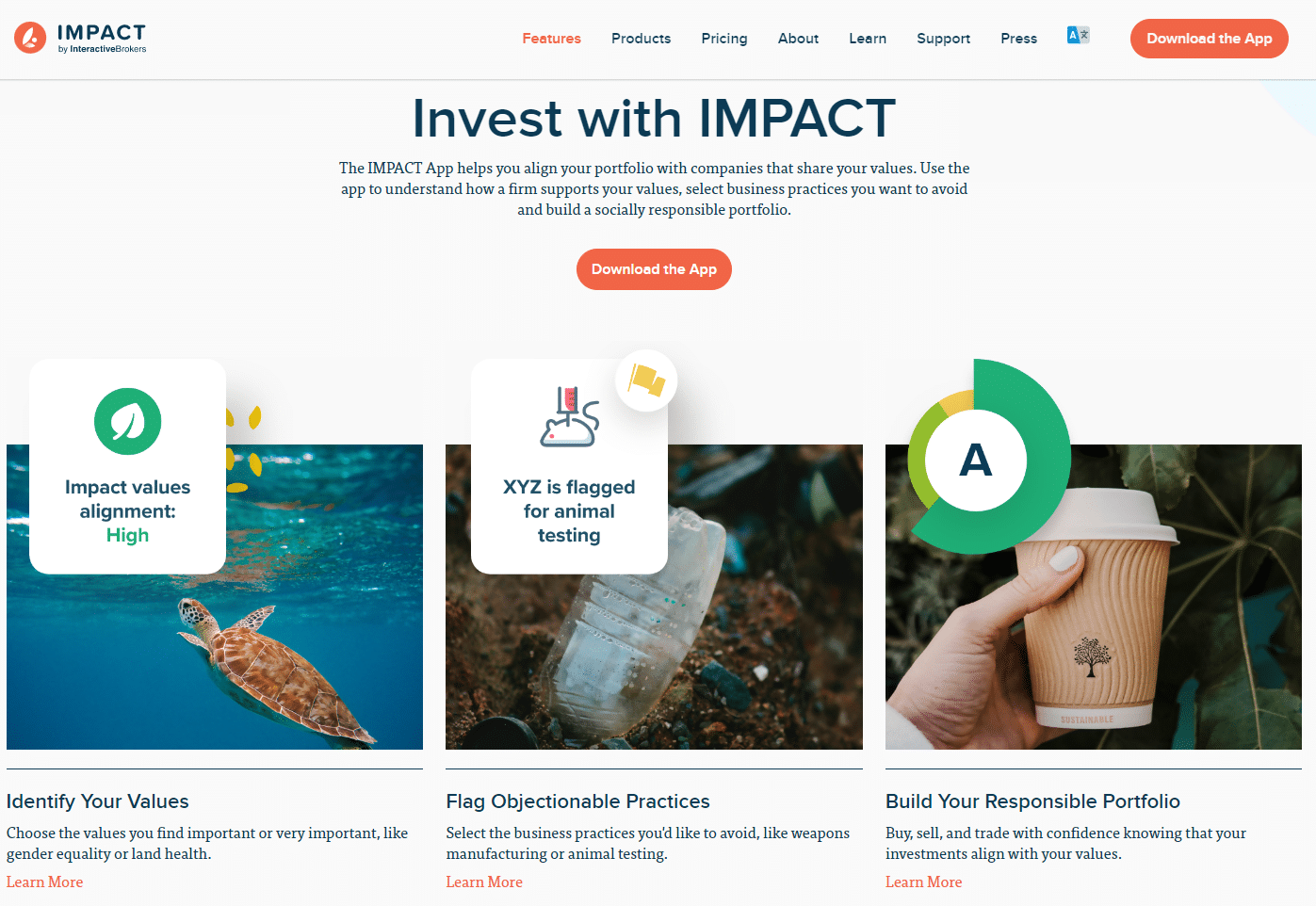
US clients on IBKR Lite trade US stocks and ETFs commission-free on IMPACT. Non-US clients, and US clients who choose IBKR Pro, pay IBKR’s standard commissions: $0.005 per share (minimum $1) on the Fixed plan, or from $0.0035 per share on the Tiered plan. Carbon offsets carry a fee of between 1% and 2.5% of the offset value, depending on the amount.
Navigating the app is intuitive, especially for those familiar with Interactive Brokers’ other applications. One notable feature is the inclusion of an Impact score, which assesses the sustainability of each investment position. You can also delve into performance details, analyse the impact lens of your positions, and create personalised watchlists to monitor your preferred companies. Another advantageous feature is the ability to easily swap a position that does not align with your responsible investing values for one that aligns with your sustainability objectives.
We encourage you to check our comprehensive IMPACT review for more insights.
#2 M1 Finance

M1 Finance at a glance
M1 Finance is a popular fintech company known for its automated, commission-free investing portfolios. It combines do-it-yourself (DIY) investing with automated portfolio management. It also offers a high-yield cash account and borrowing, so you can manage several parts of your finances in one place.
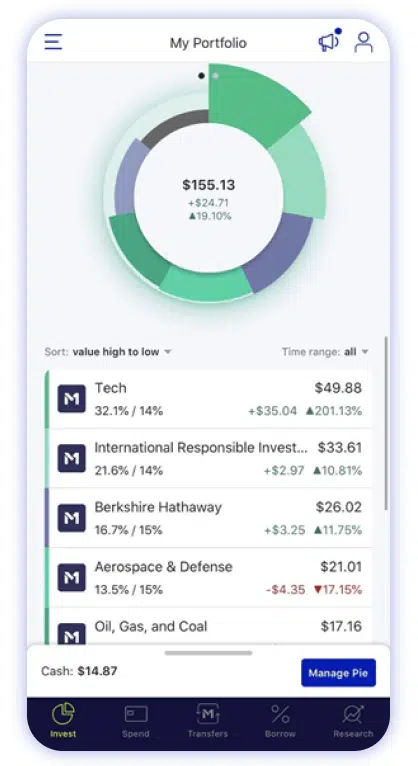
One of the key features of M1 Finance is its customisable investment portfolios, known as “Pies.” You can create your Pies by selecting individual stocks, ETFs, and other investment assets and assigning specific weightings to each holding. This allows you to customise your portfolio to your preferences and values, whether it’s focusing on a specific sector, asset class, or investment theme or avoiding certain sectors and companies altogether.
If you prefer not to build your own portfolio, M1 offers ready-made Model Portfolios (formerly called Expert Pies), including a Responsible Investing (ESG) category that you can invest in as is or adjust.
M1 Finance caters to various types of investors, offering a comprehensive selection of account types such as individual and joint taxable accounts, custodial accounts, retirement accounts (Traditional, Roth, and SEP IRAs), and trust accounts. The minimum deposit is $100 for taxable accounts, $500 for IRAs, and $5,000 for trusts. Therefore, you can select the account structure that aligns best with your financial goals and tax considerations.
In terms of fees, M1 Finance offers commission-free trading. M1 discontinued its paid M1 Plus subscription in May 2024 and replaced it with a $3 monthly platform fee, which is waived once your total M1 assets reach $10,000 (or if you have an active M1 personal loan).
Not a US resident? Here are our M1 Finance alternatives.
#3 Betterment

Betterment at a glance
Founded in 2008, Betterment is another leading investment platform that prioritises responsible investing. With more than $70 billion in Assets Under Management (AUM) and over 1 million customers in 2026, Betterment is one of the largest robo-advisors. It offers socially responsible investing portfolios and provides additional features like cash management and financial planning tools, making it a comprehensive platform for investors seeking to align their investments with their values.
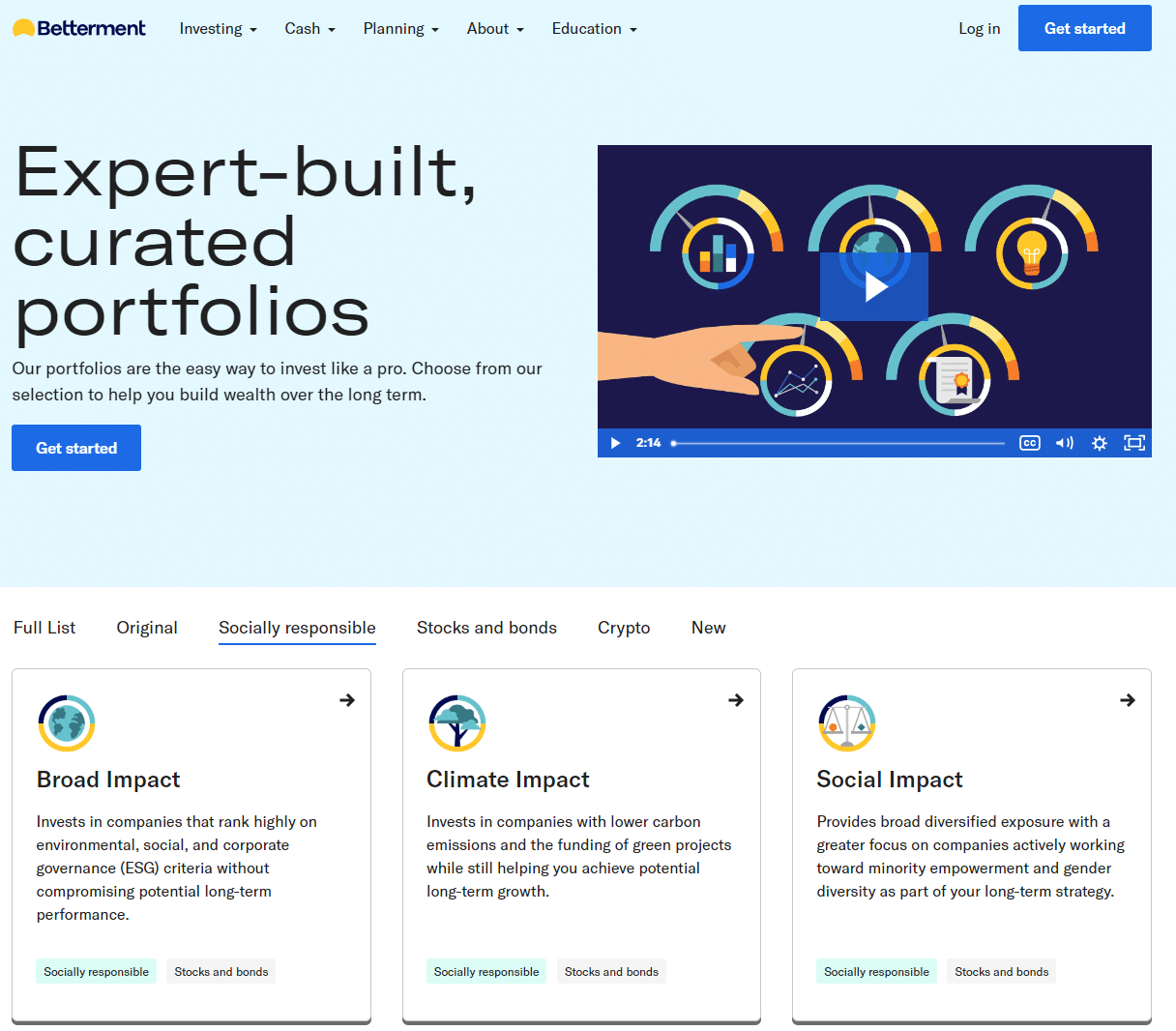
Betterment promotes Socially Responsible Investing (SRI) by offering impact-focused SRI portfolios designed for investors looking to align their investments with their values. These portfolios include Broad Impact, Climate Impact, and Social Impact, each tailored to different sustainability criteria, and all three were updated in January 2026. They are built from low-cost ETFs that favour companies with strong ESG practices, while keeping the portfolio diversified.
Betterment caters to investors of all types with its diverse offerings. For those seeking a more affordable solution, Betterment Digital costs $5 per month, or 0.25% a year once your balance reaches $24,000 or you set up recurring deposits of at least $200 a month. You can start investing with a $10 deposit.
Alternatively, for individuals desiring a premium experience, Betterment Premium offers unlimited access to certified financial planners, tailored financial planning, and portfolio management for an annual fee of 0.65%, with lower rates on assets above $1 million.
#4 Wealthfront

Wealthfront at a glance
Wealthfront is a US-based robo-advisor founded in 2008, providing personalised investment portfolios, brokerage, and cash management services. It is listed on Nasdaq (ticker: WLTH) and passed $100 billion in platform assets at the end of August 2026, with 1.51 million funded clients. Following a short questionnaire, Wealthfront provides personalised investment portfolio recommendations based on your risk profile and financial goals. Notably, it offers a range of products, including cash management with a competitive APY, automated investing for retirement and education savings, and borrowing against your portfolio.
Wealthfront offers portfolios that prioritise sustainability, diversity, and equity as part of its socially responsible investing strategies. You just open an “Automated Investing Account”, and you will get access to their socially responsible portfolios. These portfolios use iShares ESG funds that track MSCI indices (expense ratios of 0.09% to 0.18%) and exclude businesses involved in civilian firearms, controversial weapons, tobacco, thermal coal, and oil sands.
Furthermore, they emphasise investments in companies that excel in Environmental, Social, and Governance measures. Additionally, they manage the portfolio automatically by rebalancing investments and employing tax-loss harvesting when needed to optimise your tax obligations.

For those who prefer a hands-on approach, Wealthfront also offers a “Stock Investing Account,” where you can invest in individual stocks that align with your values. Wealthfront provides a user-friendly platform with fractional shares investing ability, no commission trades, and a low minimum investment of just $1 for self-directed portfolios and $500 for pre-built portfolios.
#5 Wealthsimple

Wealthsimple at a glance
Founded in 2014, Wealthsimple is a leading Canadian wealth management firm that offers a comprehensive suite of financial services, including investing, saving, and trading. It is known for its user-friendly interface and commitment to innovation and has gained recognition for democratising investing and making it accessible to a wider audience. It has become popular among Canadian investors seeking to effectively manage their wealth and take advantage of innovative financial solutions.
Wealthsimple offers the opportunity to construct socially responsible portfolios that prioritise sustainable and ethical practices. These portfolios adhere to stringent sustainability standards, aligning with the temperature-change goals outlined in the IEA Sustainable Development Scenario and the Paris Agreement. Wealthsimple screens out oil and gas, coal, weapons, tobacco, alcohol, gambling, and companies that breach the UN Global Compact, and also excludes the top 25% of carbon emitters in each industry. Companies must have at least three women on their board (or 25% female representation), and the bond portion is invested in green and sustainable bonds.
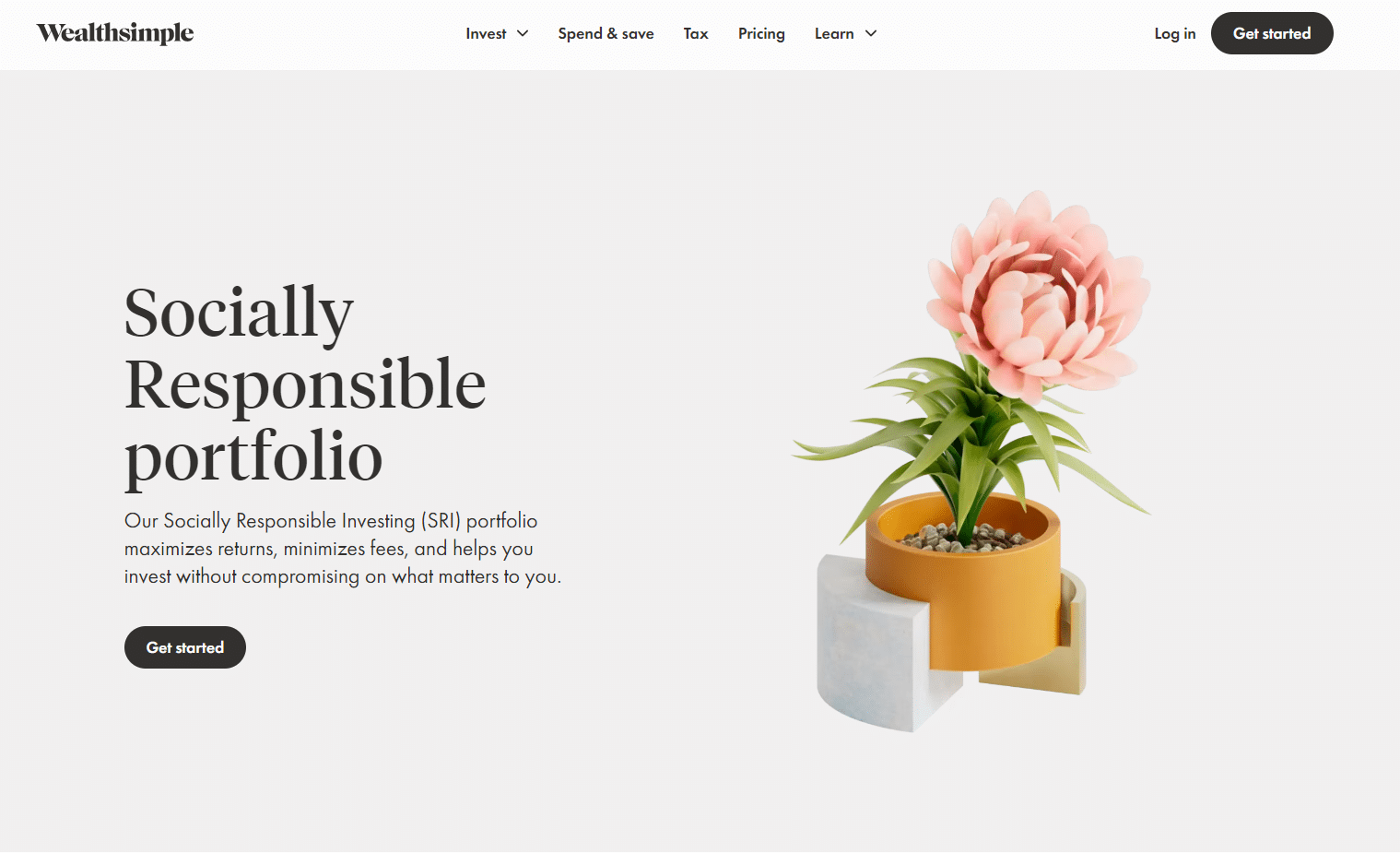
Wealthsimple also offers a self-directed investing option, allowing you to select and manage your investments personally. With this option, you can invest in fractional shares and enjoy the convenience of automatic dividend reinvestment. Both managed and self-directed accounts can be held in registered wrappers such as a TFSA, RRSP, or FHSA for tax-sheltered growth.
Wealthsimple is only available in Canada, and you can start investing with as little as $1. The management fee depends on your balance: 0.5% a year on the Core tier, 0.4% from $100,000 (Premium), and between 0.4% and 0.2% for Generation clients with $500,000 or more, with the 0.2% rate reserved for balances of $10 million or more.
#6 eToro

eToro at a glance
Established in 2007, eToro is a social trading and investment platform listed on Nasdaq (ticker: ETOR), with 4.28 million funded accounts at the end of June 2026. In 2022 it added ESG scores from the data provider ESG Book for more than 2,700 stocks, using a “traffic light” colour scheme. The green score indicates leadership in ESG within its sector, while amber signifies an average rating, and red suggests a poor ESG rating compared to peers.
You can take various approaches to integrating ESG scores into your decision-making process. For instance, you can use these scores to gain additional insights into companies beyond financial analysis, apply them as a filtering mechanism for portfolio selection (preferring high-scoring companies or excluding lower-scoring ones), or leverage them as flags for monitoring purposes (investigating changes in ESG scores as potential signals).
eToro also offers thematic Smart Portfolios, ready-made baskets of assets built around a theme such as clean energy. With CopyTrader, you can also copy investors whose portfolios focus on sustainable companies, although past performance doesn’t guarantee future results.
The minimum first deposit on eToro ranges from $10 to $10,000, depending on your country. ETFs are commission-free, and stock trades carry a $1 or $2 commission, depending on the market. For more detailed information and insights about eToro, we recommend checking out our comprehensive eToro review.
eToro is a multi-asset investment platform. The value of your investments may go up or down. Your capital is at risk. 51% of retail investor accounts lose money when trading CFDs with this provider. You should consider whether you can afford to take the high risk of losing your money.
What makes a good ESG investing app?
With the growing interest in sustainable and responsible investing, ESG investing apps have emerged to cater to investors seeking to align their portfolios with their values. Here are some key factors that make a good ESG investing app:
- Comprehensive ESG data and analysis: A good ESG investing app should provide comprehensive and reliable ESG data and analysis. This includes detailed information on companies’ environmental impact, social practices, and governance policies. The app should offer ESG scores or ratings for individual assets or portfolios, allowing investors to evaluate the sustainability and ethical practices of their investments.
- Diverse range of ESG investment options: An ideal ESG investing app should offer a diverse range of ESG investment options, including access to companies that excel in ESG criteria across various industries. For instance, investment opportunities in renewable energy, clean technology, gender diversity, and other sustainable sectors. The app should provide a wide selection of ESG-themed portfolios or funds tailored to different investor preferences.
- User-friendly interface and tools: A good ESG investing app should have a user-friendly interface that simplifies the process of researching, analysing, and investing in ESG assets. It should provide intuitive tools and resources for investors to explore ESG data, track their investments’ performance, and monitor their ESG goals’ progress. The app should also offer educational materials and insights on ESG investing to help users make informed decisions.
- Transparency and disclosure: A reputable ESG investing app should be transparent about its methodology for evaluating and scoring ESG factors. It should disclose the sources of its data, the criteria used in the assessment, and any limitations or biases in its analysis. Clear and transparent reporting of the ESG impact of investments is also important for investors to track and measure their sustainability goals.
- Low minimum deposit requirement: A good ESG investing app should have a minimum deposit that is accessible and flexible for a wide range of investors. This allows individuals with varying investment budgets to participate in ESG investing and have a positive impact on their future.
- Regulatory alignment and anti-greenwashing safeguards: with regulators clamping down on misleading sustainability claims, a good ESG app should be clear about how its products map to recognised frameworks. ESG ratings can also differ a lot between providers (the same company is often scored quite differently by MSCI and Morningstar Sustainalytics), so apps that disclose their data sources and methodology deserve more trust than those that show a single opaque score.
ESG investing rules in 2026
Sustainability labels on funds are changing, so it helps to know what they mean before you pick an ESG portfolio:
- EU (SFDR): today, EU funds disclose under the Sustainable Finance Disclosure Regulation (SFDR) as Article 8 (promoting ESG characteristics) or Article 9 (sustainable investment objective). The European Commission proposed an overhaul in November 2025 that would replace them with three categories: Transition, ESG Basics, and Sustainable. The Council agreed its position in June 2026 and the Parliament’s economic committee in September 2026, but the reform is not yet law and is expected to apply from around 2029.
- EU (fund names): under ESMA’s guidelines on fund names, funds using ESG or sustainability terms in their name must invest at least 80% in line with those characteristics and apply exclusions. They have applied to all existing funds since 21 May 2025.
- UK (SDR): the FCA’s Sustainability Disclosure Requirements introduced four voluntary labels (Sustainability Focus, Sustainability Improvers, Sustainability Impact, and Sustainability Mixed Goals) from July 2024, plus naming and marketing rules from December 2024.
- US: there is no federal ESG fund label. The SEC voted in March 2025 to stop defending its climate disclosure rule for companies, so US investors rely mostly on each provider’s own methodology.
Money keeps flowing into this market, but more slowly than a few years ago. According to Morningstar’s Global Sustainable Fund Flows report, sustainable funds worldwide held $3.73 trillion at the end of June 2026 and took in $3.7 billion of net inflows in the second quarter, with passive funds gaining and active funds losing money. You can find more data in our ESG investing statistics.
Conclusion
All in all, the rise of ESG and impact investing has paved the way for a new generation of investment apps that prioritise financial returns and positive social and environmental impact. These apps offer a range of features, such as ESG scoring, socially responsible portfolios, and customisable investment options, empowering investors to align their portfolios with their values.
Whether you’re an experienced investor or just starting, these platforms equip you with the tools and resources to make informed investment decisions that align with your values while generating financial and societal returns.
FAQs
What is ESG investing?
ESG, which stands for Environmental, Social, and Governance, is a framework used to evaluate the sustainability and ethical impact of investments. It considers three key factors:
- Environmental: This focuses on a company’s impact on the environment, including carbon emissions, energy usage, waste management, and resource conservation.
- Social: This examines how a company manages relationships with stakeholders, such as employees, customers, and communities. It includes factors like labour standards, diversity, community engagement, and product safety.
- Governance: This evaluates a company’s internal structures, policies, and practices related to decision-making, transparency, and accountability.
How does ESG or impact investing differ from traditional investing?
ESG and impact investing differ from traditional investing in their focus and objectives. Traditional investing primarily considers financial returns as the primary goal, with little or no emphasis on environmental, social, or governance factors. Impact investing goes a step further by explicitly seeking investments that generate positive social or environmental outcomes alongside financial returns. It focuses on investments that address pressing societal or environmental challenges, such as renewable energy, affordable housing, or clean water. The intention is to make a measurable and beneficial impact on specific issues while still achieving competitive financial returns.
Can I customise my portfolio based on specific ESG values or impact themes?
Yes, many ESG and impact investing apps offer customisation options. They allow you to select specific ESG values or impact themes that align with your values and investment goals. This allows you to tailor your portfolio to focus on areas such as renewable energy, gender equality, or sustainable agriculture, among others.
Are there any risks associated with ESG and impact investing?
As with any investment, there are risks involved in ESG and impact investing. These risks can include market fluctuations, company-specific risks, and the potential for underperformance compared to traditional investments. It’s important to conduct thorough research, understand the specific risks associated with each investment, and diversify your portfolio to mitigate potential risks.
Are there any minimum investment requirements for ESG and impact investing apps?
The minimum investment requirements vary depending on the ESG and impact investing app or platform you choose. Some apps have low or no minimum investment requirements, allowing you to start with a small amount. However, certain platforms may have specific minimum investment thresholds that you need to meet.
What is greenwashing?
Greenwashing is when a company or fund presents itself as more sustainable than it really is, for example by using ESG terms in a fund name without investing accordingly. Rules such as ESMA’s fund name guidelines in the EU and the FCA’s anti-greenwashing rule in the UK aim to limit it, but it is still worth checking a fund’s holdings and methodology before investing.
What is the difference between Article 8 and Article 9 funds?
Under the EU’s SFDR, Article 8 funds promote environmental or social characteristics, while Article 9 funds have sustainable investment as their objective. A reform proposed in November 2025 would replace these with three categories (Transition, ESG Basics, and Sustainable), but it is not yet in force.