If you are a UK investor, it is hard not to hear the name “Hargreaves Lansdown”. Founded in 1981, it is one of the oldest and largest UK investment platforms, with 2.09 million active clients and £190 billion in assets under administration at the end of December 2025. The company was listed on the London Stock Exchange until 2025, when it was taken private by a consortium that includes CVC Capital Partners and Nordic Capital.
Being regulated by the FCA and having a long track record make Hargreaves Lansdown a well-known and trusted platform. However, it also has its disadvantages, as any other platform does. The most commonly cited con is its fees, which are still higher than those of many other platforms.
From 1 March 2026, Hargreaves Lansdown cut its online share dealing charge from £11.95 to £6.95 and its ISA and SIPP platform fee from 0.45% to 0.35%, but it also introduced a £1.95 charge on fund trades (free via monthly regular investing) and a 0.35% charge for holding shares in its Fund and Share Account. Its FX charges also remain higher than those of most app-based brokers.
Pros
-
Extensive educational resources: guides, videos, webinars
-
Easy-to-use platform interface
-
Reliable customer support
-
Wide choice of accounts and investments
-
Advanced research and analysis tools
- Ready-made investment options for beginners
Cons
-
Higher dealing and platform fees than app-based brokers
-
New £1.95 charge on fund trades (since March 2026)
-
FX charges higher than most app-based brokers
-
Limited offer of international financial products
-
No demo account
- Potential conflict of interest (HL also sells its own funds)
If the cons of the platform outweigh the pros for you, it may be time to consider other platforms that better meet your investing needs. These are our top picks for Hargreaves Lansdown alternatives:
Best Hargreaves Lansdown alternatives in 2026
Interactive Brokers | Best global broker overall
Founded in 1978, it is one of the world’s most established brokers. It offers a wide selection of financial products (stocks, bonds, ETFs, funds, currencies, options and futures) from 170 markets in 40 countries, with low commissions and currency exchange fees. Stocks and Shares ISA, Junior ISA and SIPP accounts are also available.
Trading 212 | Best for commission-free stocks and ETFs
A simple and intuitive platform, no commission on stocks and ETFs (other fees may apply, see terms and fees) and fractional shares make Trading 212 popular with beginner investors. Stocks and Shares ISA and Cash ISA accounts are available for UK residents.
Interactive Investor | Best flat-fee platform
One of the biggest UK investment platforms, known for charging a flat monthly fee instead of a percentage of your assets. Its simple interface, quick account opening and wide choice of funds make Interactive Investor a common choice for beginner investors. Every plan includes a trading account, a Stocks and Shares ISA and a SIPP.
Freetrade | Best for a free ISA and SIPP
Freetrade offers commission-free investing (other fees may apply), and its free Basic plan includes a General Investment Account, a Stocks and Shares ISA and a SIPP. Owned by IG Group since 2025, it now also offers mutual funds and gilts on every plan.
AJ Bell | Best for investment funds
Being more of a traditional platform, AJ Bell offers a good quality of service from start to finish, including the trading platform and customer service. You can choose between a wide range of accounts, including ISAs, a Lifetime ISA, a SIPP and a dealing account. Its percentage fees are low for smaller portfolios, but you pay a dealing charge on every share trade.
IG | Best for CFD and forex trading
Primarily a CFD and forex broker, IG also offers commission-free share dealing and a Stocks and Shares ISA to UK residents. A long track record (IG Group was established in 1974), a London Stock Exchange listing and regulation by multiple authorities make IG a well-known broker. A SIPP is also available through a third-party provider.
Comparison of the alternatives
| Broker | US stock fees | FX fee | Minimum deposit | Products |
| Interactive Brokers | $0.0005 to $0.0035 per share (Tiered) or $0.005 (Fixed) | 0.002% (0.2 basis points) of the trade value, $2 minimum per order | £0 | Stocks, bonds, ETFs, funds, currencies, options, futures |
| Trading 212 | No commission (other fees may apply, see terms and fees) | 0.15% | £1 (£10 for bank transfers) | Stocks, ETFs |
| Interactive Investor | £3.99 per trade (plus a monthly fee from £5.99) | 0.75% (Core plan, lower on higher plans) | £0 | Stocks, ETFs, funds, investment trusts, bonds |
| Freetrade | £0 commission (other fees may apply) | 0.39% to 0.99% (depending on the plan) | £0 | Stocks, ETFs, investment trusts, mutual funds, gilts |
| AJ Bell | £5 per trade (£3.50 after 10+ deals a month) plus a 0.25% account fee (max £3.50 a month) | 0.75% (lower for larger amounts) | £0 | Stocks, ETFs, funds, bonds |
| IG | £0 commission with instant FX conversion (other fees may apply) | 0.70% | £0 (bank transfers) | Stocks, ETFs, investment trusts, CFDs, forex |
Fees from each provider’s own website, checked in October 2026.
1. Interactive Brokers

Interactive Brokers at a glance
Having been around since 1978, listed on the Nasdaq and included in the S&P 500 index since August 2025, with more than 5.5 million client accounts, Interactive Brokers’ major advantage is its reputation.
Other significant advantages of using Interactive Brokers are its wide selection of financial products from 170 markets in 40 countries, solid trade execution (IB SmartRouting) and support for multiple currencies in the same account.
Some downsides of using Interactive Brokers are:
- The complex fee structure
- Lengthier than average registration and deposit processes
- No commission-free stock trading for UK clients (IBKR Lite is only available to US residents)
However, the last point is largely offset by lower FX fees than most of its competitors.
Speaking of the fee structure, there are two plans to choose from: Tiered and Fixed. Under the Tiered plan, fees depend on your monthly trading volume. Fees also vary across markets. You can see the full fee structure here.
There are several apps to access your account: the IBKR Desktop and Trader Workstation (TWS) desktop platforms, the IBKR GlobalTrader and IBKR Mobile apps, and the web-based Client Portal.
The IBKR GlobalTrader mobile app is a common choice for beginner investors, offering stocks, ETFs and options trading in a user-friendly format, with automatic currency conversions and fractional shares on thousands of US, European and Canadian stocks and ETFs.
Trader Workstation (TWS) and IBKR Desktop offer many basic and advanced features, but their learning curve can be steep for beginners. The web-based Client Portal sits halfway between them and GlobalTrader, both in simplicity and in available features.

Interactive Brokers also offers tax-favourable Stocks and Shares ISA and Junior ISA accounts for UK residents, and a Self-Invested Personal Pension (SIPP) through an external SIPP administrator.
Overall, Interactive Brokers suits both beginners and advanced investors who want an established broker and access to many financial products. If you need more info, check out our detailed review of Interactive Brokers.
Pros
-
Established, publicly listed and well-regulated broker
-
Wide choice of financial products and global markets
- Low commissions and currency exchange fees
Cons
-
Higher learning curve than some other platforms (partially fixed with IBKR GlobalTrader)
-
More complicated account opening and deposit process than average
- Complicated fee structure
2. Trading 212

Trading 212 at a glance
Capital at Risk. Sponsored Link. To get free fractional shares worth up to 100 EUR/GBP, you can open an account with Trading 212 through this link. Terms apply.
Founded in 2006, Trading 212 launched the UK’s first commission-free share dealing service. According to its website, it has more than 5 million lifetime funded accounts.
UK residents can open a Trading 212 Invest account, a Stocks and Shares ISA and a Cash ISA. Trading 212 received FCA approval to offer a SIPP and has been rolling it out gradually since March 2026.
The Trading 212 Invest account is popular with beginner investors for a few reasons:
- The minimum deposit is just £1 (£10 for bank transfers)
- No commission on stocks and ETFs (other fees may apply, see terms and fees), with fractional shares available
- The platform is simple to use, both for account opening and for investing
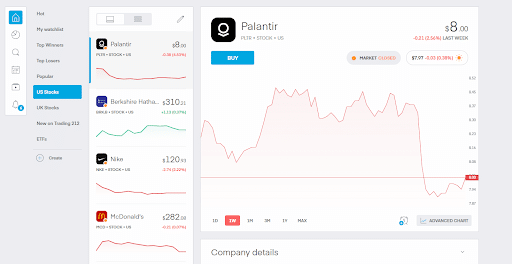
The account opening and deposit process is one of the simplest on the market, and investing is easy on both the mobile and web apps.
Commission-free doesn’t mean there are no fees. A 0.15% FX fee applies when converting funds. Other fees may apply. See terms and fees.
The main cons of the platform are a narrower product range than traditional platforms (no funds or bonds, for example) and a SIPP that is still being rolled out.
Sponsored Link. To get a free fractional share worth up to £100, you can open an account with Trading 212 through this link and enter the promo code “IITW” after you verify your identity and fund your account. Terms apply.
If you need more info, check out our detailed review of Trading 212.
Pros
-
No commission on stocks and ETFs (other fees may apply)
-
Intuitive and simple platform
- Free fractional share with promo code (terms apply)
Cons
-
Narrower product range than traditional platforms
-
0.15% FX fee when converting currencies
- SIPP still being rolled out gradually
Disclaimer: When investing, your capital is at risk and you may get back less than invested. Past performance doesn’t guarantee future results. Pies & Autoinvest is an execution-only service. Not investment advice or portfolio management. Automatic investing refers to executing scheduled deposits. You are responsible for all investment and rebalancing decisions.
3. Interactive Investor

Interactive Investor at a glance
Disclaimer: As investment values can go down as well as up, you may not get back all of the money you invest. If you’re unsure if an investment account is right for you, please speak to an authorised financial adviser.
Interactive Investor is a UK flat-fee investment platform with 525,000 customers and £108 billion in assets under management and administration (June 2026). It is owned by Aberdeen Group, which is listed on the London Stock Exchange.
Since February 2026, every plan includes a trading account, a Stocks and Shares ISA and a SIPP:
- Core: £5.99 a month, for portfolios up to £100,000
- Plus: £14.99 a month, with one free trade a month, £1.49 fund trades, Junior ISAs and free accounts for up to five family members
- Premium: £39.99 a month, with 10 free trades a month, free fund trades, £2.99 share trades and a 0.25% FX fee
The trading platforms (web and mobile) are user-friendly and well-designed. You can choose from thousands of UK and global stocks, as well as ETFs, funds, investment trusts and bonds. However, some products are missing, such as CFDs and forex.
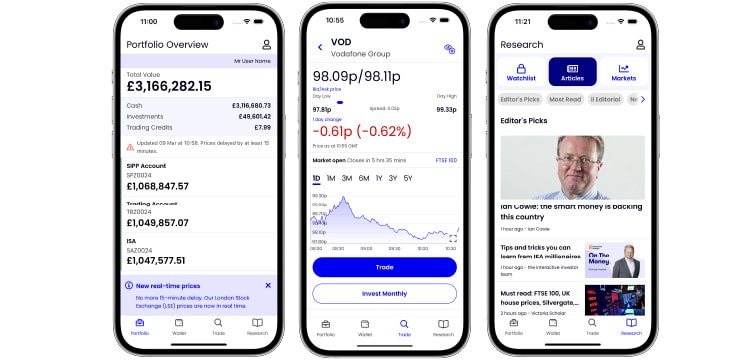
If you don’t know where to begin, you can use its lists of selected funds, such as the ii Super 60 and the ii ACE 40 (a list of responsible investment options), or its ready-made model portfolios.
Account opening and deposits are fast and easy. The biggest drawback of Interactive Investor is the monthly fee, which weighs more on small portfolios. UK and US share trades cost £3.99 on the Core and Plus plans, and the FX fee is 0.75% on the Core plan (on Plus, 0.25% above £50,000). You can see its fees in more detail here.
Overall, Interactive Investor is a good choice for investors with larger portfolios, since a flat fee costs relatively less as your investments grow. It also makes it easy to invest in traditional assets like stocks, ETFs, funds and bonds.
Pros
-
Flat monthly fee that suits larger portfolios
-
ISA, SIPP and trading account included in every plan
- User-friendly platform
Cons
-
Monthly fee weighs more on small portfolios
-
Dealing fee on share trades
- Limited offer of financial products
4. Freetrade

Freetrade at a glance
Freetrade is a UK investment platform owned by IG Group since April 2025. It offers commission-free investing (other fees may apply) in stocks, ETFs and investment trusts, and since January 2026 its free Basic plan also includes mutual funds and gilts.
Some of the other features of the platform include:
- General Investment Account, Stocks and Shares ISA, Junior ISA and SIPP, all available on the free Basic plan
- Fractional shares on US stocks
- Variable interest on uninvested cash: 1% AER on up to £1,000 on Basic, 2.5% on up to £2,000 on Standard (£5.99 a month, or £4.99 if paid annually) and 3.5% on up to £3,000 on Plus (£11.99 a month, or £9.99 if paid annually)
- Limit orders, stop losses and recurring orders on every plan, Basic included
There are 3 plans to choose from (Basic, Standard and Plus). All of them include commission-free investing, but they differ in FX fees (0.99% on Basic, 0.59% on Standard and 0.39% on Plus), interest on cash and other features. You can compare the plans in more detail here.
There is no account fee on any plan, and the app is user-friendly. Freetrade also runs a free share programme when you invite someone to join the platform.
The main limitations of Freetrade are the 0.99% FX fee on the Basic plan, a narrower fund range than traditional platforms and limited research tools.

Overall, Freetrade does what it was designed to do very well: it offers a simple way to start investing commission-free, now with a free ISA and SIPP. If you need more information, check out our detailed Freetrade review.
Pros
-
Commission-free investing (other fees may apply)
-
Free ISA and SIPP on the Basic plan
- No account fees
Cons
-
0.99% FX fee on the Basic plan
-
Narrower fund range than traditional platforms
- Limited research tools
5. AJ Bell

AJ Bell at a glance
Founded in 1995, AJ Bell is a UK investment platform listed on the London Stock Exchange. Account opening is quick and easy, with no initial deposit required, and you can invest from £25 a month through regular investing. The platform is user-friendly but lacks some of the more advanced features. You can choose from stocks, ETFs, funds and bonds, but there are no forex, options, futures or CFDs. If you are new to investing, you can also choose one of its ready-made portfolios.
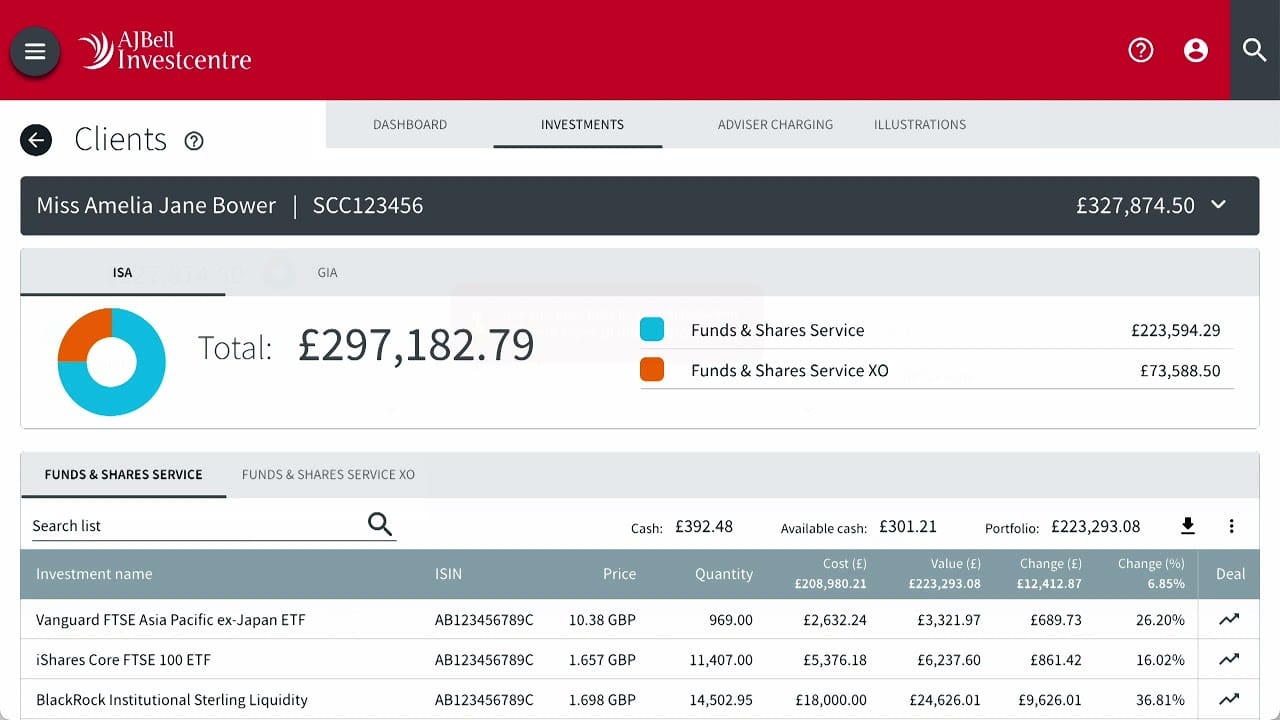
There is a wide range of accounts to choose from, including a Stocks and Shares ISA, Lifetime ISA, Junior ISA, SIPP and a regular Dealing account.
According to AJ Bell’s charges, its main fees for the Dealing account are:
- Account charge on shares, ETFs and bonds of 0.25% a year, up to a maximum of £3.50 a month
- Account charge on funds of 0.25% a year on the first £250,000, falling to 0.10% up to £500,000 and nothing above that
- Share dealing fee of £5 per online trade (£3.50 if you made 10 or more share deals in the previous month) and £1.50 per fund deal
- No dealing charge on regular investments
- FX fee of 0.75% on the first £10,000, 0.50% on the next £10,000 and 0.25% above £20,000
Customer service is available by phone, email and live chat.
Apart from the dealing fees and the absence of some financial products, another con of AJ Bell is its limited advanced tools (research, charts, order types, etc.).
Overall, AJ Bell is more of a traditional platform that offers good service from start to finish, including customer service. Its percentage fees are low for small and medium portfolios, but frequent share traders will pay more than on commission-free apps.
Pros
-
User-friendly platform
-
Low account fees on small and medium portfolios
- Free regular investing and wide choice of accounts (including a Lifetime ISA)
Cons
-
Dealing fee on every share trade
-
Limited offer of financial products
- Limited advanced tools (research, charts, order types)
6. IG

IG at a glance
67% of retail CFD accounts lose money.
IG is a well-known broker, offering a wide choice of markets, primarily in CFD and forex trading. The IG Group was established in 1974, is listed on the London Stock Exchange and served more than 1.4 million customers in the first half of 2026 across its brands, which also include tastytrade and Freetrade.
If you are a UK resident, you can also open a share dealing account or a Stocks and Shares ISA with access to real shares, ETFs, investment trusts and ready-made portfolios (IG Smart Portfolios). Share trades are commission-free when you use instant currency conversion, and IG removed its £24 quarterly custody fee in January 2026. You can find more info here.
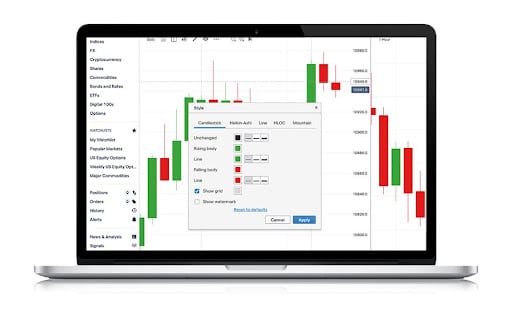
However, most traders will be drawn to IG because of its CFD and forex trading capabilities. Some of the features of the platform include:
- Extensive educational materials
- 24-hour support on weekdays
- Weekend trading and extended hours trading
- Access to MetaTrader 4, a leading forex trading platform
- Advanced tools such as a customisable screener and personalised news
CFD trades on most markets are commission-free, with IG’s costs built into the spread. The exception is share CFDs, which are offered at the market price with a commission when opening and closing a position.
Other fees include:
- FX conversion fee of 0.70% on share dealing
- Overnight funding fees on CFD positions (depending on the product)
- An annual management fee on Smart Portfolios (0.5%, capped at £250)
You can learn more about its fees at this link.
A Junior ISA has also been available since March 2026, and a SIPP is offered through a third-party provider, with a £210 yearly fee.
In a nutshell, IG is a broker that primarily offers CFD and forex trading in a user-friendly interface, and its share dealing account and ISA have become much cheaper in 2026. It suits both beginner and advanced traders thanks to its mix of educational materials and advanced trading tools.
Pros
-
User-friendly trading platform
-
Commission-free share dealing and no custody fee on the ISA
- Additional features: educational materials, extended trading hours, etc.
Cons
-
High share CFD fees
-
0.70% FX fee on share dealing
- Share dealing account available only to UK residents
Bottom line
Choosing a broker among numerous options can be a daunting task. The key is to choose one that suits your investing needs, because no single broker is right for every investor.
All of them have pros and cons that may be more or less important to you, such as the account types on offer (ISA, SIPP or GIA) or the financial products available (stocks, ETFs, funds, bonds, CFDs, etc.). Fees also play a big role, or as we like to say: “The only thing that’s 100% certain in investing are the fees”.
Hargreaves Lansdown’s 2026 fee cuts narrowed the gap, but for many investors a commission-free or flat-fee platform is still cheaper. Hopefully, this article made it easier for you to choose an alternative to Hargreaves Lansdown.
FAQs
Which Hargreaves Lansdown alternative is cheapest?
It depends on how you invest. For regular buying of stocks and ETFs, commission-free apps such as Trading 212 and Freetrade are usually cheapest, although FX fees apply on foreign shares (0.15% at Trading 212, 0.39% to 0.99% at Freetrade). For larger portfolios, a flat monthly fee like Interactive Investor’s (from £5.99) can work out cheaper than a percentage platform fee.
Which alternatives offer a SIPP?
Interactive Investor and Freetrade include a SIPP on every plan, AJ Bell offers its own SIPP, Interactive Brokers and IG offer one through external providers, and Trading 212 has been rolling out its SIPP gradually since March 2026.
Which alternative is best for funds?
AJ Bell and Interactive Investor have the widest fund choice of the platforms in this list. Freetrade added mutual funds to its free Basic plan in January 2026 but its range is narrower, and Trading 212 does not offer funds.
Are these platforms regulated in the UK?
Yes. All the platforms in this article are authorised by the Financial Conduct Authority (FCA), and eligible investments are covered by the Financial Services Compensation Scheme (FSCS) up to £85,000 per person per firm if a firm fails.