eToro, the leading social trading platform, is available in the Netherlands. The platform enables more than 40 million registered users to trade commodities, currencies, ETFs, stocks, indices and cryptocurrencies, including shares listed on Euronext Amsterdam such as ASML, ING Groep and Heineken. ETF trading is commission-free, real stock trades carry a flat commission, and you can follow and copy other investors.
On the downside, currency conversion costs apply depending on how you fund the account, and you need to make sure you are buying the underlying asset rather than a CFD. See our article on the differences between CFDs and real stocks.
Want to know more? Keep reading.
Is eToro legal in the Netherlands?
Yes. eToro publishes a list of restricted countries and the Netherlands is not among them, so using eToro as an investment platform is perfectly legal for Dutch residents.
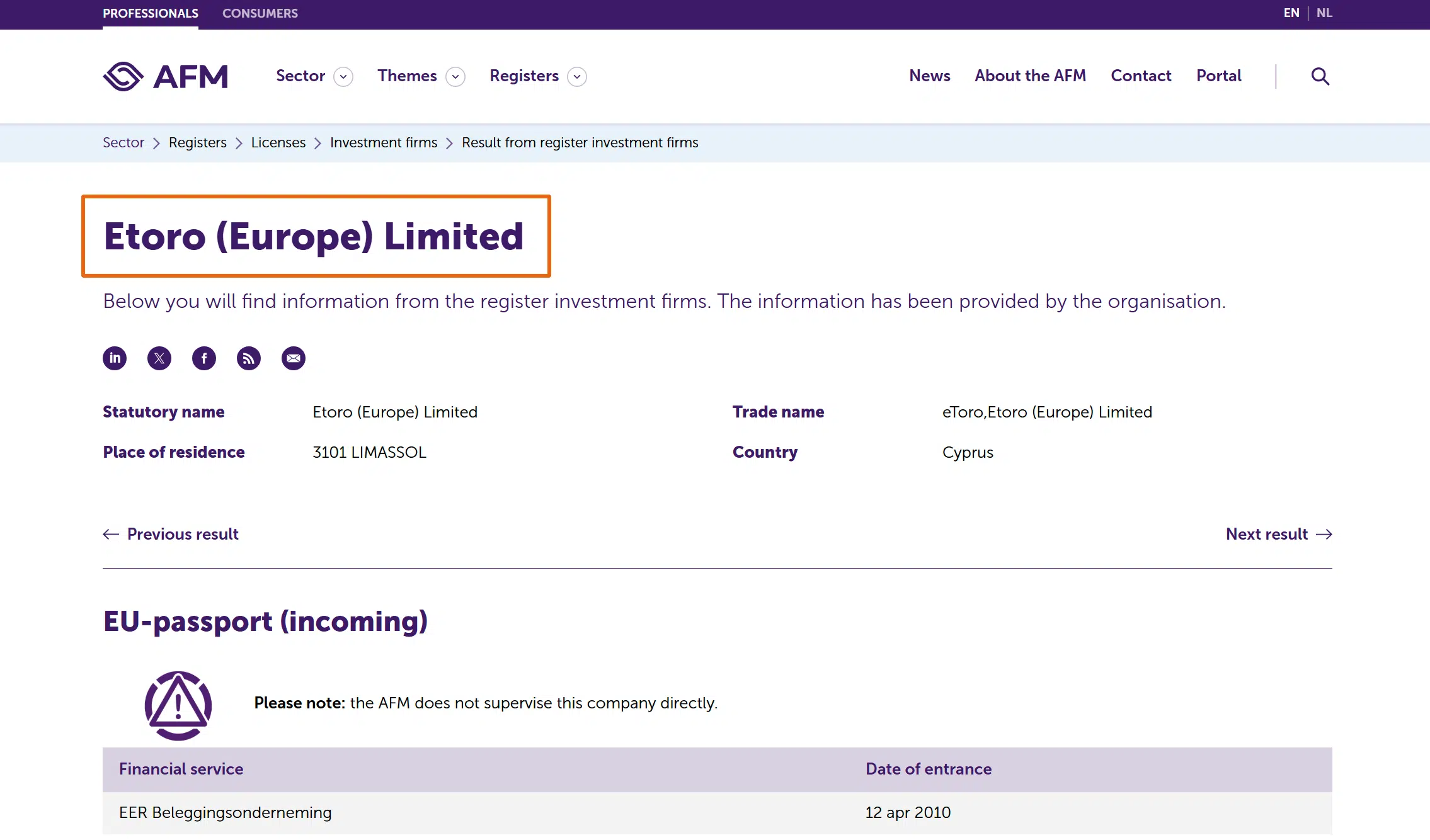
As a Dutch client you contract with eToro (Europe) Ltd, authorised and regulated by the Cyprus Securities and Exchange Commission (CySEC), which passports its services into the Netherlands under EU rules. The Netherlands Authority for the Financial Markets (AFM) supervises conduct in the Dutch market, and the usual MiFID II protections and restrictions apply, including leverage limits on CFDs for retail clients.
eToro Netherlands highlights
| 👨⚖️ Legal in the Netherlands | Yes |
| 💰 Stocks fees | $1 per trade on European and US exchanges, charged on opening and closing |
| 💰 ETFs fees | Commission-free |
| 💰 Cryptos and CFDs fees | Spreads apply; 1% on crypto |
| 💰 Inactivity fee | None (removed in May 2026) |
| 💰 Withdrawal fee | $5 (minimum withdrawal $30) |
| 💵 Minimum Deposit | $50 |
| 📍 Products offered | Stocks, ETFs, Cryptos and CFDs |
| 🎮 Demo Account | Yes |
| 📜 Regulatory entities | CySEC (entity serving Dutch clients), plus FCA and ASIC across the group |
| 📈 Listed company | Yes (Nasdaq: ETOR, since May 2025) |
How safe is eToro?
This is usually the first question people ask, and reasonably so.
eToro offers three layers of protection:
- Segregated securities: eToro acts as an intermediary. Each time you buy a non-leveraged stock or ETF position, you acquire an asset that belongs to you and is held with a custodian. If something went wrong with eToro, you would be able to transfer your securities to another broker.
- Investor compensation: As a Dutch investor you open an account through eToro (Europe) Ltd, regulated by CySEC, which must maintain membership of the Cyprus Investor Compensation Fund. That provides cover of up to €20,000 per client.
- Private insurance: eToro has partnered with Lloyd’s of London to provide insurance cover of up to €1 million, applied automatically when you open an account. Cover of this kind is renewed periodically, so check the current terms if you hold a large balance.
A fourth point worth adding: since May 2025 eToro has been listed on the Nasdaq, which means it publishes audited accounts. That is a level of transparency most privately held platforms cannot match, and it lets you check the company’s financial position yourself rather than taking its word for it.
Note that the €20,000 compensation ceiling covers the failure of the firm, not investment losses. If the market falls, no scheme compensates that.
For more detail, see our analysis of the safety of eToro.
How Dutch tax affects your investing
The Netherlands taxes investments differently from most countries, and it changes how you should think about what you buy.
You are taxed on wealth, not on gains. Investments held by individuals fall into Box 3, where tax is calculated on your assets as at 1 January each year using an assumed rate of return, rather than on the profit you actually made. A year in which your portfolio falls can still produce a tax bill, and a year of large gains does not necessarily increase it proportionally.
What this changes in practice. The accumulating versus distributing question that dominates ETF choice elsewhere in Europe matters far less here, because you are not taxed on realised gains or on dividends in the usual way. What matters more is the total value of your holdings on the reference date, and there is a tax-free allowance below which no Box 3 tax applies.
The system is in flux. Box 3 has faced sustained legal challenge over taxing assumed rather than actual returns, and successive governments have committed to reform. The rules, rates and the basis of calculation have all moved in recent years and are likely to move again.
Because of that, we are not publishing specific rates or thresholds here: anything we quoted would risk being out of date by the time you read it. Check the current position with the Belastingdienst or a Dutch tax adviser before making decisions on the basis of tax.
One thing that does hold regardless: as a foreign broker, eToro does not withhold Dutch tax or file on your behalf, so declaring your holdings is your responsibility.
What financial instruments and features will I find?
You can trade a wide range of products:
- Stocks: shares from 17 stock exchanges including Amsterdam, Zurich, Frankfurt, London, Madrid, Milan, New York and Nasdaq.
- ETFs: funds from providers including iShares, Vanguard, PIMCO and Invesco, among others.
- Commodities: gold, silver, copper, platinum, palladium and others.
- Forex: exposure to currency markets through a range of pairs, with EUR/USD, AUD/USD and GBP/JPY among the most traded.
- CFDs: leveraged exposure across the asset classes above. Be aware that leverage increases the likelihood of significant losses, and retail leverage is capped under EU rules.
You can also use Copy Trading to mirror other investors automatically, delegating your allocation to someone whose approach you want to follow. Copy Trading does not amount to investment advice, and copying a successful past record does not guarantee future results.

eToro’s fees
eToro earns primarily through spreads, the difference between the bid and ask price, alongside commissions and non-trading charges.
Stocks. eToro charges a flat commission of $1 per trade on stocks listed in the UK, Europe and the US, which covers Euronext Amsterdam. Australian, Hong Kong, Dubai and Abu Dhabi listings cost $2 per trade. The commission is charged when you open the position and again when you close it.
ETFs. Commission-free, which is the strongest part of the offer for a long-term investor building a passive portfolio.
Crypto and CFDs. You pay a spread on every buy and sell, and crypto carries a 1% fee. Spreads vary considerably by product, so check eToro’s fees page for what applies to what you are trading.
Leverage. Financing rates apply overnight on leveraged positions.
Non-trading fees. A $5 withdrawal fee applies, with a $30 minimum withdrawal. There is no longer an inactivity fee, eToro having removed it in May 2026.
The cost European investors most often underestimate is currency conversion, which we cover in the next section.
How to open an account
Go to eToro’s website, click “Join now”, and provide the required information as shown below:
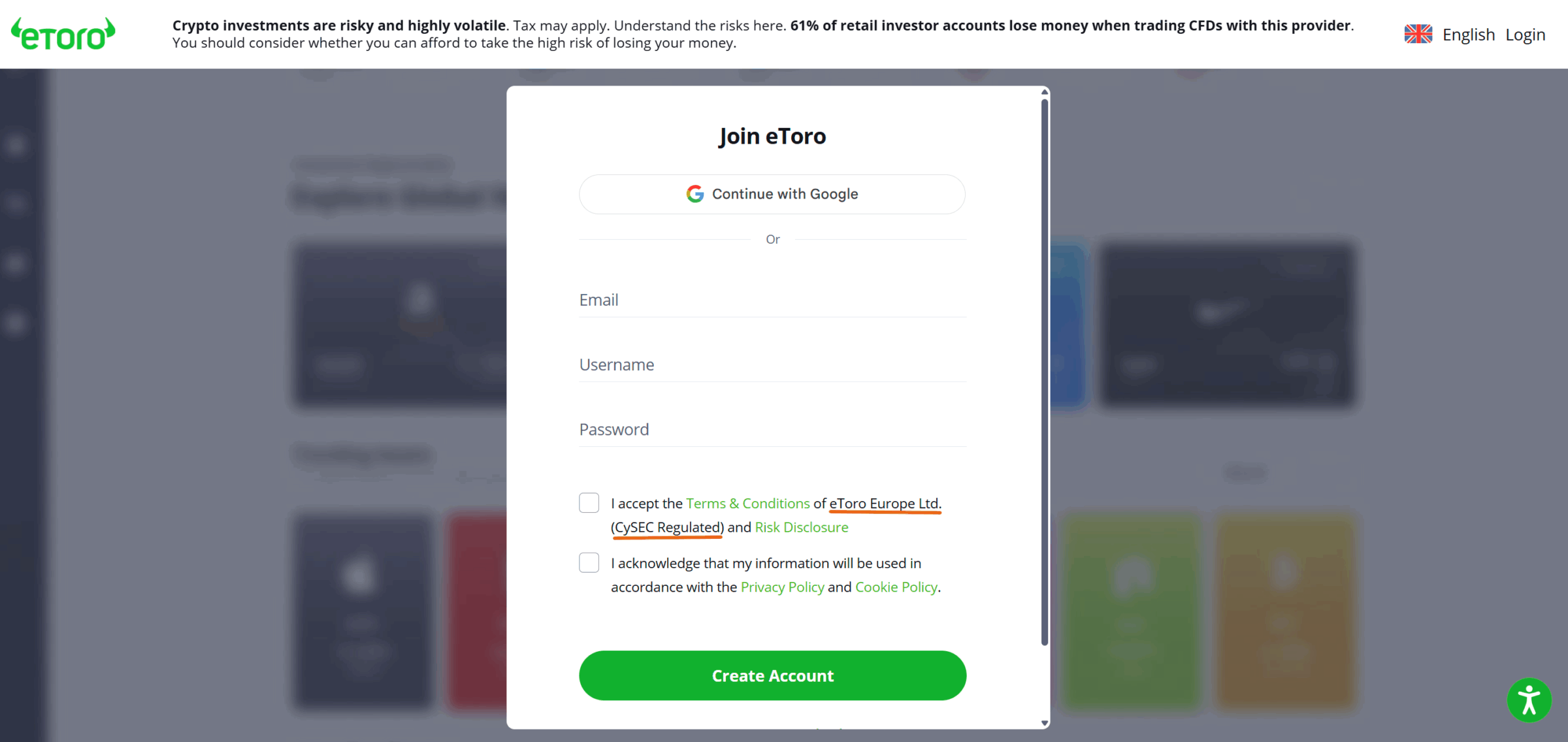
In the first check box, confirm which entity you are registering with. As a Dutch resident this will be eToro (Europe) Ltd.
You then verify your identity and address. Proof of identity can be your ID or passport; proof of residence can be a driving licence, bank statement or utility bill.
We suggest submitting all documents when you open the account rather than later, to avoid delays when you come to withdraw. We have had no issues taking money out of the platform, but it can take longer if your account is not fully verified.
Once set up, you can deposit and start trading:
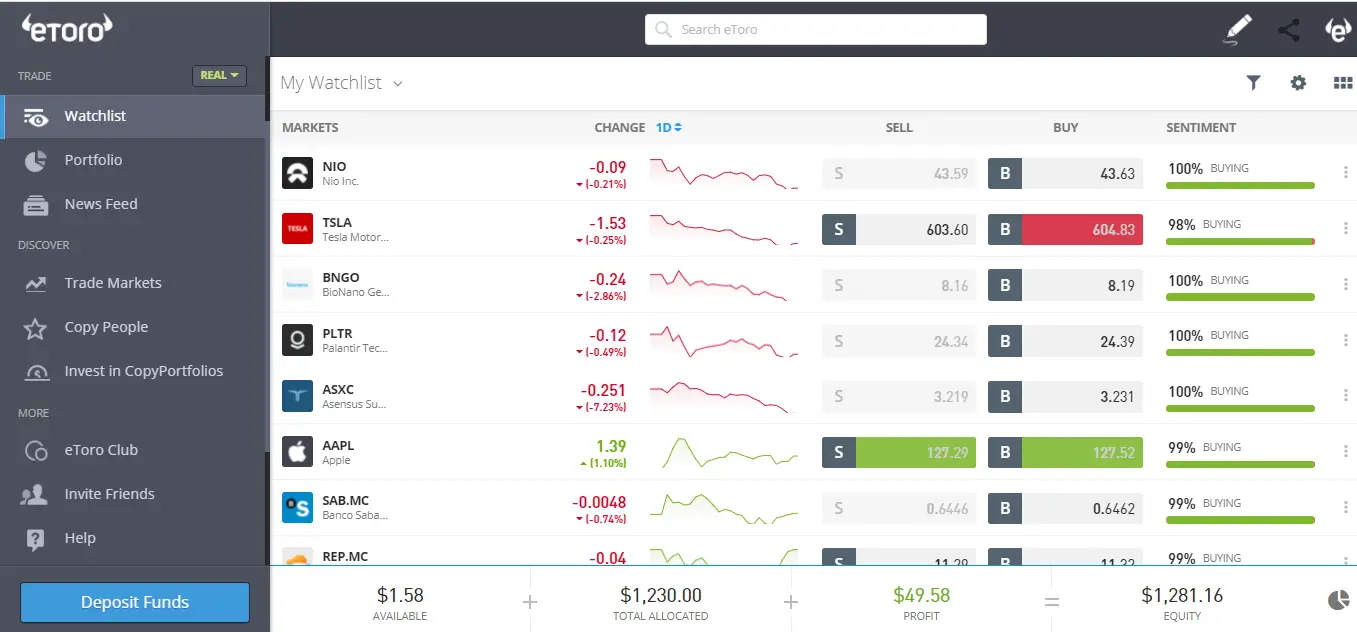
The sidebars and search function are straightforward, and you should find what you are looking for quickly.
How to deposit and withdraw
Before depositing, remember you can use the demo account to try the platform with virtual funds.
Deposits: On your dashboard you will find “Deposit Funds”, which opens a window with several options including card, bank transfer and e-wallets. The minimum deposit in the Netherlands is $50.
Withdrawals: Use the “Withdraw Funds” tab. The method you used to deposit should be the same one you use to withdraw. The minimum withdrawal is $30, and a fixed $5 fee applies per withdrawal.
Currency conversion: This is where Dutch investors most often pay more than they expect. eToro’s conversion costs depend on your account currency, the currency you fund in, the payment method, and your eToro Club tier. The way to minimise it is to match your account currency to the currency you deposit in, and to buy EUR-denominated assets where you can.
Check the conversion cost that applies to your own account before funding, since the figures change and vary by circumstance. If you are moving money between currencies regularly, a service such as Wise can be cheaper for the transfer itself.
How to trade stocks or any other security
The process for buying or selling stocks is straightforward, and works the same way for ETFs, cryptocurrencies and other assets.
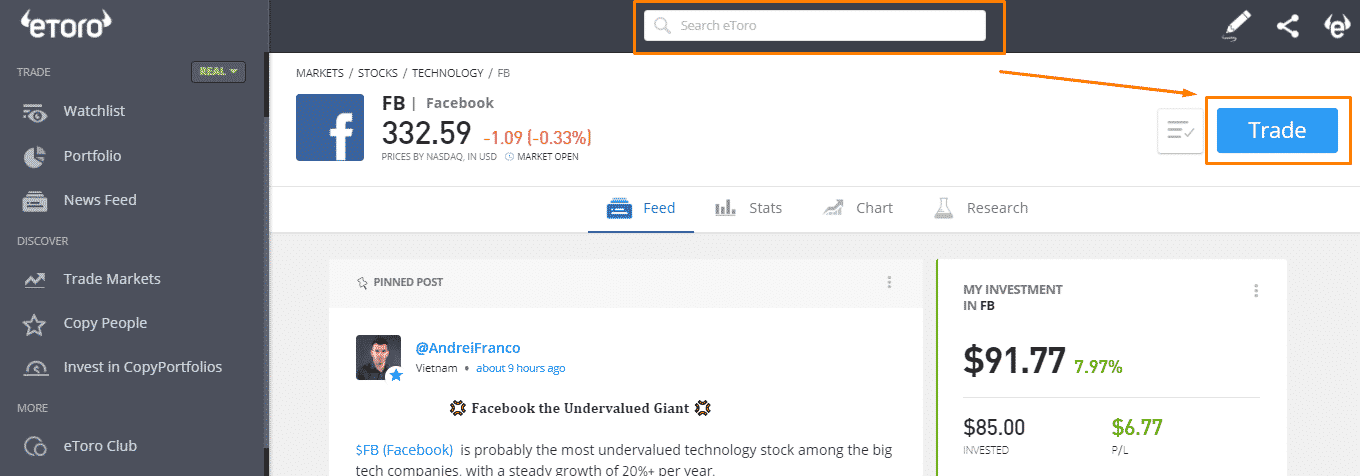
First, use the search bar to find the company you want and click “Trade”:
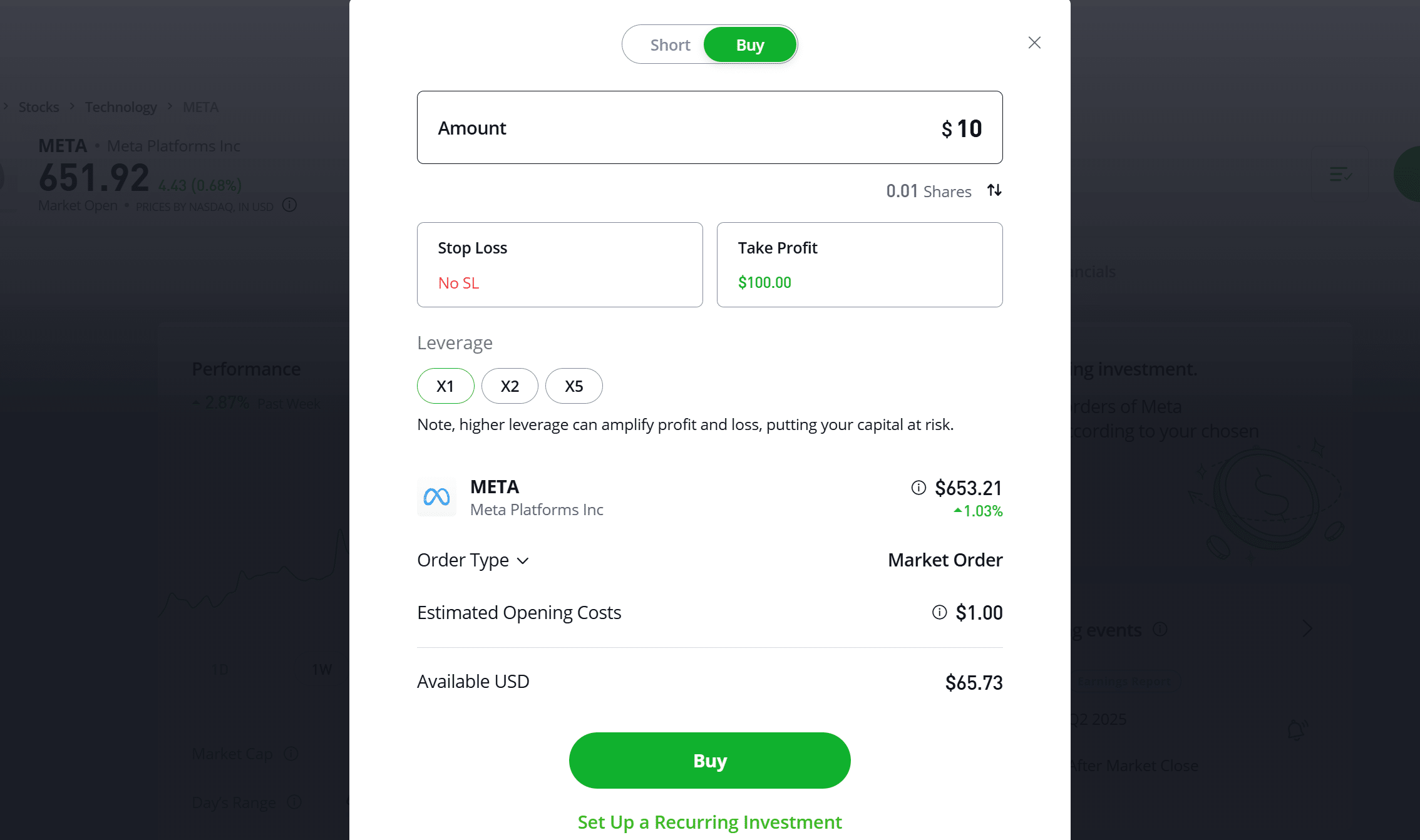
A window then appears where you can buy or short the asset. Left at X1, you are buying the underlying asset rather than a CFD. Changing X1 to X2 or higher turns the position into a leveraged CFD, which is a different product with different risks and costs. If you want to own the share, leave it at X1.
Customer support
Our assessment comes from our own experience. We have contacted customer support more than once, and response times vary. The longest we waited was around seven days, though in normal circumstances it takes under three.
Support is available through the help centre and in-platform ticketing rather than by phone, which suits some people and frustrates others.
Final thoughts
eToro is a solid option for Dutch investors, whether beginner, intermediate or experienced. Commission-free ETF trading suits a passive portfolio, the platform is genuinely easy to use, and its Nasdaq listing means you can read its accounts rather than take its financial position on trust.
Two things to weigh before deciding. Real stock trades now carry a flat commission on both opening and closing, so frequent trading in individual shares costs more than it used to. And currency conversion, rather than commission, is usually the larger recurring cost for a euro-based investor, so it is worth structuring your account to minimise it.
For a complete overview of how eToro operates globally, read our eToro review.