Founded in 2007 and listed on the Nasdaq since 2025 (ticker: ETOR), eToro is a well-known multi-asset platform with 4.28 million funded accounts (June 2026). The platform is intuitive and suits beginners, and you can practise with virtual funds in its demo account.
You can use eToro to invest in stocks, ETFs and cryptocurrencies, as well as to trade CFDs on stocks, ETFs, commodities, currencies (forex), indices and cryptocurrencies.
Can you buy bonds on eToro?
No, eToro does not offer individual bonds. You can only invest in bonds indirectly, through bond ETFs. This means you can buy a fund (ETF) that holds many bonds, but not individual bonds.
Each approach has pros and cons. Bond ETFs spread your money across many bonds, which diversifies your risk, but they charge an annual management fee (included in the TER, or total expense ratio) and have no maturity date, so their price keeps moving with interest rates.
Individual bonds pay a known coupon and, if you hold them until maturity, return their face value, which makes your income more predictable. However, the issuer could default, and if you sell before maturity, you may get less than you paid if interest rates have risen.
If you want to invest in individual bonds, check our step-by-step guide on how to buy US Treasury bonds from Europe and the UK, or read on for the best alternative platforms.
How to buy bond ETFs on eToro
As an eToro user, you can invest in some of the biggest bond ETFs, including US ETFs that track Treasury bills, notes and bonds, such as:
- SPDR Bloomberg 1-3 Month T-Bill ETF (BIL)
- iShares 1-3 Year Treasury Bond ETF (SHY)
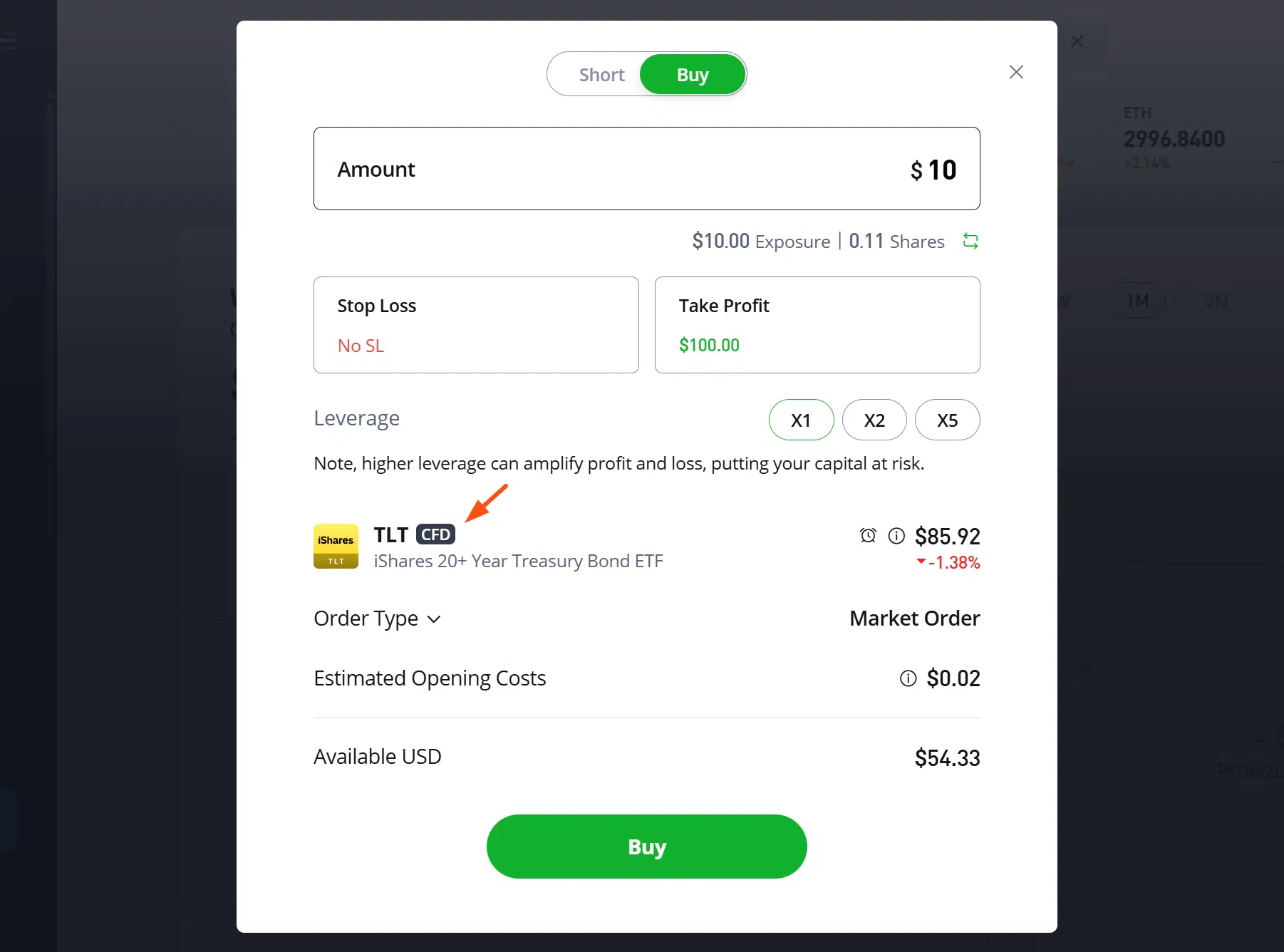
- iShares 20+ Year Treasury Bond ETF (TLT)
eToro also lists European (UCITS) bond ETFs, such as the iShares $ Treasury Bond 0-1yr UCITS ETF, which are usually the option for European retail investors.

How you hold these ETFs depends on your country and on how you open the position. On eToro, a non-leveraged buy position is usually a real ETF, while leveraged or short positions are CFDs. In the EU and the UK, US-listed ETFs such as BIL, SHY and TLT are generally not available to retail investors as real ETFs because of the PRIIPs rules, so eToro may only offer them as CFDs. Any CFD position is marked “CFD” in the trade window.
With a CFD, you don’t own the ETF, and leveraged positions pay overnight fees. If you want to own real bond ETFs, choose UCITS ETFs available in your country.
Best eToro alternatives for investing in bonds
Interactive Brokers | Best global broker overall
Founded in 1978, it is one of the world’s most established brokers. It offers a wide selection of financial products, including bonds from the US, Canadian, UK, European and Hong Kong markets. Bond trading fees are low, although they rise with larger trade sizes. Its IBKR GlobalTrader mobile app is a good option for beginners.
DEGIRO | Best European broker for low-cost ETFs
DEGIRO is one of the leading online brokers in Europe, available in 15 European countries. It became popular mainly thanks to its low fees. Apart from ETFs, it offers stocks, bonds, futures, options, funds and crypto. Its bond selection is limited to selected European bonds, but the fees are low.
Disclaimer: Investing involves risk of loss.
Saxo | Best broker for experienced traders
This Danish broker gives experienced traders access to exchanges worldwide, with over 70,000 instruments, including stocks, bonds, options, futures, forex and more. Its bond offering covers thousands of government and corporate bonds, but the €20 minimum bond commission makes it better suited to larger investors.
All these platforms offer bond trading. Interactive Brokers is our recommended choice, thanks to its wide bond selection and low fees. DEGIRO is a simpler alternative for European investors, but it has a much smaller choice of bonds. Saxo is best for experienced investors with larger portfolios who don’t mind higher fees.
| Broker | Bond trading fees | Bond markets | Minimum deposit | Currency conversion fee | Available in |
| Interactive Brokers | 0.002% of face value (min. $5) for US Treasuries, from $1 for corporate and municipal bonds | US, Canadian, UK, European and Hong Kong bonds | $0 | 0.08 to 0.20 basis points of the trade value ($2 minimum per order) | Internationally (exceptions apply) |
| DEGIRO | €2 commission + €1 handling fee (EU government bonds) | Selected European bonds | No minimum | 0.25% | 15 European countries |
| Saxo | 0.20% with a €20 minimum (Classic account) | Thousands of government and corporate bonds worldwide | $0 in most countries (Classic account) | 0.25% | Internationally (exceptions apply) |
#1 Interactive Brokers

Interactive Brokers at a glance
Having been around since 1978 and survived multiple financial crises, Interactive Brokers’ major advantage is its reputation. It is also listed on the NASDAQ (ticker: IBKR) and is part of the S&P 500 index, which means it publishes audited financial results.
Other significant advantages of Interactive Brokers are its wide selection of financial products from 170 markets in 40 countries, solid trade execution (IB SmartRouting) and support for multiple currencies in the same account.
Some downsides of Interactive Brokers are its complex fee structure, its lengthier than average registration and deposit processes, and the lack of commission-free stock trading outside the US (IBKR Lite is only available to US residents). However, its low FX fees help offset this.
Speaking of the fee structure, there are two plans to choose from: Tiered and Fixed. Under the Tiered plan, fees depend on your monthly trading volume. Fees also vary across markets. You can see the full fee structure here.
The bond selection is wide, with US, Canadian, UK, European and Hong Kong bonds to choose from. IBKR gives access to over 1 million bonds. For US Treasuries, the commission is 0.002% of the face value (minimum $5), while corporate and municipal bonds start from $1 per order. Bonds from other markets have their own fees, which you can check here.
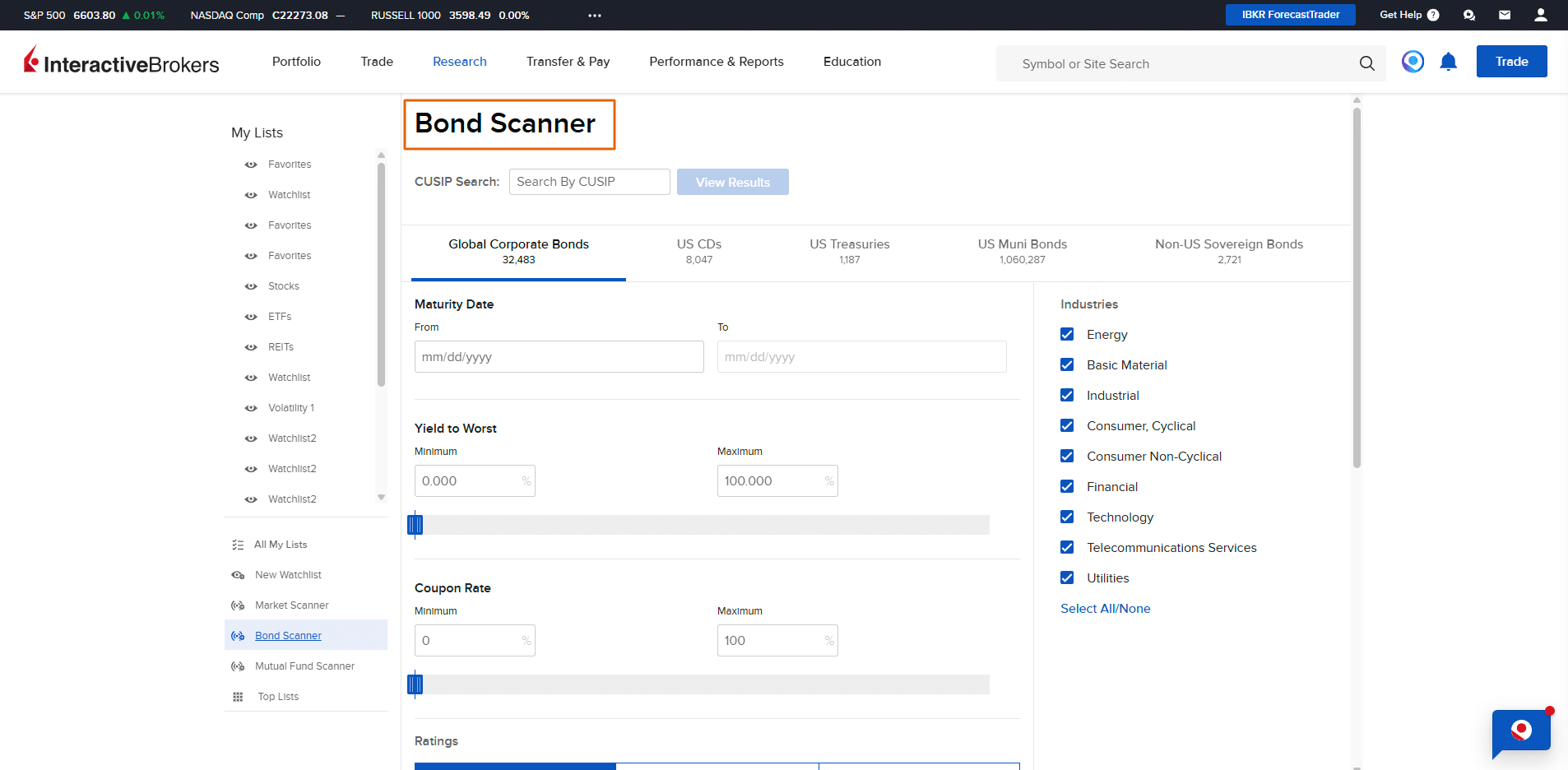
The Trader Workstation (TWS) and IBKR Desktop platforms offer many basic and advanced features, such as a demo account, watchlists, real-time alerts and advanced technical analysis tools, including a bond scanner. The downside is that the learning curve can be steep for beginners, even with the educational materials provided.
The IBKR GlobalTrader mobile app is a much more intuitive choice for beginner investors, offering stocks, ETFs and options trading in a user-friendly format. Other features include automatic currency conversions and fractional shares on thousands of US, European and Canadian stocks and ETFs.
Overall, Interactive Brokers suits both beginners and advanced investors who want an established broker and access to many financial instruments, including bonds. If you need more info, check out our detailed review of Interactive Brokers.
#2 DEGIRO

DEGIRO at a glance
Investing involves risk of loss.
Launched in 2013 in the Netherlands, DEGIRO has become one of the most popular European brokers. It is part of flatexDEGIRO, a group listed on the Frankfurt Stock Exchange, and operates as the Dutch branch of flatexDEGIRO Bank SE. This means your cash is protected up to €100,000 under the deposit guarantee scheme.
DEGIRO is best known for its low fees and wide selection of financial products. Its main cons are that it is only available in 15 European countries and that its deposit options are limited.
DEGIRO’s fee structure is fairly simple, with no deposit, withdrawal or inactivity fees.
Keep in mind that DEGIRO only offers individual bonds from selected European markets. EU government bonds cost a €2 commission plus a €1 handling fee per trade.
DEGIRO’s Core Selection now covers all ETFs listed on Tradegate, which you can trade for just a €1 handling fee, with no connectivity fee. ETFs outside the Core Selection cost a €2 commission plus the €1 handling fee.
Commission fees for stocks on different exchanges include:
- US and Canadian exchanges: €1 commission
- Other European exchanges: €3.90 commission
- Australian, Hong Kong, Japanese and Singapore exchanges: €5 commission
The most common additional fees include:
- A €1 handling fee on most orders
- A connectivity fee of €2.50 per exchange per year outside your home market (capped at 0.25% of your account value)
- A currency conversion fee of 0.25%
Fees may differ slightly depending on your country, so check the fee schedule for your country. If you need more info, check out our detailed review of DEGIRO.
#3 Saxo

Saxo at a glance
62% of retail CFD accounts lose money.
Founded in 1992, Saxo is one of the longest-running global brokers and holds a Danish banking licence. Since March 2026, the J. Safra Sarasin Group has been its majority shareholder. Saxo is known for its wide range of financial products (over 70,000 instruments) and access to many exchanges worldwide.
Saxo mainly targets experienced investors, with advanced tools such as TradingView integration. Its SaxoTrader platform is designed for active traders, while SaxoInvestor offers a simpler experience for long-term investors.

Saxo’s Classic account has no minimum deposit in most countries, but the platform remains geared towards larger investors through its premium tiers and fee structure. Saxo is not available in some large markets, such as the US.
There are three account levels: Classic, Platinum (€200,000 minimum) and VIP (€1,000,000 minimum), each with its own fees.
Fees are one of the biggest cons of Saxo. Commissions on US stocks and ETFs are 0.08% (min. $1) for Classic accounts, 0.05% (min. $1) for Platinum and 0.03% (min. $1) for VIP.
The bond selection is impressive, with thousands of bonds worldwide. Bond commissions depend on your account level: 0.20% for Classic, 0.10% for Platinum and 0.05% for VIP, with a minimum of €20 per trade on all levels. This makes Saxo better suited to investors who buy bonds in larger amounts.
The fee structure is fairly complex, and there are some additional fees to be aware of:
- Custody fee: up to 0.15% a year on Classic accounts (0.12% on Platinum and 0.09% on VIP), with a monthly minimum. Saxo has reduced or removed it in some countries, and you can offset it by joining its stock lending programme
- Currency conversion fee: 0.25% in the EU (higher for UK accounts)
Saxo does not charge an inactivity fee. To see the full fees for a specific product, check the pricing overview on its website.
In a nutshell, Saxo is tailored to experienced investors because of its advanced tools, higher-than-average fees and complex interface, which is also why it may not suit beginners.
If you would like to know more about Saxo, check out our Saxo review.
What to look for in a broker that offers bond trading
Several key factors matter when choosing a broker for bond trading:
- Overall experience and user interface: make sure you are comfortable using the platform from start to finish, including account opening, minimum deposit, user experience and available tools.
- The range of available bonds: not all brokers offer bonds from many markets, so check that your broker covers the bond markets you’re interested in.
- Commissions: fees are one of the few certain things in investing, and minimum commissions can eat into the returns on smaller bond purchases.
- Currency exchange fees: bonds are usually denominated in their local currency. If you buy bonds in a currency other than your own, you pay currency conversion fees and take on currency risk.
Bottom line
With interest rates well above the near-zero levels of the early 2020s, bonds have become more attractive again. They can offer a predictable income, but they still carry risks, such as interest rate risk and the risk of the issuer defaulting.
eToro only gives you access to bonds through bond ETFs (or CFDs on them). If you want to buy individual bonds, Interactive Brokers, DEGIRO and Saxo are, in our opinion, some of the best alternatives.
We hope this article helps you make your choice.