Investing in stocks through a company means opening a corporate brokerage account, funding it with the company’s money and then buying stocks, ETFs or other assets through the broker’s platform. The process is similar to personal investing, but it involves more documentation and your company’s own tax and accounting rules.
One of the main global brokers offering this service is Interactive Brokers (IBKR). It gives companies access to more than 160 markets worldwide, with low trading costs, a very wide range of products, strong research tools and interest on cash balances (subject to conditions). IBKR also offers flexible account structures, so you can give different users different permissions.
Creating a corporate investment account with Interactive Brokers is fairly straightforward. Here is a step-by-step guide to help you through the process.
How to invest through a company (step by step)
Step 1: Research and preparation
Before starting the application, review Interactive Brokers‘ offer for corporate accounts: its fee structure, the products available and any requirements that apply to your type of company and country. Companies are served by the IBKR entity for their region: for example, companies in the EU usually open their account with Interactive Brokers Ireland, regulated by the Central Bank of Ireland.
IBKR is not the only broker offering business accounts. We have reviewed several other brokers with business accounts internationally, in Australia, the UK and the US. In this article, we focus on Interactive Brokers, since it’s the broker we chose for our own business brokerage account.
Step 2: Visit the Interactive Brokers website
To start the account opening process, visit the Interactive Brokers website and click the “Open Account” button, which is prominently displayed on the homepage.
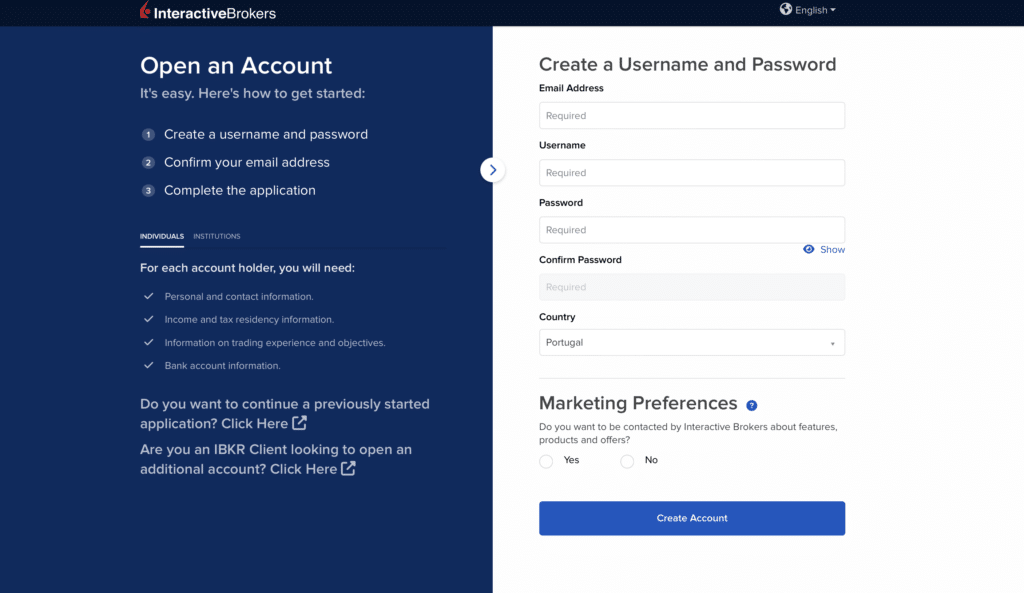
Step 3: Choose the “Small Business” option
Interactive Brokers offers different account types, including individual, joint, trust and business accounts. Select the “Small Business” option, which covers corporations, limited companies, partnerships and similar entities, so the account is opened in your company’s name.
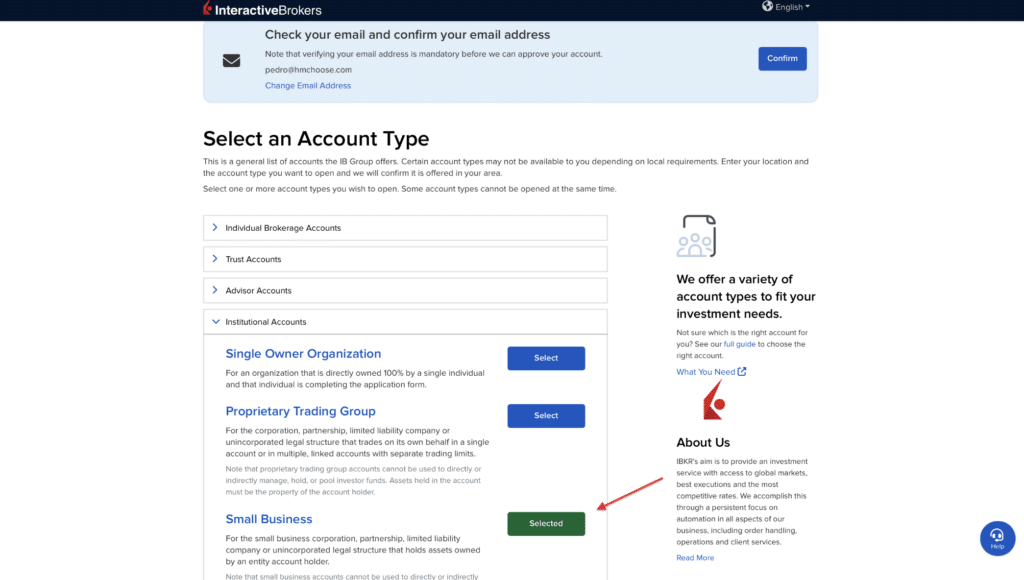
Step 4: Complete the application
Next, you’ll fill in an application form with detailed information about your company. Be prepared to provide:
- Company name, address and contact details;
- Legal structure (for example, corporation, limited company or partnership);
- Industry and nature of the business;
- Tax identification number (such as an EIN in the US or your company’s tax number in Europe);
- Company registration documents, such as the certificate of incorporation, articles of association or partnership agreement;
- Information about the directors and beneficial owners (usually anyone holding 25% or more), including their ID documents;
- Financial information, such as revenue, assets and liabilities;
- The company’s Legal Entity Identifier (LEI), if required in your jurisdiction (see below).
Make sure all the information is accurate and up to date, since any discrepancy can delay the approval.
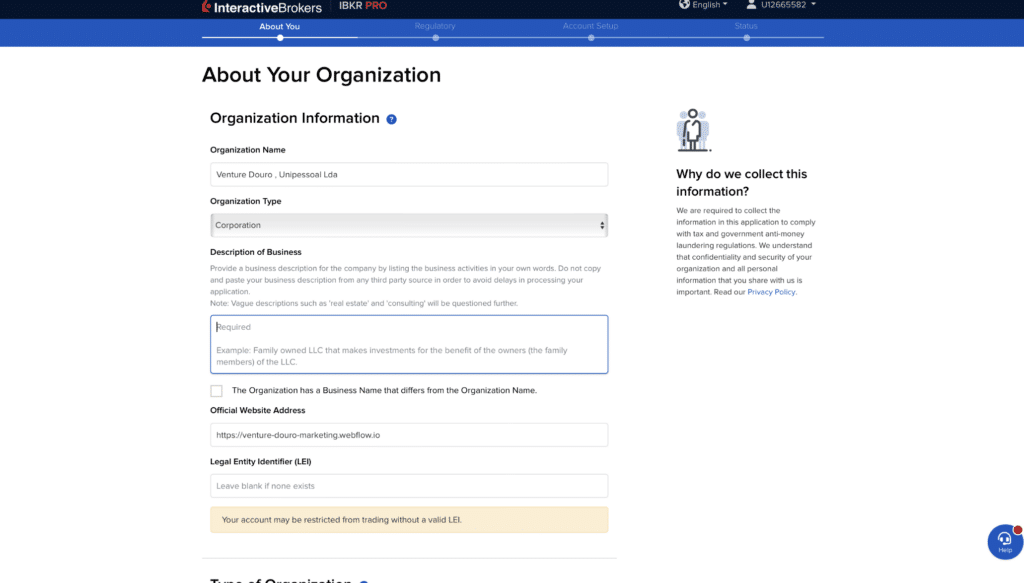
Step 5: Regulatory information and investment objectives
Interactive Brokers will also ask for regulatory information and your investment objectives, including the trading experience of the people who will manage the account, any professional affiliations and any regulatory licences they hold.
You will also need to state the company’s investment goals, such as capital growth, income or hedging. This information determines which products the account can trade.
Step 6: Review and submit the application
Once you have completed all the sections, review the application carefully, since mistakes or missing details can delay the approval.
Then submit it online. You should receive a confirmation email acknowledging your application.
Step 7: Account approval and funding
Interactive Brokers will review the information and carry out its due diligence, which can take longer than for a personal account, since the company’s documents and owners have to be verified.
Once the account is approved, you can fund it from a bank account in the company’s name. Funding options depend on your region and include bank transfers (such as SEPA transfers in Europe), wire transfers and, in the US, ACH transfers.
Step 8: Start investing
With the account funded, the company can invest in the wide range of products available through Interactive Brokers, including stocks, ETFs, bonds, mutual funds, options and futures.
Consider the company’s risk tolerance, investment horizon, liquidity needs and diversification when choosing your investments. Interactive Brokers offers research tools and educational resources to help you.
Why you may need an LEI (Legal Entity Identifier)
A Legal Entity Identifier (LEI) is a unique 20-character alphanumeric code that identifies legal entities involved in financial transactions. It was introduced after the 2008 financial crisis, at the initiative of the G20, to improve transparency in financial markets.
In the European Union and the UK, legal entities must have an LEI to trade stocks, ETFs and other securities, because brokers have to report their transactions to regulators under MiFID II / MiFIR rules. That’s why Interactive Brokers and other brokers ask EU and UK companies for an LEI before they can trade.
The LEI serves several purposes:
- Regulatory oversight: it lets regulators identify exactly which entity is behind each transaction, which helps prevent market abuse, money laundering and fraud;
- Risk management: it helps financial institutions and regulators monitor exposures and identify risks within the financial system;
- Data standardisation: it provides a single, global way to identify companies across different jurisdictions.
You can get an LEI from an accredited issuer (listed on the GLEIF website) for a small annual fee, and it must be renewed every year to stay valid.
Pros of corporate investment accounts
Investing through a company can offer several advantages:
- Separation of assets: keeping investments in the company’s name separates them from your personal finances, which can make accounting clearer and, depending on the legal structure, limit your personal exposure;
- Possible tax advantages: depending on your country, investing surplus company cash can allow you to defer personal taxes until profits are distributed, and some countries exempt certain dividends or gains received by companies. The rules vary widely, so consult a tax professional;
- Putting idle cash to work: companies with cash they don’t need in the short term can invest it, for example in ETFs or money market funds, instead of leaving it in a current account.
Cons of corporate investment accounts
There are also some drawbacks to consider:
- More paperwork: opening a corporate account requires more documents, including information on directors and beneficial owners, and sometimes an LEI;
- Administrative burden: the company’s investments have to be recorded in its accounts and tax returns, which usually means extra work for your accountant and possibly higher costs;
- Getting the money out: the investments themselves are as liquid as in a personal account, but moving the money from the company to you usually means paying yourself a salary or dividends, which can be taxed;
- Tax treatment can be less favourable: in some countries, gains and dividends inside a company are taxed at a higher rate than in a personal account, or personal tax-advantaged accounts are more attractive, so the corporate route isn’t always the best one.
Bottom line
Investing through a corporate account can make sense if your company has surplus cash to invest, and it can offer clearer separation from your personal finances and, depending on your country, tax advantages.
However, it also involves more paperwork, extra accounting and tax work, and costs to take the money out of the company. Weigh these factors, and speak with your accountant, before deciding to open a corporate account.
Have any doubts about investing through your business? Feel free to contact us.
Disclaimer: Investing involves risk and you may get back less than you invest. This article is for information only and is not tax, legal or investment advice.