Founded in 2014, Wealthsimple started as a robo-advisor and has grown into the fastest-scaling financial platform in Canada. What began as automated ETF portfolios now covers self-directed trading, crypto, chequing and spending, credit cards, mortgages, tax filing and prediction markets, and the company has repeatedly beaten its own asset targets years ahead of schedule.
In this article, we’ll explore Wealthsimple’s latest statistics. We will examine the platform’s assets under administration (AUA), number of clients, ownership, valuation, revenue and other relevant data, which showcase the company’s growth and its impact on Canadian financial services.
Whether you’re a current or potential Wealthsimple client or simply interested in the investment management industry, read on to discover the latest Wealthsimple statistics.
Overview
Wealthsimple began with a mission to provide smart, simple investing that is accessible to everyone. Its focus on low fees without an account minimum opened investing to Canadians who had been priced out of traditional investment management. The product suite has since expanded well beyond managed portfolios and now covers:
- Managed investing: globally diversified ETF portfolios that are automatically rebalanced and optimised for tax efficiency, including socially responsible and halal options, plus alternative allocations such as private credit and private equity at higher tiers.
- Self-directed investing: commission-free trading in Canadian and US stocks and ETFs, fractional shares from $1, and options contracts at $0.
- Crypto: buying, selling, staking and self-custody withdrawals across a curated list of coins.
- Chequing and spending: a high-interest chequing account, a debit card, and a credit card launched in June 2025 with 2% cash back and no foreign exchange fees.
- Credit and lending: mortgages and a Portfolio Line of Credit.
- Wealthsimple Tax: a pay-what-you-want filing service, formerly SimpleTax.
- Wealthsimple Predict: a standalone prediction markets app announced in June 2026.
Here are some key corporate facts about Wealthsimple:
- Founded in: 2014
- Headquarters: Toronto, Ontario
- IPO date: privately held, no IPO date disclosed
- Sector: financials
- Industry: investment banking and brokerage
- Founders: Michael Katchen, Rudy Adler, Brett Huneycutt
- Regulator: Canadian Investment Regulatory Organization (CIRO)
- Number of employees: around 2,500 (source: Tracxn, July 2026)
Ownership
Wealthsimple is a privately held Canadian company. Before its most recent raise it had taken in roughly CAD 630 million of primary capital, and in October 2025 it added a further CAD 550 million of primary funding as part of a CAD 750 million offering.
The company is controlled by Power Corporation of Canada, which holds its position collectively through Power Financial, IGM Financial and Portage Ventures I. That combined undiluted equity interest sits at roughly 52.4%, down from 55.1% in mid-2024 as successive financing rounds diluted the group. Within that total, IGM is the single largest individual shareholder with an interest of about 25.5% following the October 2025 round.
Here is a list of the major investors:
Wealthsimple investors
| Power Corporation | GIC | CPP Investments | Dragoneer Investment Group |
| IGM Financial | ICONIQ Capital | Greylock Partners | Meritech Capital Partners |
| DST Global | Sagard | TCV | Inovia Capital |
| Allianz X | Alkeon Capital Management | Base10 Partners | Portage Ventures |
| Plus Capital | Rhombuz VC | Steadfast Capital Ventures | Aubrey Graham (Drake) |
| Dwight Powell | Max Motschwiller | David Thacker |
Source: Pitchbook, Crunchbase
As a private company, Wealthsimple does not publish a full shareholder register, so the ownership structure above reflects disclosed positions and may change with each financing round.
Wealthsimple users
Wealthsimple has grown quickly since its launch in 2014. As of 30 June 2026, the platform had 3.6 million clients excluding tax filers, and the company says it serves more than 4 million Canadians in total once tax filing is included. Nearly a quarter of Canadians aged 18 to 40 now use at least one Wealthsimple product, up from one in five just one quarter earlier.
A notable shift happened in the second quarter of 2026: for the first time, new chequing account openings outpaced new investment account openings. For a company that built its name on robo-advisory portfolios, that says a great deal about where the growth is now coming from.
Wealthsimple aims to make its platform accessible regardless of income or investing experience, which has made it particularly popular among younger Canadians who may have been priced out of traditional investment management services.
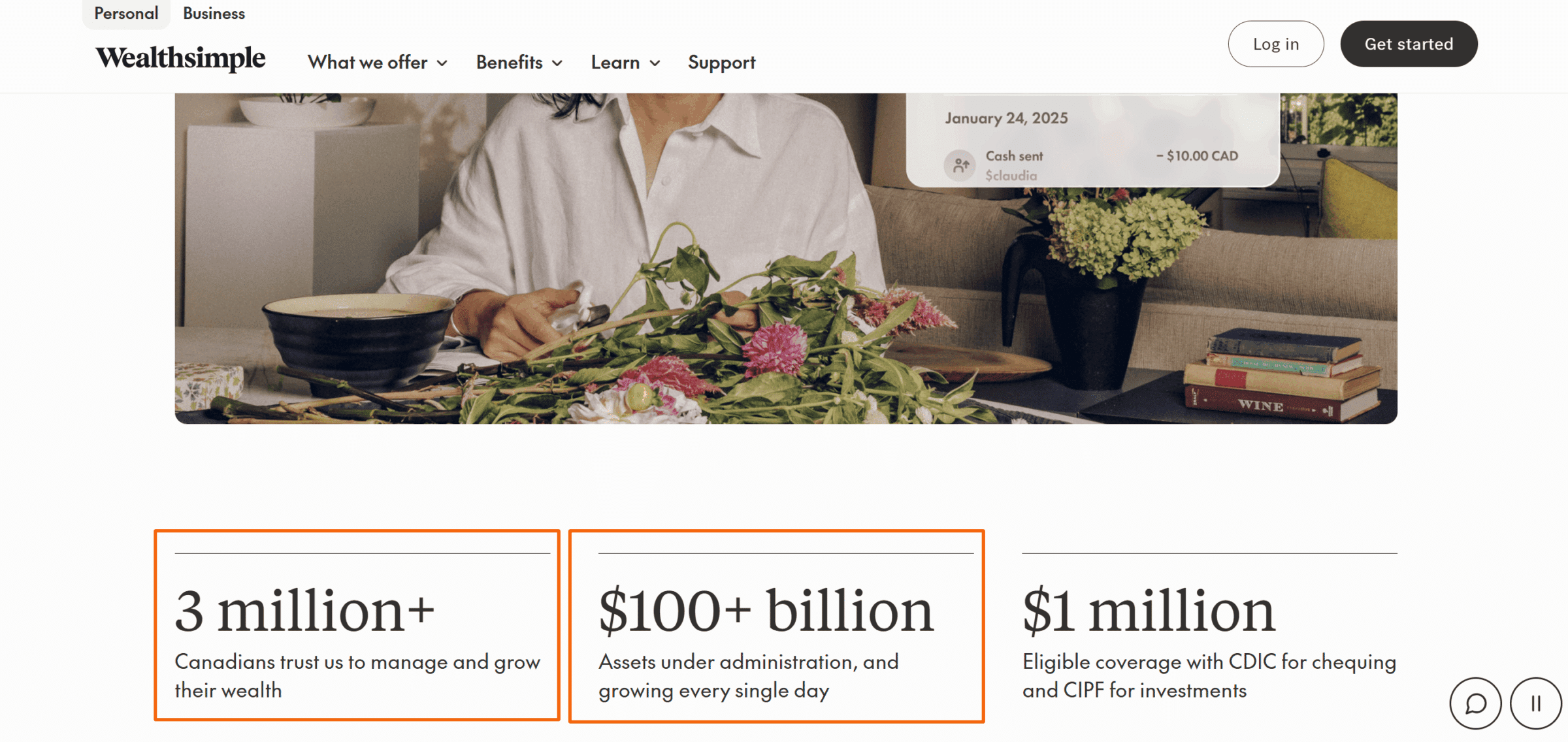
In December 2015, Wealthsimple had only 10,000 users. Between 2019 and 2022 the base grew from 150,000 to 2 million, and it has continued to compound since, adding roughly 200,000 net clients in the second quarter of 2026 alone.
The company only began publishing quarterly client figures in 2025. For earlier years, we have compiled the numbers from company statements, filings and interviews with its CEO:
Wealthsimple users by year
Figures from 2025 onward are quarterly client counts reported by the company and exclude tax filers. Earlier figures were disclosed on an ad hoc basis and are not always compiled on the same basis, so year-to-year comparisons before 2025 should be treated as indicative.
According to Wealthsimple’s CEO Michael Katchen, the client base spans ages 18 to 102, though the majority are young professionals in their 20s, 30s and 40s.
Wealthsimple AUM
A quick note on terminology. Wealthsimple now reports assets under administration (AUA) rather than assets under management (AUM). AUA is the broader measure: it captures everything held on the platform, including self-directed brokerage accounts, crypto and chequing balances, not only the money managed inside its robo-advisory portfolios. Earlier figures in the table below were reported as AUM, which is why the two labels appear side by side across the history.
The growth has been steep. Wealthsimple ended the second quarter of 2026 with CAD 155.6 billion in assets, up 24.7% on the previous quarter and 84.1% year over year, with net inflows of roughly CAD 17 billion in the quarter alone. It crossed CAD 100 billion in October 2025, three years ahead of a target it had originally set for December 2028.
Wealthsimple assets under administration
Wealthsimple valuation
Wealthsimple remains private and has not gone public, so its valuation is only formally set when it prices a funding round. There have been three such moments in recent years: CAD 1.4 billion in 2020, CAD 5 billion in May 2021, and CAD 10 billion in October 2025.
The most recent round was an equity offering of up to CAD 750 million, made up of a CAD 550 million primary offering and a secondary offering of up to CAD 200 million. It was co-led by Dragoneer Investment Group and GIC, with CPP Investments joining as a new investor alongside existing backers Power Corporation, IGM Financial, ICONIQ, Greylock and Meritech. That doubled the company’s valuation in roughly a year.
Wealthsimple valuation at each priced round
Between rounds, the closest thing to a live valuation signal is the fair value that Power Corporation and IGM Financial place on their combined holding each quarter. That mark was cut by more than half in 2022 during the technology sell-off, bottoming at CAD 0.9 billion, before being written back up quarter after quarter as the business scaled. It reached CAD 4.7 billion at 30 June 2026, a 15% increase in a single quarter.
This is a fair value estimate of a minority-controlled stake rather than a market price, so it moves on Power’s own assumptions about revenue and public market comparables. It is a useful directional indicator, not a quoted valuation.
Power group stake fair value
Wealthsimple revenues
Wealthsimple’s oldest revenue line is the management fee on its managed portfolios, tiered by household assets: 0.5% a year for Core clients, 0.4% for Premium clients from CAD 100,000, and 0.4% falling to 0.2% for Generation clients between CAD 500,000 and CAD 10 million. Self-directed accounts pay no management fee at all, which means revenue increasingly comes from elsewhere:
- Currency conversion: a 1.5% spread on CAD to USD conversions for self-directed accounts, tiered down for larger manual conversions and reduced inside managed portfolios.
- Crypto spreads: up to 2% per trade for Core clients, lower at higher tiers.
- Interest on cash: earned on client deposits held in chequing and savings balances, now the largest source of new account openings.
- Interchange: from debit card and credit card spending, with the credit card launched in June 2025.
- Margin and lending: margin interest priced off prime with better rates at higher tiers, plus the Portfolio Line of Credit and mortgages.
- Administrative charges: including a CAD 150 transfer-out fee per account and a CAD 10 monthly USD account fee for Core clients.
- Tax filing: a pay-what-you-want model through Wealthsimple Tax.
The last revenue figure the company disclosed was CAD 129 million for the second quarter of 2024, an 88% increase on the same period a year earlier, according to BNN Bloomberg. Wealthsimple also confirmed then that it had been profitable since the second quarter of 2023, and it described itself as a profitable and growing business again when announcing the October 2025 round.
Since then it has stopped publishing quarterly revenue, and neither Power Corporation nor IGM Financial breaks out a Wealthsimple earnings contribution: both carry the position at fair value, so the stake shows up in book value rather than in reported profits. Given that assets have roughly tripled since that CAD 129 million quarter, and that the mix has shifted towards higher-margin spending, lending and crypto products, revenue today is almost certainly a multiple of the last published figure. Any specific number would be an estimate.
Conclusion
Wealthsimple has established itself as a dominant player in Canadian financial services and ranks among the largest robo-advisors by AUM, with CAD 155.6 billion in assets under administration and 3.6 million clients as of June 2026. Its low-fee, accessible model now spans managed investing, self-directed trading, crypto, chequing, credit cards, mortgages, tax filing and prediction markets, and assets have grown 84% in a single year.
Sceptics once questioned whether a low-fee model could turn a profit at scale. Wealthsimple has answered that: it has been profitable since the second quarter of 2023 and reached a CAD 10 billion post-money valuation in October 2025, one of the highest for a private venture-backed Canadian technology company. The open question now is a different one. As chequing accounts overtake investment accounts in new openings, and as the company adds prediction markets and private assets to its shelf, Wealthsimple is competing less with other robo-advisors and more with the Big Six banks. That is a far larger market, and a far harder one.
Other FAQs
Is Wealthsimple safe? Is my money with Wealthsimple protected?
Wealthsimple Investments Inc. is regulated by the Canadian Investment Regulatory Organization (CIRO), the national self-regulatory body that replaced IIROC and the MFDA in 2023. Investment accounts are covered by the Canadian Investor Protection Fund (CIPF) for up to CAD 1 million per account category if the firm becomes insolvent. CIPF protects against the failure of the dealer, not against investment losses, and it does not cover crypto holdings. Cash held in the chequing account is separately insured by CDIC through the partner banks that hold the deposits.
Can I open an account with Wealthsimple if I'm not Canadian?
Wealthsimple is only available to clients residing in Canada, having sold its US book of business to Betterment in 2021. If you live elsewhere, you can check our “BrokerMatch” feature for platforms available in your country.
What is the minimum amount to open an account at Wealthsimple?
There is no minimum amount required to open an account at Wealthsimple. Self-directed trades start from CAD 1 through fractional shares, and managed portfolios have no minimum balance. The CAD 100,000 and CAD 500,000 thresholds only determine which pricing tier you fall into.
Is Wealthsimple profitable?
Yes. Wealthsimple disclosed in September 2024 that it had been profitable since the second quarter of 2023, and it described itself as profitable and growing when it announced its funding round in October 2025. It does not publish detailed financial statements, and its majority shareholders carry the stake at fair value rather than consolidating its earnings, so no current profit figure is public.
Is Wealthsimple going public?
There is no announced IPO. Wealthsimple raised up to CAD 750 million privately in October 2025 at a CAD 10 billion post-money valuation, which reduces the near-term pressure to list. Power Corporation of Canada and its affiliates hold roughly 52% of the company between them, so any listing would also be a decision for its controlling shareholders.