
Are you worried about how to buy your stake in Alphabet (Google) or Tesla with their famously high share prices?
This is where fractional shares come in, or partial shares as they are sometimes known. Once one online broker offered fractional shares, most of the industry followed suit.
This article delves into two questions: does Vanguard offer fractional shares? And what are the alternatives if you want fractional shares of individual stocks? Let’s get right into it.
What is fractional share trading?
It’s as it sounds. Instead of paying the total cost for a full share of, let’s say, any blue-chip stock, you first determine the amount you wish to pay. If that’s only $50 for now, no problem: you receive $50 worth of Amazon stock, not the full share.
Does Vanguard offer fractional shares?
Yes, but only for Vanguard’s own funds. Through its dollar-based investing feature, Vanguard Brokerage lets you buy Vanguard ETFs and mutual funds by dollar amount instead of by number of shares. The minimum is $1 for Vanguard ETFs, while mutual funds keep their own investment minimums (often $1,000 or more). Dollar-based orders in Vanguard ETFs are executed as market orders, and fractional holdings receive dividends in proportion to what you own.
What Vanguard still does not offer is fractional shares of individual stocks or of ETFs from other providers. If you want to buy Alphabet, Tesla or an iShares ETF at Vanguard, you still need to buy whole shares. Fractional positions in those securities can only appear in your account through Vanguard’s dividend reinvestment plan (DRIP), which uses the cash from dividends to buy more shares of the company you already own.
One more limitation to keep in mind: fractional shares generally cannot be transferred to another broker, so if you leave Vanguard the fractional part of each position is sold and moved as cash.
If your goal is to buy a slice of a high-priced stock, we’ve got you covered with a list of Vanguard alternatives below.
Best Vanguard alternatives for fractional shares
If your goal is to find an online broker offering the possibility of buying partial shares of individual stocks, here is the breakdown of our top four alternatives:
Interactive Brokers
Founded in 1978, Interactive Brokers is one of the most trusted brokers worldwide. You can invest as little as $1 in eligible US, Canadian and European stocks and ETFs, regardless of the share price, with fractional trading available on more than 10,500 US stocks and ETFs. Both market and limit orders are accepted.
💡 Interactive Brokers also offers IBKR GlobalTrader, a simplified mobile trading app for stocks, options and ETFs, ideal for novice investors.
eToro
A modern and easy-to-use broker available worldwide that offers commission-free ETF investing (a $1 or $2 commission per stock trade applies in most countries and other fees apply) and the possibility of belonging to a community of investors where you can follow and replicate what they are doing. You can buy fractional shares starting at $10.
eToro is a multi-asset platform which offers both investing in stocks and cryptoassets, as well as trading CFDs. CFDs are complex instruments and come with a high risk of losing money rapidly due to leverage. 61% of retail investor accounts lose money when trading CFDs with this provider. You should consider whether you understand how CFDs work, and whether you can afford to take the high risk of losing your money.
Webull
A leading Nasdaq-listed US broker that offers commission-free stocks, ETFs and options trading (for US-listed products). Fractional share trading is only available for eligible stocks and ETFs, only supports market orders during regular market hours and starts at $1.
Public.com
Public.com is a US broker that lets you invest in stocks, ETFs, options, bonds and crypto from one app, with no commissions on stock, ETF and options trades. Fractional share orders start at $5, or at $1 when placed through a recurring Investment Plan. Both market and limit orders are accepted, but not all securities are eligible for fractional orders.
1# Interactive Brokers

IB at a glance
Founded in 1978 and publicly listed on Nasdaq (ticker: IBKR), Interactive Brokers is a global online broker with more than 4 million client accounts. It has weathered several financial crises, showing resilience and a rigorous risk management process.
Interactive Brokers provides several different options for traders and investors to choose from. The platform is designed for individuals and institutions alike, boasting global access to stocks, options, futures, currencies, bonds and funds from more than 150 markets. Interactive Brokers makes them all accessible from one streamlined and centralised platform. Its technology ensures efficient trading speed and sophisticated portfolio analysis.
Of course, we would be remiss if we failed to mention that users can invest in fractional shares with Interactive Brokers. The company believes that investors should be able to buy the shares they want to diversify and build their portfolios regardless of price. The minimum investment for a fractional share is only $1 in eligible US, Canadian and European stocks and ETFs, and fractional trading is available on more than 10,500 US stocks and ETFs. European stocks and ETFs are eligible when they are listed on select exchanges and have an average daily volume above $5 million and a market cap above $5 billion, which means many smaller UCITS ETFs do not qualify. Unlike several competitors, Interactive Brokers accepts both market and limit orders for fractional shares, and fractional positions receive proportional dividends.
As an aside, Interactive Brokers also offers IBKR GlobalTrader, a mobile app geared toward newcomers to the investment industry that allows stock, options and ETF trading. This app offers automatic currency conversions, fractional shares and a demo version.
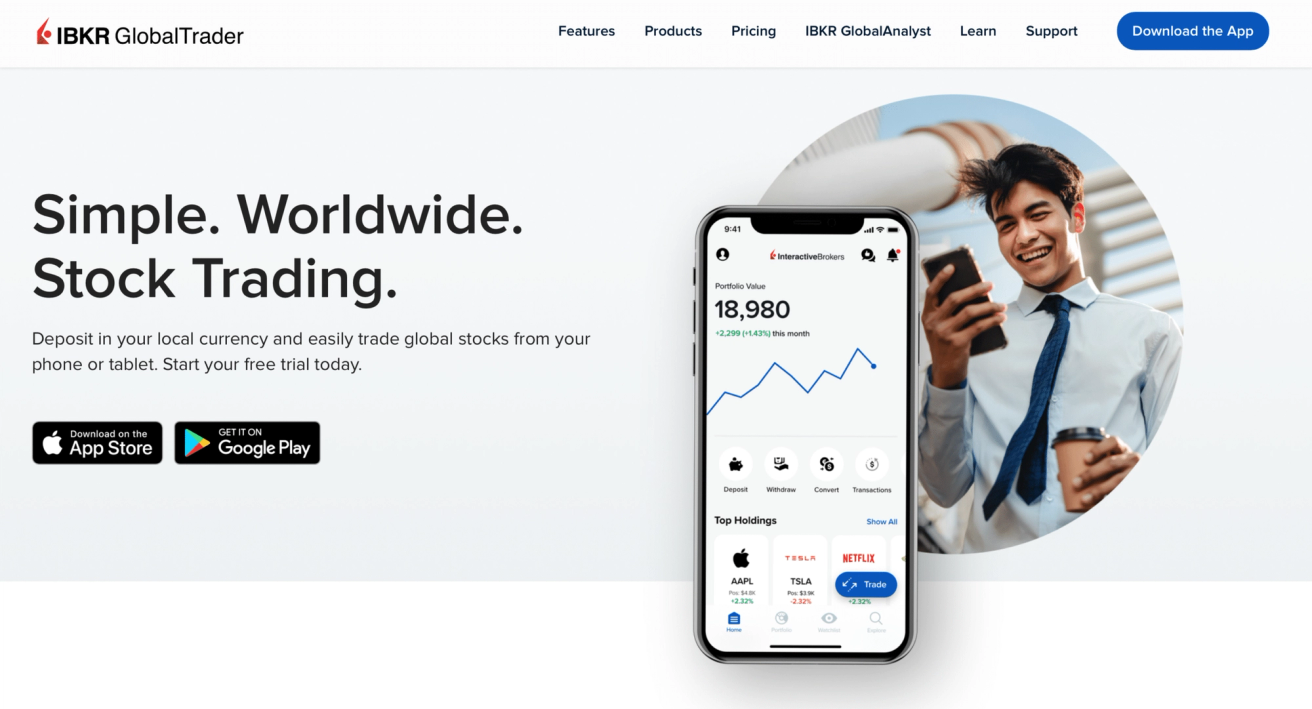
IBKR GlobalTrader
Although a global enterprise, the group is headquartered in Greenwich, Connecticut. Interactive Brokers LLC is regulated by the US SEC and the CFTC and is a member of FINRA and SIPC, so US client accounts are protected by SIPC up to $500,000 (including a $250,000 cash sublimit). Clients in the European Union are served by Interactive Brokers Ireland Limited, regulated by the Central Bank of Ireland and a member of the Irish Investor Compensation Scheme, while other affiliates are regulated by the FCA (UK), CIRO (Canada), ASIC (Australia), the SFC (Hong Kong) and the MAS (Singapore), among others.
Want to know more about Interactive Brokers? Check our Interactive Brokers review.
Interactive Brokers pros and cons
Pros
- Low commissions on US stock trading
- No monthly inactivity fee
- The broadest product and markets range in the brokerage industry
- Demo account
- Excellent reputation (founded in 1978)
- Extensive research and Education tools
- Has a modern mobile trading app to trade Stocks, Options and ETFs, ideal for novice investors, IBKR GlobalTrader.
- Offers interest on uninvested cash balances
Cons
- Complicated and lengthy account opening process (but fully online)
- Steeper learning curve for beginners
- Website is difficult to navigate
- Interactive Advisors (Robo-advisor feature) is only available for US customers
2# eToro

eToro at a glance
55% of retail CFD accounts lose money.
As the world’s leading “social investing” platform, eToro offers fractional share trading with a minimum of $10 per trade, on both stocks and ETFs. In addition, it provides a helpful resource explaining how fractional shares work on its platform. Yet further below, we’ve done the work for you of highlighting the key pros and cons of fractional shares.
To buy or sell fractional shares on eToro, follow the same steps you naturally would for whole shares. Instead of specifying the number of shares you wish to transact with, select the option for determining the exact currency amount to trade. ETFs are commission-free on eToro, while stock trades carry a flat $1 or $2 commission in most countries (depending on your country of residence and the exchange). Other fees apply.
Social investing refers to copying the trades of retail or professional investors. While the platform provides a broad learning database with instructional videos and a full-length blog, it prides itself on springboarding your practical learning.
eToro also provides a wide selection for CFD (“Contract for Difference”) trading. These enable you to gain exposure to an underlying asset’s movements without owning it. This is a risky strategy, with most traders losing money, so make sure you know the risks involved. Check out our detailed guide on CFDs vs real shares trading.
eToro remains a solid platform for the most popular asset classes alongside thorough investor education and social investing. The one-stop-shop approach works for new investors and veterans alike.
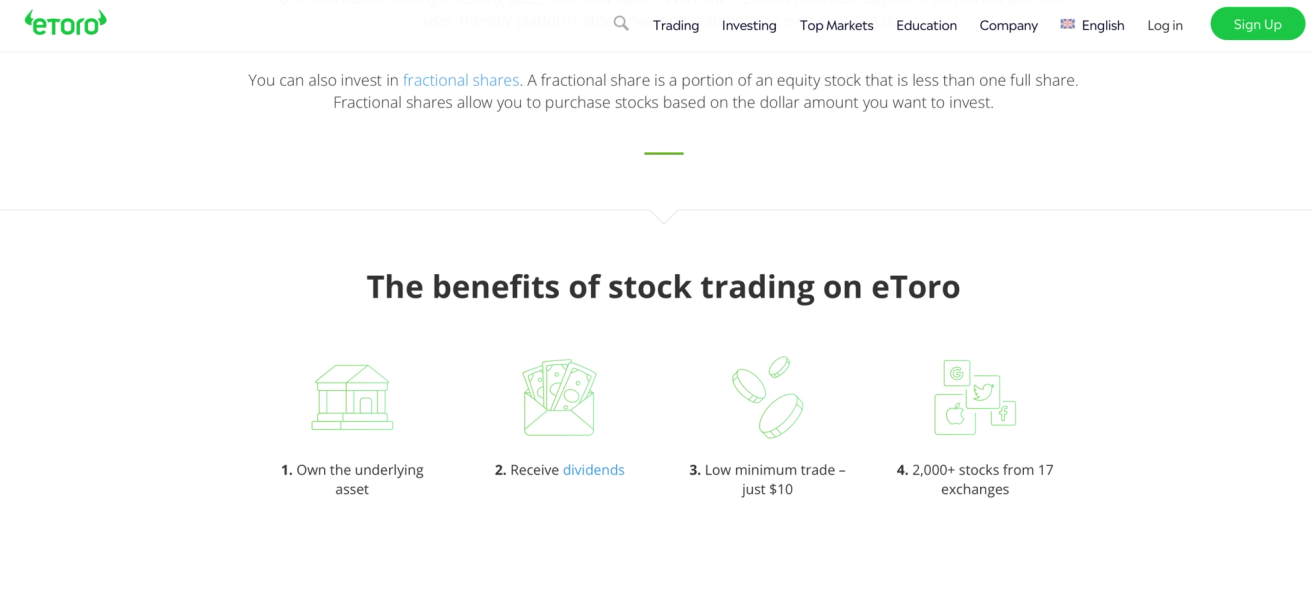
eToro
eToro Group has been publicly listed on Nasdaq since May 2025 (ticker: ETOR). In the US, securities trading is offered by eToro USA Securities Inc., a member of FINRA and SIPC. Its international entities are regulated by the FCA (UK), CySEC (EU), ASIC (Australia), the FSRA of the Abu Dhabi Global Market and the FSA Seychelles.
If you want to learn more, check our eToro review.
eToro is a multi-asset platform which offers both investing in stocks and cryptoassets, as well as trading CFDs. CFDs are complex instruments and come with a high risk of losing money rapidly due to leverage. 61% of retail investor accounts lose money when trading CFDs with this provider. You should consider whether you understand how CFDs work, and whether you can afford to take the high risk of losing your money.
eToro pros and cons
Pros
- Low stock trading fees (from $0 per trade)
- Commission-free ETFs (other fees apply)
- Social trading and other innovative products
- Wide variety of financial products
- Slick, modern, and easy for anyone to use
- European users have access to three account currencies: EUR, USD and GBP
- Top tier regulators
Cons
- Limited disclosed financial information
- Withdraw and inactivity fees
- Spread, overnight, inactivity, and currency conversion fees higher than average
- Doesn’t offer bonds, futures, or options
3# Webull

Webull at a glance
Webull provides high-tech financial solutions for traders and investors. Founded in 2016, it launched in the US in 2018 and has been publicly listed on Nasdaq since April 2025 (ticker: BULL).
Fractional share trading is only available for eligible stocks and ETFs: you will notice a fractional indicator on the detail page of each asset, showing whether a particular security is supported. Fractional orders only support market orders placed during regular market hours, you can invest from as little as $1 and the number of shares must be greater than 0.00001. You can check all this information in Webull’s guide for fractional shares.
Moreover, if you’re looking for a place to get up and running quickly with liquid investments, including margin accounts and options, Webull does its job well. American investors appreciate the inclusion of IRAs and Roth IRAs.
Webull has $0 commissions on US-listed stocks, ETFs and options (regulatory and exchange fees may apply, and some index options carry a per-contract fee). Its revenue streams come from stock lending, interest on free credit balances, margin interest and payment for order flow.
If you are looking for forex or non-US markets, Webull may not be the right investment platform, although it has broadened its range in recent years with futures, bonds, money market funds and crypto trading. It supports several features such as extended hours trading (pre-market, after-hours and overnight sessions for select securities), a desktop version for more advanced customisation (plus mobile and web versions) and customer support 24/7.
Webull Financial LLC is registered with and regulated by the US SEC and FINRA, and is a member of SIPC. Futures are offered by Webull Futures LLC, registered with the CFTC and a member of the NFA.
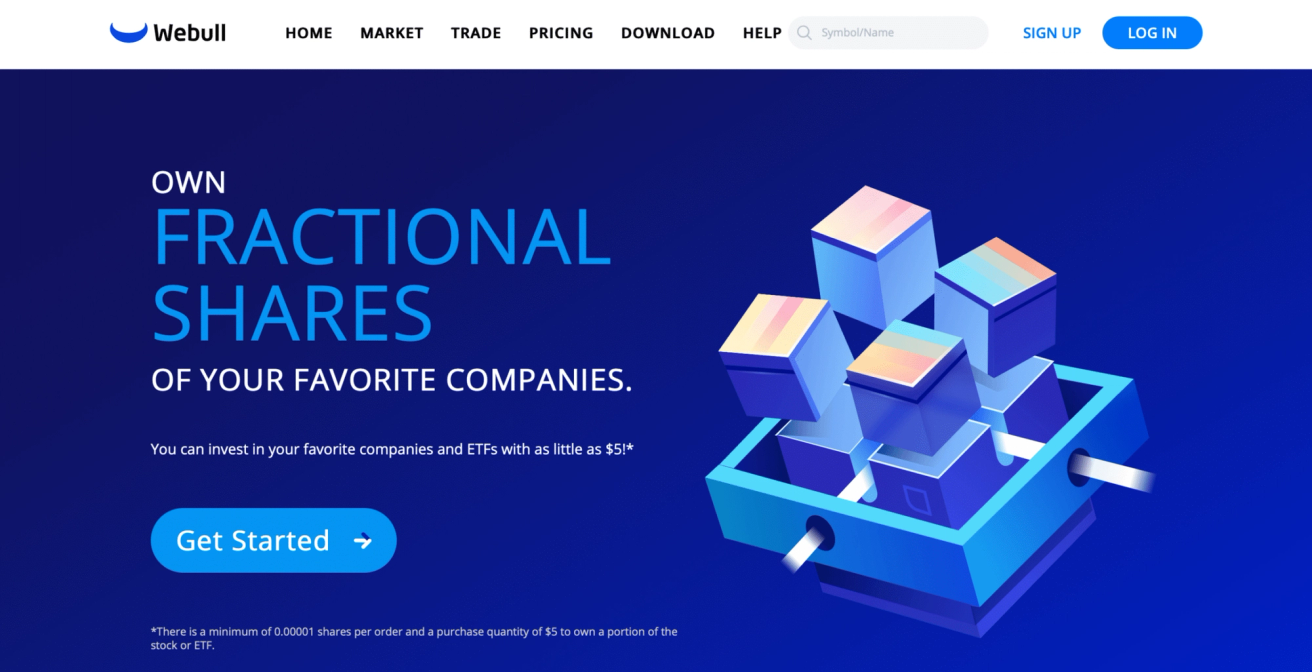
Webull
Webull pros and cons
Pros
- No minimum deposit required
- Commission-free trading on stocks, ETFs, and options
- No account opening, inactivity, or currency exchange fees
- User-friendly mobile and desktop app
- High interest on uninvested cash - up to 3.6% APY with Webull Premium, or 3.25% APY for non-Premium accounts (April 2026)
- Straightforward account opening process
- Fractional shares
- OTC shares
- Demo account available
Cons
- Limited market coverage
- High withdrawal fees for wire transfers
- High deposit fees for wire transfers
- Live chat support open to limited clients
- No mutual funds
4# Public.com

Public at a glance
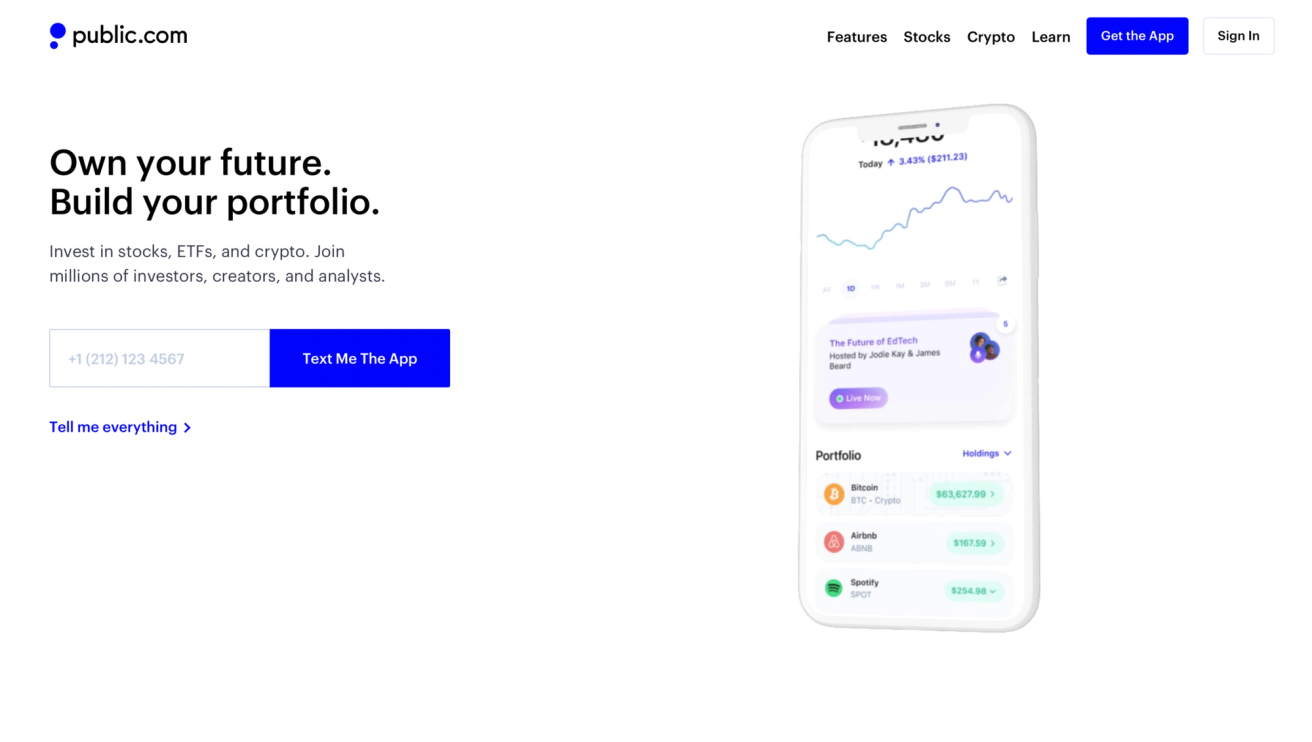
Founded in 2019, Public.com gives users the ability to invest in stocks, ETFs, options, bonds, Treasuries and crypto from a single app, with no commissions on stock, ETF and options trades. The platform also offers a variety of educational tools and AI-powered research features for those who are new to, or open to exploring more about, the stock market and investing.
The platform offers fractional shares with a minimum order of $5, or $1 for purchases made as part of a recurring Investment Plan. Both market and limit orders are accepted for fractional shares, although some order types and trading sessions may not be available, and not all securities are eligible for fractional share orders. For more details, please consult the Public.com fractional shares disclosure.
Public.com does not accept payment for order flow (PFOF) on stock and ETF orders, which it routes directly to exchanges and other venues instead of selling them to market makers. On options, it does receive PFOF, but shares part of that revenue with clients through a rebate of $0.06 to $0.18 per contract.
Finally, Public.com enables fractional share investing for users, so they can invest in the companies they want while still minding their budget and risk tolerance.
Public.com
Brokerage services for US-listed securities, options and bonds are offered by Open to the Public Investing, Inc., a member of FINRA and SIPC. Crypto trading is offered through a separate partner and is not covered by SIPC.
Public.com pros and cons
Pros
- Stock and ETF trades are commission-free
- Offers crypto and alternative assets (fine art, collectibles, etc)
- Investment community (social feed)
- Supports fractional shares
- High fees transparency
- No minimum deposit
Cons
- No mutual funds or futures
- No international or custodial accounts
- No robo-advisor
Why trade fractional shares?
There are key advantages and disadvantages to fractional shares, yet ultimately we feel the benefits are much more significant. We’ll break them both down here.
The advantages of fractional shares
First, a great question investors tend to ask is if fractional shares provide fractional dividends. Yes. The essence of the share remains the same, whether 1.00 of a share or 0.01. You do not forfeit your right to a dividend, which is paid in proportion to the fraction you own.
Additional benefits include:
- Investing with small amounts: with some brokers, for as little as $1.
- Being able to invest in companies with high stock prices.
- Perfecting your stock diversification strategy by using dollar amounts instead of share amounts, which also makes dollar-cost averaging easier.
On this note, it feels difficult to say that there are negatives to fractional shares. Previously out-of-reach investments remained so until a stock split (1 into five shares, for example) occurred. Now, this is no longer the case. Yet there are some disadvantages you should consider.
The disadvantages of fractional shares
These mostly have to do with the technical and less noticed aspects of shares, such as:
- Limited voting rights. Some brokers (such as Public.com and Webull) aggregate the proxy votes of their clients’ fractional holdings, but others do not, and the issuer may not fully count aggregated votes.
- Being nontransferable. Fractional shares generally cannot be moved to another broker: if you transfer your portfolio, whole shares are transferred in kind and the fractional part of each position is sold and sent as cash.
- Order restrictions. Some brokers only accept market orders for fractional shares, only during regular trading hours, and only for a limited list of eligible securities.
- Over-diversification. Diversification refers to dividing your portfolio’s risk, so when one investment’s value drops, the other is less affected (or even increases). Over-diversification reduces risk even further (in theory) but siphons off too much of your projected return.
Wrapping up
In our view, new and veteran investors alike should feel excited at the rapid growth of fractional shares. They open new investments and asset classes to retail investors (that’s you!) without many real downsides.
The critical thinking required has to do with the online brokerage itself. Vanguard now lets you buy its own ETFs and mutual funds by dollar amount from $1, which is enough for a simple index-fund portfolio. If you want fractional shares of individual stocks or ETFs from other providers, though, Vanguard still falls short, and the brokers above offer far more complete fractional share trading.
With investing, always give yourself priority. Fractional share capability is now commonplace for American, European and other international investors, so there is no need to settle for a broker that limits it.
Did we answer all your questions on Vanguard fractional shares? If not, please let us know your feedback below!