Revolut is a financial technology company from the United Kingdom, founded in 2015, that provides banking services. In 2019, it released a feature within its app called Revolut Trading, where you can trade financial instruments such as stocks, cryptocurrencies, and commodities.
One popular financial instrument among investors who want to diversify their investments is the ETF (exchange-traded fund). We can define it as a security that tracks a specific asset or a group of assets. It is traded on stock exchanges, similar to stocks, and represents a group of securities or commodities that often share similarities.
In this article, you will find out if you can trade ETFs in Revolut, what it costs, and alternative platforms to trade these instruments.
Can you trade ETFs on Revolut?
Yes. ETFs are available to Revolut customers in the EEA, the UK and the US, though the range and the entity behind your account differ depending on where you live:
- Revolut Securities Europe UAB serves clients in the European Economic Area and is supervised by the Bank of Lithuania, with investor compensation of up to €22,000;
- Revolut Trading Ltd serves UK clients and is authorised by the Financial Conduct Authority for shares and ETFs. UK clients can also hold their investments inside a Revolut Stocks and Shares ISA;
- Revolut Securities Inc. serves US clients and is regulated by the SEC and FINRA, with SIPC cover.
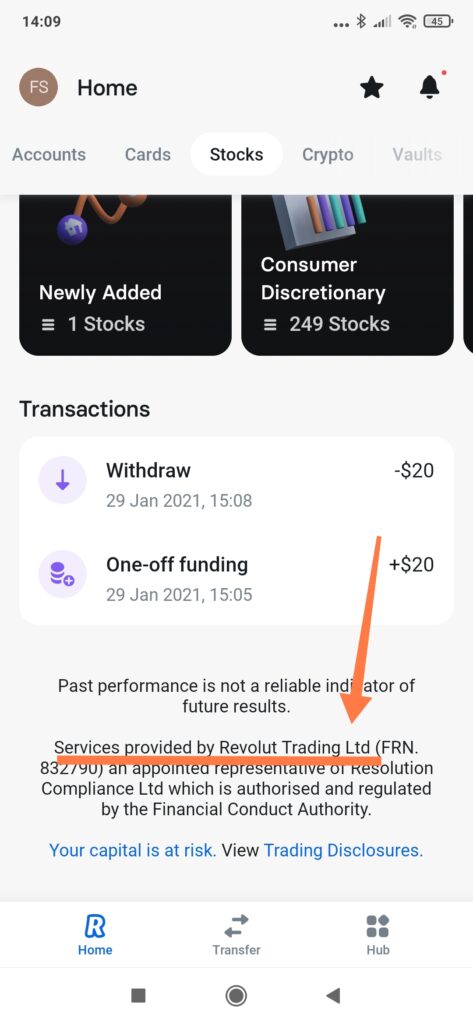
The ETF range is not identical across these entities, and it keeps changing as Revolut adds funds. You can see which entity you signed up with by opening the app, selecting “Stocks” and scrolling to the bottom of the screen:
The exact list of funds available to you is set out in Revolut’s own help pages for your country, and it is worth checking there rather than relying on any third-party list, including ours. The themes on offer range from broad world indices such as the S&P 500, the Nasdaq, the DAX and the FTSE, through to narrower sector funds.
Revolut has also added recurring investment plans for eligible ETFs, so you can set up an automatic monthly purchase rather than buying manually each time.
Investing in the S&P 500 in Revolut
Finding the ETFs can be challenging.
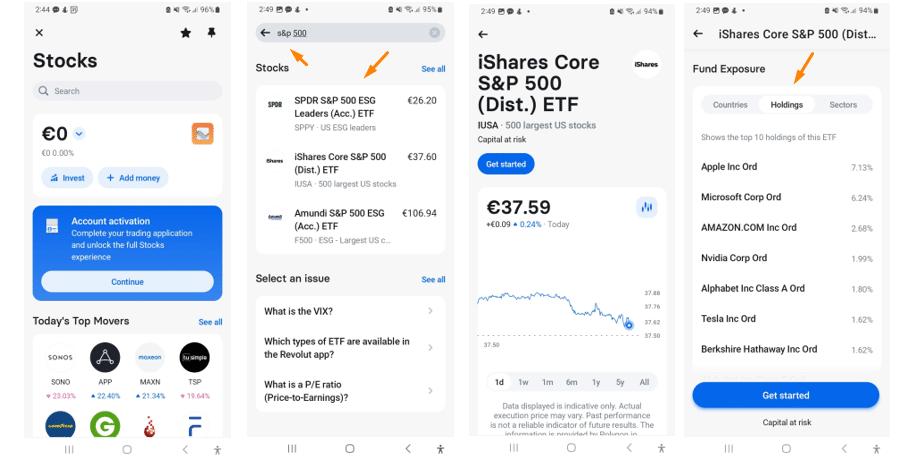
To find any ETF, you need to select the “Stocks” tab and search for the index or the ETF you are looking for. There is no separate ETF section in the search, which is why many users assume the funds are not there.
We searched for “S&P 500” to find ETFs replicating this major US index:
ETF trading fees
Revolut’s trading costs are tied to your subscription plan. Each plan includes a monthly allowance of commission-free ETF orders:
- Standard plan: 1 free trade per month;
- Plus plan: 3 free trades per month;
- Premium plan: 5 free trades per month;
- Metal plan: 10 free trades per month;
- Ultra plan: 10 free trades per month.
Once you use up the allowance, a 0.25% commission per trade applies, with a minimum of €1. On the Ultra plan that rate drops to 0.12%.
There is also a Trading Pro add-on, which lowers the commission to 0.12% with no minimum fee and unlocks a web trading terminal. It is included for Ultra subscribers and is not available on the Standard plan. Pricing for the add-on varies, so check the figure shown in your app.
Two things people forget when comparing this with a conventional broker:
- The commission sits on top of the fund’s own ongoing charge (TER), which you pay in every case, at any broker;
- Some countries apply a financial transaction tax on certain trades, such as France, Spain and Italy. That is a government charge, not a Revolut fee, but it still comes out of your money.
Fees and plan names differ by country of residence, so confirm the current numbers in the app or on Revolut’s local help page before you commit. For a deeper look, see our Revolut Trading review.
Best Revolut alternatives for trading ETFs
Revolut works well if you already bank there and want to buy the occasional fund. If ETFs are the main thing you plan to do, a dedicated broker will usually give you a wider choice of funds and a lower running cost. We focused on low-cost brokers available in most European countries. Here are our suggestions:
eToro
With over 40 million users, eToro is the leading social investing platform (copy and follow other traders and investors). It offers commission-free ETF trading (other fees apply).
Disclaimer: Your capital is at risk. Other fees apply. For more information, visit etoro.com/trading/fees.
Interactive Brokers
Founded in 1978, IBKR is one of the world’s most trustworthy brokers. It offers an enormous range of financial products (stocks, ETFs, options and more), and low currency conversion fees (FX fees).
💡 Interactive Brokers also launched IBKR GlobalTrader, a modern mobile trading app to trade stocks, options and ETFs, ideal for novice investors.
XTB
Broker that offers commission-free stocks and ETFs in many countries and regions (Czech Republic, France, Germany, Italy, Poland, Portugal, Romania, Slovakia, Spain, South America, UAE and UK). It also allows you to invest in stocks, CFDs, cryptocurrencies and forex with low fees.
Disclaimer: 76-83% of retail CFD accounts lose money.
DEGIRO
One of the leading online brokers in Europe due to its low-cost structure. It offers low-cost ETF trading (external fees apply) and a wide product portfolio.
Disclaimer: Investing involves risk of loss.
Top-tier regulators supervise all the companies mentioned here, such as the UK’s Financial Conduct Authority (FCA) and the Cyprus Securities and Exchange Commission (CySEC).
eToro at a glance

52% of retail CFD accounts lose money.
Founded in 2007, eToro is an international online broker with over 40 million users, listed on the Nasdaq since May 2025, where you can trade thousands of financial assets, including stocks, ETFs, cryptocurrencies, and CFDs on stocks, ETFs, commodities, forex, indices and cryptocurrencies. ETFs are traded commission-free, whole or fractional (other fees apply), while real stocks carry a $1 commission in most major regions.
eToro’s investment platform, accessible through both web and mobile, is a social trading hub. Investors can discuss investments and market news with fellow investors, replicate trading strategies (CopyTrader) and invest in ready-made portfolios (Smart Portfolios) built around themes.
The demo account is particularly useful for a beginner, with $100,000 of virtual money. It lets you get hands-on experience as if you were using real money, so when you switch to a real account, nothing about the mechanics surprises you. On the downside, withdrawals from a USD account carry a $5 fee with a $30 minimum, and currency conversion is a meaningful cost for euro-based investors.
eToro is fully regulated and supervised by top-tier regulators such as the UK’s Financial Conduct Authority (FCA) and the Australian Securities and Investments Commission (ASIC). The European subsidiary is authorised and regulated by the Cyprus Securities and Exchange Commission (CySEC).
For more details, visit our eToro review and check eToro’s website directly.
Interactive Brokers at a glance

Founded in 1978 and publicly listed on the Nasdaq (ticker: IBKR), Interactive Brokers is a global online broker that surpassed major financial crises, showing resilience and a rigorous risk management process.
Interactive Brokers offers an advanced investment platform that includes a wide range of products (stocks, options, mutual funds, ETFs, futures, bonds, and currencies) from 150 markets, solid trade execution (IB SmartRouting), and a set of technical and fundamental tools to help you in your investment decisions. For ETF investors specifically, the appeal is the breadth of European exchanges you can reach from a single account, plus currency conversion at a fraction of what most apps charge.
On the downside, Interactive Brokers’ fee structure is quite complex, the registration process is lengthy but fully online, and the broker doesn’t offer commission-free trading. However, when considering FX fees, narrower spreads, and the stock loan program, Interactive Brokers’ clients still get significant savings compared to most brokers.
Interactive Brokers also launched IBKR GlobalTrader, a modern mobile trading app to trade stocks, options and ETFs, ideal for beginner investors. Some of the features of IBKR GlobalTrader include automatic currency conversions, fractional shares, a demo account, and more.
Want to know more about Interactive Brokers? Check our Interactive Brokers review and visit IBKR’s website directly.
XTB at a glance

69-80% of retail CFD accounts lose money.
Founded in 2002, XTB is a major player in the brokerage industry with extensive worldwide experience, regulated by the Financial Conduct Authority (FCA) plus other relevant regulatory bodies, and listed on the Warsaw Stock Exchange.
You can invest through xStation 5 and xStation Mobile in different investment products, such as stocks, ETFs, and CFDs on stocks, forex, indices, commodities, and cryptocurrencies (this product offering may vary slightly from country to country). It offers 0% commission on stocks and ETFs, but only in some countries*.
Opening an account and transferring money is a quick and hassle-free process. For beginners, it presents a demo account where you can trade as if it were real money, and you get access to educational tools. For intermediate and advanced investors, you will find plenty of technical and fundamental tools to help you better assess your investment decisions.
On the downside, you will face an inactivity fee of €10 a month if you have not traded for a year and have not deposited in the last 90 days. It charges high commissions on cryptocurrency CFDs, though costs for forex are low. XTB is not available in the United States and Australia.
Want to know more about XTB? Check our XTB review and visit XTB’s website directly.
*The Czech Republic, France, Germany, Italy, Poland, Portugal, Romania, Slovakia, Spain, South America (all countries), UAE and the UK.
DEGIRO at a glance

Investing involves risk of loss.
Founded in 2013, DEGIRO is a low-cost brokerage firm that has become very popular due to its low rates. With over 3 million users, the platform is widely known for its do-it-yourself philosophy, in the sense that you have everything at your disposal to start investing on your own. It offers a wide range of financial assets to trade, including stocks, ETFs, bonds, options, futures contracts, warrants, investment funds, and some leveraged products (not quite the same as CFDs, more info here).
For instance, you can trade ETFs at low cost, with a €1.00 flat handling fee plus external costs. The web trading platform is basic, but it is efficient and straightforward to use. In a matter of minutes, you get used to it. The same applies to its mobile app. On the downside, there is an absence of any significant fundamental research, a €2.50 annual connectivity fee applies per exchange, a €1.00 commission applies on US stocks, and pricing alerts are missing.
Regarding security, DEGIRO is the Dutch branch of flatexDEGIRO Bank AG (a German-regulated bank). In the unlikely event that the segregated assets cannot be returned to clients, DEGIRO falls under the German Investor Compensation Scheme, which compensates any losses from non-returned assets up to 90%, with a maximum of €20,000, so do bear this in mind if you are planning to invest much larger volumes. Furthermore, any money deposited in a DEGIRO Cash Account with flatexDEGIRO Bank AG is guaranteed up to €100,000 under the German Deposit Guarantee Scheme.
Still have doubts? Go through our DEGIRO review and visit DEGIRO’s website directly.
What to look for in an online broker to trade ETFs?
Now that you have a few alternatives for trading ETFs, here are the factors worth weighing when choosing where to invest:
- Currency conversion fees: if the ETF trades in a currency other than your account currency, the broker will convert it, and the markup applied varies enormously between platforms. On a portfolio you keep adding to for years, this often costs more than the commission;
- Commissions: check both the percentage and the minimum per order. A €1 minimum is irrelevant on a €5,000 purchase and expensive on a €50 one, which matters if you invest small amounts monthly;
- Range of ETFs offered: app-based platforms tend to offer a curated shortlist, while conventional brokers give you access to whole exchanges. If you already know which fund you want, check it is actually available before opening the account;
- ETF screener: a handy tool to compare and filter funds by index, cost, size and replication method, narrowing the field to what fits your strategy;
- Recurring investment plans: if you intend to buy every month, an automated plan saves you both the discipline problem and, at some brokers, the commission.
Bottom line
ETFs are popular instruments traded on exchanges like stocks. Compared with holding a single company, a fund spreads your money across many holdings at once, which is why they suit investors who want broad exposure without picking individual names. They still carry market risk, and their value can fall.
You can trade ETFs on Revolut, in the EEA, the UK and the US alike. Whether you should depends on how you plan to use it: for an occasional purchase alongside your banking, the convenience is real. For a portfolio you will build monthly over years, look closely at the choice of funds, the per-order minimum and the currency conversion cost, then compare that with a dedicated broker.
Set your objectives first, then pick the platform that fits them.
Note that this article is for informational purposes only and should not be considered financial advice. We hope this helps with your choice, and we wish you the best of luck with your investments.