
Want to buy a stake in companies with high share prices, such as Berkshire Hathaway, or invest small, regular amounts without committing thousands at a time?
This is where fractional shares (sometimes called partial shares) come in: the ability to buy less than one full share of a stock. Once a niche offering, fractional shares have become mainstream across most major online brokers since around 2019 and 2020, as brokers competed to lower barriers to entry for retail investors.
This article tackles two questions:
- Does Moomoo offer fractional shares?
- If not, or if its fractional offering is limited where you live, what are the best alternatives for fractional share trading in 2026?
What is fractional share trading?
It’s exactly what it sounds like: instead of paying the full price for a complete share of a stock, you decide on a dollar (or euro) amount you want to invest, and you receive that proportional fraction of a share.
For example, if a share costs $250 and you invest $50, you receive 0.2 of a share. You still benefit proportionally from price changes and, in most cases, dividends. This makes fractional shares particularly useful for:
- High-priced stocks: companies like Berkshire Hathaway Class A, whose shares cost hundreds of thousands of dollars, or Booking Holdings and NVR, which cost thousands of dollars each, become accessible to small investors.
- Dollar-cost averaging: investing a fixed amount monthly (e.g., $100) into a diversified basket without needing to round up to whole shares.
- Diversification on small budgets: spreading €500 across 10 different stocks (€50 each) rather than being forced to concentrate in just one or two.
- Recurring investment automation: many brokers offer recurring investment plans that rely on fractional shares to invest the exact amount you choose.
Does Moomoo offer fractional shares?
Yes, in most of the countries where it operates, but only on US stocks and ETFs. Moomoo is available in the US, Canada, Singapore, Australia, Japan, Malaysia and New Zealand, and does not serve clients in the UK or the EU (moomoo).
- Moomoo Singapore: fractional orders on eligible US stocks and ETFs, from US$5 and as little as 0.0001 shares, with market or limit day orders (moomoo SG help centre).
- Moomoo Australia and Malaysia: fractional shares on selected US stocks and ETFs from US$5 (moomoo AU).
- Moomoo US: fractional shares on eligible US stocks and ETFs.
- Other countries: availability varies by entity, so check the Fractional Shares section in the app.
If you live in Europe, or want fractional shares on European, Canadian or other non-US markets, you need one of the alternatives below.
Best Moomoo alternatives for fractional shares
If you want a strong online broker with fractional shares and broader market coverage than Moomoo, here are the four standout alternatives for 2026:
Interactive Brokers
Founded in 1978, IBKR is one of the most trusted brokers worldwide. You can invest as little as $1 in eligible US, Canadian and European stocks and ETFs, regardless of the share price.
💡 Interactive Brokers also launched IBKR GlobalTrader, a mobile app for stocks, options and ETFs designed for newer investors.
eToro
An easy-to-use multi-asset platform with $0 commission on ETFs (other fees apply) and a community of investors you can follow and copy. You can buy fractions of stocks and ETFs by entering the amount you want to invest.
Webull
A US-based broker with $0 commission on US-listed stocks and ETFs. In the US, you can invest in eligible stocks and ETFs from $1 with fractional shares.
Public.com
A US broker for stocks, ETFs, options, bonds, Treasuries and crypto. Fractional shares are available on eligible US stocks and ETFs, for US residents only.
1# Interactive Brokers

IB at a glance
Founded in 1978 and publicly listed on NASDAQ (ticker: IBKR), Interactive Brokers is one of the largest global online brokers, with more than 5.5 million client accounts, and has been part of the S&P 500 index since August 2025.
Interactive Brokers offers a comprehensive set of platforms (Trader Workstation, IBKR Desktop, Client Portal, IBKR Mobile, GlobalTrader) designed for both retail investors and institutions, with global access to stocks, ETFs, options, futures, forex, bonds, mutual funds, and commodities across 170 markets in 40 countries. All these markets are accessible from a single account, with Smart Routing ensuring competitive execution prices across exchanges.
On the fractional shares front, IBKR lets you invest as little as $1 in eligible US, Canadian and European stocks and ETFs, with both market and limit orders (IBKR fractional trading). IBKR may close fractional positions in stocks that stop being eligible.
For European investors, fractional shares on European exchanges are a real advantage, since many brokers limit fractional trading to US-listed instruments.
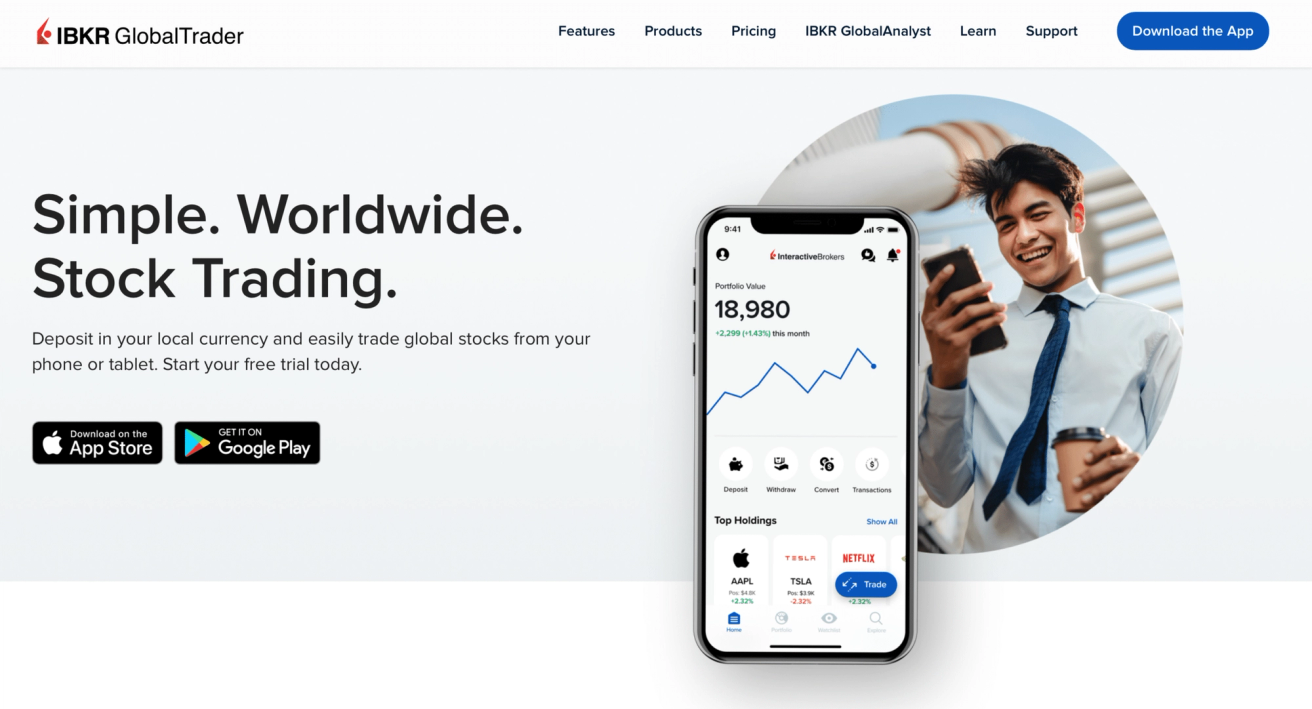
Interactive Brokers also offers IBKR GlobalTrader, a mobile app designed for newer investors looking for simple, accessible global trading. GlobalTrader offers automatic currency conversion, fractional shares and a simpler interface than IBKR’s main platforms.
IBKR GlobalTrader
Interactive Brokers is headquartered in Greenwich, Connecticut, and operates as a publicly listed global financial services company. It is regulated by authorities including the SEC, FINRA and CFTC (US), FCA (UK), Central Bank of Ireland (CBI), ASIC (Australia), SFC (Hong Kong), MAS (Singapore), SEBI (India), MNB (Hungary) and CIRO (Canada). As a listed company, it also publishes audited accounts.
Want to know more about Interactive Brokers? Check our Interactive Brokers review.
Pros
- Low commissions on US stock trading
- No monthly inactivity fee
- The broadest product and markets range in the brokerage industry
- Demo account
- Excellent reputation (founded in 1978)
- Extensive research and Education tools
- Has a modern mobile trading app to trade Stocks, Options and ETFs, ideal for novice investors, IBKR GlobalTrader.
- Offers interest on uninvested cash balances
Cons
- Complicated and lengthy account opening process (but fully online)
- Steeper learning curve for beginners
- Website is difficult to navigate
- Interactive Advisors (Robo-advisor feature) is only available for US customers
2# eToro

eToro at a glance
55% of retail CFD accounts lose money.
A leading social investing platform with more than 4 million funded accounts, eToro offers fractional shares on non-leveraged buy positions. eToro has been listed on NASDAQ (ticker: ETOR) since May 2025.
eToro is a multi-asset investment platform. The value of your investments may go up or down. Your capital is at risk.
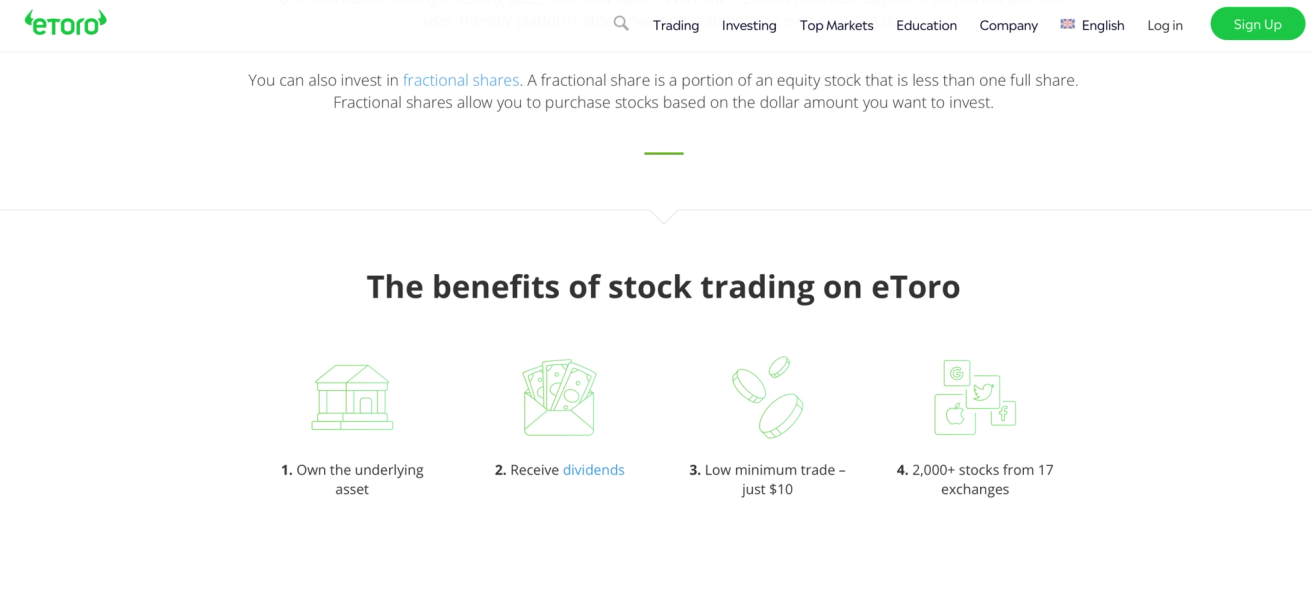
To buy or sell fractional shares on eToro, the process is exactly the same as for whole shares: instead of specifying the number of shares, you specify the dollar/euro amount you want to invest, and eToro allocates the corresponding fractional position. For example, eToro says you can invest $50 to buy part of a share priced at $1,000. Fractional buying applies only to non-leveraged positions, where you own the underlying asset.
eToro’s social investing (CopyTrader) feature lets you automatically copy the trades of other investors on the platform, ranked by past return on investment (ROI), risk score and other factors. Combined with eToro’s Smart Portfolios (thematic baskets of stocks and ETFs), this creates a hands-off approach that relies on fractional positions.
eToro also offers CFD (Contract for Difference) trading, allowing leveraged exposure to underlying asset movements without owning the asset. CFDs are complex instruments and come with a high risk of losing money rapidly due to leverage. Check our detailed guide on CFDs vs real shares trading if you’re considering this route.
European investors can hold a EUR account, which avoids conversion fees on euro deposits, and withdrawals from it are free (a $5 fee applies to withdrawals from a USD account). Stock trades cost $1 or $2 depending on the exchange, and ETFs have $0 commission. Spreads on some products can be wider than at specialist brokers.
eToro
eToro is regulated by CySEC in the EU, the FCA in the UK, ASIC in Australia and the FSRA in Abu Dhabi, and its US broker-dealer is a member of FINRA and SIPC.
If you want to learn more, check our eToro review.
Pros
- Low stock trading fees (from $0 per trade)
- Commission-free ETFs (other fees apply)
- Social trading and other innovative products
- Wide variety of financial products
- Slick, modern, and easy for anyone to use
- European users have access to three account currencies: EUR, USD and GBP
- Top tier regulators
Cons
- Limited disclosed financial information
- Withdraw and inactivity fees
- Spread, overnight, inactivity, and currency conversion fees higher than average
- Doesn’t offer bonds, futures, or options
3# Webull

Webull at a glance
Webull provides modern, mobile-first financial trading solutions for retail investors. Founded in 2017, it operates in the US, UK, Singapore, Australia, Japan and several other markets, and has been listed on NASDAQ (ticker: BULL) since April 2025.
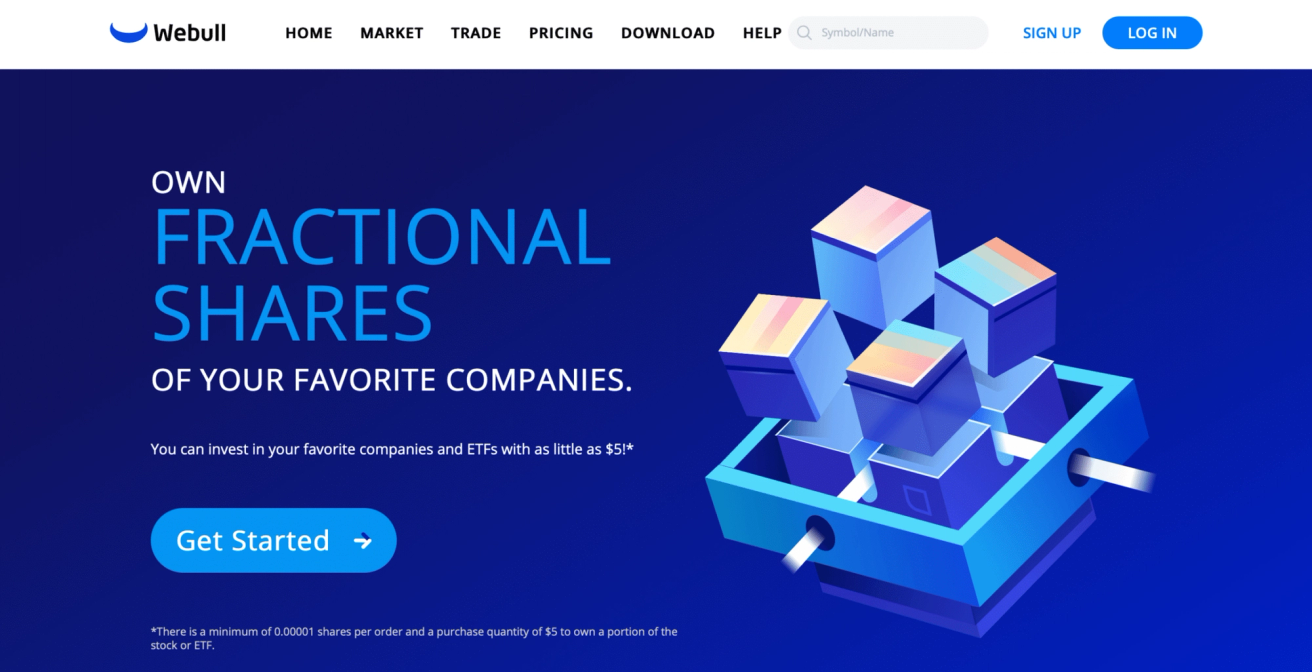
In the US, Webull lets you invest in eligible stocks and ETFs from $1 with fractional shares (Webull). Not every stock or ETF is eligible, so check the asset’s page in the app before you place an order.
If you’re looking for a platform to get up and running quickly with liquid US investments, including margin accounts and options, Webull does its job well. US investors can also open traditional and Roth IRAs, and UK investors can open a Stocks & Shares ISA.
Webull charges $0 commission on US-listed stocks and ETFs. It earns money from sources such as margin interest, securities lending, interest on cash balances and, in the US, payment for order flow.
Webull
If you are looking for forex, bonds or mutual funds, Webull is not the right platform: its range focuses on stocks, ETFs, options and, in some markets, crypto. It offers extended-hours trading (pre-market, after-hours and overnight sessions on select stocks and ETFs) and desktop, web and mobile platforms with strong charting tools.
Webull is regulated by the SEC and FINRA (US), FCA (UK), MAS (Singapore) and ASIC (Australia). US clients are covered by SIPC up to $500,000 (including $250,000 for cash), and UK clients by the FSCS up to £85,000 for investments.
Pros
- No minimum deposit required
- Commission-free trading on stocks, ETFs, and options
- No account opening, inactivity, or currency exchange fees
- User-friendly mobile and desktop app
- High interest on uninvested cash - up to 3.6% APY with Webull Premium, or 3.25% APY for non-Premium accounts (April 2026)
- Straightforward account opening process
- Fractional shares
- OTC shares
- Demo account available
Cons
- Limited market coverage
- High withdrawal fees for wire transfers
- High deposit fees for wire transfers
- Live chat support open to limited clients
- No mutual funds
4# Public.com

Public at a glance
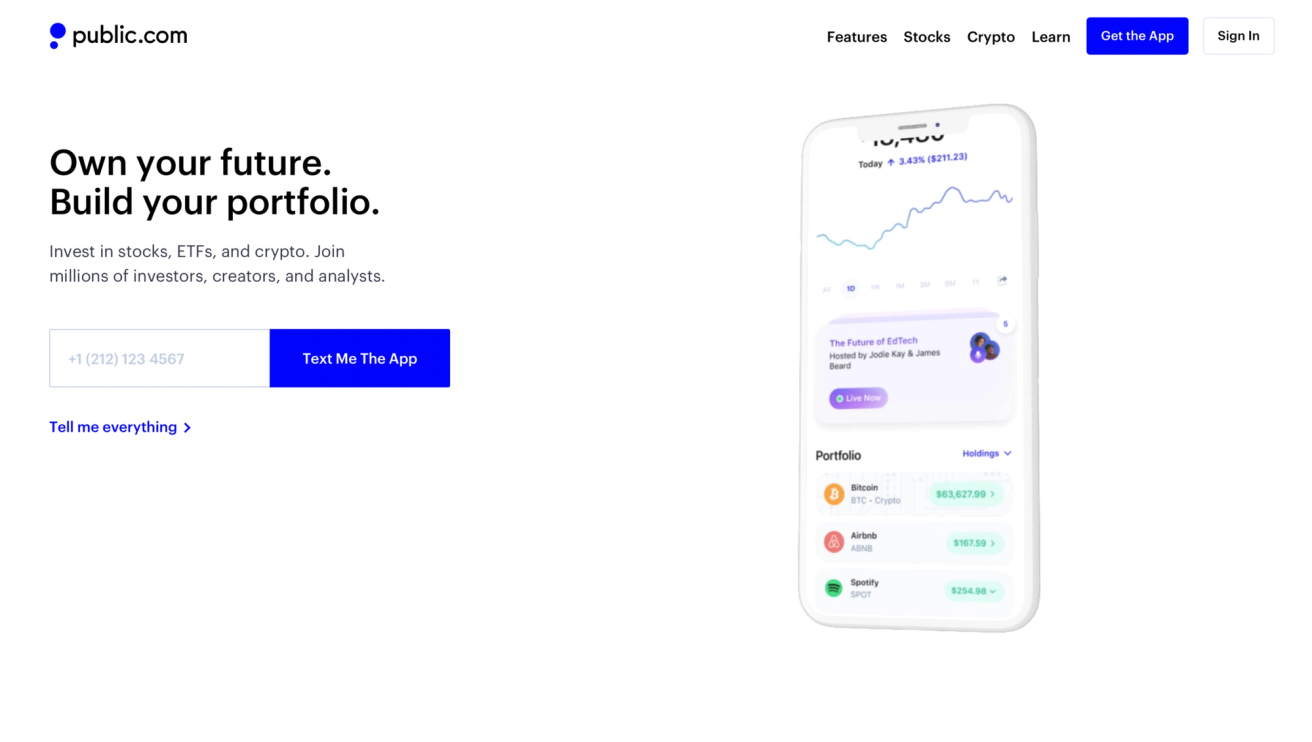
Public.com lets US users invest in stocks, ETFs, options, bonds, Treasuries and crypto, and also offers a High-Yield Cash Account and IRAs.
Public.com offers fractional shares on eligible US-listed stocks and ETFs. Public notes that fractional shares are illiquid outside its platform and cannot be transferred to another broker.
One critical caveat: Public.com is only available to US residents. International investors need one of the other alternatives in this article, such as IBKR or eToro.
Public.com
Pros
- Stock and ETF trades are commission-free
- Offers crypto and alternative assets (fine art, collectibles, etc)
- Investment community (social feed)
- Supports fractional shares
- High fees transparency
- No minimum deposit
Cons
- No mutual funds or futures
- No international or custodial accounts
- No robo-advisor
Fractional shares compared
| Broker | Minimum order | Fractional markets | Available to |
| Moomoo | US$5 (SG, MY, AU) | Eligible US stocks and ETFs | US, Canada, Singapore, Australia, Japan, Malaysia, New Zealand |
| Interactive Brokers | $1 | Eligible US, Canadian and European stocks and ETFs | Most countries |
| eToro | Varies by asset | Stocks and ETFs (non-leveraged buy positions) | Most countries |
| Webull | $1 (US) | Eligible US stocks and ETFs | US, UK, Singapore, Australia and other countries |
| Public.com | Varies | Eligible US stocks and ETFs | US residents only |
Fractional share rules from the brokers’ websites as of 8 October 2026.
Why trade fractional shares?
Fractional shares have clear advantages and a few practical caveats. For most retail investors, the benefits outweigh the drawbacks.
Advantages of fractional shares
A common first question: do fractional shares pay fractional dividends? Yes. At most brokers, you receive your proportional share of any dividends paid by the company.
Additional benefits:
- Invest with small amounts: get started with as little as $1 (depending on broker).
- Access high-priced stocks: companies like Berkshire Hathaway Class A, Booking Holdings or NVR become accessible to all budget sizes.
- Better diversification on small budgets: spreading €500 across 10 different stocks (€50 each) is genuinely easier with fractional shares than being forced to round up to whole shares.
- Dollar-cost averaging: investing a fixed monthly amount (e.g., $200) precisely into your portfolio without leftover cash sitting uninvested.
- Auto-invest and recurring contribution features: recurring investment plans and portfolios such as eToro’s Smart Portfolios rely on fractional positions.
Disadvantages of fractional shares
The drawbacks are mostly technical, but worth understanding:
- No voting rights: voting rights are typically conferred only with whole shares. If you only hold fractional positions, you won’t be able to vote at company annual meetings or on shareholder resolutions.
- Non-transferability: in most jurisdictions, a fractional share represents an agreement between you and your broker (who legally owns the whole share and credits you the proportional value). You generally cannot transfer fractional shares between brokers. If you switch platforms, the fractional position is usually sold and the proceeds transferred as cash.
- Cash-only compensation in liquidation: if a broker fails, investor compensation schemes typically transfer whole shares in-kind to a new broker but pay the monetary value of fractional positions as cash.
- Over-diversification risk: some investors use fractional shares to over-diversify (e.g., spreading $500 across 50 individual stocks at $10 each). While diversification spreads risk, over-diversification can dilute returns without meaningfully improving risk-adjusted performance. A single broad-market ETF often beats a sprawling portfolio of individual fractional positions.
- Tax reporting complexity: in some jurisdictions, the tax reporting around dozens of small fractional positions can become administratively cumbersome compared to fewer whole-share holdings.
The bottom line
Fractional shares open up access to high-priced stocks, help you diversify on a small budget and let regular investing work with exact amounts.
The critical decision isn’t really about whether to use fractional shares, but rather which broker to use them through. Moomoo offers fractional shares on US stocks and ETFs in the countries it serves, but it is not available in Europe and does not offer fractions on other markets, so the alternatives are often a better fit:
- Interactive Brokers: best for breadth, with fractional shares on US, Canadian and European stocks and ETFs from $1.
- eToro: best for social investing and Smart Portfolios.
- Webull: best for US-listed fractional shares on a polished mobile-first platform.
- Public.com: a good option for US residents who also want bonds and Treasuries in the same app.
The final choice depends on which broker’s overall package (fees, regulation, markets and features) best fits your situation.
FAQ
What is the minimum for fractional shares on Moomoo?
In Singapore, Malaysia and Australia, fractional orders start at US$5, with a minimum quantity of 0.0001 shares in Singapore. Only eligible US stocks and ETFs can be bought in fractions.
Can I transfer fractional shares to another broker?
Usually not. Most brokers, including Interactive Brokers and Public.com, warn that fractional shares cannot be transferred. If you move your account, fractions are normally sold and the cash is transferred instead.
Is Moomoo available in Europe?
No. Moomoo serves the US, Canada, Singapore, Australia, Japan, Malaysia and New Zealand. European investors who want fractional shares can use brokers such as Interactive Brokers or eToro.