M1 Finance is a US digital investment platform that combines automation and customisation. It lets clients invest, earn interest on cash, borrow against their portfolios and, since October 2026, get advice from an AI financial advisor, all in one app. On 6 October 2026, M1 reported more than 400,000 clients and $14 billion in client assets.
In this article, we provide an overview of M1 Finance’s key statistics, including its Assets Under Management (AUM), number of users, revenue, and key milestones. We also look at how M1 Finance has performed over the years and what differentiates it from other US robo-advisors and brokerages such as Betterment, Wealthfront, SoFi Invest, Acorns and Robinhood.
One important caveat upfront: M1 Finance is only available to US residents. International investors will need an alternative available in their country.
Overview
M1 Finance is a digital investing platform founded in 2015 to provide a comprehensive suite of financial tools that empower retail investors. What sets M1 Finance apart is its distinctive blend of automation and customisation in a clean, user-friendly interface, bridging the gap between fully managed robo-advisors and fully self-directed brokerages.
The platform’s signature feature is its “Pies” portfolio visualisation: client portfolios are presented as visual pie charts divided into slices, making asset allocation intuitive at a glance. Users can build a fully customised Pie from more than 6,000 US-listed stocks and ETFs, or select from pre-built model Pies across themes such as general investing, retirement, ESG (environmental, social and governance) and dividends. Beyond automated, commission-free investing, M1 offers a High-Yield Cash Account (3.35% APY, annual percentage yield, in October 2026), margin loans, crypto investing through M1 Digital and, from October 2026, M1 Advisor, an AI advisor run by its SEC-registered adviser.
M1 used to sell premium features through its M1 Plus subscription. It ended M1 Plus on 15 May 2024 and made those features standard for all clients, replacing the subscription with a $3 monthly platform fee for accounts below $10,000.
Here are M1 Finance’s key corporate facts:
- Founded: 2015
- Headquarters: Chicago, Illinois, United States
- Founder & CEO: Brian Barnes
- Parent company: M1 Holdings Inc.
- IPO status: Privately held (no public listing announced)
- Sector: Financial services, fintech
- Industry: Robo-advisor, brokerage, cash management
- Geographic availability: United States only
- Clients: more than 400,000 (September 2026)
- Client assets: more than $14 billion (September 2026)
- Main entities: M1 Finance LLC (broker-dealer), M1 Advisory Services LLC (investment adviser), M1 Spend LLC (cash and banking partnerships), M1 Digital LLC (crypto, separate affiliate)
M1 Finance ownership
M1 Finance is a privately-held company founded by Brian Barnes, who continues to serve as Founder and CEO. The company has raised multiple rounds of funding to support its growth and expand its integrated investing, banking, and lending platform. M1 has raised more than $300 million across its Series B to Series E rounds alone, according to its milestones page. The Series E, led by SoftBank Vision Fund 2 in 2021, valued the company at about $1.45 billion post-money, giving M1 unicorn status.
Key investors backing M1 Finance include:
- SoftBank Vision Fund 2 (Series E lead, 2021)
- Coatue Management (Series D lead, 2021)
- Left Lane Capital (Series C lead)
- Jump Capital (early-stage backer)
- Clocktower Technology Ventures
- Toba Capital
- Chaifetz Group
- AMK Investment Office
Sources: Crunchbase, Pitchbook
M1 Finance users
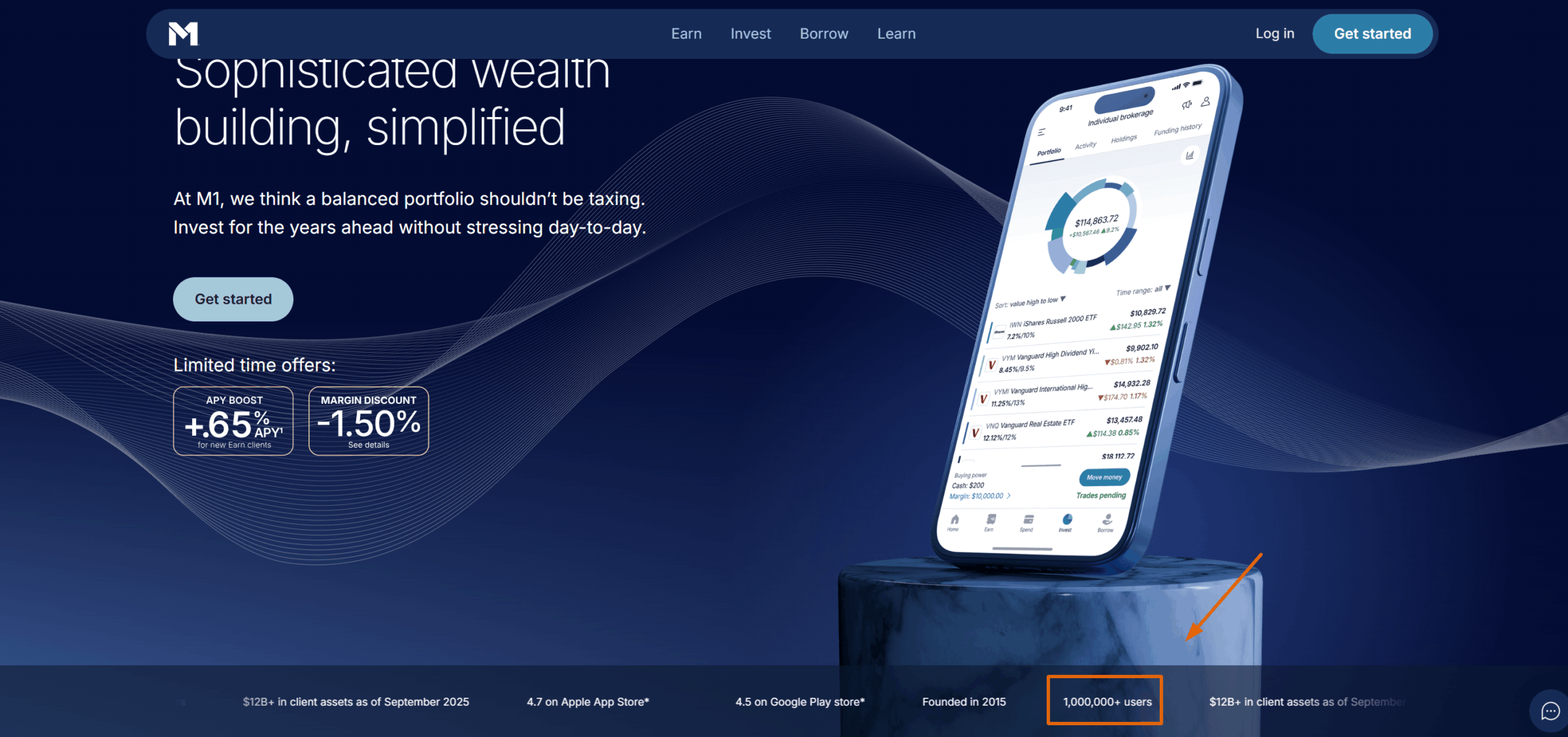
M1’s client base has grown steadily since its launch in 2015. On 6 October 2026, when it announced M1 Advisor, M1 said it had more than 400,000 clients.
Note that this is a count of clients, which is not the same as the “users” M1 reported in its early years. Earlier figures, and the “1 million users” often quoted for M1, likely included registered accounts that were never funded, so the series is not directly comparable.
M1 Finance users over time
M1 users and clients over time. Sources: M1 and press releases.
M1 Finance AUM
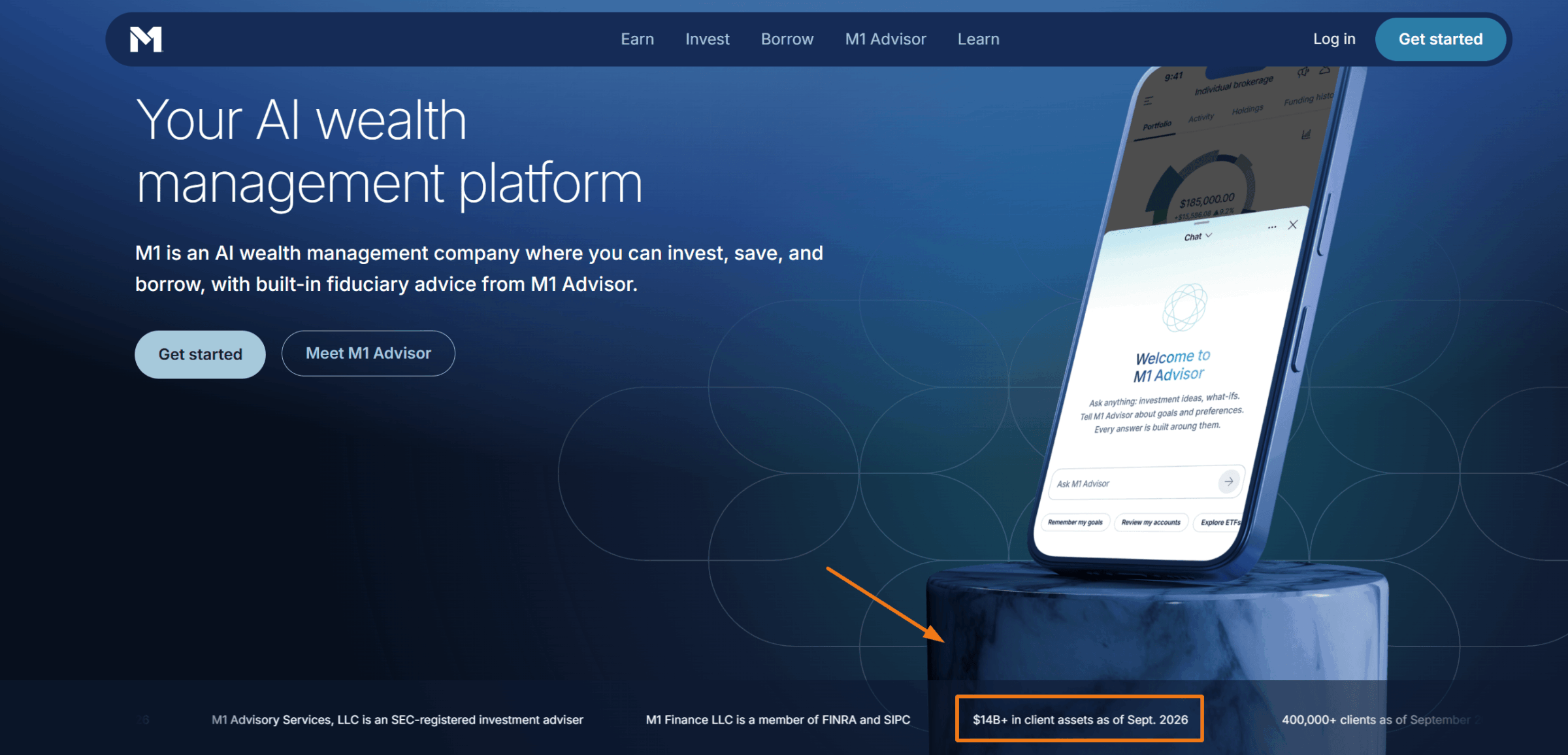
Most of M1’s client assets sit in self-directed brokerage accounts, so M1 reports them as client assets rather than as regulatory assets under management (AUM). We have compiled the figures M1 has announced over time.
In September 2026, M1 had more than $14 billion in client assets, up from about $12 billion a year earlier and $10 billion in October 2024. That growth came from market gains and client contributions.
M1 Finance AUM over time
M1 client assets over time. Sources: M1 announcements and press releases. Latest figure: September 2026.
M1 Finance revenue
M1 has several revenue streams that let it offer self-directed investing without management fees:
- Invest: revenue from interest on brokerage cash balances and from securities lending.
- Borrow: M1 generates revenue by charging interest on portfolio-backed margin loans (using your invested portfolio as collateral).
- Earn: M1 keeps part of the interest earned on deposits in its High-Yield Cash Account, which it offers through partner banks.
- Crypto: trading fees on crypto investing through M1 Digital, whose assets are held with Bakkt.
- Platform fee: M1 charges a $3 monthly platform fee, waived if you hold at least $10,000 in M1 assets or have an active M1 Personal Loan.
- Advice: M1 Advisory Services can charge an advisory fee of up to 0.20% a year, currently 0%, and M1 Advisor is free until 31 December 2027.
Note that M1 ended M1 Plus on 15 May 2024, making its former premium features standard for all clients. It also closed the Owner’s Rewards credit card in May 2025, after its card partner Deserve was acquired and ended support for partner cards.
M1 Finance aims to generate approximately 1% of its AUM in revenue per year, which was confirmed by CEO Brian Barnes in an interview with TechCrunch in 2020. Based on this target, estimated annual revenue trajectory:
- 2020: ~$25 million (on ~$2.5B AUM)
- 2021: ~$30-50 million (on ~$5B AUM)
- 2026: potentially more than $100 million, if the 1% target applied to $14 billion in client assets
Important caveat: as a privately held company, M1 is not required to publicly publish income statements (including revenue) in the same way a publicly listed company would. Any recent revenue figures are estimates based on the 1% target, not disclosed results.
M1 Finance valuation
M1 Finance has experienced rapid growth and attracted significant investor interest across multiple funding rounds. The company’s most recent reported valuation came from its July 2021 Series E funding round, when M1 raised $150 million at a $1.45 billion post-money valuation, giving the company unicorn status. This round was led by SoftBank Vision Fund 2.
Since M1 hasn’t announced a new funding round since 2021, its current valuation is harder to pin down. Fintech valuations fell sharply in 2022 and 2023, which suggests any new round could price below 2021 levels. M1’s growth to more than $14 billion in client assets works in the other direction.
Using publicly available information from Pitchbook and M1 press releases, here’s the historical valuation timeline:
M1 Finance valuation over time
| Date | Valuation (USD) | Round |
| Jul 2018 | $56.2M | Series A |
| Jun 2020 | $143.0M | Series B |
| Nov 2020 | $463.8M | Series C |
| Mar 2021 | $805.0M | Series D |
| Jul 2021 | $1.45B | Series E (SoftBank Vision Fund 2 lead) |
| 2022-2026 | N/A | No new funding round announced since 2021 |
M1 valuation by funding round. Sources: Pitchbook and M1 press releases.
Conclusion
M1 Finance has established itself as a leader in the US online investment and financial services industry through its distinctive blend of automation and customisation. Its signature Pies feature bridges the gap between fully managed robo-advisors and fully self-directed brokerages. The company has grown steadily since its 2015 launch and now ranks among the largest US robo-advisors by AUM with more than $14 billion in client assets and over 400,000 clients.
M1’s integrated products, Invest, Earn and Borrow, let clients manage investing, cash and lending on one platform. Ending M1 Plus in 2024, closing the credit card in 2025 and launching M1 Advisor in 2026 point to a company concentrating on its core investing product and on more value per client.
For US investors, M1 remains a compelling choice, particularly for those who want robo-advisor-style automation with the flexibility to customise their portfolio composition. For international investors, the geographic limitation remains the key drawback. M1 has shown no sign of international expansion, so non-US residents need to look at alternatives available in their country.
M1 has not announced a new funding round or an IPO since 2021. Its continued growth in client assets suggests it will remain a significant player in US digital wealth management.
This article is for informational purposes only and does not constitute investment advice. M1 Finance is only available to US residents. Past performance and historical company growth are not indicative of future results.
FAQs
How many clients does M1 Finance have?
M1 reported more than 400,000 clients and more than $14 billion in client assets in September 2026.
What is M1 Advisor?
M1 Advisor is an AI financial advisor launched on 6 October 2026. It gives non-discretionary advice on your M1 investment, cash and borrowing accounts, is provided by M1 Advisory Services LLC, an SEC-registered investment adviser, and is free until 31 December 2027.
How much does M1 Finance cost?
There are no commissions or management fees on self-directed accounts. M1 charges a $3 monthly platform fee, waived if you hold at least $10,000 in M1 assets or have an active M1 Personal Loan.
Is M1 Finance safe and insured?
M1 Finance LLC is a member of the Securities Investor Protection Corporation (SIPC), which protects securities in customer accounts up to $500,000, including up to $250,000 in cash, if the broker fails. Cash in the High-Yield Cash Account is eligible for FDIC insurance of up to $4.75 million through M1’s partner banks.
Is M1 Finance regulated?
Yes. M1 Finance LLC is a broker-dealer registered with the US Securities and Exchange Commission (SEC) and a member of the Financial Industry Regulatory Authority (FINRA). M1 Advisory Services LLC, which runs M1 Advisor, is an SEC-registered investment adviser.
Is M1 Finance available outside the United States?
No, M1 Finance is currently only available to residents of the United States. However, there are other robo-advisors that may be suitable for your needs. You can check out our “Help Me Choose” feature for recommendations or check out the M1 Finance alternatives article. Our comparison table makes it easy to compare the leading investment platforms and find the one that’s right for you.