Wondering how to buy into Alphabet or Tesla when a single share costs hundreds of dollars?
That is where fractional shares, sometimes called partial shares, come in. Once one broker began offering them, most others followed, and they are now a standard feature at many platforms.
This article covers two questions: does E*TRADE offer fractional shares, and if not, what are the alternatives?
What is fractional share trading?
It works as the name suggests. Rather than paying the full price for one share, you decide how much you want to invest. Put in $50 and you receive $50 worth of the stock – a fraction of a share rather than a whole one.
Two practical advantages worth understanding:
- Your money is fully invested. Without fractional shares, buying whole shares leaves a cash remainder sitting idle. With them, every dollar goes to work;
- Diversification becomes achievable at small amounts. Building a portfolio of ten expensive stocks might otherwise require thousands; with fractional shares it can be done with far less.
Two limitations to note. Fractional shares generally cannot be transferred between brokers – you would need to sell them, which may trigger a taxable event. And voting rights typically do not apply to fractional holdings, though dividends usually are paid proportionally.
Does E*TRADE offer fractional shares?
E*TRADE does not offer direct fractional share trading, and has announced no timeline for introducing it.
Fractional shares are available in two limited contexts:
- Dividend reinvestment plans: through a DRIP, dividends from stocks you already own are automatically reinvested, which can produce fractional holdings. You cannot buy fractions directly this way;
- Recurring investment programmes: fractional ETF purchases are possible, but only through automatic recurring investments, and only from E*TRADE’s selected ETF list. The minimum is $25 per recurring investment, weekly or monthly.
Put plainly: if you want to buy $50 of Amazon today, E*TRADE cannot do it. The alternatives below can.
Note that E*TRADE is now part of Morgan Stanley, following the 2020 acquisition.
Best E*TRADE alternatives for fractional shares
If your goal is to find an online broker offering the possibility of buying partial shares, here is the breakdown of our top four alternatives:
Interactive Brokers
Founded in 1978, IBKR is one of the world’s most trustworthy brokers worldwide. The minimum amount to invest in fractional shares is $1 for eligible US and European stocks and ETFs, regardless of the share price.
💡 Interactive Brokers also launched IBKR GlobalTrader, a modern mobile trading app to trade Stocks, Options, and ETFs, ideal for novice investors.
eToro
A modern and easy-to-use broker available worldwide that offers free commissions on ETFs (other fees apply) and the possibility of belonging to a community of investors where you can follow and replicate what they are doing. You can buy fractional shares starting at $10.
Disclaimer: eToro is a multi-asset investment platform. The value of your investments may go up or down. Your capital is at risk.
Webull
A leading US-based broker that offers commission-free stocks, ETFs, and options trading (for US-listed products). Fractional share trading is only available for specific stocks and ETFs, only supported for market orders and the minimum amount to purchase a fractional share position is $5.
Public.com
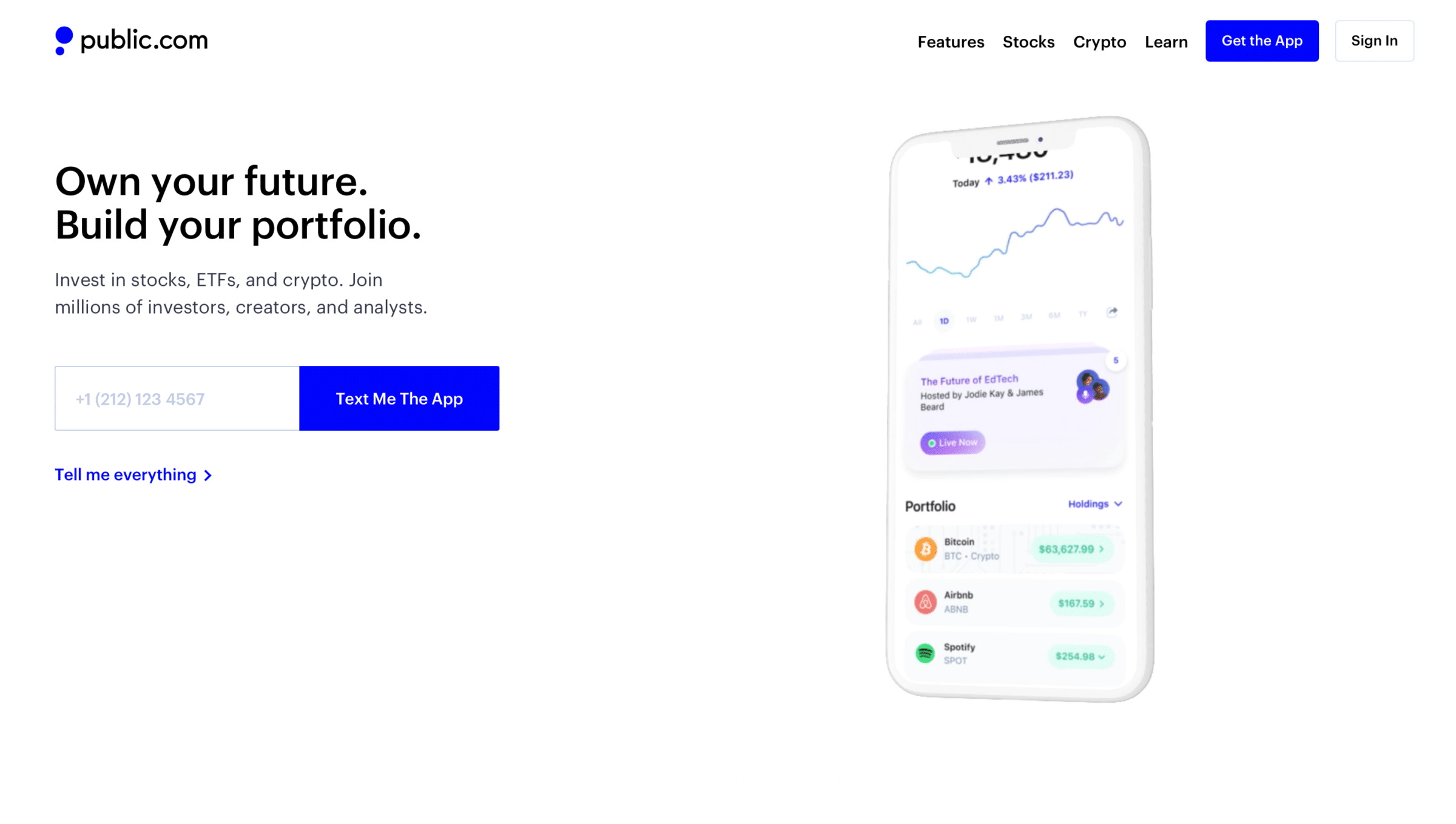
Public.com is a US broker that gives users the ability to invest in stocks, ETFs, options, bonds, Treasuries, crypto, and alternative assets (like music royalties and collectibles), commission-free on stocks and ETFs. You can buy fractional shares starting at $1, but not all securities available are eligible for fractional share orders, and it only applies to market orders (it does not permit limit orders for fractional shares).
IB at a glance

Founded in 1978 and listed on NASDAQ (ticker: IBKR, an S&P 500 constituent since 2024), Interactive Brokers has weathered multiple financial crises, demonstrating resilience and rigorous risk management. It serves over 5 million client accounts with more than $900 billion in client equity.
IBKR serves both individuals and institutions, offering global access to stocks, options, futures, currencies, bonds, and funds across 170+ markets in 36+ countries from a single platform, with strong execution technology and comprehensive portfolio analysis.
On fractional shares, IBKR is among the most generous providers. The minimum is $1 for US stocks listed on the NYSE, AMEX, NASDAQ, ARCA, and BATS, alongside selected OTC securities. European stocks and ETFs are also available fractionally, subject to liquidity and market capitalisation thresholds – which is unusual, since most brokers offering fractional trading limit it to US listings.
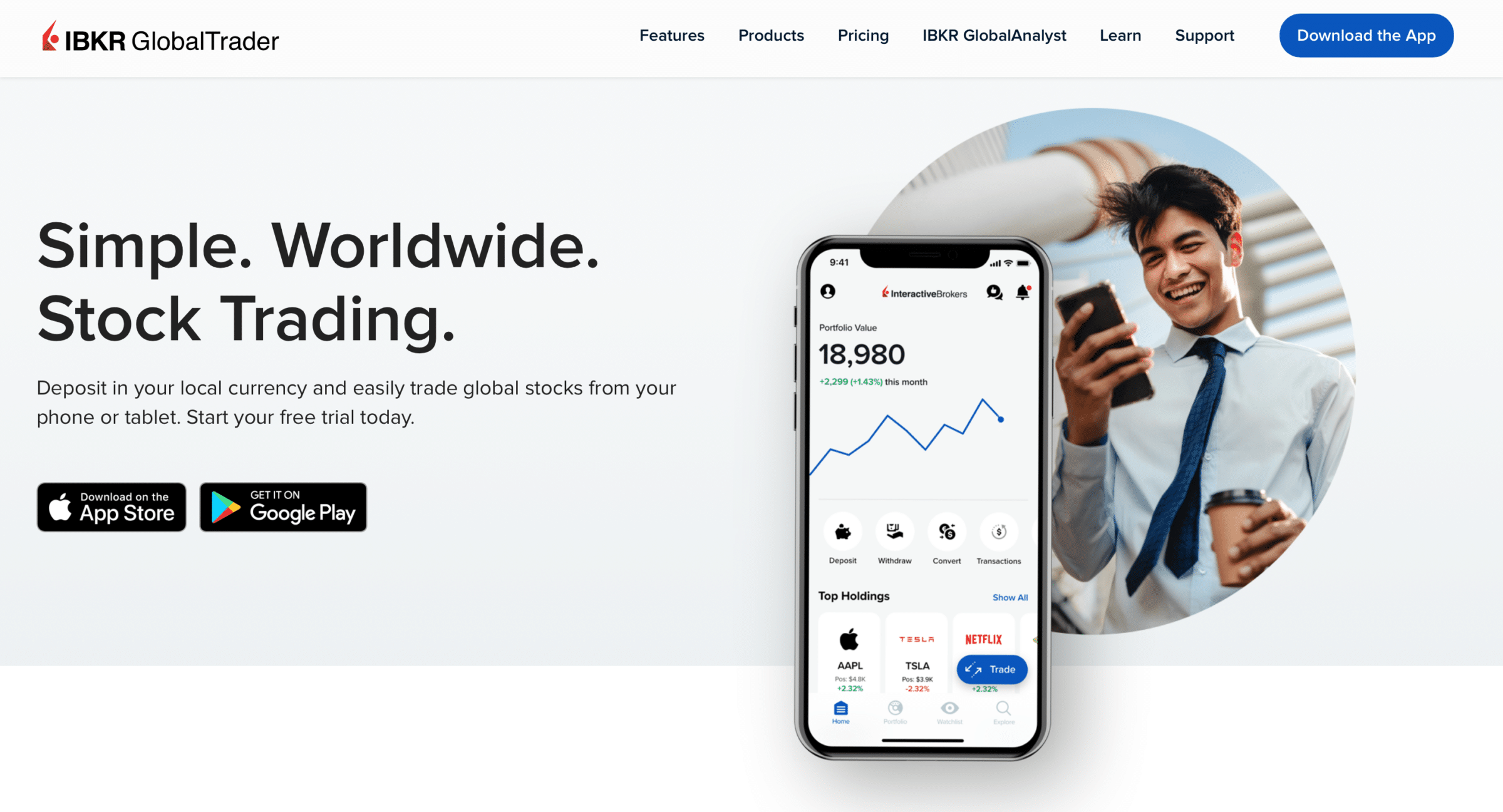
Interactive Brokers also offers IBKR GlobalTrader, a mobile app aimed at newer investors covering stocks, options, and ETFs, with automatic currency conversion, fractional shares, and a $10,000 virtual demo account.
Headquartered in Greenwich, Connecticut, Interactive Brokers is a member of FINRA and SIPC, with client assets protected up to $500,000 including a $250,000 cash sub-limit. It is regulated by the SEC in the US and by top-tier authorities across its other markets, including the FCA, ASIC, and the Central Bank of Ireland.
There is also no minimum deposit, which makes it accessible if you are starting with modest amounts – the scenario fractional shares are designed for.
Want to know more? Check our Interactive Brokers review.
Pros
- Low commissions on US stock trading
- No monthly inactivity fee
- The broadest product and markets range in the brokerage industry
- Demo account
- Excellent reputation (founded in 1978)
- Extensive research and Education tools
- Has a modern mobile trading app to trade Stocks, Options and ETFs, ideal for novice investors, IBKR GlobalTrader.
- Offers interest on uninvested cash balances
Cons
- Complicated and lengthy account opening process (but fully online)
- Steeper learning curve for beginners
- Website is difficult to navigate
- Interactive Advisors (Robo-advisor feature) is only available for US customers
eToro at a glance

52% of retail CFD accounts lose money.
As the leading social investing platform, eToro offers fractional share trading across its stock and ETF range, serving over 40 million users in 140+ countries.
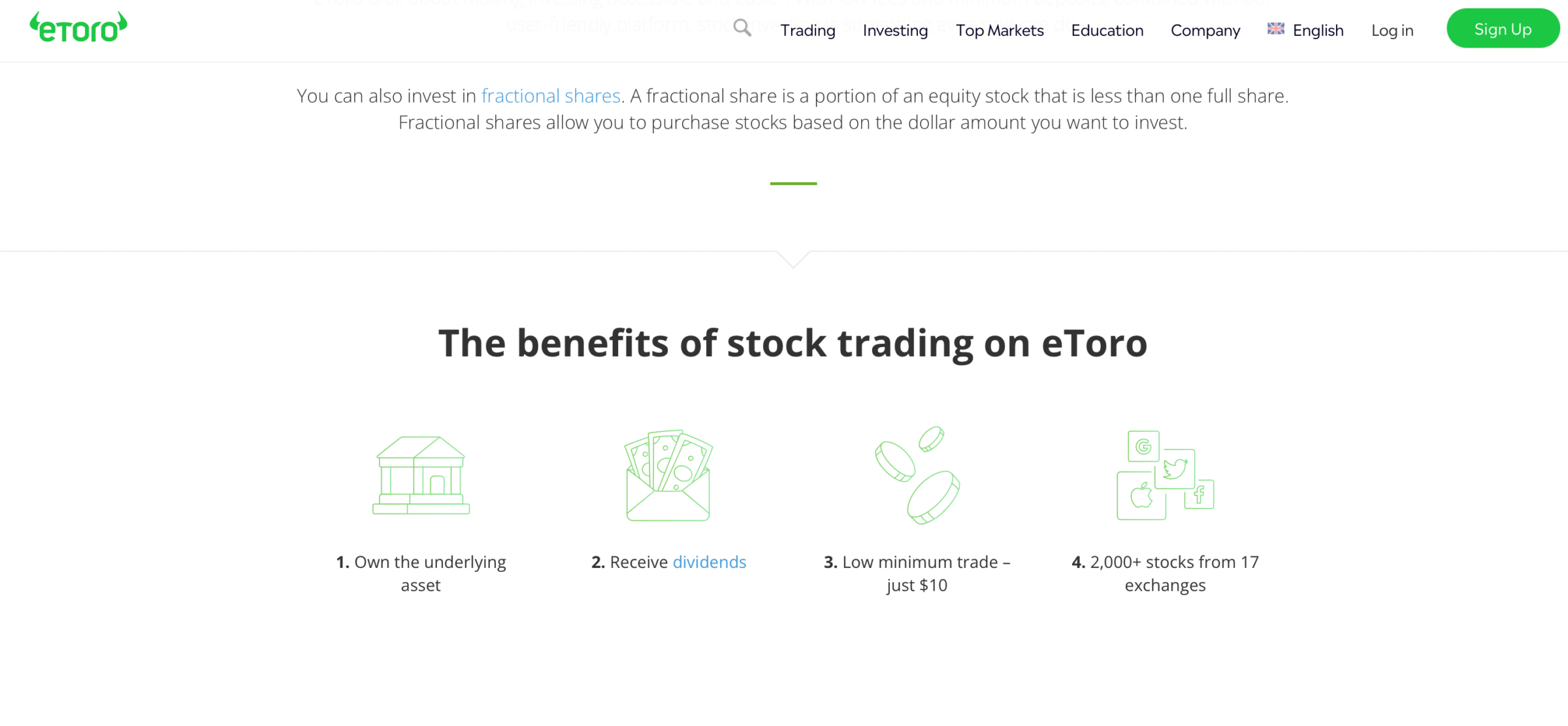
Buying fractionally works the same way as buying whole shares: instead of specifying a number of shares, you enter the amount you want to invest. The minimum is $10 for most stocks.
Social investing means copying the trades of other investors through CopyTrader. The platform also provides substantial educational material, including video courses and market analysis, alongside a $100,000 demo account for practising.
eToro additionally offers CFDs, which give exposure to price movements without owning the underlying asset. These are leveraged instruments and most retail traders lose money on them – see our guide comparing CFDs and real shares before using them.
On pricing, ETFs trade commission-free, while stocks carry a $1 commission in most markets, with no commission for UK residents. Note that eToro operates in USD only, so deposits in other currencies are converted both ways.
eToro operates through separate regulated entities by region: eToro USA LLC is a FINRA member with SIPC coverage and SEC oversight, while international clients are served by FCA-regulated (UK), CySEC-regulated (EU), and ASIC-regulated (Australia) entities.
Note that eToro also operates a Seychelles entity, which carries materially weaker protection than the others – no compensation scheme applies there. Confirm which entity would hold your account before depositing.
eToro has been listed on NASDAQ (ticker: ETOR) since May 2025, which brings SEC reporting and audited disclosure.
To learn more, see our eToro review.
Pros
- Low stock trading fees (from $0 per trade)
- Commission-free ETFs (other fees apply)
- Social trading and other innovative products
- Wide variety of financial products
- Slick, modern, and easy for anyone to use
- European users have access to three account currencies: EUR, USD and GBP
- Top tier regulators
Cons
- Limited disclosed financial information
- Withdraw and inactivity fees
- Spread, overnight, inactivity, and currency conversion fees higher than average
- Doesn’t offer bonds, futures, or options
CFDs are complex instruments and come with a high risk of losing money rapidly due to leverage. 52% of retail investor accounts lose money when trading CFDs with this provider. You should consider whether you understand how CFDs work and whether you can afford to take the high risk of losing your money.
Webull at a glance

Founded in 2017, Webull offers a technology-focused platform with charting and analysis tools deeper than most competitors at its price point. Its parent is listed on NASDAQ (ticker: BULL).
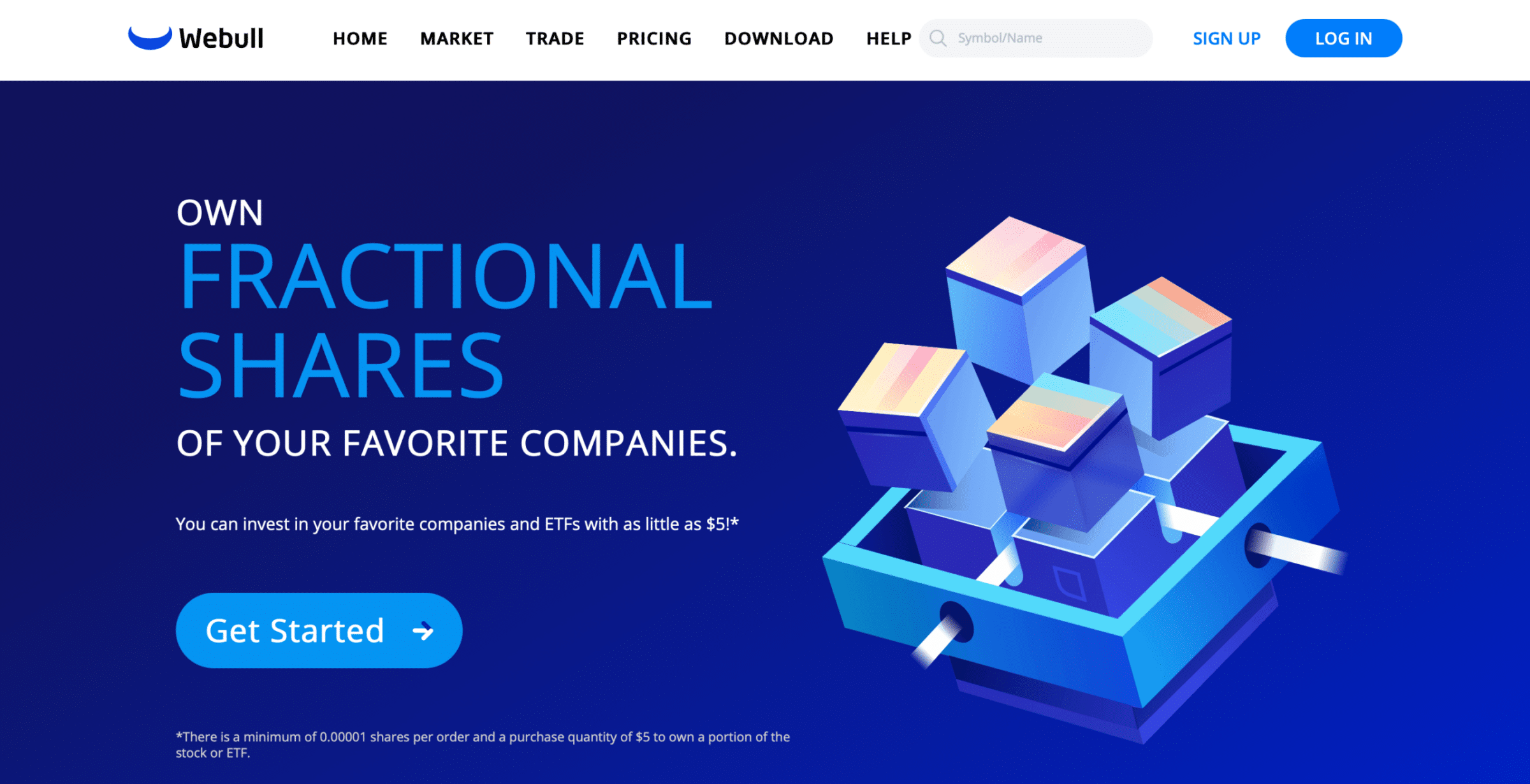
Fractional trading is limited to selected stocks and ETFs, identified by an “F” marker on each security’s page. Several constraints apply: fractional orders support market orders only, the minimum is $5, and the quantity must exceed 0.00001 shares. Full details are in Webull’s fractional shares guide.
The market-order restriction is worth noting: without limit orders you cannot control your execution price, which matters more on less liquid securities than on large-cap stocks.
Webull suits investors wanting quick access to liquid markets, including margin and options. US clients also get access to IRAs and Roth IRAs.
Trading is commission-free across the product range, with revenue coming from stock lending, interest on cash balances, margin interest, and payment for order flow.
Pros
- No minimum deposit required
- Commission-free trading on stocks, ETFs, and options
- No account opening, inactivity, or currency exchange fees
- User-friendly mobile and desktop app
- High interest on uninvested cash - up to 3.6% APY with Webull Premium, or 3.25% APY for non-Premium accounts (April 2026)
- Straightforward account opening process
- Fractional shares
- OTC shares
- Demo account available
Cons
- Limited market coverage
- High withdrawal fees for wire transfers
- High deposit fees for wire transfers
- Live chat support open to limited clients
- No mutual funds
If you want forex, futures, or other complex instruments, Webull is not the right platform. It does cover extended hours trading in pre-market and after-hours sessions, offers desktop, web, and mobile versions, and provides 24/7 support – but the product range covers the fundamentals rather than the full spectrum.
Webull is registered with and regulated by the SEC and FINRA, and is a SIPC member with coverage up to $500,000.
Public at a glance

Public.com offers stocks, ETFs, options, bonds, Treasuries, crypto, and alternative assets, with commission-free stock and ETF trading. It also provides an options rebate programme, a high-yield cash account, IRAs including crypto IRAs, and educational tools for newer investors.
Fractional shares are available from a $1 minimum on market orders, though not every security is eligible – see Public’s fractional shares disclosure for the full position.
A distinguishing feature: Public does not accept payment for order flow on stocks and ETFs, unlike most commission-free US brokers. On options it operates a rebate programme returning 50% of PFOF revenue to users.
That matters more than it sounds. Payment for order flow creates a potential conflict between the broker’s revenue and your execution quality, since orders are routed to whoever pays for them rather than to whoever offers the best price. Public forgoing it on equities is a genuine structural difference.
Note that Public is available to US residents only.
Pros
- Stock and ETF trades are commission-free
- Offers crypto and alternative assets (fine art, collectibles, etc)
- Investment community (social feed)
- Supports fractional shares
- High fees transparency
- No minimum deposit
Cons
- No mutual funds or futures
- No international or custodial accounts
- No robo-advisor
Why trade fractional shares?
Fractional shares carry clear advantages and some less obvious limitations. Both are worth understanding.
The advantages
A common question first: do fractional shares pay fractional dividends? Yes. A dividend is paid proportionally whether you hold 1.00 shares or 0.01, so you do not forfeit income by owning a fraction.
The main benefits:
- Investing small amounts: some brokers accept as little as $1;
- Access to high-priced stocks: companies trading at hundreds or thousands per share become reachable;
- Precise allocation: you can build a portfolio by dollar amount rather than share count, which makes target weightings far easier to hit;
- Full deployment of capital: no cash left idle because you could not afford another whole share – particularly useful for regular monthly investing.
The disadvantages
These are mostly technical, but two of them matter considerably:
- No voting rights. These attach to whole shares only;
- Not transferable between brokers. This is the most consequential limitation. A fractional holding is effectively an arrangement with your broker, who holds the whole share. If you later move to another platform, you must sell your fractional positions rather than transferring them – which realises any gains and may create a tax bill you did not plan for. Anyone building a substantial position fractionally should be aware they are also building a switching cost;
- Cash settlement on broker default. In an insolvency, whole shares can transfer in kind while fractional holdings would typically be settled in cash;
- Over-diversification. The ease of buying small amounts of many companies can lead to holding dozens of positions without meaningfully reducing risk beyond what a handful would achieve – while making the portfolio harder to monitor. Over-diversification dilutes returns without a corresponding risk benefit.
Wrapping up
Fractional shares have made investing considerably more accessible, opening previously out-of-reach companies to anyone investing modest amounts. For regular monthly investing in particular, they solve a genuine problem.
E*TRADE does not offer them directly, limiting fractional purchases to dividend reinvestment and recurring ETF plans. The alternatives above all do:
- Interactive Brokers: $1 minimum, and unusually, fractional trading on European stocks and ETFs as well as US ones. Available in over 200 countries;
- eToro: straightforward interface with social trading, available in 140+ countries;
- Webull: $5 minimum, though limited to selected securities and market orders only;
- Public.com: $1 minimum with no payment for order flow on equities, US residents only.
One consideration before committing: since fractional shares cannot be transferred between brokers, choosing a platform you intend to stay with matters more than it would otherwise. Switching later means selling, and selling means realising gains.
Weigh the platform on its overall merits – cost, market access, and regulation – rather than on fractional availability alone, since most competitive brokers now offer it.