White label trading platforms offer customisable, ready-made solutions that save businesses time and money while enabling fast market entry.
This article covers the benefits of these platforms, the leading options on the market, and how to choose the right provider for your needs – whether you’re a startup or an established firm.
What is a white label trading and investment platform?
A white label investing platform is a software solution that lets businesses offer stock trading (and often broader investment) services to their customers under their own brand, without having to develop the underlying technology and infrastructure in-house.
These platforms provide a comprehensive suite of tools and features that let businesses deliver a complete trading experience while focusing on what they do best: onboarding, marketing, customer support, and added-value services like research. By leveraging a white label provider, you can offload the heavy lifting of IT infrastructure, software development, hosting, and regulatory plumbing – and concentrate instead on growing your customer base.
Best white label trading & investment platforms providers
Interactive Brokers
An established brokerage firm with global reach and the broadest product range in the industry (stocks, ETFs, options, futures, FX, bonds, mutual funds, and now real crypto). Its white label and institutional offering is targeted at professional advisors, introducing brokers, hedge funds, and family offices, and is relatively fast to implement compared to building infrastructure in-house.
Saxo
A full-service multi-asset platform (formerly Saxo Bank) with over 25 years of white-labelling experience, providing advanced trading tools and 71,000+ instruments across asset classes. Saxo offers both off-the-shelf and fully customised solutions to licensed financial institutions, neobrokers, and wealth managers via its OpenAPI and Saxo Connect partner programme.
Stock Republic
An Israeli fintech offering a white label investing app focused on social investing and community engagement. Its fully customisable solution lets you build a branded platform with built-in social features (following, copying, discussion feeds), tailored to your specific requirements and target user base.
ETNA
A tech provider offering trading platforms for stocks, ETFs, mutual funds, and options, with deep API integration, direct market access (DMA), and extensive customisation. ETNA is a strong choice for startups and firms targeting active or professional clients, thanks to its wide feature set and clean, user-friendly interface.
CMC Connect
The institutional and white label arm of CMC Markets (LSE-listed, ticker CMCX), providing partners with a customisable trading platform focused on CFDs, FX, and spread betting, with advanced charting and risk management tools. Operational integration can typically be completed in weeks, allowing partners to launch quickly.
To ensure a comprehensive evaluation, we assess these platforms across several criteria:
- User interface and experience: we evaluate usability, intuitiveness, and overall user experience. A well-designed and intuitive interface is essential for smooth navigation, efficient trading, and a low support burden on the operator.
- Range of trading features and functionality: we examine each platform’s available trading tools, order types, charting capabilities, market analysis features, and other functionalities. A broad feature set lets you serve a wider range of trading strategies and client segments.
- Level of technology and customisation: we analyse the technological infrastructure and the customisation options available – branding, layout adjustments, white labelling depth (e.g. logo and colours only vs. full UX customisation), and the ability to tailor the platform to your specific business needs.
- Support, integration, and ongoing service: we evaluate the implementation support, account management, and ongoing technical support provided by the platform – including SLAs, dedicated points of contact, and the speed of bug fixes and feature rollouts.
- Regulatory coverage and infrastructure: we consider what the white label provider handles on the regulatory side (market access licences, trade reporting, settlement, custody) versus what your business needs to handle itself.
Best white label trading & investment platforms compared
| Platform | Interactive Brokers | Saxo | Stock Republic | ETNA | CMC Connect |
| Trading instruments | Stocks, ETFs, options, futures, forex, commodities, bonds, mutual funds, and crypto | Stocks, ETFs, bonds, CFDs, forex, futures, and options | Stocks and ETFs | Stocks, ETFs, mutual funds, and options | Forex, cryptocurrencies, CFDs on stocks, ETFs, commodities, and indices |
| User interface | Professional | Professional | User-friendly | User-friendly and professional | Professional |
| Desktop app | Yes | Yes | No | No | Yes |
| Web platform | Yes | Yes | No | Yes | Yes |
| Mobile app | Yes | Yes | Yes | Yes | Yes |
| Technical support | 24/7 | 24/5 | Not disclosed but available | Not disclosed but available | 24/5 |
| Integration APIs | Yes | Yes (OpenAPI) | Yes | Yes | Yes |
| Charting tools | Advanced | Advanced | Basic | Advanced | Advanced |
| Estimated deployment time | 2-3 weeks | Few weeks to several months | A few weeks | A few weeks | A few weeks |
| Customisation | Intermediate | Limited | Advanced | Advanced | Intermediate |
| White label demo availability | No | No | Yes | Yes | No |
#1 Interactive Brokers

Interactive Brokers at a glance
Interactive Brokers is widely recognised as one of the leading online brokerage firms, and its white label offering further solidifies its position as a top choice for trading and investment solutions. The white branding feature allows businesses (brokers and professional advisors) to customise IBKR’s trading platforms and reporting systems with their own logos and company branding – including Trader Workstation (TWS) (one of the most powerful trading platforms in the industry), IBKR Client Portal, IBKR Desktop, the registration system, statements, and portfolio analytics.
The platform offers access to over 170 markets in 36+ countries and 26 currencies, covering equities, ETFs, options, futures, forex, fixed income, and now real cryptocurrencies. This breadth lets businesses serve clients with diverse strategies and global investment needs.
IBKR’s white label is backed by its institutional-grade technology stack: robust order management, real-time risk monitoring, deep market data, IB SmartRouting for best execution, and full algorithmic trading support. These let partners deliver a seamless, low-friction trading experience to their end clients.
The IBKR white branding programme caters to three user types: Registered Advisors, Fully Disclosed Brokers, and Non-Disclosed Brokers – each with varying levels of customisation. Registered Advisors can white-brand client emails, the TWS Users’ Guide, and the contract database, but certain legal disclosures and agreements (such as the IBKR Customer Agreement) cannot be modified. Brokers (both Fully Disclosed and Non-Disclosed) enjoy more flexibility in their branding and operational setup.
IBKR also provides partners with free CRM tools, full white branding capabilities, custom website support, flexible client management, electronic onboarding, configurable user permissions, and dynamic fee structures (including automated billing and electronic invoicing).
The white branding fee is not publicly disclosed and varies by level of customisation and partner requirements – contact IBKR directly for a tailored quote. Thanks to IBKR’s deep liquidity and low-cost infrastructure, partners can typically offer their end clients competitive commissions and tight spreads, which is a meaningful retention and acquisition advantage.
The application review process typically takes 2-3 weeks, and IBKR requires a $10,000 minimum funding at account opening, which is applied toward the first five months of commissions.
#2 Saxo Bank

Saxo Bank at a glance
62% of retail CFD accounts lose money.
Saxo (formerly Saxo Bank), the well-known Danish investment bank acquired by J. Safra Sarasin in March 2025, has developed a robust white label programme that allows businesses to offer their own branded trading and investment platforms to end clients. It primarily caters to institutional partners – banks, brokers, family offices, fund managers, External Asset Managers (EAMs), Independent Asset Managers (IAMs), and Independent Financial Advisors (IFAs). Saxo currently powers more than 200 banks and brokers and over 300 financial intermediaries globally.
One of the standout features is Saxo’s global market access. White label partners gain access to 71,000+ instruments across margin and cash products. This includes 23,500+ stocks from major markets (New York, Hong Kong, London, and others), 5,900+ government and corporate bonds, 17,400+ mutual funds, 7,000+ ETFs across sectors, plus crypto ETFs and ETNs tracking major cryptocurrencies (Bitcoin, Ethereum, and others). The solution also includes leveraged products and managed portfolios, allowing partners to serve clients across a wide range of investment preferences and risk profiles.
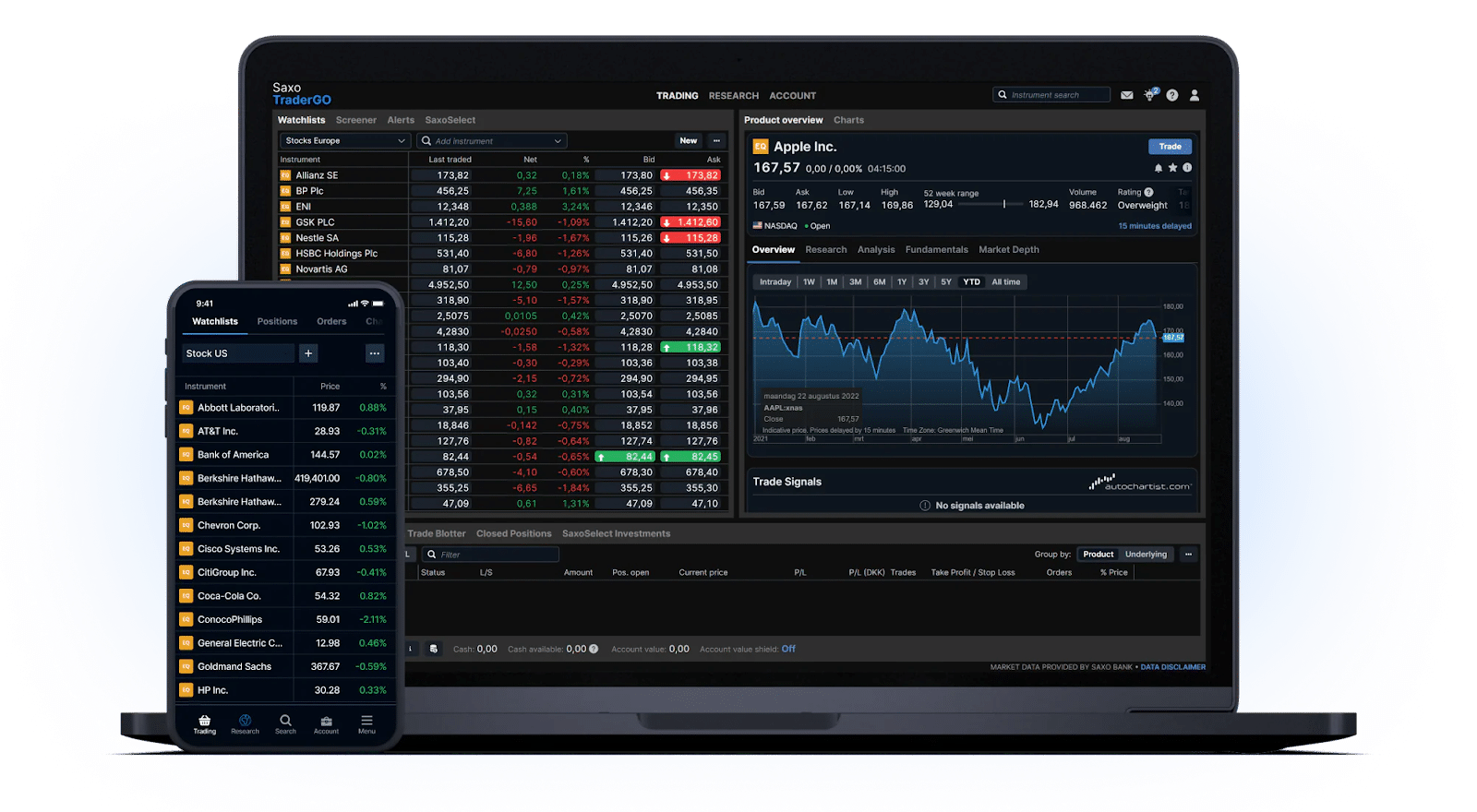
Saxo’s white label solution provides partners with:
- A pre-launch project management team to help configure and implement the solution;
- Off-the-shelf packages and fully tailored solutions to meet specific business needs;
- The full trading value chain – from execution to post-trade clearing and settlement;
- Daily account management and operational support;
- 24/7 IT maintenance, monitoring, and incident management;
- Deep platform customisation and integration flexibility;
- SaxoTraderPRO for professional-grade desktop trading;
- SaxoTraderGO for web, mobile, and tablet trading;
- SaxoInvestor for simplified, retail-friendly investing;
- SaxoPortfolio for read-only portfolio oversight (useful for advisors and asset managers);
- Tailored multi-asset liquidity via FIX API;
- Seamless integration into your existing systems via Saxo’s REST OpenAPI.
The infrastructure runs on Microsoft Cloud for scalability and security, with real-time redundancy and full incident management built in.
On the downside, while Saxo provides a demo for end users to explore the various platforms, it does not currently offer an administrator-side demo that lets prospective partners see the back-office and management experience before signing on.
#3 StockRepublic

StockRepublic at a glance
Stock Republic is a software company providing white label social trading platforms for financial institutions. Top-tier banks and brokers have used the platform across multiple markets, with thousands of users, including well-known European investing platforms such as Interactive Investor and comdirect. Stock Republic’s solution is fully customisable, allowing partners to build a branded social investing experience aligned with their identity, target audience, and specific requirements.
The white label app offers powerful investment insights and portfolio analytics. Built-in portfolio analysis gives users a comprehensive view of their holdings, including risk diversification, return attribution, ESG/climate analysis, and ratings – data-driven insights that help end clients make better-informed investment decisions. The social experience can be configured to be anonymous, allowing users to create profiles, follow personalised feeds, participate in group discussions, and chat in real time without revealing their identities. This creates a privacy-respecting community environment while still enabling the network effects that make social trading useful.
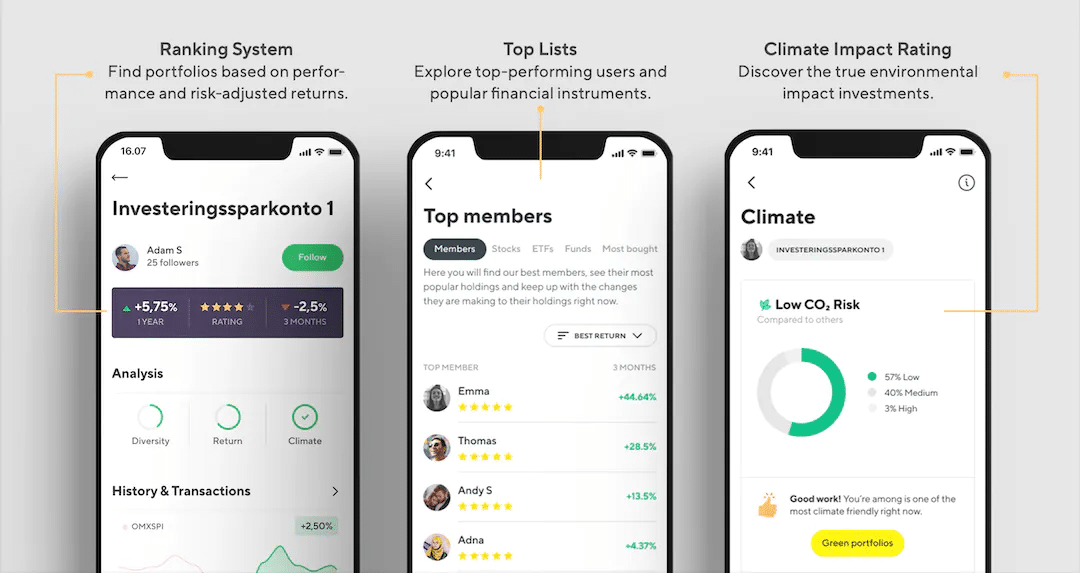
Stock Republic’s white label app is designed to comply with applicable financial regulations, meeting the legal requirements partners need for their jurisdictions. Stock Republic handles the engineering, providing guided onboarding and ongoing customer support – which lets your internal team focus on go-to-market rather than on building and maintaining a social trading stack from scratch. The app can typically be launched within weeks, enabling a fast and efficient deployment.
Stock Republic also publishes detailed guides on social trading compliance and the broader regulatory framework. Their handbook “Buy vs. Build for Social Trading Applications” walks through the key trade-offs across resources, time-to-market, support, technology, compliance, and costs – the same level of detail you can expect from their team when you schedule a demo.
#4 ETNA

ETNA at a glance
ETNA is a US-based technology firm offering a range of software solutions for capital markets. One of its flagship products is the ETNA Web Trading Platform, a white label solution that enables broker-dealers and fintech firms to give their clients a polished, professional-grade trading experience. ETNA also offers a white label mobile stock trading app, allowing brokers and digital wealth management firms to launch mobile investing within days rather than building from scratch.
The ETNA Web Trading Platform is a fast, HTML5-based trading interface that runs in any modern browser – no downloads, no installations. The complementary mobile app is highly customisable and integrates with your existing investment management and trading infrastructure, delivering a synchronised look and feel across web and mobile, with the functionality self-directed investors expect.
ETNA’s white label solution offers a personalised trading experience with drag-and-drop dashboards, customisable widgets, and third-party integrations. It supports multi-monitor setups, real-time market data, customisable watchlists, and Level II market depth data – giving traders a time-stamped view of all transactions at every price level. Order routing execution can be fully customised by asset class, account, or order type, making it ideal for partners launching a Direct Market Access (DMA) trading platform.
The platform supports a wide range of order types, from simple market and limit orders to sophisticated conditional and bracket orders. Beyond stocks, ETNA includes advanced options trading functionality – including option chains with implied volatility, full Greeks (delta, gamma, theta, vega), and multi-leg strategies (spreads, straddles, condors) – making it a strong fit for brokers serving active options traders.
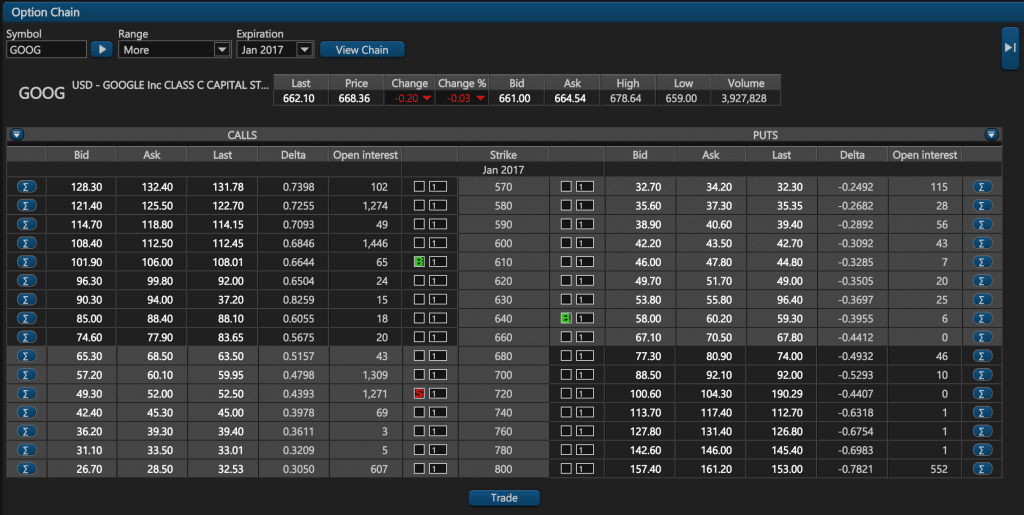
The ETNA Web Trading Platform offers a comprehensive solution for wealth management firms and broker-dealers, integrating news, content, and analytics from various sources to create customised trading dashboards without requiring programming skills. Partners get responsive customer support from a dedicated team, alongside a comprehensive documentation portal and knowledge base with tutorials, user guides, and technical documentation.
ETNA’s platform also includes a digital account opening and funding API, which streamlines client onboarding by letting end users open investment accounts directly from your web or mobile app. Built-in KYC and risk management tools automate the compliance steps that would otherwise slow down account opening, eliminating manual paperwork and getting clients trading faster.
#5 CMC Connect

CMC Connect at a glance
Founded in 1989 and publicly listed on the London Stock Exchange (FTSE 250, ticker CMCX), CMC Markets is a leading global provider of online retail financial services with over 1 million active clients. Alongside its retail business, CMC operates a dedicated institutional offering – CMC Connect – that provides a comprehensive suite of B2B services for startups, brokers, and established financial firms. CMC Connect partners are served across Europe, the UK, Australia, and the Middle East.
CMC Connect offers three solutions designed to help businesses generate revenue in financial markets:
- White Label: lets businesses brand the trading platform with their own name and logo while running on CMC Markets’ technology and infrastructure underneath;
- Grey Label: a neutrally branded platform for regulated entities that introduces clients or trades on their behalf – includes a native mobile app, streamlined client application process, and the ability to execute on clients’ behalf;
- Introducing Broker: lets regulated brokers refer clients to CMC Markets’ desktop and mobile platforms in exchange for remuneration.
One of the main advantages of partnering with CMC Connect is its multi-asset liquidity and broad market access. The offering covers 330+ FX pairs, 12,000+ CFD stocks across 20+ countries, 80+ futures, 1,000+ options, plus a wide range of commodities, treasuries, and equity indices. This breadth lets partners offer end clients diverse investment opportunities across asset classes and geographies.

Another significant advantage of partnering with CMC Connect is access to deep liquidity pools, ensuring efficient execution even during volatile market conditions. CMC also provides professional services throughout the implementation journey, with a dedicated relationship manager and 24/5 ongoing support after go-live.
The CMC Connect platform is available on desktop, tablet, and mobile, with a customisable and intuitive interface built for experienced retail traders. It includes industry-leading charting with over 100 technical indicators and drawing tools for in-depth technical analysis, alongside innovative trading tools like client sentiment analysis, pattern recognition scanners, and advanced order types (boundary orders, guaranteed stop-loss orders, trailing stops, and more). Comprehensive market news and analysis from sources including Morningstar and Reuters further enhance the trading experience.
CMC Connect follows a structured partnership process to ensure smooth collaboration with new partners:
- Understanding your needs: CMC Connect’s business development team engages with you to discuss requirements and design a tailored solution;
- Legal agreements and due diligence: CMC moves through the necessary legal agreements and due diligence steps, including signing an NDA and finalising the partnership agreements;
- Testing and integration: CMC works with your chosen technology provider or internal setup to ensure seamless integration, typically through an API connection;
- Ongoing support: a dedicated relationship manager provides continued support to ensure CMC’s solutions keep meeting your business needs as you scale.
Factors to consider when choosing a white label trading and investment platform
When evaluating a white label provider, several key factors should guide your decision:
- Security: the provider should run a secure platform and have a strong track record of protecting customer data, with no major breaches or material incidents.
- Reputation: look for a provider with a proven track record of stability, reliability, and partner satisfaction. Research their existing client base, ask for references, and check whether their partners are still active or have churned.
- Market access: the provider should offer access to a wide range of markets and instruments. Verify that the specific markets and asset classes your clients want are supported.
- Regulatory coverage: confirm what the provider handles on the regulatory side (market access licences, trade reporting, settlement, custody) versus what your business needs to handle itself.
- Pricing: the platform should be affordable and offer good value, with a pricing structure that scales sensibly as your business grows (not a flat fee that crushes early-stage partners).
- Support: the provider should offer responsive customer support and ideally 24/7 (or at minimum 24/5) technical support, with defined SLAs.
Once you’ve narrowed down providers based on these factors, examine the technical features each one offers. The right technical setup will significantly affect both your end users’ experience and your operational efficiency:
- Flexibility in customisation: look for a provider that offers deep customisation – not just logo and colour swaps, but UX layout, branded mobile apps, and the ability to tailor specific workflows to your client base.
- Scalability: the platform should scale with you so you can grow your client base and trading volumes without needing to migrate to a different provider mid-growth.
- Integrations: the platform should connect cleanly with other tools you use (CRM, accounting, marketing automation, compliance reporting). Some white label providers bundle these capabilities; others rely on you to integrate them.
- Documentation and training: clear technical documentation, well-maintained API references, and training programmes for your team are essential for ongoing operations.
- User experience and platform functionality: the platform should be intuitive enough that end clients can navigate, execute trades, and manage their portfolios without heavy support intervention.
By selecting a platform that meets these criteria, you can give your clients a strong trading experience while building a sustainable investing and trading business of your own.
What does it cost to establish a white label trading and investment platform?
The cost of establishing a white label platform varies significantly depending on the provider, the level of customisation, and the features included. Here are the main cost categories to plan for:
- Setup fees: white label providers typically charge an upfront setup fee covering implementation, configuration, and initial integration. This scales with the complexity of your requirements and the level of customisation.
- Monthly platform fees: ongoing fees for using the platform. These can range from a few hundred dollars per month for basic setups to several thousand for larger deployments, scaling with the number of users, trading volume, and feature usage.
- Customisation costs: if you want UX changes, branded mobile apps, or specific feature additions beyond the standard offering, additional development costs apply.
- Integration costs: integrating the platform with your existing back-end systems (CRM, accounting, compliance, KYC providers) typically carries one-off engineering fees and may have ongoing maintenance costs.
- Ongoing operational costs: beyond the platform fees themselves, budget for ongoing costs like software updates, security patches, regulatory updates, customer support staffing, and infrastructure (especially if you self-host any components).
- Per-trade or volume-based fees: many providers charge a small per-trade fee or take a slice of trading revenue, in addition to the fixed monthly fee. Understanding the unit economics here is critical to your pricing strategy.
The “all-in” total cost can range from low five figures annually for simple deployments to seven figures or more for complex institutional setups. Ask each provider for a detailed cost breakdown including all of the above categories, so you can compare apples-to-apples.
Conclusion
White label trading and investment platforms offer a genuine opportunity for businesses to enter the financial services industry without building everything from scratch. With continued demand for digital trading and investing solutions, the right white label provider can dramatically shorten your time-to-market while letting you focus on customer acquisition, brand-building, and value-added services.
Our analysis has highlighted the leading platforms in this space – Interactive Brokers, Saxo, Stock Republic, ETNA, and CMC Connect – each with a distinct combination of features, target client types, and partnership models. The right choice will depend on your business model, target client base, jurisdiction, and the depth of customisation you need.
Ultimately, selecting a provider with transparent pricing, comprehensive services, and a strong track record is essential to manage costs and avoid unpleasant surprises. Make sure to ask for a detailed breakdown of all fees (setup, monthly, customisation, integration, ongoing), check whether a demo or sandbox is available so you can experience the platform first-hand, and speak to existing partners about their actual experience before committing.
FAQs
What is a white label trading and investment platform?
A white label trading and investment platform is a software solution that allows businesses to create their own branded trading and investment platforms without developing the technology and infrastructure from scratch. The platform is designed to be customised with your branding, logo, and brand colours. You can choose from variouspre-built templates or work with a provider to create a custom design. The platform typically includes a range of features, such as trading tools, charting software, and real-time market data.
What are the benefits of using a white label trading and investment platform?
The main benefits of using a white label trading and investment platform are:
- Cost-effectiveness: White label platforms are typically much more affordable than developing a platform from scratch.
- Time-efficiency: White label platforms can be up and running in a matter of weeks, compared to the months or even years it can take to develop a platform from scratch.
- Expertise: White label platforms are typically developed by experienced trading and investment professionals, so businesses can be confident that they are using a platform that is reliable and secure.
- Ability to focus on your core business: You can avoid the distraction and complexity of developing and maintaining the platform, so you can focus on your core competencies, such as onboarding clients, conducting research, and providing other services.
Can I integrate the platform with other systems?
Yes, many white label trading and investment platform providers offer APIs and integrations with other systems, such as CRMs, back-office systems, and third-party trading platforms.
How long does it take to implement a white label trading and investment platform?
Implementation times can vary depending on the provider and the complexity of your requirements. Some providers offer rapid deployment options that can have you up and running in a matter of weeks, while others may require several months for a more customised implementation.