Founded in 1996 and operating a bank in Switzerland, Swissquote is one of the more reputable brokers available. That is reinforced by being publicly traded and regulated by top-tier authorities including FINMA, the FCA, MAS and the SFC.
The reputation and breadth of products come at a price, though, in the form of a complex fee structure. Depending on your residency and account type, fees vary considerably and tend to sit above the industry average, covering stocks, bonds and ETFs as well as spreads on CFDs and forex.
Trustpilot reviews are middling rather than strong, with recurring complaints about customer service response times, limited tools and high fees. Add an inactivity fee and relatively high minimum deposits, and the reasons to look elsewhere become clear.
Here are our top picks for Swissquote alternatives:
- Interactive Brokers: Best global broker overall
- Trading 212: Best for commission-free stocks, ETFs and crypto (Other fees may apply. See terms and conditions)
- eToro: Best for social trading and commission-free ETFs
- Saxo: Best for experienced traders
- Plus500: Ideal for CFD trading
- IG: Best for forex trading
Disclaimer: When investing, your capital is at risk and you may get back less than invested. Past performance doesn’t guarantee future results.
Best Swissquote alternatives in 2026
Interactive Brokers | Best global broker overall
Founded in 1978, it is one of the world’s most trustworthy brokers. It offers a wide selection of financial products (stocks, bonds, ETFs, mutual funds, currencies, options, futures and crypto) across more than 170 exchanges and market centres in 40 countries, at reasonable commissions and with the lowest currency conversion costs on this list.
Trading 212 | Best for commission-free stocks, ETFs and crypto
A simple and intuitive platform throughout, with commission-free stock, ETF and crypto trading and fractional shares, making Trading 212 a strong fit for beginner investors.
eToro | Best for social trading and commission-free ETFs
Since being founded in 2007, eToro has amassed over 40 million registered users. ETF trading is commission-free (other fees apply), and it also offers cryptocurrencies and its social investing feature for copying and following other investors.
Disclaimer: eToro is a multi-asset investment platform. The value of your investments may go up or down. Your capital is at risk.
Saxo | Best for experienced traders
This Danish broker gives experienced traders access to exchanges worldwide, with a wide product selection including stocks, ETFs, funds, options, forex options, commodities and futures. Its relatively high fees make it better suited to advanced investors.
Plus500 | Ideal for CFD trading
Primarily a CFD broker, Plus500 offers commission-free CFD trading on indices, forex, commodities, cryptocurrencies, shares, options and ETFs. It also offers a low-fee real share account, Plus500 Invest.
Disclaimer: 80% of retail CFD accounts lose money.
IG | Best for forex trading
Primarily a forex and CFD broker, IG enables trading in shares, indices, commodities, futures and ETF CFDs with moderate fees. A long track record dating to 1974, a London Stock Exchange listing in the FTSE 250, and oversight by multiple regulators make IG a well-established name.
| Broker | Minimum deposit | Supported Products | Currency conversion fee | Available in | Trading fees (US stocks) |
| Interactive Brokers | €/$/£0 | Stocks, bonds, ETFs, mutual funds, currencies, options, futures and crypto | 0.002% of trade value (min. $2 per order) | Internationally (exceptions apply) | From $0.0035 (Tiered) to $0.005 (Fixed) per share |
| Trading 212 | €/£1 (€/£10 for bank transfers) | Stocks, ETFs (212 Invest), crypto (212 Crypto), CFDs (212 CFD) | 0.15% (Invest account), 0.50% (CFD account) | Internationally (not available in the US, Canada, and some other countries) | Commission-free (other fees may apply) |
| eToro | $50 (varies across countries) | ETFs, stocks, cryptocurrencies, CFDs | Varies by currency and payment method | Internationally (exceptions apply) | $1-$2 per trade ($0 in the UK and Ireland) |
| Saxo | Varies by country of residence | Stocks, ETFs, bonds, currencies, futures, options, mutual funds, CFDs | 0.25% | Internationally (exceptions apply) | From 0.03% to 0.08% (min. $1) |
| Plus500 | €/$/£100 (€/$/£500 for bank transfers) | Stocks (Plus500 Invest), CFDs (Plus500 CFD) | Up to 0.70% | Internationally, not available in the US and some other countries | $0.006 per share, higher on other exchanges (Plus500 Invest) |
| IG | €/$/£0 (for bank transfers) | CFDs, forex, stocks, ETFs | 0.5% | Internationally (exceptions apply) | Commission-free (other fees may apply) |
#1 Interactive Brokers

Interactive Brokers at a glance
Having been around since 1978 and publicly listed on the NASDAQ, Interactive Brokers’ major advantage is its reputation and financial strength. As of June 2026 it held 5.19 million customer accounts and $930 billion in customer equity.
Other significant advantages of using Interactive Brokers are its wide product selection across more than 170 exchanges and market centres in 40 countries, solid trade execution through IB SmartRouting, and support for multiple account currencies with over 100 currency pairs available for exchange. Since March 2026 it has also offered real crypto-assets to eligible EEA clients.
Some downsides:
- The complex fee structure;
- A lengthier than average registration and deposit process;
- No commission-free trading outside the US.
On fees, there are two plans: Tiered, where costs depend on trading volume, and Fixed. Rates also vary by market. You can see the full schedule here.
Where IBKR is hardest to beat is currency conversion, at roughly 0.002% with a $2 minimum. If you regularly buy assets priced outside your account currency, that alone can outweigh a competitor’s zero commission.
The IBKR GlobalTrader mobile app is a common entry point for newer investors, offering stocks, ETFs and options in a simpler format, with automatic currency conversion and fractional shares. It was redesigned in December 2025.
Trader Workstation (TWS) is the desktop application, offering both basic and advanced features, though the learning curve is steep. Client Portal is the web-based option, sitting between TWS and GlobalTrader in both simplicity and capability.

Overall, Interactive Brokers is a strong choice for beginners and advanced investors alike who want a secure broker and access to a wide range of products. For more, see our detailed Interactive Brokers review.
Pros
-
Reputable, publicly listed, and well-regulated broker
-
Wide choice of financial products and global markets
-
Lowest currency conversion cost of the brokers here
- Low commissions and trading spreads
Cons
-
Higher learning curve than some other platforms (partially addressed by IBKR GlobalTrader)
-
More complicated account opening and deposit process than average
- Complicated fee structure
#2 Trading 212

Trading 212 at a glance
Capital at Risk. Sponsored Link. To get free fractional shares worth up to 100 EUR/GBP, you can open an account with Trading 212 through this link. Terms apply.
Founded in 2004, Trading 212 claims the title of the first commission-free broker in both the UK and Europe. It passed 4.5 million clients and €30 billion in client assets during 2025, and has continued growing since. It acquired BaFin-licensed FXFlat Bank in 2024 and received FCA authorisation to offer SIPPs in February 2026.
It offers three distinct account types: Trading 212 Invest for commission-free stock and ETF trading, Trading 212 CFD for leveraged products, and Trading 212 Crypto.
The Invest account has gained popularity with beginner investors for good reasons:
- The minimum deposit is just €/£1 (€/£10 for bank transfers);
- Commission-free stock and ETF trading, with fractional shares;
- The platform is very simple to use, for both account opening and trading.
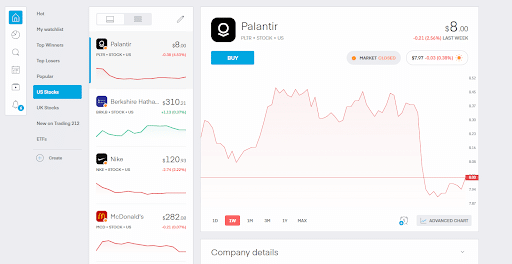
The account opening and funding process is among the simplest on the market, and trading is intuitive on both mobile and web.
Commission-free trading has to be funded somehow, and part of the answer is a share lending programme. Check the current terms and whether participation is optional in your account before signing up, as this has changed over time.
Other fees to know about:
- 0.7% for deposit methods other than bank transfer, free up to the first €2,000;
- Currency conversion of 0.15% on Invest accounts, 0.50% on CFD accounts;
- Overnight fees on CFDs.
The 0.15% conversion fee is worth highlighting: it is a third of what most competitors here charge, and for anyone buying US-listed assets regularly it usually matters more than the commission.
If you are considering joining, you can claim a free share when you sign up via this link. After verifying your identity and funding the account, use promo code “IITW” to claim one free share worth up to €100.
In short, Trading 212 is a good choice for beginners wanting a simple, effective and cheap way to buy stocks and ETFs. For more, see our detailed Trading 212 review.
Pros
-
Commission-free stocks and ETFs trading
-
Lowest currency conversion fee of the app-based brokers here (0.15%)
-
Intuitive and simple platform
- Free share upon signup
Cons
-
Limited product range: no bonds or options
-
Share lending programme
- Card deposit fee after the first €2,000
Disclaimer: Crypto-assets are high-risk and volatile. You could lose your invested capital, and these assets are not covered by protection schemes. Make sure you understand the risks before investing and whether you can afford to lose your money. Past performance doesn’t guarantee future results. Pies & AutoInvest is an execution-only service. Not investment advice or portfolio management. You are responsible for all investment and rebalancing decisions.
#3 eToro

eToro at a glance
52% of retail CFD accounts lose money.
Established in 2007, regulated by top-tier authorities and with over 40 million registered users, eToro is a well-known broker. It has been listed on the Nasdaq since May 2025 under the ticker ETOR.
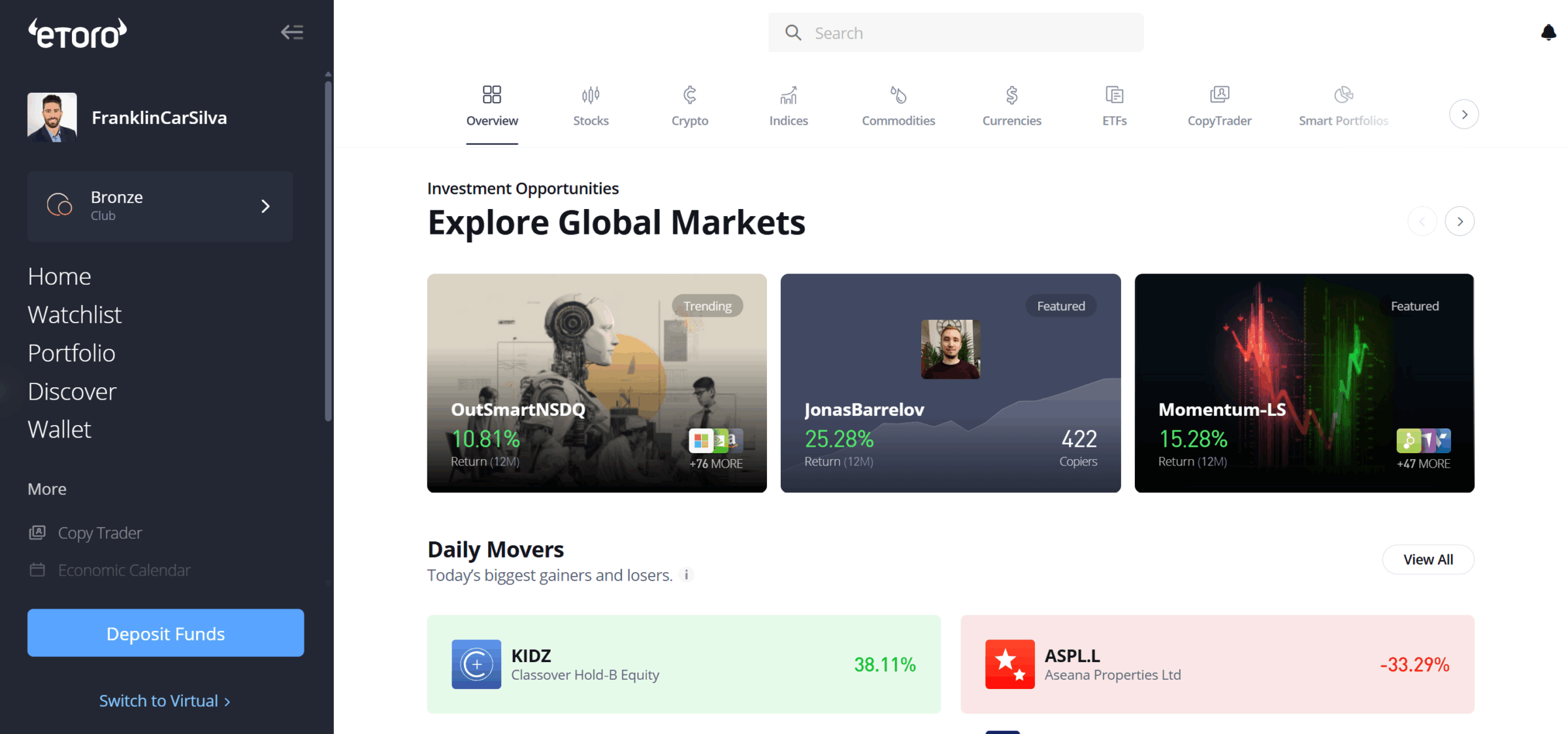
The platform is best known for its social trading feature, CopyTrader, which lets you follow and copy other investors’ trades and portfolios. There is also a wide selection of markets and products for investing on your own, including stocks, ETFs, cryptocurrencies and CFDs on stocks, ETFs, commodities, currencies, indices and cryptocurrencies.
Another distinctive feature is Smart Portfolios, an automated investing tool. Most are created and managed by the eToro Investment Team, with some managed by partners.
The platform is intuitive and suits beginners, with a demo account for practising using virtual funds. Account opening and funding are quick.
On costs, the picture changed recently and is worth understanding clearly:
- ETFs are commission-free, which is the strongest part of the offer for a long-term investor;
- Real stock trades carry a flat commission of $1 or $2, depending on your country and the exchange, charged when you open and again when you close. It is $0 for UK and Irish clients;
- Currency conversion applies when depositing or trading outside your account currency, and is the cost European investors most often underestimate;
- A fixed withdrawal fee of $5, with a $30 minimum withdrawal;
- 1% on buying and selling cryptocurrencies;
- No inactivity fee, removed in May 2026.
Overall, eToro suits beginners wanting a simple way to start investing through a well-known broker with a broad product range, and anyone specifically interested in copy trading. For more, see our detailed eToro review.
Pros
-
Intuitive, easy-to-use, and beginner-friendly platform
-
Commission-free ETF trading
-
No inactivity fee
-
Innovative features such as CopyTrader and Smart Portfolios
- Publicly listed, so it publishes audited accounts
Cons
-
Real stock trades carry a flat commission in most countries
-
Withdrawal fee ($5) with a $30 minimum
- High spreads on certain products
#4 Saxo

Saxo at a glance
62% of retail CFD accounts lose money.
Founded in 1992, Saxo is one of the longest-established global brokers, known for a wide product range of over 70,000 instruments, broad exchange access, and support for many base currencies.
Ownership changed recently. In March 2026 the Swiss private banking group J. Safra Sarasin completed its acquisition of a majority stake, with Daniel Belfer becoming CEO and founder Kim Fournais moving to Chairman. In July 2026 the group agreed to acquire Fournais’s remaining holding, subject to regulatory approval.
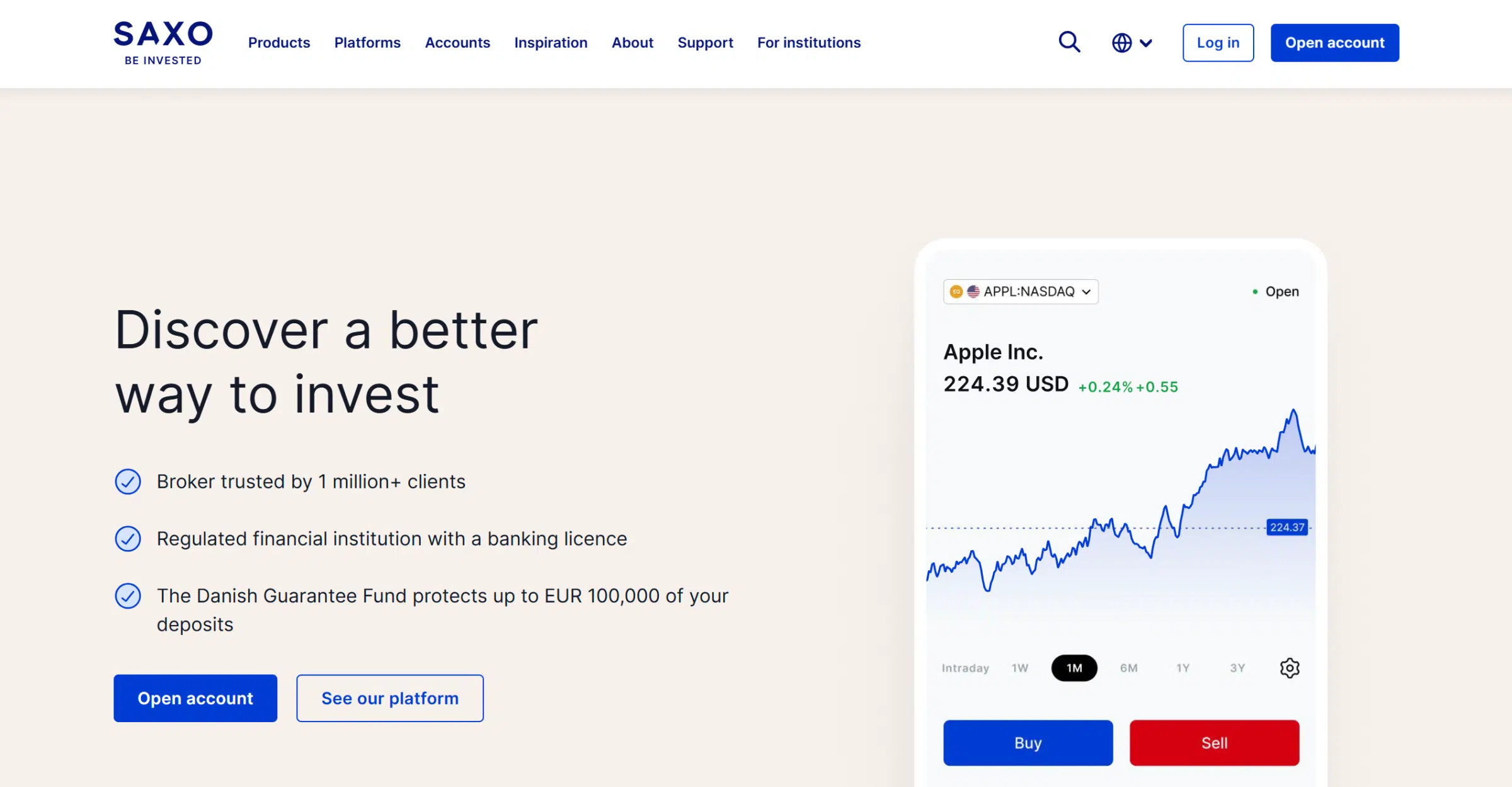
Saxo has always aimed at more sophisticated investors, offering advanced tools including TradingView integration. Its two proprietary platforms are SaxoInvestor, for those wanting a simpler interface, and SaxoTrader, available on web, desktop and mobile for active users.
Minimum deposits vary considerably by country of residence, and in some markets are among the highest in the industry, so check the figure that applies to you before applying. Saxo is also unavailable in some large markets outside Europe, including the US.
Three account tiers are available: Classic, Platinum ($200,000 minimum) and VIP ($1,000,000 minimum), each with its own pricing. US stock commissions run from 0.03% at the top tier up to 0.08% at Classic, with a $1 minimum.
The fee structure is complex, and there are additional charges to be aware of:
- Custody fees, which have been removed across core European markets but still apply in some jurisdictions;
- Currency conversion at 0.25%.
In short, Saxo is tailored to more experienced investors through its advanced tools, higher than average fees and denser interface. Those same qualities make it a poor fit for beginners.
Pros
-
Very wide selection of financial products
-
Advanced trading tools and data
- Reputable, bank-regulated broker with a long track record
Cons
-
Higher than average fees
-
Minimum deposits can be high depending on your country
- Not suitable for beginners
#5 Plus500

Plus500 at a glance
81% of retail CFD accounts lose money.
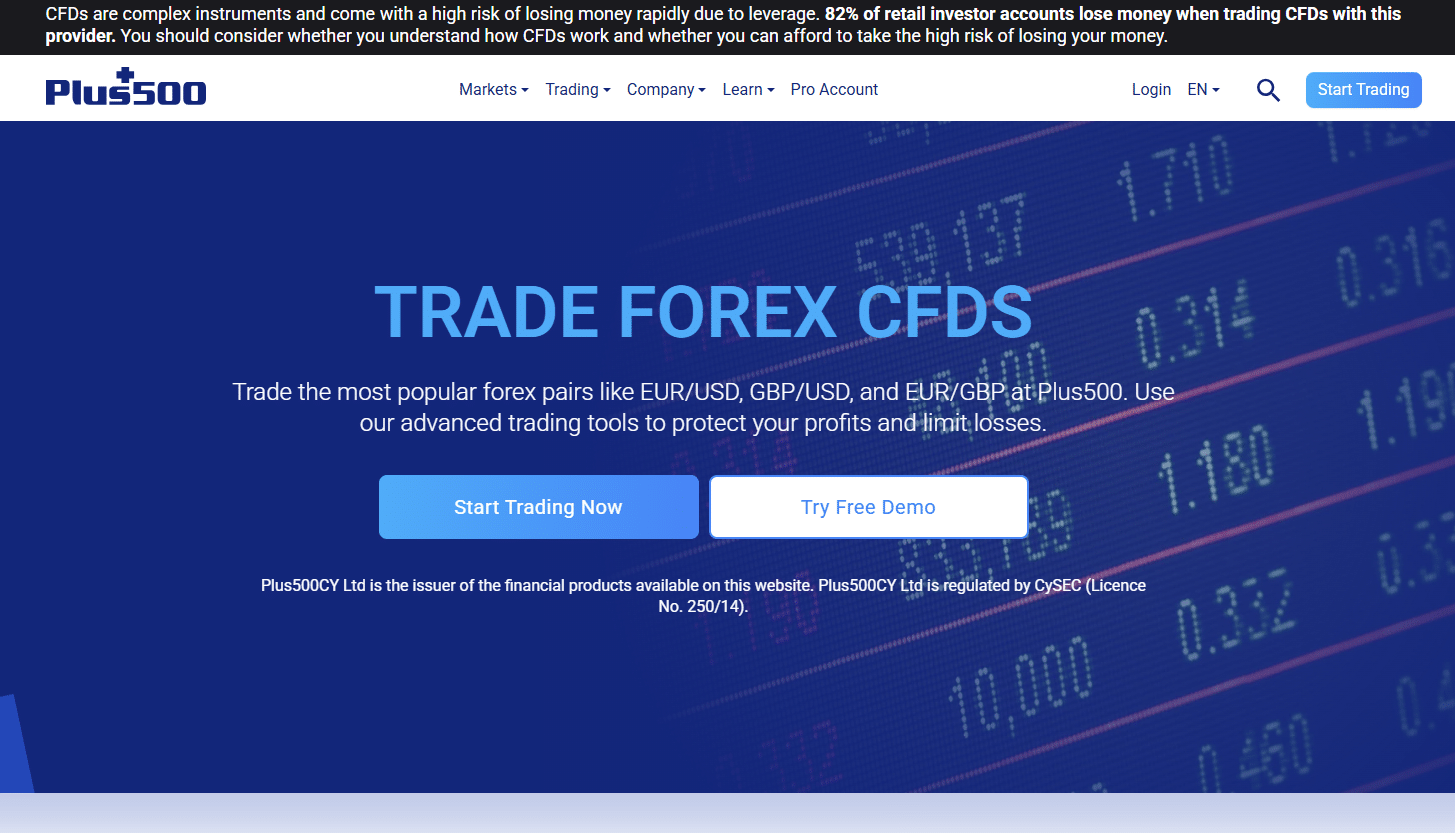
Founded in 2008, Plus500 is best known for commission-free trading across a wide choice of CFDs in its Plus500 CFD account. It also offers low-fee real share trading through Plus500 Invest.
The company is listed on the London Stock Exchange and available in over 50 countries, with 16 base currencies including USD, EUR and GBP.
The web platform, WebTrader, offers an intuitive interface accessible across devices including a mobile app, with a demo account for testing features using virtual funds.
Plus500 CFD costs come mainly from bid/ask spreads, which vary widely by product. On Plus500 Invest, each trade carries a fee depending on the exchange, as low as $0.006 per share for US stocks but considerably higher for EU stocks, where the minimum runs between €2 and €6 per trade.
There is also a currency conversion fee of up to 0.70% and a $10 monthly inactivity fee after three months without logging in to the CFD account.
Find more detail on Plus500 CFD fees here and Plus500 Invest fees here. For more on Plus500 generally, see our detailed Plus500 review.
Pros
-
Low fees and wide choice for CFD trading
-
Available in 50+ countries and supports 16 currencies
-
Intuitive interface with a demo account option
- Listed on the London Stock Exchange
Cons
-
Primarily a CFD broker
-
Inactivity fee after three months
- Relatively high fees for non-US stocks, and a 0.70% conversion fee
#6 IG

IG at a glance
67% of retail CFD accounts lose money.
IG is a well-established broker offering wide choice and competitive costs, primarily in CFDs and forex. The IG Group was established in 1974, is a constituent of the FTSE 250, and covers a very large number of markets.
The platform is available internationally with some exceptions, and offers six base currencies: USD, GBP, AUD, EUR, SGD and HKD. UK residents and those in its territories can also open a share dealing account giving access to real shares, ETFs and automated ETF portfolios through IG Smart Portfolio. More information here.
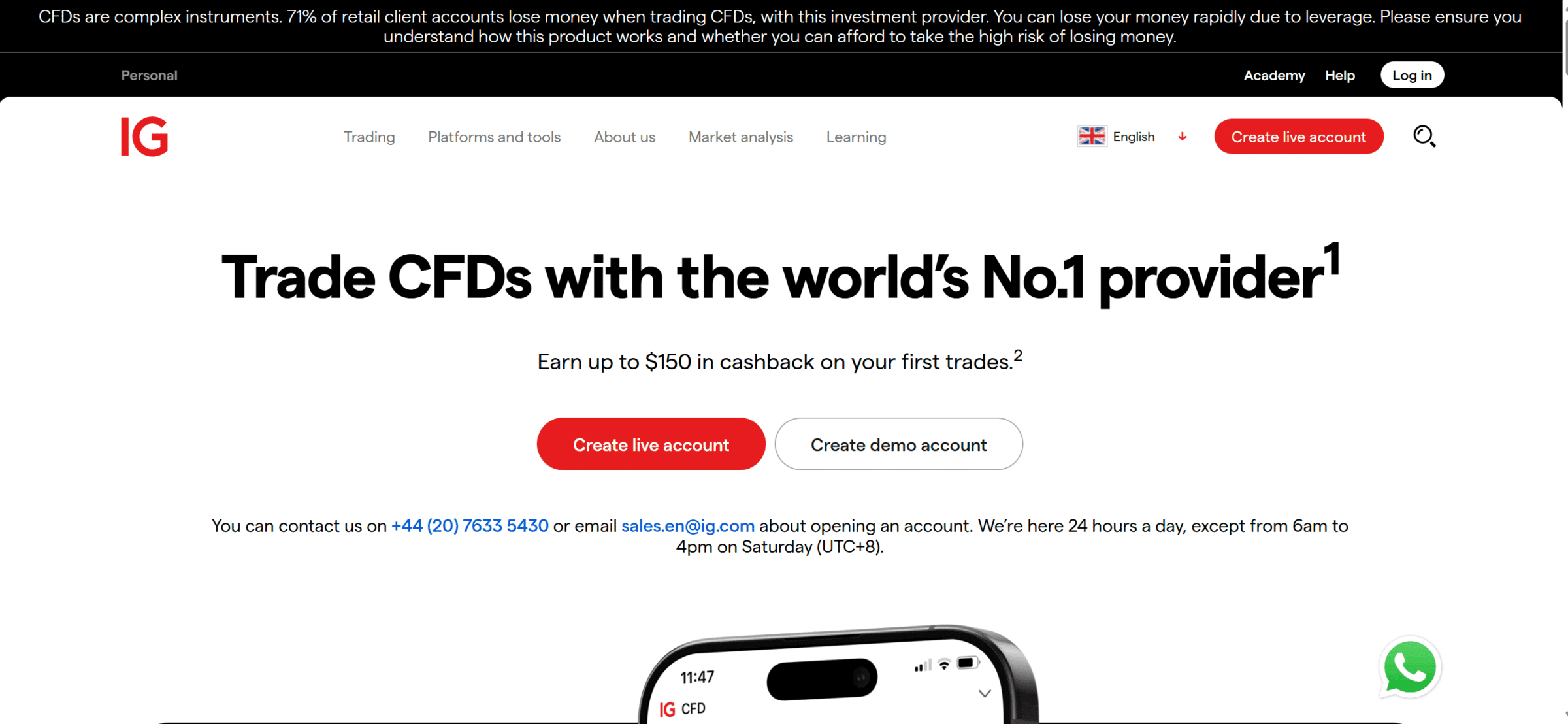
Most traders come to IG for its CFD and forex capabilities.
Platform features include:
- Extensive educational materials;
- 24-hour support;
- Weekend and extended hours trading;
- Fast execution;
- Access to MetaTrader 4;
- Advanced tools including a customisable screener and tailored news.
IG offers commission-free trading on most CFDs but adds its own spread on top of the market spread. The exception is share CFDs, offered at the real market price without added spread but with a commission on opening and closing.
Other fees include:
- FX conversion of 0.5%;
- Overnight fees, depending on the product;
- An inactivity fee after a period without activity;
- A custody fee on the UK share dealing account for accounts placing fewer than three trades per quarter.
You can review the full schedule at this link, as the specific amounts vary by region and account type.
In short, IG offers CFD and forex trading in a user-friendly interface with competitive costs, suited to both beginner and advanced traders thanks to its mix of educational material and advanced tools.
Pros
-
User-friendly trading platform
-
Competitive fees and spreads
-
Long track record and listed on the London Stock Exchange
- 24-hour support, educational materials and extended trading hours
Cons
-
Inactivity and share CFD fees
-
Share dealing account available only to UK residents
- Limited range of real investment products outside the UK
Bottom line
Choosing between brokers is a daunting task, and the honest answer is that no single one suits everyone. What matters is matching the broker to how you actually invest.
If you are leaving Swissquote over cost, the two clearest wins are Interactive Brokers for breadth and the lowest currency conversion cost, and Trading 212 for simplicity and a 0.15% conversion fee. If you want Saxo-level depth of product, expect to pay for it. If you trade CFDs or forex rather than investing long term, Plus500 and IG are built for that and the others are not.
One general point worth carrying into any comparison: the headline commission is rarely the largest cost. For anyone buying assets priced outside their account currency, the conversion fee usually is, and it ranges from roughly 0.002% at Interactive Brokers to 0.5% or more elsewhere on this page.
We hope this makes choosing a Swissquote alternative easier.