Spread betting is a uniquely British way to trade: you stake an amount per point of movement in a market, profits are currently free of capital gains tax and stamp duty for UK residents, and you can go long or short on thousands of instruments without owning the underlying asset.
In this article, we compare the best spread betting platforms available to UK residents, all authorised and regulated by the Financial Conduct Authority (FCA).
For related comparisons, see our guides to the best trading platforms in the UK and the best forex brokers in the UK.
Video summary
Best spread betting platforms in the UK
- Capital.com: Best overall, commission-free spread betting with strong education and a £20 minimum deposit
- Pepperstone: Best for raw spreads and platform choice
- IG: The pioneer of spread betting, with the widest market range
- OANDA: Best for low-stake forex spread betting
- CMC Markets: Best charting on a proprietary platform
Disclaimer: Investing involves risk of loss.

Spread bets and CFDs are complex instruments and come with a high risk of losing money rapidly due to leverage. 65% of UK retail investor accounts lose money when trading spread bets and CFDs with this provider.

72-95% of retail CFD accounts lose money.

67% of retail CFD accounts lose money.


69% of retail CFD accounts lose money.
Comparison of best brokers in the UK


For a list of brokers we do not recommend, you can visit our full list of broker reviews, and filter by “Not recommended”.
Other resources
- Check our Youtube channel! You will find step-by-step guides of how to invest in the S&P 500 on different apps, as well as other educational videos about investing and investment platforms.
- Explore our tools: Check our comparison tool, reviews, broker bonuses, broker interest rates, BrokerMatch, and others.
What is spread betting?
With a spread bet, you stake a pound amount per point of movement in a market, say £5 per point on the FTSE 100, rather than buying a number of shares or lots. If the market moves 20 points in your favour, you make £100; if it moves 20 points against you, you lose £100. You can bet on prices rising or falling, and positions are leveraged, meaning both gains and losses are amplified relative to your initial margin.
The structure matters for UK residents because spread betting profits are currently exempt from capital gains tax and stamp duty, unlike CFD or share trading profits. Tax treatment depends on individual circumstances and may change in the future, but for a consistently profitable trader, the difference is meaningful. The mechanics, margin, leverage, overnight financing on daily funded bets, are otherwise very similar to CFDs.
Broker reviews
Capital.com at a glance
Spread bets and CFDs are complex instruments and come with a high risk of losing money rapidly due to leverage. 65% of UK retail investor accounts lose money when trading spread bets and CFDs with this provider.
Capital.com serves UK clients through Capital Com (UK) Limited, authorised and regulated by the FCA (reference number 793714), and takes the top spot as the best all-round spread betting platform: commission-free pricing on over 3,000 markets, with all costs built into competitive spreads and no deposit, withdrawal, or inactivity fees.
The £20 minimum deposit is the lowest paid entry point on this list, and the platforms are a genuine strength: Capital.com’s own clean web and mobile apps, TradingView for advanced charting, and MetaTrader 4. Major index spread bets can be placed 24 hours a day, five days a week.
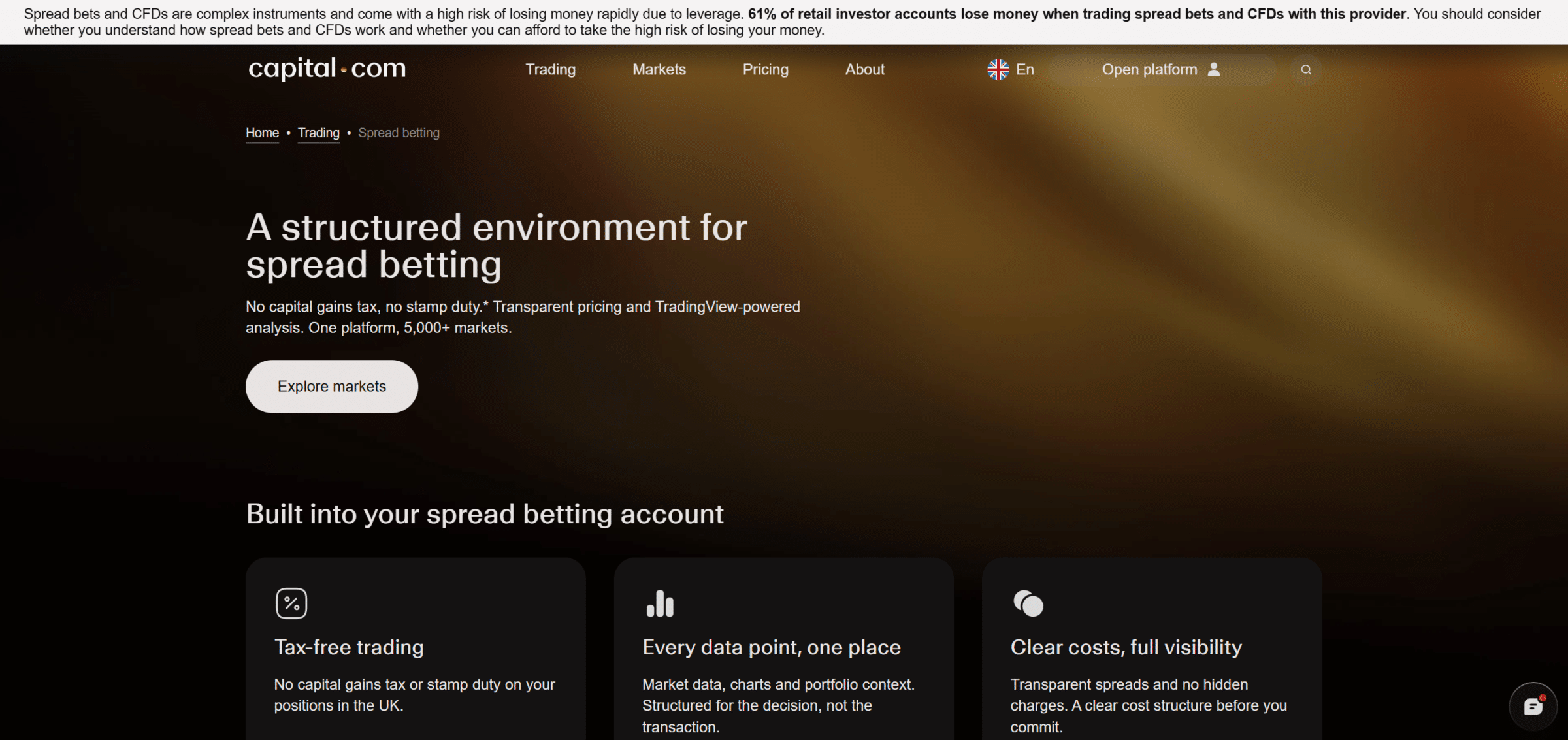
For traders newer to spread betting, Capital.com is arguably the best place to learn: the Investmate education app, extensive in-platform courses, and AI-powered insights that analyse your own betting patterns and flag behavioural biases before they become expensive habits.
The limitation for high-volume traders is the absence of raw pricing: at scale, spread-only costs more than Pepperstone’s Razor structure. For everyone else, the combination of low entry point, education, and platform quality is the strongest overall package.
Pros
- Low commissions on US stock trading
- No monthly inactivity fee
- The broadest product and markets range in the brokerage industry
- Demo account
- Excellent reputation (founded in 1978)
- Extensive research and Education tools
- Has a modern mobile trading app to trade Stocks, Options and ETFs, ideal for novice investors, IBKR GlobalTrader.
- Offers interest on uninvested cash balances
Cons
- Complicated and lengthy account opening process (but fully online)
- Steeper learning curve for beginners
- Website is difficult to navigate
- Interactive Advisors (Robo-advisor feature) is only available for US customers
Want to know more? Check our Capital.com review and visit Capital.com’s website.
Spread bets and CFDs are complex instruments and come with a high risk of losing money rapidly due to leverage. 61% of retail investor accounts lose money when trading spread bets and/or CFDs with this provider. You should consider whether you understand how spread bets and CFDs work, and whether you can afford to take the high risk of losing your money.
Pepperstone at a glance
72-95% of retail CFD accounts lose money.
Founded in 2010, Pepperstone brings the pricing of a raw spread broker to the tax structure of spread betting. UK clients trade with Pepperstone Limited, authorised and regulated by the FCA (reference number 684312), with FSCS protection of up to £85,000 and segregated client funds.
Most spread betting providers only offer all-in spreads. Pepperstone’s Razor account brings raw pricing to spread betting: spreads from 0.0 pips on major forex pairs plus a small commission-equivalent built into the pricing, while the Standard account offers straightforward spread-only pricing from around 1.0 pip. There is no minimum deposit, and deposits and withdrawals are free.

Execution is the other differentiator: orders route through low-latency infrastructure with execution measured in milliseconds, and the group reports a 99.32% order fill rate (Pepperstone Group data, as at 31 March 2026). For active spread bettors, slippage control matters as much as the headline spread.
Platform choice is unmatched among spread betting providers: MetaTrader 4, MetaTrader 5, cTrader, TradingView integration, and Pepperstone’s own platform, so algorithmic and discretionary traders alike can spread bet from the environment they prefer, something none of the traditional spread betting firms on this list can offer.
Pros
- Acessible and responsive platform
- Low spreads
- No dealing commissions
- Demo Account
- Top-tier regulators
Cons
- No ETF offering
- Inactivity fee ($10 per month after no login activity in 3 months)
- High overnight funding fees
- Very little research and education provided
Want to know more? Check our Pepperstone review and visit Pepperstone’s website.
Spread bets and CFDs are complex instruments and come with a high risk of losing money rapidly due to leverage. 75.3% of retail investor accounts lose money when trading spread bets and CFDs with this provider. You should consider whether you understand how spread bets and CFDs work, and whether you can afford to take the high risk of losing your money.
IG at a glance
67% of retail CFD accounts lose money.
IG invented financial spread betting in 1974, and half a century later it remains the reference point for the industry. UK spread bets are provided through IG Index Ltd, authorised and regulated by the FCA (reference number 114059), and the parent, IG Group, is listed on the London Stock Exchange as a FTSE 250 company.
The standout feature is range: over 17,000 markets, from major indices and forex to individual small-cap shares, sectors, bonds, and weekend markets on selected indices and crypto, so you can react to news when everything else is closed. Spreads are competitive at the core: FTSE 100 from 1 point and EUR/USD from 0.6 pips.
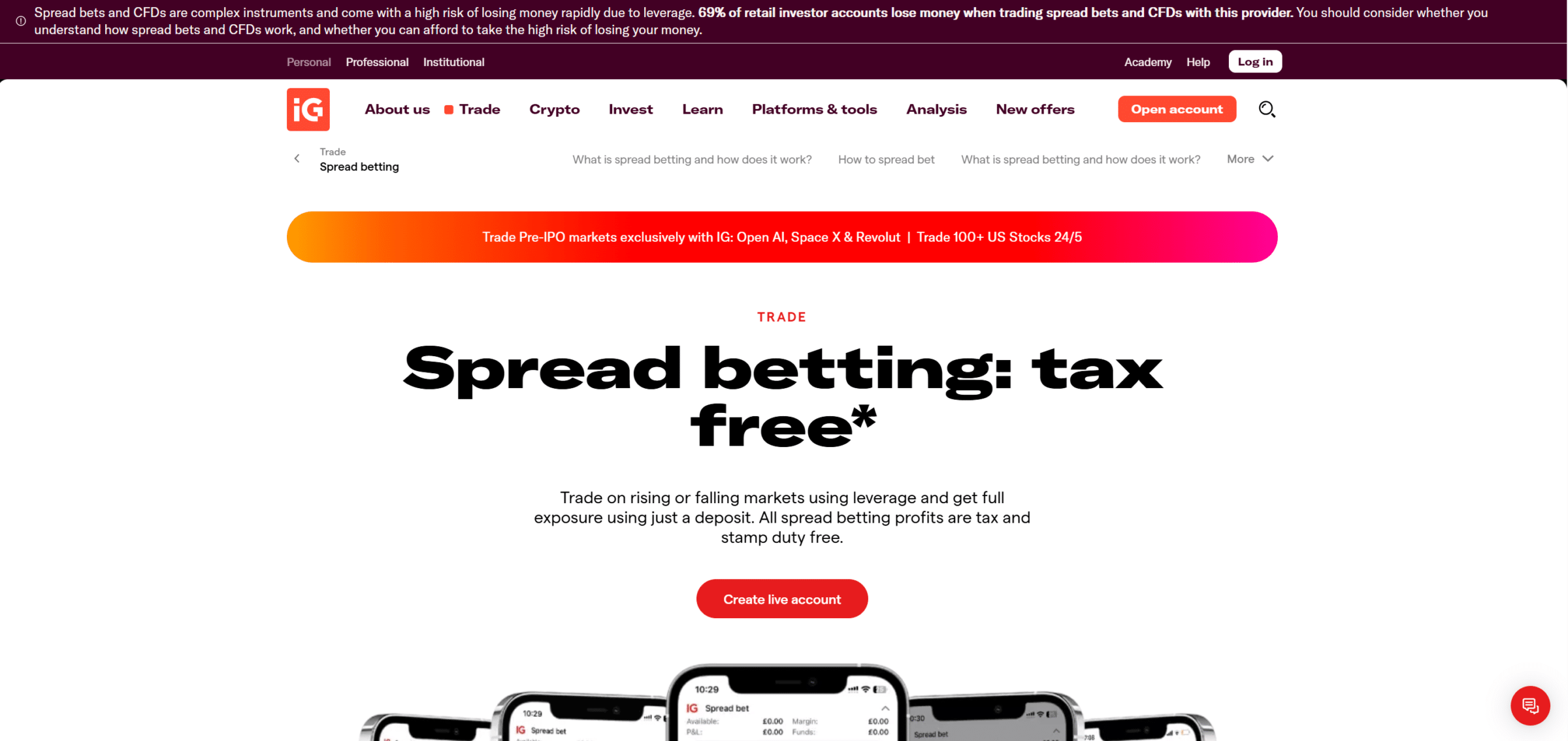
Platform depth matches the market range: IG’s own web and mobile platforms, ProRealTime advanced charting, MetaTrader 4, and level II access for professionals. Research, news, and the IG Academy education hub round out a very complete offering.
The trade-offs are cost-related at the margins: some peripheral markets carry wider spreads, and the £250 card minimum deposit is the highest on this list, although funding by bank transfer has no minimum.
Pros
- Acessible and responsive platform
- Low spreads
- No dealing commissions
- Demo Account
- Top-tier regulators
Cons
- No ETF offering
- Inactivity fee ($10 per month after no login activity in 3 months)
- High overnight funding fees
- Very little research and education provided
Want to know more? Visit IG’s website.
Spread bets and CFDs are complex instruments and come with a high risk of losing money rapidly due to leverage. 69% of retail investor accounts lose money when trading spread bets and CFDs with this provider. You should consider whether you understand how spread bets and CFDs work, and whether you can afford to take the high risk of losing your money.
OANDA at a glance
OANDA has been a reference name in retail forex since the 1990s, and UK clients are served by OANDA Europe Limited, authorised and regulated by the FCA (reference number 542574), with spread betting available specifically for UK residents alongside CFDs.
The forex focus shows in the pricing: EUR/USD from 0.6 pips and GBP/USD from 0.9 pips on spread-only pricing, aggregated in real time from OANDA’s liquidity providers. What makes OANDA particularly attractive for newer spread bettors is stake flexibility: bets can be sized from as little as £0.01 per point, so you can trade live markets with genuinely small risk while learning.
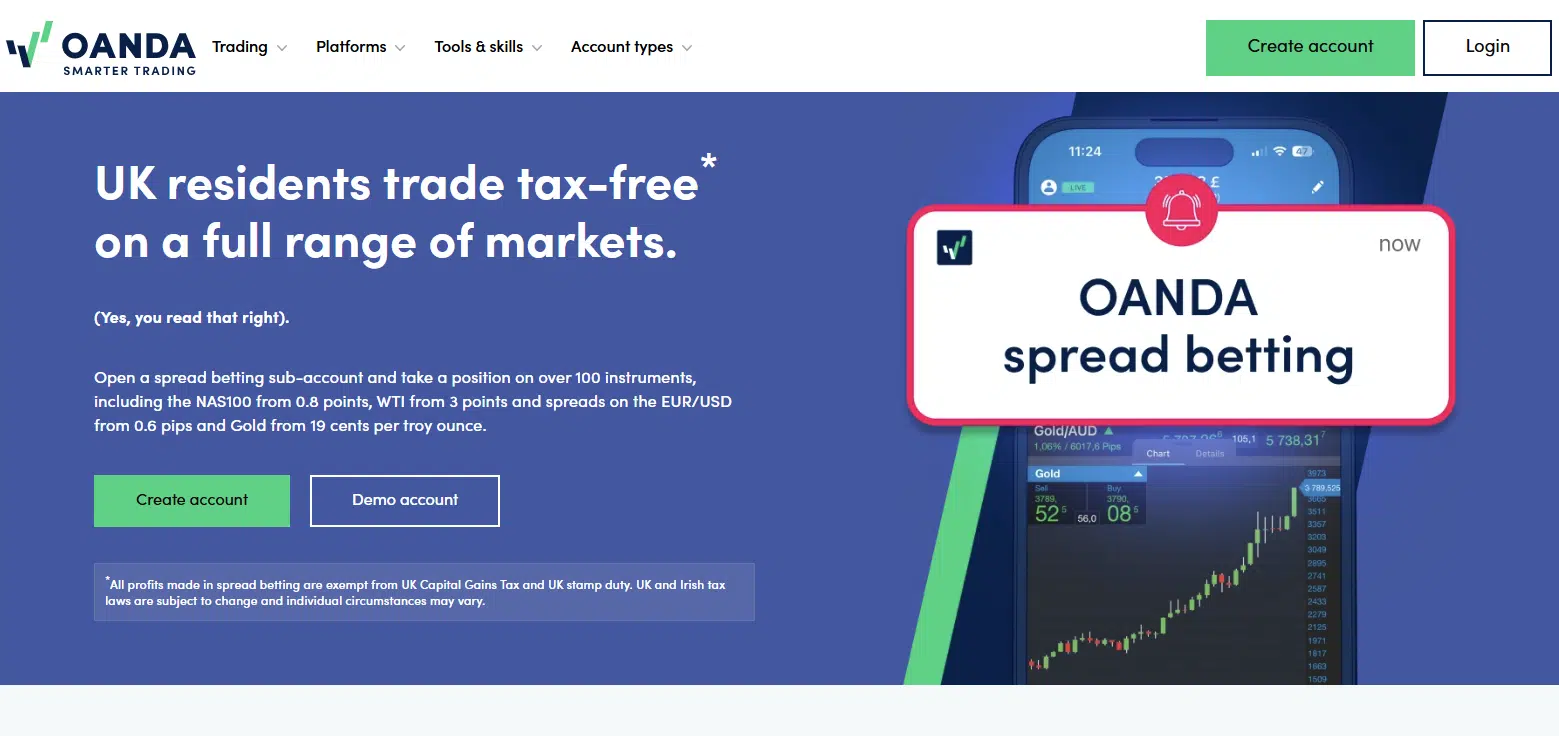
Platform choice is broad for a forex specialist: the proprietary OANDA Trade web and mobile platforms, plus MetaTrader 4, MetaTrader 5, and TradingView, with free Autochartist pattern-recognition signals included. There is no minimum deposit.
The trade-off is range: around 150 markets covers forex, major indices, and commodities well, but there are no individual shares to spread bet on, which keeps OANDA a specialist choice rather than an all-rounder.
Pros
- Acessible and responsive platform
- Low spreads
- No dealing commissions
- Demo Account
- Top-tier regulators
Cons
- No ETF offering
- Inactivity fee ($10 per month after no login activity in 3 months)
- High overnight funding fees
- Very little research and education provided
Want to know more? Visit OANDA’s website.
Spread bets and CFDs are complex instruments and come with a high risk of losing money rapidly due to leverage. 76.6% of retail investor accounts lose money when trading spread bets and CFDs with this provider. You should consider whether you understand how spread bets and CFDs work, and whether you can afford to take the high risk of losing your money.
CMC Markets at a glance
69% of retail CFD accounts lose money.
CMC Markets has been running since 1989 and, like IG, is listed on the London Stock Exchange. UK clients trade with CMC Markets UK plc, authorised and regulated by the FCA (reference number 173730).
The Next Generation platform is the main attraction: arguably the best proprietary charting in the spread betting industry, with 13 chart types, over 40 indicators, pattern recognition tools, and client sentiment data showing how other CMC traders are positioned. MetaTrader 4 is available for those who prefer it.
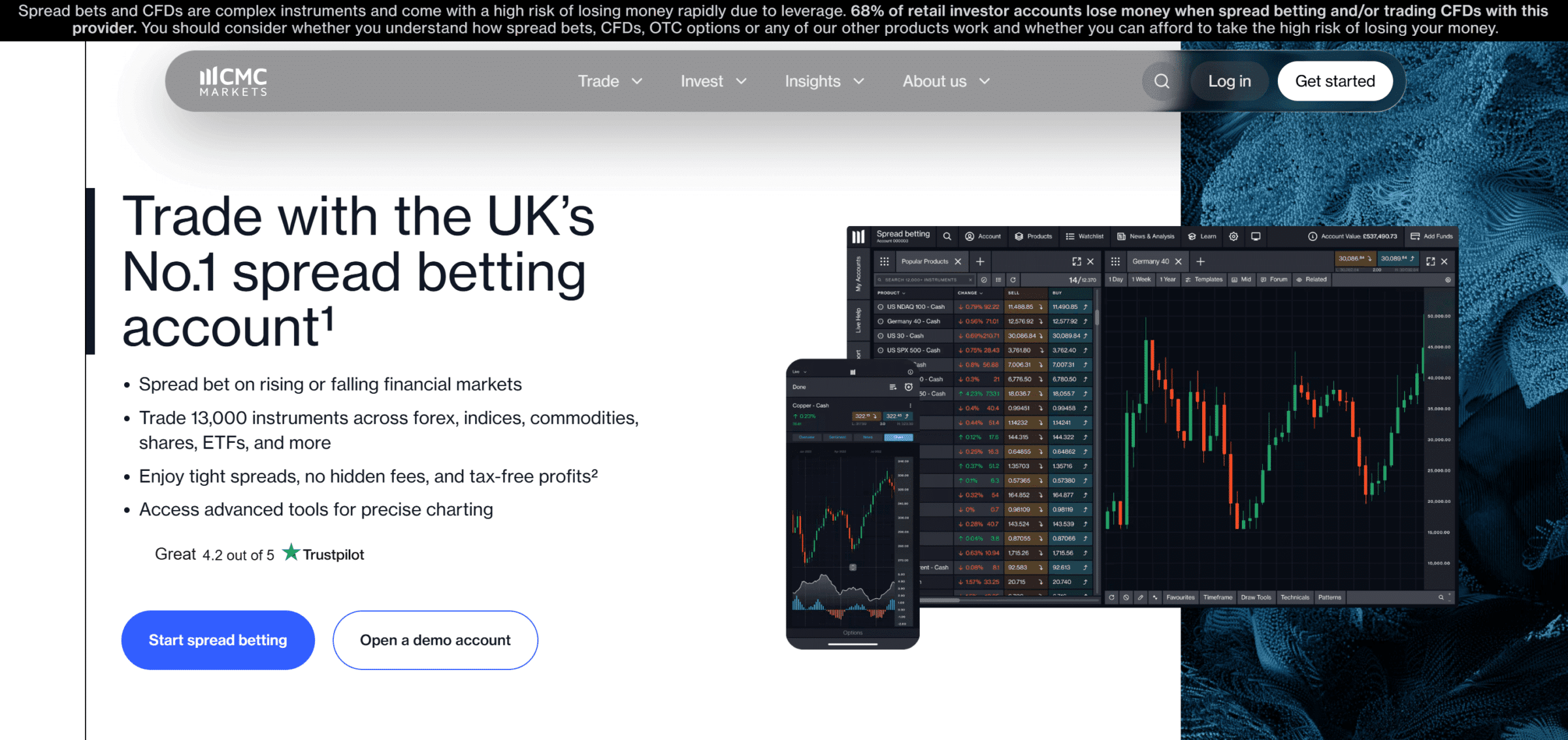
Market coverage is deep where it counts: over 12,000 instruments, including 330+ forex pairs, more than any other provider on this list, with tight pricing on core markets such as gold from 0.2 points. Loyalty pricing schemes (Price+ and Alpha) reduce spreads for active traders.
There is no minimum deposit, and education and market analysis are solid. The main gap versus Pepperstone is the absence of raw pricing and third-party platforms beyond MT4; versus IG, a somewhat narrower share range.
Pros
- Acessible and responsive platform
- Low spreads
- No dealing commissions
- Demo Account
- Top-tier regulators
Cons
- No ETF offering
- Inactivity fee ($10 per month after no login activity in 3 months)
- High overnight funding fees
- Very little research and education provided
Want to know more? Visit CMC Markets’ website.
Spread bets and CFDs are complex instruments and come with a high risk of losing money rapidly due to leverage. 68% of retail investor accounts lose money when spread betting and/or trading CFDs with this provider. You should consider whether you understand how spread bets and CFDs work, and whether you can afford to take the high risk of losing your money.
How we chose the best spread betting platforms
Our team has professional experience in finance and portfolio analysis, and we have reviewed well over 100 brokers and trading platforms since we started publishing comparisons. This ranking follows the same methodology we apply across the site.
First, regulation: we only considered providers authorised by the FCA for their UK entity, verified directly on the Financial Conduct Authority register, with FSCS eligibility checked where applicable. Spread betting is a UK-specific product, so offshore alternatives were excluded by definition.
Second, the all-in cost of betting: spreads on the markets people actually trade (FTSE 100, EUR/USD, gold, US indices), overnight financing on daily funded bets, and non-trading fees, measured against published pricing and our own account testing rather than headline claims. We paid attention to how spreads behave in volatile conditions, not just at their advertised minimums.
Third, platform quality, execution, and market range: charting, order types, published execution statistics, mobile experience, and the breadth of instruments available for spread betting specifically, which is often narrower than a provider’s CFD range.
Finally, a note on independence: we may earn a commission when you open an account through some links on this page, at no extra cost to you. This never determines our rankings, which reflect the criteria above, and we regularly re-verify spreads, fees, and regulatory details to keep this comparison current.
Spread betting and tax
Under current UK rules, spread betting profits are free of capital gains tax and stamp duty, because spread bets are legally structured as bets rather than investments. This is the main reason a UK trader might choose a spread bet over an economically identical CFD, where gains are subject to capital gains tax above the annual exemption.
Two caveats matter. Tax treatment depends on individual circumstances: if trading is your primary source of income, HMRC’s treatment can differ. And tax rules can change in the future. Losses on spread bets also cannot be offset against other capital gains, precisely because they sit outside the capital gains regime, a real disadvantage for the majority of traders who lose money.
Final thoughts
Capital.com takes the top spot as the best all-round spread betting platform, combining commission-free pricing, education, and a low entry point. Pepperstone is the pick for cost-focused traders who want raw spreads and platform choice, IG offers unmatched market range from the firm that invented the product, OANDA suits forex-focused traders who value small stakes and transparent pricing, and CMC Markets has the best proprietary charting.
Whichever provider you choose, confirm the FCA authorisation on the Financial Services Register, start with a demo account, and remember that the tax advantage only matters if you are profitable, which most retail spread bettors are not. For related comparisons, see our guides to the best trading platforms in the UK and the best forex brokers in the UK.
This article is for information purposes only and does not constitute investment advice, tax advice, or a recommendation. Spread bets are leveraged products and carry a high level of risk. Between 61% and 76.6% of retail investor accounts lose money when trading spread bets and CFDs with the providers listed in this article. Tax treatment depends on individual circumstances and may change.