


Hello, fellow investor! In this article, we will give you our honest review of XTB to help you determine whether it is the right online broker for you!
XTB is a world leader in forex and CFD trading, listed on the Warsaw Stock Exchange (ticker: XTB). As a publicly traded company, XTB must publicly disclose its financial statements – bringing a meaningful level of financial transparency that most private brokers don’t offer.
On the negative side, XTB has a more focused product portfolio than full-service brokers (no individual bonds or mutual funds), though it now offers vanilla options on US stocks and ETFs alongside its CFD, real stocks, ETFs, and FX range. XTB also offers an Investment Plan feature for recurring ETF investing, and fractional shares from €10.
With over 1.9 million clients globally, more than two decades of operating history (founded 2002), offices across 13+ countries, and regulation by multiple top-tier authorities including the FCA (UK), KNF (Poland), CySEC (Cyprus), and DFSA (Dubai), XTB has proven resilient through several financial crises and intense industry competition – giving solid grounds to consider it a safe and reliable choice.
That’s the XTB review in a nutshell. For a deeper look at fees, products, platforms, and what XTB is actually like to use as a customer, keep reading.
Overview
Founded in 2002, XTB is a global online broker headquartered in Warsaw, Poland, and listed on the Warsaw Stock Exchange (ticker: XTB). The business model originally focused on CFD and forex trading – earning XTB multiple awards as a leading CFD and FX broker over the years. Over time, XTB has expanded substantially into the real-stocks-and-ETFs space, becoming a competitive option for long-term investors alongside its CFD heritage. By 2026, the company serves 1.9 million+ clients across more than 13 countries.

XTB offers two main trading platforms: xStation 5 (web and desktop) and xStation Mobile (iOS and Android). Both offer strong search functionality, high customisation, and a user-friendly experience for beginners (a meaningful improvement compared with where the platforms were a few years ago).
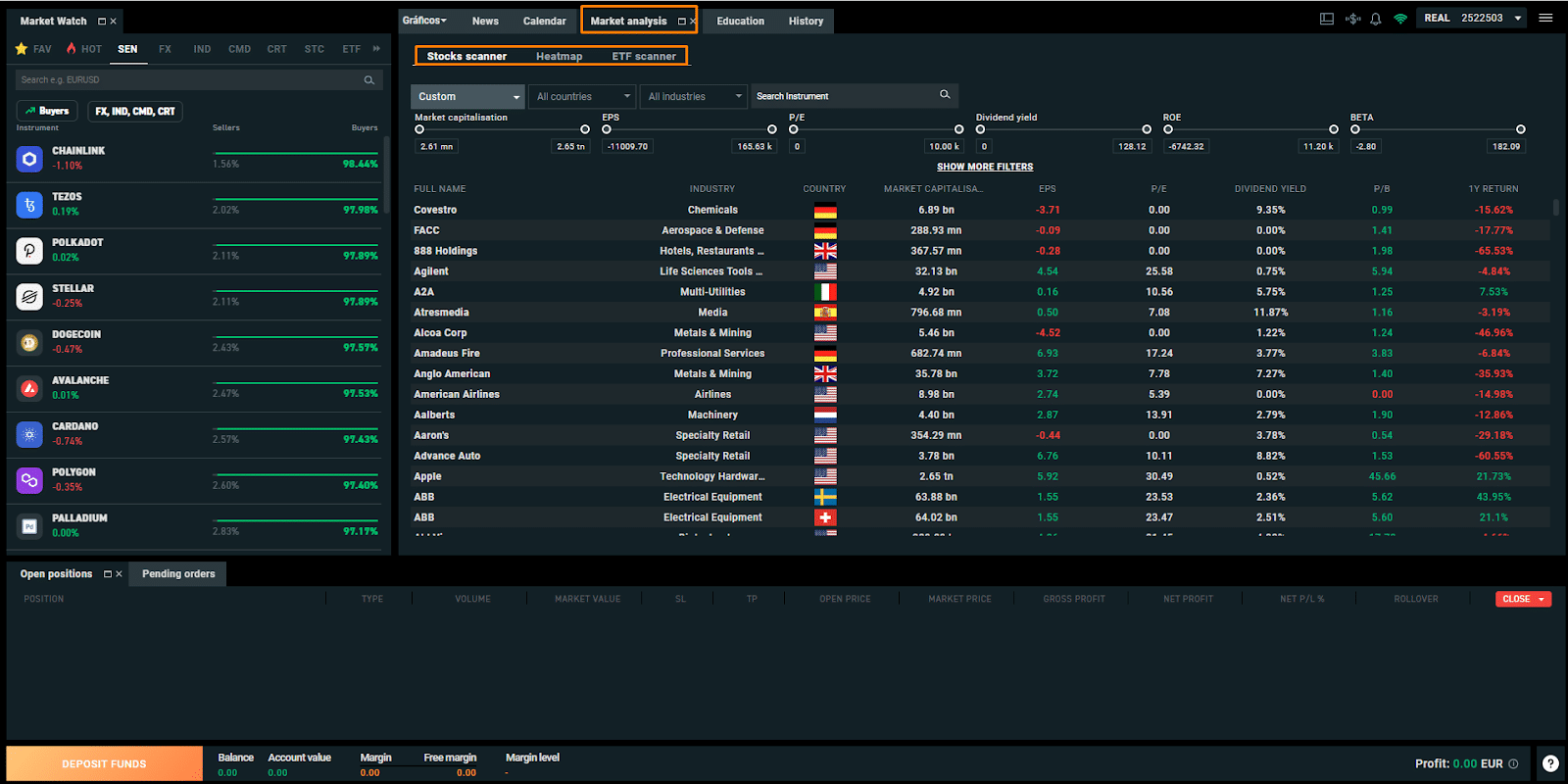
The toolkit leans toward technical analysis rather than fundamental research, though XTB has continued to expand its fundamental features – including its “market analysis” tool, which lets you filter stocks and ETFs by fundamental indicators. XTB also provides a strong educational library through XTB Academy with courses, webinars, and trading content for beginners and intermediate users.
XTB’s forex and stock index CFD spreads are competitive, real stocks and ETFs trade at 0% commission up to €100,000 of monthly turnover (then 0.2%, €10 minimum), and account opening is fully digital and typically takes under an hour. Deposits and withdrawals are fast and easy, and a free demo account makes it straightforward to familiarise yourself with the platform before committing real money.
In terms of products, XTB’s offering varies by region but typically includes over 9,500 financial instruments across real stocks, ETFs, CFDs (on stocks, indices, commodities, forex, and crypto), and vanilla options on US stocks and ETFs. Fractional shares are available from €10, and the Investment Plan feature allows automated recurring contributions into ETF baskets – particularly useful for long-term portfolio building.
Highlights
| 🗺️ Supported countries | Worldwide – main exclusions: US, Canada (served via XTB FR for residents), and some restricted jurisdictions |
| 💰 Stocks and ETFs fees | 0% commission up to €100k monthly turnover (then 0.2%, €10 minimum) |
| 💰 Crypto and CFD fees | Spread-based (competitive on forex and major indices; wider on crypto CFDs) |
| 💰 Currency conversion fee | 0.50% |
| 💰 Inactivity fee | €/$/£10 per month after 12 months of no trading, combined with no deposits in the previous 90 days |
| 💰 Withdrawal fee | €/$/£5 for withdrawals under €/$/£50; free above |
| 💵 Minimum deposit | €/$/£1 (fractional shares from €10) |
| 📍 Products offered | Real stocks, ETFs, vanilla options* on US stocks/ETFs, CFDs on stocks, forex, indices, commodities, and cryptocurrencies; Investment Plans for recurring ETF investing |
| 🎮 Demo account | Yes (free, with virtual funds) |
| 📜 Regulatory entities | FCA (UK), KNF (Poland), CySEC (Cyprus), DFSA (Dubai), FSC (Belize) |
| 📈 Listed on | Warsaw Stock Exchange (ticker: XTB) |
*Options are live in Cyprus, Czech Republic, France, Germany, Portugal, Slovakia and Spain.
Pros and cons
Pros
- 0% commission on stock and ETF trading (only applicable to some EU countries)
- 0% commission on Stock and ETF CFDs
- Fractional Shares
- Low Forex spreads
- Customizable trading platform (charts and workspace)
- Demo account
- No minimum account deposit
- Valuable education materials
- Top-tier Regulators
Cons
- Complex trading platform for a beginner
- Limited product portfolio offering
- Withdrawal fees for transfers below $100 or €200
- Inactivity fee (€10/monthly after 1+ year with no activity plus no deposit in the last 90 days)
Trading platform
XTB has a web (xStation 5) and mobile (xStation Mobile) trading platform. Below, we’ll help you navigate through XTB’s web trading app.
After login, you will be presented with the following dashboard:
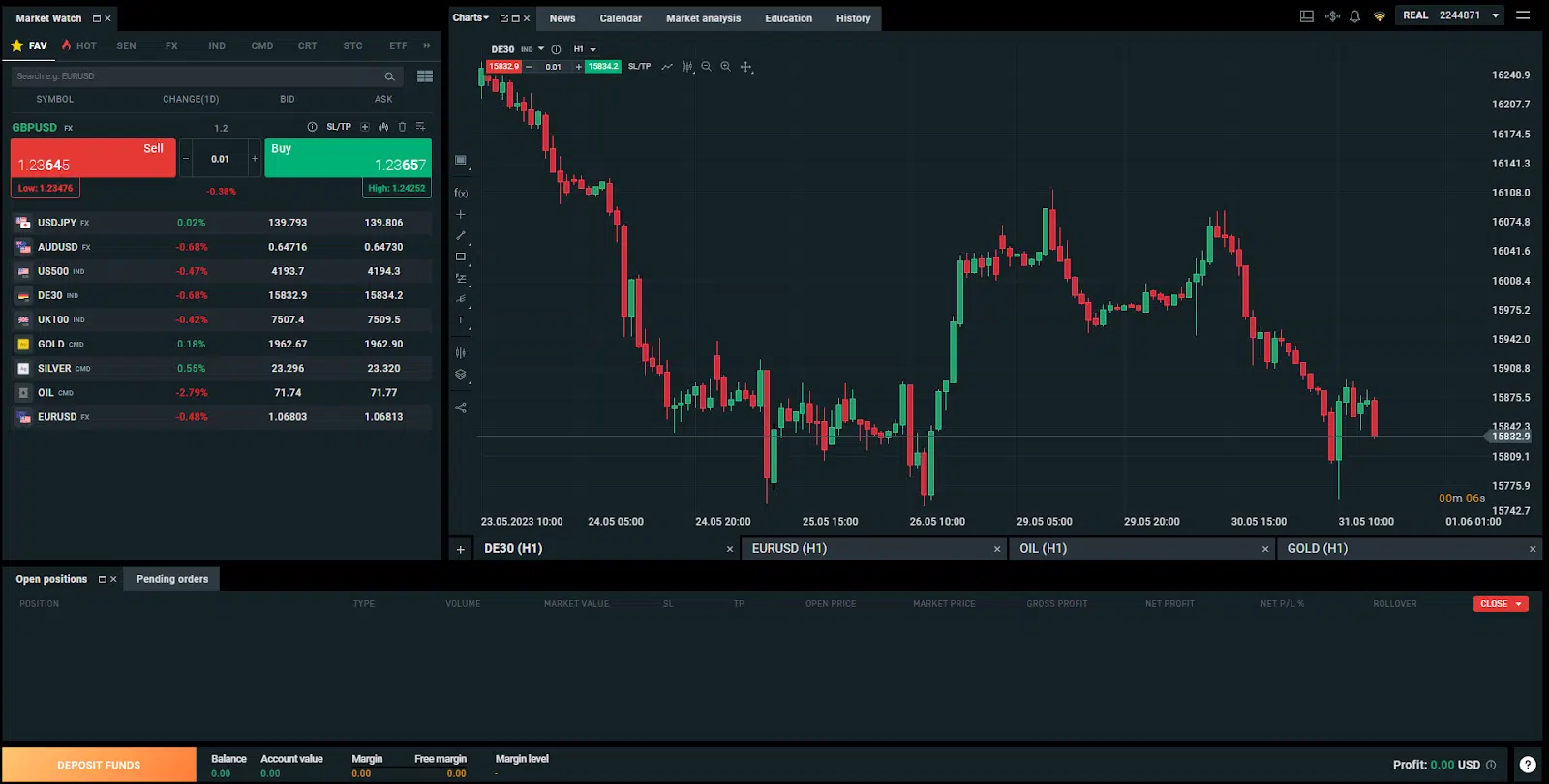
On the top left corner, you can search for the asset class and instrument type (“FX” for Forex, “IND” for indices, “CMD” for commodities, and so on). If you already know what to invest in, you can use the search bar instead.
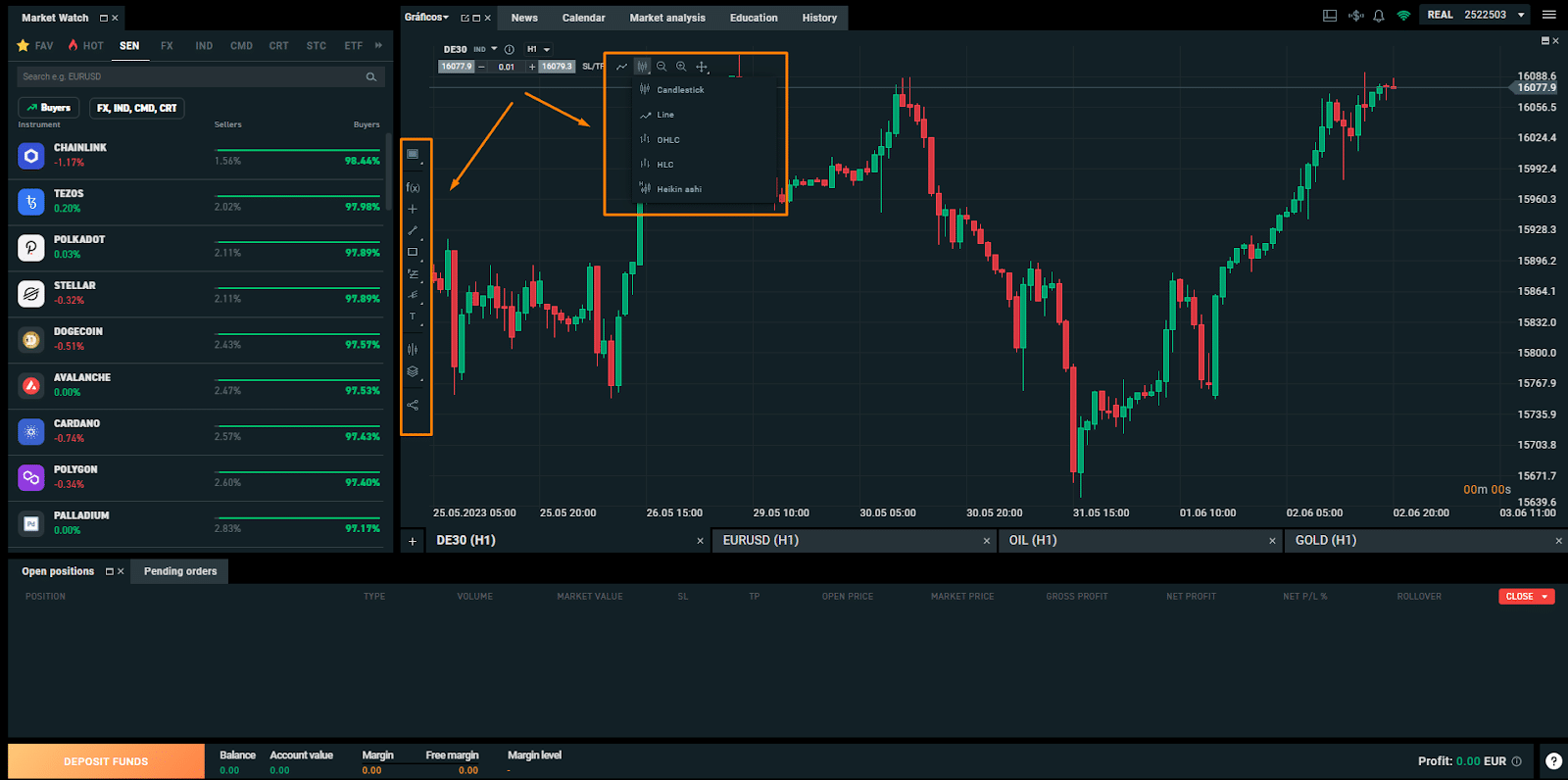
Going to the right, you will quickly notice a sizeable graphic representation of the asset selected (in this case: “DE30”, the German Index). It includes several technical indicators to improve your analysis, including Fibonacci retracements, trendlines, and Elliot Waves:
By clicking on “Market Analysis”, you get valuable tools such as Stock and ETF scanners to quickly selected the best stocks/ETFs according to your criteria:
At the bottom, you have a summary of your open positions, current account balance, and profit/loss.
Markets and products
XTB’s product and market offerings vary slightly by region. In total, the platform provides real stocks, ETFs, vanilla options (on US stocks and ETFs), and CFDs on stocks, forex, indices, commodities, and cryptocurrencies.
In December 2024, XTB launched its Flexible Stocks & Shares ISA in the UK, where eligible investors can:
- Invest in over 3,000 stocks and 700+ ETFs with 0% commission up to a monthly trading volume equivalent to €100,000 (then 0.2%, minimum £10). A 0.5% currency conversion fee may apply on non-GBP trades.
- Earn competitive interest on GBP uninvested cash (calculated daily, paid monthly).
- Benefit from the ISA’s tax-free wrapper – no UK tax on interest, dividends, or capital gains. Withdraw and replace funds within the same tax year without affecting your annual ISA allowance.
| Products | Available? |
| Real stocks | ✔ (3,000+ across 16 exchanges) |
| ETFs | ✔ (300+ across major categories) |
| Bonds | ✘ |
| Mutual funds | ✘ |
| Options | ✔ (vanilla options on US stocks/ETFs, EU only) |
| Futures | ✘ |
| Forex | ✔ (CFDs) |
| Cryptocurrencies | ✔ (CFDs) |
| Commodities | ✔ (CFDs) |
| Indices | ✔ (CFDs) |
| Investment Plans | ✔ (automated recurring ETF contributions) |
- Stocks: over 3,000 names across 16 international exchanges (US, UK, EU, plus selected Asian and CEE markets). Fractional shares available from €10 per trade, with 0% commission up to €100,000 in monthly turnover (then 0.2%, €10 minimum). Includes free real-time quotes and a built-in stock screener.
- ETFs: over 700 ETFs covering indices, sectors, themes, and commodities. Same fee structure as stocks – €10 minimum trade, commission-free up to €100,000 monthly volume. An ETF screener and Investment Plan automation tools are also available.
- Options: XTB offers American-style vanilla options on US stocks and ETFs (Apple, NVIDIA, Tesla, S&P 500, Nasdaq, etc.). Buyer’s risk is limited to the premium paid, and all options are cash-settled with no physical delivery of the underlying asset. Note: vanilla options are currently available only in selected EU countries.
- Forex: through CFDs, leverage up to 30x for EU/UK retail clients (under ESMA/FCA caps) or up to 500x for non-EU/UK clients onboarded under XTB International (Belize). Spreads start at 0.5 pips on EUR/USD, with 70+ currency pairs available.
- Indices: via CFDs, leverage up to 20x for EU/UK retail clients (or up to 500x for non-EU/UK clients). 35+ index CFDs available with competitive spreads on major benchmarks (S&P 500, Nasdaq 100, DAX, FTSE 100, Nikkei).
- Commodities: via CFDs, leverage up to 10x for EU/UK retail clients (up to 500x for non-EU/UK clients). 20+ commodity CFDs including gold, silver, oil, natural gas, and agricultural products. Spreads start at very competitive levels on gold and silver.
- Cryptocurrencies: CFDs on 50+ crypto pairs (BTC, ETH, SOL, XRP, ADA, DOGE, and others) with leverage up to 2x for EU/UK retail clients (under ESMA rules). Spreads on crypto CFDs are wider than on forex pairs given the underlying volatility.
CFDs
| Instrument (all as CFDs) | Number of instruments | Spreads | Leverage* |
| Stocks | +3,000 | Low | None |
| ETFs | +300 | Low | None |
| Forex | +50 | From 28 pips | Up to 30x |
| Indices | +35 | From 39 pips | Up to 20x |
| Commodities | +20 | From 1 pip | Up to 10x |
| Cryptocurrencies | +50 | From 22 pips | Up to 2x |
*Leverage can be higher (up to 500x) in countries outside Europe and the UK.
Fees snapshot
XTB’s fee structure is somewhat less transparent than at some other brokers – it varies depending on your account type, the jurisdiction you’re in, and which entity onboards you (EU-regulated vs XTB International in Belize). Below is a snapshot of fees for the Standard account type.
| Fee type | Classification |
| Real stocks and ETFs | 0% commission up to €100k monthly turnover (then 0.2%, €10 minimum) |
| Stock CFDs and ETF CFDs | 0% commission (spread-based) |
| Forex CFDs | Competitive spreads (from 0.5 pips on EUR/USD), no commission |
| Commodity CFDs | Competitive spreads on gold, silver, oil, gas |
| Indices CFDs | Competitive spreads on major benchmarks (S&P 500, Nasdaq, DAX, etc.) |
| Options (vanilla, US stocks/ETFs) | $0.30 commission per option contract (varies by tier) |
| Crypto CFDs | Wider spreads than forex (reflecting underlying volatility) |
| Withdrawal fee | $/€/£5 for withdrawals under $/€/£50; free above $/€/£50 |
| Inactivity fee | $/€/£10 per month after 12 months with no trading activity and no deposits in the previous 90 days |
| Currency conversion fee | 0.50% on non-base-currency trades |
| Overnight/swap fees (CFDs) | Applied to leveraged CFD positions held overnight; varies by instrument |
For long-term investors, the most important headline is that XTB offers commission-free stock and ETF trading up to €100,000 in monthly volume (after which a 0.2% commission applies, with a minimum of €/£10 per trade). For most retail investors who trade well below €100k per month, this effectively means free stock and ETF investing.
CFD spreads vary between asset classes and even within the same asset class (depending on the specific instrument and market conditions). The spread is the difference between the buy and sell prices – it’s how XTB earns revenue on commission-free CFD trading. Using CFDs on indices as an example, you can clearly see the disparity between different instruments (and how spreads can widen during volatile market conditions):

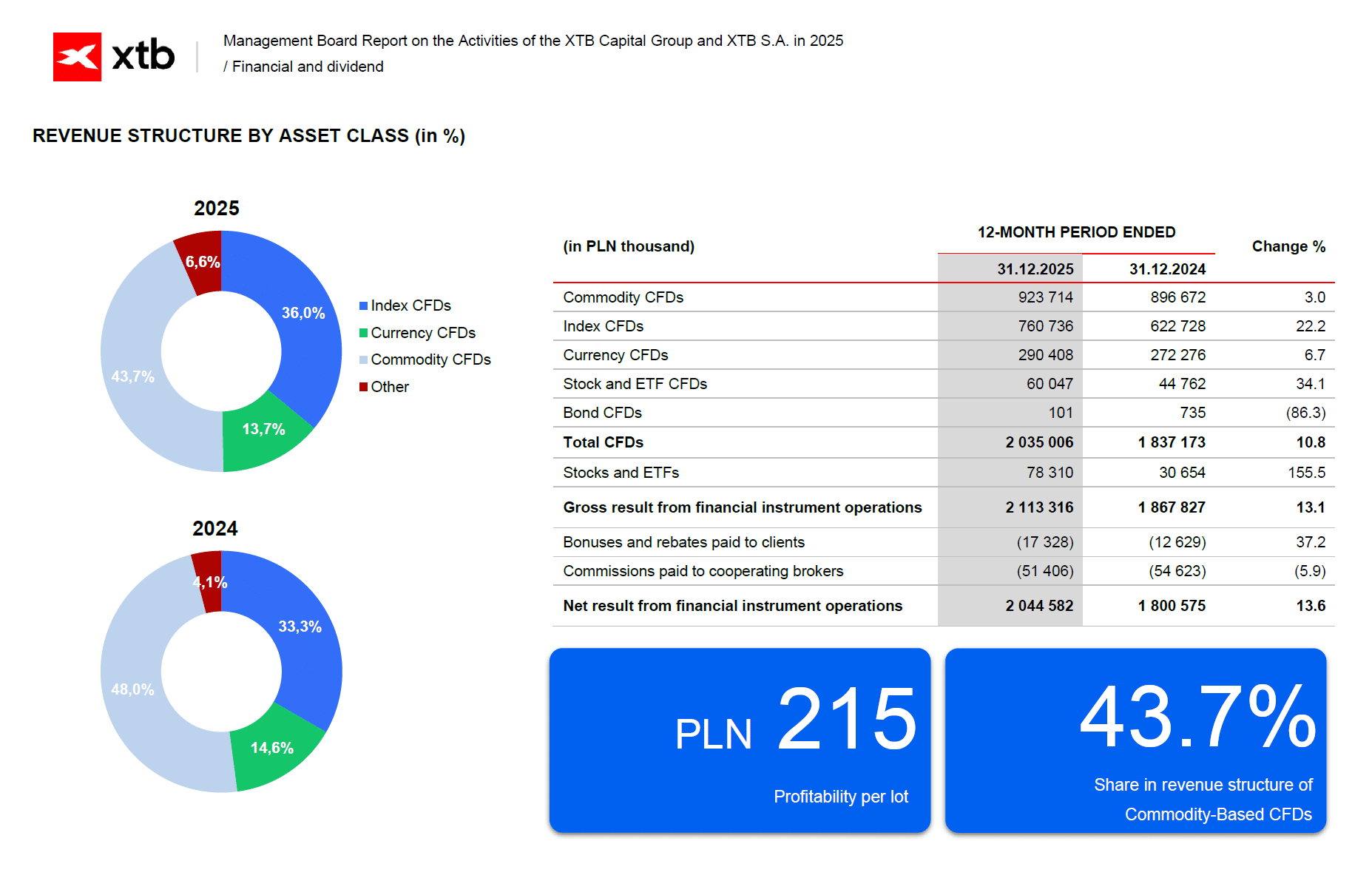
From their published financial statements, these are the contributions of the instruments traded:
When trading an asset in a currency different from your base account currency, you’ll incur a 0.50% currency conversion fee. For example, if you open a EUR-denominated account and want to trade US stocks, the EUR-to-USD conversion will carry a cost. Besides this, an inactivity fee of $/€/£10 per month applies if you go 12 months without trading and haven’t deposited funds in the previous 90 days.
Finally, there’s a withdrawal fee of $/€/£5 for withdrawals under $/€/£50 – free above that threshold.
Account opening
Opening an account at XTB is done through the official website and is a fast, fully digital process. After clicking “Open an account” on the homepage, you’ll be presented with the registration form.

From there, the steps are straightforward:
- Fill out the registration form with your personal details (name, address, phone number, date of birth).
- Complete the appropriateness/compliance questionnaire about your investor profile, experience, and financial situation (mandatory under MiFID II for EU/UK clients).
- Choose the account type – Standard (default for most retail investors) or Pro (available to clients meeting the professional client criteria).
- Verify your identity (KYC). You’ll typically need:
- Proof of identity: passport, national ID card, or driving licence.
- Proof of address: utility bill, bank statement, or government letter (typically dated within the last 3 months).
- Proof of bank account ownership.
- A short video verification call with your ID document, or an automated video verification step.
- Once XTB’s compliance team has verified everything, you can fund your account and start trading. The entire process typically completes within a few hours to a few business days, depending on verification queue and document quality.
Safety and regulation
XTB’s subsidiaries are fully supervised by top-tier regulators including the Financial Conduct Authority (FCA) in the UK, the Polish Financial Supervision Authority (KNF), the Cyprus Securities and Exchange Commission (CySEC), the Dubai Financial Services Authority (DFSA), and the Financial Services Commission (FSC) in Belize.
When opening an account, you’ll be onboarded by one of the XTB subsidiaries depending on your country of residence. Here are the main ones:
| Subsidiary | Regulator | Investor protection | Applicable regions |
| XTB S.A. | KNF (Poland) | Up to €22,000 under Poland’s investor compensation scheme | Poland and selected EU markets |
| XTB Limited (CY) | CySEC (Cyprus) | Up to €20,000 under the Cyprus Investor Compensation Fund (ICF) | Most EU/EEA countries (via passporting) |
| XTB Limited (UK) | FCA (UK) | Up to £85,000 under the FSCS | United Kingdom |
| XTB MENA Limited | DFSA (Dubai, UAE) | None statutory (segregated client funds) | UAE and selected MENA markets |
| XTB International Limited | FSC (Belize) | None statutory (segregated client funds) | Non-EU/UK/UAE international clients |
As soon as you click “create account”, you will notice that at the bottom, you will notice the jurisdiction you will be in:
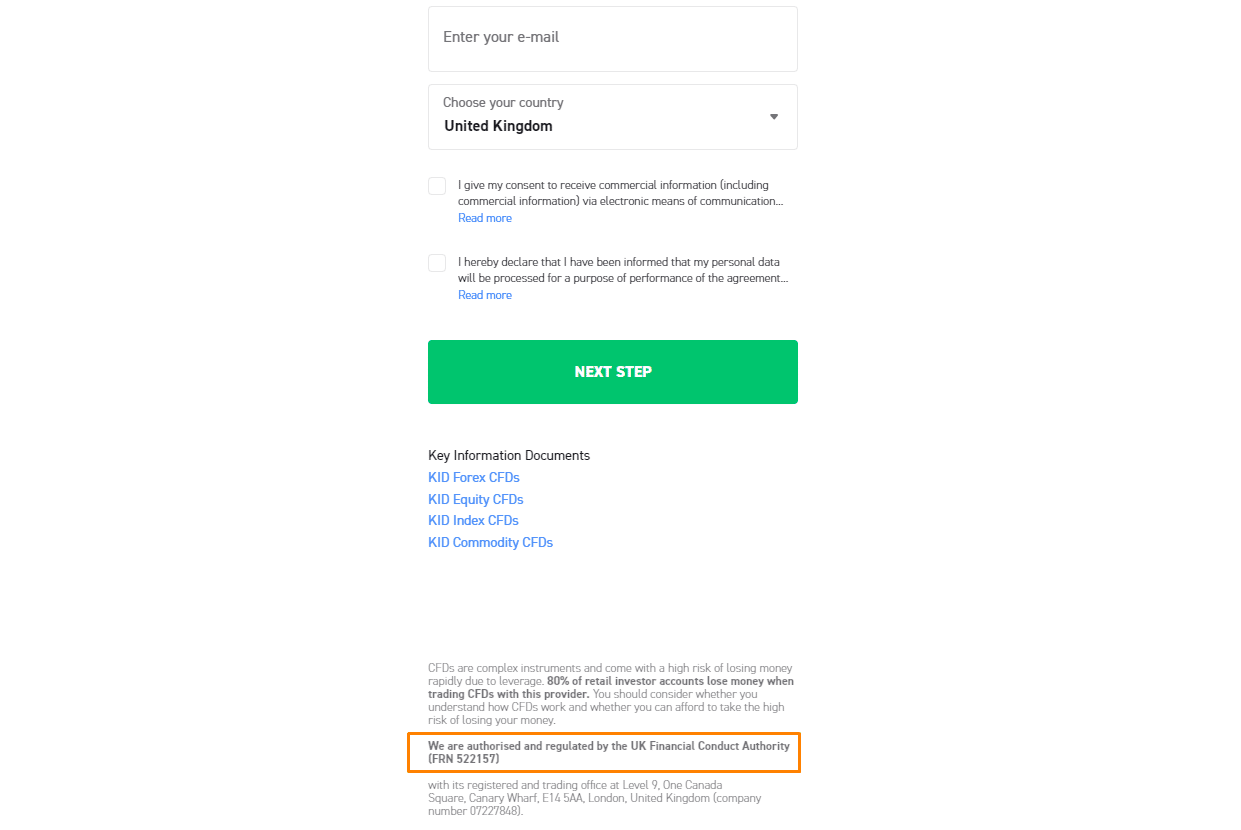
XTB also operates branches in many other countries, registered with the relevant local financial regulators. For example, XTB is registered with CMVM in Portugal, BaFin in Germany, Consob in Italy, AMF in France, and CNMV in Spain, among others – giving it the right to provide investment services across the EU under MiFID II passporting.
Additionally, XTB is listed on the Warsaw Stock Exchange (WSE) and is a constituent of the WIG30 index, which means the company is required to publish regular audited financial statements, comply with stricter corporate governance and reporting standards, and face ongoing scrutiny from market analysts and investors. As a publicly traded broker, XTB has a meaningful additional layer of transparency and accountability that most private brokers don’t offer.
Finally, XTB provides negative balance protection for forex and CFD trading on a per-account basis to retail clients across the EU and UK, in line with ESMA and FCA rules. What does this mean in practice? Imagine you deposit €1,000 in your account and open a position with 5:1 leverage, giving you €5,000 of market exposure. If the market dropped 25%, you’d lose €1,250 – which is more than your initial €1,000 deposit, leaving you €250 in the red. Under ESMA/FCA negative balance protection, your account balance is automatically reset to €0, so you can never lose more than you’ve deposited. (More detail on the regulatory framework here.)
Want to read more? Check our dedicated article on investment protection for EU and UK investors.
Supported countries
XTB operates in most countries worldwide, but due to local regulatory requirements there are some exceptions. XTB cannot legally offer its services in the following countries (non-exhaustive list, subject to change):
- Afghanistan, Albania, Australia, Bangladesh, Belarus, Belize, Bosnia and Herzegovina, Congo (Republic and Democratic Republic), Cuba, Ethiopia, Guyana, Hong Kong, India, Indonesia, Iran, Iraq, Israel, Japan, Kenya, Laos, Libya, Macao, Mauritius, Mozambique, Myanmar, New Zealand, North Korea, Pakistan, Palestine, Panama, Russia, Singapore, South Korea, Syria, Turkey, Uganda, United States, Vanuatu, Venezuela, Yemen, and Zimbabwe.
You can find the full, up-to-date list of accepted countries on the official XTB help centre page.
Note: although Canada is not on this list of restricted countries, Canadian residents are typically onboarded through XTB FR (the French branch), with services available subject to provincial requirements. Australian and New Zealand residents previously couldn’t access XTB directly; check current availability via the help centre before applying.
If XTB isn’t available in your country, you can always look at alternative trading platforms. Check our comparisons between XTB and Trading 212 or XTB and Trade Republic.
The bottom line
XTB is a strong, established broker offering a diverse range of services across many regions. The platform is user-friendly and intuitive, making it accessible to beginners, while its expanding product range (real stocks/ETFs at 0% commission up to €100k monthly, vanilla options on US stocks/ETFs, fractional shares, Investment Plans for recurring ETF investing) increasingly suits long-term investors alongside its historical CFD/forex audience. Being listed on the Warsaw Stock Exchange and regulated by multiple top-tier authorities (FCA, KNF, CySEC, DFSA) adds significant credibility.
On the downside, XTB’s product range is still narrower than full-service brokers (no individual bonds, mutual funds, or futures), customer support quality has been reported to be uneven, and while the educational suite has improved meaningfully (XTB Academy), it’s not yet as deep as the offerings from Interactive Brokers or Saxo. For active CFD traders, spread costs on certain crypto and exotic instruments can be wider than at specialist competitors. Compare XTB against alternatives in our detailed comparisons: XTB vs Trading 212 or XTB vs Interactive Brokers.
Overall, XTB is a solid choice for European and UK investors who want commission-free real stocks and ETFs alongside CFD/forex access in a single, well-regulated platform – though if you need bonds, mutual funds, futures, or the deepest research/educational suite, brokers like Interactive Brokers or Saxo may be better fits.
Contact us and let us know about your experiences with XTB.
Disclaimer
CFDs are complex instruments and come with a high risk of losing money rapidly due to leverage. Between 69-80% of retail investor accounts lose money when trading CFDs. You should consider whether you understand how CFDs work and whether you can afford to take the high risk of losing your money.
