The Vanguard Total Stock Market ETF (VTI) offers investors a simple way to own practically the whole US stock market: more than 3,500 large, mid and small cap companies, with a 0.03% expense ratio.
However, due to regulatory restrictions, VTI isn’t available to retail investors in Europe and the UK.
In this article, we explain why, what workarounds exist, which UCITS ETFs European and UK investors can buy instead, and how to invest in them.
Why isn’t VTI available in Europe & UK?
VTI is a US-domiciled ETF, and in the European Union it falls under the Packaged Retail and Insurance-based Investment Products (PRIIPs) regulation.
This regulation requires that investment products sold to retail investors in the EU come with a Key Information Document (KID), which sets out the product’s features, risks and costs in a standard format, so investors can compare products easily.
US-domiciled ETFs like VTI don’t produce KIDs, because US rules don’t require them. As a result, they can’t be sold to ordinary retail investors on European platforms such as eToro, DEGIRO, Interactive Brokers, Trading 212* and Trade Republic.
In the UK, the PRIIPs rules were replaced on 6 April 2026 by the new Consumer Composite Investments (CCI) regime, with a transition period until June 2027. Instead of a KID, products now need a CCI “product summary”, and platforms can’t sell a product to retail investors without one. So, unless Vanguard produces a UK product summary for VTI, it remains out of reach for UK retail investors for now.
In some cases, investors classified as professional clients can buy US ETFs, but most retail investors don’t meet the requirements. VTI is also quoted in US dollars, so buying it would involve currency conversion for most European and UK investors.
*When investing, your capital is at risk and you may get back less than invested. Past performance doesn’t guarantee future results.
Is there any workaround to invest in VTI?
The only direct way for most European and UK investors to get exposure to VTI is through contracts for difference (CFDs), on platforms like eToro. A CFD lets you speculate on VTI’s price movements without owning the ETF. This approach carries significant risks, especially if you use leverage, and most retail CFD accounts lose money.
What are CFDs?
CFDs are financial instruments that let traders take positions on the price changes of an underlying asset, such as VTI, without owning it. That’s very different from investing, where you own the asset. To learn more, read our article CFDs vs shares: understand the differences.
As far as we know, there is no UCITS ETF in Europe or the UK that tracks the exact index behind VTI (the CRSP US Total Market Index). The other option, and the one we prefer for long-term investors, is to buy UCITS ETFs that cover the same companies, as we explain below.
How to buy the VTI CFD on eToro
If you are a European or UK investor and want to trade the VTI CFD on eToro, follow these steps:
a) Search for VTI:
- In the eToro search bar, type “VTI” or “Vanguard Total Stock Market ETF”;
- Select the VTI instrument from the search results.

b) Open a trade:
- Click the “Trade” button on the VTI page to open the order window.

c) Set your trade parameters:
- Amount or units: enter the amount of money you want to invest or the number of units;
- Leverage: keep it at x1 to avoid magnifying losses. Leverage amplifies both gains and losses;
- Stop loss and take profit: optional orders to manage your risk. A stop loss closes your trade if the price drops to a set level, while a take profit closes it when the price reaches your target.

d) Execute the trade:
- Review your order details carefully;
- Click the “Buy” button to place your order.

CFDs are complex instruments and come with a high risk of losing money rapidly due to leverage. Most retail investor accounts lose money when trading CFDs. You should consider whether you understand how CFDs work and whether you can afford to take the high risk of losing your money.
Best VTI alternatives for European and UK investors
EU and UK investors have solid alternatives to get exposure to the US stock market without taking on the risks of CFDs. VTI tracks the CRSP US Total Market Index, covering large, mid and small cap US companies. Since no UCITS ETF tracks that index, you have three main options:
- Buy an S&P 500 ETF: the S&P 500 covers around 80% of the US stock market’s value, so its performance is very close to VTI’s. This is the simplest option;
- Combine an S&P 500 ETF with a small cap ETF: adding a US small cap ETF, such as one tracking the Russell 2000, brings you closer to VTI’s full coverage of the US market;
- Go global: if you don’t need US-only exposure, ETFs on the MSCI World (IWDA) or the FTSE All-World (VWCE) give you global diversification, with the US still making up most of the portfolio. The FTSE All-World also includes emerging markets.
The table below shows some of the most popular options, with the ticker in euros (on European exchanges such as Xetra or Euronext Amsterdam) and in pounds (on the London Stock Exchange). All five use physical replication and are domiciled in Ireland:
VTI alternative ETFs in Europe and the UK
| ETF | Tickers (EUR / GBP) | Exposure | TER | Use of income | Fund size |
| iShares Core S&P 500 UCITS ETF IE00B5BMR087 |
SXR8 / CSP1 | US large and mid caps (S&P 500) | 0.07% | Accumulating | €131.8bn |
| Vanguard S&P 500 UCITS ETF IE00B3XXRP09 |
VUSA / VUSA | US large and mid caps (S&P 500) | 0.07% | Distributing | €45.7bn |
| SPDR Russell 2000 US Small Cap UCITS ETF IE00BJ38QD84 |
ZPRR / R2SC | US small caps (Russell 2000) | 0.30% | Accumulating | €4.6bn |
| iShares Core MSCI World UCITS ETF IE00B4L5Y983 |
IWDA / SWDA | Developed markets (around 72% US) | 0.20% | Accumulating | €123.9bn |
| Vanguard FTSE All-World UCITS ETF IE00BK5BQT80 |
VWCE / VWRP | Developed and emerging markets (around 62% US) | 0.14% | Accumulating | €45.3bn |
Fund size in EUR, from justETF (July and August 2026).
How to buy a VTI alternative (CSP1) on DEGIRO
As an example, we show how to buy the iShares Core S&P 500 UCITS ETF on the London Stock Exchange in GBP (ticker CSP1), the largest S&P 500 ETF in Europe. Investors in the EU follow the same process with the euro listing (SXR8 on Xetra).
Below are the steps to buy CSP1 on DEGIRO:
a) Search for CSP1 and select it:
- In the DEGIRO app, type “CSP1” in the search bar;
- Select the iShares Core S&P 500 UCITS ETF from the search results.

b) Open a trade:
- Click the “Buy” button on the CSP1 page to open the order window.

c) Set trade parameters:
- Enter the number of shares you want to buy. You can also choose the order type, such as market, limit, stop loss, stop limit or trailing stop orders.

d) Execute the trade:
- Review your order details and click “Place Order” to execute your purchase.

By following these steps, you can invest in the iShares Core S&P 500 UCITS ETF (CSP1) on DEGIRO, getting exposure to the S&P 500 within a regulated framework.
What to look for in an ETF (in GBP and EUR)?
When evaluating an ETF, consider several factors to make sure it fits your goals and strategy:
a) Fees
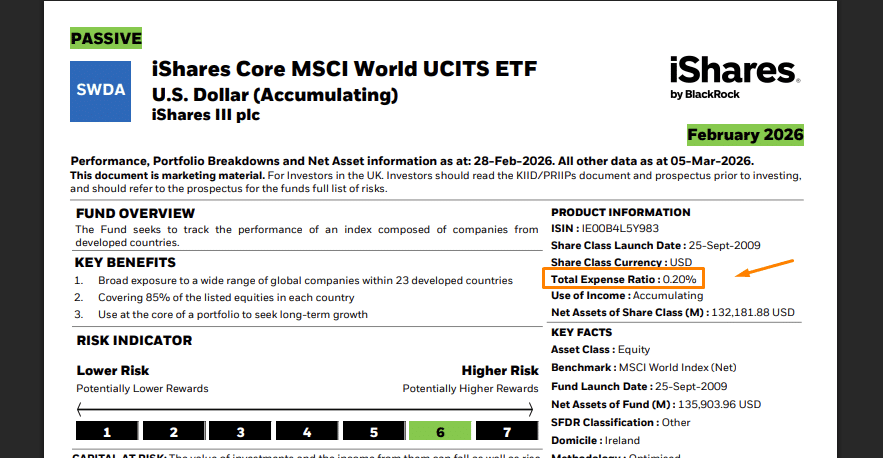
ETF providers charge an annual fee, usually shown as the ongoing charges figure (OCF) or total expense ratio (TER), as is the case with iShares by BlackRock.
Taking the iShares Core MSCI World UCITS ETF (SWDA) factsheet as an example, you can see the TER of 0.20%:
b) Replication method
ETFs can replicate the performance of their index in two ways:
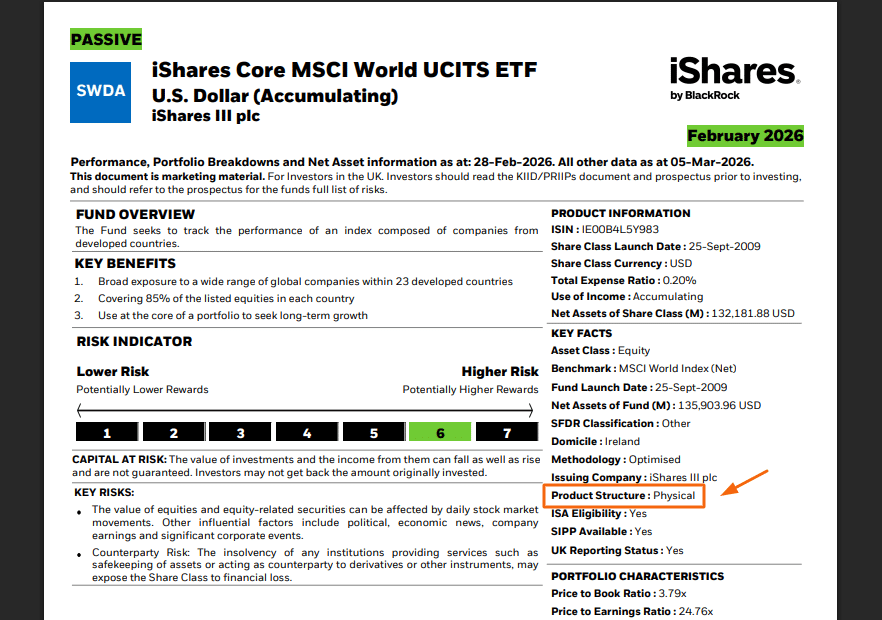
- Physical replication: the ETF holds the actual shares in the index, which gives direct exposure and avoids the complexity of derivatives;
- Synthetic replication: the ETF uses derivatives, usually a swap with a bank, to deliver the index return. This can be cheaper, but it adds counterparty risk.
The iShares Core MSCI World UCITS ETF (SWDA) uses physical replication with optimised sampling: it holds most of the stocks in the MSCI World Index, in the right proportions, rather than every single one:
c) Use of income
ETFs handle the dividends from their holdings in different ways:
- Accumulating ETFs reinvest the dividends inside the fund, which can boost returns through compounding;
- Distributing ETFs pay out the dividends to you regularly, which gives you an income but may be less tax-efficient in some countries.
The best choice depends on your goals. An accumulating ETF may suit you better if you’re focused on long-term growth. A distributing ETF is the natural choice if you want a regular income.
The iShares Core MSCI World UCITS ETF (SWDA) is an accumulating ETF:

d) Size
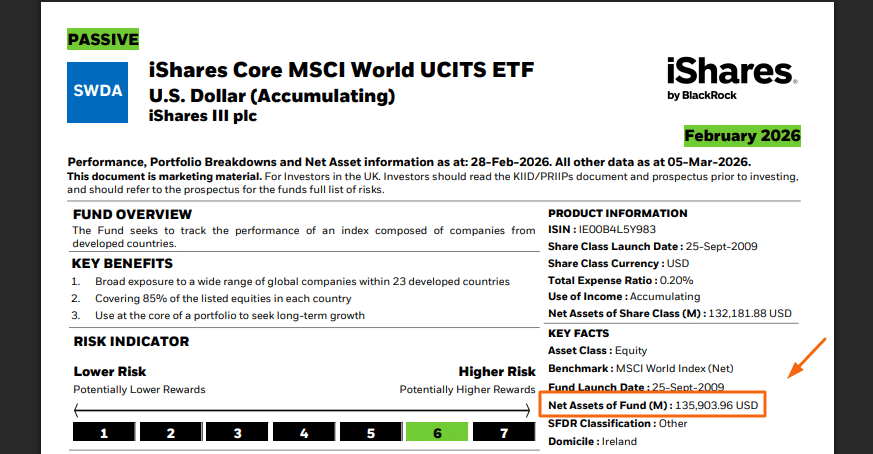
Larger ETFs usually have tighter spreads and a lower risk of being closed down.
SWDA’s share class had net assets of $148.9 billion at the end of August 2026 (the fund as a whole had $153.3 billion). The factsheet shows the fund’s net assets:
e) Currency
ETFs can be listed in different currencies, such as USD, EUR or GBP. This affects your investment in a few ways:
- Currency risk: the listing currency doesn’t remove currency risk. These ETFs mostly hold US stocks, so their value in pounds or euros still moves with the dollar, whatever currency you buy them in;
- Transaction costs: buying a listing in a currency different from your account currency may involve conversion fees;
- Convenience: buying the listing in your own currency (EUR for European investors, GBP for UK investors) makes things simpler and avoids repeated conversions.
f) Currency hedging
Some ETFs offer hedged share classes that reduce the impact of movements between the euro or pound and the US dollar. Hedging can reduce short-term swings, but it has a cost and can reduce long-term returns if the dollar strengthens.
Looking to backtest your ETF portfolios?
If you are an EU investor looking to backtest your ETF portfolios, check out our Portfolio Analyser. It lets you analyse your portfolios with charts and metrics, so you can compare and evaluate EU-domiciled ETFs.
Bottom line
VTI isn’t available to retail investors in Europe and the UK: EU rules require a KID it doesn’t have, and the UK’s new CCI regime still requires a product summary. However, several UCITS ETFs offer very similar exposure to the US stock market, with the protection and transparency of European rules.
The simplest alternative is an S&P 500 ETF, such as SXR8 in the EU or CSP1 in the UK, which covers around 80% of the US market. If you want to get closer to VTI’s full coverage, you can add a US small cap ETF, and if you prefer global diversification, IWDA/SWDA and VWCE/VWRP are popular choices. Buying the listing in your home currency avoids conversion fees, although you remain exposed to the dollar.
Platforms such as Interactive Brokers, DEGIRO, Trading 212* and Trade Republic offer access to these ETFs.
*When investing, your capital is at risk and you may get back less than invested. Past performance doesn’t guarantee future results.