VOO, the ticker of the Vanguard S&P 500 ETF, is one of the simplest ways to track the performance of the S&P 500 index.
Since its launch in 2010, VOO has grown into the largest ETF in the world, with more than $1 trillion in assets (August 2026). That scale spreads its fixed costs over a huge asset base, which helps keep it one of the cheapest funds available, at 0.03% a year.
In this article, we explain how to choose a broker to buy VOO, walk through the purchase step by step, look at what the ETF holds and explain what European and UK investors can do instead, since VOO isn’t available to them.
How to buy the VOO ETF (step-by-step guide)
1. Choose a good stock broker
VOO is offered by most brokers that give access to US markets. Check the terms of each one, and make sure it accepts residents of your country. These are four options:
| Broker | US stock and ETF commission | Minimum deposit | Available in |
| eToro | $1 per stock trade, $0 on ETFs | $50 (varies by country) | Most countries (exceptions apply) |
| Interactive Brokers | $0 for US clients on IBKR Lite. Up to $0.0035 per share (min. $0.35) for other clients | $0 | Most countries (exceptions apply) |
| Trading 212 | €/£0 commission (other fees may apply) | No minimum to start | Europe and other countries, not the US |
| Saxo | Up to 0.08% (min. $1) | $0 in most countries | Most countries, not the US |
Fees checked in September 2026. Trading 212: other fees may apply, see terms and fees.
2. Open and fund your account
Once you have compared the brokers, you can open your account. Verification usually takes from a few minutes to a few days, depending on the broker. After that, you deposit money into the account.
3. Place a buy order
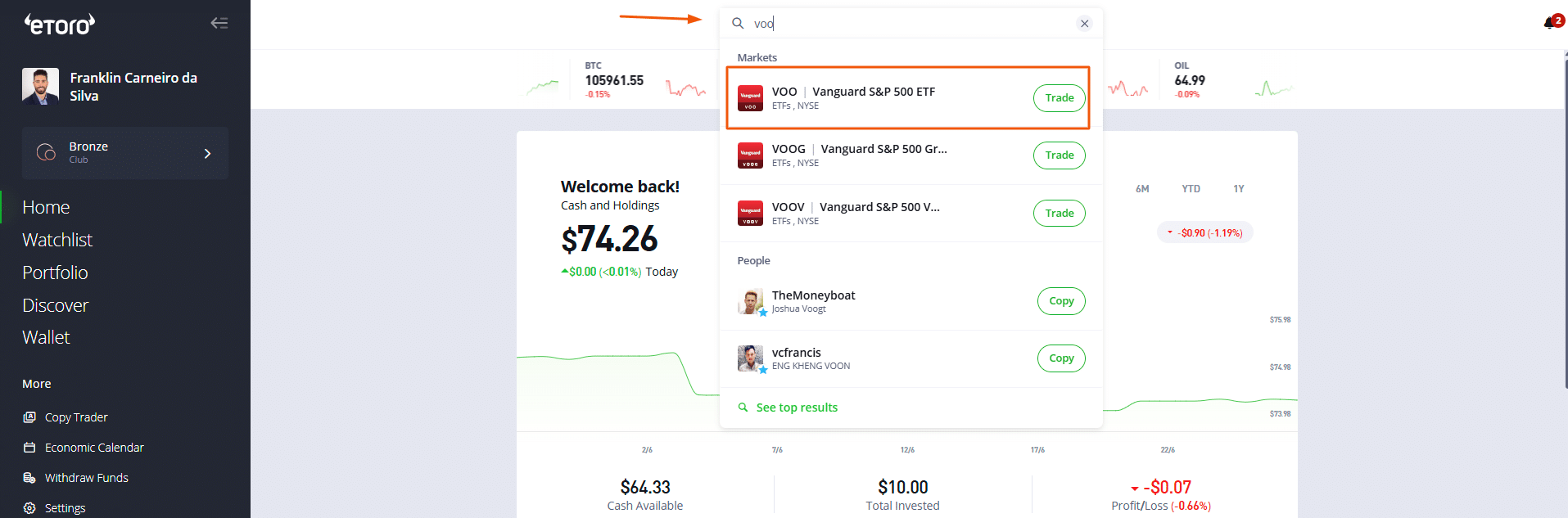
With your account open and funded, search for the ETF and place a buy order. In this example, we use eToro:
a) Search for the Vanguard S&P 500 ETF (ticker “VOO”) and click “Trade”:
b) Choose the order details. Now it is time to decide how to invest:
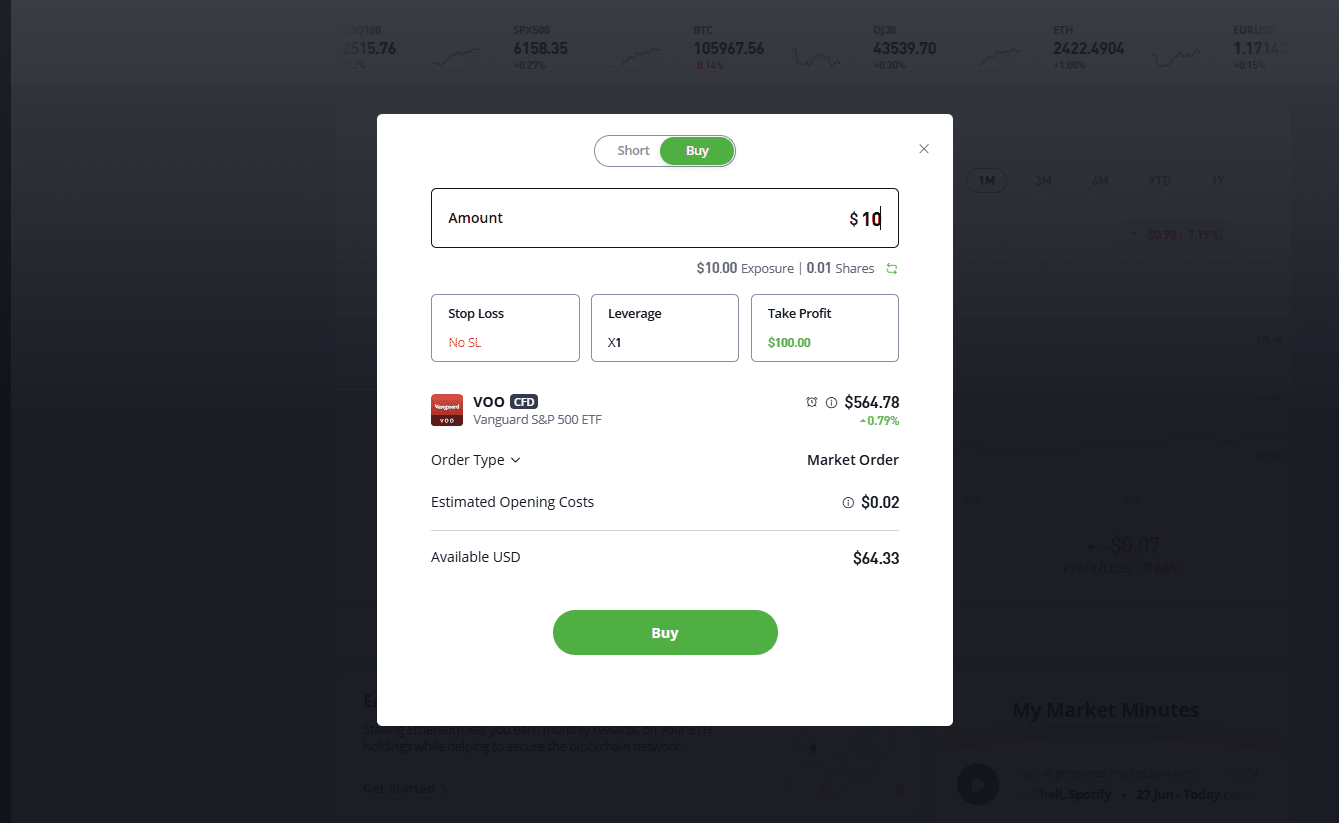
- Amount: you choose how much money to invest instead of the number of shares, so your position may include fractional shares.
- Units: here you set the number of shares you want to buy. You can use either “Amount” or “Units”.
- Leverage: “X1” means no leverage. Anything above that multiplies both gains and losses, and the position becomes a CFD, which is why the window then shows “CFD Trade”.
- Stop loss: the maximum loss you are willing to take before the position closes automatically.
- Take profit: the profit level at which the position closes automatically.
Only “Amount” (or “Units”) and “Leverage” are mandatory. Keep leverage at X1 if you want to hold the ETF rather than trade a CFD. Stop loss and take profit are not guaranteed, and trading with leverage involves a high risk of losing money quickly.
c) Place the order: click “Open Trade”. A new window confirms that the order was filled and shows your exposure.

Can European and UK investors buy VOO?
Generally, no. VOO is a US-domiciled ETF, and under the EU’s PRIIPs rules it doesn’t publish a Key Information Document in European languages. As a result, brokers can’t offer it to retail investors in the EU or the UK as a regular investment. Some platforms offer it as a CFD instead, which is a leveraged derivative where you don’t own the fund.
European and UK investors usually buy an equivalent UCITS ETF that tracks the same index. The best-known options are:
- Vanguard S&P 500 UCITS ETF (VUSA): distributing, 0.07% TER
- Vanguard S&P 500 UCITS ETF (VUAA): the accumulating version of the same fund, 0.07% TER
- iShares Core S&P 500 UCITS ETF (SXR8/CSPX): accumulating, 0.07% TER
Some providers now offer S&P 500 UCITS ETFs for as little as 0.03% a year, which matches VOO. Accumulating versions reinvest dividends inside the fund, which is usually more tax-efficient in several European countries.
For more detail, read our guides on how to invest in the S&P 500 from Europe.
VOO overview
VOO, the Vanguard S&P 500 ETF, tracks the S&P 500, the second-oldest US stock index. The S&P 500 is capitalisation-weighted, which means each company’s weight depends on its market value. As a result, VOO’s largest positions are the biggest US companies. As of mid-2026, the top holdings were roughly:
- Nvidia at about 7.4%
- Apple at about 7.1%
- Microsoft at about 6.2%
The fund holds around 520 securities, slightly more than 500, because some companies have more than one share class in the index.
One point worth knowing: the top 10 holdings now account for over 36% of the fund, against roughly 20% a decade ago, and technology-related companies make up close to 38% of its weight. VOO is diversified across 500 companies, but it is more concentrated than it used to be.
Index weights and membership change as prices move and companies are added or removed, and the index is reviewed every quarter. You can check current holdings on Vanguard’s VOO page.
VOO is a low-cost fund, with an expense ratio of 0.03% a year, which means $3 a year for every $10,000 invested. Vanguard handles all the tracking work, and the ETF pays dividends quarterly.
Vanguard’s website also publishes key statistics for VOO and its benchmark:
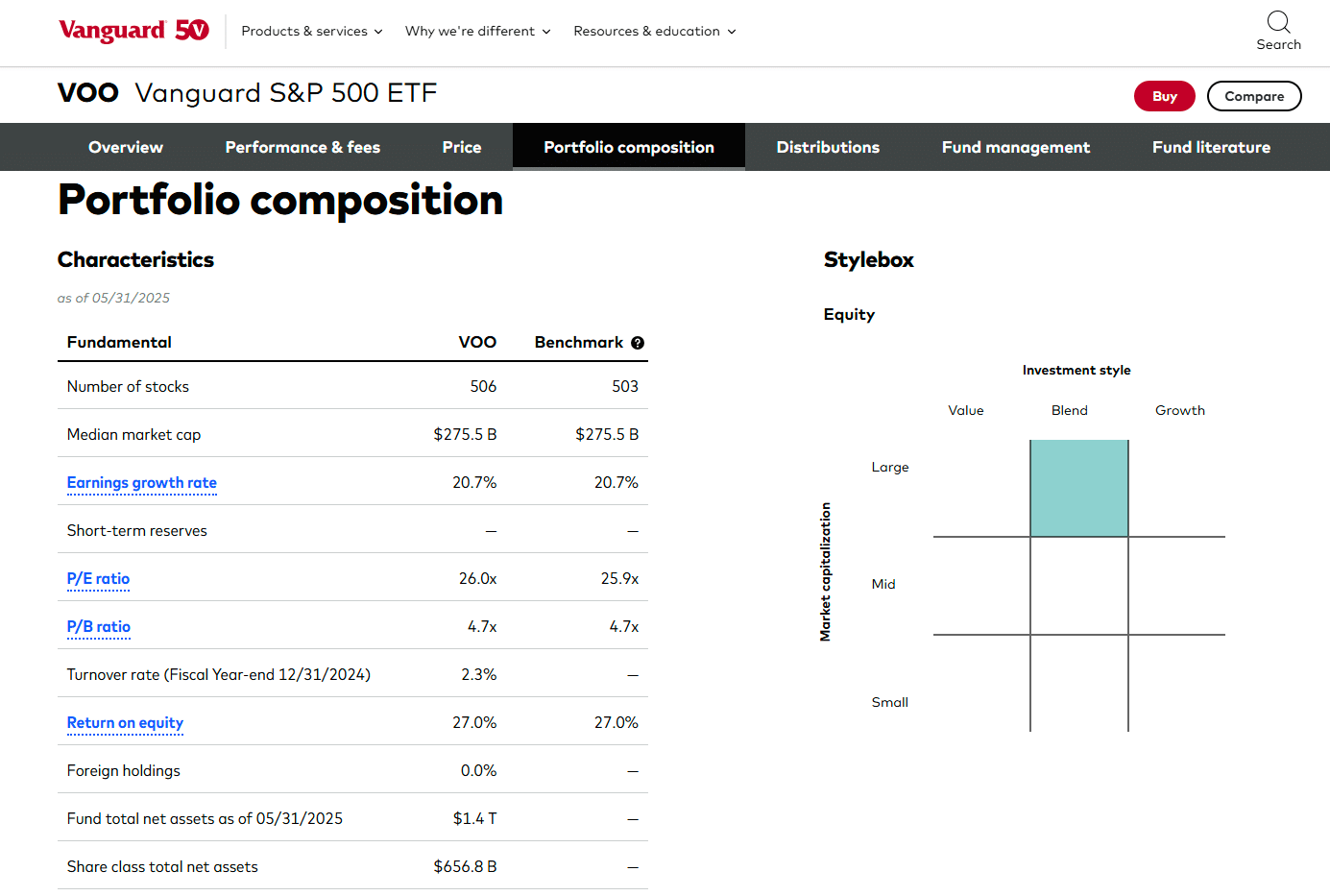
The two main ratios shown there are:
- Price-to-earnings (P/E): the price of the companies relative to their profits.
- Price-to-book (P/B): the price of the companies relative to their accounting value.
You can compare the current P/E and P/B of the S&P 500 with historical levels on multpl.com.
Vanguard also offers two variations of the fund, one focused on value companies and one on growth companies:
- Vanguard S&P 500 Value ETF (VOOV), which tracks the value companies in the index.
- Vanguard S&P 500 Growth ETF (VOOG), which tracks the growth companies in the index.
Both distribute dividends and cost more than VOO, so check their current expense ratios and number of holdings on Vanguard’s site before investing.
Who is Vanguard?
Vanguard is the second-largest asset manager in the world, behind BlackRock, and the company that brought index funds to ordinary investors. You can read its full history here. Some key facts:
- Founded in 1975 by John Bogle
- Manages hundreds of funds worldwide
- Serves tens of millions of investors
- Owned by its US funds, which are in turn owned by their investors, so it has no outside shareholders
That ownership structure is why Vanguard has been able to keep cutting fees over the years.
Bottom line
To sum it up:
- Find a suitable broker: check that it accepts residents of your country, and compare its fees and market access in case you want other ETFs or shares later.
- Open an account and deposit money: the process is fully online with most brokers.
- Place a buy order: search for the ETF and buy it, keeping leverage at X1 if you want to own the fund rather than trade a CFD.
- If you live in the EU or the UK: look for a UCITS equivalent such as VUSA, VUAA or SXR8 instead, since VOO isn’t available to retail investors there.
- Keep an eye on what you own: VOO’s holdings and sector weights shift over time, and it is more concentrated in a few large technology companies than it used to be.
We hope this guide helped. Do your own research to find the strategy that suits you.
Disclaimer: When investing, your capital is at risk and you may get back less than invested. Past performance doesn’t guarantee future results.