Short selling is a sophisticated trading strategy that allows investors to profit from falling asset prices or hedge existing portfolios against downside risk.
Beyond market timing, successful short selling depends heavily on broker-specific factors such as stock availability, borrow fees, locate systems, and the risk of forced buy-ins.
Short selling can involve significant losses (including losses beyond your initial position), higher and variable borrowing costs, and the risk of forced buy-ins or margin calls that may close a position at an unfavourable price.
For this reason, choosing the right broker is far more important for short sellers than for traditional long-only investors.
In this guide, we review the best short-selling brokers, comparing their fees, market access, available instruments, and overall suitability for different trading styles.
Whether you are an active trader focusing on U.S. equities or an investor looking to short global markets across multiple asset classes, this comparison will help you identify the broker that best matches your strategy.
Best short-selling brokers in 2026
- TradeZero: Best for shorting U.S. stocks and hard-to-borrow shares. New users benefit from a welcome promo with our promo code “IITW“.
- Interactive Brokers: Best for shorting international stocks.
- Plus500: One of the best for taking short positions through CFDs (contracts for difference) on an intuitive platform.
- Pepperstone: Best for automated short strategies, with support for MetaTrader 4 (MT4), MetaTrader 5 (MT5), cTrader and TradingView.
- eToro: Best for social trading (following and copying other traders).
- XTB: Best for shorting with CFDs.
- Saxo: Best for professionals who don’t mind paying higher fees (not available in the US).
Brokers comparison
Before we delve into the key differentiating factors for each of the brokers, let’s compare their product offering for investors looking to short sell financial assets:


Only two brokers in this selection let you borrow and sell real shares. The others let you take a short position through derivatives, mostly CFDs, which changes both the costs and the risks:
| Broker | How you go short | Main short-side costs |
| TradeZero | Borrowed U.S. shares (real short sale) | Locate fees on hard-to-borrow stocks, commissions on some orders |
| Interactive Brokers | Borrowed shares in many countries (real short sale) | Borrow fee (annualised rate charged daily), commissions |
| Plus500 | Sell CFD | Spread, overnight funding, borrowing fee on some share CFDs |
| Pepperstone | Sell CFD | Spread or commission, overnight funding, dividend adjustments |
| eToro | Sell CFD (not available to U.S. users) | Spread and overnight fees |
| XTB | Sell CFD | Spread and swap (overnight) fees |
| Saxo | CFDs, index futures, inverse ETFs or put options | Depends on the instrument used |
How each broker lets you go short. Source: brokers’ websites, October 2026.
Video summary
Reviews
Let us now continue with a quick overview of each of the seven brokers covered in our selection for traders interested in short-selling assets traded on the financial markets.
TradeZero at a glance

Investing involves risk of loss.
Founded in 2015 in the Bahamas, TradeZero has built its reputation around one core strength: short-selling U.S. equities. The broker later expanded to the United States in 2018, to Canada in 2022, and, most recently, entered the European market via the Netherlands, bringing its short-focused trading capabilities to a wider global audience.
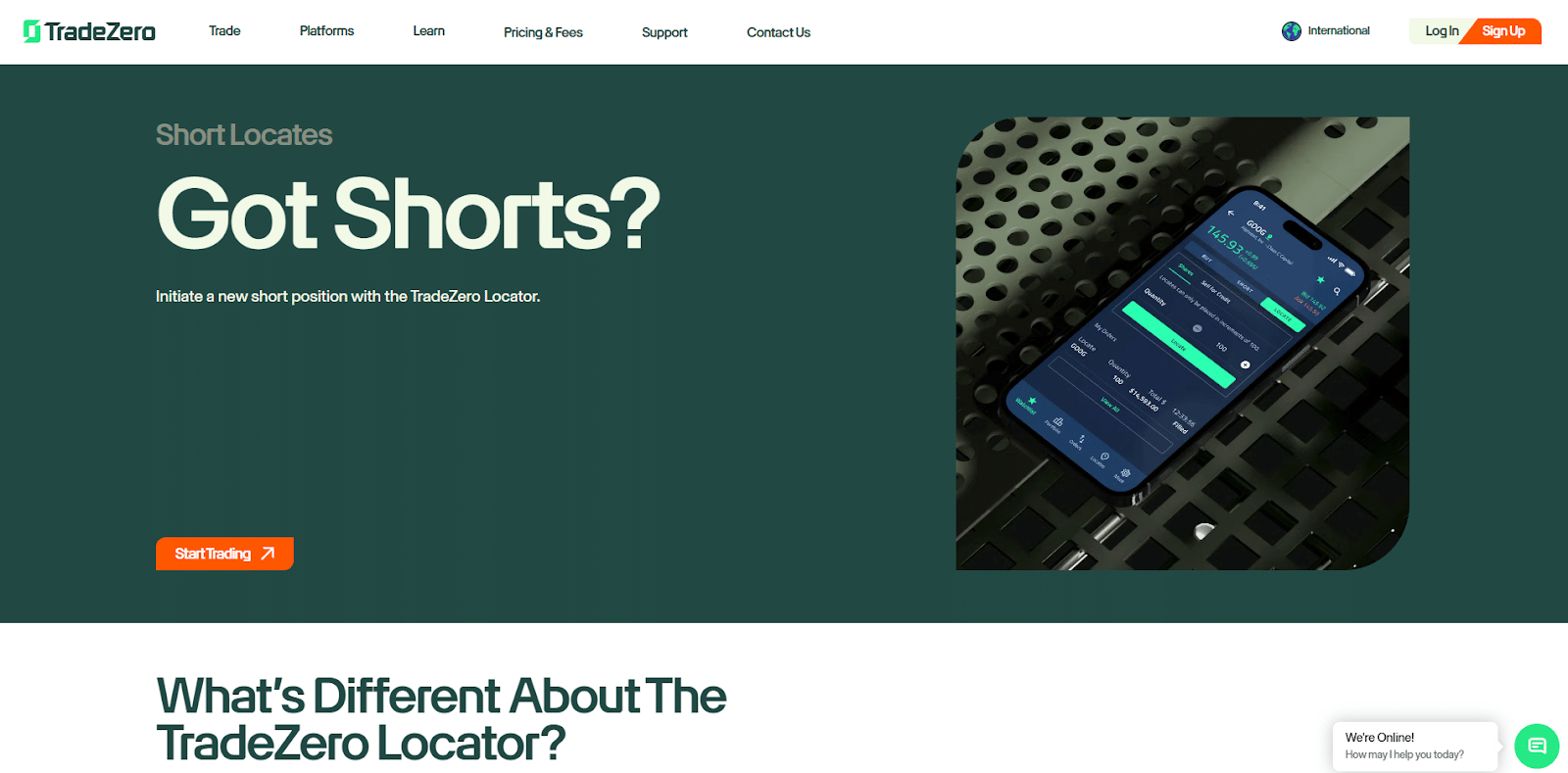
TradeZero is particularly well known for facilitating short sales of hard-to-borrow securities, including stocks subject to Regulation SHO. While easy-to-borrow (ETB) large-cap stocks are readily available across most brokers, TradeZero stands out in its ability to support shorting opportunities where borrowing is more challenging.
A key feature supporting this focus is TradeZero’s use of single-use (SU) locates. These locates allow one short-sale transaction per day and are especially well-suited for one-time trades in Regulation SHO securities.
Additionally, TradeZero allows traders to “mark locates for credit” if they are no longer needed. This makes the locate available to other TradeZero clients and can help traders recover part of the original locate cost, ultimately reducing overall short-selling expenses.
Beyond its short-selling strengths, TradeZero’s broader mission is to combine a no-commission trading structure with the ability to trade stocks, options and ETFs (ETFs not available through its Netherlands entity).
The broker offers its proprietary TZ1 platform free of charge to all users, including ZeroMobile for traders on the go. More advanced traders can opt for ZeroPro, which costs $59 per month. TradeZero Europe waives this fee once you trade more than 100,000 shares in a month. Both ZeroPro and TZ1 also include ProScanner, a real-time U.S. equity market scanner built directly into the platforms at no additional cost.
Please note accounts are denominated in USD, and currency conversion fees only apply when funding in another currency.
Although TradeZero originated in the Bahamas, it has since obtained top-tier regulatory oversight across its global entities. TradeZero operates through regulated subsidiaries in their respective jurisdictions, including oversight by the SEC and FINRA (U.S.), CIRO (Canada), AFM (Netherlands), and the Securities Commission of the Bahamas.
Each entity also operates under different margin conditions. TradeZero offers margin accounts with the following leverage across its entities:
- TradeZero International: up to 6:1 intraday and 2:1 overnight.
- TradeZero Canada: up to 3:1.
- TradeZero America: since 4 June 2026, the pattern day trader (PDT) rule has been replaced by a new intraday margin framework, so margin accounts no longer need $25,000 to day trade. A margin account typically requires $2,000.
- TradeZero Europe: up to 3:1 in pre-market and regular hours, and 2:1 from 16:00 to 20:00 ET.
Finally, TradeZero currently offers a welcome bonus based on the size of an initial deposit, with full details available on the company’s website (use the promo code “IITW”).
Pros
-
Low-cost broker for trading U.S. stocks
-
Sign-up promo with the promo code IITW
-
No inactivity fee
- Paper trading (with free NASDAQ data)
Cons
-
Limited selection of non-U.S. companies.
-
No interest on cash balances.
-
Trading exclusively in U.S. markets.
- Minimum deposit of $250 in Europe and $500 for International and Canada.
Interactive Brokers at a glance

Founded in 1978 and listed on NASDAQ (ticker: IBKR), Interactive Brokers has seen rapid growth in its customer base, to more than 5.5 million accounts, and joined the S&P 500 index in August 2025. As such, it is arguably the industry benchmark when it comes to a reasonable mix between low trading costs and wide market access.
Interactive Brokers’ main appeal is its wide geographic footprint, allowing clients to trade in 170 markets across 40 countries. As such, for investors interested in short selling, IBKR’s main advantage is the ability to short assets in multiple jurisdictions from one platform.
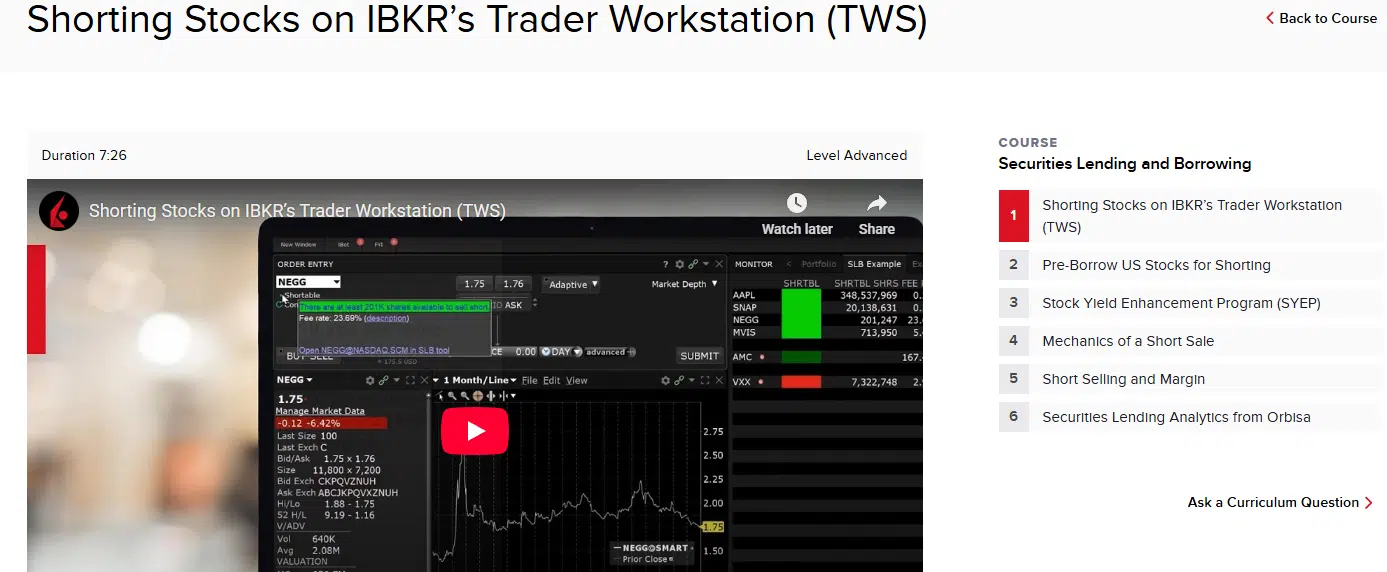
The process of shorting shares on IBKR is intuitive, with a full description available in the IBKR Traders’ Academy here. Key considerations when shorting shares through IBKR include the fee rate (the annualized interest on borrowed shares), which is charged daily.
The platform also provides information on shortable shares (shares currently available for shorting at IBKR) and utilization (demand versus supply in the lending market for shares sold short).
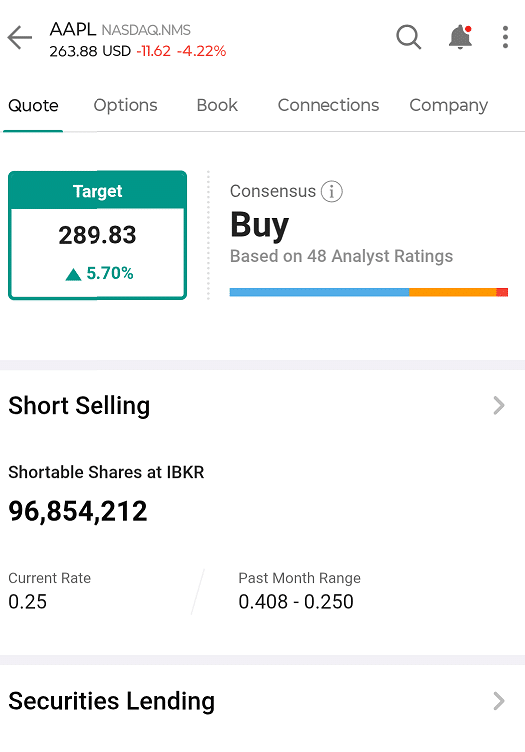
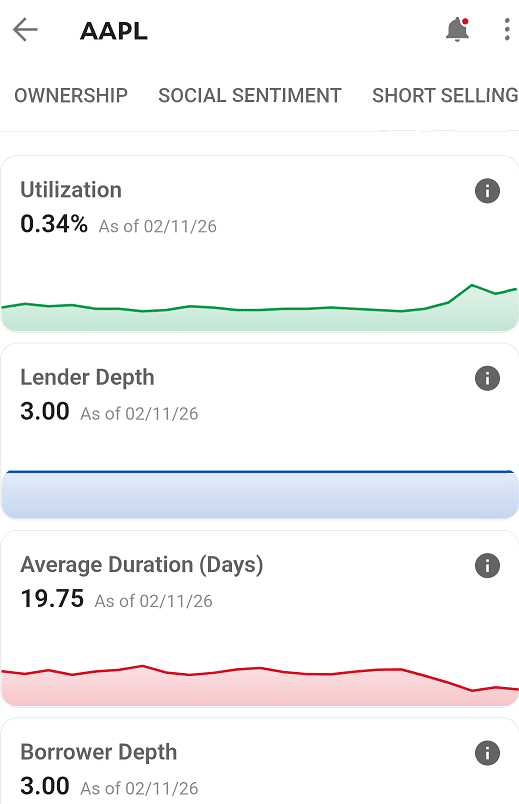
As long as locates are available, you can short the shares you wish, and your order should fill automatically. If locates are not available and IBKR is unsuccessful in locating them, the order will be held until it expires and will not execute.
Given the vast number of markets tradeable by Interactive Brokers, IBKR is arguably the most regulated choice among the seven brokers in our selection. Its regulators include the Securities and Exchange Commission (SEC) in the U.S., the Financial Conduct Authority (FCA) in the U.K., as well as local regulators in markets where IBKR has direct market access, such as MNB in Hungary and MAS in Singapore. IBKR is also a member of self-regulatory organizations such as FINRA in the U.S. Investors can also monitor the broker’s financial health via its financial statements.
As such, I believe IBKR is the natural choice for investors looking for wide geographic diversification at a low cost.
You can read our IBKR review and check IBKR’s website for more information.
Pros
- Low commissions on US stock trading
- No monthly inactivity fee
- The broadest product and markets range in the brokerage industry
- Demo account
- Excellent reputation (founded in 1978)
- Extensive research and Education tools
- Has a modern mobile trading app to trade Stocks, Options and ETFs, ideal for novice investors, IBKR GlobalTrader.
- Offers interest on uninvested cash balances
Cons
- Complicated and lengthy account opening process (but fully online)
- Steeper learning curve for beginners
- Website is difficult to navigate
- Interactive Advisors (Robo-advisor feature) is only available for US customers
Plus500 at a glance

81% of retail CFD accounts lose money.
Founded in 2008 and listed on the London Stock Exchange (LSE:PLUS), Plus500 is a FTSE 250 multi-asset fintech group regulated across a broad set of tier-1 jurisdictions.
Unlike the other brokers in this guide, Plus500 does not offer traditional short selling. There is no borrowing of shares, no locate system, and no hard-to-borrow inventory. Instead, Plus500 lets you take a short position by opening a “sell” CFD on a stock, ETF, index, commodity or currency. You profit if the price falls and lose if it rises, without ever owning or borrowing the underlying asset.
This makes Plus500 the most straightforward option in our selection for traders who simply want directional downside exposure rather than a dedicated short-selling workflow. The proprietary platform is clean and quick, with guaranteed stop-loss orders available, a genuinely useful feature when shorting, given that losses on a short position are theoretically unlimited. Costs are built into the floating spread, with no separate commission, though holding a CFD overnight incurs an overnight funding charge that varies by instrument, and short positions on some share CFDs also carry a borrowing fee.
The trade-offs are clear: Plus500 is CFD-only, so it is unsuitable for anyone who wants to short actual shares. There is no MetaTrader or cTrader support, and the research tools are limited. Client funds are held in segregated accounts and negative balance protection is standard, which caps your downside at your account balance.
You can read our full Plus500 review for more detail.
Pros
-
Intuitive, quick way to take short CFD positions
-
Guaranteed stop-loss orders available
-
No commissions (costs built into the spread)
-
Free unlimited demo account to practise short setups
-
Listed on the London Stock Exchange (FTSE 250) with strong financial transparency
- Regulated by multiple tier-1 authorities
Cons
-
Not true short selling: no share borrowing, locates or hard-to-borrow inventory
-
CFD-only; cannot short actual shares
-
Overnight swap fees on short positions held beyond the day
-
Currency conversion fee up to 0.7% and inactivity fee up to $10 per month after 3 months
-
No MetaTrader or cTrader support; limited research tools
- No interest on uninvested cash
Pepperstone at a glance

74-89% of retail CFD accounts lose money.
Founded in Melbourne in 2010, Pepperstone serves more than 900,000 traders and operates under seven regulators, including the FCA in the UK and CySEC in Cyprus, where European clients are served by Pepperstone EU Limited under licence 388/20.
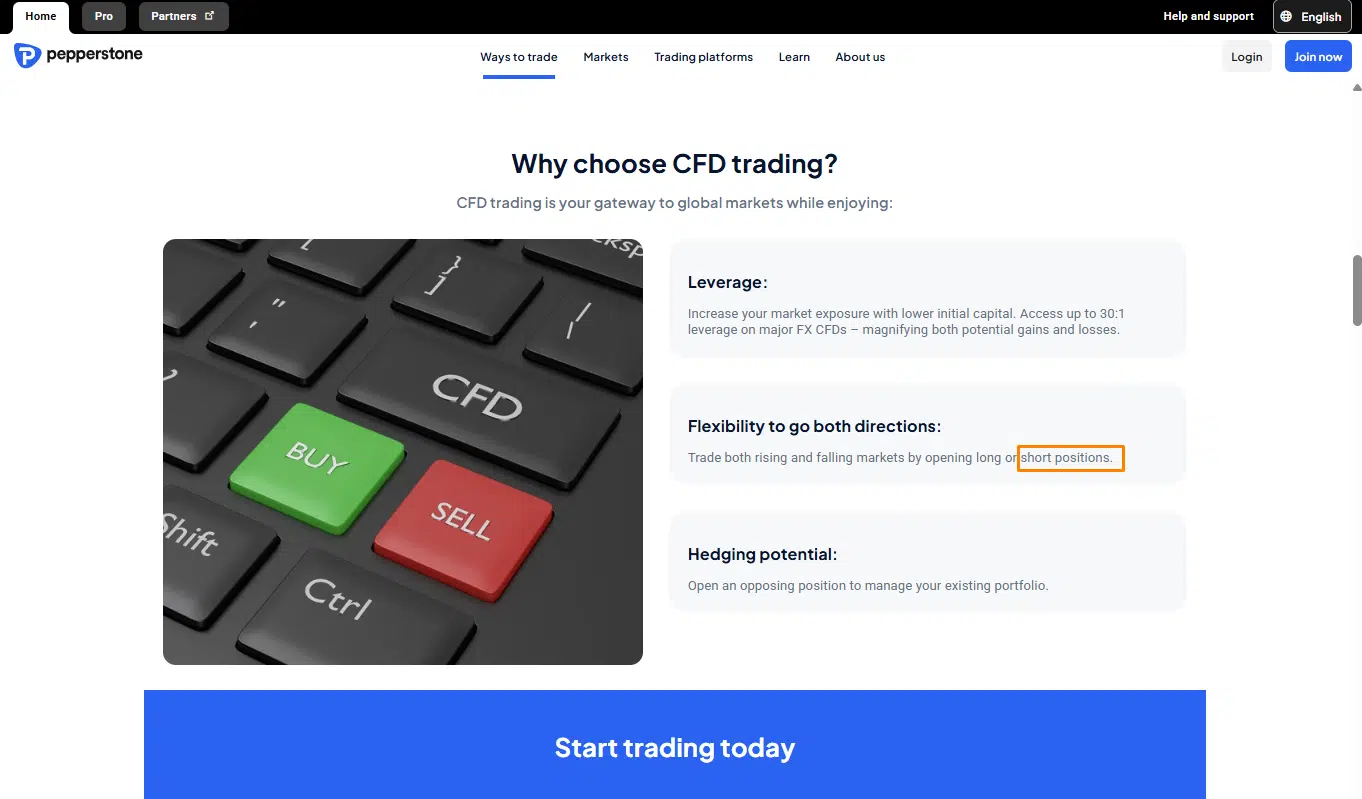
Pepperstone does not offer traditional short selling. There is no share borrowing, no locate system and no hard-to-borrow inventory. Going short means opening a sell CFD, and the mechanics are symmetrical with going long: the same spread, the same commission, no separate borrow fee and no risk of a forced buy-in when a lender recalls stock. For traders who have been squeezed out of a correct thesis by a recall, that structural difference matters more than a few basis points of commission.
Where Pepperstone separates itself from the other CFD brokers in this guide is execution infrastructure for systematic short strategies. It supports MetaTrader 4, MetaTrader 5, cTrader and native TradingView execution alongside its own platform, and permits scalping, hedging and fully automated trading. If your short signals are generated by an Expert Advisor or a cBot, this is the only broker in this comparison you can plug them into directly.
Costs on the short side deserve attention, because they do not mirror the long side. Overnight funding is charged on positions held past 5pm New York time. On forex, short positions can actually earn a positive swap when the interest rate differential runs in your favour, which quietly improves the economics of a longer-held currency short. On share CFDs the reverse applies: hold a short through an ex-dividend date and you pay the dividend adjustment, an easily overlooked cost that can wipe out a small gain on a high-yield name.
Two limitations matter specifically for shorting. There are no guaranteed stop-loss orders, so unlike Plus500 you cannot cap gap risk on an overnight short with certainty. Standard stops can slip through the level on an opening gap, and gap risk cuts hardest against a short position. And Pepperstone pays no interest on uninvested cash, so capital parked between setups earns nothing. On the protective side, negative balance protection applies to retail clients, capping your loss at your account balance despite a short’s theoretically unlimited downside, and a 50% margin close-out rule applies.
You can read our full Pepperstone review for more detail.
Pros
-
Short positions carry no borrow fee, no locate requirement and no forced buy-in risk
-
Only broker here supporting MT4, MT5, cTrader and TradingView, ideal for automated short strategies
-
Hedging permitted: hold long and short in the same instrument
-
Raw spreads from 0.0 pips on the Razor account
-
Short forex positions can earn a positive swap depending on the rate differential
-
Negative balance protection caps downside at your account balance
-
No inactivity, deposit or withdrawal fees
- Free demo account for testing short setups
Cons
-
Not true short selling: no share borrowing, locates or hard-to-borrow inventory
-
No guaranteed stop-loss orders, so overnight gap risk cannot be fully capped
-
Short share CFD holders pay the dividend adjustment through ex-dividend dates
-
Overnight funding makes multi-week shorts expensive on most instruments
-
No interest on uninvested cash between trades
- Not available to residents of Belgium or the U.S.
eToro at a glance

52% of retail CFD accounts lose money.
Founded in 2007 in Israel and listed on Nasdaq since May 2025, eToro has become the market leader in social trading. The broker puts an emphasis on ease of use, making its platform the ideal choice for beginner traders. Presented in a user-friendly way, traders have quick access to analyses and news that can help them make the right trade.
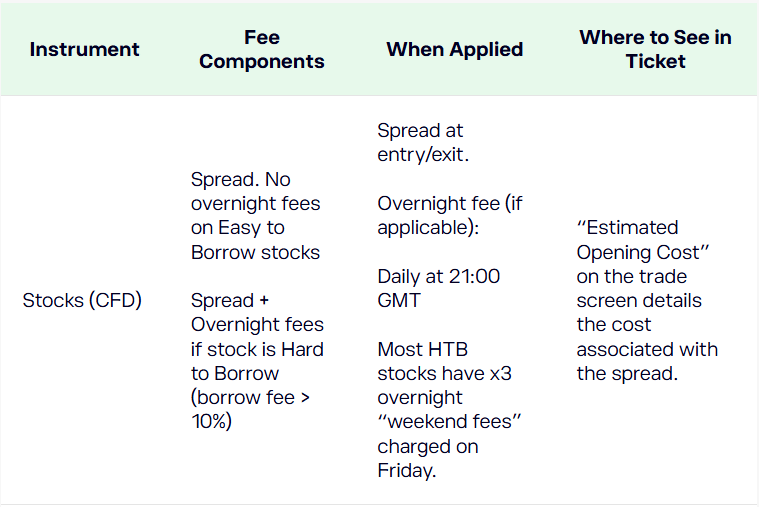
eToro allows users to go short on a particular stock or ETF via contracts for difference (CFDs). The process is straightforward, with a full description of the process available here. Because short positions are executed as CFDs, you don’t pay the stock commission. Instead, you pay the CFD spread and overnight fees for every night the position stays open. The same applies when shorting CFDs on ETFs, indices, commodities and currencies. Short selling through CFDs is not available to eToro users in the U.S.
The principal differentiating factor for eToro is the ability to use social trading when researching short sell ideas. eToro users can follow and automatically copy other short sellers.
eToro is regulated by top-tier institutions such as the FCA in the United Kingdom, ASIC in Australia, and CySEC in Cyprus. As such, I think eToro is a reliable choice for investors looking for an easy-to-use social trading platform.
Check the current eToro sign-up offer. For a full assessment, read our comprehensive eToro review and explore eToro’s website.
Pros
- Low stock trading fees (from $0 per trade)
- Commission-free ETFs (other fees apply)
- Social trading and other innovative products
- Wide variety of financial products
- Slick, modern, and easy for anyone to use
- European users have access to three account currencies: EUR, USD and GBP
- Top tier regulators
Cons
- Limited disclosed financial information
- Withdraw and inactivity fees
- Spread, overnight, inactivity, and currency conversion fees higher than average
- Doesn’t offer bonds, futures, or options
XTB at a glance

69-80% of retail CFD accounts lose money.
Started in 2004 as X-Trade Brokers, XTB has grown into one of the largest brokers specializing in CFD trading, with more than 2.9 million clients.
The broker offers a tiered pricing structure, with monthly trades on stocks and ETFs up to €100,000 coming at no commission to the customer. This makes it ideal for more casual investors.
XTB would be a good choice for traders looking to short commodities, indices, and currency pairs via CFDs. The broker also offers shorting of individual stocks via CFDs, but as we have seen so far, this is not a differentiating factor for XTB.
Instead, XTB is best suited for investors looking for a one-stop shop for CFD trading, allowing traders to participate in downside moves in a wide array of assets, ranging from commodities such as oil, gold, and silver to cryptocurrencies such as bitcoin and ethereum.
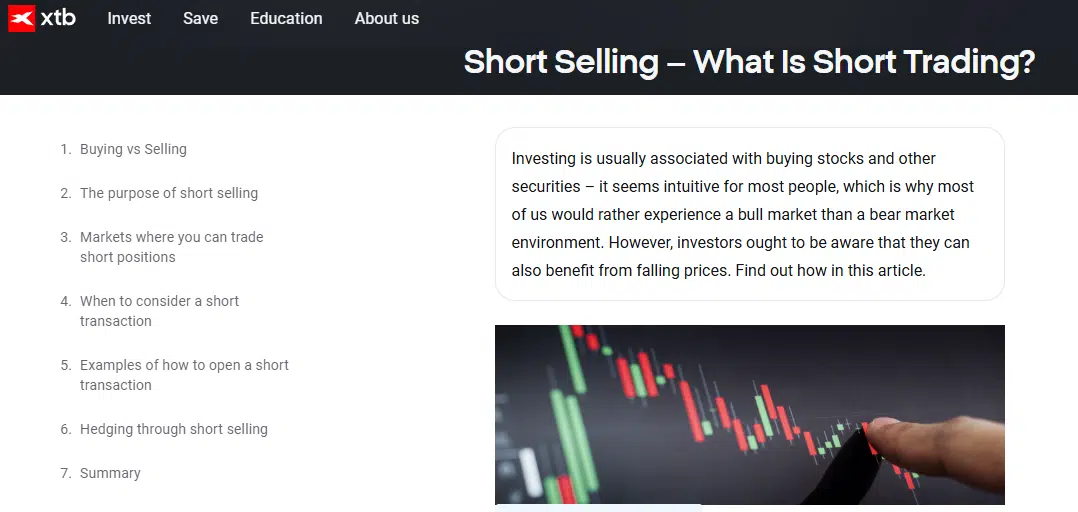
XTB currently offers more than 11,700 instruments for trading, the vast majority of which are also available for shorting. If you decide to hold your short position overnight, you will have to pay a swap fee dependent on the individual instrument you are trading.
XTB is regulated by the KNF, Poland’s financial services watchdog, and the FCA in the United Kingdom. Other regulators include CySEC in Cyprus, the DFSA in Dubai and the IFSC in Belize.
Want to know more about XTB? Check out our XTB Review and visit XTB’s website.
Pros
- Free stocks trading (only applicable to some countries)
- Customizable trading platform (charts and workspace)
- Low Forex Spreads
- Demo account
- No minimum account deposit
- Valuable education materials
- Top-tier Regulators
Cons
- Complex trading platform for a beginner
- High Stock CFD spreads
- Limited product portfolio
- Withdrawal fees for transfers below $100
- Inactivity fee (€10/monthly after 1+ year with no activity plus no deposit in the last 90 days)
Saxo at a glance

62% of retail CFD accounts lose money.
Founded in 1992 in Denmark, Saxo Bank serves more than 1.5 million clients with stocks, ETFs, bonds, mutual funds, options, futures, forex and CFDs. Since March 2026, the Swiss private banking group J. Safra Sarasin has owned a majority stake.
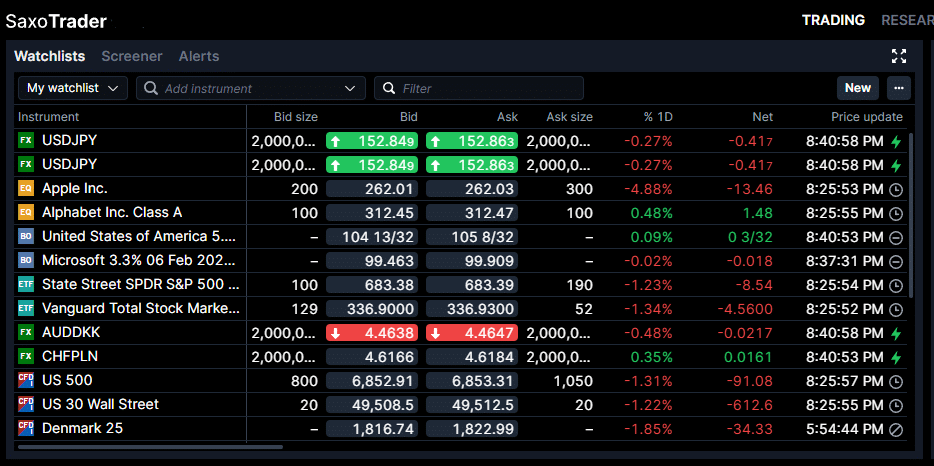
SaxoTrader is the broker’s principal platform, offering the complete array of available investments and markets. It is available in two versions. SaxoTrader for Desktop comes with full functionalities such as charting, while SaxoTrader for web and mobile is suitable for quick trades on the go. Last but not least, SaxoInvestor may appeal to novice investors with a longer-term horizon, as it offers a limited array of investment options, confined to stocks, bonds, and ETFs.
Saxo’s fees are higher than the market average, making the broker a poor choice for traders focused solely on trading costs. As we all know, however, sooner or later, investors will need the help of customer service with more nuanced cases. This is where Saxo Bank stands out, providing top-tier service to clients.
Saxo does not offer shorting stocks in the traditional way of borrowing and subsequently selling a share. Instead, as explained here, there are four main ways to participate in downside movements if you are a client of Saxo Bank, through CFDs, futures on stock indices, ETFs that rise in price when the asset they are shorting goes down in value (inverse ETFs), and options.
CFDs are the most straightforward way to short a stock or commodity you are bearish on. As always, if you hold your position overnight, you will incur a swap fee dependent on the instrument you are trading.
Another easy way to make a short-term bearish bet is to go long inverse ETFs. Just pay attention to whether the ETF itself uses leverage (300% ETFs have become popular in recent years).
Futures trading is a convenient way to position for broad downside movement in a stock index. Here, the key factor to watch is margin requirements. Last but not least, buying put options allows for a tailored bet on individual companies, with the risk limited to the premium you pay upfront.
Saxo Bank is a Danish bank supervised by the Danish FSA, and it is also regulated by the FCA in the United Kingdom, among others. It holds an A- rating from S&P Global Ratings and reports more than €150 billion in client assets.
In summary, Saxo Bank offers a comprehensive trading toolbox to investors willing to bet on downside movements in asset prices, ranging from broad bear markets via index futures and inverse ETFs to idiosyncratic company movements via put options.
Want to know more about Saxo Bank? Check our Saxo Bank Review and visit Saxo Bank’s website.
Pros
- Excellent research materials
- Outstanding trading platforms (SaxoInvestor and SaxoTrader)
- Extensive range of investment products and commercial offers
- Long track record
- Supervised by worldwide top-tier regulators
Cons
- $0 in most countries; higher minimums in some regions (e.g. $5,000 in MENA)
- Fees higher than average
- Fee structure is complex
- Does not accept US residents
Bottom line
To sum up, here are our key findings for investors looking for the best short-selling broker:
TradeZero
Best for shorting U.S. stocksInteractive Brokers
Best for shorting international stocksPlus500
One of the best for short CFD positions on an intuitive platformPepperstone
Best for automated short strategies and platform choiceeToro
Best for social tradingXTB
Best for shorting with CFDsSaxo Bank
Best for customer service
Frequently asked questions
What is short selling?
Short selling means borrowing shares, selling them at the current price and buying them back later to return them to the lender. If the price falls in the meantime, you keep the difference. If it rises, you lose money. With CFDs, you get the same price exposure without borrowing any shares.
How much does it cost to short a stock?
With a real short sale, you pay a borrow fee (an annual rate charged daily), any locate fees for hard-to-borrow stocks, and you must pay the lender any dividends paid while the position is open. With CFDs, you pay the spread or commission and an overnight funding charge for each night the position stays open.
Can you lose more than you invest when shorting?
Yes. A share price can rise without limit, so losses on a real short position are theoretically unlimited. Retail CFD clients in the UK and the EU have negative balance protection, which stops losses at the account balance, but the position can still be closed at a large loss.
What is a short squeeze?
A short squeeze happens when a heavily shorted stock rises quickly and short sellers rush to buy shares back to limit their losses. That buying pushes the price even higher. Stocks with a high share of their float sold short and few shares available to borrow are the most exposed.
What is a forced buy-in?
When the lender recalls the shares, or the broker can no longer borrow them, your broker can close the short position by buying the shares back, even at an unfavourable price. CFD short positions are not exposed to recalls, although the broker can still close them if your margin runs out.
Do I need a margin account to short stocks?
Yes, a real short sale requires a margin account. In the U.S., a margin account typically needs at least $2,000 in equity. Since 4 June 2026, the $25,000 pattern day trader requirement no longer applies, after the U.S. Securities and Exchange Commission (SEC) approved a new intraday margin framework.
We hope you found this article enlightening and wish you the best of luck in your trading journey!
Disclaimer: The inclusion of TradeZero’s name, logo or web links is present pursuant to an advertising arrangement only. TradeZero is not a contributor, reviewer, provider or sponsor of content published on this site and is not responsible for the accuracy of any products or services discussed.