When it comes to investing, simplicity is key, especially for those looking to grow their wealth without constantly managing a complex portfolio. Vanguard’s LifeStrategy funds offer a ready-made fund portfolio designed to relieve the stress of investing while maintaining a diversified, balanced approach.
But do these funds live up to their promise of a reliable, long-term financial solution?
In this review, we’ll explore how Vanguard LifeStrategy works, its key benefits, potential drawbacks, and whether it’s the right choice for your investment strategy.

Please note that this review focuses on UK investors (GBP versions of each LifeStrategy fund). For other European investors, you can find the EUR versions here. To understand the differences clearly, jump to this section.
What is a Vanguard LifeStrategy fund?
LifeStrategy funds work as a “fund of funds”, which means that unlike “traditional” mutual funds or ETFs that buy individual securities to create a diversified investment, a fund of funds diversifies by owning other funds. In this case, Vanguard only uses its own Index Funds.
Each LifeStrategy fund comprises a combination of exposure to Equity (stocks) and Fixed Income (bonds): from 20% to 100% in Equity, with the remaining being the Fixed Income component. Each fund indicates the percentage of Equity on the names, as shown:
| UK LifeStrategy funds (ISINs*) | Distributing** | Accumulating** |
| LifeStrategy 20% Equity Fund | GB00B4620290 | GB00B4NXY349 |
| LifeStrategy 40% Equity Fund | GB00B41F6L43 | GB00B3ZHN960 |
| LifeStrategy 60% Equity Fund | GB00B4R2F348 | GB00B3TYHH97 |
| LifeStrategy 80% Equity Fund | GB00B4KWNF91 | GB00B4PQW151 |
| LifeStrategy 100% Equity Fund | GB00B545NX97 | GB00B41XG308 |
*ISIN (International Securities Identification Number) codes (“GB00…”) are the global ISO standard for identifying financial instruments.
**Accumulating: reinvests any dividends with the aim of growing your investment over time. Distributing: pays any dividends out to you as income.

Stocks generally provide higher returns over time but come with increased risk, while bonds tend to be more stable, though they usually offer lower returns. By blending these two asset types, the funds aim to balance potential growth and risk management.
Summary table
The differences between all the LifeStrategy funds come down to the mix of stocks and bonds in each, so the following information is similar to all:
| LifeStrategy funds | Characteristics |
| Inception date | 23 Jun 2011 |
| Ongoing charges figure (OCF) | 0.20% (cut from 0.22% in January 2026) |
| ISA ready | Yes |
| Income versions | Accumulating and distributing |
| Fund structure | Non-UCITS Retail Scheme (NURS) since January 2026 |
| Minimum one-off/monthly payment (Vanguard Investor) | £500/£100 per fund |
| Vanguard Investor account fee | £4 a month below £32,000, then 0.15% a year (capped at £375) |
Highlights
- Investments on track: Vanguard ensures that the equity exposure remains stable throughout your investment time horizon. So, if you invest in a 60% equity LifeStrategy fund, you will not see an equity exposure of 40% or 80% in 3, 5 or 10 years down the line.
- Highly diversified: Each LifeStrategy fund holds 6,000 to 20,000 shares and bonds around the world.
- Rebalancing: Automatically done for you. No need to worry about what assets to buy or sell.
- Risk profiles: From more conservative (higher exposure to bonds) to more aggressive (higher exposure to equities) risk profiles.
- Costs: All UK LifeStrategy funds have an ongoing charge (OCF) of 0.20% since 27 January 2026, down from 0.22%.
Performance comparison
The following graph compares the performance of all the Vanguard LifeStrategy funds. The top green line is the 100% equity exposure LifeStrategy whereas the bottom blue line is the 20% equity exposure LifeStrategy:
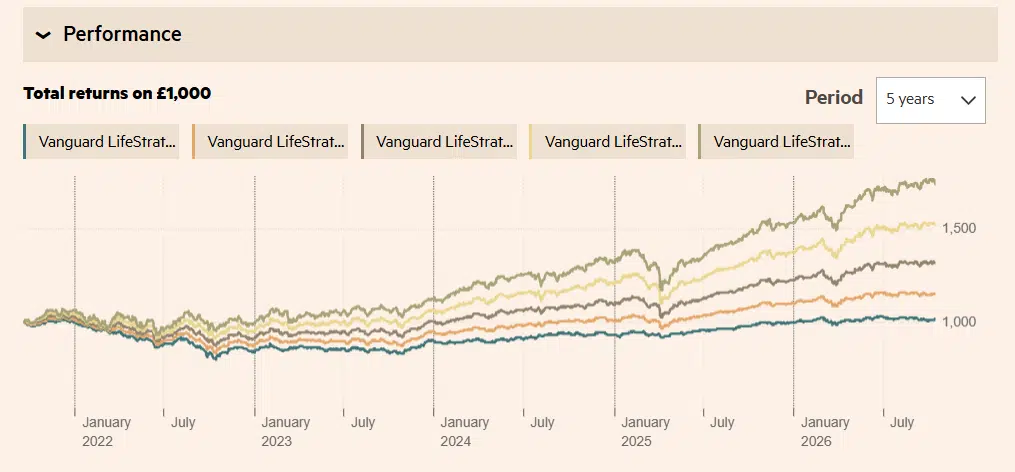
As you notice, the more exposure to stocks a fund has, the more likely it is to show higher returns.
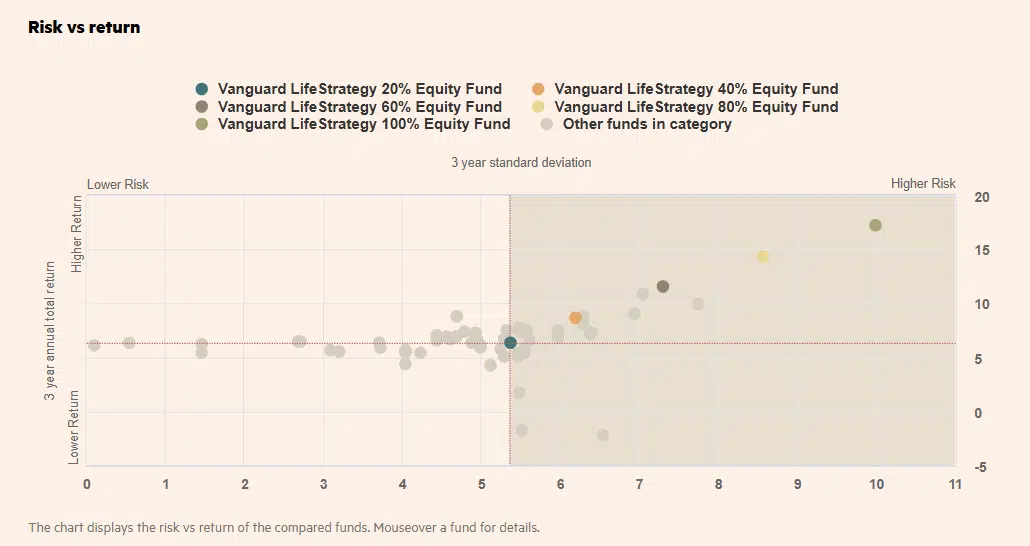
However, you must also consider the other side of the same coin: risk. And, with no surprise, the higher equity exposure brings the most risk (higher volatility):
Annual costs
One particular aspect of Vanguard LifeStrategy funds is that the ongoing charge, now 0.20%, already includes the costs associated with each Index Fund inside each strategy.
The breakdown below comes from the Vanguard annual report (page 125), published before the January 2026 fee cut:

The “Total Synthetic OCF” is the sum of the “Fund Direct Charge,” which is the weighted average annual cost of all the Index Funds in each LifeStrategy fund, plus the “Synthetic element,” which is no more than the additional cost of setting up the LifeStrategy investment structure.
If you buy the funds through Vanguard Investor, there is also an account fee: £4 a month for accounts below £32,000 (since February 2025) and 0.15% a year above that, capped at £375 a year. Other platforms charge their own fees.
| Amount invested | Fund OCF (0.20%) | Vanguard Investor fee | Total per year |
| £10,000 | £20 | £48 | £68 (0.68%) |
| £50,000 | £100 | £75 | £175 (0.35%) |
| £250,000 | £500 | £375 | £875 (0.35%) |
Estimated annual cost of a LifeStrategy fund held at Vanguard Investor, as of October 2026. Source: Vanguard Investor fees.
What changed in 2026
Vanguard made several changes to the LifeStrategy range in 2026:
- Lower fees: the ongoing charge fell from 0.22% to 0.20% on 27 January 2026.
- Less UK bias: between 27 March and the end of June 2026, Vanguard cut the share of UK-listed shares from 25% to 20%, and the share of sterling bonds from 35% to 20%. Vanguard estimated the transaction costs of the switch at 0.01% to 0.05%.
- New LifeStrategy Global range: rolled out from 22 January 2026 with the same 0.20% charge, it holds only around 3% to 4% in UK assets, close to the UK’s weight in global markets.
- New fund structure: since around 7 January 2026, the funds are a Non-UCITS Retail Scheme (NURS) rather than a UK UCITS (Undertakings for Collective Investment in Transferable Securities). Fees, strategy, risk profiles and ISINs did not change, so this does not change how you buy or hold them.
Note that the portfolio composition charts below may still show the allocations before the 2026 rebalancing.
Here is how the two ranges now compare:
| Feature | LifeStrategy | LifeStrategy Global |
| Launch | 23 June 2011 | From 22 January 2026 |
| Ongoing charges figure | 0.20% | 0.20% |
| UK-listed shares | About 20% of the equity portion | About 3% of the equity portion |
| Sterling bonds | About 20% of the bond portion | In line with global bond indices |
| Equity levels | 20%, 40%, 60%, 80% and 100% | Same risk levels as the standard range |
Source: Vanguard Investor fund changes and the LifeStrategy Global 20% Equity factsheet, data at 31 August 2026.
Analysis of each LifeStrategy fund
As stated above, the LifeStrategy funds only differ from one another in what concerns the mix of stocks and bonds. As such, we will focus on that.
LifeStrategy 20% equity fund
Let’s start with the most conservative portfolio. As stated on the Vanguard website:
“The Fund seeks to hold investments that will pay out money and increase in value through a portfolio comprising approximately 20% shares and 80% bonds”.
The portfolio composition shows that (orange boxes are the equity exposure):

The performance has been the following:

LifeStrategy 40% equity fund
As stated on the Vanguard website:
“The Fund seeks to hold investments that will pay out money and increase in value through a portfolio comprising approximately 40% shares and 60% bonds and other similar fixed income investments”.
The portfolio composition shows that (orange boxes are the equity exposure):

Compared to the 20% Equity, the 40% Equity adds more exposure to the Pacific region and increases the weight in the other Equity Index Funds.
The performance has been the following:

LifeStrategy 60% equity fund
As stated on the Vanguard website:
“The Fund seeks to hold investments that will pay out money and increase in value through a portfolio comprising approximately 60% shares and 40% bonds and other similar fixed income investments”.
The portfolio composition shows that (orange boxes are the equity exposure):

From the 40% Equity to the 60% Equity, we notice a significant rise in the exposure to the US stock markets through the “Vanguard U.S. Equity Index Fund GBP Acc”.
The performance has been the following:

Out of curiosity, my co-founder at Investing in the Web, Pedro Braz, has exposure to this particular Vanguard LifeStrategy fund.
LifeStrategy 80% equity fund
As stated on the Vanguard website:
“The Fund seeks to hold investments that will pay out money and increase in value through a portfolio comprising approximately 80% shares and 20% bonds and other similar fixed income investments”.
The portfolio composition shows that (orange boxes are the equity exposure):

From the 60% Equity to the 80% Equity, the same pattern remains: higher exposure to global equities.
The performance has been the following:

LifeStrategy 100% equity fund
As stated on the Vanguard website:
“The Fund seeks to hold investments that will pay out money and increase in value through a portfolio comprising approximately 100% shares”.
The portfolio composition shows that (only equities):

The performance has been the following:

Tax efficiency: ISAs, SIPPs, and LifeStrategy funds
When investing in Vanguard LifeStrategy funds, tax considerations play an important role, particularly for UK investors using ISAs (Individual Savings Accounts) or SIPPs (Self-Invested Personal Pensions). Here’s how these tax-efficient vehicles impact LifeStrategy investments:
ISAs
ISAs are one of the most tax-efficient ways to invest in the UK. By investing in Vanguard LifeStrategy funds through an ISA, investors can enjoy several key benefits:
- Tax-free growth: Any gains from investments within an ISA are exempt from capital gains tax (CGT).
- Tax-free income: Dividends and interest received from LifeStrategy funds in an ISA are also completely tax-free.
- Contribution limits: The annual ISA allowance is £20,000 for the 2026/27 tax year. From April 2027, the overall limit stays at £20,000, but under-65s will only be able to put up to £12,000 of it into cash ISAs, so the change does not affect stocks and shares ISAs.
This makes ISAs a natural home for LifeStrategy funds if you are building a long-term, tax-efficient portfolio.
SIPPs
SIPPs offer another tax-efficient way to invest in Vanguard LifeStrategy funds, particularly for those focused on retirement planning. Here’s how investing through a SIPP works:
- Tax relief on contributions: Contributions to a SIPP are eligible for tax relief, meaning that the government adds 20% to your contributions, and higher and additional-rate taxpayers can claim extra relief through their tax return.
- Tax-free growth: Like ISAs, investments held in a SIPP grow free of capital gains tax.
- Tax-free withdrawal (to an extent): From age 55 (rising to 57 from 6 April 2028), investors can withdraw up to 25% of their pension tax-free, capped at £268,275 (the Lump Sum Allowance). The remaining 75% will be subject to income tax, but this can still be advantageous depending on your tax bracket at the time of withdrawal.
- No more Lifetime Allowance: The Lifetime Allowance was abolished on 6 April 2024. Instead, tax-free lump sums are capped by the Lump Sum Allowance (£268,275) and the Lump Sum and Death Benefit Allowance (£1,073,100).
SIPPs suit long-term retirement investors who want to reduce the tax they pay, as long as they are comfortable with the money being locked away until minimum pension age.
Who are LifeStrategy funds best suited for?
Vanguard LifeStrategy funds are designed with simplicity and broad diversification in mind, making them appealing to various investor profiles. Here are the key types of investors who may benefit from LifeStrategy funds:
- Beginner investors: Those new to investing often appreciate the simplicity of a “set-it-and-forget-it” approach. LifeStrategy funds offer instant diversification across global equities and bonds, eliminating the need for beginners to research individual stocks or manage complex portfolios. By automatically rebalancing, these funds also reduce the effort needed to maintain a balanced portfolio over time.
- Long-term investors: These funds are particularly suited for individuals with a long-term investment horizon. Because they are built with a passive investment strategy, LifeStrategy funds are well-suited for individuals focused on long-term growth and who are comfortable holding their investments for decades. The bond-equity mix enables investors to adjust the risk according to their timeline.
- Risk-averse investors: For those who prioritize stability, LifeStrategy funds with a higher bond allocation (like LifeStrategy 20% or 40%) show lower volatility than the more equity-heavy funds. These are ideal for investors nearing retirement, or those looking to preserve wealth rather than chase high returns.
- Investors seeking simplicity: Vanguard LifeStrategy funds are perfect for investors who want diversification without the hassle of managing multiple investments. The funds automatically rebalance to ensure they remain aligned with the chosen risk level.
- Cost-conscious investors: With low fees, Vanguard LifeStrategy funds are also ideal for those seeking to minimise investment costs. Investors sensitive to expense ratios and hidden fees may find these funds appealing because they are significantly more affordable than many actively managed funds or other investment products.
However, LifeStrategy funds may not be the best option for more experienced investors who prefer full control over their asset allocation or those looking to fine-tune their investments with specific asset classes (e.g., real estate, commodities, or sector-specific stocks).
Furthermore, there is still a UK bias: even after the 2026 reduction, the LifeStrategy funds keep around 20% of their equity portion in UK stocks, much higher than the UK’s weight in the global market (less than 4%). Investors who want a fully global portfolio can choose the new LifeStrategy Global funds instead.
Do Vanguard LifeStrategy funds differ in EUR and GBP versions?
Yes, there are several differences that you must take into account:
- Investment vehicles: The UK versions only invest in index funds, whereas the EUR versions only use exchange-traded funds (ETFs). The main practical difference is that ETFs can be traded at any time during trading hours. On the other hand, Index Funds can be traded only once at the end of the trading day. In practice, you may notice a minor difference in performance.
- Number of funds available: In the UK version, you can invest in a LifeStrategy fund with 100% equity exposure. However, the same version is not available on the EUR side. The maximum equity exposure is 80% through the Vanguard LifeStrategy 80% Equity UCITS ETF. Why? Because a Vanguard LifeStrategy 100% Equity would be equivalent to the already existing Vanguard FTSE All-World UCITS ETF (VWCE).
- Country exposure: The UK version has a large exposure to the UK, with around 20% of both the equity and the bond portions in UK assets since the 2026 rebalancing. The European version has a more global exposure, and its bonds are hedged to EUR.
- Ongoing charges: The annual fee is 0.20% in the UK and 0.25% in Europe.
European versions of the Vanguard LifeStrategy funds:
| EUR LifeStrategy ETFs (ISINs*) | Distributing** | Accumulating** |
| LifeStrategy 20% Equity Fund | IE00BMVB5L14 | IE00BMVB5K07 |
| LifeStrategy 40% Equity Fund | IE00BMVB5N38 | IE00BMVB5M21 |
| LifeStrategy 60% Equity Fund | IE00BMVB5Q68 | IE00BMVB5P51 |
| LifeStrategy 80% Equity Fund | IE00BMVB5S82 | IE00BMVB5R75 |
*ISIN codes (“IE00…”) are the global ISO standard for identifying financial instruments.
**Accumulating: reinvests any dividends with the aim of growing your investment over time. Distributing: pays any dividends out to you as income.
Final verdict
Vanguard LifeStrategy funds offer a robust, all-in-one investment solution that caters to a wide range of investors. With a balanced mix of equities and bonds, low fees, and automatic rebalancing, these funds provide a simple yet effective way to invest for the long term.
For investors seeking an easy-to-manage portfolio that aligns with their risk tolerance, the LifeStrategy range provides a solid foundation. However, those who want more control over their investment choices or who are looking for exposure to specific asset classes (such as real estate or commodities) may find the funds a bit limiting. In such cases, constructing a custom portfolio or exploring alternatives like robo-advisors or ETFs might be a better option.
Ultimately, Vanguard LifeStrategy funds serve as an excellent choice for individuals looking for a long-term, hands-off investment strategy with the peace of mind that their portfolio is well-diversified and aligned with their risk preferences.
FAQs
Which Vanguard LifeStrategy fund should I choose?
It depends on how much risk you can take and how long you will stay invested. The higher the equity percentage, the higher the expected long-term return and the bigger the swings along the way. Investors with decades ahead often look at the 80% or 100% versions, while those close to needing the money tend to prefer 20% to 60%.
Is LifeStrategy 100% Equity the same as a global tracker?
No. It still keeps around 20% of its shares in UK companies after the 2026 changes, against less than 4% in a global index. The new LifeStrategy Global 100% Equity Fund is the closer match to a global tracker.
How much do Vanguard LifeStrategy funds cost?
The ongoing charges figure is 0.20% a year for every fund in the range since 27 January 2026. At Vanguard Investor you also pay an account fee of £4 a month below £32,000 invested, or 0.15% a year above that, capped at £375.
Can I hold LifeStrategy funds in an ISA or a SIPP?
Yes. All UK LifeStrategy funds can be held in a stocks and shares ISA or a SIPP, at Vanguard Investor and at most other UK investment platforms.