


The Invesco QQQ ETF (QQQ is the ticker) is one of the most widely held ways to get exposure to the Nasdaq-100, the index of the 100 largest non-financial companies listed on the Nasdaq.
However, due to regulatory restrictions, QQQ is not directly accessible to retail investors in Europe and the UK.
In this article we explain why, what the equivalent European and UK products are, and how to buy them.
Why isn’t QQQ directly available in Europe and the UK?
QQQ is a US-domiciled ETF, and it is unavailable to European and UK retail investors because of the EU’s Packaged Retail and Insurance-based Investment Products regulation, known as PRIIPs.
The rule requires that any investment product marketed to retail investors in the EU publishes a Key Information Document (KID), setting out features, risks and costs in a standardised format. The aim is to make products comparable and transparent.
US-domiciled ETFs such as QQQ do not produce a KID, because US rules do not require one and their client base is overwhelmingly American. Without that document, European brokers cannot offer them to retail clients, which is why you will not find QQQ on eToro, DEGIRO, Interactive Brokers, Trading 212 or Trade Republic in Europe.
This is not specific to QQQ. The same applies to SPY, VOO, IVV and essentially every other US-listed ETF. The upside is that European issuers have built UCITS equivalents tracking exactly the same indices, which is what the rest of this article covers.
There is a second reason the European versions often suit you better, and it has nothing to do with regulation: US-domiciled products sit inside the US estate tax net. Non-US persons holding US-situs securities above a relatively low threshold can face US estate tax exposure, which UCITS products avoid.
Disclaimer: when investing, your capital is at risk and you may get back less than invested. Past performance doesn’t guarantee future results.
Is there any workaround to invest in QQQ?
There are two routes, and they are not equivalent.
The first is a Contract for Difference (CFD) on QQQ, available on platforms such as eToro. A CFD lets you take a position on the price without owning the underlying ETF.
What are CFDs? They are instruments that track the price of an underlying asset without conveying ownership, in contrast to traditional investing. To understand the difference properly, read our article on CFDs vs shares.
If you hold a CFD without leverage, the economics of a buy-and-hold position are closer to owning the ETF than people often assume, since no overnight financing applies at x1. What you give up is ownership: you cannot transfer the position to another broker, you are exposed to the broker as counterparty, and you pay the spread on the way in and out. Using leverage changes the picture entirely, adding financing costs and the risk of losses beyond your initial position.
The second route is simpler and is what most long-term investors should look at first: buy a UCITS ETF tracking the same index. These give you the Nasdaq-100 in a product designed for European investors, with full ownership and no counterparty question.
How to buy the QQQ ETF CFD on eToro
If you are a European or UK investor and want to buy the QQQ CFD on eToro, here is the process.
a) Search for the QQQ CFD
In the eToro search bar, type “QQQ” or “Invesco QQQ”, and select the instrument from the results.

b) Open a trade
Click “Trade” on the instrument page to open the order window.

c) Set your trade parameters
- Amount or number of shares: how much you want to invest, or how many units;
- Leverage: leave this at x1 for a long-term position. Leverage amplifies both gains and losses and adds overnight financing costs;
- Stop loss and take profit: optional orders that close the position automatically at a level you set.

d) Execute the trade
Review the order details and click “Buy”.

Best QQQ alternatives for European and UK investors
There is no need to use CFDs to get Nasdaq-100 exposure. Several UCITS ETFs track the same index, hold the same companies, and are designed for investors in your region.
Before the tables, one point that saves confusion: an ETF can be listed on several exchanges in different currencies while being one single fund. The iShares Nasdaq 100 UCITS ETF trades as SXRV in euros on Xetra and as CNX1 in pounds on the London Stock Exchange, and both share the ISIN IE00B53SZB19. Same fund, same holdings, same underlying dollar assets, just a different trading line.
That matters for what the listing currency does and does not do, which we come back to below.
Nasdaq-100 UCITS ETFs listed in euros
| Name | Ticker | ISIN | TER | Replication | Income |
| iShares Nasdaq 100 UCITS ETF | SXRV | IE00B53SZB19 | 0.30% | Physical | Accumulating |
| Invesco EQQQ Nasdaq-100 UCITS ETF | EQQQ | IE0032077012 | 0.30% | Physical | Distributing |
| Invesco EQQQ Nasdaq-100 UCITS ETF Acc | EQQB | IE00BFZXGZ54 | 0.30% | Physical | Accumulating |
| Amundi Nasdaq-100 II UCITS ETF | LYMS | LU1829221024 | 0.22% | Synthetic | Accumulating |
| Xtrackers Nasdaq 100 UCITS ETF 1C | XNAQ | IE00BMFKG444 | 0.20% | Physical | Accumulating |
Nasdaq-100 UCITS ETFs listed in pounds
| Name | Ticker | ISIN | TER | Replication | Income |
| iShares Nasdaq 100 UCITS ETF | CNX1 | IE00B53SZB19 | 0.30% | Physical | Accumulating |
| Invesco EQQQ Nasdaq-100 UCITS ETF | EQQQ | IE0032077012 | 0.30% | Physical | Distributing |
| Amundi Nasdaq-100 II UCITS ETF | NASL | LU1829221024 | 0.22% | Synthetic | Accumulating |
| Xtrackers Nasdaq 100 UCITS ETF 1C | XNAQ | IE00BMFKG444 | 0.20% | Physical | Accumulating |
Note that several tickers appear in both tables: they are the same funds, cross-listed. Fund sizes move constantly, so check the current figures on the issuer’s page or on justETF before choosing.
What about currency-hedged versions?
If your concern is the dollar rather than the index, note that listing currency does not give you any currency protection. Buying CNX1 in pounds still leaves you fully exposed to the dollar, because the fund holds US companies priced in dollars. The pound listing only saves you a conversion at the moment of the trade.
What does change your exposure is a hedged share class, which uses forward contracts to neutralise the currency movement. Issuers including iShares, Invesco and Amundi offer EUR-hedged and GBP-hedged versions of their Nasdaq-100 ETFs, usually with a ticker or name containing “EUR Hedged” or “GBP Hedged”.
The trade-off is real. Hedging costs money, typically a higher TER plus the ongoing cost of rolling the forwards, which reflects the interest rate differential between the two currencies. It removes the currency swings in both directions, so it helps when the dollar falls and costs you when it rises. For a long-term equity position most investors skip it, on the basis that currency effects tend to wash out over decades while the cost does not. For shorter horizons, or if currency volatility would genuinely affect your plans, it is worth considering.
How to buy a QQQ alternative (SXRV) on DEGIRO
The iShares Nasdaq 100 UCITS ETF (SXRV) is the largest of the euro-listed options. Here is how to buy it on DEGIRO.
a) Search for SXRV and select it
Type “SXRV” in the search bar and select the iShares Nasdaq 100 UCITS ETF from the results. Searching by ISIN is more reliable than by name, since several similar funds exist.

b) Open the order window
Click “Buy” on the ETF page.

c) Set your order parameters
Enter the number of shares. You can also choose the order type: market, limit, stop loss, stop limit or trailing stop.

d) Execute the trade
Review the details and click “Place Order”.

That is all it takes. One thing worth checking on DEGIRO specifically: whether the ETF appears in its Core Selection, which affects what you pay in handling fees.
What to look for in a Nasdaq-100 ETF
Since these funds all track the same index, the differences between them are structural rather than about performance. Here is what to compare.
a) Fees
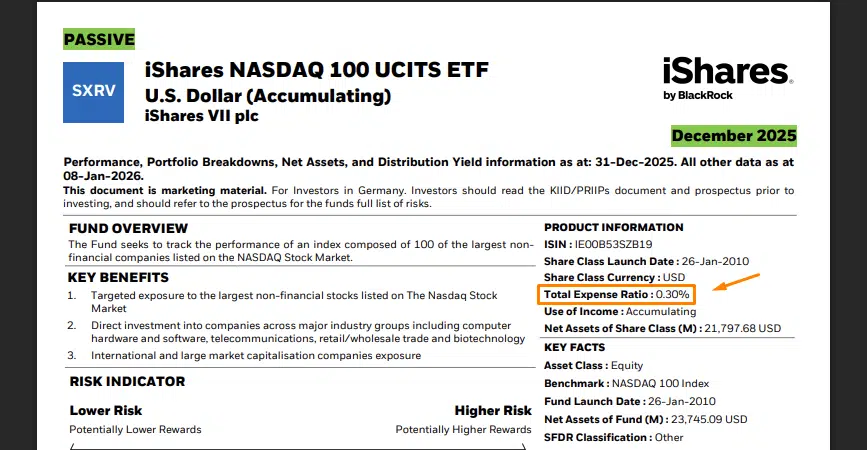
Ongoing charges vary by provider, quoted as the Ongoing Charges Figure (OCF) or Total Expense Ratio (TER). The range here runs from 0.20% to 0.33%, which on a €10,000 position is a difference of about €13 a year. Not decisive on its own, but it compounds.
Taking the iShares Nasdaq 100 UCITS ETF (SXRV) factsheet as an example:
b) Replication method
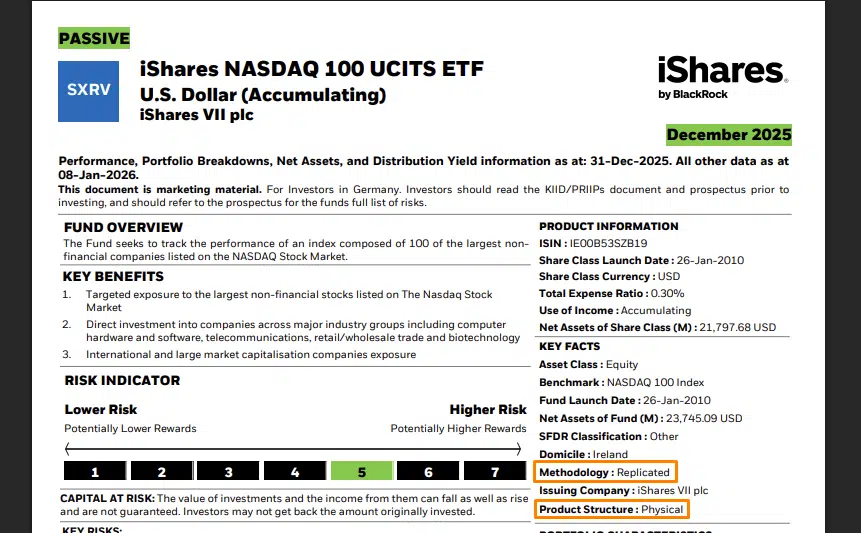
- Physical replication means the fund holds the actual shares in the index, which is transparent and avoids derivative exposure.
- Synthetic replication uses swaps to deliver the index return. It can be cheaper and can track more closely, particularly on US indices where it can improve the tax treatment of dividends, but it introduces counterparty risk if the swap provider fails. That risk is collateralised, though not eliminated.
The Amundi products in the tables above are synthetic; the others are physical. SXRV uses physical replication:
c) Use of income
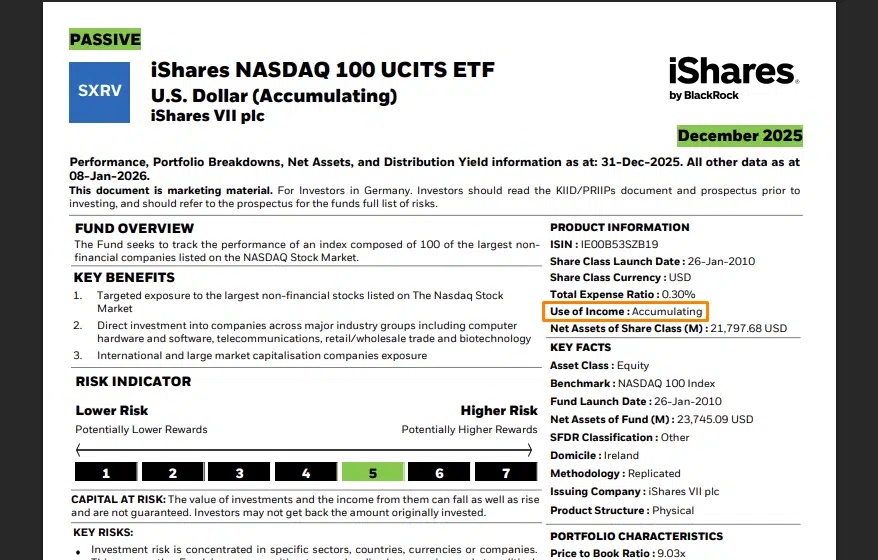
- Accumulating ETFs reinvest dividends inside the fund, compounding automatically and, in many countries, deferring tax until you sell.
- Distributing ETFs pay dividends into your account, which suits investors who want income but usually triggers tax each time.
Which is better depends on your goals and, importantly, on where you are taxed. The treatment differs a lot between countries, so check your local rules rather than assuming accumulating is always more efficient.
SXRV is accumulating:
d) Size
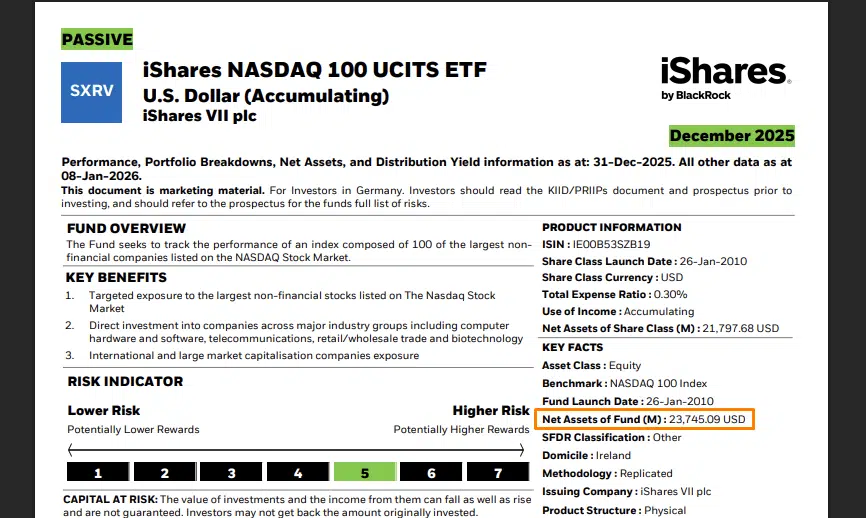
Larger funds tend to be more liquid, with tighter bid-ask spreads, which lowers your real cost of trading. A very small fund also carries a higher chance of being closed or merged, which forces a sale at a time not of your choosing.
e) Listing currency
The currency of the listing affects the conversion you pay when you trade, not your underlying exposure. Buying the euro line saves you a conversion if your account is in euros, and that is worth something, since broker FX fees range from 0.15% to over 0.5%.
What it does not do is protect you from the dollar. The fund holds US companies whose value is set in dollars, so your returns move with the exchange rate whichever line you buy.
f) Currency hedging
This is the only way to change that exposure, and we covered the trade-off above: it costs more and works in both directions.
g) Concentration
Worth saying plainly, since these tables make the funds look interchangeable with a broad market ETF. The Nasdaq-100 is not diversified in the way an S&P 500 or world ETF is: it excludes financials, is heavily weighted to a handful of large technology companies, and the top names account for a large share of the index. That has been an advantage for years. It is still a concentrated bet, and worth knowing you are making it.
Looking to backtest your ETF portfolios?
If you are an EU investor looking to backtest ETF portfolios, check out our Portfolio Analyser. The tool lets you analyse your selected portfolios and get visual data and metrics to compare and evaluate EU-domiciled ETFs.
Bottom line
QQQ is not directly accessible to European and UK investors because it does not publish the Key Information Document that EU rules require. That is a paperwork problem, not an investment one: several UCITS ETFs track the same Nasdaq-100 index, hold the same companies, and are available on every major European platform.
For euro-based investors, SXRV and EQQB are the main accumulating options, with EQQQ if you want distributions. UK investors get the same funds through the London listings, CNX1 among them. Cheaper options exist at 0.20% to 0.22%, with the Amundi products using synthetic replication, which is a structural choice rather than simply a better price.
Remember that buying the euro or pound line saves you a currency conversion but leaves your dollar exposure intact. Only a hedged share class changes that, and it comes at a cost that works against you when the dollar rises.
Platforms such as Interactive Brokers, DEGIRO, Trading 212 and Trade Republic all offer these ETFs, so access is not the constraint. Choosing between them comes down to fees, replication and how the income is handled.
We hope this has answered your questions about investing in the Nasdaq-100 from Europe and the UK.



