Widely known across Europe, Trade Republic has now arrived in Poland, the German fintech officially launched in Poland in September 2025, making it the company’s first market outside the Eurozone. Polish investors get a modern app with a Polish IBAN account paying 6% interest on PLN balances (up to 200,000 zł for clients who joined since July 2026), trading in złoty, low commissions and a Visa debit card with 1% Saveback rewards.
If you’re a Polish investor curious about how Trade Republic works in Poland, the features now available, and the strongest alternatives to consider alongside it, we’ve got you covered.
Is Trade Republic available in Poland? 🇵🇱
Yes, Trade Republic is now available in Poland, as announced in a press release by the company in September 2025:
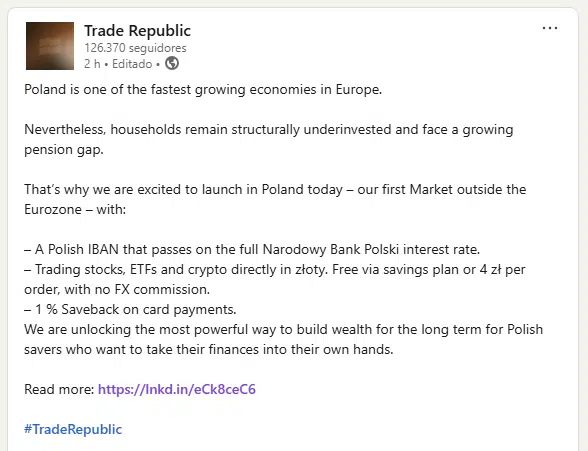
Poland is the first market outside the Eurozone where Trade Republic has launched. The Polish offering includes:
- A Polish IBAN account paying 6% interest on PLN cash. Since 12 May 2026, the rate applies to all clients, not only new ones. For clients who joined from July 2026, it covers balances up to 200,000 zł, and anything above that earns the National Bank of Poland (NBP) deposit rate, currently 3.25%. Interest is paid monthly, with the 19% Belka tax withheld.
- Trading in stocks, ETFs and crypto in złoty (PLN): free through savings plans, or 4 zł per order, with no FX fee. Since July 2026, orders are routed to the best price across around 30 exchanges.
- A Visa debit card with 1% Saveback on card spending, up to 40 zł a month, automatically invested into your savings plan (you need a savings plan of at least 100 zł a month). ATM withdrawals are free from 200 zł, and cost 4 zł below that.
Trade Republic now has more than 10 million customers in 18 European countries and over €150 billion in assets, according to its May 2026 press release. Since April 2026 it also offers 24/7 customer support with real people.
Should you use Trade Republic in Poland?
Now that Trade Republic is officially available in Poland, many investors might be wondering whether it’s the right platform for them.
Trade Republic offers clear advantages, such as:
- A Polish IBAN account paying 6% on PLN balances, one of the highest rates in Poland.
- Low-cost access to stocks, ETFs, and crypto directly in złoty, with free Savings Plans and a simple flat 4 PLN fee per regular trade.
- A clean, mobile-first platform that’s easy to use, especially for beginners.
- Supervision by BaFin and the Bundesbank (Trade Republic Bank GmbH is a fully licensed German bank), €100,000 German deposit protection on cash, and securities held separately at Clearstream in Frankfurt.
However, there are also limitations to consider:
- Fewer advanced trading tools compared with global brokers like Interactive Brokers or Saxo.
- A narrower product range, no options, futures, or forex (though stocks, ETFs, bonds, crypto, and derivatives are available).
- Simpler tax handling for interest than for investments: Trade Republic withholds the 19% Belka tax on interest, but for capital gains and dividends you will usually file the PIT-38 yourself, using the annual tax report in the app.
- No IKE or IKZE retirement accounts, which Polish brokers offer with tax advantages.
- Educational resources are more limited than at some larger, established brokers.
For beginners or those looking for a simple, low-cost way to start investing and earn interest on uninvested cash, Trade Republic is an attractive choice. For investors seeking more sophisticated tools, broader asset classes, or simpler Polish tax reporting, other strong alternatives are also worth considering, we cover them below.
Trade Republic alternatives in Poland
- Interactive Brokers: Best for experienced investors
- eToro: Best for ETF investing with no commission and social trading
- Trading 212: The closest alternative. Sponsored Code: new users can get a free fractional share (terms apply)
- XTB: Best Polish broker, with IKE and IKZE accounts and Polish tax forms


55% of retail CFD accounts lose money.

Capital at Risk. Sponsored Link. To get free fractional shares worth up to 100 EUR/GBP, you can open an account with Trading 212 through this link. Terms apply.

69-80% of retail CFD accounts lose money.
Tax considerations for Polish investors
When choosing a broker in Poland, the tax reporting experience is worth considering carefully:
- Polish brokers (such as XTB): automatically generate the PIT-38 tax form, making annual Polish tax reporting significantly easier.
- Foreign brokers (Trade Republic, IBKR, eToro, Trading 212): you’ll usually need to calculate your capital gains and dividends in Polish złoty and file the PIT-38 yourself. Trade Republic withholds the 19% Belka tax on interest and provides an annual tax report in the app, but check before tax season whether it issues a PIT-8C for your account.
- IKE and IKZE: these Polish retirement accounts let you avoid the 19% Belka tax (IKE) or deduct contributions from your income (IKZE), within annual limits. They are offered by Polish brokers such as XTB, but not by Trade Republic.
This is a meaningful practical difference: for investors who value convenience and easier local tax reporting, a Polish-regulated broker like XTB can save significant time at tax-filing season. For those willing to do the extra paperwork (or use accounting tools), foreign brokers often offer features and pricing that compensate for the added effort.
Conclusion
If you’re based in Poland, you can now open a Trade Republic account directly, as the broker officially launched in the country in September 2025. With a Polish IBAN account paying 6% on PLN cash, and low-cost trading in stocks, ETFs, and crypto, it’s a solid option for many investors, particularly beginners and those looking for a simple, modern, mobile-first experience.
However, Trade Republic won’t fit every investor’s needs. If you prefer a platform with a wider range of assets, more advanced tools, local Polish tax reporting (PIT-38), or a different fee structure, the alternatives we’ve highlighted, XTB (a Warsaw-headquartered broker with native PLN support and automatic PIT-38 generation), Interactive Brokers (for the widest global market access), eToro (for social trading and a broad asset range), or Trading 212 (for stocks and ETFs with no commission, other fees may apply, fractional shares and Pies & AutoInvest), remain excellent choices.
Ultimately, the best broker depends on your investment style, priorities, and how you want to handle Polish tax reporting. Take some time to explore each platform’s offering and choose the one that best aligns with your financial goals.
If you haven’t found a clear match, you can also look at our comparison of online brokers available by country.
Risk disclaimer: When investing, your capital is at risk and you may get back less than invested. Past performance doesn’t guarantee future results. Trading 212: if you enable interest, Trading 212 will hold your cash in qualifying money market funds and banks. Otherwise, your cash will be held only in banks. Interest applies on cash in an investment account. Terms apply. Rates may no longer be current. 0.15% FX fee applies when converting funds. Other fees may apply.
FAQs
What is Trade Republic?
Founded in 2015 in Berlin, Trade Republic is an investment app and bank that lets you invest in stocks, ETFs, bonds, derivatives and crypto, including through savings plans. It has more than 10 million customers and over €150 billion in assets. Trade Republic Bank GmbH is supervised by BaFin and the Deutsche Bundesbank. Cash is protected up to €100,000 by the German deposit guarantee scheme, and securities are held in custody, usually at Clearstream in Frankfurt, separately from the bank’s own assets.
How does Trade Republic make money?
For years, Trade Republic earned a large part of its income from payment for order flow (PFOF), where market makers pay the broker to receive its clients’ orders. The EU banned this practice, and the last national exemptions ended on 30 June 2026. Since July 2026, Trade Republic routes orders to the best available price across exchanges for a fee of €1 (4 zł in Poland), with a €2 option to choose the exchange yourself. Its other income comes from the margin on client cash, card payments and other services.
Is the 6% interest at Trade Republic Poland a promotion?
Since 12 May 2026, Trade Republic pays 6% on PLN cash to all Polish clients, with no announced end date. For clients who joined from July 2026, the rate covers balances up to 200,000 zł, and the NBP deposit rate applies above that. Rates can change, so check the app for the current terms.
Does Trade Republic offer IKE or IKZE in Poland?
No. Trade Republic doesn’t offer IKE or IKZE accounts in Poland. If you want these tax-advantaged retirement accounts, you need a Polish broker such as XTB.