Investors in Germany often look for familiar, reputable platforms when deciding where to put their money to work. Charles Schwab is an investment firm with a global reputation, so it is natural for German investors to ask whether they can use it.
Keep reading to find out whether the Charles Schwab platform is accessible to investors based in Germany. We cover the account opening requirements, the practical limitations that apply to European clients, the German tax implications, and the alternatives worth considering locally.
Is Charles Schwab available in Germany?
Yes, German residents can apply for a Schwab One International brokerage account. However, there are several important factors to understand before doing so.
Charles Schwab primarily operates in the United States, but offers an international service accessible to applicants based in Germany. Specific eligibility requirements apply, which narrow the range of investors for whom this brokerage is a practical choice – and, as we cover below, the product restrictions imposed on European clients are significant enough that most German investors will be better served elsewhere.
It is also worth noting that Schwab One International is a US brokerage account, not a German or EU-regulated one. You are contracting with a US entity regulated by the SEC and FINRA, with assets protected by SIPC coverage up to $500,000 (including a $250,000 cash sub-limit) rather than by any EU investor compensation scheme. SIPC protects against broker failure, not investment losses.
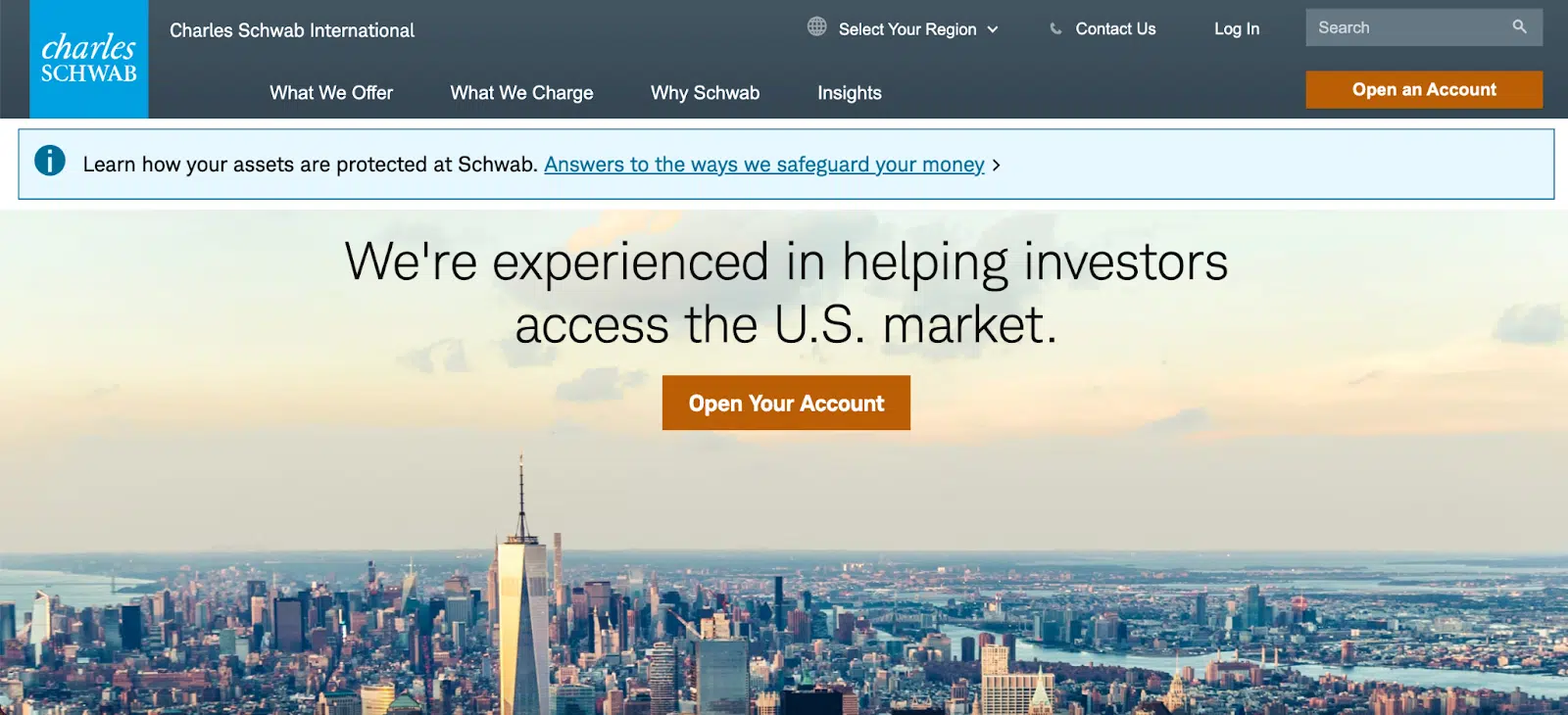
How to use Charles Schwab in Germany
As a German resident, you will need to meet a set of requirements when opening a Schwab One International account. Schwab also applies a minimum deposit of $25,000 for international applicants, which is considerably higher than most European brokers and immediately rules the platform out for many investors.
To apply, you will typically need to provide:
- Tax identification number: for German residents, this is your Steueridentifikationsnummer;
- Valid photo identification: normally your passport;
- Proof of residence: a recent utility bill or equivalent document showing your full name, address, and date;
- Employment details: your current employer’s name and mailing address;
- Form W-8BEN: this certifies your non-US tax status and allows you to claim treaty benefits. Under the Germany-US double taxation treaty, this reduces US withholding tax on dividends from 30% to 15%, so completing it correctly matters financially;
- Access to a printer and scanner: the application process requires uploading signed documents rather than completing everything digitally.
The paperwork-heavy process is a notable contrast to German and EU brokers, most of which complete onboarding fully online in minutes via VideoIdent or PostIdent.
Other things you need to know about using Charles Schwab in Germany
Several practical points are worth weighing before opening a Schwab account from Germany:
- USD-only accounts: you can only hold and trade in US dollars. There is no EUR base currency option;
- Currency conversion costs: because your income and savings are in euros, every deposit and withdrawal involves an FX conversion. These costs recur throughout the life of the account and can meaningfully erode returns over time;
- No access to US ETFs: this is the single biggest limitation. Under EU PRIIPs regulation, US-domiciled ETFs do not publish a Key Information Document (KID) in the required format, so EU retail investors cannot buy them. This rules out the low-cost US ETFs (VOO, VTI, SPY, and similar) that are often the main reason investors look at a US broker in the first place;
- Commission-free US stocks: individual US stocks trade without commission, so the platform can still work for stock pickers, though the investment universe is narrower than at comparable European brokers;
- $25,000 minimum deposit: high relative to European alternatives, most of which have no minimum at all;
- German tax reporting: Schwab does not act as a German paying agent and therefore does not withhold Abgeltungsteuer at source. You must declare all investment income yourself via Anlage KAP in your annual Steuererklärung, including the 25% flat tax plus solidarity surcharge and, where applicable, church tax. Foreign account holdings may also carry additional reporting obligations, so consulting a Steuerberater is advisable;
- US estate tax exposure: US-situs assets above $60,000 held by non-resident aliens can fall within the scope of US estate tax. The Germany-US estate tax treaty provides relief, but this is a genuine consideration for larger accounts and one that rarely gets mentioned.
Taken together, these constraints mean Schwab One International tends to suit a narrow group: German residents with substantial US ties, US tax obligations, or a specific need for a US-domiciled brokerage account. For most German investors building a diversified portfolio, an EU-regulated broker offering UCITS ETFs, EUR base currency, and simpler tax handling will be the more practical route.
Charles Schwab alternatives in Germany
These are leading online brokerage options operating in Germany, regulated by top-tier authorities, and providing some features similar to those of Charles Schwab. Given that, here are our suggestions:
eToro
eToro, boasting a user base exceeding 40 million, stands out as the foremost social investment platform where users can emulate and track the strategies of fellow traders and investors. Furthermore, it provides commission-free trading for stocks and ETFs (other fees apply).
Disclaimer: eToro is a multi-asset investment platform. The value of your investments may go up or down. Your capital is at risk.
Interactive Brokers
Catering to the needs of seasoned investors, Interactive Brokers presents an extensive array of products sourced from various global exchanges. In addition, they provide a sophisticated trading platform known as the IB Trader Workstation. They also offer a user-friendly app called IBKR GlobalTrader, tailored for beginners.
XTB
A globally recognised broker for forex and CFDs, this company stands out as a top choice for derivative trading. Moreover, their in-house trading platform, XStation 5, is renowned for its advanced features and user-friendly interface, making it one of the industry’s best options. Notably, they have introduced commission-free trading for real stocks and ETFs in Germany.
DEGIRO
A prominent online brokerage in Europe, this platform has gained recognition for its cost-effective structure. It provides commission-free ETF trading (with external fees applicable) and boasts an extensive range of investment products. Disclaimer: Investing involves risk of loss.
| Broker | Minimum Deposit | US Stock Fees |
| eToro | $50 | $0 for buying and selling stocks (spread and conversion fees may apply) |
| Interactive Brokers | $0 | Between $0.0005 and $0.0035 per US share (maximum 1% of the trade) |
| XTB | $0 | $0 on real stocks and ETFs |
| DEGIRO | €0 | €2 per trade (€1 commission plus a €1 handling fee) |
#1 eToro

52% of retail CFD accounts lose money.
Established in 2007, eToro is a well-known brokerage recognised for pioneering social trading. It is now one of the largest fintech companies globally, with a user base exceeding 40 million across 140+ countries, offering more than 3,000 assets across major international exchanges.
eToro’s platform, available via web and mobile, functions as a social trading hub. German investors can discuss trade ideas and market news with peers, replicate the strategies of experienced traders through CopyTrader (mirroring Popular Investors), or invest in thematic Smart Portfolios. A $100,000 virtual demo account is available for practising without risking capital.
Both the web and mobile versions offer comprehensive, intuitive interfaces supporting commission-free real stocks and ETFs from the US, UK, and major EU exchanges – including Xetra for German equities. eToro also offers CFDs on stocks, indices, commodities, forex, and cryptocurrencies.
On safety, eToro is regulated by top-tier authorities including the FCA (UK), ASIC (Australia), CySEC (Cyprus), and the SEC/FINRA (US). German residents are served by eToro (Europe) Ltd, CySEC-regulated and passported into Germany under MiFID II with BaFin oversight. Client funds are segregated and covered by the Cyprus Investor Compensation Fund (ICF) up to €20,000, plus additional Lloyd’s of London insurance up to €1 million per eligible client. eToro has also been publicly listed on NASDAQ (ticker: ETOR) since its May 2025 IPO, adding a layer of public-company transparency.
The main drawback for German investors is that eToro operates in USD as its only base currency, so EUR deposits are converted to USD (FX cost ~50 pips). There is also a $5 withdrawal fee and a $10 monthly inactivity fee after 12 months without login. As with any non-German broker, you will need to declare investment income yourself via Anlage KAP.
Overall, eToro is a solid choice for beginners through to more experienced investors in Germany. For deeper detail, see our full eToro review.
eToro is a multi-asset investment platform. The value of your investments may go up or down. Your capital is at risk.
CFDs are complex instruments and come with a high risk of losing money rapidly due to leverage. 52% of retail investor accounts lose money when trading CFDs with this provider. You should consider whether you understand how CFDs work and whether you can afford to take the high risk of losing your money.It is important to read and understand the risks of this investment which are explained in detail at this link.
Zero commission means that no broker fee will be charged when opening or closing the position and does not apply to short or leveraged positions. Other fees apply including FX fees on non-USD deposits and withdrawals. Your capital is at risk. For more information, click here.
#2 Interactive Brokers (IBKR)

Interactive Brokers is arguably the strongest direct alternative to Charles Schwab for German investors, since it delivers comparable global market access without the US-only account structure. Founded in 1978 and listed on NASDAQ (ticker: IBKR; an S&P 500 constituent since 2024), it serves 3 million+ client accounts across 170+ markets in 36+ countries – including Xetra and the Frankfurt Stock Exchange.
Trader Workstation (TWS) remains one of Europe’s most capable investing platforms, serving both newcomers seeking educational resources through IBKR Campus (formerly Traders’ Academy) and professionals wanting advanced technical, fundamental, and research tooling. For those who find TWS overwhelming, the IBKR GlobalTrader mobile app offers a simplified experience with fractional shares from $1 and a $10,000 virtual demo account.
Key advantages for German investors include no minimum deposit, low commissions on US stocks (from $0.0035 per share, $0.35 minimum), European stocks and ETFs at 0.05% of order value (€1.25 minimum), and among the cheapest FX conversion available at 0.20 basis points (minimum $2). Critically, unlike Schwab, IBKR offers native EUR base currency support and full access to UCITS ETFs, which are the EU-compliant equivalents of the US ETFs unavailable through Schwab One International.
German clients are served by Interactive Brokers Ireland Limited, regulated by the Central Bank of Ireland and passported into Germany under MiFID II with BaFin oversight. IBKR also offers cash interest on uninvested EUR and USD balances above certain thresholds and the Stock Yield Enhancement Program (SYEP).
Together, these features make IBKR a compelling alternative to Charles Schwab for German investors. For more, see our detailed Interactive Brokers review.
#3 XTB

69-80% of retail CFD accounts lose money.
XTB is a prominent global player in online brokerage, founded in 2002 in Warsaw and publicly listed on the Warsaw Stock Exchange (ticker: XTB). It serves more than 1.7 million clients across 16 countries and is regulated by top-tier authorities including BaFin (Germany), the FCA (UK), KNF (Poland), CySEC (Cyprus), and AFM (Netherlands). Its proprietary platform, xStation 5, is regularly recognised for usability and execution quality.
XTB offers 0% commission on real stocks and ETFs up to €100,000 of monthly turnover in Germany (0.2% above that, with a €10 minimum), alongside CFDs across multiple asset classes and vanilla options, launched in early 2026. The ETF range includes UCITS-compliant funds suitable for German investors, and XTB pays cash interest on uninvested EUR balances linked to ECB policy.
XTB’s research and educational resources stand out against competitors, with the XTB Trading Academy available in German. Thanks to multiple European offices, customer service is delivered in local languages, including German – a meaningful practical advantage over a US-based broker.
The main limitation is product breadth: XTB’s offering centres on stocks, ETFs, forex, and CFDs, without bonds or mutual funds. There is also a €10 monthly inactivity fee after one year without trading and no deposit in the past 90 days. As a non-German paying agent, XTB does not withhold Abgeltungsteuer at source.
For a fuller analysis, see our XTB review.
CFDs are complex instruments and come with a high risk of losing money rapidly due to leverage. 76-83% of retail investor accounts lose money when trading CFDs with XTB.
#4 DEGIRO

Investing involves risk of loss.
Founded in 2013, DEGIRO is a low-cost brokerage that has become widely popular across Europe for its competitive pricing. With more than 3 million users across 18+ European countries, its self-directed platform gives German investors the tools to invest independently across stocks, ETFs, bonds, options, futures, warrants, investment funds, and certain leveraged products.
DEGIRO’s Core Selection ETFs trade commission-free (subject to a €1.00 handling fee covering external costs), with no minimum investment required. US stocks cost €1.00 per order, while European stocks – including Xetra and Frankfurt – are typically €3.90 plus the €1.00 handling fee. The web platform is straightforward rather than feature-rich, but most users adapt quickly, and the mobile app mirrors it. Limitations include minimal fundamental research, a €2.50 annual connectivity fee per exchange, and no price alerts.
DEGIRO’s biggest structural advantage for German investors is its regulatory footprint. It operates as the Dutch branch of flatexDEGIRO Bank AG, a German credit institution supervised by BaFin and the Deutsche Bundesbank. Client assets are covered by the German Investor Compensation Scheme (EdW) up to 90% of losses, capped at €20,000, and cash held with flatexDEGIRO Bank AG is guaranteed up to €100,000 under the German Deposit Guarantee Scheme. Being a German bank, it also handles German tax reporting directly, which removes the Anlage KAP burden that applies with most foreign brokers.
For further detail, read our full DEGIRO review.
Bottom line
Charles Schwab does allow German residents to open a Schwab One International account, so accessibility itself is not the obstacle.
The obstacle is suitability. Schwab One International requires a $25,000 minimum deposit, operates exclusively in US dollars, and – because of EU PRIIPs regulation – does not give German investors access to US-domiciled ETFs, which are typically the main attraction of a US broker. Add self-managed Anlage KAP tax reporting, recurring EUR-USD conversion costs, and a paperwork-heavy onboarding process, and the proposition narrows considerably.
Realistically, Schwab One International makes sense for a specific profile: German residents with meaningful US ties, existing US tax obligations, or a particular need for a US-domiciled brokerage account.
For everyone else, the German market is well served. The alternatives above offer EUR base currency, access to UCITS ETFs, BaFin oversight or MiFID II passporting, no minimum deposits in most cases, and – in DEGIRO’s case – German tax reporting handled at source. In practice, most German investors building a diversified long-term portfolio will find one of these a better fit than a US brokerage account.