


Ireland has one of the highest GDP per capita figures in the European Union, second only to Luxembourg in the eurozone, although the figure is boosted by the large multinationals based in the country. Irish households also enjoy high incomes, and many are looking for ways to make the most of their savings. One easily accessible way to build wealth over the long term is through the stock market.
In this article, we explain how Irish residents can pick stocks, buy shares on international markets, invest in the local stock market, choose a broker and understand how shares and ETFs are taxed in Ireland. We also cover how foreigners can get exposure to Irish shares.
Choose a stock to buy
There are tens of thousands of listed companies around the world, so there is no silver bullet when it comes to choosing a stock. That said, companies are often divided into two groups:
- Value stocks: companies that look cheap on measures such as the price-to-earnings ratio, but usually grow more slowly.
- Growth stocks: companies expected to grow quickly over the long term, but that are more expensive on those same measures.
You can favour one type or combine both in your portfolio, depending on your goals and time horizon.
Useful resources include:
- Stock screeners such as Finviz.
- Company annual reports, filings and investor presentations.
- Economic and industry publications.
Whatever you choose, compare several companies, look at how they perform against their competitors and avoid putting all your money into a single stock.
How to buy shares on international markets (step-by-step guide)
1. Choose a good stock broker
Once you have chosen the stock you want to invest in, you need a broker to buy it. Ireland is well integrated into global financial markets, so there are plenty of brokers to choose from. Below, we highlight four brokers available to Irish residents:
| Broker | US stock commission | Minimum deposit | Regulators |
| eToro | $1 per trade (ETFs: $0, other fees apply) | $50 | CySEC, FCA, ASIC, FSRA |
| Interactive Brokers | $0.005 per share, min. $1 (fixed pricing) | €0 | CBI, SEC, FINRA, CFTC, FCA, CIRO, ASIC, SFC, SEBI, MAS, MNB |
| DEGIRO | €1 (+ €1 handling fee) | €0 | BaFin, AFM and DNB |
| Trading 212 | No commission (other fees may apply, see terms and fees). A 0.15% FX fee applies when converting funds | €1 (€10 for bank transfers) | FCA, BaFin, CySEC, ASIC |
Fees from the brokers’ websites as of 8 October 2026.
eToro is a multi-asset investment platform. The value of your investments may go up or down. Your capital is at risk. Trading 212: When investing, your capital is at risk and you may get back less than invested. Past performance doesn’t guarantee future results.
2. Open and fund your account
Once you have weighed up the pros and cons of each broker, you can open an account. The process usually takes from a few minutes to a few days while the broker verifies your identity. Once your account is approved, deposit money into it, usually by bank transfer or card.
3. Place a “Buy” order
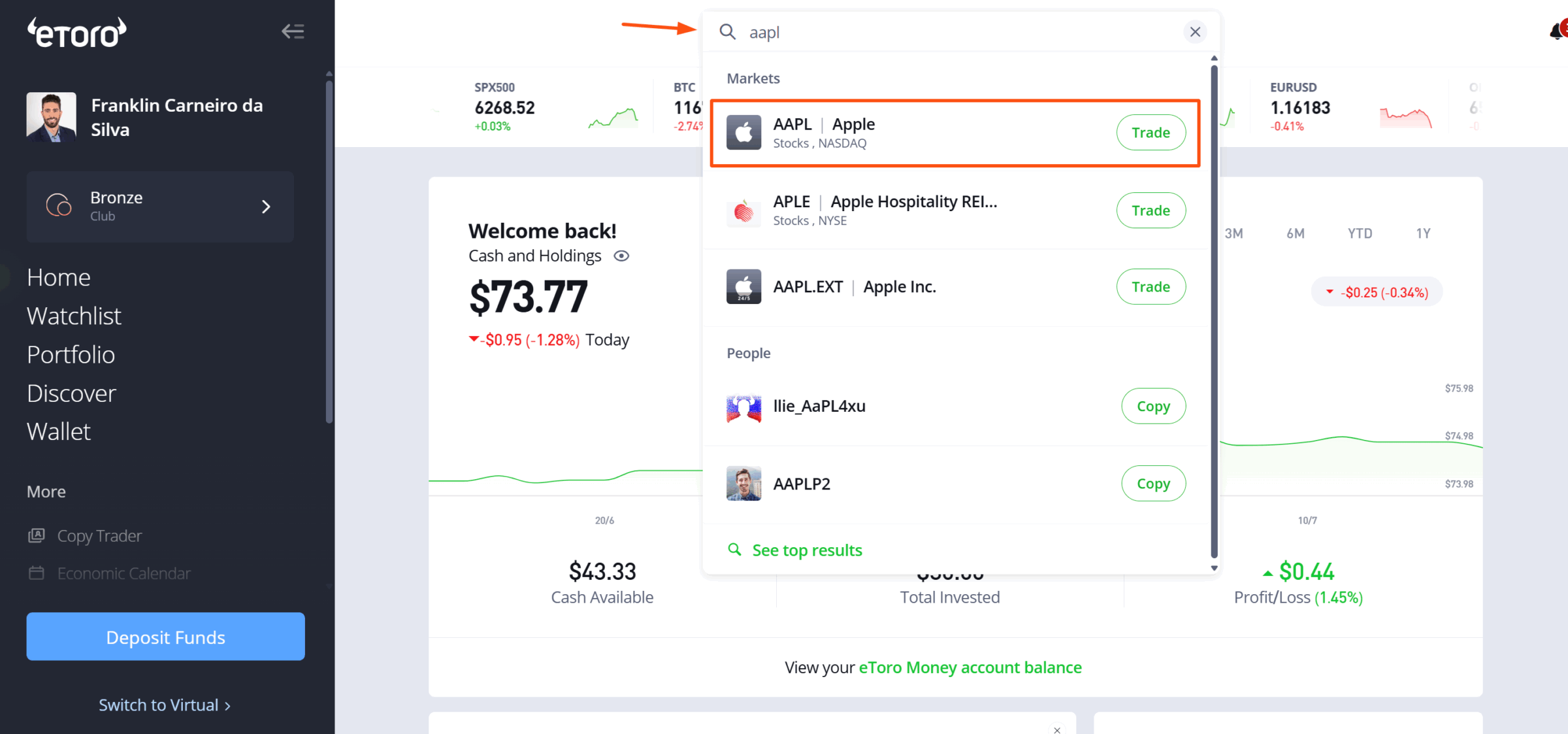
Once your account is funded, you are ready to buy your stock. Find the share on your broker’s platform and place a buy order. For this example, we will use eToro:
1. Search for the stock (we will use Apple, ticker “AAPL”):
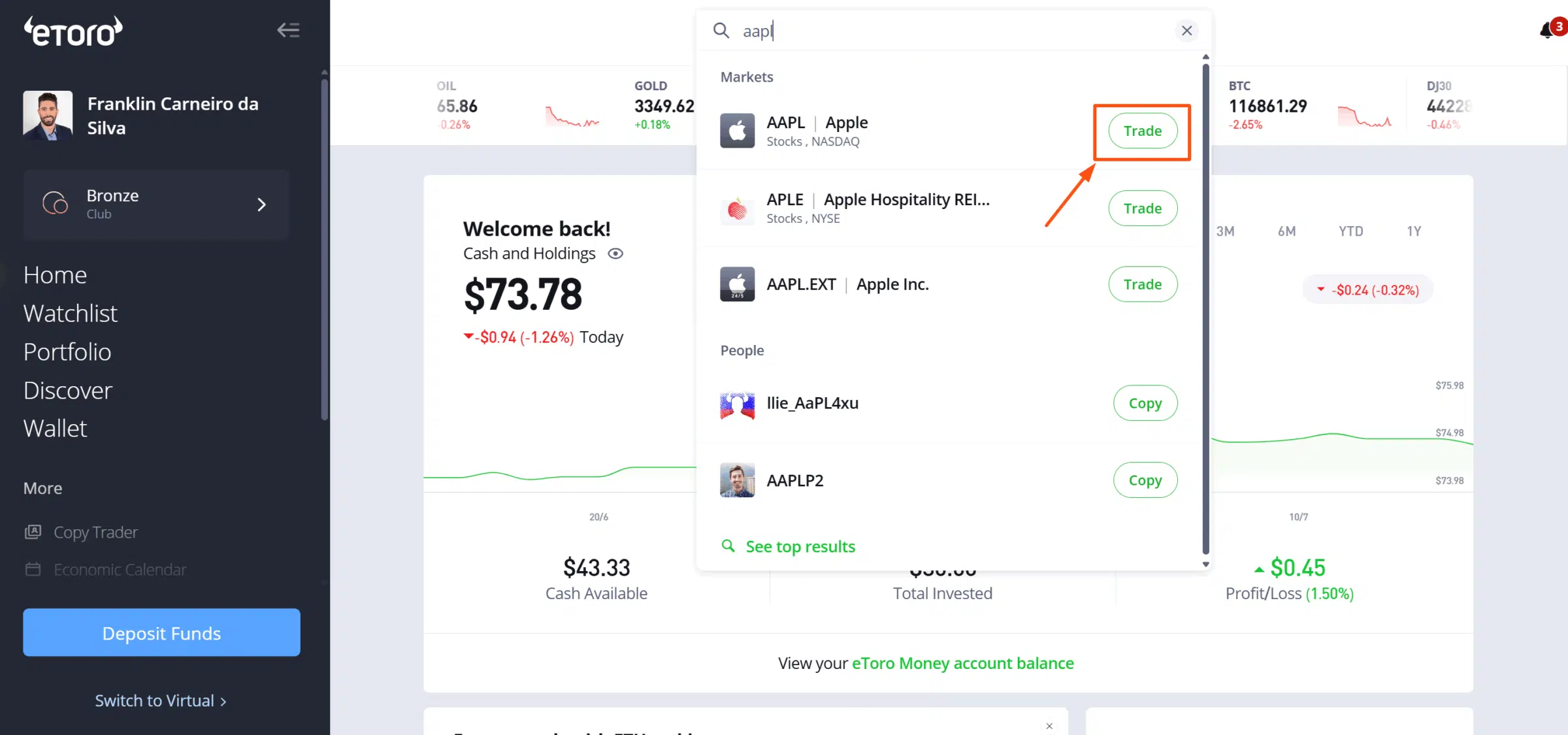
2. Click “Trade”:
3. Choose the order details:
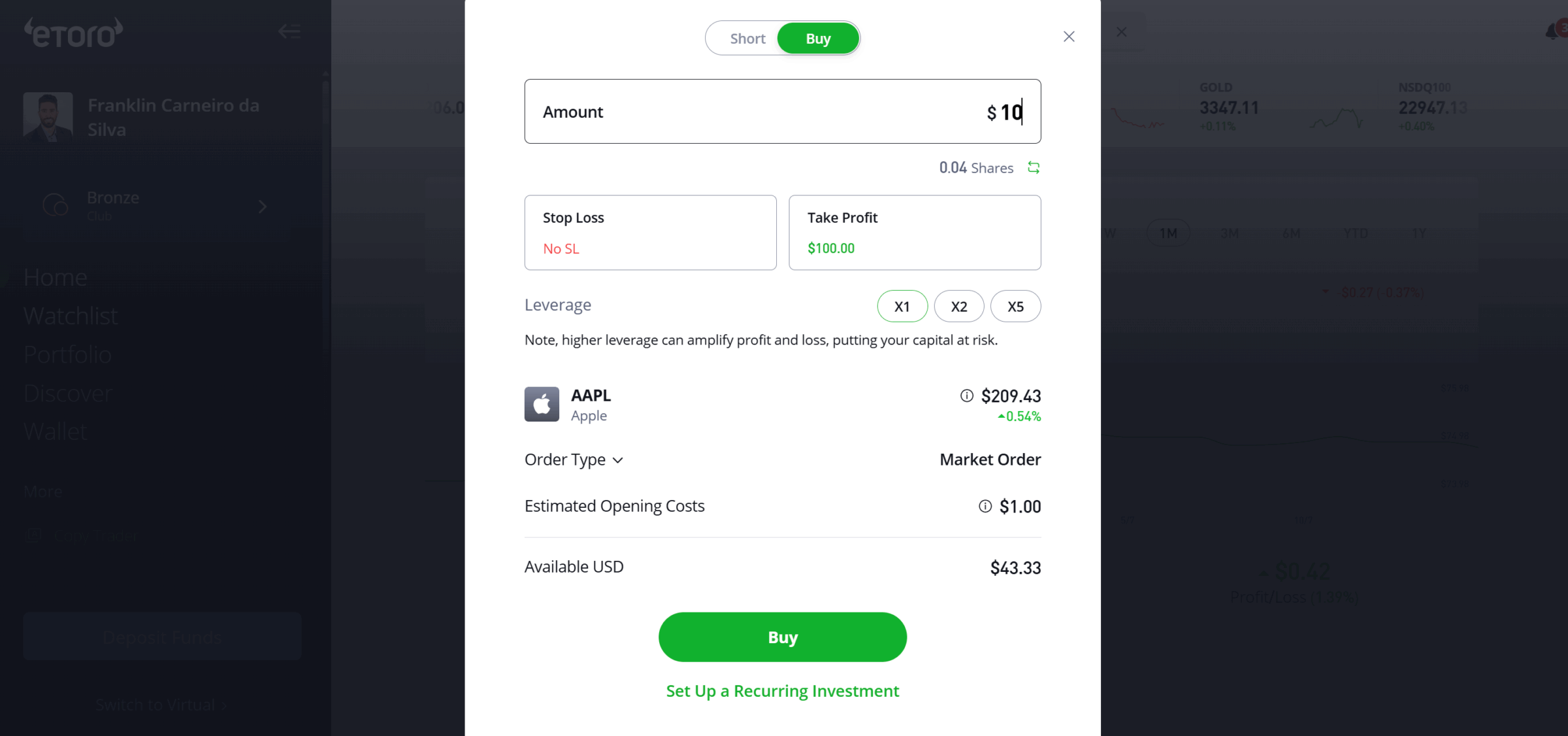
- Amount: the amount of money you want to invest in Apple, instead of a number of shares. Your investment may then be fully or partly in fractional shares.
- Units: the number of shares you want to buy (you can use either “Amount” or “Units”).
- Leverage: “x1” means no leverage, so you buy the real share. With “x2” or more, you would be trading a contract for difference (CFD) on Apple, not the stock itself. CFDs are complex instruments and come with a high risk of losing money rapidly due to leverage. That is why the order screen says “you are buying the underlying asset”.
- Stop loss: the maximum loss you accept before the position is closed automatically.
- Take profit: the profit level at which the position is closed automatically.
Stop loss and take profit orders are not guaranteed, and trading with leverage involves high risk. Only “Amount” (or “Units”) and “Leverage” are mandatory.
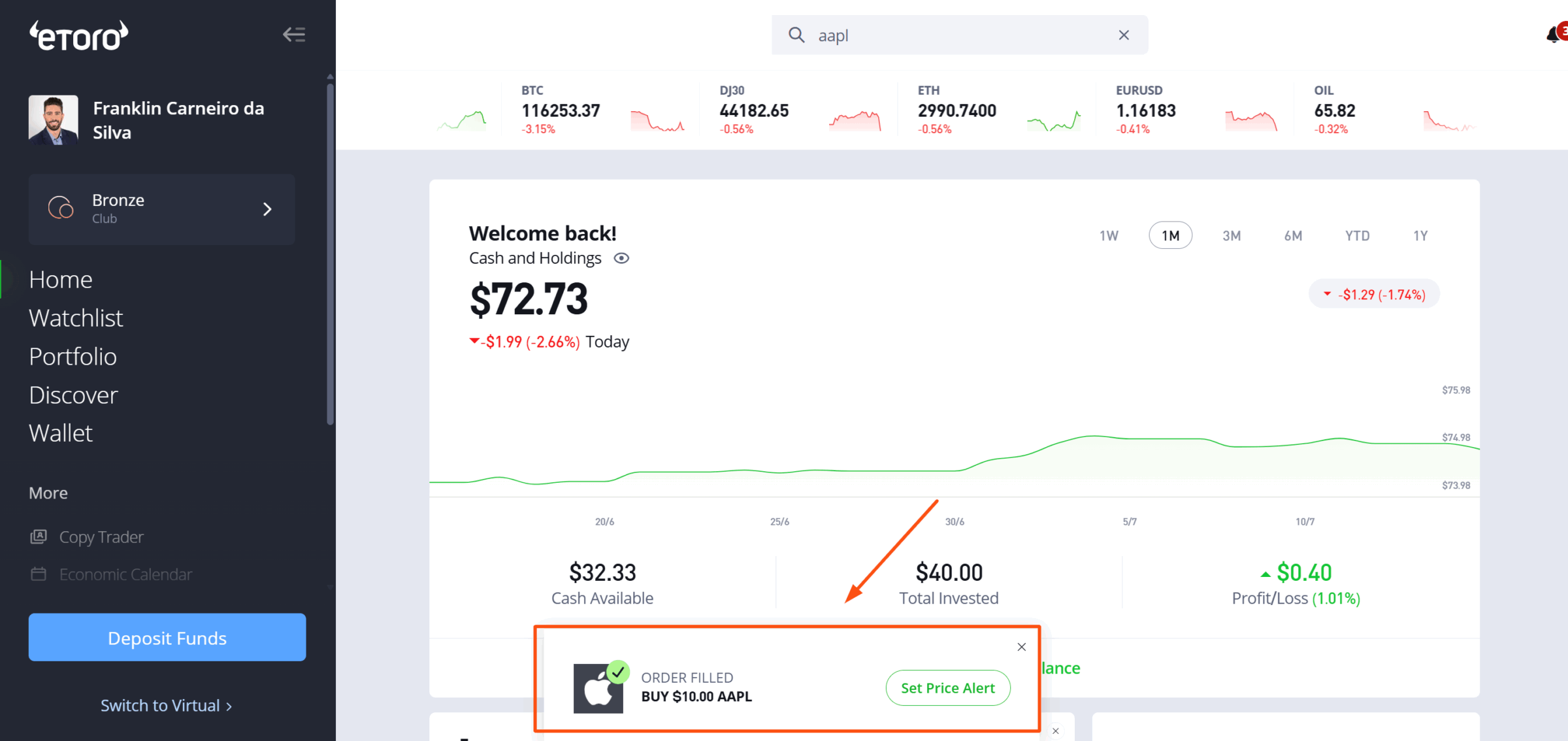
4. Place the order: click “Open Trade”. A new window confirms that the order was filled and shows your exposure.
ETFs: an alternative way to invest
Exchange-traded funds (ETFs) let you invest in dozens or even thousands of companies with a single purchase. ETFs can be a good option if you:
- Are unsure which individual stock to choose.
- Want to reduce your portfolio’s volatility, by spreading your money across many companies and sectors.
- Want to follow a specific theme (Irish stocks, technology, real estate and so on).
If you want exposure to Irish companies only, the choice is limited. The WisdomTree ISEQ 20 UCITS ETF (ISQE), which tracked the 20 largest companies on Euronext Dublin, was closed by WisdomTree in 2020 (WisdomTree notice), and we are not aware of another UCITS ETF that tracks Irish shares only.
There is also the iShares MSCI Ireland ETF (EIRL), which held 26 Irish stocks and about $76 million in assets in October 2026, with an expense ratio of 0.50%. However, it is a US-domiciled ETF, and retail investors in the EU generally cannot buy it because of the PRIIPs (packaged retail and insurance-based investment products) rules. It is only an option for investors outside the EU.
Beyond Irish stocks, you can choose from thousands of ETFs investing worldwide. Before you do, read the tax section below: ETFs are taxed very differently from shares in Ireland.
How to invest in the S&P 500 from Ireland
Another popular way to invest in the stock market from Ireland is to invest in the S&P 500, one of the best-known indexes in the world. Check our video summary if you are interested:
How shares and ETFs are taxed in Ireland
Tax is one of the most important things to understand before investing from Ireland, because shares and funds are treated very differently:
- Shares: gains are subject to capital gains tax (CGT) at 33%, with an annual exemption of €1,270 of gains per person, and losses can be offset against gains. Budget 2027 announced a cut to 31%, which still has to pass through the Finance Bill. Dividends are taxed as income at your marginal rate, plus Universal Social Charge (USC) and Pay Related Social Insurance (PRSI).
- EU-domiciled ETFs and funds: gains are subject to exit tax, which was cut from 41% to 38% from 1 January 2026, following Budget 2026, and falls to 35% from 1 January 2027. On top of that, the “deemed disposal” rule taxes your gains every eight years, even if you do not sell.
- Stamp duty: buying shares in Irish-registered companies usually carries 1% stamp duty (more below).
- Irish Investment Account: from 1 July 2027, the new Irish Investment Account lets you invest up to €12,000 a year. Balances up to €50,000 are tax-free, a flat 1% a year applies above that, and CGT, exit tax and deemed disposal do not apply inside it.
Because of deemed disposal and the higher rate, many Irish investors weigh up individual shares against ETFs more carefully than investors in other countries. Tax rules are complex and change over time, so consider getting advice from a tax professional.
| Investment | Tax | Rate | Key rules |
| Individual shares | CGT | 33% (31% announced in Budget 2027) | €1,270 annual exemption, losses can be offset |
| EU-domiciled ETFs | Exit tax | 38% (35% from 1 January 2027) | Deemed disposal every 8 years, no exemption |
| Dividends | Income tax, USC and PRSI | Your marginal rate | Foreign withholding tax can be credited |
| Irish Investment Account | Flat tax on value | 0% up to €50,000, 1% a year above | From 1 July 2027, up to €12,000 a year |
Irish tax rules for individual investors as of 8 October 2026. Budget 2027 measures still have to be legislated in the Finance Bill.
Buying shares on Euronext Dublin
Buying shares on the local market works just like buying international shares. Euronext Dublin is part of Euronext, which also runs exchanges in Amsterdam, Brussels, Lisbon, Milan, Oslo and Paris, among others. You can see all the companies listed on Euronext Dublin on its website. There are only a few dozen.
The main benefit of buying shares on the local market is that you avoid currency conversion fees, since shares on Euronext Dublin trade in euros. If you buy Apple shares on the US market with euros, you would have to:
- Sell EUR and buy USD to buy the shares.
- Sell USD and buy EUR when you sell them.
That means paying currency conversion fees twice, unless your broker lets you hold USD.
Ireland charges a 1% stamp duty on purchases (not sales) of shares in Irish-registered companies. Following Budget 2026, shares in Irish-registered companies with a market capitalisation below €1 billion that trade on a regulated market or multilateral trading facility are exempt, until 31 December 2030.
The drawback of the local market is the small number of companies available, many of them closely linked to the Irish economy. If you want to diversify your wealth, it makes sense to also invest internationally.
Accessing Irish equities as a foreigner
If you live outside the EU and want exposure to the country’s economy, the simplest way is through an ETF such as EIRL, as described above. Keep in mind that ETFs tracking small markets like Ireland usually have higher fees than ETFs tracking large markets like the United States, so check whether the extra cost is worth it for you.
If you want to buy a specific Irish company, you can use one of the brokers listed above. The only drawback is currency conversion fees if your home currency is not the euro.
Bottom line
To sum it up, here is what you need to do:
- Choose what to buy: an individual company or an ETF. The local market only has a few dozen listed companies, so it is hard to build a diversified portfolio with Irish shares alone.
- Understand the tax: 33% CGT on shares versus 38% exit tax (35% from 2027) and deemed disposal on EU-domiciled ETFs.
- Find a suitable broker: make sure it accepts Irish residents and compare fees, currency conversion costs and market access, including Euronext Dublin if you want Irish shares.
- Open an account, deposit money and place your order: once your account is funded, finding the stock and placing a buy order only takes a few clicks.
Do your own research to find the investing strategy that suits you best.
FAQ
Do I pay tax on shares in Ireland?
Yes. Gains on shares pay capital gains tax at 33% above an annual exemption of €1,270, and Budget 2027 announced a cut to 31%. Dividends are taxed at your marginal income tax rate, plus USC and PRSI.
When do I pay CGT on shares in Ireland?
For gains made from 1 January to 30 November, you pay CGT by 15 December of the same year. For gains made in December, you pay by 31 January of the following year (Revenue).
Is there an ETF that tracks Irish shares?
Not one that EU retail investors can easily buy. The WisdomTree ISEQ 20 UCITS ETF closed in 2020, and the iShares MSCI Ireland ETF (EIRL) is US-domiciled, so PRIIPs rules usually stop EU retail investors from buying it.
Do I pay stamp duty on US shares?
No. Irish stamp duty of 1% applies to purchases of shares in Irish-registered companies. Buying US shares does not trigger Irish stamp duty, although some other countries charge their own transaction taxes.



