Investing in exchange-traded funds (ETFs) is one of the most popular ways to build a portfolio, since a single fund gives you exposure to a whole index or sector rather than one company. Like stocks and forex, brokers give you access to ETFs through their platforms.
Finding the best ETF broker in the UK can be challenging, given the number of brokers available, each offering a different set of services. You need to weigh how many ETFs you get access to, the fees you will pay, the platform you will use, and which regulator supervises the broker.
Below, we compare 9 well-established UK brokers that offer ETF trading. We include the fee per ETF trade, the minimum deposit, the ISA fee, the range of ETFs, and the currency conversion fee, which applies if you deposit in a different currency or buy a fund that is not priced in GBP. On a buy-and-hold ETF portfolio, that last one often costs more than the commission.
Best ETF platforms in the UK in 2026
XTB
Cheapest ETF trading platform in the UK
InvestEngine
Best for managed ETF portfolios
Interactive Brokers
Best reputation and widest range of ETFs supported
eToro
Best for social trading
Disclaimer: eToro is a multi-asset investment platform. The value of your investments may go up or down. Your capital is at risk.
Trading 212
Best for ISA and commission-free ETF trading (other fees may apply, see terms and conditions).
Disclaimer: Capital at risk. Sponsored link. To get free fractional shares worth up to 100 EUR/GBP, you can open an account with Trading 212 through this link. Terms apply.
Freetrade
Best for beginners, with a free ISA and SIPP
| Top platforms (+ others) | Fee per ETF trade | Minimum deposit | ISA fee | Range of ETFs |
| XTB | £0 up to a monthly trading volume equivalent to €100,000 (after that, 0.2% with a minimum of £10) | £0 | £0 | 700+ |
| Interactive Brokers | Tiered by exchange: 0.05% of trade value (min €1.25, max €29.00) | £0 | £0 | 13,000+ |
| eToro | Free (other fees apply) | $50 | £0 | 260+ |
| Freetrade | Free | £0 | £0 on the Basic plan | 400+ |
| Interactive Investor | £5.99 | £0 | From £4.99 (monthly) | 1,000+ |
| InvestEngine | £0 (no dealing fees) | £100 | £0 | 500+ |
| Trading 212 | £0 | £1 | £0 | 2,000+ |
| Saxo | From 0.08% (min. $1) on US-listed ETFs | £0 | £0 | 6,000+ |
| Hargreaves Lansdown | £11.95 | £0 | 0.45% p.a. | 1,000+ |
A £0 ISA fee does not mean the account is free to run. Currency conversion applies whenever you buy a fund priced in a currency other than sterling, and some platforms charge custody on ETF holdings. Check both before choosing on the trade fee alone.
Below, we review the six platforms we consider the best for UK ETF investors: XTB, InvestEngine, Interactive Brokers, eToro, Trading 212 and Freetrade.
#1 XTB

XTB at a glance
69-80% of retail CFD accounts lose money.
XTB is a global investment firm offering a range of instruments, including stocks, ETFs, forex, commodities, indices, and cryptocurrencies.
Among its more recent offerings is the Individual Savings Account (ISA), a tax-efficient account available to UK residents. The Stocks and Shares ISA lets you build a portfolio from over 3,000 stocks and more than 700 ETFs, with returns sheltered from UK tax.
XTB offers competitive terms on its ISA, including free account opening and maintenance for active clients, regardless of trading volume or balance. Investors get 0% commission on stocks and ETFs up to a monthly trading volume equivalent to €100,000, with 0.2% (minimum £10) above that. A currency conversion fee of 0.5% may apply, which matters if you buy funds priced in dollars or euros. XTB also pays interest on uninvested funds, calculated daily and paid monthly, at a rate that varies by currency and moves with central bank rates.
For more information on XTB, take a look at our review.

#2 InvestEngine

InvestEngine at a glance
When investing your capital is at risk.
InvestEngine is a UK-based investment platform launched in 2020, giving users access to low-cost, diversified ETF portfolios. It offers both managed portfolios and a do-it-yourself option for investors who prefer to build their own.
Pros:
- Low-cost investing, with competitive fees on both managed portfolios and the DIY option;
- Diversification: a range of ETFs to build a portfolio matched to your objectives;
- Auto-rebalancing on managed portfolios, keeping the allocation where you set it;
- A user-friendly interface, with risk questionnaires and educational resources.
Cons:
- Limited investment options: fewer ETFs than some rivals, which may frustrate investors looking for a specific fund;
- No individual stocks or bonds: InvestEngine is ETFs only, so it cannot be your single account if you also want direct shares.
All in all, it is a strong option for buy-and-hold investors who only want ETFs for the long term.
#3 Interactive Brokers

Interactive Brokers at a glance
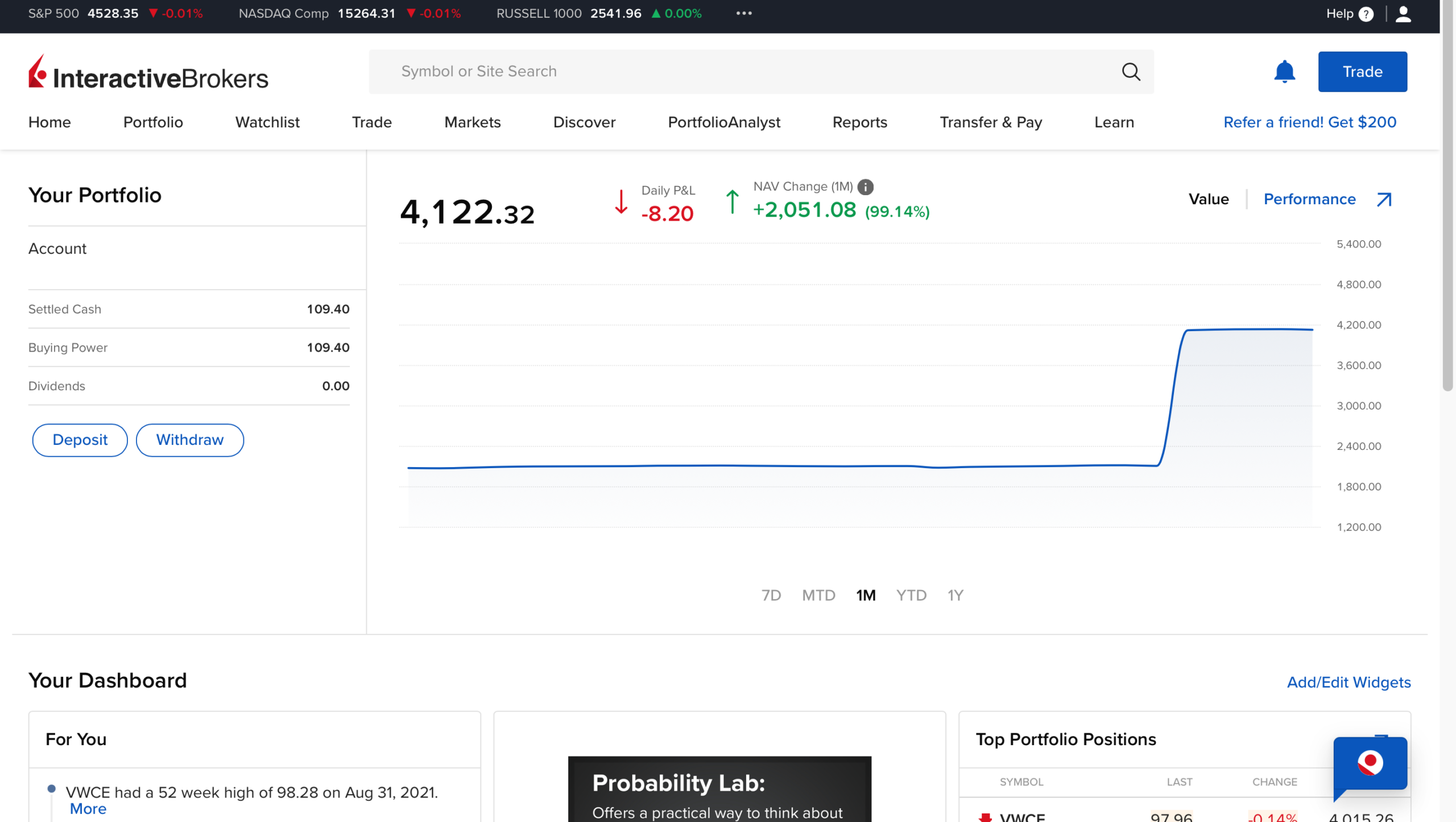
Interactive Brokers offers the most extensive range of ETFs on this list and lets you trade almost any instrument, including stocks, options, futures, forex, commodities, bonds and over-the-counter securities. It was founded in 1978 and is regulated by several top-tier authorities, including the SEC and the FCA.
Nearly all UK investors are eligible to open an account. Its web-based Client Portal, the IBKR GlobalTrader mobile app and the professional Trader Workstation platform are all well designed, though a beginner may find the number of tools overwhelming.
Deposits are made by bank transfer, with no minimum to open an account. ETF fees follow tiered pricing and vary by exchange and volume. On most EU-listed ETFs the fee is 0.05% of trade value, with a minimum of €1.25 and a maximum of €29.00. The other reason it suits ETF investors is currency conversion at a fraction of what app-based platforms charge, which compounds over years of monthly buying.
Customer support is available by phone, email, live chat and the automated iBot. The team is experienced, though email replies are not always immediate.
Interactive Brokers also offers UK residents a Self-Invested Personal Pension (SIPP), a Stocks and Shares ISA and a Junior ISA.
Overall, it is a good choice for beginners and advanced investors alike who want a secure broker and access to a wide product range. For more, see our detailed Interactive Brokers review.
#4 eToro

eToro at a glance
52% of retail CFD accounts lose money.
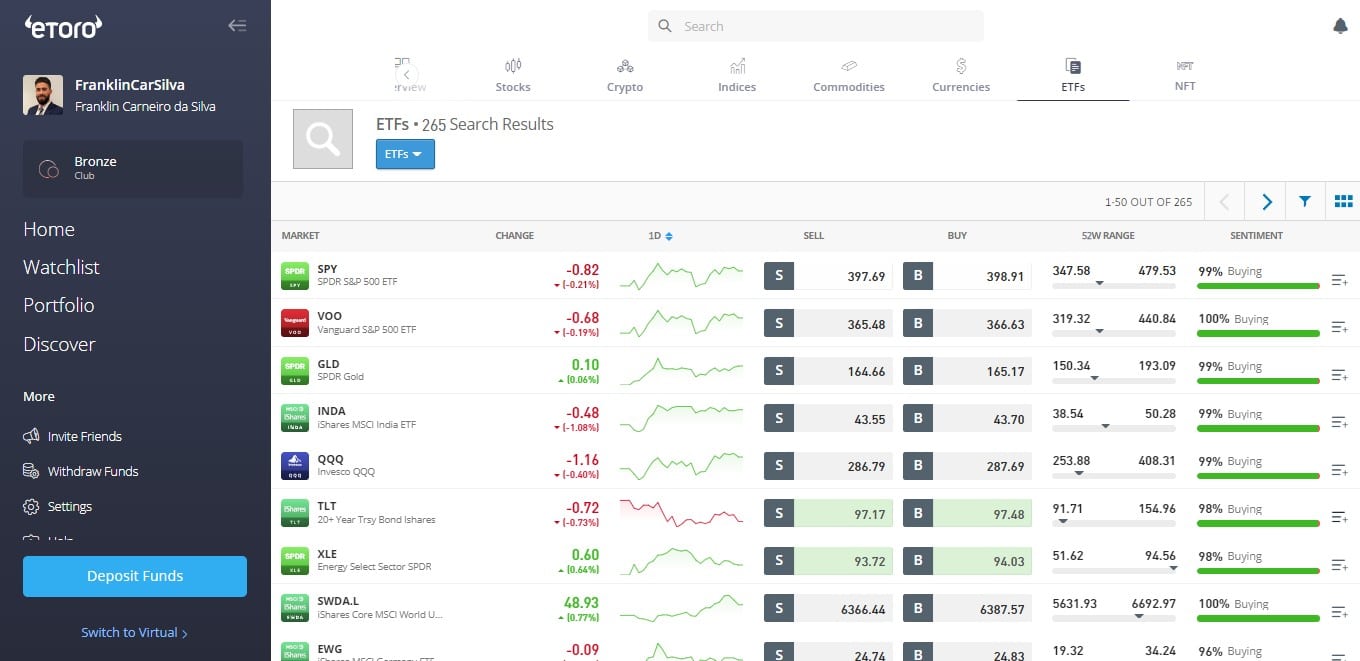
eToro is a global online broker best known for its social trading platform, where you can copy the trades of other investors. It has over 40 million registered users, has been listed on the Nasdaq since May 2025, and gives access to thousands of instruments, including 260+ ETFs.
The platform is intuitive, and you can fund an account by credit or debit card, PayPal, Skrill or bank transfer. The minimum deposit is $50, varying by country, and there are no deposit fees. Real ETFs are commission-free, while real stocks carry a $1 commission in most major regions.
eToro offers a Stocks and Shares ISA through a partnership with Moneyfarm.
eToro is regulated and supervised by several top-tier regulators, including the Financial Conduct Authority (FCA) and the Cyprus Securities and Exchange Commission (CySEC). It provides negative balance protection on forex and CFD trading for retail clients.
On the downside, withdrawals from a USD account carry a $5 fee with a $30 minimum, and currency conversion is a real cost for a UK investor: converting between GBP and USD costs around 0.50%, which applies every time you buy a dollar-priced fund. Customer support can take a couple of business days to reply.
For a full assessment, read our comprehensive eToro review.
#5 Trading 212

Trading 212 at a glance
Capital at Risk. Sponsored Link. To get free fractional shares worth up to 100 EUR/GBP, you can open an account with Trading 212 through this link. Terms apply.
Trading 212 claims the title of the first commission-free broker in the UK and Europe, and it has grown into one of the largest, with millions of users across its markets.
It offers distinct account types: Trading 212 Invest, with commission-free stocks and ETFs, Trading 212 CFD, for leveraged trading only, and Trading 212 Crypto.
The Invest account has been gaining popularity with beginners, for good reasons:
- The minimum deposit is just £1, or £10 for bank transfers;
- Commission-free stocks and ETFs, with fractional shares and a free Stocks and Shares ISA;
- The platform is straightforward for both account opening and trading;
- Currency conversion is 0.15%, the lowest among the app-based platforms here, which matters on every purchase of a dollar-priced fund.
Commission-free does not mean cost-free, and it helps to understand where the money comes from. Trading 212 runs a securities lending programme:
- It can lend your shares to a third party;
- This does not affect your ability to trade them or receive dividends;
- It holds collateral equal to at least 102% of the value of the shares lent.
Other fees to know about:
- 0.7% on card, Google Pay and Apple Pay deposits, free for the first €2,000 deposited;
- 0.15% currency conversion on Invest, 0.50% on CFD;
- Overnight fees on CFDs.
If you are considering it, you can claim a free share by following this link. After verifying your identity and funding the account, use promo code IITW to claim one free share worth up to €100.
To sum up, Trading 212 is a good choice for beginners who want a simple, cheap way to buy stocks and ETFs. For more, see our detailed Trading 212 review.
Disclaimer: When investing, your capital is at risk and you may get back less than invested. Past performance doesn’t guarantee future results. Crypto-assets are high-risk and volatile. You could lose your invested capital, and these assets are not covered by protection schemes. Make sure you understand the risks before investing. Pies & Autoinvest is an execution-only service. Not investment advice or portfolio management. Automatic investing refers to executing scheduled deposits. You are responsible for all investment and rebalancing decisions.
#6 Freetrade

Freetrade at a glance
Freetrade is a mobile-first, commission-free UK broker founded in 2016. It was acquired by IG Group in April 2025 and continues to operate as a separate platform under its own brand.
Freetrade set out to strip complexity from investing. There are no CFDs in the app, it does not promote day trading, and account opening is quick. The main drawback is the narrow product range compared with a full-service broker: no options, forex, commodities or cryptocurrencies.
The pricing has improved since the acquisition, and this is the part most comparisons have not caught up with. Freetrade runs three plans:
- Basic, free, which now includes the Stocks and Shares ISA and the SIPP at no monthly cost;
- Standard, £5.99 a month;
- Plus, £11.99 a month.
What you pay for on the upper plans is mainly a lower currency conversion fee, which is 0.99% on Basic, 0.59% on Standard and 0.39% on Plus. That fee is the real cost of using Freetrade, and it is where an ETF investor should focus: on the free plan, every purchase of a dollar-priced fund costs almost 1% before you own anything. Trading 212 charges 0.15% for the same conversion, which is worth weighing if most of your portfolio is in US or global funds.
The arithmetic is simple enough to do yourself. If your annual currency conversion bill on Basic exceeds the cost of a paid plan, upgrading pays for itself.
If you are interested, read our full Freetrade review.
Methodology
Investing in the Web aims to offer investors fair and unbiased reviews of online brokers. Our team examined each of the brokers above, taking several variables into account:
- Regulation, meaning registration with the FCA
- ETF offering, including access to several exchanges
- Low trading and non-trading fees, currency conversion included
- Easy deposit and withdrawal methods
- Sound customer service
- Availability of an ISA
Finally, we checked that each broker gives you access to other products should you want to expand beyond ETFs.
What makes a good ETF broker?
A good ETF broker should first be a safe broker, regulated by a top-tier authority. Deposits and withdrawals should be available through ordinary methods such as bank transfer and cards.
On fees, many brokers offer commission-free ETF trading, so the headline is rarely where the difference lies. Look at the non-trading costs instead: currency conversion, custody or platform fees, inactivity charges and withdrawal fees. On a portfolio you top up monthly for years, these quietly cost far more than the commission ever would.
Bottom line
Finding the best ETF platform in the UK is not straightforward, since each broker prices things differently and the cheapest headline is rarely the cheapest overall.
We examined the conditions offered by major UK brokers to build this list, focusing on those giving access to a wide range of ETFs with a clear point of differentiation. If you take one thing from the comparison, make it this: for a long-term ETF portfolio inside an ISA, currency conversion and platform fees usually matter more than the dealing commission, because you pay them on every contribution and every year you hold.
You can always visit our broker reviews page for in-depth assessments, and our comparison tool to compare the top brokers in your country.
We hope this addressed some of your questions. Before deciding, consider opening a demo account and exploring the platform first.
FAQs
What is an ETF? How does it work?
ETFs let investors pool their money into a basket of securities. They typically track the performance of an index, industry, commodity or other asset class, and are bought and sold throughout the day on an exchange. Their prices move with supply and demand, but usually stay close to the net asset value (NAV) of the underlying securities. Over the last decade, ETFs have been the main instrument used by robo-advisors to build their portfolios.
Do ETFs pay dividends?
Not all of them. There are two types: distributing and accumulating. Distributing ETFs pay out the dividends received from the underlying holdings, usually quarterly. Accumulating ETFs reinvest them inside the fund instead. Inside an ISA the distinction is mainly practical rather than tax-driven, since returns are sheltered either way.
What's the difference between an ETF and a mutual fund?
Despite their similarities, they differ in a few ways. ETFs trade throughout the day on an exchange like shares, while mutual funds are priced once a day at their net asset value. They also differ in management: ETFs typically track an index and are passively managed, while mutual funds are often actively managed by a manager buying and selling according to a mandate.
Does a £0 commission platform mean free ETF investing?
No. Commission is only one cost. You will also pay the fund’s own ongoing charge (TER), a currency conversion fee whenever you buy a fund priced in a currency other than sterling, and on some platforms a custody or platform fee on the value of your holdings. A platform with £0 dealing and 0.99% currency conversion can easily cost more than one charging a few pounds per trade.