


Interactive Brokers is one of the most well-established brokers in the global market. Its original business was created as a market maker in 1977 and it has run a brokerage since 1993, demonstrating resilience and adaptability, surviving financial crises, expanding into many different markets, and providing clients with a wide range of investment products and services.
Despite its impressive track record and market presence, it is natural to question the safety and reliability of any broker, so you might be asking yourself: “Is Interactive Brokers safe?” or “How is my money protected?”
In this article, we will address those concerns by examining the various aspects that affect the safety and security of Interactive Brokers, looking at different countries and jurisdictions. By the end, you’ll understand how Interactive Brokers safeguards your investments, enabling you to make an informed decision about your financial future.
Video summary
Quick summary
Before going in-depth into the subject, we can highlight the following points:
- Interactive Brokers has a robust business model with sound financial results that have grown in recent years, backed by $22.3 billion in equity capital as of the second quarter of 2026, more than $13.9 billion above its regulatory requirement.
- The broker has conservative risk-management measures in place to avoid financial distress, such as the daily calculation of the value of clients’ assets, high margin ratios, and a capital buffer over client funds.
- It is regulated by many top-tier regulators (SEC, FCA, ASIC, among others), which supports its integrity and adherence to strong compliance rules.
- If the first layers of protection against possible insolvency do not work, investors are protected by regulatory measures, including investor compensation schemes (more details below).
- Additionally, eligible clients can use IBKR’s Insured Bank Deposit Sweep Program, which spreads uninvested USD cash across multiple banks to provide up to $5,000,000 of FDIC insurance for an individual account ($10,000,000 for joint accounts), on top of the standard SIPC coverage. It applies to USD cash balances above $250,000.
- The amount you are covered for varies enormously by entity, and this is the single most useful thing to check before you open an account. A client of the US entity has $500,000 of SIPC cover plus a large excess policy; a retail client of the Irish entity, which now serves the whole EEA, has 90% of the loss up to €20,000.
What is the Interactive Brokers business model?
Interactive Brokers is a global broker that offers financial services to professional, institutional, and retail investors by providing direct-access (“online”) trade execution and clearing services for a wide range of electronically traded assets. Interactive Brokers’ business model is focused on client trading: since exiting its market-making arm (Timber Hill) in 2017 to concentrate on electronic brokerage, the firm does not run a proprietary trading business and essentially acts as a facilitator for clients to trade securities.
Although the complete list of services may vary according to the subsidiary that accepts you as a client, you will generally be able to trade stocks, options, futures, currencies, bonds, gold, crypto, and funds. For that purpose, the broker created desktop, web, and mobile platforms suited to different levels of knowledge and experience, such as the IBKR GlobalTrader app, focused on beginners who do not want to be overwhelmed by the advanced, sophisticated tools found in its other platforms.
If you want to learn more about Interactive Brokers’ business model and an overview of the broker, please check our review on Interactive Brokers!
How does Interactive Brokers make money?
Interactive Brokers makes money in a few different ways: commissions charged for its services, net interest income from several activities (such as lending money to clients on margin, lending stocks for short sales, and earning interest on uninvested client cash), market data and other subscription fees, and other fees and services.
As we can see from the broker’s 2025 financial results, net interest income is its largest source of revenue, followed by commissions. In the 2025 fiscal year, net interest income was $3.56 billion and commissions $2.15 billion, and total net revenues passed $6 billion for the first time, at $6.21 billion.
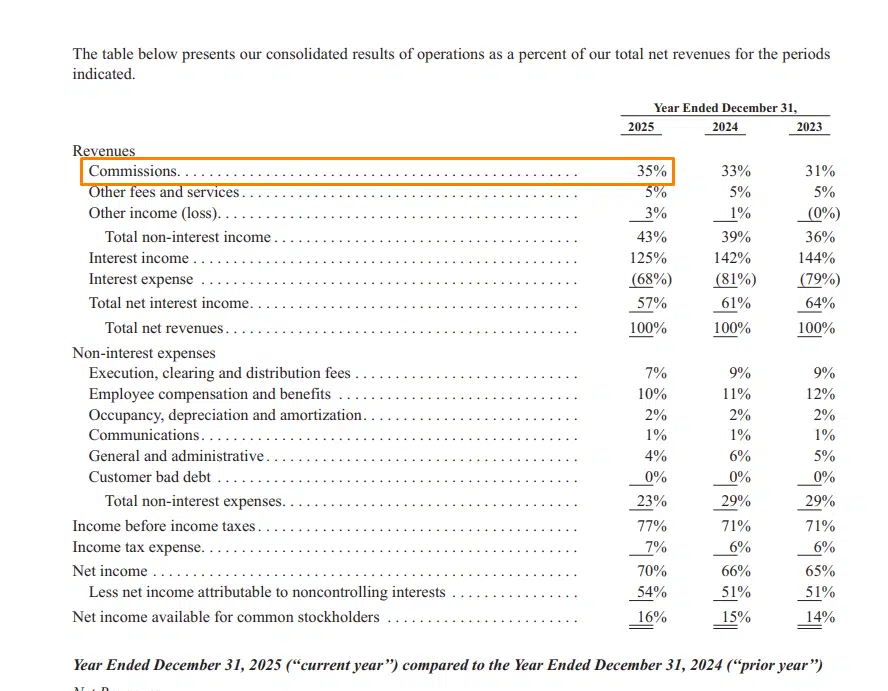
Interactive Brokers financials
Interactive Brokers is listed on the NASDAQ, so it must publish quarterly and annual reports on its business activity, which point to a good track record and a strong financial position. From our analysis, we conclude that Interactive Brokers’ financial condition is sound. The company has no long-term debt and shows solid financial strength.
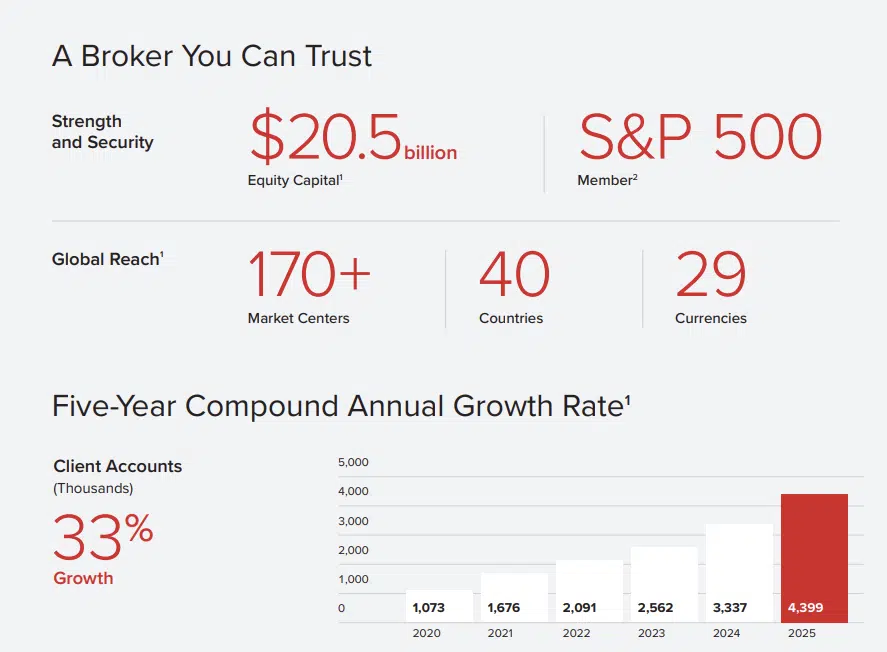
Over the past years, Interactive Brokers’ net income has grown considerably, demonstrating the profitability of the business. The broker also reports other metrics that reinforce its reputation and financial health: its large base of client assets places it among the largest online brokers by AUM. Client equity reached roughly $780 billion at the end of 2025 and $962.8 billion by the end of August 2026, across 5.46 million client accounts.
From an external perspective, the broker also appears to manage its financial risks well, with investments in short-term government securities, margin ratios above standard market practice, collateralised loans, and automated risk-management measures.
But even with this positive information, financial markets are unpredictable, and you may still be wondering whether Interactive Brokers is safe. A “black swan” event could happen at any moment, so it is essential to know whether your funds would be secure if the broker faced difficulties, and which authority is responsible for overseeing your account.
All Interactive Brokers subsidiaries and their regulators
Interactive Brokers is a global company that serves clients from more than 200 countries and territories, reaching 170 markets in 29 currencies.
The type of protection offered by the broker varies according to your country of residence and the respective subsidiary that onboards you. Therefore, to know how your investment will be protected, you first need to know which subsidiary will provide the service for you.
| Subsidiary | Countries | Regulator |
| Interactive Brokers LLC (IB LLC) | All the eligible countries not under the scope of the other entities below. Includes the Americas (except for Canada), Asia (except the countries listed below), Africa, and European countries that are not in the EEA. | US Securities and Exchange Commission, the Commodity Futures Trading Commission, and member of FINRA, NYSE, and SIPC |
| Interactive Brokers Canada Inc (IBC) | Canada | Member of the Canadian Investment Regulatory Organization (CIRO) and member of the Canadian Investor Protection Fund |
| Interactive Brokers (U.K.) Limited (IBUK) | United Kingdom, Switzerland and other European countries outside the EEA | Financial Conduct Authority (FCA register entry number 208159) |
| Interactive Brokers Ireland Limited (IBIE) | All EU and EEA countries. Since 1 August 2024 this includes Hungary, Romania, Bulgaria, Croatia, Slovenia, Slovakia and Czechia, which were previously served by Interactive Brokers Central Europe | Central Bank of Ireland (reference number C423427) |
| Interactive Brokers (U.K.) Limited, DIFC Branch | Dubai International Financial Centre | Dubai Financial Services Authority (registration number F008423) |
| Interactive Brokers Australia Pty. Ltd. (IBA) | Australia and New Zealand | Australian Securities and Investments Commission (AFSL: 453554) |
| Interactive Brokers Hong Kong Limited (IBHK) | Hong Kong, China and Taiwan | Hong Kong Securities and Futures Commission and a member of SEHK and the HKFE |
| Interactive Brokers (India) Pvt. Ltd. (IBI) | India | Trading member of the NSE and BSE, registered with SEBI (registration number INZ000217730) |
| Interactive Brokers Securities Japan, Inc. (IBSJ) | Japan | Kanto Local Finance Bureau (registration number 187) and a member of the Japan Securities Dealers Association and the Commodity Futures Association of Japan |
| Interactive Brokers Singapore Pte. Ltd. (IBSG) | Singapore, Malaysia, Indonesia, Thailand, Philippines, Vietnam, South Korea | Monetary Authority of Singapore (License No. CMS100917) |
Importance of top-tier regulation
Top-tier regulation is crucial in determining how safe your investments will be with a given broker. Interactive Brokers is regulated by several top-tier regulatory bodies, such as the SEC in the US, the FCA in the UK, and the Central Bank of Ireland. As you will see below, the level and quality of the protection of your investments with the broker will vary according to the subsidiary that takes you on as a client.
Having top-tier regulation ensures that the broker operates in a controlled and transparent manner, which allows for oversight and accountability. Investors are better protected from fraud, misconduct, information asymmetry, and even from a crisis. In short, good regulation helps maintain the integrity of the financial market. You should always look for a broker regulated by top-tier authorities to ensure the highest level of protection and safety, which is the case with Interactive Brokers.
What if Interactive Brokers goes bust?
We have covered the importance of regulation, explained why we think Interactive Brokers can be considered safe, and shown you how to identify your regulator. But we still need to explain what would happen in a crisis or if the broker went bankrupt.
Due to the complex structure of Interactive Brokers and the different levels of protection offered by the various jurisdictions mentioned above, the answer will depend on the region where you live and the respective subsidiary that accepts you as a client. For your convenience, we have summarised and simplified the regulatory aspects below, based on each of the subsidiaries.
a. Segregated accounts for securities and investment of cash balances
Specific regulatory requirements for each Interactive Brokers subsidiary vary by region. However, the broker segregates customer funds and maintains this level of protection across all subsidiaries. This means that if the broker becomes insolvent, its clients’ funds will be separated from the firm’s own funds. In practice, you would only need to transfer your assets from Interactive Brokers to another broker. In the US, this segregation is a core requirement of the SEC’s Customer Protection Rule (Rule 15c3-3).
It is important to note, however, that Interactive Brokers holds clients’ securities in “street name” rather than registering them directly in the investor’s name. This means the segregated assets are registered under the broker’s name: the broker is the legal owner of the asset, while the investor is the beneficial owner.
But does this mean Interactive Brokers is not safe, or that the segregation of assets is pointless? At the risk of oversimplifying, we believe the answer to both is no. Holding securities in street name does not undermine segregation, and the method is accepted by regulators. It does have a procedural impact: because the broker does not hold securities in each customer’s name, segregation occurs by pooling the assets of all customers. If the broker goes bankrupt, you would claim your share of the pool in proportion to your net equity claim. To strengthen this protection, Interactive Brokers calculates the value of its clients’ assets daily and segregates that amount, plus a substantial buffer of its own funds.
While Interactive Brokers segregates all clients’ assets, it treats client cash differently. The broker invests most of the cash in very short-term instruments and keeps a portion in segregated bank accounts. As of 1 July 2026, Interactive Brokers LLC (the US subsidiary) held approximately 89% of client funds in short-term US Treasury securities and reverse repurchase agreements (collateralised by the same US Treasuries), while around 11% was segregated in special bank or custody accounts, topped up with the broker’s own money to cover client needs. Its investment policy targets a weighted average maturity of 30 to 40 days with a maximum term of one year, puts no client money in money market funds, and spreads bank deposits so that no single bank holds more than 5% of total client funds.
b. Investor compensation schemes
If Interactive Brokers goes bust, your assets will not be used to pay off the broker’s debts because they are segregated, although administrative fees may apply. There is also the risk of malpractice or an operational error. In a worst case, this could lead to a situation where the segregated funds are not enough to cover everything clients invested.
If that happens, generally speaking, your investment with Interactive Brokers will be protected by an investor compensation scheme: a safety net that works much like an insurance policy, compensating investors for certain losses up to a set amount.
Since this protection varies according to the jurisdiction where the investor resides, we have summarised below the key information on the investor compensation scheme that applies to each subsidiary.
| Subsidiaries | Investor protection schemes / other protections |
| Interactive Brokers LLC (IB LLC) | Securities are protected by the Securities Investor Protection Corporation (“SIPC”) for a maximum of $500,000 (cash sub-limit of $250,000). Futures and options on futures are not covered. The broker also holds an excess policy at Lloyd’s of London that extends coverage by an additional $30 million per account (cash sub-limit of $900,000), up to an aggregate limit of $150 million. |
| Interactive Brokers Canada Inc (IBC) | The broker is a member of the Canadian Investor Protection Fund (CIPF). In the event of the firm’s insolvency, eligible customers who do not receive their cash, securities, or other eligible property are covered for up to CAD 1 million across all general accounts combined (cash, margin, TFSAs and FHSAs), plus CAD 1 million across all registered retirement accounts combined, plus CAD 1 million across all registered education savings plans combined. The limits are per category, not per account. |
| Interactive Brokers (U.K.) Limited (IBUK) | Most UK customers have their accounts cleared by Interactive Brokers LLC, making them eligible for SIPC coverage, as above. If you are an individual or a small business, your investment may also be covered by the Financial Services Compensation Scheme (FSCS), as IBUK is a member. Only limited products are eligible, and the limit is up to £85,000 per person, per firm. Note that £85,000 is the FSCS limit for investment business: the higher £120,000 limit introduced in December 2025 applies to bank deposits, not to a broker. |
| Interactive Brokers Ireland Limited (IBIE) | Certain securities positions and cash are held with the US subsidiary and protected by SIPC. Retail investors are also protected by the Irish Investor Compensation Scheme, run by the ICCL, which does not cover institutions or professional clients. Cover is limited to 90% of the amount lost, subject to a maximum of just €20,000 per investor, by far the lowest limit among IBKR’s major entities. This now applies to clients across the whole EEA, including the seven central European countries previously served by Interactive Brokers Central Europe. |
| Interactive Brokers Australia Pty. Ltd. (IBA) | Certain securities positions and cash are held with the US subsidiary and protected by SIPC. Retail clients are also eligible for compensation under the National Guarantee Fund. The old rule capping all claims at 15% of the fund has been replaced by fixed amounts: a claimant can receive up to A$1 million for claims relating to the same event and participant, with the cash component capped at A$250,000, and total compensation for any one insolvent participant is capped at A$18 million. |
| Interactive Brokers Hong Kong Limited (IBHK) | Certain securities positions and cash are held with the US subsidiary and protected by SIPC. IBHK clients are also protected by the Investor Compensation Fund for products traded on the HKEX and Northbound securities traded through Shanghai and Shenzhen Stock Connect, with maximum compensation of HK$500,000 per investor. |
| Interactive Brokers (India) Pvt. Ltd. (IBI) | Certain securities positions and cash are held with the US subsidiary and protected by SIPC. IBI is registered with the Securities and Exchange Board of India (SEBI) and is covered by the exchanges’ Investor Protection Funds, whose limits differ: the NSE pays up to INR 35 lakh per investor for defaults after August 2024, while the BSE pays up to INR 15 lakh in the equity segment. |
| Interactive Brokers Securities Japan, Inc. (IBSJ) | IBSJ is a member of the Japan Investor Protection Fund, which provides compensation of up to ¥10 million per client for eligible clients. |
| Interactive Brokers Singapore Pte. Ltd. (IBSG) | Certain securities positions and cash are held with the US subsidiary and protected by SIPC. Singapore does not operate a statutory investor compensation scheme equivalent to SIPC or the FSCS, so this US-based protection, together with MAS regulation and asset segregation, is the main safeguard. |
The rules for the compensation schemes can be complex, so please research whether your investment is eligible. If you are not sure, do not hesitate to contact the broker or leave a comment below, we can try to help you!
And remember: investing is risky. Compensation schemes can only be used if the broker goes bankrupt, but never to compensate for your losses due to a market fluctuation.
c. Additional protection
The so-called negative balance protection is another form of protection that deserves attention. Retail clients of the Irish subsidiary, which since August 2024 covers the whole EEA, are protected from a negative balance when trading CFDs, under the Central Bank of Ireland’s product intervention measure. As a result, retail investors cannot lose more money than they deposited on those instruments. We cover this protection and a few others in our article on investor protection in the EU, so please check it out if you are interested.
Besides the mandatory regulatory protections, Interactive Brokers also offers an insurance programme as an additional layer of protection. Eligible IBKR clients can join the Insured Bank Deposit Sweep Program from their account settings. Through the programme, clients can obtain up to $5,000,000 of FDIC insurance for an individual account ($10,000,000 for a joint account), in addition to the standard $250,000 SIPC cash coverage. Two conditions are easy to miss: it applies to USD free credit balances above $250,000, and it is not restricted to US residents, since clients outside the US can take part by providing a foreign tax or national ID number.
Final thoughts
Your protection as an investor may vary according to where you live, but Interactive Brokers manages to maintain consistently strong protection across all subsidiaries, following robust measures and principles that mitigate financial risks.
That said, our goal is to contribute to your financial literacy, so we should stress that even though the broker is reliable and financially sound, no one can predict the future. Investing always comes with risks: learn about those risks and educate yourself.
We hope this article has helped you answer the question “Is Interactive Brokers safe?”. Remember to be aware of the risks, do your research, and make safe, informed decisions!
FAQs
What is proprietary trading?
Proprietary trading is a practice where a firm uses its own capital to trade financial instruments with the aim of generating profits for itself. It involves taking on significant market risk in order to potentially earn high returns.
What does it mean to hold assets in street name?
Holding assets in the street name means that a broker holds securities in its own name instead of the client’s name. The broker acts as the legal owner of the security, while the investor acts as the beneficial owner.
Does Interactive Brokers segregate its clients’ funds?
Yes, Interactive Brokers segregates its clients’ funds, despite holding them in street name. Clients’ funds are pooled and deposited in a segregated custodian account.



