Known for its social trading features, eToro has become a very popular broker. Other eToro pros include a wide range of financial products, an intuitive platform, commission-free ETFs, and low minimum deposits.
However, eToro is not without its drawbacks. It uses the US dollar as its base currency, so unless you qualify for one of its local-currency accounts (GBP, EUR, DKK, or AUD, available only in certain regions), deposits and withdrawals in other currencies incur a conversion fee. It also charges a $5 withdrawal fee on USD accounts (withdrawals from local-currency accounts are free), a $1 to $2 commission per stock trade in many countries, an inactivity fee, and relatively high spreads on some products such as crypto.
Depending on your situation, it may be worth considering other platforms that can meet your investing needs more effectively. These are our top picks for eToro alternatives:
Best eToro alternatives in 2026
Interactive Brokers | Best global broker overall
Having been founded in 1978, it is one of the world’s most trustworthy brokers. It offers a wide selection of financial products (stocks, bonds, ETFs, mutual funds, currencies, options, and futures) from more than 150 global markets at reasonable commissions (free for US investors) and low currency exchange fees.
Plus500 | Best for CFD trading
Plus500 is a multi-asset online broker that offers no commissions when trading CFDs in Indices, Forex, Commodities, Cryptocurrencies, Shares, Options, and ETFs. It also offers an account for those who want to invest in real shares called Plus500 Invest.
81% of retail CFD accounts lose money.
Trading 212 | Best for commission-free stocks, ETFs and cryptos
A simple and intuitive platform, commission-free stocks, ETFs and crypto trading (Other fees may apply. See terms and conditions), and fractional shares make Trading 212 ideal for beginner investors. The platform has amassed over 5 million customers and has excellent customer reviews.
DEGIRO | Best European broker for ETFs
DEGIRO is one of the leading online brokers in Europe (available in 15 European countries), with over 3 million users. It has become popular primarily due to its low-cost structure.
Disclaimer: Investing involves risk of loss.
Saxo Bank | Best broker for experienced traders
This Danish broker offers experienced traders access to exchanges worldwide. It has a wide financial product selection, including options, forex options, commodities, futures, and more. It is most suitable for advanced investors because of its relatively high fees.
Disclaimer: When investing, your capital is at risk and you may get back less than invested. Past performance doesn’t guarantee future results.
| Broker | Minimum deposit | Supported products | Available in | Trading fees (US stocks) |
| Interactive Brokers | $0 | Stocks, bonds, ETFs, mutual funds, currencies, options, futures, and crypto | Internationally (exceptions apply) | From $0.0005 (Tiered) to $0.005 (Fixed) – free for US investors on IBKR Lite |
| Trading 212 | €/£10 | Stocks, ETFs (212 Invest), CFDs (212 CFD), and crypto in eligible countries (not the UK) | Internationally (not available in the US, Canada, and other countries) | Commission-free (other fees may apply) |
| DEGIRO | €/£1 | Stocks, ETFs, bonds, options, futures | Europe | €/£1 per trade |
| Plus500 81% of retail CFD accounts lose money. |
$100 | Stocks (Plus500 Invest), CFDs (Plus500 CFD) | Internationally – not available in the US and other countries (Plus500 CFD) | $0.006 per share – higher on other exchanges (Plus500 Invest) |
| Saxo | £0 (depending on your residency) | Stocks, ETFs, bonds, currencies, futures, options, mutual funds, CFDs | Internationally (exceptions apply) | $1 minimum (Classic account) |
For a full comparison of the brokers presented here, make sure to check our broker comparison page.
Interactive Brokers at a glance

Having been around since 1978 and survived multiple financial crises, Interactive Brokers’ major advantage is its reputation. It is also publicly listed on the NASDAQ exchange (ticker: IBKR), which subjects it to additional disclosure and scrutiny compared with many other platforms.
Other significant advantages of using Interactive Brokers are its wide selection of financial products across more than 150 markets, solid trade execution (IB SmartRouting), and support for up to 29 currencies in a single account. There are also 100+ currency pairs available for exchange.
Some downsides are its complex fee structure, a lengthier-than-average registration and funding process, and limited commission-free trading (available only to US investors on IBKR Lite). However, that last point is largely offset by narrower spreads and lower FX fees than many competitors.
On fees, there are two plans to choose from – Tiered and Fixed – with Tiered fees depending on your trade volume, and fees varying across different markets. You can see the full fee structure here.
The Interactive Brokers Trader Workstation (TWS) platform offers many basic and advanced features, such as a demo account, watch lists, real-time alerts and monitoring, and advanced technical analysis tools. One downside is that the learning curve can be steep for beginners, even with the educational materials provided.

The IBKR GlobalTrader mobile app is a much more intuitive choice for beginner investors, offering stocks, ETFs, and options trading in a more user-friendly format. Other app features include automatic currency conversions, fractional shares (mainly for US stocks), and more.
Overall, Interactive Brokers is a good choice for both beginners and advanced investors looking for a secure broker with access to a large variety of financial instruments. If you need more information, feel free to check out our more detailed review of Interactive Brokers.
Pros
- Low commissions on US stock trading
- No monthly inactivity fee
- The broadest product and markets range in the brokerage industry
- Demo account
- Excellent reputation (founded in 1978)
- Extensive research and Education tools
- Has a modern mobile trading app to trade Stocks, Options and ETFs, ideal for novice investors, IBKR GlobalTrader.
- Offers interest on uninvested cash balances
Cons
- Complicated and lengthy account opening process (but fully online)
- Steeper learning curve for beginners
- Website is difficult to navigate
- Interactive Advisors (Robo-advisor feature) is only available for US customers
Plus500 at a glance

81% of retail CFD accounts lose money.
Founded in 2008, Plus500 is a trading platform best known for its wide choice of CFDs and low fees through its Plus500 CFD account. However, it also offers real shares through its Plus500 Invest account.
The company is listed on the London Stock Exchange (a FTSE 250 constituent) and is available in over 50 countries.
The web platform (WebTrader) offers an intuitive interface with access from multiple devices, including a mobile app. There is also a demo account to test the features and trade with virtual funds.

Plus500 offers accounts in 16 different currencies (including USD, EUR, and GBP, to name a few). There is also a currency conversion fee (up to 0.7% of the trade’s realised net profit and loss) and a $10 monthly inactivity fee (charged after three months without logging in to the platform).
Plus500 CFD fees come mainly from the buy/sell (Bid/Ask) spread, which varies across different instruments. With Plus500 Invest, each trade has a fee that depends on the exchange you are using. It is as low as $0.006 per share for US stocks but can be significantly higher for EU stocks (the minimum is between €2 and €6 per trade).
Find more details about Plus500 CFD fees here and Plus500 Invest fees here.
If you need more information about this platform in general, feel free to check out our more detailed review of Plus500.
Pros
- Acessible and responsive platform
- Low spreads
- No dealing commissions
- Demo Account
- Top-tier regulators
Cons
- No ETF offering
- Inactivity fee ($10 per month after no login activity in 3 months)
- High overnight funding fees
- Very little research and education provided
Trading 212 at a glance

Capital at Risk. Sponsored Link. To get free fractional shares worth up to 100 EUR/GBP, you can open an account with Trading 212 through this link. Terms apply.
Founded in 2004, Trading 212 claims the title of the first-ever commission-free broker in both the UK and Europe. By early 2026, it had grown to around 5 million funded accounts and over €30 billion in client assets.
It offers the following account types:
- Trading 212 Invest: commission-free stocks and ETFs;
- Trading 212 CFD: CFD trading only;
- Trading 212 Crypto: spot crypto trading, available in eligible EU countries under its MiCA authorisation (not available in the UK).
The Trading 212 Invest account has been rapidly gaining popularity, especially with beginner investors, and for good reasons:
- The minimum deposit is just €1;
- Commission-free stock and ETF trading is available (along with fractional shares);
- A very simple platform (both registration and trading).

The platform is available in 100+ countries, but that list does not include the US and Canada. The account opening and funding process is one of the simplest out there, and trading is easy and intuitive. There are virtually zero fees for the end user when depositing funds by bank transfer and trading stocks or ETFs.
Part of how Trading 212 can offer commission-free trading is through its securities lending programme. In a nutshell:
- Trading 212 may lend your shares to a third party (a borrower);
- this does not affect your ability to trade the shares, receive dividends, and so on;
- Trading 212 must always hold collateral, in the form of US Treasury bonds, equal to or greater than 102% of the value of the shares lent.
However, that does not mean Trading 212 is entirely fee-free. Some of the fees it charges include:
- 0.7% on deposits by debit or credit card (free up to the first €2,000 deposited);
- currency exchange fees of 0.15% (Trading 212 Invest) or 0.50% (Trading 212 CFD);
- overnight fees on CFD positions.
You can see the fee structure in more detail here for Trading 212 Invest and here for Trading 212 CFD.
If you are thinking about joining Trading 212, you can claim a free share when you sign up by following this link. After you verify your identity and fund the account, be sure to include the promo code “IITW” to claim free shares worth up to €100.
All in all, Trading 212 is a good solution for beginners who want to buy and hold US stocks and ETFs. It is an independent, FCA- and CySEC-regulated broker that uses Interactive Brokers and the Bank of New York Mellon as custody partners to safeguard client assets.
If you need more information, feel free to check out our more detailed review of Trading 212.
Pros
- Commission-free real stock, ETFs and crypto trading (other fees may apply. See terms and fees)
- AutoInvest & Pies feature (execution-only service, not financial advice)
- Fast and easy account opening process
- Demo account
- Top Tier Regulators
- Free fractional shares worth up to €100
- High interest on uninvested cash
Cons
- Limited product portfolio (no Options, Bonds, Mutual Funds or Futures)
- No relevant Fundamental tools
- 0.15% of Foreign exchange fees
DEGIRO at a glance

Investing involves risk of loss.
Founded in 2008 in the Netherlands (and launched to retail investors in 2013), DEGIRO became one of the most popular European brokers, with over 3 million customers. It is part of flatexDEGIRO SE, a company listed on the Frankfurt Stock Exchange and a member of the MDAX index, which holds a banking licence.
DEGIRO is perhaps best known for its low fees and wide selection of financial products. There are no deposit, withdrawal, or inactivity fees, and low-cost ETF trading is available for a selected list of ETFs found here.
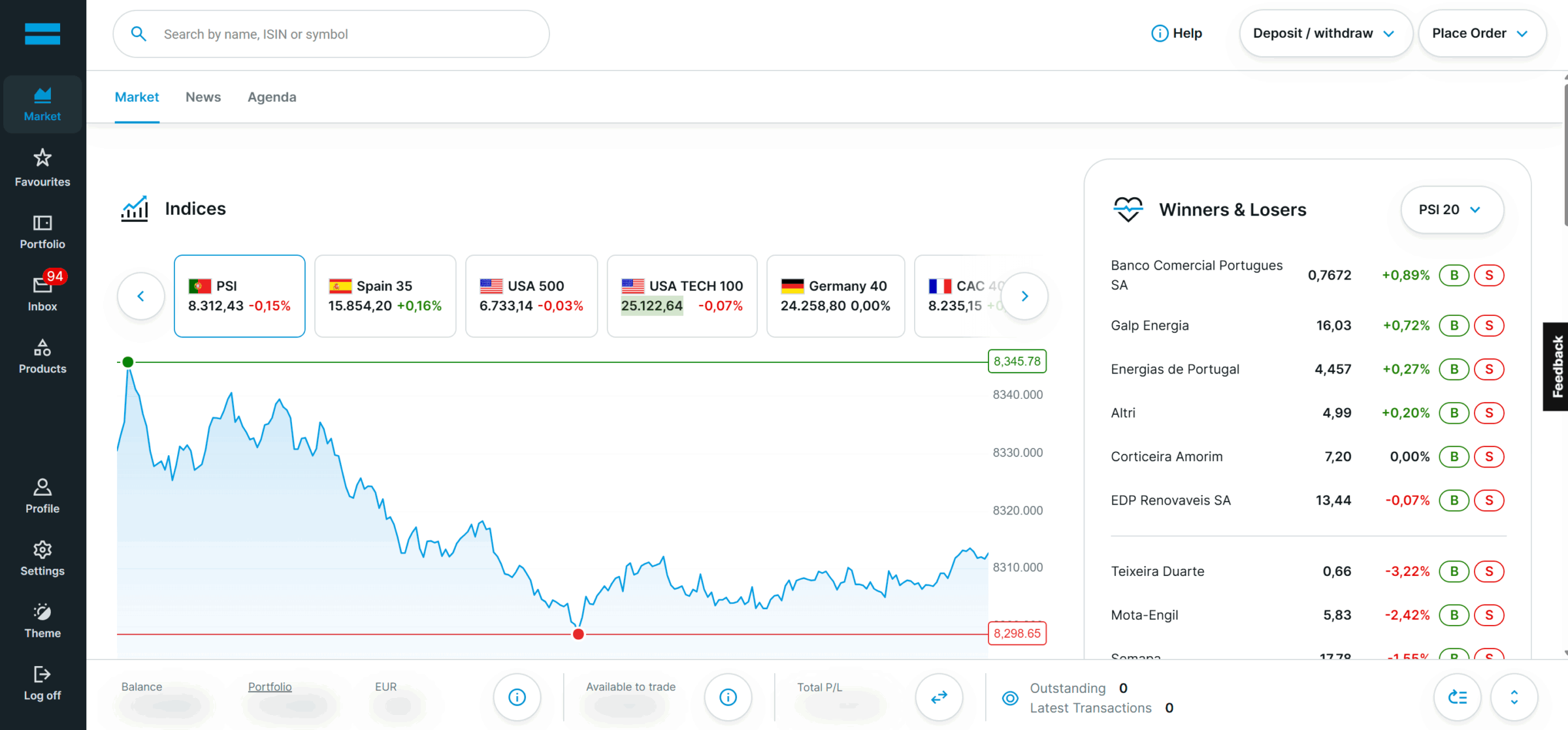
One of the cons of using DEGIRO is that bank transfers are the only deposit method available.
DEGIRO’s fee structure (effective October 2025):
- ETF Core Selection: €0 commission + €1 handling fee per trade (only on Tradegate Exchange)
- US stocks (NYSE/NASDAQ/Arca): €1.00 commission + €1 handling fee + 0.25% FX
- European stocks: from €1.00 (varies by exchange) + €1 handling fee
- Currency conversion: 0.25% (Auto FX) or €10 + 0.25% (Manual FX)
- Connectivity fee: €2.50 per exchange, per year (waived for ETFs on Tradegate and your home exchange)
- Outbound position transfer fee: €45 per position (raised from €25)
Other commissions on different exchanges:
- Irish exchanges: €/£2.00 commission;
- EU, UK, and Turkish exchanges: €/£3.90;
- Australian, Hong Kong, Japanese, and Singapore exchanges: €/£5.00.
Another thing to remember is that leveraged products for US exchange-listed stocks are limited. If you want to trade options and futures, Interactive Brokers or Saxo are probably more suitable choices.
If you need more information, please check out our more detailed review of DEGIRO.
Pros
- ETF Core Selection: full range of ETFs/ETCs/ETNs on Tradegate (1,000+ products) for only the €/£1 handling fee, with no connectivity fee (external fees apply)
- User-friendly web and mobile app
- Wide range of investment options
- Education material: Investor’s Academy and Investing with DEGIRO
- Low overall commission structure
- No account opening, inactivity, or withdrawal fee
Cons
- 0.25% currency conversion fee (charged if you deposit or invest in a different currency than your base currency)
- €/£1 flat handling fee (charged in most transactions)
- €/£2.50 of connectivity fee (paid annually), per exchange where you’re invested
- Does not offer Forex or CFDs
- No ISA account (for UK residents)
- Low-quality customer support
- No interest paid on cash balances
Saxo Bank at a glance

62% of retail CFD accounts lose money.
Founded in 1992, Saxo has been in business longer than any broker on this list except Interactive Brokers. It is known for its wide variety of financial products (over 70,000 instruments), access to a large number of global exchanges (50+), and a large number of base currencies (around 18).
Saxo has, more than anything, built its reputation with active and professional investors. It has done so by offering advanced tools, such as its integration with the TradingView charting platform. The SaxoTraderGO and SaxoTraderPRO apps are also tailored to experienced users, while the simpler SaxoInvestor platform (launched in 2024) targets newcomers and long-term investors.

Saxo overhauled its pricing in 2024 and now has no minimum deposit to open a Classic account in most regions (including the UK, France, Switzerland, Singapore, and Australia). A few markets are exceptions, however: notably, Spain and Portugal currently require a minimum deposit of €100,000. It is also worth noting that Saxo is not available in some markets, most notably the US (it does operate in Japan and Australia).
Saxo offers three account tiers: Classic, Platinum (€200,000+), and VIP (€1,000,000+), each with progressively better pricing. It charges between 0.03% and 0.08% (min. $1) on US stocks and ETFs.
The fee structure is still fairly detailed, and there are some additional fees to be aware of. A few of the most common ones:
- Custody fee on stocks, ETFs, and bonds: 0.09% to 0.15% per year (minimum €5/month, plus 25% Danish VAT for EU residents) – removed entirely in some core markets, and avoidable by opting in to Saxo’s share-lending programme;
- Currency conversion fee: 0.25% across all account tiers;
- No inactivity fee (Saxo abolished it in 2024).
It is best to select the desired financial product on their website and check the full fee structure. In a nutshell, Saxo is a premium, feature-rich broker that suits active and experienced investors; its 2024 pricing overhaul (no minimum deposit, no inactivity fee, lower commissions) has made it more accessible to everyday investors than it used to be, though custody fees and complexity can still be a drawback.
Pros
- Excellent research materials
- Outstanding trading platforms (SaxoInvestor and SaxoTrader)
- Extensive range of investment products and commercial offers
- Long track record
- Supervised by worldwide top-tier regulators
Cons
- $0 in most countries; higher minimums in some regions (e.g. $5,000 in MENA)
- Fees higher than average
- Fee structure is complex
- Does not accept US residents
Bottom line
To summarize, here’s our list of eToro Alternatives:
- Interactive Brokers: Best global broker overall
- Plus500: Best for CFD trading
- Trading 212: Best for commission-free stocks and ETFs
- DEGIRO: Best European broker for commission-free ETFs
- Saxo Bank: Best broker for experienced traders
When choosing a broker, you have to define your priorities. Some brokers offer a wider choice of financial products and advanced trading tools, while others (like eToro) offer lower fees and more intuitive platforms. Needless to say, each broker has its pros and cons. There is no such thing as a broker that fits everyone’s needs.
We hope we helped you in choosing your broker with this article.