


Hedge funds rely heavily on prime brokers for crucial services such as risk management, access to financial instruments, leverage, and trade facilitation. Selecting the right prime broker is therefore a foundational decision for any hedge fund, one that materially affects operational efficiency, financing costs, and strategic flexibility.
In this article, we take a closer look at the best prime brokers for hedge funds in 2026. We’ll explain what a prime broker is, how the market is actually structured, how to choose the right provider for your needs, and provide an in-depth review of the leading solutions available.
One thing to say up front: the five providers below do not compete for the same clients. Goldman Sachs and UBS are bulge-bracket banks serving large established funds. Interactive Brokers, Saxo and IG Prime are technology-led platforms that mostly serve emerging and mid-sized managers. Comparing them like for like on balance sheet size misses the point, so we have flagged which segment each one fits.
What is a prime broker?
A prime broker is a financial institution that serves hedge funds and other institutional clients by providing liquidity, financing, custody, risk management, and operational support under one umbrella. Prime brokers help hedge funds implement their strategies, optimise returns, and scale their businesses, earning fees and commissions based on transaction volume, financing balances, and the complexity of services provided.
The key services offered by prime brokers include:
- Trade execution and intermediation: connecting hedge funds with counterparties (large institutional investors, exchanges, alternative trading systems) to access liquidity and execute trades efficiently.
- Custody and cash management: safekeeping client assets, managing cash sweeps, FX, and money market exposures.
- Trade clearing and settlement: handling post-trade clearing and settlement across multiple venues to simplify operations and reporting.
- Securities lending: lending securities to hedge funds for short-selling, hedging, or other strategies, and lending out client long positions to other market participants.
- Financing and leverage: providing margin lending, repo financing, and synthetic exposure to amplify trading capacity.
- Risk management and reporting: daily risk analytics, portfolio stress testing, and performance reporting, often integrated with third-party risk providers.
- Capital introduction: connecting hedge fund clients with potential investors from the prime broker’s institutional, family office, and private banking networks.
- Research and market access: premium research, corporate access, and IPO or syndicate participation to support investment decisions.
Now let’s look at how the market is structured, and then at some of the top prime brokers serving hedge funds today.
How the prime brokerage market is structured
Prime brokerage had a record year in 2025, with banks generating an estimated $32.7 billion in combined prime services revenue. The business has become one of the most valuable parts of investment banks’ trading divisions, which is why competition for hedge fund mandates has intensified.
At the top, the picture is concentrated. The 2026 Alternative Fund Insight ranking has JPMorgan and Goldman Sachs dominating, with Goldman leading on breadth of clients and JPMorgan on scale. UBS sits fifth by revenue and has said publicly that it is targeting a top-four position, having grown prime services revenue 27% year on year to $2 billion over the first nine months of 2025 with client balances up for six consecutive quarters.
Below that tier sit the technology-led platforms. They do not compete with the bulge bracket on balance sheet, and they are not trying to: their proposition is cost, API connectivity and a willingness to take on funds that are too small to interest a large bank.
| Provider | Segment served | Scale marker |
| Goldman Sachs | Large established funds | Leads the 2026 AFI ranking on breadth of clients, clears on 97%+ of global equity and derivatives exchanges |
| UBS | Large established funds | Fifth-largest prime broker by revenue, with prime services revenue up 27% to $2bn over the first nine months of 2025 |
| Interactive Brokers | Emerging and mid-sized funds | 170+ market destinations, $20.5bn equity capital, S&P 500 constituent since 2025 |
| Saxo | Emerging and mid-sized funds | 1.7 million clients and 400+ partners, A- rating from S&P, majority-owned by J. Safra Sarasin since March 2026 |
| IG Prime | Smaller and emerging funds | FTSE 100 constituent since June 2026, around 15 million trades a month |
Market positions and scale markers checked on 25 September 2026. Sources: Alternative Fund Insight 2026 prime broker ranking, Hedgeweek on UBS prime services, and each provider’s own disclosures.
This matters practically. A fund running $50 million is unlikely to get an attractive quote from a bulge-bracket prime, and a fund running $5 billion across multiple strategies will find the technology platforms cannot provide the financing or capital introduction reach it needs. Work out which tier you are in before you start the conversation.
Best Prime Brokers for hedge funds
Interactive Brokers
A leading prime broker offering a wide range of services to hedge funds, including trading, clearing, custody, reporting, and securities financing, all integrated within the IBKR Trader Workstation (TWS) platform. With S&P 500 membership since 2025, 170+ market destinations, and a strong reputation for competitive financing rates, IBKR is a complete one-stop solution for many emerging and mid-sized hedge funds.
Goldman Sachs
Goldman Sachs’ Marquee platform is a comprehensive digital marketplace for institutional investors that provides hedge funds with cross-asset analytics, execution, and risk tools to manage their portfolios more effectively. Goldman is one of the two dominant prime brokers globally and a long-standing leader in serving large established hedge funds.
Saxo
A leading provider of prime brokerage and execution services to hedge funds, Saxo offers multi-asset execution, integrated custody, clearing, and post-trade services across a wide range of markets and instruments through its OpenAPI and SaxoTraderPRO infrastructure. The firm holds an A- credit rating from S&P and, since March 2026, is majority-owned by the J. Safra Sarasin Group.
IG
With over 50 years of experience in the trading industry (founded 1974, promoted to the FTSE 100 in June 2026 under ticker IGG), IG Prime provides institutional prime services, including synthetic exposure, custody, trading, and financing solutions, to a diverse range of clients, with a particular focus on smaller and emerging hedge funds.
UBS
A globally renowned financial institution with over 160 years of experience, UBS offers customised prime brokerage services to hedge funds, including daily account management, technology solutions, and access to market data and research through the UBS Neo platform. UBS is currently the fifth-largest prime broker by revenue and is working to move into the top four.
#1 Interactive Brokers

Interactive Brokers at a glance
Interactive Brokers is a well-established prime brokerage firm offering innovative, technology-driven services to its clients. Founded in 1978 and a S&P 500 constituent since 2025, when it replaced Walgreens Boots Alliance in the index, the company provides access to over 170 market destinations worldwide, giving it a distinct competitive advantage in today’s rapidly evolving institutional landscape. It reports $20.5 billion of equity capital and more than 4 million client accounts, which is the relevant number when you are assessing counterparty risk.
As one of the leading prime brokers, Interactive Brokers offers a wide range of services to hedge funds, including trading, clearing, custody, reporting, and securities financing. The firm focuses on delivering cost-sensitive solutions that provide genuine advantages to institutions through around-the-clock global service coverage and a strong balance sheet that supports client asset protection and consistent operational performance.
One of the main benefits of Interactive Brokers’ prime brokerage offering is the IBKR OMS, a complete one-stop solution that integrates with the IBKR Trader Workstation (TWS). This fully integrated OMS and EMS setup is well-suited for institutions looking to reduce costs and improve productivity, offering order management, trading, research, risk management, operations, reporting, compliance tools, clearing, and execution all within a single platform. The IBKR OMS is also fully customisable and can be used within an existing multi-broker setup.
The IBKR OMS offers a comprehensive feature set at highly competitive prices. The monthly minimum IBKR commission is $2,500, with an additional $100 per month for each linked executing broker. This includes 25 terminals, with an extra $100 per month per additional terminal, no installation fees, and no minimum term commitment. Regular commission charges on orders routed through IBKR are credited against the monthly minimum, so an active fund may never pay the minimum at all.
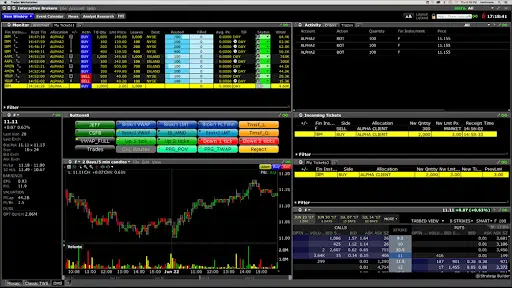
Interactive Brokers also offers securities financing services that combine deep stock availability, transparent stock loan rates, global reach, dedicated support, and automated tools to streamline the financing process. The firm also provides margin financing, the ability to absorb trades from other brokers, alongside corporate actions handling and dedicated customer service.
Hedge funds can benefit from Interactive Brokers’ Hedge Fund Marketplace, an online capital introduction programme that lets hedge funds using IBKR as their principal prime broker market their funds to IBKR clients, including Accredited Investors. This programme provides access to a sophisticated, high-net-worth client base, a meaningful tool for a manager who cannot yet command a bulge-bracket capital introduction team.
Additionally, IBKR provides a range of powerful trading technology and tools to help hedge funds execute strategies effectively. These include multiple trading platforms, advanced order types and algorithms, the TWS and Web APIs, sophisticated risk management, fractional share trading, reporting and analytics, and several other advanced trading tools. The company also offers a Soft Dollar Commission Programme, giving hedge funds the flexibility to offset the costs of approved research products and services through trading commissions.
Interactive Brokers offers two distinct fund account structures, Multiple Fund accounts and Allocation Fund accounts, to help investment managers set up arrangements that match their operating models. Accounts are accepted from citizens or residents of most countries, with exclusions for those on the US Office of Foreign Assets Control (OFAC) sanctions list or other jurisdictions IBKR deems higher risk.
Finally, Interactive Brokers provides detailed video tutorials, comprehensive documentation, and a dedicated institutional sales team in every geographic region.
#2 Goldman Sachs

Goldman Sachs at a glance
Goldman Sachs is a leading provider of prime brokerage services to hedge funds, offering a range of customised solutions tailored to each client’s needs. Its prime brokerage platform provides financing, securities lending, margin financing, trade execution, clearing, and reporting, alongside global capital introduction and post-trade infrastructure. Goldman tops the 2026 Alternative Fund Insight prime broker ranking on breadth of clients and has long served the largest and most sophisticated hedge funds across multi-strategy, macro, equity long/short, and event-driven mandates.
The scale is the selling point. Goldman clears on over 97% of the world’s equities and derivatives exchanges, processing around 3 million trades per day, covers 55 major derivatives exchanges on futures, and is active in 30+ agency securities lending markets and 50+ securities lending markets across developed and emerging economies. Client services run 24 hours a day with more than 100 professionals.
Marquee is Goldman Sachs’ digital marketplace for institutional investors, offering cross-asset analytics, execution, and risk tools to help hedge funds manage their portfolios more effectively. Through Marquee, hedge funds can access the tools and data they need to make informed investment decisions, monitor portfolios in real time, and manage liquidity while scaling their businesses.
One of the key strengths of Marquee is its management toolset, covering cash, locates, reporting, and trade oversight. The platform offers cash management tools that let hedge funds move cash rapidly and securely with transparent oversight, including initiating multiple outgoing wire transfers, incoming receipts, and cash journals simultaneously, customising and sharing views, uploading multiple payments or instructions in bulk, and approving transactions with two clicks.
Marquee also provides trade management tools that consolidate trade activity. Hedge funds can enter trades with matched status, make amendments, and monitor activity intraday, with access to enhanced trade data including settled trades and US and international trade matching, all through customisable and savable views. Marquee offers an extensive library of market content and analytics tailored to the hedge fund industry, including in-depth Prime Analytics data on hedge fund performance and positioning metrics.
Goldman Sachs also offers a dedicated Capital Introduction team that connects hedge fund clients with pension plans, endowments, foundations, family offices, sovereign wealth funds, insurance companies, funds of funds, private banks and consultants worldwide, alongside quarterly publications and regional forums across major financial centres. Lastly, Goldman’s Hedge Fund Consulting team, running for over a decade, supports managers in launching, building, and managing their businesses, offering budgeting and cash flow projection, real estate sourcing, vendor analysis, talent acquisition support, and more.
#3 Saxo

Saxo at a glance
62% of retail CFD accounts lose money.
Saxo offers an extensive range of prime brokerage and execution services to hedge funds, covering all types of strategies. Hedge funds can execute from a single margin account covering 70,000+ instruments, materially reducing complexity and operational costs. Saxo provides multi-asset execution and integrated custody, clearing, and post-trade services, allowing hedge funds to access real-time risk management, financing, and clearing across multiple asset classes through one relationship.
Saxo serves more than 1.7 million clients and over 400 partners, with client assets above DKK 1 trillion. It provides 24/5 expert service, giving hedge funds access to senior sales traders, market analysts, and dedicated relationship managers, and maintains 24/7 IT operations.
Ownership changed in 2026. On 2 March 2026 the J. Safra Sarasin Group completed the purchase of roughly 71% of Saxo Bank, buying out Geely Financials Denmark, Mandatum and other minority shareholders. Founder Kim Fournais retains about 28%. The combined group holds client assets of over $460 billion. Saxo also holds an A- credit rating from S&P Global Ratings, which is worth weighing when you assess it as a counterparty against the bulge-bracket banks.

Hedge funds can trade across a wide range of markets and instruments, including forex, CFDs, stocks, ETFs, FX options, listed options, futures, bonds, and mutual funds. Saxo offers access to 190+ FX spot pairs and 130 forward outrights, 9,000+ CFDs across stocks, indices, FX, commodities, and bonds, and 22,000+ stocks on 50+ exchanges globally. Hedge funds can also access 7,300+ ETFs and ETCs, plus ETNs on cryptocurrencies, puts and calls on 40+ FX vanilla options, and 3,100+ equity, index, and futures options on metals, energy, and rates.
What sets Saxo apart from other prime brokers is the ability to quickly launch a Singapore-domiciled Variable Capital Company (VCC) vehicle. This gives hedge funds greater operational flexibility and the structural advantages of the VCC framework, particularly attractive for funds looking to expand into Asia-Pacific. Saxo offers accelerated onboarding to the VCC structure and supports funds transitioning from managed account structures into a full fund structure.
Saxo provides execution with tier-1 liquidity sourced from multiple global venues. Hedge funds can execute across global macro, event-driven, CTA, systematic, long-only, and long/short equity strategies. Saxo also provides a gateway to China’s capital markets, offering direct electronic access to Chinese bonds and stocks, a meaningful differentiator for funds looking to access Asian markets at scale.
Finally, Saxo’s technology helps hedge funds access and execute across global capital markets through its multi-asset prime brokerage and execution services, proprietary platforms, and connectivity and APIs (including the OpenAPI). The multi-device SaxoTraderGO integrates with the institutional-grade SaxoTraderPRO, providing a fully customisable, professional-grade trading environment.
#4 IG

IG at a glance
67% of retail CFD accounts lose money.
IG Prime provides institutional prime services to a diverse range of clients, including hedge funds. With over 50 years of experience in the trading industry (founded 1974), IG is a well-established firm listed on the London Stock Exchange. It was promoted to the FTSE 100 in June 2026 (ticker: IGG), having previously been a FTSE 250 constituent. IG has offered prime brokerage services since 2006.
IG focuses on building long-term partnerships with its clients, offering synthetic, custody, trading, and financing solutions. The company provides web-based and mobile platforms engineered for speed, stability, and resilience, processing around 15 million trades per month and providing access to more than 40 global financial markets. IG’s proprietary platform, L2 Dealer, enables Direct Market Access (DMA) execution using native, synthetic, and algorithmic order types, supported by tier-1 bank smart order routing technology. The platform also allows clients to manage both synthetic and cash trading and schedule end-of-day reports for delivery via SFTP. IG supports third-party trading access via FIX, MT4, REST APIs, and Bloomberg EMSX.
IG’s deep liquidity pools and diverse range of assets offer clients opportunities to execute across a broad spectrum of asset classes. These include access to 19,000+ equities, more than 80 major, minor, and exotic currency pairs with 24-hour liquidity, a wide selection of commodities with no fixed expiries on 31 key markets such as metals, energies, and softs, and over 30 major and niche indices, with 24-hour dealing available on 26 key markets.
Clients receive comprehensive support throughout their relationship with IG Prime. The company has a dedicated technical development team that works to ensure integration between IG’s systems and clients’ systems. Technical experts are available around the clock, and a dedicated account manager is assigned to each client.
Hedge funds can benefit from IG’s execution technology and access to multiple external liquidity venues, alongside IG’s proprietary professional platform. Clients also benefit from customisable reporting through IG’s web-based back-office application, providing visibility of their accounts in real time. Multiple trading platforms are available, as well as a full algorithmic execution suite including VWAP, TWAP, Percentage of Volume, Pegged, Implementation Shortfall, and Target Close.
#5 UBS

UBS at a glance
UBS is a globally recognised financial institution that has been providing services to clients for over 160 years. The bank offers a wide range of financial services to private, institutional, and corporate clients, including prime brokerage services to hedge funds.
The Credit Suisse integration is still under way. UBS acquired Credit Suisse in 2023 and completed the migration of client accounts booked outside Switzerland, then completed the Swiss client migration in March 2026. The bank has said it is on track to complete the full integration by the end of 2026, so a fund onboarding now is joining a platform still being consolidated. That is worth asking about directly.
On prime brokerage specifically, UBS is currently the fifth-largest prime broker by revenue and has stated it is targeting a top-four position. Prime services revenue grew 27% year on year to $2 billion over the first nine months of 2025, with client balances rising for six consecutive quarters, so the direction of travel is clear even if it is not yet in the leading group.
UBS offers a comprehensive suite of prime brokerage services tailored to each fund’s objectives, including access to dedicated specialists in accounting, margin, operations, swaps, and securities lending. This includes daily account management, customised technology solutions, and access to market data, expert insights, trading commentary, and research through the UBS Neo platform.
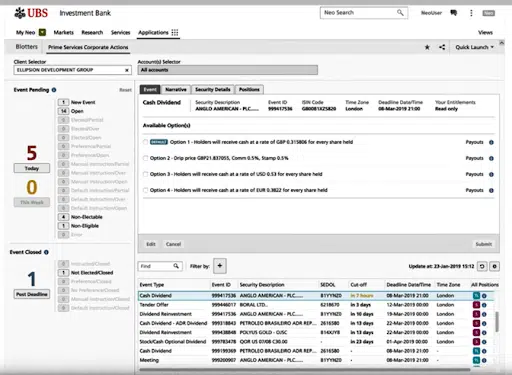
UBS Neo offers institutional investors access to UBS’s equities offering through a single platform, covering Cash Equities, Equity Derivatives, Prime Brokerage, and Equity Financing Services. The platform provides differentiated research content, portfolio management tools, and reporting and analytics capabilities. UBS Neo’s offering also includes a range of advisory services covering different geographies, asset classes, and sectors.
In addition, UBS Neo provides Transaction Cost Analysis (TCA) tools that offer detailed statistics and visualisations to help investors monitor and analyse their cash trading performance. The platform also offers smart search, follow, alerts, market snapshots, custom views, and charting tools. Finally, UBS Neo’s Global Financing Services provide asset managers with access to a comprehensive network of clearing and settlement, securities lending, cash management, and reporting capabilities.
Factors to consider when choosing a prime broker
Choosing a prime broker is one of the most consequential decisions for institutional investors, especially hedge funds. Here are the most critical factors:
- Reputation and track record: investigate the broker’s history, regulatory compliance record, and financial stability. A strong reputation helps ensure reliable service throughout the relationship.
- Services offered: ensure the broker offers the specific services you require, for example the ability to trade in particular markets, access to research, or customised reporting.
- Technology and infrastructure: evaluate trading platforms, risk management systems, OMS and EMS integration, and connectivity options such as APIs and FIX. Reliable technology usually means better service and execution.
- Counterparty risk: your fund relies on the broker’s balance sheet for financing and custody. Evaluate creditworthiness, capitalisation, balance sheet strength, and credit ratings before committing material assets to a single counterparty.
- Pricing: compare commissions, financing rates, securities lending spreads, and other charges. Financing spreads are usually the largest cost over time, so weigh them above headline commission rates.
- Customer support and capital introduction: evaluate the quality and responsiveness of the support team as well as the strength of the investor network behind any capital introduction offer.
- Regulatory compliance: verify that the broker is regulated and licensed by the relevant authorities, and that it has a clean record with regulators such as the SEC, FCA, BaFin, FINMA or MAS depending on geography.
- Strategy and size fit: some brokers excel at servicing large multi-strategy and macro funds (Goldman Sachs, JPMorgan, Morgan Stanley), others are better suited to emerging managers and mid-sized funds (Interactive Brokers, Saxo, IG Prime). Match the broker to your fund’s strategy, size, and operational needs.
- Integration or ownership change: if a provider is mid-way through a merger or has just changed hands, ask what it means for your service team, your platform and your terms. Both UBS and Saxo are in that position in 2026.
Other resources
If you’re still unsure which alternative to choose, feel free to explore our website, as well as our Youtube channel, where we dive into the best brokers in several regions, as well as provide step-by-step guides on how to invest in some of these platforms.
If you’re still unsure, feel free to contact us or just book a meeting with us.
Conclusion
Launching and operating a hedge fund involves significant operational and regulatory complexity, and selecting the right prime broker is one of the most consequential decisions a fund manager will make. An experienced prime broker can streamline trade execution, custody, financing, and reporting, while also providing capital introduction services that help fund managers connect with the right institutional investors at the right time.
The trade-offs come down to cost, technology, balance sheet strength, capital introduction reach, and strategy fit, and these vary materially between bulge-bracket banks and technology-led platforms. The banks offer the deepest capital introduction networks and the most robust balance sheets, which is why JPMorgan and Goldman Sachs dominate the 2026 rankings and why they are the natural choice for large established funds. Technology-led platforms offer more competitive pricing, advanced API connectivity, and operational flexibility better suited to emerging managers, mid-sized funds, and quant-driven strategies.
Two of the five providers here are in transition. UBS is still integrating Credit Suisse, with completion targeted for the end of 2026, and Saxo changed majority ownership in March 2026. Neither is a reason to rule them out, but both are reasons to ask specific questions about service continuity before signing.
This article has provided an overview of the leading prime brokers for hedge funds in 2026. The right decision depends on the specific size, strategy, geography, and operational needs of the fund. We recommend speaking with multiple prime brokers before committing: understanding the differences in financing terms, technology integration, and capital introduction support is essential to making the right choice for the long term.
Prime Brokers for hedge funds FAQs
What is a prime broker, and why do hedge funds need one?
A prime broker is a financial institution that offers hedge funds a bundle of services, including trade execution, financing, securities lending and custody. Hedge funds use one to access financial markets, borrow securities for short positions, finance leverage, hold assets, and consolidate reporting across counterparties into a single relationship.
How many prime brokers should a hedge fund have?
Typically at least two, often one large bank and one mid-sized or technology-led provider. Multiple relationships give diversification of counterparty risk, access to a broader range of services and stock borrow, and negotiating power on pricing. Industry surveys have long shown that funds using more than one prime broker average around three relationships.
Can hedge funds negotiate pricing and terms with their prime brokers?
Yes, particularly if they have significant assets under management or generate substantial trading volume. It is worth understanding each broker’s pricing model in detail before negotiating, because the headline commission rate is rarely the largest cost. Financing spreads and securities lending rates usually matter more over a full year.
Who are the largest prime brokers in 2026?
JPMorgan and Goldman Sachs dominate the 2026 Alternative Fund Insight ranking, with Goldman leading on breadth of clients and JPMorgan on scale. UBS sits fifth by revenue and has said it is targeting a top-four position. Banks collectively generated an estimated $32.7 billion in prime services revenue in 2025, a record year for the sector.
Can a small or emerging fund get a prime broker?
Yes, though not usually from the bulge bracket. Large banks set minimum revenue expectations that most launching funds cannot meet. Technology-led providers such as Interactive Brokers, Saxo and IG Prime are built for this segment, with published pricing and lower minimums. The IBKR OMS, for example, carries a $2,500 monthly minimum commission that active trading offsets entirely.
What happens to my fund if my prime broker is acquired or merged?
Your contractual terms usually survive, but your service team, technology platform and financing terms may all change over the course of the integration. Both UBS, which is integrating Credit Suisse through the end of 2026, and Saxo, majority-acquired by J. Safra Sarasin in March 2026, are in that situation. Ask about service continuity, platform migration timelines and whether your terms are being repapered.



