Are you wondering how to buy a stake in Alphabet (Google), Tesla, or Berkshire Hathaway given their famously high share prices? Or simply want to invest small, manageable amounts in expensive stocks without committing thousands at a time?
This is where fractional shares (sometimes called partial shares) come in – the ability to buy less than one full share of a stock. Once a niche offering, fractional shares have become mainstream across most major online brokers since around 2019-2020, as brokers competed to lower barriers to entry for retail investors.
This article tackles two questions:
- Does Moomoo offer fractional shares?
- If not (or if its fractional offering is limited), what are the best alternatives for fractional share trading in 2026?
Let’s get right into it.
What is fractional share trading?
It’s exactly what it sounds like: instead of paying the full price for a complete share of a stock, you decide on a dollar (or euro) amount you want to invest, and you receive that proportional fraction of a share.
For example, if Amazon’s share price is around $230 and you want to invest just $50, you’d receive approximately 0.22 of an Amazon share. You still benefit proportionally from price appreciation, stock splits, and (in most cases) dividends – just at a fractional level. This makes fractional shares particularly useful for:
- High-priced stocks: companies like Berkshire Hathaway Class A (~$700K per share), Booking Holdings (~$5K+), or NVR (~$10K+) become accessible to small investors.
- Dollar-cost averaging: investing a fixed amount monthly (e.g., $100) into a diversified basket without needing to round up to whole shares.
- Diversification on small budgets: spreading €500 across 10 different stocks (€50 each) rather than being forced to concentrate in just one or two.
- Recurring investment automation: many brokers now offer auto-invest features (Saxo AutoInvest, eToro Smart Portfolios) that depend on fractional shares to work properly.
Does Moomoo offer fractional shares?
The picture in 2026 is a bit more nuanced than a flat “yes” or “no”:
- Moomoo Singapore (MAS-regulated): offers fractional shares on US stocks for retail clients – users can buy as little as 1/100,000 of a share (with minimum order values typically around USD 5).
- Moomoo US (Futu/TradeUP entity): offers fractional shares on US stocks.
- Moomoo Australia, Malaysia, Canada: fractional share availability varies by entity and product – check the platform for your specific region.
- Moomoo for European clients: Moomoo does not currently serve EU/EEA retail clients directly, and fractional share availability through any cross-border configuration is limited.
For users wanting to combine fractional shares with broader European market access, Moomoo’s offering may not be sufficient – which is why it’s worth exploring alternatives below that offer fractional shares alongside broader European market coverage. From the Moomoo community forum, ongoing user requests highlight where fractional share availability is still being expanded.
If you’re outside Moomoo’s supported markets or need broader fractional share access across markets, the alternatives below cover the strongest options.
Best Moomoo alternatives for fractional shares
If your priority is finding a strong online broker offering fractional shares – particularly with broader market coverage than Moomoo’s regional setups – here’s our breakdown of the four standout alternatives for 2026:
Interactive Brokers
Founded in 1978, IBKR is one of the world’s most trustworthy brokers worldwide. The minimum amount to invest in fractional shares is $1 for eligible US and European stocks and ETFs, regardless of the share price.
💡 Interactive Brokers also launched IBKR GlobalTrader, a modern mobile trading app to trade Stocks, Options and ETFs, ideal for novice investors.
eToro
A modern and easy-to-use broker available worldwide that offers free commissions on ETFs (other fees apply) and the possibility of belonging to a community of investors where you can follow and replicate what they are doing. You can buy fractional shares starting at $10.
Webull
A leading US-based broker that offers commission-free stocks, ETFs, and options trading (for US-listed products). Fractional share trading is only available for specific stocks and ETFs, only supported for market orders and the minimum amount to purchase a fractional share position is $5.
Public.com
Public.com is a recent US broker that gives users the ability to invest in stocks, ETF, and crypto, commission-free. You can buy fractional shares starting at $1, but not all securities available are eligible for fractional share orders, and it only applies to market orders (it does not permit limit orders for fractional shares).
1# Interactive Brokers

IB at a glance
Founded in 1978 and publicly listed on NASDAQ (ticker: IBKR), Interactive Brokers is one of the largest global online brokers, having weathered every major financial crisis since the late 1970s with strong risk management and operational resilience.
Interactive Brokers offers a comprehensive set of platforms (Trader Workstation, IBKR Desktop, Client Portal, IBKR Mobile, GlobalTrader) designed for both retail investors and institutions, with global access to stocks, ETFs, options, futures, forex, bonds, mutual funds, and commodities across 150+ markets in 30+ countries. All these markets are accessible from a single account, with Smart Routing ensuring competitive execution prices across exchanges.
On the fractional shares front, IBKR’s offering has expanded significantly:
- US stocks and ETFs: fractional shares available from $1 minimum on stocks listed on NYSE, AMEX, NASDAQ, ARCA, BATS, and selected OTC Pink US penny stocks – covering essentially every major US-listed equity.
- European stocks and ETFs: fractional shares available from €1 minimum on shares listed on Euronext (Paris, Amsterdam, Brussels), Frankfurt/Xetra, London Stock Exchange, Borsa Italiana, BME (Madrid), and SIX Swiss Exchange – covering most major European equities with average daily volume above $5M and market cap above $5B.
- Canadian stocks: fractional shares available on TSX-listed stocks via IBKR Canada.
- Hong Kong stocks: fractional shares now available on HKEX-listed shares for many users.
For European investors specifically, IBKR’s fractional share availability on European exchanges is a meaningful advantage – most other brokers offering fractional shares limit them to US-listed instruments only. This makes IBKR particularly strong for building diversified European portfolios with small position sizes.
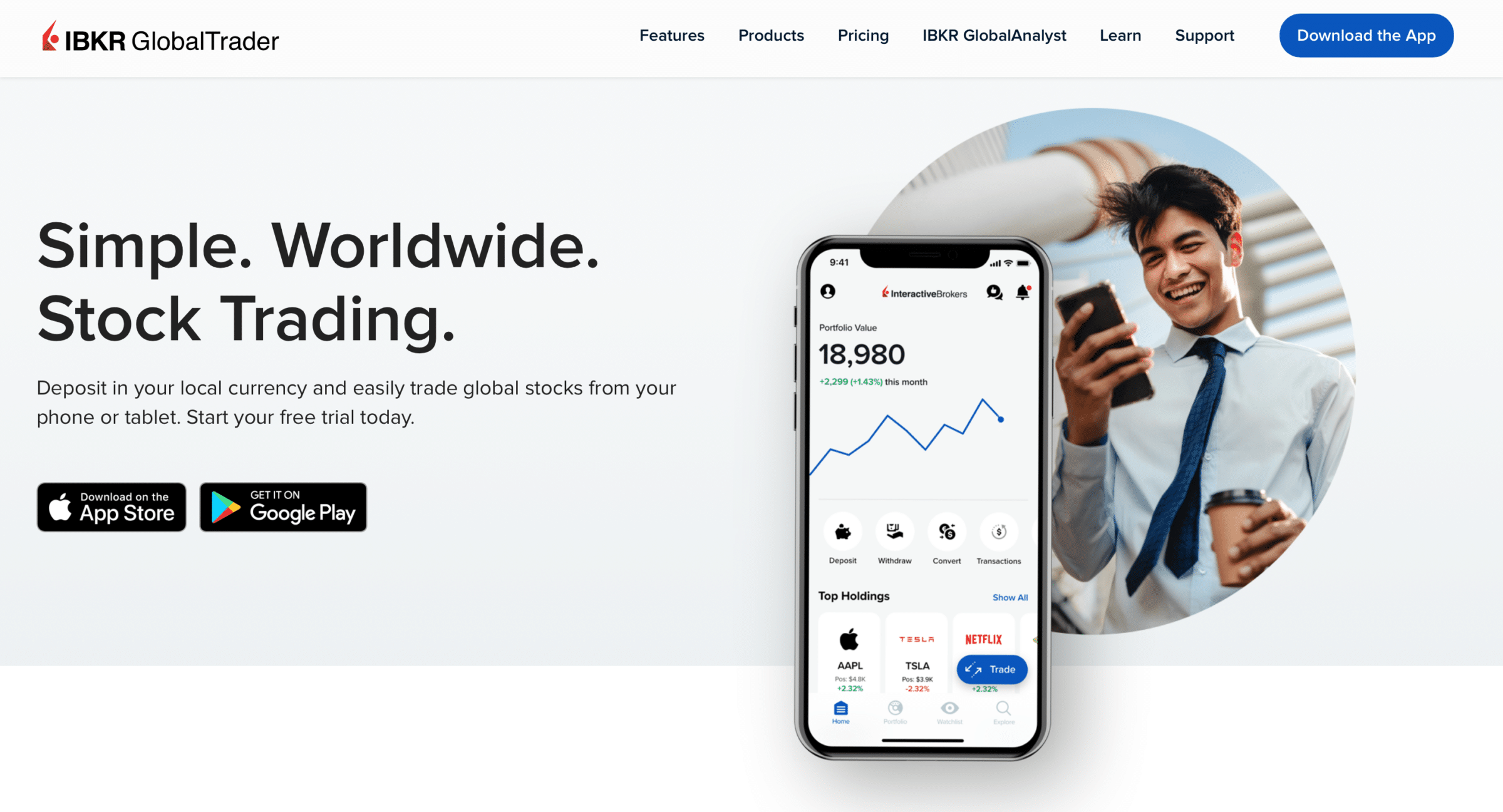
Interactive Brokers also offers IBKR GlobalTrader, a mobile app designed for newer investors looking for simple, accessible global trading. GlobalTrader features include automatic currency conversions, fractional shares from $1, a paper trading mode with $10,000 in simulated cash, and a much more accessible interface than IBKR’s main platforms.
Interactive Brokers is headquartered in Greenwich, Connecticut, and operates as a publicly listed global financial services company. It’s regulated by multiple top-tier authorities worldwide including the SEC, FINRA, SIPC, and CFTC (US); FCA (UK); Central Bank of Ireland (CBI); ASIC (Australia); SFC (Hong Kong); MAS (Singapore); and CIRO (Canada). As a NASDAQ-listed company, IBKR is also subject to ongoing SEC disclosure, audit, and corporate governance requirements – adding meaningful transparency beyond standard broker regulation.
Want to know more about Interactive Brokers? Check our Interactive Brokers review.
Pros
- Low commissions on US stock trading
- No monthly inactivity fee
- The broadest product and markets range in the brokerage industry
- Demo account
- Excellent reputation (founded in 1978)
- Extensive research and Education tools
- Has a modern mobile trading app to trade Stocks, Options and ETFs, ideal for novice investors, IBKR GlobalTrader.
- Offers interest on uninvested cash balances
Cons
- Complicated and lengthy account opening process (but fully online)
- Steeper learning curve for beginners
- Website is difficult to navigate
- Interactive Advisors (Robo-advisor feature) is only available for US customers
2# eToro

eToro at a glance
52% of retail CFD accounts lose money.
As the world’s leading social investing platform with over 40 million users globally, eToro offers fractional share trading as a core part of its retail proposition. eToro went public on NASDAQ (ticker: ETOR) in May 2025 – adding meaningful credibility through public-market disclosure and oversight.
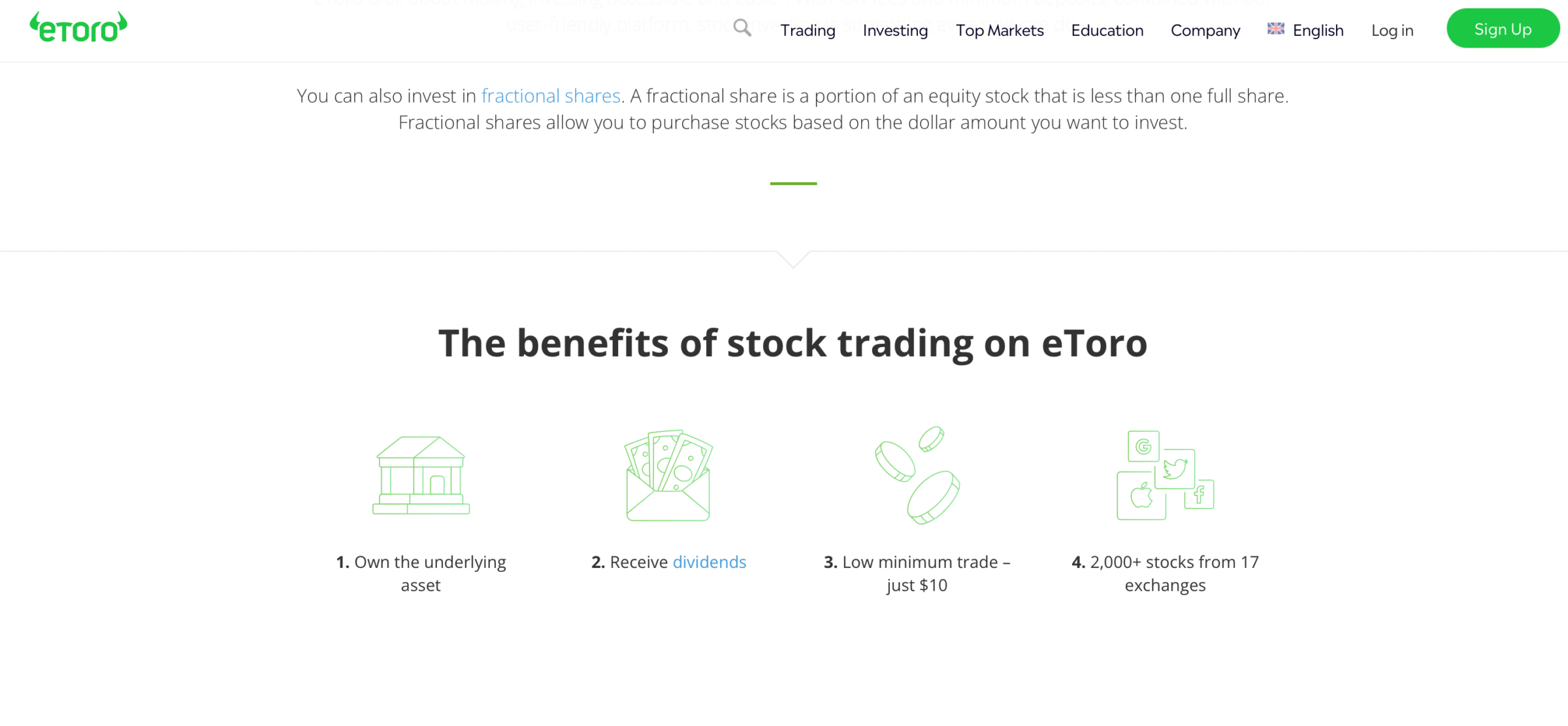
To buy or sell fractional shares on eToro, the process is exactly the same as for whole shares: instead of specifying the number of shares, you specify the dollar/euro amount you want to invest, and eToro allocates the corresponding fractional position. Fractional shares are available on most stocks and ETFs across major US, European, and select Asian exchanges, with minimum investment amounts typically starting at $10 for stocks and ETFs (slightly higher for certain exotic stocks).
eToro’s social investing (CopyTrader) feature lets you automatically copy the trades of other retail or professional investors on the platform – genuinely the platform’s defining differentiator. There are thousands of verified traders to choose from, ranked by past Return on Investment (ROI), risk profile, and other factors. Combined with eToro’s Smart Portfolios (thematic baskets of stocks and ETFs around a particular strategy), this creates a hands-off investment approach that depends on fractional share mechanics to work effectively.
eToro also offers CFD (Contract for Difference) trading, allowing leveraged exposure to underlying asset movements without owning the asset. CFDs are complex, higher-risk instruments and a majority of retail accounts lose money trading them. Check our detailed guide on CFDs vs real shares trading if you’re considering this route.
European investors can now open and fund their account in EUR directly – removing the FX conversion costs that previously applied for non-USD users. Spreads can be wider on some products than at specialist brokers, withdrawals carry a $5 fee with a $30 minimum, and stock trades carry a $1 commission on most exchanges ($2 on Australia, Hong Kong, Dubai, and Abu Dhabi exchanges) – though real ETFs trade commission-free.
The platform is a member of FINRA and SIPC, and is regulated by the US SEC. Its international equivalents, based in the UK, EU, Australia, or Seychelles, are also regulated.
If you want to learn more, check our eToro Review.
Pros
- Low stock trading fees (from $0 per trade)
- Commission-free ETFs (other fees apply)
- Social trading and other innovative products
- Wide variety of financial products
- Slick, modern, and easy for anyone to use
- European users have access to three account currencies: EUR, USD and GBP
- Top tier regulators
Cons
- Limited disclosed financial information
- Withdraw and inactivity fees
- Spread, overnight, inactivity, and currency conversion fees higher than average
- Doesn’t offer bonds, futures, or options
3# Webull

Webull at a glance
Webull provides modern, mobile-first financial trading solutions for retail investors. Founded in 2017, Webull has grown to over 20 million users globally, with operations across the US, UK, Singapore, Australia, Japan, and several other markets. It went public on NASDAQ (ticker: BULL) in April 2025 via a SPAC merger, adding institutional credibility.
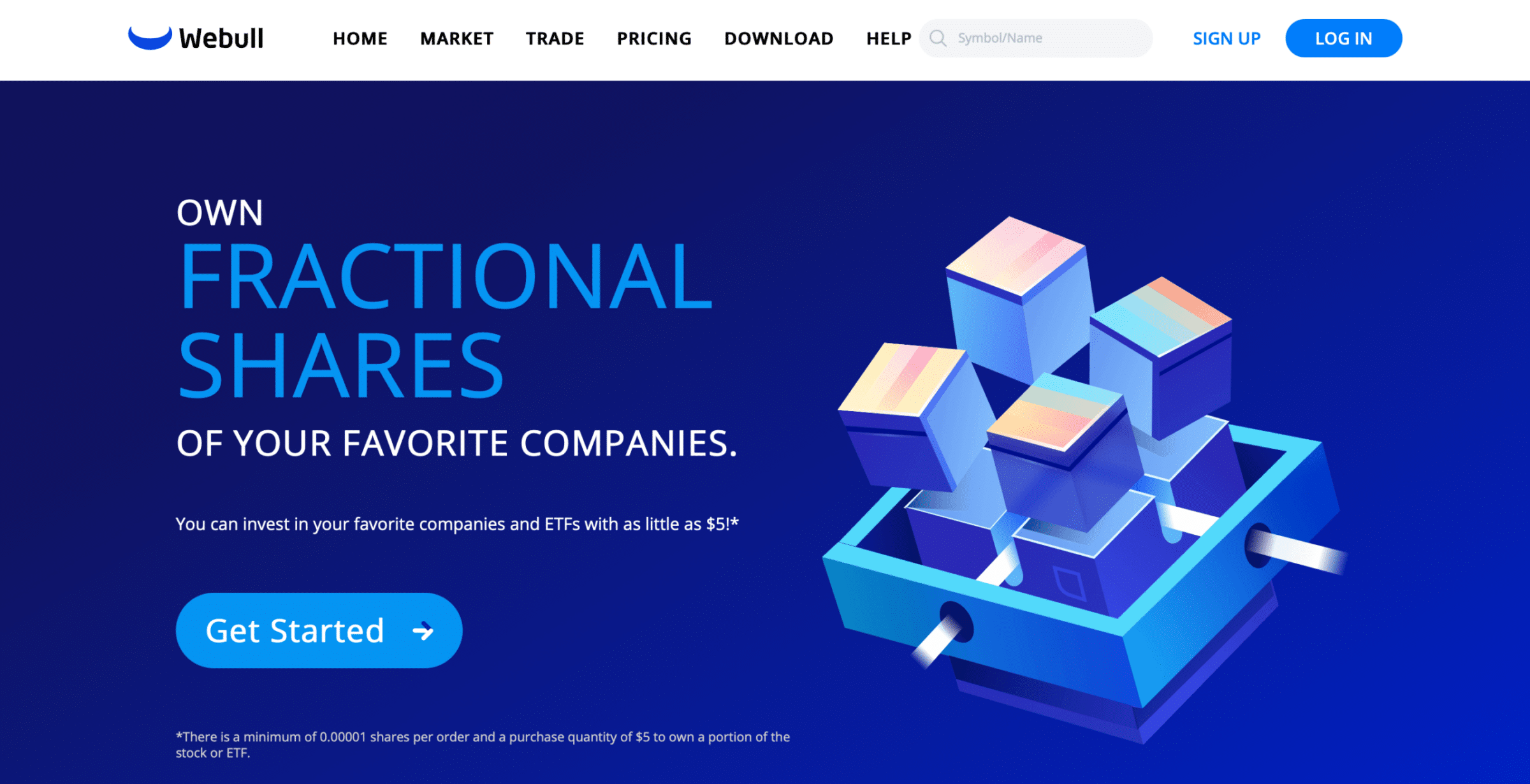
Fractional share trading on Webull is available on a curated list of US-listed stocks and ETFs – look for the “F” icon on the asset’s detail page to confirm fractional availability. Key fractional trading mechanics:
- Minimum trade size: $5 per fractional share position.
- Order types: market orders only (limit orders not supported for fractional trades).
- Minimum quantity: 0.00001 shares.
- Asset coverage: a curated subset of US-listed stocks and ETFs, not the full Webull universe.
You can find all the specifics in Webull’s fractional shares guide.
If you’re looking for a platform to get up and running quickly with liquid US investments – including margin accounts and options – Webull does its job well. US investors can also access traditional and Roth IRAs, while UK investors benefit from Webull’s Stocks & Shares ISA (launched in 2025), making it one of the few low-cost mobile brokers offering tax-efficient UK investing.
Webull offers 0% commission on stock and ETF trading across its main markets. Revenue is generated through stock lending, interest on uninvested cash balances, margin interest, and (in the US) payment for order flow.
If you’re looking for advanced or exotic products (forex, futures, bonds, mutual funds), Webull is not the right platform – the product range is intentionally focused on stocks, ETFs, options, and (in some markets) crypto. Webull supports useful retail features including extended-hours trading (pre-market and after-hours sessions), desktop, web, and mobile platforms with strong charting tools, and 24/7 customer support. You’ll find the essentials covered well, though not the depth or breadth of an IBKR or Saxo.
Webull is regulated across its operating markets by multiple authorities: SEC, FINRA, and SIPC (US); FCA (UK, FRN 996099); MAS (Singapore); ASIC (Australia). Client funds are protected up to $500,000 (with $250,000 cash limit) under SIPC for US clients, and £85,000 under FSCS for UK clients.
Pros
- No minimum deposit required
- Commission-free trading on stocks, ETFs, and options
- No account opening, inactivity, or currency exchange fees
- User-friendly mobile and desktop app
- High interest on uninvested cash - up to 3.6% APY with Webull Premium, or 3.25% APY for non-Premium accounts (April 2026)
- Straightforward account opening process
- Fractional shares
- OTC shares
- Demo account available
Cons
- Limited market coverage
- High withdrawal fees for wire transfers
- High deposit fees for wire transfers
- Live chat support open to limited clients
- No mutual funds
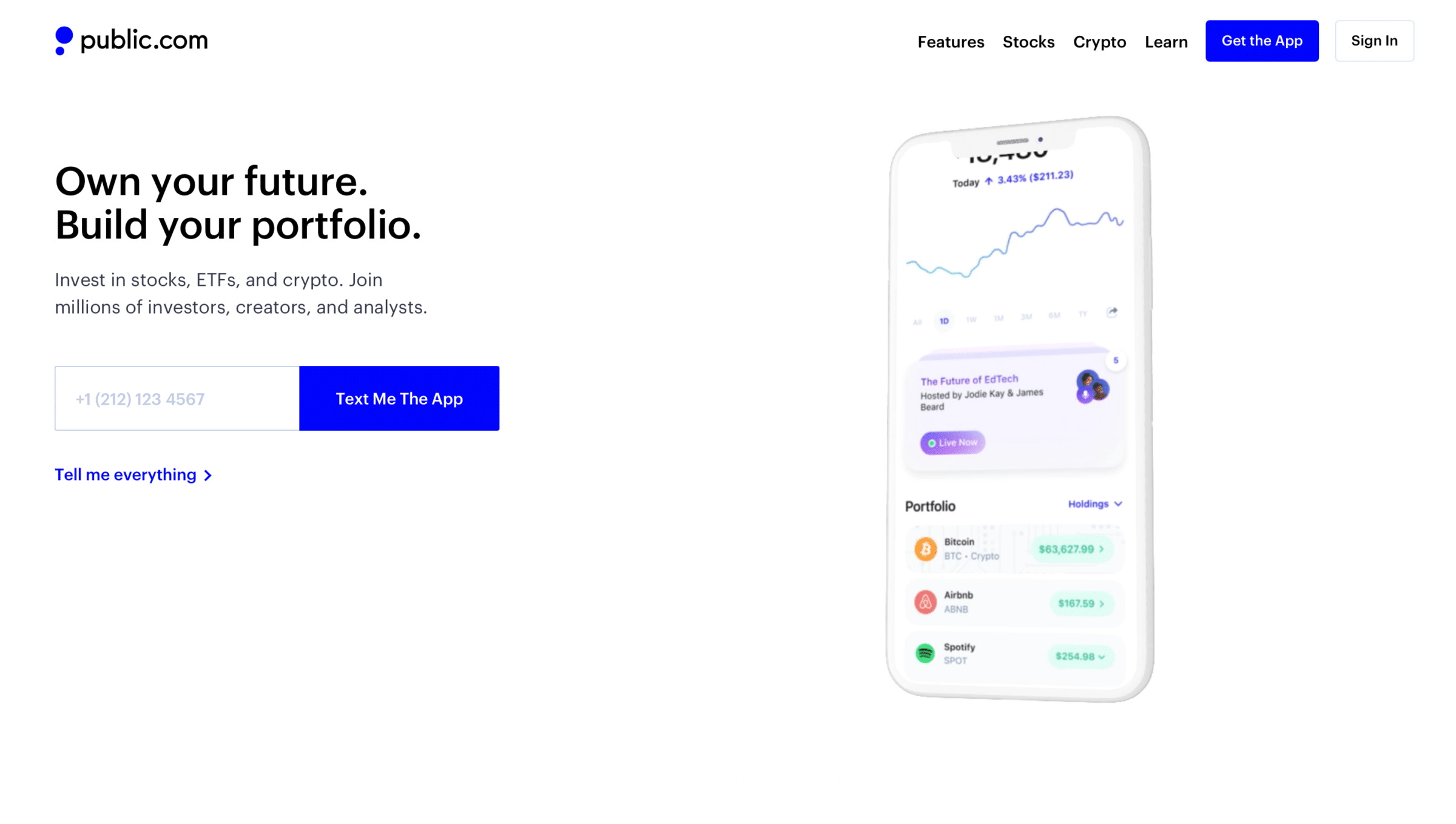
4# Public.com

Public at a glance
Public.com gives US users the ability to invest in stocks, ETFs, options, bonds, treasuries, and crypto – much of it commission-free. The platform also offers a strong selection of educational tools and content for newer investors, alongside features like high-yield cash accounts (currently competitive with major brokers) and US Treasury bond investing.
Public.com offers fractional share trading on US-listed stocks and ETFs from a minimum market order of $1. Not all securities are eligible for fractional orders – for full details, see Public.com’s fractional shares disclosure.
The platform is used by a community of over 3 million members and differentiates itself by avoiding Payment for Order Flow (PFOF) – a revenue model used by Robinhood and many other US retail brokers that some investors view as creating conflicts of interest. Instead, Public.com generates revenue through tipping, premium subscriptions, cash interest spreads, and securities lending.
One critical caveat: Public.com is only available to US residents. International investors looking for fractional share trading need to use one of the other alternatives covered in this article (IBKR, eToro,…).
Pros
- Stock and ETF trades are commission-free
- Offers crypto and alternative assets (fine art, collectibles, etc)
- Investment community (social feed)
- Supports fractional shares
- High fees transparency
- No minimum deposit
Cons
- No mutual funds or futures
- No international or custodial accounts
- No robo-advisor
There are clear advantages and a few practical caveats to consider with fractional shares. Overall, we believe the benefits significantly outweigh the drawbacks for most retail investors – here’s the full picture.
Why trade fractional shares?
Advantages of fractional shares
A common first question: do fractional shares pay fractional dividends? Yes – the underlying economic exposure is identical whether you own 1.00 share or 0.01 share, and you receive your proportional share of any dividends paid by the underlying company.
Additional benefits:
- Invest with small amounts: get started with as little as $1 (depending on broker).
- Access high-priced stocks: companies like Berkshire Hathaway Class A (~$700K per share), Booking Holdings (~$5K+), NVR (~$10K+), Costco, or expensive ETFs become accessible to all budget sizes.
- Better diversification on small budgets: spreading €500 across 10 different stocks (€50 each) is genuinely easier with fractional shares than being forced to round up to whole shares.
- Dollar-cost averaging: investing a fixed monthly amount (e.g., $200) precisely into your portfolio without leftover cash sitting uninvested.
- Auto-invest and recurring contribution features: brokers like Saxo (AutoInvest), and eToro (Smart Portfolios) depend on fractional share mechanics to deliver hands-off automated investing.
Disadvantages of fractional shares
The drawbacks are mostly technical and don’t significantly affect most retail investors, but worth understanding:
- No voting rights: voting rights are typically conferred only with whole shares. If you only hold fractional positions, you won’t be able to vote at company annual meetings or on shareholder resolutions.
- Non-transferability: in most jurisdictions, a fractional share represents an agreement between you and your broker (who legally owns the whole share and credits you the proportional value). You generally cannot transfer fractional shares between brokers – if you switch platforms, the fractional position is typically sold and the proceeds transferred as cash.
- Cash-only compensation in liquidation: if a broker fails, investor compensation schemes typically transfer whole shares in-kind to a new broker but pay the monetary value of fractional positions as cash. This is generally fine but worth knowing.
- Over-diversification risk: some investors use fractional shares to over-diversify (e.g., spreading $500 across 50 individual stocks at $10 each). While diversification reduces risk, over-diversification can dilute returns without meaningfully improving risk-adjusted performance. A single broad-market ETF often beats a sprawling portfolio of individual fractional positions.
- Tax reporting complexity: in some jurisdictions, the tax reporting around dozens of small fractional positions can become administratively cumbersome compared to fewer whole-share holdings.
The bottom line
Whether you’re a newer investor or an experienced trader, the rapid mainstream growth of fractional shares is genuinely good news. They open up access to high-priced stocks, enable proper diversification on smaller budgets, power auto-invest features, and let dollar-cost averaging work precisely – all without meaningful downsides for most retail investors.
The critical decision isn’t really about whether to use fractional shares, but rather which broker to use them through. Moomoo’s offering varies significantly by jurisdiction (strong in Singapore and the US, limited or absent elsewhere), so for users in other markets – particularly Europe – the alternatives are typically a better fit:
- Interactive Brokers: best for breadth of fractional share availability – US, European, Canadian, and Hong Kong markets all supported, with low minimums and access to 150+ global markets.
- eToro: best for social investing and Smart Portfolios that depend on fractional shares to work effectively. Now publicly listed on NASDAQ for additional credibility.
- Webull: best for US-listed fractional shares with a polished mobile-first platform, plus UK Stocks & Shares ISA access for tax-efficient UK investing.
- Public.com: best for US residents who value avoiding Payment for Order Flow alongside fractional share access (US-only).
By 2026, fractional share trading has become standard across most major retail brokers in the US, UK, EU, and many Asia-Pacific markets – making this a genuinely solved problem for most investors. The remaining choice is which broker’s overall package (fees, regulation, available markets, additional features, tax efficiency) best fits your specific situation.