In 2014, DEGIRO expanded its online trading platform beyond the Netherlands, its country of origin, into several European markets. Since then it has grown steadily, reaching over 3 million clients across 18+ European countries.
Is DEGIRO available in Lithuania?
Yes, but not directly. Lithuania is one of DEGIRO’s accepted residency countries, so Lithuanian residents can open and use an account. What DEGIRO does not have is a dedicated Lithuanian website or local entity, and Lithuania is not one of its focus markets – those are the countries with localised sites, such as Germany, France, Spain, and the Netherlands.
In practice, this means you sign up through one of DEGIRO’s existing entities rather than a “DEGIRO Lithuania” page. Registration is done through the DEGIRO app, and you will need to be 18 or over, hold valid identification, have a euro-denominated bank account within the SEPA zone, and be a tax resident in an accepted country (Lithuania qualifies).
A few practical points before you decide. DEGIRO operates as the Dutch branch of flatexDEGIRO Bank AG, a German credit institution supervised by BaFin and the Deutsche Bundesbank, passported into Lithuania under MiFID II with Lietuvos bankas oversight. Client assets are covered by the German Investor Compensation Scheme (90% of losses up to €20,000), and cash held with flatexDEGIRO Bank AG up to €100,000 under the German Deposit Guarantee Scheme.
Two things specific to Lithuanian investors. Since Lithuania uses the euro, the SEPA requirement poses no obstacle – an advantage over investors in non-eurozone markets. However, DEGIRO does not provide Lithuanian tax reporting, so declaring investment income to the VMI falls entirely to you, unlike domestic providers that withhold at source.
It works, then, but it is less straightforward than in DEGIRO’s core markets.
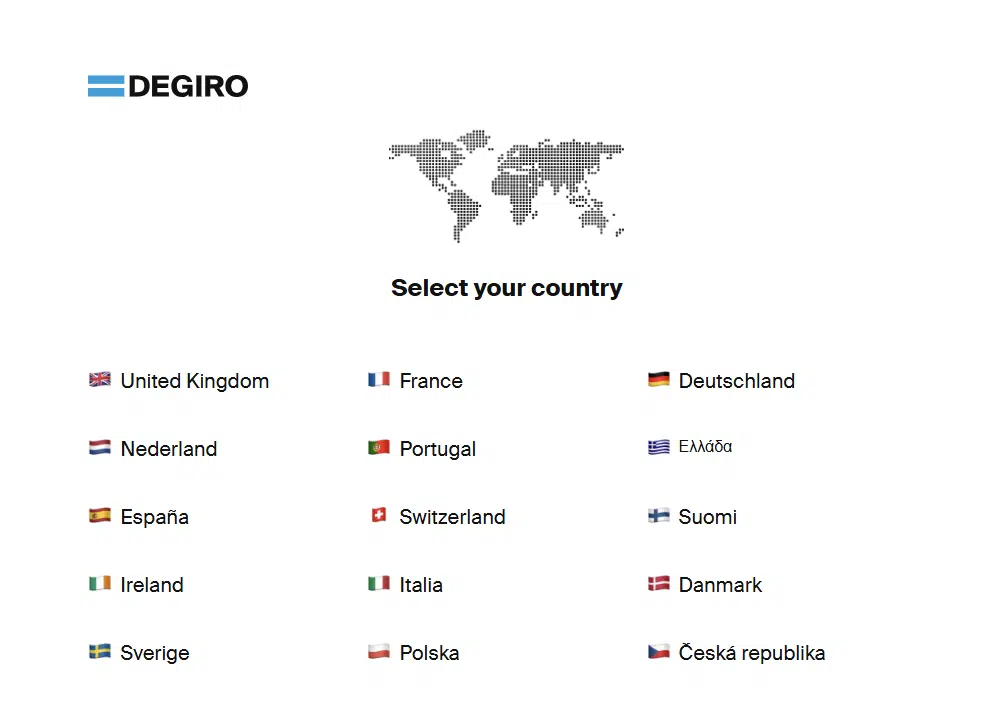
Because the setup is less direct and customer support is not tailored to the Lithuanian market, it is worth comparing DEGIRO against brokers that actively serve Lithuanian clients before you decide.
Want to know which online brokers are available in Lithuania? Read on.
What is DEGIRO?
Founded in 2008 and opened to retail investors in 2013, DEGIRO reshaped European investing by making low-cost market access widely available. That proposition has drawn investors across Europe who value cost above the additional services traditional brokers bundle in.
DEGIRO built its platform around simplicity for both desktop and mobile, giving access to real-time data, a broad product range covering stocks, ETFs, bonds, options, futures, and warrants, and connectivity to exchanges worldwide.
DEGIRO is the Dutch branch of flatexDEGIRO Bank AG, a German credit institution supervised by BaFin and the Deutsche Bundesbank, with additional conduct oversight from the Dutch AFM. Client assets fall under the German Investor Compensation Scheme, covering 90% of losses up to €20,000, while cash held with flatexDEGIRO Bank AG is guaranteed up to €100,000 under the German Deposit Guarantee Scheme.
DEGIRO alternatives in Lithuania
DEGIRO does accept Lithuanian residents, but if you would rather use a broker better suited to your situation, or simply want to weigh your options first, there is plenty of choice. Growing competition has pushed many leading brokers to eliminate commissions on most stock and ETF trades.
All the alternatives below are regulated by top-tier authorities – the FCA (UK), BaFin (Germany), CySEC (Cyprus), and the Central Bank of Ireland among them – and passport into Lithuania under MiFID II with Lietuvos bankas oversight, with investor compensation typically capped at €20,000 depending on the entity.
Worth noting that Lithuania has become a significant hub for financial services licensing in recent years, with several international firms – including Robinhood Europe – choosing Vilnius as their EU base. That means Lithuanian investors sometimes have earlier access to new entrants than other EU markets.
Based on criteria including demo account availability, commission-free trading, educational resources, and security, here are our top picks:
#1 eToro

52% of retail CFD accounts lose money.
Founded in 2007, eToro is a well-known global fintech and the leading platform in social trading, with over 40 million users across 140+ countries. It offers commission-free ETF investing in Lithuania, while stock trades carry a $1 or $2 commission depending on the exchange, applied on both opening and closing a position.
Beyond ETFs and real stocks, you can trade CFDs, commodities, forex, and cryptocurrencies through an interface that is intuitive and approachable, making it a reasonable choice for beginners or anyone wanting a self-directed platform.
Opening an account and depositing is straightforward, with a $100,000 demo account available for practice. On the downside, spreads can be relatively high on some products, and eToro operates in USD as its only base currency – so euro deposits are converted on the way in and out, which is a recurring cost for a eurozone investor. There is also a $5 withdrawal fee and a $10 monthly inactivity fee after 12 months without login.
Lithuanian clients are served by eToro (Europe) Ltd under CySEC supervision with Lietuvos bankas oversight, covered up to €20,000 plus Lloyd’s insurance. eToro has been NASDAQ-listed (ETOR) since May 2025.
Want to know more? Check our eToro review.
CFDs are complex instruments and come with a high risk of losing money rapidly due to leverage. 52% of retail investor accounts lose money when trading CFDs with this provider. You should consider whether you understand how CFDs work and whether you can afford to take the high risk of losing your money.
#2 Interactive Brokers

Interactive Brokers at a glance
Founded in 1978 and publicly listed on NASDAQ (ticker: IBKR, an S&P 500 constituent since 2024), Interactive Brokers is a global broker that has weathered multiple financial crises, demonstrating resilience and rigorous risk management. It serves over 5 million client accounts with more than $900 billion in client equity.
IBKR offers an advanced platform covering stocks, options, funds, ETFs, futures, bonds, currencies, and cryptocurrencies across 170+ markets in 36+ countries – including Nasdaq Vilnius for Lithuanian and Baltic equities – with solid execution via IB SmartRouting and comprehensive analysis tools.
Beginners have educational resources through IBKR Campus, though the main TWS platform has a steep learning curve, which is why we mainly recommend it to more experienced investors. Customer support gives clear, concise answers.
On the downside, the fee structure is complex and registration is lengthy, though fully online. Factoring in FX conversion at 0.20 basis points, tight spreads, and the Stock Yield Enhancement Program, clients still achieve significant savings versus most brokers. There is no minimum deposit and native EUR support. Lithuanian clients are served by Interactive Brokers Ireland Limited under Central Bank of Ireland supervision.
IBKR also offers IBKR GlobalTrader, a modern mobile app for stocks, options, and ETFs, well suited to beginners, with automatic currency conversion, fractional shares from $1, and a $10,000 demo account.
Want to know more? Check our Interactive Brokers review.
3. Freedom24

Freedom24 at a glance
Investing involves risk of loss.
Freedom24, part of Freedom Holding Corp (NASDAQ: FRHC), serves over 500,000 clients with access to stocks, 3,600+ ETFs, bonds, futures, and US options across international markets including NASDAQ, NYSE, CME, HKEX, LSE, and Deutsche Börse.
Its Bonds Showcase gives access to higher-rated bonds (B+ and above) from as little as €/$1,000, simplifying a market retail investors usually struggle to reach.
Two pricing plans are available: Smart in EUR for self-directed investors and All Inclusive in EUR (formerly Prime) with a dedicated account manager. Commissions start from €1.20 per order plus €0.008 per share, with no minimum deposit.
The web and mobile platforms are well designed and intuitive, complemented by InvestIdeas, which surfaces research from Freedom24’s analyst team, and Freedom Academy for educational content.
On the downside, Freedom24 charges €7 per withdrawal, has above-average currency conversion costs (though you can deposit directly in EUR, USD, or GBP without conversion), and does not offer cryptocurrencies.
Freedom Finance Europe Ltd is regulated by CySEC with Lietuvos bankas oversight, covered up to €20,000. The NASDAQ-listed parent is subject to SEC reporting and PCAOB audit oversight.
Want to know more? Check our Freedom24 review.
Disclaimer: investments in securities and other financial instruments always involve the risk of loss of capital. Past performance is no guarantee of future results.
#4 Revolut Trading

Revolut Trading at a glance
Investing involves risk of loss.
Revolut trading is a feature within the Revolut app rather than a separate platform, offering a straightforward way to invest in a few taps. The number of commission-free trades per month depends on your plan, with paid tiers offering more.
Alongside stocks, you can access cryptocurrencies, and precious metals. There are no inactivity or withdrawal fees, though a small annual custody fee applies to securities holdings.
The main limitation is product range. Revolut’s stock coverage is narrower than a full broker’s, and it lacks bonds, options, and futures. Research and educational material is minimal, so you are largely on your own in terms of analysis.
Revolut holds a full European banking licence through Revolut Bank UAB, headquartered in Vilnius – which makes it a locally domiciled option for Lithuanian investors, unusual among the brokers here. EU deposits are protected up to €100,000 under the Lithuanian deposit guarantee scheme, though that covers cash rather than investments.
Want to know more? Check our Revolut trading review.
DEGIRO’s advantages
Compared with eToro, Interactive Brokers, Freedom24, and Revolut, DEGIRO combines a few benefits you will not easily find elsewhere:
- Trading platform: the interface is about as clean as it gets, balancing minimalism with genuine usefulness. You can locate any security by name, ticker, or ISIN;
- Manual currency conversion: DEGIRO lets you convert manually into nine currencies rather than auto-converting. If you sell Amazon shares, the proceeds stay in USD. At brokers that auto-convert, you would pay a conversion fee on the sale and again when buying back – effectively a double charge. For anyone trading US markets repeatedly, this alone can outweigh other cost differences;
- Notifications: DEGIRO keeps alerts informative rather than promotional, covering market holidays and regulatory updates. Some competitors send price-movement alerts that nudge you toward short-term decisions, making it harder to stick to a long-term plan.
DEGIRO’s drawbacks
DEGIRO’s first-mover advantage has largely eroded as competitors have caught up. Here are the drawbacks you would encounter there but not elsewhere:
- Connectivity fee: €2.50 per year per exchange (capped at 0.25% of account value). Holding positions on NYSE, NASDAQ, and Frankfurt costs a minimum of €7.50 annually just to keep them open;
- Trading and external costs: a €1.00 handling fee applies to every transaction, including Core Selection ETFs. US, Canadian, and home-market stocks cost €1.00 per order, other European stocks €3.90. In fairness, DEGIRO often delivers tighter spreads, but since that is hard to quantify we have focused on the costs you can be certain of;
- No interest on uninvested cash, unlike several competitors here;
- Investor protection: coverage is 90% of securities up to €20,000, so €20,000 invested would recover €18,000. The alternatives offer the full €20,000. That said, cash with flatexDEGIRO Bank AG is separately guaranteed up to €100,000, more generous than most brokers offer;
- No Lithuanian localisation: no local entity, no Lithuanian-language site, and no support tailored to the market.
Which platform should you choose?
Whether you invest through eToro, Interactive Brokers, Freedom24, Revolut, or DEGIRO itself, it is worth comparing properly before committing.
For Lithuanian investors, a few factors deserve weight:
- Total cost of ownership: commissions, currency conversion, custody, and connectivity fees together. A broker with slightly higher per-trade costs but no recurring charges can work out cheaper over a long holding period;
- Currency handling: Lithuania uses the euro, so brokers with native EUR accounts avoid the conversion costs that apply on USD-only platforms such as eToro;
- Local domicile: Revolut Bank UAB is Lithuanian-regulated, while the others passport in under MiFID II with Lietuvos bankas oversight. Confirm which entity holds your account and what protection applies;
- Market access: only Interactive Brokers offers Nasdaq Vilnius among these options, so if you want Lithuanian or Baltic equities alongside international markets, that narrows the choice;
- Tax reporting: none of these brokers report to VMI on your behalf, so keep records of purchase dates and prices.
The right broker depends on your profile, preferences, and objectives. Explore the platforms above and decide for yourself.
A reminder that the above should not be construed as investment advice and should be considered information only. Investors should do their own research and due diligence about the services and opportunities best suited for their risk, returns, and impact strategy.