eToro, the leading social trading platform, is available in Switzerland. This online platform enables over 40 million users across 140+ countries to trade real stocks, ETFs, cryptocurrencies, commodities, indices, and CFDs. eToro listed on NASDAQ in May 2025 (ticker: ETOR), reinforcing its credibility and transparency as a publicly traded company.
eToro offers commission-free real stock and ETF trading (other fees apply), a slick and intuitive platform, fractional shares from $10, and the ability to follow and copy other investors through its signature social trading feature.
On the downside, eToro accounts use USD as the only base currency – meaning Swiss investors depositing in CHF or EUR will incur currency conversion fees on both deposits and withdrawals (typically around 50 pips for major currency pairs). New users can claim a free asset for new users meeting deposit thresholds.
Want to know more? We’ve got you covered – keep reading.
Is eToro legal in Switzerland?
Yes – eToro is fully available and legal for Swiss residents. Switzerland is not among eToro’s blocked countries list, meaning Swiss investors can open accounts, deposit funds, and trade across eToro’s full product range without restrictions.
Swiss clients are typically served by eToro (Europe) Ltd, authorised and regulated by the Cyprus Securities and Exchange Commission (CySEC), with passporting across the EEA under MiFID II. While eToro does not hold a direct licence from the Swiss Financial Market Supervisory Authority (FINMA), the platform operates legitimately in Switzerland as a cross-border financial service provider. Swiss residents are also covered by eToro’s broader regulatory framework, which includes the FCA (UK), ASIC (Australia), and SEC and FINRA (US).
Client funds are protected up to €20,000 under the Cyprus Investor Compensation Fund (ICF) for Swiss clients of eToro (Europe) Ltd. For peace of mind, eToro’s global regulatory footprint and its NASDAQ public listing (since May 2025) mean the company is subject to substantial reporting, transparency, and supervisory requirements across multiple jurisdictions.
eToro Switzerland highlights
| 👨⚖️ Legal in Switzerland | Yes (cross-border via MiFID II passporting, no direct FINMA licence) |
| 💰 Stock and ETF fees | Commission-free for real stocks and ETFs (other fees apply) |
| 💰 Crypto fees | 1% spread on buy/sell transactions |
| 💰 FX conversion fee | ~50 pips on EUR/USD; applies to CHF and EUR deposits (USD is the only base currency) |
| 💰 Inactivity fee | $10/month after 12 months of inactivity |
| 💰 Withdrawal fee | $5 per withdrawal |
| 💵 Minimum deposit | $50 (first deposit) |
| 💸 Cash interest | Up to ~3.55% on uninvested USD balances (linked to US Federal Reserve policy, subject to change) |
| 📍 Products offered | Real stocks, ETFs, cryptocurrencies, commodities, indices, CFDs, Smart Portfolios |
| 🎮 Demo account | Yes ($100,000 virtual portfolio) |
| 📜 Regulatory entities | CySEC (Cyprus, primary for Swiss clients), FCA (UK), ASIC (Australia), SEC and FINRA (US) |
| 🛡️ Investor protection | Up to €20,000 under the Cyprus Investor Compensation Fund (ICF) for Swiss clients of eToro (Europe) Ltd |
| 📈 Public listing | NASDAQ (ticker: ETOR) since May 2025 |
How safe is eToro?
This is one of the first questions most investors ask – and rightly so. As investors ourselves, broker safety is our top concern when evaluating any platform.
eToro provides three layers of safety for Swiss investors:
- Segregated client securities: eToro acts as an intermediary in the financial system. When you buy a non-leveraged position in a real stock or ETF, the underlying asset belongs to you and is held in a segregated custodian account separate from eToro’s own corporate funds. In the unlikely event that eToro became insolvent, your securities would remain legally protected and could be transferred to another broker;
- Investor compensation scheme (regulatory protection): as a Swiss investor, you open an account through eToro (Europe) Ltd, authorised and regulated by the Cyprus Securities and Exchange Commission (CySEC). As a CySEC-regulated firm, eToro is required to maintain membership of the Cyprus Investor Compensation Fund (ICF), providing coverage of up to €20,000 per client per account in the unlikely event of broker insolvency;
- Private insurance via Lloyd’s of London: eToro has partnered with Lloyd’s of London to provide additional insurance coverage of up to €1 million per eligible client. This protection is automatically granted to clients of eToro (Europe) Ltd at no additional cost – though specific terms and conditions apply.
Beyond these formal protections, eToro’s broader credibility is reinforced by:
- NASDAQ public listing (ticker: ETOR) since May 2025 – subjecting the company to quarterly financial reporting, SEC oversight, and audited financial statements;
- Multi-jurisdictional regulation: FCA (UK), ASIC (Australia), CySEC (Cyprus), and SEC and FINRA (US) all supervise different eToro entities globally;
- 40+ million users across 140+ countries: substantial track record across multiple market cycles, including major volatility events.
For more details on security, check our analysis of the safety of eToro.
What financial instruments and features will I find?
eToro offers Swiss investors a diverse range of products and features:
- Real stocks: thousands of stocks from US, European, UK, and Asian exchanges, with fractional shares from $10;
- ETFs: hundreds of ETFs from major issuers (iShares, Vanguard, Invesco, etc.);
- Cryptocurrencies: direct crypto trading with eToro acting as a regulated crypto-asset service provider in supported jurisdictions;
- Commodities: gold, silver, oil, and other commodities (via CFDs);
- Indices: major global indices including the S&P 500, Nasdaq 100, FTSE 100, DAX, and others (via CFDs);
- CFDs: leveraged products available on stocks, ETFs, indices, commodities, and forex. Note that CFDs are complex, leveraged instruments where most retail traders lose money – exercise caution and only use them if you fully understand the risks;
- Smart Portfolios: ready-made thematic investment portfolios curated by eToro around themes such as artificial intelligence, renewable energy, dividend-paying stocks, sector strategies, and cryptocurrency baskets.
One of eToro’s signature features is CopyTrader: a social investing tool that lets you automatically replicate the trades of experienced investors (called Popular Investors) in real time. You can copy up to 100 different investors simultaneously, with full control over allocation size and risk management. eToro’s Popular Investors are ranked transparently based on return on investment (ROI), risk score, drawdown history, and asset allocation – allowing Swiss investors to delegate portions of their portfolio to experienced traders.
The platform also offers an integrated $100,000 virtual demo account for practising trades risk-free before committing real capital, plus a built-in news feed and social network where users discuss markets and share insights.

eToro’s fees
As with any broker, eToro needs to generate revenue. Its primary income sources come from spreads (the difference between ask and bid prices) and currency conversion fees on non-USD deposits and withdrawals – particularly relevant for Swiss investors depositing in CHF or EUR.
Here’s a breakdown of eToro’s main fees:
- Stocks and ETFs: commission-free for real stocks and ETFs on US, UK, and European exchanges; $2 per trade for stocks listed on other exchanges, including the SIX Swiss Exchange. Other fees may still apply;
- Cryptocurrencies: 1% spread on buy and sell transactions;
- CFDs: charged via spreads (varies by asset class) plus overnight financing fees on leveraged positions held overnight;
- FX conversion fee: approximately 50 pips on EUR/USD conversions; applies to all non-USD deposits and withdrawals. Swiss investors holding CHF or EUR should factor this into total cost of investing;
- Withdrawal fee: $5 per withdrawal (minimum withdrawal $30);
- Inactivity fee: $10/month after 12 months of no login activity;
- Cash interest: eToro now pays interest on uninvested USD balances (up to ~3.55%, linked to US Federal Reserve policy and subject to change) – a meaningful offset against deposit-related costs for cash-heavy investors.
For Swiss investors, the most material costs are typically the FX conversion on initial deposits and withdrawals (since USD is eToro’s only base currency), and any spread costs on crypto or CFD trades. Always review eToro’s official fees page before opening an account, as terms can change.
How to open an account?
To open an account, you need to go to eToro’s website, click on “Join now”, and provide the required information, as shown in the following image:

In the first check box (underlined in red), confirm in which subsidiary you are registering.
After this step, you need to verify your identity and address. Your proof of identity could be your ID or your passport. Meanwhile, your proof of residency could be your driving licence, a copy of a bank statement or a utility bill.
We suggest you submit all the remaining documents as soon as you open an account to prevent delays when withdrawing your money! We have witnessed no issues in taking money out of the platform, but it may take a more extended period if your account is not fully updated or verified.
Once everything is correctly set up, you’ll be able to deposit money to start trading with your real account on the eToro platform:
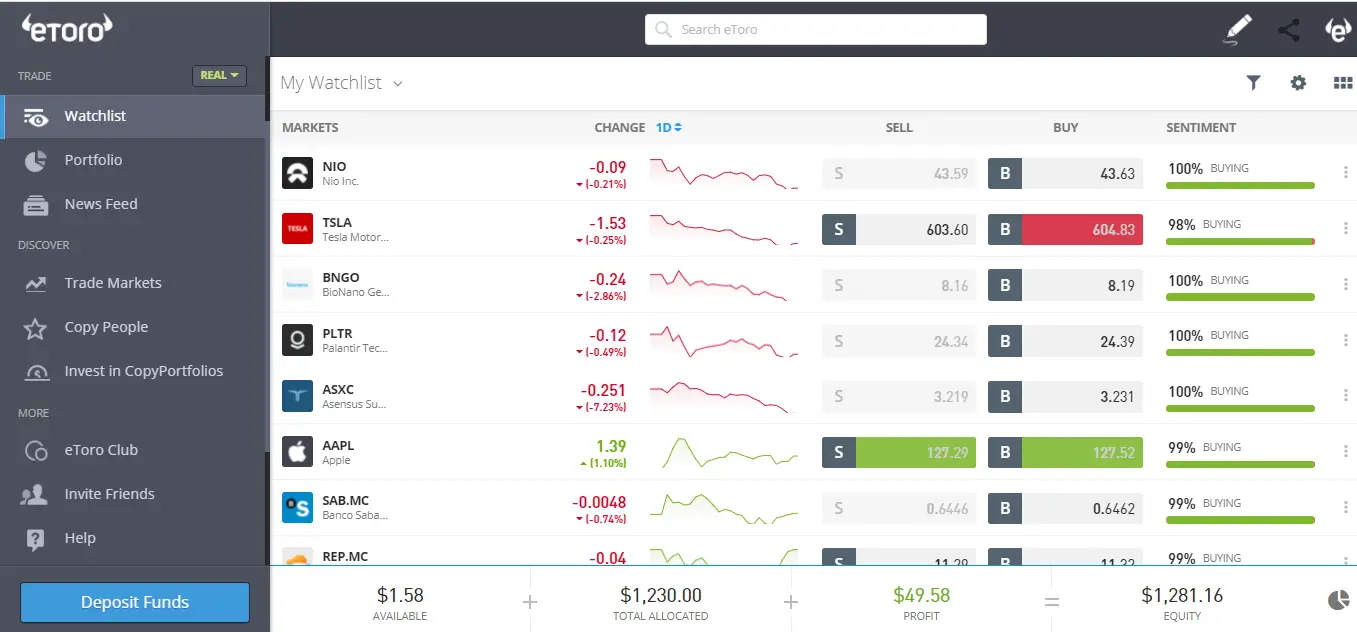
It is effortless to navigate through all the sidebars and the search function on the top. We are confident that you will find what you came looking for in less than a minute.
How to deposit and withdraw?
Before answering this question, it’s worth noting that you can use the eToro $100,000 virtual demo account to practise trading risk-free before committing real capital.
Deposits: from your eToro dashboard, click “Deposit Funds” to see the available deposit methods. Options include:
- Debit/credit card;
- Bank transfer (SEPA in EUR, SWIFT in USD/CHF);
- Skrill, Neteller, PayPal (e-wallets, depending on jurisdiction);
- Rapid Transfer.
The eToro minimum first deposit for Swiss residents is $50 (some payment methods may have different minimums).
Withdrawals: from the same dashboard, use “Withdraw Funds” to initiate a withdrawal. Under anti-money laundering rules, withdrawals are typically processed back to the original deposit method where possible. Key withdrawal terms:
- Minimum withdrawal: $30;
- Withdrawal fee: $5 per withdrawal;
- Processing time: 1-2 business days for card/e-wallet; longer for bank transfers.
Important note for Swiss investors: since USD is eToro’s only base currency, you will incur a currency conversion fee on both deposits and withdrawals if you fund in CHF or EUR. For example, depositing CHF via SWIFT bank transfer will involve both your bank’s outbound charge and eToro’s FX markup on conversion to USD. The same conversion cost applies in reverse when withdrawing.
A common workaround used by Swiss investors is to fund eToro accounts in USD via multi-currency platforms like Wise, which typically offer significantly better exchange rates than traditional Swiss banks. This can save meaningful amounts on large deposits.
How to trade CFDs?
The process for buying or selling CFDs is straightforward.
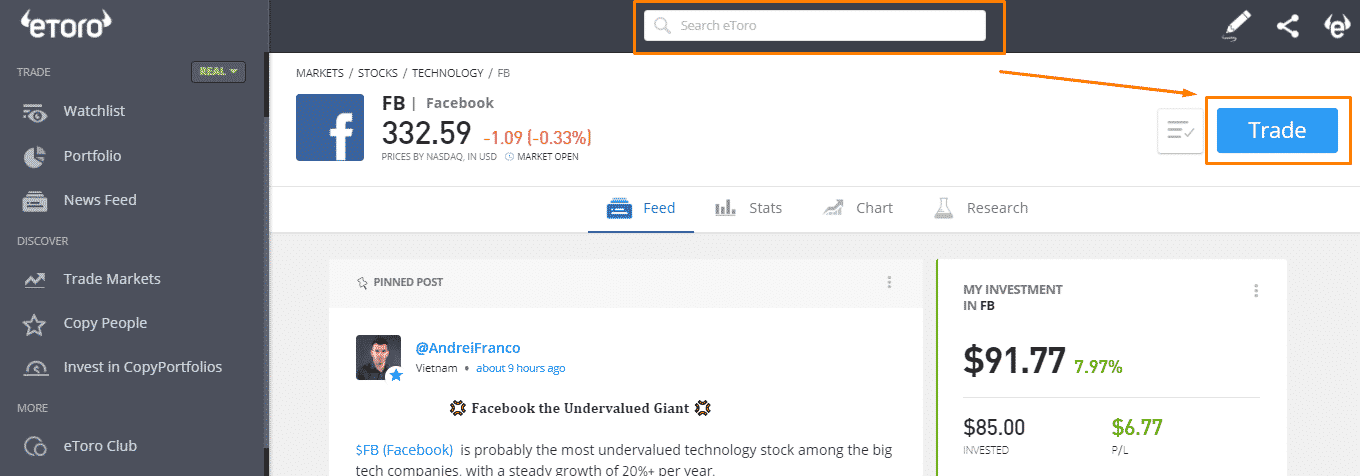
First, use the search bar to find the company you are looking for and then click on “Trade”, as shown in the image below:
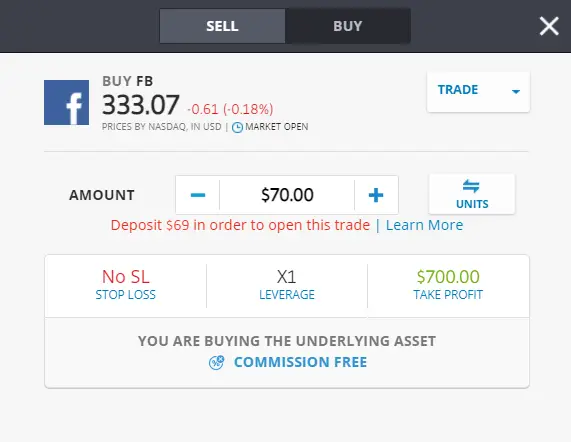
Second, a pop-up will appear where you can buy (or short) the CFD.
Customer support
Our assessment of customer support comes from direct experience using the platform. Overall, eToro’s customer service has continued to improve in recent years, with the platform investing significantly in support infrastructure as its user base has grown to 40+ million.
Based on our testing, response times typically range from 24-72 hours for most inquiries via the in-platform ticketing system or email, though we’ve occasionally waited up to a week for more complex issues. eToro also offers:
- In-app live chat for premium account tiers (eToro Club members);
- Help Centre: a comprehensive knowledge base covering account, trading, deposits/withdrawals, and tax-related queries;
- Multi-language support: available in major European languages including English, German, French, Italian, and Spanish – relevant for Swiss investors.
For urgent issues, escalating through the support ticket system tends to be the fastest route. Compared to dedicated full-service brokers offering 24/5 phone support, eToro’s customer service is more typical of online-only platforms – generally responsive but not instant.
Final thoughts
All in all, eToro is a solid option for Swiss investors across experience levels – whether you are a beginner exploring social trading, an intermediate investor building a diversified portfolio of real stocks and ETFs, or a more experienced trader engaging with CFDs or specific asset classes.
Key strengths to weigh:
- Strong multi-jurisdictional regulation (CySEC + FCA + ASIC + SEC and FINRA) plus NASDAQ public listing since May 2025;
- Commission-free real stocks and ETFs on US, UK, and European exchanges;
- Unique social trading and CopyTrader functionality;
- Smart Portfolios for thematic investing without active management;
- Cash interest on uninvested USD balances.
Key considerations:
- USD-only base currency: means Swiss investors face FX conversion fees on CHF/EUR deposits and withdrawals – factor this into your total cost calculation;
- $2 commission on SIX Swiss Exchange stocks: if you primarily trade Swiss equities, alternatives offering local market access at lower cost (like Interactive Brokers or Saxo) may be more cost-effective;
- Less suitable for very high-volume traders: brokers like Interactive Brokers offer lower per-trade costs and tighter spreads for active trading at scale.
For Swiss investors, eToro works particularly well as a complementary platform alongside a local Swiss broker, or as a primary platform if your portfolio is mostly USD-denominated and you value the social trading features. For a complete overview of how eToro operates globally, please read our eToro review.
CFDs are complex instruments and come with a high risk of losing money rapidly due to leverage. 52% of retail investor accounts lose money when trading CFDs with this provider. You should consider whether you understand how CFDs work and whether you can afford to take the high risk of losing your money.