Every decision you make in life rests on a set of underlying principles. When you buy a house, you trust that the right to private property won’t be put into question, as enshrined in the Universal Declaration of Human Rights. You also know that if you make a business deal and the other party doesn’t fulfil its commitment, you can turn to the courts.
The same applies to financial services. You need trust to invest your hard-earned money. Without it, your capital would probably stay under the mattress. That’s why regulation plays such an essential role in protecting you from events you have no control over. In other words, investors should be able to make informed decisions with the confidence that they’re adequately protected if something goes wrong.
What are investment protection, balance protection, and negative balance protection?
When you invest your money through an online broker, several measures and policies are put in place to protect investors and ensure a safer, more transparent environment.
Beyond data protection, account security measures (preventing hackers from accessing your account or misusing your data), and standard cybersecurity controls, there are also specific protection measures designed to safeguard your investments if something goes wrong with the broker itself.
Here are the three primary measures you should be aware of:
- Investment protection: designed to safeguard the securities you hold (stocks, bonds, ETFs, and so on). It’s also known as an “Investor Compensation Scheme” (ICS), and its purpose is to protect retail investors (people like you and us) in the event of the insolvency of a financial intermediary (such as eToro, DEGIRO, XTB, and others). In the EU, this is governed by the Investor Compensation Schemes Directive (ICSD), which sets a minimum coverage of €20,000 per investor per firm (in the UK, the Financial Services Compensation Scheme, or FSCS, covers up to £85,000).
- Balance protection: this refers to the cash you hold with your broker. In many cases the ICS covers both securities and cash, but cash protection can also come from a separate deposit guarantee scheme when client cash is held at a partner bank (typically up to €100,000 per bank under the EU’s Deposit Guarantee Schemes Directive). It’s worth checking how your specific broker structures cash protection.
- Negative balance protection: this means you can’t lose more money than what you deposit in your account. It’s particularly relevant for those who use leverage (for example, CFDs). For example: you invest €1,000 in a position with 5x leverage. Your total exposure is €5,000, of which only €1,000 is yours (€4,000 is borrowed). If the market drops 25%, you would lose €1,250 (25% × €5,000), more than your initial deposit, meaning you would in theory owe €250 to your broker. Under the rules introduced by the European Securities and Markets Authority (ESMA) and now applied by national regulators, your account balance is automatically reset to €0, so you only lose your deposit (and never owe extra). This protection is mandatory for retail clients trading CFDs in the EU.
Some companies go further with additional protection. For example, eToro offers free insurance from Lloyd’s of London to Platinum, Platinum+ and Diamond Club members of eToro (Europe) Ltd. It covers up to €1 million per client for losses above the first €20,000 in case of eToro’s insolvency or certain types of misconduct, and it doesn’t cover real crypto positions.
The European Securities and Markets Authority (ESMA)
In the European Union, the European Securities and Markets Authority (ESMA) is the body that contributes to the stability of the EU’s financial system by providing the guidelines for a high, harmonised level of investor protection. It works to ensure you’re informed about any investment that may not suit your needs or risk profile, and that your interests sit firmly at the centre of any financial institution’s business model.
Together with the other European Supervisory Authorities, the European Banking Authority (EBA) and the European Insurance and Occupational Pensions Authority (EIOPA), ESMA promotes supervisory convergence across financial entities within the EU.
In summary, its two primary purposes are:
- To “ensure the consistent treatment of investors across the Union, enabling an adequate level of protection of investors through effective regulation and supervision.”
- To “promote equal conditions of competition for financial service providers.”
That said, ESMA does not directly compensate you if your online broker commits fraud, administrative malpractice, or operational errors. That responsibility falls to the national regulators and compensation schemes we’ll cover in the next section.
Investor protection in Europe
The Directive 97/9/EC of the European Parliament, established in 1997, widely known as the Investor Compensation Scheme Directive, requires every EU country to have at least one Investor Compensation Scheme (ICS) with minimum protection of €20,000 per investor and per firm.
So, whatever EU country you read this article from, you are covered up to at least €20,000 if an EU-regulated broker fails and can’t return your assets (warning: crypto-assets are excluded). Some countries allow the scheme to pay only 90% of your claim, within that limit.
A practical example
For the sake of simplicity, let’s use, as an example, eToro, a social trading platform with over 40 million registered users worldwide. If you go to its footnote, you will notice the following text:
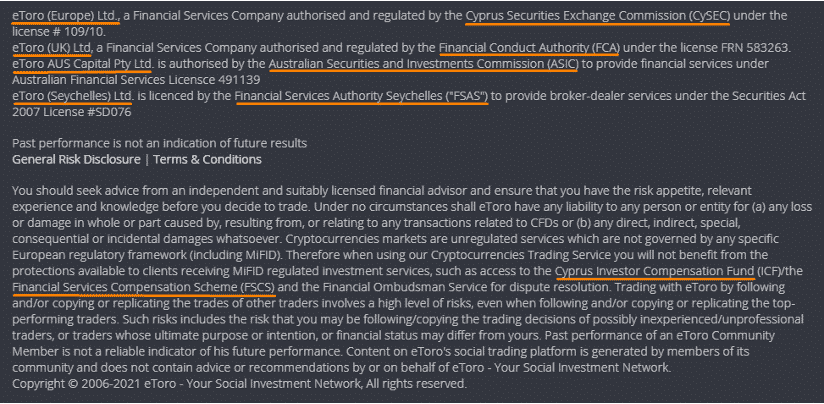
Quite complex, right? Let’s decompose piece by piece! As you can observe, eToro works in several jurisdictions. If you are an EU investor, you will be under the “eToro (Europe) Ltd” subsidiary, which means that the regulatory body that supervises eToro’s activity is the Cyprus Securities and Exchange Commission (CySEC). As a UK investor, you will be asked to create an account under the “eToro (UK) Ltd” subsidiary. In this case, the regulator to look for would be the Financial Conduct Authority. Therefore, when signing up with any online broker, ensure what subsidiary you are opening an account with!
Now, let’s imagine you are a German investor, and eToro goes bust. At this stage, the Cyprus Investor Compensation Fund (ICF) comes in, and this fund should pay you the money you can’t recover. eToro (Europe) Ltd is a member of ICF, an entity designed for the Clients of Cyprus’ regulated investment firms, so you are eligible for a maximum compensation of up to €20,000. This coverage applies to each investor against only one ICF member, irrespective of the number of accounts (and currency). If you have two accounts at eToro, you are entitled to €20,000 in total for both. But if you have accounts with two different brokers, each is protected up to €20,000, so up to €40,000 in total.
Here’s a summary of the Investment protection of some European ICS:
| Financial Regulator | Investor Compensation Scheme | Country-based | Max. Protection Amount |
| Cyprus Securities and Exchange Commission (CySEC) | Cyprus Investor Compensation Fund (ICF) | Cyprus | €20,000 |
| Financial Conduct Authority (FCA) | Financial Services Compensation Scheme (FSCS) | UK | £85,000 |
| German Federal Financial Supervisory Authority (BaFin) | German investor compensation schemes (EdB for banks, EdW for investment firms) | Germany | 90% of the claim, up to €20,000 |
| Central Bank of Ireland | Investor Compensation Company (ICCL) | Ireland | 90% of the claim, up to €20,000 |
| Portuguese Securities Market Commission (CMVM) | Sistema de Indemnização aos Investidores (SII) | Portugal | €25,000 |
Sources: CySEC, FSCS, DEGIRO (German scheme), Interactive Brokers Ireland and CMVM, October 2026.
The table focuses on countries whose regulators supervise brokers with clients across Europe. Each EU country has its own scheme, and what counts is the country where your broker is authorised, not where you live. For example, if you are Italian and invest through a broker authorised in Portugal, you fall under the Portuguese scheme, which protects your investments up to €25,000.
Everyone talks about diversifying investments, but spreading your money across more than one platform can also be useful. The risk is small, but it is still there.
What about balance (cash) protection?
First, it’s important to understand how each broker is structured. Most brokers treat your invested money and your cash balance (the money “parked” in your account waiting to be invested) under a single protection scheme. So in the case of a CySEC-regulated broker, if you hold €15,000 in ETFs and €3,000 in cash, both amounts together are protected by the Investor Compensation Fund (ICF) up to its €20,000 limit.
However, this isn’t always how it works. With DEGIRO, for example, your invested capital is protected up to €20,000 under the German Investor Compensation Scheme. Your cash balance, however, is protected separately up to €100,000 under the German Deposit Guarantee Scheme, because DEGIRO is part of flatexDEGIRO Bank SE, and client cash is held with this German-regulated bank. This structure means Dutch and other European DEGIRO clients benefit from the higher €100,000 cash protection threshold available to deposits at a regulated bank.
It’s worth checking how each broker structures cash holdings. Some hold client cash in segregated accounts at partner banks (often giving you deposit-protection-scheme coverage up to €100,000), while others hold it within the brokerage entity itself (where the lower €20,000 ICS limit applies). Brokers should disclose this clearly in their terms.
Does a broker’s bankruptcy automatically mean a 100% loss?
Not necessarily. A broker only acts as an intermediary that deposits your ETFs, shares or another financial instrument in a custodian bank or creates a separate entity (called Special Purpose Vehicle), making sure the creditors of any broker do not claim your assets.
Given that, what would happen in practice is that you would have to wait (it can take months or years) for the financial authorities to know what belongs to you and allow you to transfer those assets to another broker. If eToro went bust, clients would have their share of the segregated money investments returned, minus any administrators’ costs from handling and distributing these funds. If things always worked like this, the protection amount would be only a formality.
However, we know that frauds occasionally happen, like when a Turkish CEO of a crypto exchange decided to flee from its country, leaving 400,000 users empty-handed (he was later arrested and convicted)[1]. Events like this are practically impossible to predict and, as such, difficult to get away from. You never know how companies are internally managed, so everyone in the financial markets must accept that risk as part of the game.
To avoid being caught off guard, some investors choose not to hold more than the protected amount at a single broker, or to check that their broker keeps client assets in segregated accounts at a reputable custodian.
[1] This was just an example. Crypto-assets are not covered by investor compensation schemes. Even under the EU’s Markets in Crypto-Assets Regulation (MiCA), which has applied since 30 December 2024, crypto held with a CySEC-regulated or any other EU-regulated provider is not protected by schemes such as the Cyprus Investor Compensation Fund.
Final thoughts
From time to time, problems arise in the financial markets. The only thing we can do is use the tools at our disposal and not be materially affected by those circumstances.
In addition, you also need to be prepared for what might follow after any bankruptcy. When using a broker with its activity based in a foreign country, you would need to solve any issues through the courts of that country and not your domestic courts. In practice, you would probably have to pay a lawyer to represent you there.
Finally, this article is not meant to scare you! It is to make sure you are fully aware of your investment surroundings!
Be safe out there!